
MOUFLON
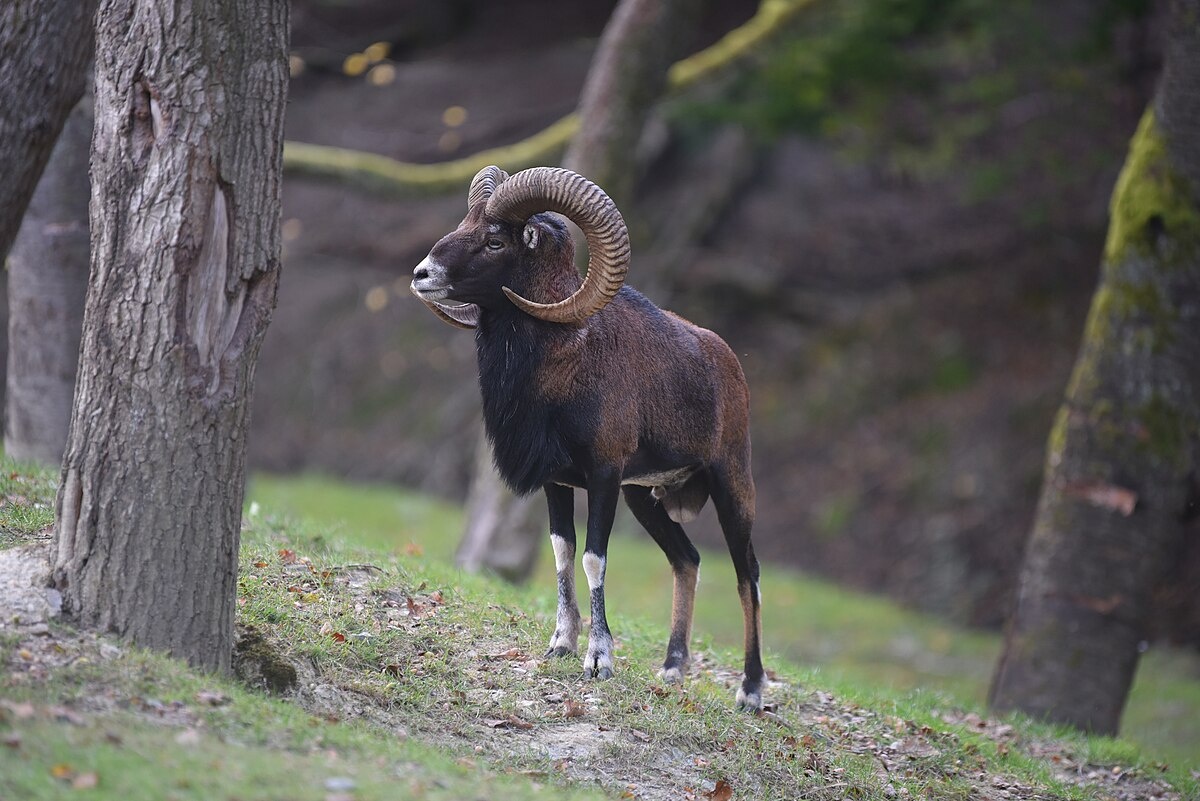
Moufflon are a kind of wild sheep still found in remote parts of Europe and Western Asia. They are small and have long legs. Both the ram and ewe have heavy ringed horns and develop a wooly undercoat in the winter and shed it in the summer. Wild moufloun still live in the mountains of Corsica and Sardinia. In the 1970s, an Asian mouflon was born to a domestic wool sheep.
Mouflon (Ovis gmelini) are the smallest wild sheep. Regarded as the ancestors of domesticated and resembling goats more than sheep, they are 1.1 to 1.3 meters (3.6 to 4.3 feet) in length, with a seven to 12 centimeter tail (2.7 to 4.7 inch) and weigh 25 to 55 kilograms (55 to 122 pounds). They have relatively long legs. Their coat is red-brown with a dark central back stripes, flanked by a paler “saddle” patch. Males are horned; some females have horns, while others are polled. The curved horns of males reaches 85 centimeters (2.7 feet) in length.
Mouflon are native to Cyprus, and the Caspian region, including eastern Turkey, Armenia, Azerbaijan, Georgia and Iran and also found in a few parts of Europe. They live in uplands and shrubby, grassy plains. Their normal habitats are steep mountainous woods near tree lines. In winter, they migrate to lower altitudes.
The scientific classification of the mouflon is disputed. The mouflon group (Ovis orientalis orientalis) is a subspecies group of the wild sheep (Ovis orientalis). Populations of O. orientalis can be divided into the mouflons (orientalis group) and the urials (vignei group). Mouflon have short-haired coats. The horns of mature rams are curved in almost one full revolution. Mouflon have shoulder heights of about 0.9 meters and body weights of 50 kilograms (males) and 35 kilograms (females). [Source: Wikipedia +]
Scientific classification:; Kingdom: Animalia; Phylum: Chordata; Class: Mammalia; Order: Artiodactyla; Family: Bovidae; Subfamily: Caprinae; Genus: Ovis; Species: Ovis orientalis. +
Mouflon Subspecies and Clones
Five subspecies of mouflon are distinguished by MSW3 (Mammal Species of the World, 3rd edition, a database of mammalian taxonomy): 1) Armenian mouflon (Ovis orientalis gmelini) (Blyth, 1851) are also known as the Armenian wild sheep. It lives northwestern Iran, Armenia and Azerbaijan and has been introduced to Texas in the United States. 2) Cypriot mouflon (O. o. ophion) (Blyth, 1841) are also called agrino. They were nearly extirpated during the 20th century. In 1997, about 1,200 of this subspecies were counted. The television show Born to Explore with Richard Wiese reported 3,000 are now on Cyprus. [Source: Wikipedia]
3) Esfahan mouflon (O. o. isphahanica) (Nasonov, 1910) are found in the Zagros Mountains of Iran. 4) Laristan mouflon (O. o. laristanica) (Nasonov, 1909) are a small subspecies. Their range is restricted to some desert reserves near Lar in southern Iran. 5) Anatolian mouflon (O. g. anatolica) (Arıhan, 2000) is an almost extinct population of mouflon that survives only around Konya, Turkey
European mouflons were once thought to be a subspecies of the mouflon, but are now considered to be feral descendants of the domestic sheep (Ovis aries), as Ovis aries musimon.[9]
A mouflon was cloned successfully in early 2001 and lived at least seven months, making it the first clone of an endangered mammal to survive beyond infancy. This demonstrated a common species (in this case, a domestic sheep) can successfully become a surrogate for the birth of an exotic animal such as the mouflon. If cloning of the mouflon can proceed successfully, it has the potential to reduce strain on the number of living specimens.
Mouflon Range
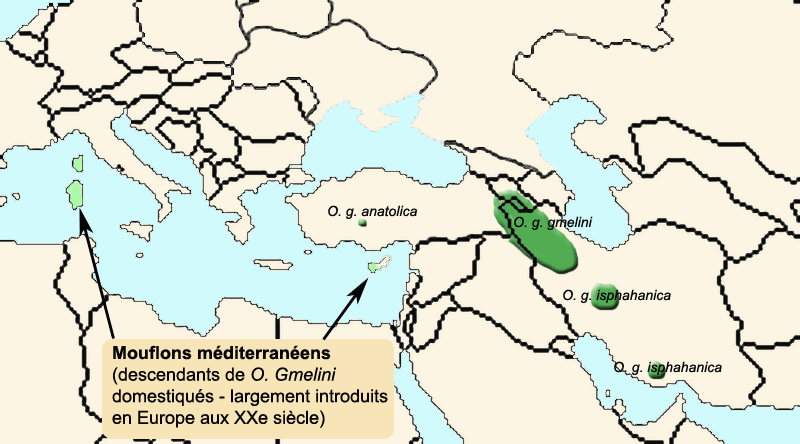
Mouflon were once widespread in Europe and Asia. Today they are still found in remote parts of Europe and Western Asia in the Caucasus, northern and eastern Iraq, and northwestern Iran. The range originally stretched further to Anatolia, the Crimean peninsula and the Balkans, where they had already disappeared 3,000 years ago and came back to Bulgaria. Mouflon were introduced to the islands of Corsica, Sardinia, Rhodes, and Cyprus during the Neolithic period, perhaps as feral domesticated animals, where they have naturalized in the mountainous interiors of these islands over the past few thousand years. [Source: Wikipedia +]
On the island of Cyprus, the mouflon or agrino became a different and endemic subspecies only found there, the Cyprus mouflon (O. o. ophion). The Cyprus mouflon population contains only about 3,000 animals. They are now rare on the islands, but are classified as feral animals by the IUCN. They were later successfully introduced into continental Europe, including Portugal, Spain, France, Germany, central Italy, Switzerland, Austria, the Netherlands, Belgium, the Czech Republic, Poland, Slovakia, Slovenia, Hungary, Bulgaria, Romania, the Canary Islands, and even some northern European countries such as Denmark, Sweden and Finland. +
A small colony of mouflon exists in the remote Kerguelen Islands in the southern Indian Ocean, and on the Veliki Brijun Island in the Brijuni Archipelago of the Istrian Peninsula in Croatia. In South America, mouflon have been introduced into central Chile and Argentina. Since the 1980s, they have also been successfully introduced to game ranches in North America for the purpose of hunting; however, on game ranches, purebreds are rare, as mouflon interbreed with domestic sheep and bighorn sheep.[citation needed] Mouflon have been introduced as game animals into Spieden Island in Washington state, and into the Hawaiian islands of Lanai and Hawaii where they have become a problematic invasive species. A small population escaped from an animal enclosure owned by Thomas Watson, Jr. on the island of North Haven, Maine in the 1990s and still survives there. +
Mouflon and Sheep
There is still a lively debate over when and from where and what wild species the first domestic sheep descended. Current chromosomal and archeological evidence indicates that the divergence occurred about 9,000 to 11000 years ago and that the first sheep domesticated were mounflon (Ovis musimon) from flocks in Sardinia and Corsica.[Source: Chris Reavill, Animal Diversity Web (ADW) /=]
Sheep were first domesticated in Western Asia (Turkey, Syria and Iran) from Asiatic moufflon, Ancient sheep roamed pastures and grassland with people for at least 11,000 years and are thought to have been domesticated at least 9,000 ago. Sheep bones, dated to 9000 B.C., found at a site called Zawi Chemi Shandidir in the foothills of the Zagros mountains in what is now Iran, suggests that sheep were being kept in herds at that time.
The mouflon is thought to be one of the two ancestors for all modern domestic sheep breeds. Both the ram and ewe develop a wooly undercoat in the winter and shed it in the summer. In the 1970s, an Asian mouflon was born to a domestic wool sheep. The similarity of the mouflon to domestic sheep, combined with its threatened status, has made it a subject of interest, both scientific and popular, in the use of biotechnology in species preservation.
Prehistoric sheep had dark hairy coats, horns and their wool could be pulled off by hand. Their closest relatives today are the sheep that are kept off the Shetland Islands off Scotland and the wild Soay, sheep on the uninhabited island of St. Kilda off the west coast of Scotland.
Sheep, some argue, have been as important to civilization as agriculture. One of the first domesticated animals, they provided man with food, clothing and shelter, and man providing the sheep with protection from predators. Over centuries, sheep were bred by men to have long white wool that was first cut off with Iron Age shears. Most domesticated varieties don't have horns.
See Separate Article: SHEEP: THEIR HISTORY, CHARACTERISTICS AND DOLLY factsanddetails.com
Taxonomy of Sheep and Goats
The taxonomy of the genus Ovis (sheep) is controversial. Various authorities have lumped domestic sheep (O. aries) with mouflon (O. orientalis) as members of the same species. Others recognize the two as distinct species, but claim that Mouflon is the ancestral species from which domestic sheep were derived. Some consider populations of sheep on the islands of Corsica and Sardinia as subspecies of Mouflon, whereas others separate them as a distinct species. In north India, populations of Argali and urial occur near one another, and some think they represent a single species. There are also those who consider Mouflon and urial (Ovis vignei), usually considered two species, to be a single species. [Source: Andrew Hagen, Animal Diversity Web (ADW) /=]
Complicating matters further, the genus Ovis has also been considered by some to be synonymous with the genus Capra (goats) because of fertile hybrids produced between domestic goats (C. hircus) and domestic sheep.
All wild species of sheep are allopatric, however, hybridization can, and does, occur.Urial sheep represent a chromosomal, geographic and morphological extreme amongst the wild sheep of Iran. Urial sheep (2N=58) hybridize with Ovis orientalis (2N=54), producing a 150 kilometer zone of hybridization. Hybrids in the hybridization zone display variable fur and chromosome number (54-58).
Mouflon Behavior and Reproduction
As with many wild sheep, females live in small groups with their young, while poundse or bachelor-band males compete for access to females. Dominance is determined in battles with males pushing, butting and ramming each other head-first with their horns. Rutting is in the autumn. Breeding begins around age of six or seven.
Mouflon rut between November and December. Ewes become sexually mature at 1.5 years of age, and may bear their first young at two years of age. Estrus lasts for one or two days. Copulation is quick, lasting a only two to three seconds. Gestation lasts 150-160 days.
Mouflon rams have a strict dominance hierarchy. Before mating season or “rut”, which is from late autumn to early winter, rams try to create a dominance hierarchy to determine access to ewes (female mouflon) for mating. Mouflon rams fight one another to obtain dominance and win an opportunity to mate with females. Mouflons reach sexual maturity at the age of 2 to 4 years. Young rams need to obtain dominance before they get a chance to mate, which takes another 3 years for them to start mating. Mouflon ewes also go through a similar hierarchy process in terms of social status in the first 2 years, but can breed even at low status. Pregnancy in females lasts 5 months, in which they produce 1 to 2 offspring. +
Image Sources: Wikimedia Commons
Text Sources: Animal Diversity Web animaldiversity.org ; National Geographic, Live Science, Natural History magazine, CNTO (China National Tourism Administration) David Attenborough books, New York Times, Washington Post, Los Angeles Times, Smithsonian magazine, Discover magazine, The New Yorker, Time, BBC, CNN, Reuters, Associated Press, AFP, Lonely Planet Guides, Wikipedia, The Guardian, Top Secret Animal Attack Files website and various books and other publications.
Last updated April 2025