
URIALS
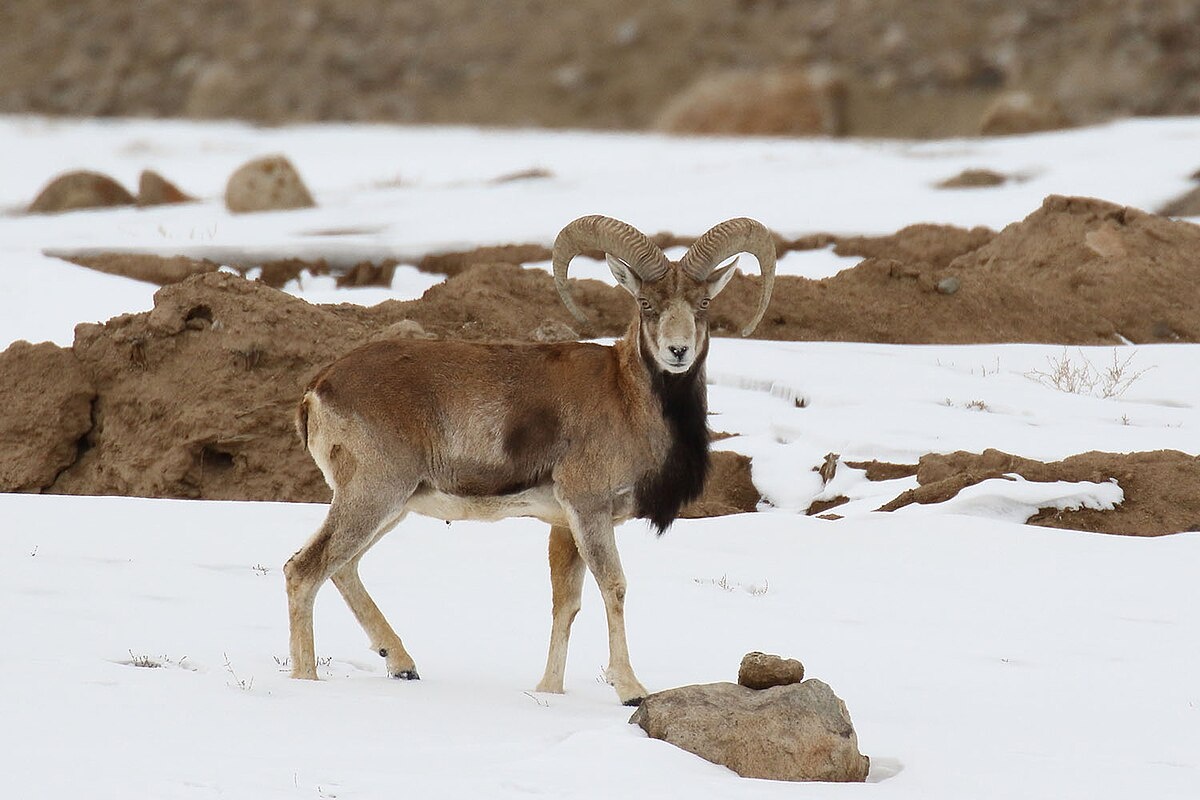
Uurial (pronounced OOR-ee-uhl; Ovis vignei) are wild sheep native to Central and South Asia. They are also known as arkars, shapo, or shapu, and are listed as Vulnerable on the IUCN Red List. They are regarded as Moufloniforms --- close relatives of Mouflon. Urial lifespan in the wild is typically eight to 12 years. [Source: Andrew Hagen, Animal Diversity Web (ADW) /=]
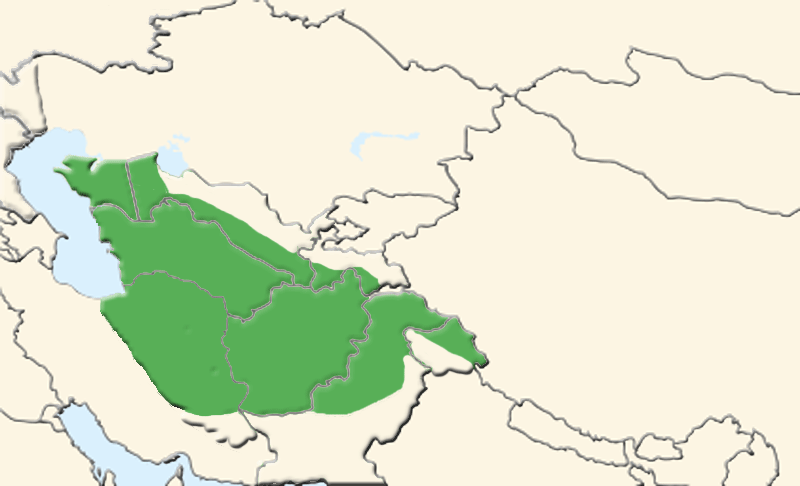
Urial sheep are widely distributed in Central Asia — in southwestern Kazakhstan through Turkmenistan, Uzbekistan, Tajikistan, Afgahnistan, Pakistan, and into the Kashmir region of India. They range eastward into Iran, and some are found in Oman, although that population is thought to have been introduced. Urial sheep inhabit steep to undulating grassy terrain up to an elevation of 6,000 meters (19,685 feet) . Their habitat tends to be moderately to very. arid. They may also be found in agricultural fields and sometimes enter partly wooded areas.
The vignei subspecies group consists of six individual subspecies:
1) Ladakh urials (Ovis vignei vignei) live in India (Ladakh and Kashmir), northern Pakistan.
2) Transcaspian urials (Ovis vignei arkal) can be found in Ustjurt-Plateau (Turkmenistan, Uzbekistan, northern Iran) and western Kazakhstan.
3) Blanford's urials (Ovis vignei blanfordi) are also known as or Baluchistan urial. They can be found in Balochistan in Pakistan.
4) Bukhara urial (Ovis vignei bochariensis) live in Uzbekistan, Tajikistan, Turkmenistan and Afghanistan
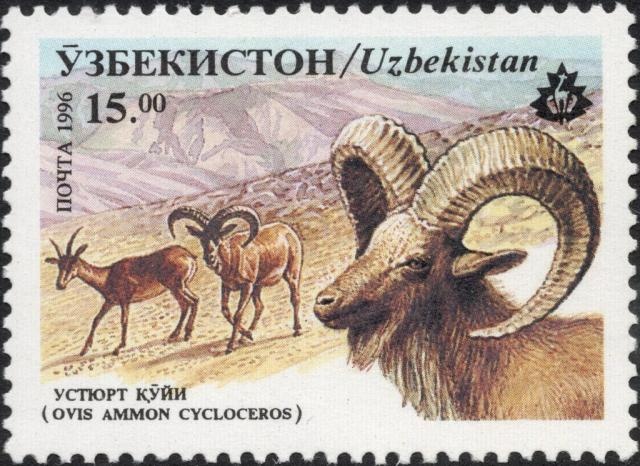
5) Afghan urials (Ovis vignei cycloceros)are also known as Turkmenian sheep : southern Turkmenistan, eastern Iran, Afghanistan, Pakistan (north Balochistan).
6) Punjab urial (Ovis vignei punjabiensis): provincial animal of Punjab, Pakistan [Source: Wikipedia]
Urial sheep represent a chromosomal, geographic and morphological extreme amongst the wild sheep of Iran. Urial sheep (2N=58) hybridize with Ovis orientalis (2N=54), producing a 150 kilometer zone of hybridization. Hybrids in the hybridization zone display variable fur and chromosome number (54-58).
Urial Characteristics
Urial weigh up to 90 kilograms (200 pounds) and have a shoulder height of about one meter (3.3 feet). Sexual Dimorphism (differences between males and females) is present: Males are larger than females. Ornamentation is different. Males have a black neck ruff which is restricted to the front of the neck and brisket. /=\
Males have massive horns, whereas female horns are much smaller and compressed. Horn shape may be variable. The large horns on males generally curl outwards from the top of the head turning in to end somewhere behind the head. The greatest horn length recorded is just shy of one meter and greatest basal circumference is 30 centimeters.
Urial sheep have antelope-like features — name sinewy bodies and long legs. They are brown colored with a lighter coat in summer than in winter. They have a distinct white rump patch below the base of the tail and along the back of the hind quarters. Urial sheep have a black and white saddle patch.
Urial are herbivores (eat plants or plants parts), and are also classified as folivores (eat leaves). The east variety of unspecified plants and plant parts, which include leaves, wood, bark, grasses, stems, seeds, grains, shrubs and nuts.
Taxonomy of Sheep and Goats
The taxonomy of the genus Ovis (sheep) is controversial. Various authorities have lumped domestic sheep (O. aries) with mouflon (O. orientalis) as members of the same species. Others recognize the two as distinct species, but claim that Mouflon is the ancestral species from which domestic sheep were derived. Some consider populations of sheep on the islands of Corsica and Sardinia as subspecies of Mouflon, whereas others separate them as a distinct species. In north India, populations of Argali and urial occur near one another, and some think they represent a single species. There are also those who consider Mouflon and urial (Ovis vignei), usually considered two species, to be a single species. [Source: Andrew Hagen, Animal Diversity Web (ADW) /=]
Complicating matters further, the genus Ovis has also been considered by some to be synonymous with the genus Capra (goats) because of fertile hybrids produced between domestic goats (C. hircus) and domestic sheep.
All wild species of sheep are allopatric, however, hybridization can, and does, occur.Urial sheep represent a chromosomal, geographic and morphological extreme amongst the wild sheep of Iran. Urial sheep (2N=58) hybridize with Ovis orientalis (2N=54), producing a 150 kilometer zone of hybridization. Hybrids in the hybridization zone display variable fur and chromosome number (54-58).
Urial Behavior and Communication
Urial are cursorial (with limbs adapted to running), terricolous (live on the ground), diurnal (active during the daytime), motile (move around as opposed to being stationary), nomadic (move from place to place, generally within a well-defined range), social (associates with others of its species; forms social groups), and have dominance hierarchies (ranking systems or pecking orders among members of a long-term social group, where dominance status affects access to resources or mates). [Source: Andrew Hagen, Animal Diversity Web (ADW) /=]
Urial spend most of their day foraging. They are gregarious and form herds of related individuals and move throughout a range, but do not maintain territories. Herds usually are comprised of females, lambs, and juveniles. Adult rams form separate all-male groups. Separation of herds reduces for forage and offers females relief from male harassment. Herds have a social structure in whch dominance is based on body size. Dominance relationships are especially evident in ram herds, where dominance is largely based on horn size — the larger the horns, the higher the dominance rank, /=\
Dominant males act as a stabalizing force in sheep society by preventing younger rams from harassing females. Young males are more aggressive and bullying towards ewes thn are older males. Aggressive encounters between similar-sized individuals usually include head twists and front kicks. Urial sheep do not rise on their back legs before clashing
Urial sense using vision, touch, sound and chemicals usually detected with smell and and communicate with touch, sound and chemicals. They also employ pheromones (chemicals released into air or water that are detected by and responded to by other animals of the same species). The aggressive physical encounters between males can be viewed as a way to communicate dominance relationships. Tactile communication seems likely. Females communicate their estrous status to adult males via chemical cues in their urine. Also, mothers and infant recognize one another based on scent. It is assumed some sort of vocal communication takes places but is not common.
Urial Mating, Reproduction and Offspring
Urial are polygynous (males have more than one female as a mate at one time) and engage in seasonal breeding — breeding once yearly, with the rut (mating season) in November and December. The number of offspring ranges from one to two. The gestation period ranges from five to 5.33 months. Parental care and provisioning is provided by females. There is an extended period of juvenile learning. The post-independence period is characterized by the association of offspring with their parents. On average males and females reach sexual or reproductive maturity at 1.5 years. [Source: Andrew Hagen, Animal Diversity Web (ADW) /=]
Although males are polygynous they do not maintain a harem. They approach females slowly in a stretched posture. The female reacts by squatting and urinating. The males then smells the female's urine to determine whether she is in estrus. Females in estrus are claimed by the dominant male. After copulation, the dominant male guards the female from other males until she is no longer in estrus. When the female is no longer receptive, the dominant male leaves in search of another female in estrus. Estrus lasts for one or two days. Copulation is quick, lasting a only two to three seconds.
Ewes give birth to one lamb per pregnancy until they are three years old. Older ewes may give birth to two or three lambs. The probability of twinning in ewes over four years old is 0.50. At birth, lambs weigh between 2.4 and 4.6 kilograms (six and 10 pounds). Lambs nurse for five to six months. They may nibble on vegetation as early as month after birth.
Ewes segregate themselves from the herd prior to giving birth. After giving birth, females and their young remain apart from the herd for three to seven days. During this time the lamb gains strength and both the mother and her offspring learn to recognize each other by smell. The ewes and lambs then return to the herd. Moufloniforms do not form nursery bands.
Urial, Humans and Conservation
On the International Union for Conservation of Nature (IUCN) Red List urial are listed as Endangered. On the US Federal List they are classified as Endangered. In CITES (Convention on International Trade in Endangered Species of Wild) they are in Appendix II. [Source: Andrew Hagen, Animal Diversity Web (ADW) /=]
Urial sometimes regarded as crop pests as they sometimes eat crops and compete with livestock for forage. They have been listed by the IUCN as vulnerable as part of Mouflon. They main threat to urial is loss of habitat due the expansion of agriculture and livestock grazing. Hunting for trophies has also led to serious decline. Urial are considered especially at risk because they often inhabit the low, open country where people commonly graze their livestock. The most vulnerable subspecies are the Ladakh urial and the Punjab urial, both of which have estimated populations of around 2,000 individuals.
Predation has not been specifically reported for urials. They are agile climbers, and fast and their antelope-like features may help them to evade predators. It is likely that large eagles, canids, and large felids, where present, could take young sheep. /=\
Image Sources: Wikimedia Commons
Text Sources: Animal Diversity Web animaldiversity.org ; National Geographic, Live Science, Natural History magazine, CNTO (China National Tourism Administration) David Attenborough books, New York Times, Washington Post, Los Angeles Times, Smithsonian magazine, Discover magazine, The New Yorker, Time, BBC, CNN, Reuters, Associated Press, AFP, Lonely Planet Guides, Wikipedia, The Guardian, Top Secret Animal Attack Files website and various books and other publications.
Last updated April 2025