
SIBERIAN IBEX
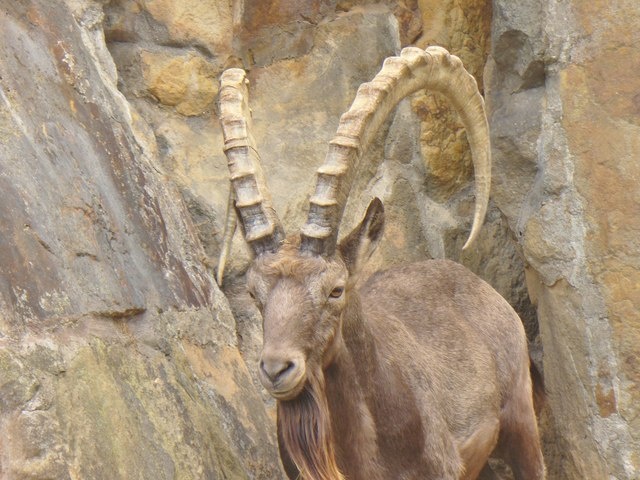
Siberian ibex (Capra sibirica) are also known as Asian ibexes. Inhabiting long and vast mountain systems of the central Asian deserts and the northwestern Himalayas, they stand .8 to one meter (2.5 to 3.3 feet) at shoulder, and weighs an average 60 kilograms (132 pounds. Adult males have long pointed beards and scimitar-shaped horns with prominent ridges on the frontal surface. Their coat is dark brown with greyish underparts. A stripe runs across the back from neck to tail. Adult males also have grey saddle patches on their backs. Females are smaller with small straight horns that are widely separated at the base. Siberian ibex are widely distributed over an area stretching from the Hindu Kush Mountains in Afghanistan to Sayan Mountains in Mongolia. They animals are found most often at elevations ranging from 3000 to 5300 meters (9,842 to 17,900 feet) are occasionally soppted as low as 1000 meters (3930 feet) in the Altai Mountains. Their main anti-predator strategy is to hang out in rugged terrain. [Source: Wikipedia +]
Siberian ibex are found as far north as southern Siberia. There are numerous distinct populations in Mongolia and China, and throughout the central Asian ranges of Afghanistan and Pakistan. Male Siberian ibexes can live up to 15 years, and females up to 17 years in the wild, though males generally live for eight to ten years . A female Siberian ibex has been reported to live over 22 years in captivity in a London Zoo.[Source: Jeffrey Williams, Animal Diversity Web (ADW) /=]
Siberian ibex are also known by a number of regional names such as Altai ibex, Asian ibex, Central Asian ibex, Gobi ibex, Himalayan ibex, Mongolian ibex and Tian Shan ibex, Some of these names correspond with subspecies. Four subspecies, based mainly on size, horn size, and fur color, are widely recognized:
Altai ibex (C. s. sibirica) are also known as Siberian Ibex. They live in the Sayan Mountains.
Tian Shan Ibex (C. s. alaiana) live in the Alay Mountains.
Gobi ibex (C. s. hagenbecki) are also known as Mongolian Ibex. They live in western Mongolia.
Himalayan Ibex (C. s. sakeen) live in the Pamir Mountains, western Himalayas and Karakorun and Hindi Kush ranges in India, Afghanistan and Pakistan. +
Siberian ibex are the largest members of the Capra (goat) genus. Their bow-shaped horns are also the largest within the genus. Throughout their Siberian ibex inhabit rocky mountain zones, especially those with steep slopes. The elevation inhabited by can range greatly due to seasonal weather conditions. There is also a large elevation difference between the mountain ranges they occupy.
RELATED ARTICLES:
IBEX: CHARACTERISTICS, BEHAVIOR, REPRODUCTION, SPECIES factsanddetails.com
NUBIAN IBEX: CHARACTERISTICS, BEHAVIOR AND REPRODUCTION africame.factsanddetails.com
WILD GOATS AND SHEEP OF CENTRAL ASIA factsanddetails.com
GOATS: HISTORY, CHARACTERISTICS, MILK AND MEAT factsanddetails.com
Siberian Ibex Characteristics

Siberian ibex are the largest member of the goat family. They are stout and thick, with short necks and large rib cages and range in weight from 30 to 100 kilograms (66 to 220 pounds).Dimorphism (differences between males and females) is present: Males are larger than females. Sexes are colored or patterned differently. The horns are different. The body length of a mature male Siberian ibex can range 1.3 to 1.65 meters (4.3 to 5.3 feet) while maximum length of a female averages slightly less longer than 1.35 meters (4.4 feet). Males weigh 80 to 100 kilograms (176 to 220 pounds). while females weigh 30 to 40 kilograms (66 to 88 pounds). Height at the should ranges between 0.8 to one meter (2.6 to 3.3 feet) in males. Chest circumference ranges from 92 to 125 centimeters in males, and 74 to 89 centimeters in females. Ear and tail lengths are similar between sexes, with ear length from 14 to 16 centimeters and tail length from 10 to 18 centimeters. [Source: Jeffrey Williams, Animal Diversity Web (ADW) /=]
The bow-shaped horns of Siberian ibex are also the largest within the goat genus. The horns of males measure one to 1.5 meters (3.3 to 4.9 feet) if uncoilded, . The maximum length of female horns is 37 to 38 centimeters (1.2 to 1.3 feet) . Horns of females are also much thinner than those of males. Similar to other ibexes, the anterior surface of Siberian ibex horns are segmented by transverse ridges. ~
Significant variation in fur color is one reason that Siberian ibex have so many names. Color variation can be attributed to size, age, sex, season, and where they live. Siberian ibexes share many common coat characteristics with other members of the goat genus such as light undersides and a dark stripe running along the back, from the neck to the tail. Siberian ibexes have light yellowish undersides, becoming lighter around the groin. They have darker brown patches that can be found on parts of their head, shoulders, legs, chest, beard, and flanks. The darker brown patches can vary greatly or even be absent on certain individuals completely. ~
Siberian Ibex Diet and Eating Habits
Siberian ibexes are herbivores (eat plants or plants parts), and are also classified as folivores (eat leaves). Among the plant foods they eat are leaves, wood, bark, stems, fruit. flowers and lichens. [Source: Jeffrey Williams, Animal Diversity Web (ADW) /=]
Siberian ibexes can be both browsers (feed off the ground on bushes and trees) and grazers (feed on the ground on things like grasses). They generally feed during the day but also feed at night on fruits, such as dogrose (Rosa) and currants (Ribes hispidulum), and other plant materials. Their daily life revolves around eating — feeding, resting after eating and ruminating (See Below). The amount of time for each of these activities varies with season. When daylight hours are short, Siberian ibexes spend more time feeding than resting. The amount of green food intake varies between sexes, with males eating up 16 kilograms a day and females 8 to 10 kilograms.
“Around 140 different plant species are known to be consumed by Siberian ibex. The species vary according to location and seasonal availability. Green grasses (Reogneria) are a significant part of the Siberian ibex diet in the spring and summe. Grasses, shoots, stems, and leaves, which are eaten in autumn . Siberian ibexes favor south-facing slopes in winter because decreased snow depth leaves food more accessible. Needles and buds of trees are common food during the winter because of accessibility above the snow. Depending on the amount of water received through food, Siberian ibexes can go multiple days without water. They frequent salt licks throughout the year to minerals they need.
Bovids
Siberian ibex are bovids. Bovids (Bovidae) are the largest of 10 extant families within Artiodactyla, consisting of more than 140 extant and 300 extinct species. According to Animal Diversity Web: Designation of subfamilies within Bovidae has been controversial and many experts disagree about whether Bovidae is monophyletic (group of organisms that evolved from a single common ancestor) or not. [Source: Whitney Gomez; Tamatha A. Patterson; Jonathon Swinton; John Berini, Animal Diversity Web (ADW) /=]
Wild bovids can be found throughout Africa, much of Europe, Asia, and North America and characteristically inhabit grasslands. Their dentition, unguligrade limb morphology, and gastrointestinal specialization likely evolved as a result of their grazing lifestyle. All bovids have four-chambered, ruminating stomachs and at least one pair of horns, which are generally present on both sexes.
Bovid lifespans are highly variable. Some domesticated species have an average lifespan of 10 years with males living up to 28 years and females living up to 22 years. For example, domesticated goats can live up to 17 years but have an average lifespan of 12 years. Most wild bovids live between 10 and 15 years, with larger species tending to live longer. For instance, American bison can live for up to 25 years and gaur up to 30 years. In polygynous species, males often have a shorter lifespan than females. This is likely due to male-male competition and the solitary nature of sexually-dimorphic males resulting in increased vulnerability to predation. /=\
See Separate Article: BOVIDS: CHARACTERISTICS, BEHAVIOR, SUBFAMILIES factsanddetails.com
Ruminants
Cattle, sheep, goats, yaks, buffalo, deer, antelopes, giraffes, and their relatives are ruminants — cud-chewing mammals that have a distinctive digestive system designed to obtain nutrients from large amounts of nutrient-poor grass. Ruminants evolved about 20 million years ago in North America and migrated from there to Europe and Asia and to a lesser extent South America, where they never became widespread.
As ruminants evolved they rose up on their toes and developed long legs. Their side toes shrunk while their central toes strengthened and the nails developed into hooves, which are extremely durable and excellent shock absorbers.
Ruminants helped grasslands remain as grasslands and thus kept themselves adequately suppled with food. Grasses can withstand the heavy trampling of ruminants while young tree seedlings can not. The changing rain conditions of many grasslands has meant that the grass sprouts seasonally in different places and animals often make long journeys to find pastures. The ruminants hooves and large size allows them to make the journeys.
Describing a descendant of the first ruminates, David Attenborough wrote: deer move through the forest browsing in an unhurried confident way. In contrast the chevrotain feed quickly, collecting fallen fruit and leaves from low bushes and digest them immediately. They then retire to a secluded hiding place and then use a technique that, it seems, they were the first to pioneer. They ruminate. Clumps of their hastly gathered meals are retrieved from a front compartment in their stomach where they had been stored and brought back up the throat to be given a second more intensive chewing with the back teeth. With that done, the chevrotain swallows the lump again. This time it continues through the first chamber of the stomach and into a second where it is fermented into a broth. It is a technique that today is used by many species of grazing mammals.
See Ruminants Under MAMMALS: HAIR, HIBERNATION AND RUMINANTS factsanddetails.com
Siberian Ibex Behavior
Siberian ibexes are cursorial (with limbs adapted to running), diurnal (active during the daytime), motile (move around as opposed to being stationary), migratory (make seasonal movements between regions, such as between breeding and wintering grounds), social (associates with others of its species; forms social groups), and have dominance hierarchies (ranking systems or pecking orders among members of a long-term social group, where dominance status affects access to resources or mates). [Source: Jeffrey Williams, Animal Diversity Web (ADW) /=]
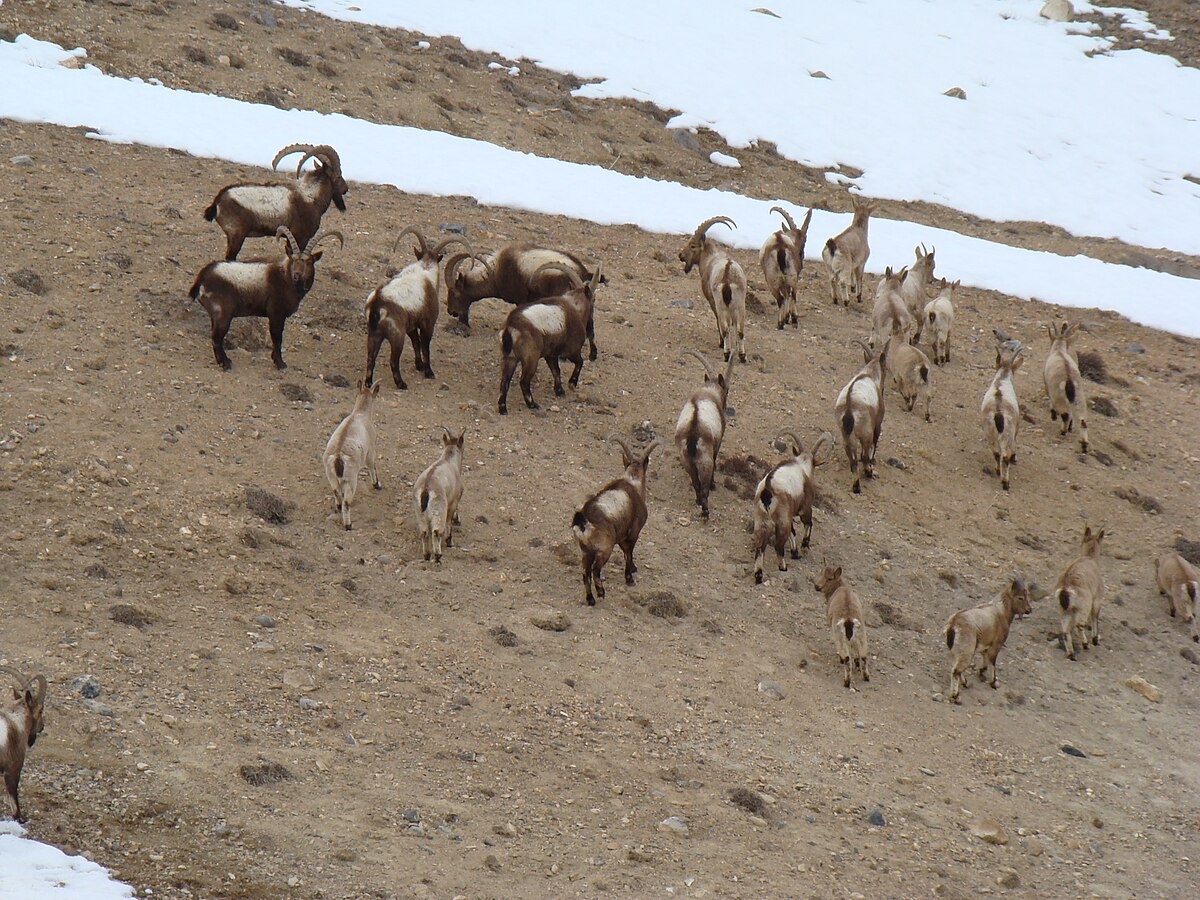
Siberian ibexes are generally found in herds. Herd sizes are often directly related to population size and the sex ratio of herds differs throughout the year. Females, yearlings, and young males commonly make up herds. Adult males can be found in small herds together. Adult males have also been known to live in solitude when not in rut. Larger herds, consisting of up to 40 individuals, can contain animals of all different ages and both sexes
Migration throughout the range of Siberian ibex is associated with snow accumulation in autumn. This is due to limited access to food during times of high snow levels. Siberian ibexes may migrate over 100 kilometers between seasons, and move up and down 2000 meters (6561 feet) in elevation. They reach food covered by 30 to 40 centimeters of snow by digging with their hooves
Siberian Ibex Senses and Communication
Siberian ibexes sense and communicate with vision, touch, sound and chemicals usually detected by smelling. They also employ pheromones (chemicals released into air or water that are detected by and responded to by other animals of the same species) and scent marks produced by special glands and placed so others can smell and taste them. [Source: Jeffrey Williams, Animal Diversity Web (ADW) /=]
Siberian ibexes communicate for mating, predator alarm, and recognition. Females recognize their newborn by scent during the first few days after birth, and rely on sight after that. Females also call their young for feeding. Communication during rut (mating season) includes physical posturing in which males perform flehmen (curling of the upper lip and a raising of the head in response to particular smells). Flehmen is a common response displayed by males in response to female urine during the rut. Flehmen is generally accompanied by closing the nostrils. This allows access to the vomeronasal organ (VNO), which aids in chemoreception and determination of female estrus condition.
Many ungulates use scent-urination around the time of the rut to communicate. According to Fedosenko and Blank, male Siberian ibexes use their mouths to masturbate during the rut. This is a common behavior for males in the genus Capra . There is controversy over whether or not the males are actually masturbating (ejaculating semen) or simply releasing urine when displaying this behavioral characteristic. Based on hundreds of observations of feral goats, Coblentz believes that what is commonly perceived as masturbation in these animals is actually urination due to the pressure, color, and amount of fluid exiting the penis. ~
Siberian Ibex Mating and Reproduction
Siberian ibexes are polygynous (males have more than one female as a mate at one time) and engage in seasonal breeding — breeding once yearly, with the Mating generally occuring around November. The number of offspring ranges from one to two, with the average number of offspring being one. The gestation period ranges from 5.7 to six months. [Source:Jeffrey Williams, Animal Diversity Web (ADW) /=]
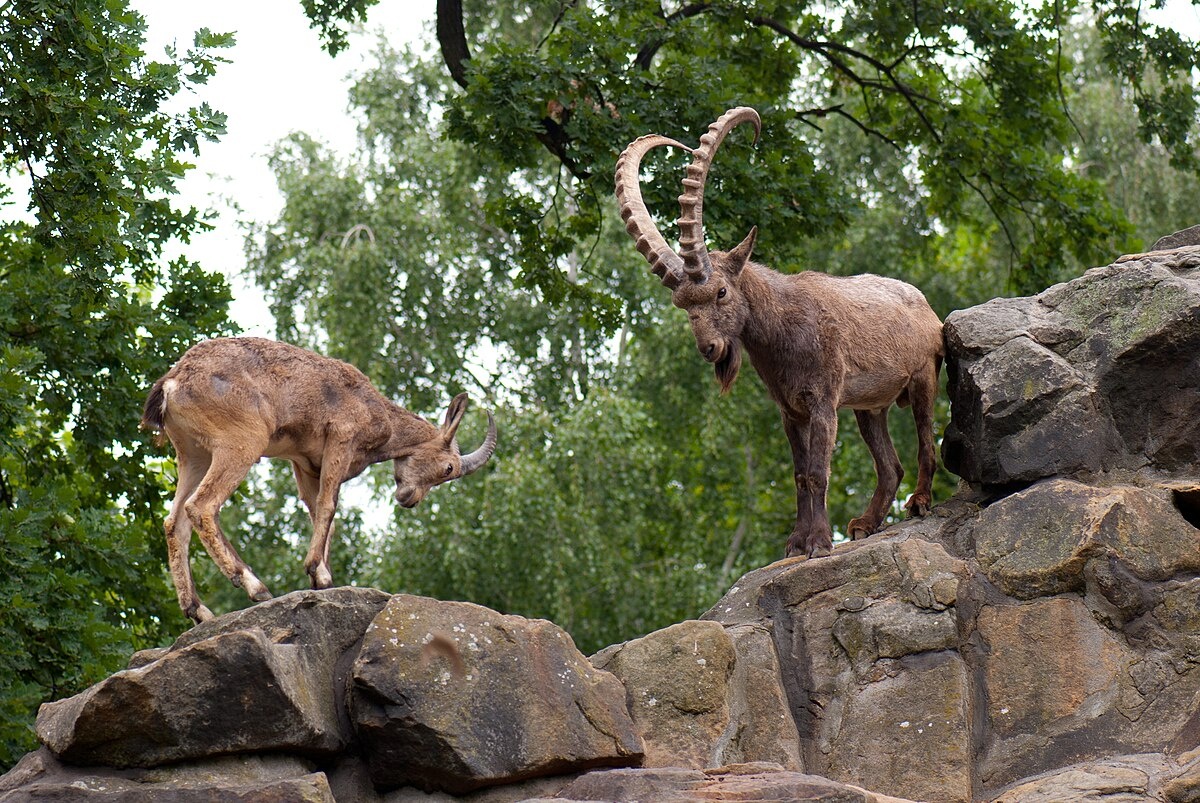
A breeding hierarchy between male Siberian ibexes is often established through fighting. Multiple aggressive tactics are used, including clashes of horns, with both males either facing each other or standing next to one another . According to Heptner et al. (1988), mortality is rare during such fights.
Jeffrey Williams wrote in Animal Diversity Web “Male Siberian ibexes begin courting females by approaching with a low-stretch pose . Males then sniff and lick the female before letting out a low scream, which causes the female to run away from the male . This can result in the female hitting the male with her horns, or urinating, which provokes the male to perform flehmen . According to Fedosenko and Blank, this courtship behavior lasts over 30 minutes. A pair must separate themselves from other animals for successful copulation to occur because of the heavy competition between males for access to females.~
“The timing of mating seasons for Siberian ibex varies between mountain ranges and is significantly affected by weather conditions. The mating season (rut) can start in October and extend into January, due to differences between ranges and weather conditions. According to Fedosenko and Blank, estrus lasts 20 days and an occasional second estrus can extend the duration of the rut. The rut generally starts when mature males migrate down in elevation to join female groups. Males generally don’t breed until they are five years old, when they can be competitive against other males. Females can breed as early as their second year . Mature males will establish and guard harems of five to fifteen females . ~
Siberian Ibex Parenting and Offspring
~ Parental duties by Siberian ibex are performed almost exclusively by females. Pre-weaning provisioning and protecting are done by females. The age in which they are weaned ranges from five to eight months.The post-independence period is characterized by the association of offspring with their parents. On average females reach sexual or reproductive maturity at two years and males do so at five (high) years.
Usually one kid is born. In one study, only two of 56 pregnant, captured females bore twins . Though young Siberian ibexes can graze like adults within 1.5 months of birth, they have been known to suckle into December. Suckling decreases each month after birth, and can extend into December, though young continue to live with their mothers through the following year . ~
Female Siberian ibexes leave their groups and yearlings for around a week before and after birth give birth in solitude . After birth the mother licks the neonate clean. A few days following birth, the newborn is often left alone to hide from predators. This length of time can vary depending on the ability of the young to handle the terrain . Young Siberian ibexes generally stay close to their mothers for protection, and bleat at signs of danger. Fedosenko and Blank (2001) report that young Siberian ibex may run to the closest adult females for protection in the presence of danger. /=\
Siberian Ibexs, Humans and Conservation
On the International Union for Conservation of Nature (IUCN) Red List, Siberian ibex are listed as a species of Least Concern. In CITES (Convention on International Trade in Endangered Species of Wild) they have no special status. [Source: Jeffrey Williams, Animal Diversity Web (ADW) /=]
Siberian ibex are mostly sought after by humans for its meat. The hides are used for a number of clothing items. Siberian ibex are also hunted for trophy purposes because of their large horns. They are also hunted by trophy hunters who pay big money to go after animals with their large horns. Siberian ibexes pose little threat to humans other than eating grazing grass that livestock might feed on.
According to IUCN/SSC said there were more than 250,000 Siberian ibex in 1996 but added that the numbers were deceptive as the rate of habitat loss to livestock was increasing and habitats were becoming more easily accessible to motorized vehicles, increasing poaching. Tough hunting regulations and protected areas have been established throughout the Siberian ibex’s range to the animals.
Image Sources: Wikimedia Commons
Text Sources: Animal Diversity Web animaldiversity.org ; National Geographic, Live Science, Natural History magazine, CNTO (China National Tourism Administration) David Attenborough books, New York Times, Washington Post, Los Angeles Times, Smithsonian magazine, Discover magazine, The New Yorker, Time, BBC, CNN, Reuters, Associated Press, AFP, Lonely Planet Guides, Wikipedia, The Guardian, Top Secret Animal Attack Files website and various books and other publications.
Last updated April 2025