
KOMODO ISLAND
Komodo Island (east of Sumbawa and generally reached by boat from Flores) is the home of the famous Komodo Dragon, the world largest lizard, which can reach lengths of three meters including the tail, and wasn't even discovered by outsiders until 1912. Tourists used to come to see the dragons fed on a goat in a pit. The pit exists but dragons are no longer fed there. Some visitors skip Komodo altogether and look for dragons on Rinca island because it is easier to get to. Komodo Dragons also live on Rinca, Padar and western Flores. These volcanic islands are inhabited by a population of around 5,700 giant lizards. Komodo Dragons exist nowhere else in the world and are of great interest to scientists, especially for their evolutionary implications.
About 30 kilometers long, Komodo is comprised mostly of grassy hills, steep mountains and dry savannahs. The forests are filled with tamarind and kapok trees. The dry savannah feature Lonar Palms, and stunted Sujube trees. The rugged hillsides of dry savannah and pockets of thorny green vegetation contrast starkly with the brilliant white sandy beaches and the blue waters surging over coral. In 1928, Komodo was named a Wilderness Area, one of the first of its kind in Asia. Komodo National Park encompasses an area of 173,00 hectares, with three fourth of that on land and one fourth in the sea.
Komodo National Park (between the islands of Sumbawa and Flores) is composed of three major islands (Rinca, Komodo, and Padar) and numerous smaller ones, all of them of volcanic origin. Located at the juncture of two continental plates, this national park constitutes the “shatter belt” within the Wallacea Biogeographical Region, between the Australian and Sunda ecosystems. The property is identified as a global conservation priority area, comprising unparalleled terrestrial and marine ecosystems and covers a total area of 219,322 ha. The dry climate has triggered specific evolutionary adaptation within the terrestrial flora that range from open grass-woodland savanna to tropical deciduous (monsoon) forest and quasi cloud forest. The rugged hillsides and dry vegetation highly contrast with the sandy beaches and the blue coral-rich waters. [Source: UNESCO]
RELATED ARTICLES:
KOMODO AREA: TOURISM, SIGHTS, NATIONAL PARK factsanddetails.com
MANGGARAI: THE MAIN ETHNIC GROUP ON KOMODO factsanddetails.com
FLORES: VOLCANOS, SIGHTS, LABUAN BAJO factsanddetails.com
KOMODO DRAGONS: CHARACTERISTICS, HABITAT, SENSES, MOVEMENT factsanddetails.com
KOMODO DRAGON BEHAVIOR: FIGHTING, REPRODUCTION, JUVENILES factsanddetails.com
KOMODO DRAGON FEEDING: PREY, HUNTING BEHAVIOR AND VENOM factsanddetails.com
KOMODO DRAGONS AND HUMANS: CONSERVATION, SCIENTISTS, VILLAGERS factsanddetails.com
KOMODO DRAGONS ATTACKS ON HUMANS factsanddetails.com
SUMBAWA: SIGHTS, BEACHES, TAMBORA factsanddetails.com
LOMBOK: HISTORY, PEOPLE, TOURISM, GETTING AROUND factsanddetails.com
NUSA TENGGARA factsanddetails.com
PEOPLE OF NUSA TENGARRA (ISLANDS EAST OF BALI) factsanddetails.com
Pink Beach on Komodo
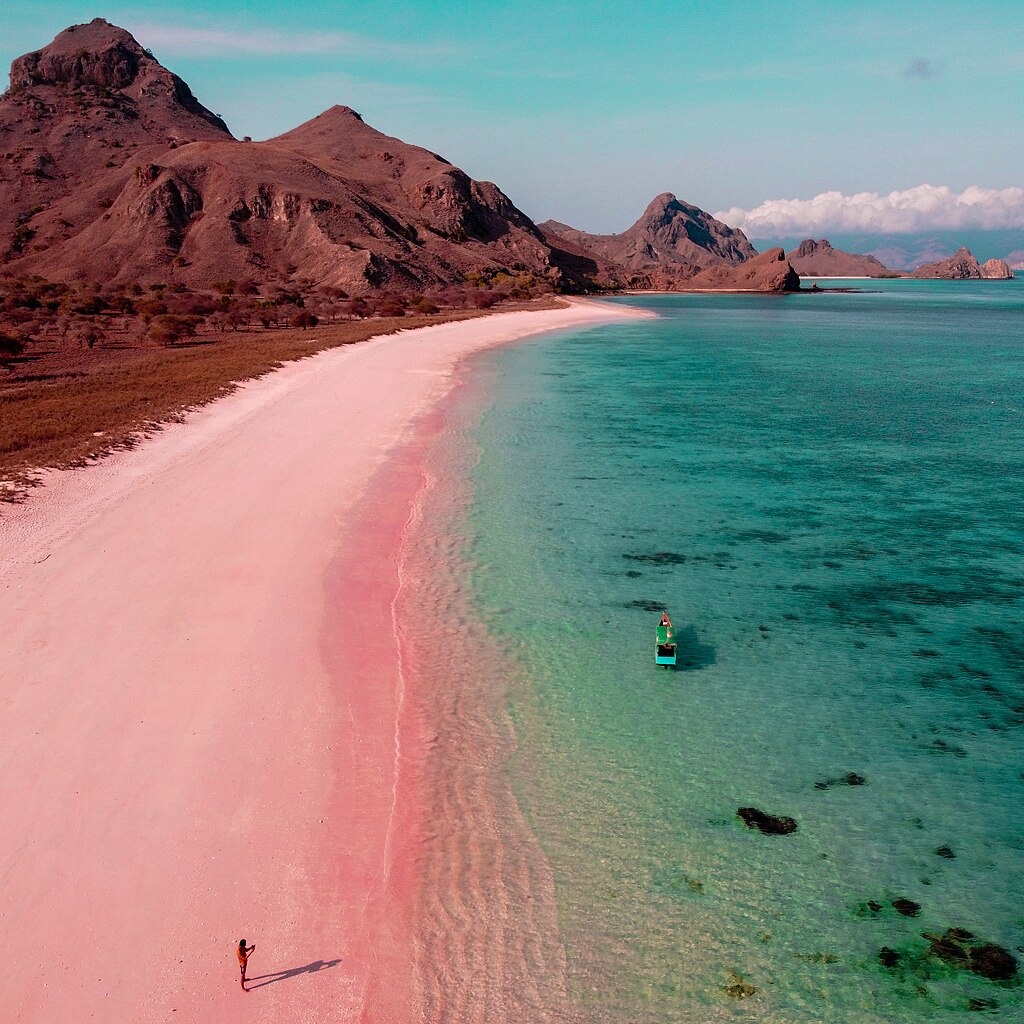
Pink Beach (eastern side of Komodo) is aptly named and one of only seven pink beaches in world. This exceptional beach gets its striking color from microscopic animals called Foraminifera, which produce a red pigment on the coral reefs. When the tiny fragments of red coral combine with the white sands, this produces the soft pink color that is visible along the shoreline. Aside from Pink Beach (Pantai Merah) itself, a few small segments along Komodo’s eastern bay also have a pinkish tint.
The beach is hard to get to and often no one is there. It’s a magical place: not only because of the pink sand but also because of the turquoise seas, green rolling hills and blue skies found at the beach. Offshore are amazing corals of all shapes and sizes jut from the sea bed.
Obviously snorkeling and diving have become a sort of compulsory activity while visiting this beach. The corals of the Pink Beach’s underwater gardens are in excellent condition, with hundreds of species of both soft and hard corals, and thousands of species of fish. Pink Beach is a terrific choice for snorkelers and beginner divers as even the shallow waters are home to an abundance of species to keep you more than entertained. Of course, there is much more to see the deeper you venture.
Relax on the fairytale-like pink sands and work on your tan. Or join in with the various other available water sports such as kayaking or just having a leisurely swim. If photography is your passion, this is definitely a place to try your hand at capturing the stunning natural beauty of the island. And make sure you stick around till sunset, as the view is amazing.
A few points to keep in mind, is that this is an uninhabited island, and it also is the natural habitat of the Komodo Dragon. If you see the creatures roaming the coast or in the water, be sure to keep a distance. Komodo Dragons are excellent swimmers and are even capable of swimming inter-island. Komodo Dragons are wild animals that could be potentially dangerous to people, so it is not recommended to visit this beach without the help of an experienced guide or ranger.
The only way to reach Pink Beach is by boat. As the area around beach is uninhabited and fairly remote area, most tourists opt to stay in Labuan Bajo in Flores for proper accommodations. If you wish to stay on Komodo itself, there are available homestays on the island with modest facilities and simple food. Your guide should be able to help you on this matter should you choose to overnight on Komodo.
Diving Around Komodo Island
The sea around Komodo Island offers vibrant colors and exotic marine life which will enchant divers and snorkelers alike as endless schools of fish ride the waterways rushing up from deep sea vents, below them the seabed is covered with a thick carpet of florescent corals and marine invertebrates, an underwater photographers paradise. Many tour operators run liveaboard tours for divers out of Bali.
The waters that surround the island are turbulent and teeming with unparalled marine life. A marine reserve has recently been established and this reserve is largely undocumented and remains unexplored. Komodo National Park was established in 1980. It was declared as a Man and Biosphere Reserve and a World Heritage Site in 1986. KNP includes three major islands - Komodo, Rinca and Padar and numerous smaller islands together totaling 41,000 ha of land contains 132,000 ha of marine waters.
The corals in Komodo National park are pristine, with Mantas, sharks, turtles, dolphins, dugong, many pelagics, to the tiny pygmy seahorses, nudibranchs, frog fish, you name it we've got it. The sites vary from gentle easy coral slopes to heart pounding adrenalin rides, from the warm waters of the Flores Sea in the north to the chillier waters down south in the Indian Ocean, the underwater terrain is so varied with sheer cliff walls, pinnacles, sandy flat bottoms, underwater plateaus, slopes, caves, swim-throughs, channels, all with varying colors, sizes and types of coral both hard and soft.
Diving the Komodo National Park provides some fantastic conditions: 1) Water Temperature: 20 - 28 Degrees Celsius (68-85 F), cooler water is experienced on the southern sites. Full 3mm wetsuit & hood is recommended. More active people will prefer a sports suit in northern sites. 2) Visibility: 10 - 50M year round. Traditionally clearer water on northern sites.CURRENT: Komodo experiences a strong tidal flow. Not all sites are affected by current. Drift diving is excellent, however during spring tides some sites are impossible to dive. Particular attention is placed on diving the correct sites at the most suitable time to ensure optimum conditions, in accordance with the preferences of the group. 3) Night Diving: The night diving in Komodo is breathtaking. The sheer beauty, color and diversity of life makes it a must see for all divers. 4) Walls, Canyons and Seamounts: There are numerous walls to choose from. Both drift and static wall dives are offered. Huge chasms drop thousands of meters, fringed by extraordinary coral gardens. Seamounts, fringing reefs, gutters, muck, and sandy locations are also found in the archipelago.
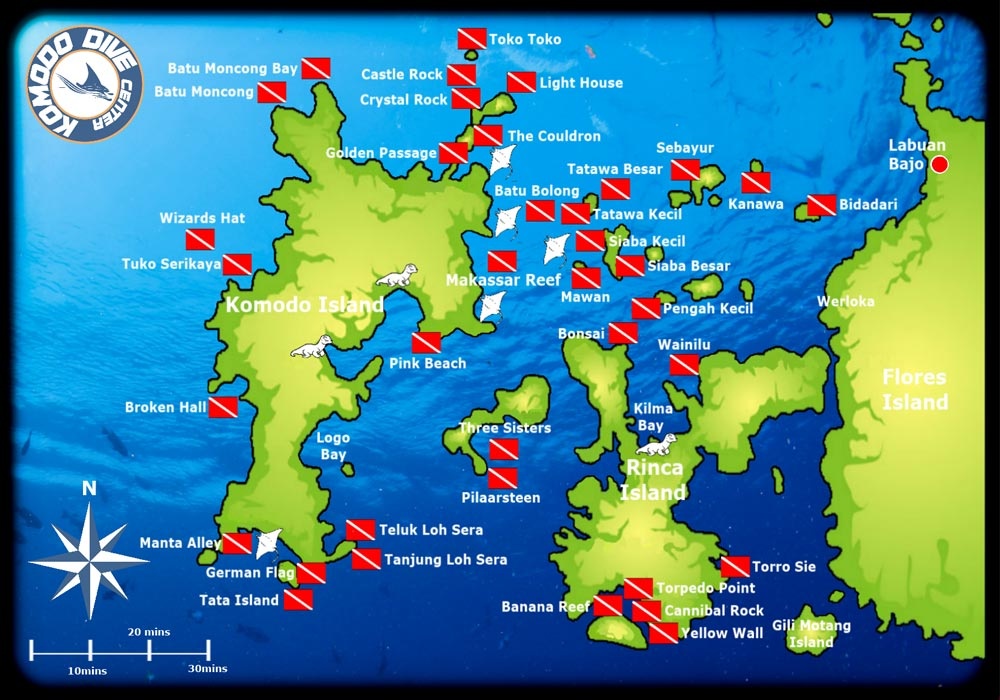
Dive Sites Around Komodo Island
Bidadari Island: Angel Steps, huge towers of stone, encrusted with hard and soft corals, covered in nudibranchs, small caves and overhangs make this a very interesting and beautiful site, Dusky sharks, humphead parrot fish are among the bigger creatures we see here. Cathedral Coral, a gentle slope covered with table corals of every color and schooling fish, a towering spire of coral with a small cave at it's base is the home to some huge lobsters.
Sabolon: Sabolon kecil a slope on the east side of this tiny island, with two underwater mounds at the southern end with fields of garden eels and sea pens, schools of round bat fish are often seen coming quite close for some nice photography.
Sabolon Besar steep slopes off the southern and western sides of the bigger island, fabulous coral coverage and a good chance of spotting Scorpion leaf fish.
Sebayur kecil walls and slopes of every kind of coral you can imagine, wide variety of marine life to be seen at this site, mantas often seen.
Tatawa Besar slope with soft coral garden changing to hard coral along the slope, lots of shoaling fish, rainbow runners, fuseliers and often turtles and black tip sharks.
Tatawa Kecil (current city) as the name implies, this site is washed by very strong currents, which is why this site is among the many world class sites in the Komodo National Park, schools of pelagic fish patrol the waters, best dived at slack tide.
Batu Bolong: A little further west from current city a small rock outcrop with a hole through it is the surface mark of another world class site, only to be dived at slack tide or with a current not long from stopping or starting to run, these giant slabs of rock which disappear into the depths are an amazing sight to see, covered with every form of marine life and patrolled by giant trevally, Napoleon Wrasse, sharks and turtles with schools of barracuda sweeping in to check out the divers.
Marine Life and Ecosystems in Komodo National Park
Marine Physical Environment: The marine area constitutes 67 percent of the Park. The open waters in the Park are between 100 and 200 meters deep. The straits between Rinca and Flores and between Padar and Rinca, are relatively shallow (30 to 70 meters deep), with strong tidal currents. The combination of strong currents, coral reefs and islets make navigation around the islands in Komodo National Park difficult and dangerous. Sheltered deep anchorage is available at the bay of Loh Liang on Komodo’s east coast, the South East coast of Padar, and the bays of Loh Kima and Loh Dasami on Rinca.
In the North of the Park water temperature ranges between 25 — 29°C. In the middle, the temperature ranges between 24 and 28°C. The temperatures are lowest in the South, ranging from 22 — 28°C. Water salinity is about 34 ppt and the water is quite clear, although the waters closer to the islands are relatively more turbid.
Marine Ecosystems: Indonesia is the only equatorial region in the world where there is an exchange of marine flora and fauna between the Indian and Pacific oceans. Passages in Nusa Tenggara (formerly the Lesser Sunda Islands) between the Sunda and Sahul shelves allow movement between the Pacific and Indian oceans. The three main ecosystems in Komodo National Park are seagrass beds, coral reefs, and mangrove forests. The Park is probably a regular cetacean migration route.
Marine Flora: The three major coastal marine plants are algae, seagrasses and mangrove trees. Algae are primitive plants, which do not have true roots, leaves or stems. An important reef-building algae is the red coralline algae, which actually secretes a hard limestone skeleton that can encrust and cement dead coral together. Seagrasses are modern plants that produce flowers, fruits and seeds for reproduction. As their name suggests, they generally look like large blades of grass growing underwater in sand near the shore. Thallasia sp. and Zastera spp. are the common species found in the Park. Mangroves trees can live in salty soil or water, and are found throughout the Park. An assessment of mangrove resources identified at least 19 species of true mangroves and several more species of mangrove associates within the Park's borders.
Marine Fauna: Komodo National Park includes one of the world's richest marine environments. It consists of forams, cnidaria (includes over 260 species of reef building coral), sponges (70 species), ascidians, marine worms, mollusks, echinoderms, crustaceans, cartilaginous and bony fishes (over 1,000 species), marine reptiles, and marine mammals (dolphins, whales, and dugongs). Some notable species with high commercial value include sea cucumbers (Holothuria), Napoleon wrasse (Cheilinus undulatus), and groupers.
Accommodation on Komodo
A Limited amount of accommodation — namely simple guest houses offering few rooms — is available at Loh Liang (Komodo Island) and Loh Buaya (Rinca Island). A luxurious hotel with limited capacity is currently being built in Loh Liang. Many visitors sleep in the boats that brought them to the islands. Most tourists visiting Rinca Island don't stay overnight (they come from Labuan Bajo and stay in the hotels in Labuan), while those coming to Komodo Island usually stay in their rented motorboats. Nearly all motorboats have cabins and bed rooms. Large motorboats usually have good bed rooms. Live aboard cruises are also available. For information on these check komodoliveaboard.com and komodo-diving.com
Ranger's Houses - Komodo Island: The new renovated ranger's houses in eco style accommodation, with modern facilities featuring with private bathroom, limited electric power supply, dining. Only few step to the beach of Lohliang. Ranger's houses becomes an alternative accommodation offer to visitors whom for some reasons are not able to sleep on boat.
Bajo Komodo Eco Lodge has developed environmentally friendly buildings with the use of solar power for hot water, an extensive rain water storage system, and the use of a biological sewage treatment plant where all waste water is returned to the gardens through irrigation. The Bajo Eco Lodge is under control of Iniradef non profit organization where to participate in developing the human resources on the area and also building the natural environment conservation. This program have fully accepted by locals.
Boat Accommodation from Labuan Bajo: Simple boat sleep on the deck with set mattresses, fit for a small group up to 4 peoples only, meals freshly cooked on board, mineral bottled water supplied, simple toilet.
Boat Accommodation depart from Bima: Larger boat with cabin, dining facilities and standard safety equipment available for those who are travel to Komodo via Bima. Although it takes you over 7 hours on water - the facilities promises on the boat better enough compare to those who are start from from Labuan Bajo.
Puri Komodo Resort Batu Gosok: Set on the northwest tip of Flores island of Indonesia, this location well known with Batu Gosok, secluded peninsula. 250.000 square meters of land hideaway guaranteed to thrill snorkelers, divers and adventurers. A magnificent secluded cove with over 1.000 meters of white sandy beach and a wooden jetty protruding 450 meters into the coral rich turquoise waters. Opulent sea gardens in colors of purple, yellow, blue and fuchsia blend with brightly colored tropical fish drifting aimlessly amongst the coral.
Komodo Resorts consists of 14 spacious bungalows that fit perfectly into the surrounding landscape, just a short stretch from the beach. The bungalows are made from teak wood that has been recycled or that has come from controlled plantations. Each bungalow is equipped with hot water and fans, and 8 of the deluxe bungalows also include air-conditioning and a minibar. Dive trips and live aboard cruises are also available at this resort. Komodo Resort, Tanjung Pelinta, Sebayur Island, Komodo, Manggarai Barat, Flores 86754, Tel. 62- 85 - 42095, Fax : 62 — 385 — 42094, Website: komodoresort.com
Bintang Flores Hotel is a four-star hotel in Labuan Bajo located amidst spacious grounds and overlooking a private beach. Guest rooms come equipped with a king-sized bed or twin beds, satellite TV, safety deposit box, mini-bar, IDD telephone and air-conditioning. Ground-floor rooms offer direct access to the hotel gardens, while those on the higher floors provide a spectacular view of the Flores Sea. Rates start at USD 120 — 230 per night. Bintang Flores Hotel, Jalan Pantai Pede, Labuan Bajo, Tel. 62 — 385 — 2443755, Fax : 62 — 385 — 2443762, E mail: info@bintangfloreshotel.com, Website: bintangfloreshotel.com
Tips for Tourists on Komodo
Tips for visitors: 1) Don't walk alone. It is best to walk around with a ranger or guide. 2) Don't disturb or feed komodos. Despite slow and lazy movement, this animal can suddenly turn aggresive and move fast. 3) When trekking, please take a stick with you. Komodos are usually afraid when threatened with a stick. 4) Please wear shoes. Komodo, Rinca, and Padar islands have 12 types of snakes and three of them are poisonous, namely green snakes living on trees, cobras and russel's viper who live on the ground in holes on the savannas. 5) Women having their menstruation must report to a guide or ranger for special attention. Komodos have a very strong sense of smell and may turn agresive when they smell blood. 6) Please bring along your insect repellant because this area has many mosquitoes who'll be excited at the prospects of having fresh blood.
Restaurants: In Loh Liang, the KNP management (PT Putri Naga Komodo) owns a restaurant. No restaurant is available in Rinca Island, though. There is only one kiosk selling drinks and snacks. If you stay in a guest house, you will have food available with your stay. If you take a rented motorboat, your rental usually includes meals (but you have to confirm it when negotiating the rental price).
Things to Buy: At the reception in Loh Buaya and Loh Liang, there are souvenir shops selling t-shirts with komodo pictures on them and wooden komodo statues. There's not yet a shop selling a t-shirt saying, "I went to see the Komodo Dragons and all I got is this lousy T-shirt." So that's a potential market for you.
Getting to Komodo
The only ways to really get to Komodo are fly from Labuan Bajo in Flores and join a group and hire a boat for the trip to Komodo or join a package tour that arranges transport to Komodo. There may be a ferry between Pelabuhan Sape on Sumbawa and Labuan Bajo in Flores. The trip takes about eight hours and is may not be operating anymore. It used to stop in Komodo but no longer does. There is a 36-hour ferry ever two weeks between Benoa, Bali — Bima, Sumbawa — and Labuan Bajo, Flores but I don’t think that one stops in Komodo. The waters between Bali, Komodo and Flores are said to be treacherous and very hard to navigate, which may be on reason why regular ferries in the region are so infrequent. Also people on the other islands generally have no reason to go to Komodo, which is why ferries don’t stop there.
Hence organizing a boat in necessary. Some people make arrangements for a boat to Komodo in Pelabuhan Sape on Sumbawa but most do it Labuan Bajo in Flores. The trip between Labuan Bajo and Komodo takes about four hours one way. Some go to island and back in a day trip. Most stay over at least one night. The journey to Rinca takes only two hours. Some stop in Komodo as part of boat tours between Lombok and Flores. The caist for charting a boat to Komodo is around $200 for up to six people. To Rinca is about $1000. Komodo has a helicopter pad for the super rich.
Most people get a group together and hire a boat. The trip can be quite an adventure The currents around Komodo are very unpredictable. One minute the ocean is calm; the next minute the next the boat is around by large waves coming from different directions, whirpools and rip tides.. Often times when you reach you destination boat anchors far offshore and you have wade in with your luggage over our heads.
These days most people visit Komodo as part of a tour arranged in Labuan Bajo (or Bali or Lombok, but starting in Labuan Bajo). These tours are generally a boat following a set route with a captain dropping you off and picking you up at certain places. There are several different options for tour routes, and different ways yo can book the tour. If you’re going in high season (May-July) you may want to book your tour online; but if you can get to Labuan Bajo there are plenty travel agencies and street tour-vendors that can fix you up. Generally, you HAVE to book the tour at least the day as they tend to leave very early in the morning.
A day tour starts at around $30 if there are enough people on the boat. if you want to spend more time and more money there are live-aboard boats and boats that will drop you off so you can spend the night on Komodo. On a typical one day tour you hike around through desert and brush looking for Komodo dragons, which your guide will protect you from with a big forked stick. Some tours of Komodo include a three to hour hike and climb 538-meter-high Mount Ara.On Rinca island, you have to trek for about one and a half hours on designated paths. In addition to the day tour fee, you’ll also have pay the Komodo National Park fee and a fee or tip for the guide.
As for getting to Labuan Bajo, everyday, there are two to three flights from Bali to Labuan Bajo by Transnusa, IAT (Indonesia Air Transport), and Merpati. In addition, there is a twice a week flight from Kupang, Timor from which there are air connections to Australia. . Inter-island motorboats from Sape in Sumbawa and Labuan Bajo are also available everyday (when the weather permits). By daily flights between Bali and Labuan Bajo take about 90 minutes. The Trans Nusa airline daily flights to Labuan Bajo on Flores is by a small jet or turbo-prop plane carrying 50 passengers. The port in Labuan Bajo is about a 10 minute drive from the Labuan Bajo airport.
Image Sources: Wikimedia Commons
Text Sources: Indonesia Tourism website ( indonesia.travel ), Indonesia government websites, UNESCO, Wikipedia, Lonely Planet guides, New York Times, Washington Post, Los Angeles Times, National Geographic, The New Yorker, Bloomberg, Reuters, Associated Press, AFP, Japan News, Yomiuri Shimbun, Compton's Encyclopedia and various books and other publications.
Last updated January 2026