
LIFE OF DANI PEOPLE
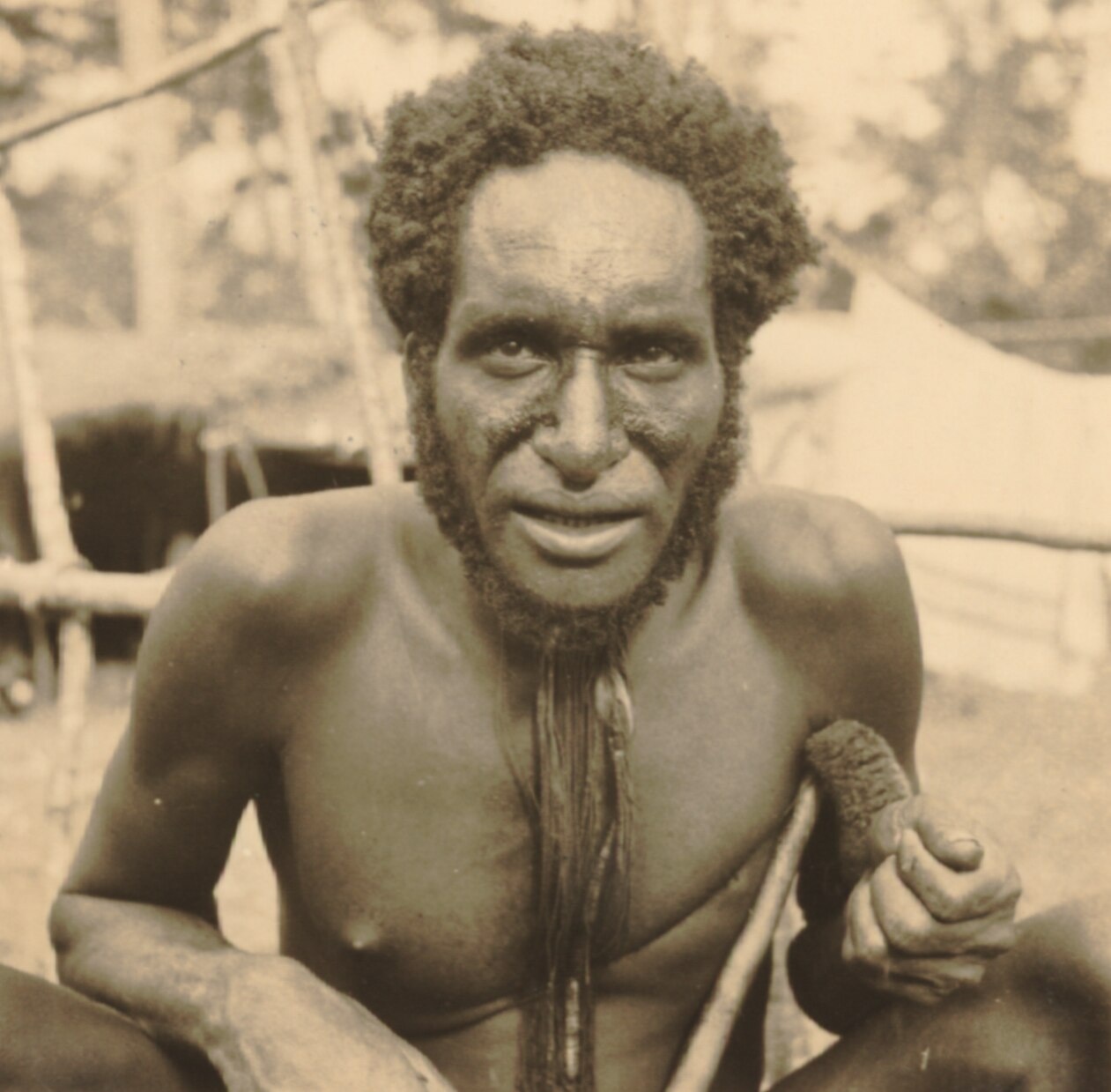
The Dani are regarded as friendly but shy, When they greet a foreigner they often use a long handshake followed by holding the other person’s hand for some period of time. The Dani world has traditionally been very rough. Describing the Dani, explorer Robin Hanbury-Tenison wrote, "There was certainly room for an infusion of the milk of human kindness into heir way of life since of their traditional practices—such as cutting of fingers when anyone died, their methods of abortion, punishment and revenge seemed unnecessarily crude and cruel." Boys go through an initiation ceremony in which their septum is pierced.
Dani tools were traditionally been made of stone, bone, pig tusk, wood and bamboo. Stone used to make axes and adze was often obtained from other groups through trading. Jale men use bows, arrows and hatchets for weapons. Hatchet also doubled as gardening tools. The Dani traditionally had no pottery or cloth, even bark cloth. String and material for skirts and nets was obtained from the bark of trees. Containers were made from gourds. Body armor was made from rattan. Arrows were unfletched, with notched and barbed (but not poisoned) tips. By the 1980s, cloth, metal axes, knives and shovels were widely used and thrown-away plastic bottles were used instead of gourds. [Source: Karl Heider “Encyclopedia of World Cultures, Oceania”edited by Terence Hays, (G.K. Hall & Company, 1996) ~]
The Baliem Valley Dani have traditionally had no art beyond decorations on arrow points and personal ornaments of furs, feathers, and shells. Formal oratory was not important, but casual storytelling was a well-developed skill. ~ The Dani were remarkably healthy until malaria and venereal disease were introduced to their homelands. Still they had an average life span of 60 years in the 1980s which was high among tribal people in New Guinea. The treatment for headaches is rubbing leaves on the forehead. To treat serious battle wounds, blood was drawn from the chest and arms. ~
Ritual warfare once played a central role in Dani society. Clans engaged in small-scale, highly structured conflicts aimed more at wounding or killing symbolic opponents—and displaying courage—than at seizing territory. Preparing for battle and tending to injuries were significant parts of daily life. One major outbreak of violence occurred in 1966, when an attack by a rival clan left 125 people dead. These forms of warfare are no longer practiced today. [Source: Wikipedia]
RELATED ARTICLES:
DANI AND PEOPLE OF THE BALIEM VALLEY: HISTORY, RELIGION, WHERE THEY LIVE factsanddetails.com
HIGHLAND GROUPS OF WEST NEW GUINEA — EIPO, DAMAL, EKAGI — AND THEIR HISTORY, LIFE AND SOCIETY factsanddetails.com
BALIEM VALLEY: HISTORY, PEOPLE, TRAVEL, HIGHLIGHTS factsanddetails.com
ETHNIC GROUPS IN NORTHERN PAPUA AND THE BIRD'S HEAD (VOGELKOP) OF NEW GUINEA factsanddetails.com
NORTHWEST PAPUA AND THE BIRDHEAD OF NEW GUINEA factsanddetails.com
PAPUA — THE INDONESIA PART OF NEW GUINEA — NAMES, HISTORY, PEOPLE factsanddetails.com
HISTORY OF PAPUA factsanddetails.com
PAPUA factsanddetails.com
FIRST PEOPLE IN NEW GUINEA ioa.factsanddetails.com
UNREST AND LIMITED AUTONOMY IN PAPUA SINCE THE OUSTER OF SUHARTO IN 1998 factsanddetails.com
Dani Society and Kinship Groups
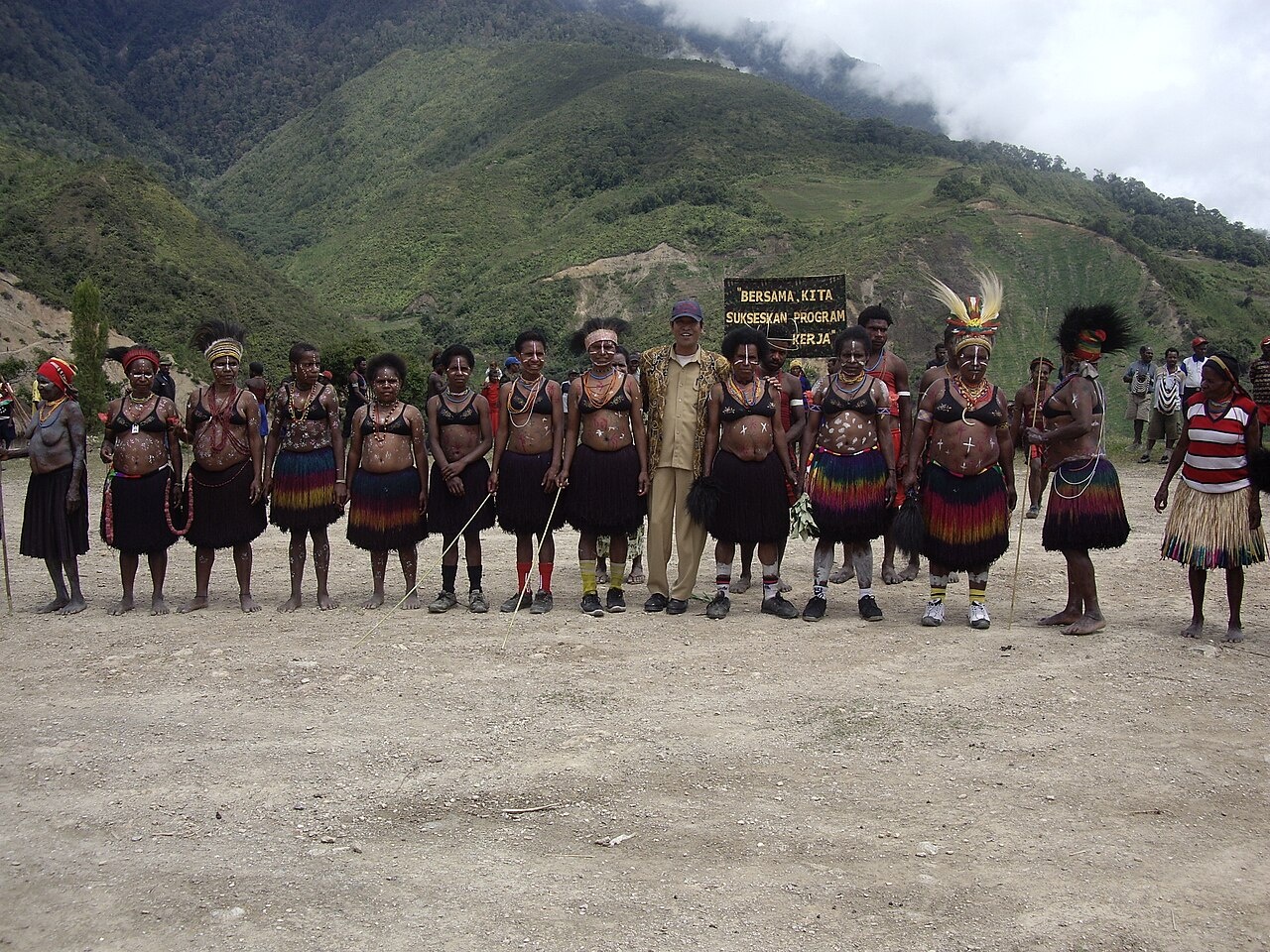
The main Dani social units are village compounds and alliances. Each alliance is composed of confederations, which are often associated with areas and have up to a thousand people. The primarily purpose of the confederations is to pool resources for pig feasts and other ceremonies and create a military organization that can be used for defense and to wage war. Compounds and confederation at led by non-hereditary “big men.” They are generally set up in an informal, consensual basis among men of status, often determined by how many pigs and wives they possess. The leaders of the confederation are involved in and preside over ceremonies, organizing pig feasts and waging war. See Villages, Below. [Source: Karl Heider “Encyclopedia of World Cultures, Oceania”edited by Terence Hays, (G.K. Hall & Company, 1996)]
Baliem Valley Dani society has traditionally revolved around exogamous patrilineal moieties and exogamous patrilineal kinship groups. Moieties are groups which have two parts. Exogamous means marrying outside the group and patrilineal refers to descent through the male line. This all means Dani individuals must marry outside their moiety and kinship group and this structure binds families, kinship groups and clans together.
Some kinship group names also appear among groups beyond the Baliem Valley, and there are indications—perhaps survivals—of a similar moiety system among the Western Dani. In the valley, people inherit their father’s kinship group, yet all children are initially considered members of the wida moiety. Before marriage, those whose fathers belong to the waiya moiety shift into waiya—boys through initiation rites and girls without ceremony. The primary function of the moieties is to regulate marriage, and each kinship group is aligned exclusively with one moiety. Kinship groups also have specific bird totems and corresponding food taboos. Local kinship group segments share sacred objects, store them in the men's house of the group's most prominent man, and periodically hold ceremonies to renew these objects. Genealogical depth is not emphasized; shared kinship group membership implies shared ancestry, but most people know their lineage only a few generations back.
Dani use Omaha-type kinship terminology, which sharply distinguishes paternal and maternal relatives and is common in patrilineal societies, On the father’s side, relatives are classified by gender and generation, similar to the Iroquois system. On the mother’s side, however, generational distinctions are often collapsed, grouping many maternal relatives into broad categories based on gender alone—a form of “skewing” that reflects the central importance of the patrilineage.
Dani Marriage, Men and Women
Dani men traditionally cleared the land and maintained the irrigation systems that drains off water in the wet season and supplies it in the dry season. Women plant, harvest and sell the sweet potato crop and transport items such as firewood, water and vegetables on building planks on their heads. Among the Jale, both sexes farmed while , males hunted bird and game while females trapped insects, lizards and frogs. [Source: Karl Heider “Encyclopedia of World Cultures, Oceania”edited by Terence Hays, (G.K. Hall & Company, 1996)]
Men and women have traditionally lived apart. The Dani have special huts for women and children and larger huts for men. Both are generally void of furniture with residents sleeping tightly packed together. Often times the most comfortable and spacious part of the compound is the rectangular pig barn. Children are allowed to run free within reason. Toilet training is casual. Disciplining, even scolding, is rare. Children learn through participation not formal instruction.
Dani marriages can be both arranged or love matches and are generally between neighbors. Weddings have traditionally only been held during times of great feasts which are every four to six years. They initiate or continue an alliance between families that involves periodic exchanges of goods such as pigs, shell bands and sacred slate stones. A man must generally give the family of the girl he plans to marry four or five pigs. [Source: Karl Heider “Encyclopedia of World Cultures, Oceania”edited by Terence Hays, (G.K. Hall & Company, 1996)]
Newlywed couples generally live initially with the groom’s parents but are expected to establish their own household reasonably soon after marriage. After a child is born, sex is taboo for two to five years, apparently to allow a child the exclusive use of he mother’s milk. Divorce is easy to obtain but many prefer long term separation
Dani Sexuality
In the 1990s about half of Dani men practiced polygamy. Some had several wives. The Grand Valley Dani appear to have remarkably little interest in sex. Married couples often abstain from sex for many years after having a child. This is not necessarily the case with other Dani groups.
Karl G. Heider stated in 1972 that the Dani said that “a couple do not begin to have sexual intercourse until a specific ceremony is held, two years after the major wedding exchange ceremony and thus two years after the couple has established a common residence”. Heider performed systematic observations, including audio- and videotaping, on mother-infant dyads in two Dani regions. He write in 1976: “Although we have not yet analysed the data, it became obvious to us during the observations that although we were seeing on the Western Dani an expectable amount of mothers erotically manipulating their infants, there was virtually none of this among the Baliem Valley Dani”. The penis gourd is worn from the age of six. Boy’s initiation rites are void of sexual reference, but teenage songs, drawings and string figures forms “one of the few areas of Dani life where there is any significant level of sexuality” [Source: “Growing Up Sexually. Volume I” by D. F. Janssen, World Reference Atlas. 0.2 ed. 2004. Archive of Sexuality, sexarchive.info ]
Denise O’Brien wrote in 1969: “Men, women, and children were always willing t o discuss most questions concerning sex and often expressed curiosity about American sexual customs. Children are not naive or uninformed about sex, and are aware of many of the terms and gestures referring to sexual intercourse by the time they are five or six years old. They are also well aware of the causal relationship between intercourse and pregnancy. Joking is common among persona of all ages…Another example of sexual Wing occurred at a feast, when a mother laughingly teased her four-year-old daughter who was partially sitting on a piece of pork, saying, ‘your vulva is touching the Pig’. Children especially are fond of teasingly accusing each other of irregular behavior such as sexual intercourse with animals...when discussing intercourse with a small mixed group of adolescents and adults which included a married couple and a boy about eight years old, a married man suggested that the young boy should leave and that the subject should not really be discussed in mixed company. Laughter and joking greeted his remarks; the young boy remained and the discussion continued”
Sexual intercourse often begun before menarche and is thought to cause menstruation. Studying the Baliem Valley Dani in 1990s, L. Butt found that “girls should marry at a sufficiently mature age "when her breasts are like papayas," said one informant”.
Dani Villages and Homes
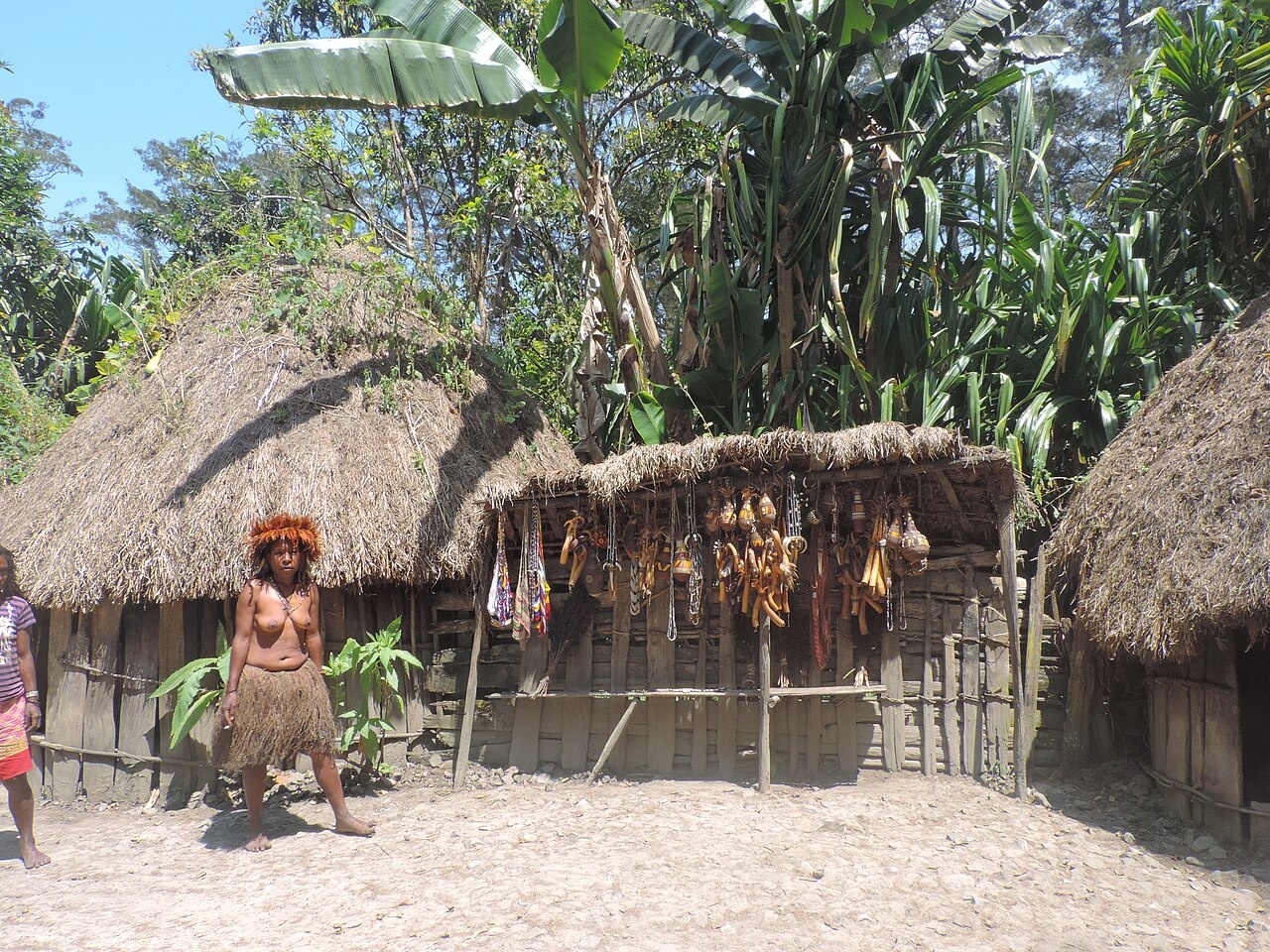
Many Dani still live in their traditional kampungs, or compounds, set up around a men’s houses, usually on the floor the Grand Valley on the upper Baliem river. Other important buildings include woman’s houses and common cook houses and pig sties. Structures are linked by fences and open onto a common courtyard. The compounds vary greatly in size. Small ones contain a single nuclear family. Large ones may house thirty or more family members. A typical one is home to four men and 20 people. [Source: Karl Heider “Encyclopedia of World Cultures, Oceania”edited by Terence Hays, (G.K. Hall & Company, 1996) ~]
Compounds usually have less than 100 people and often serve as social units that are often more important that even nuclear families or extended families. Even so the composition is often unstable with people coming and going. The larger a compound is the less likely it is to be a stable social unit. ~
Traditional Dani dome-roofed houses are built of wood and thatched with grass. Describing a typical Dani house, Marvin Howe wrote in the New York Times, the "thatched hut was about 12 feet in diameter, and made in the usual fashion with posts planted in a circle and planks tied to them with strips of rattan, and covered by a hive of pandanus thatch. There was no furniture, only the bare mud floor, where a fire was built at night to heat the place. A hole in the ceiling led to the dark windowless attic where the women and younger children slept." The Jale have traditionally live in huts and the men meet it long houses.
Dani Food
Sweet potatoes and pigs lie at the heart of Dani subsistence and social life, forming the foundation of agriculture and serving as key items of exchange, especially in bridewealth payments, with sweet potatoes being everyday food and pigs brought for special occasions. Sweet potatoes make up about 90 percent of the Dani diet. The Dani recognize 70 different types, some of which can only be eaten by certain group members such as elderly men and pregnant women. Ancestors are traditionally given the first sweet potatoes produced from a field. [Source: Karl Heider, “Encyclopedia of World Cultures, Oceania” edited by Terence Hays, (G.K. Hall & Company, 1996), Wikipedia]
Pig are a symbol of wealth and major source of protein. They live on household garbage and forage in forests and fallow fields. Communal pig feasts are major ceremonial events, and the status of a big man or event organizer is often judged by the number of pigs he can provide for slaughter. Pigs were worth about $125 a piece in the 1990s and were often the targets of thefts and the source of conflicts.
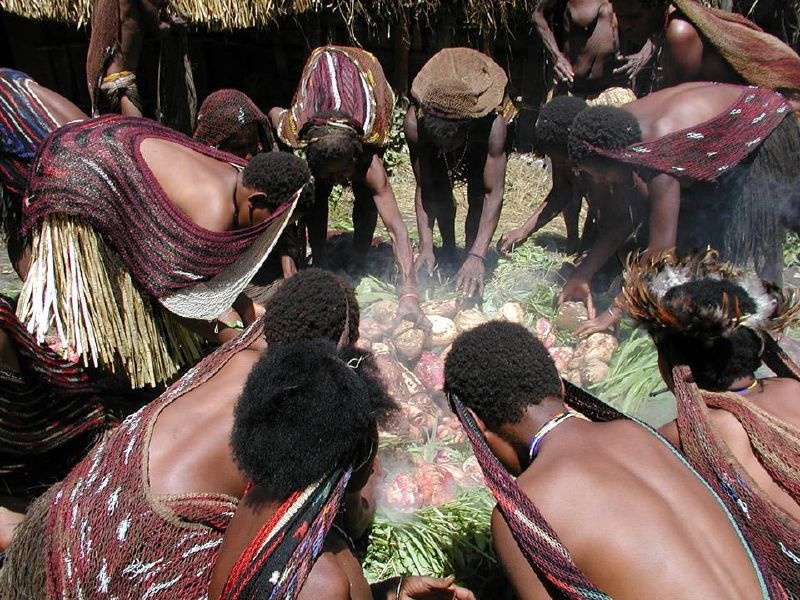
Food has traditionally been prepared in an earth oven called bakar batu (barapen) or cooked underneath rocks in "pots" fashioned from folded grass. For feasts and big meals, stones are heated in a fire, arranged in a pit, and layered with banana leaves, pork, and crops such as sweet potatoes, bananas, and cassava. Additional hot stones are placed on top, and the pit is sealed to trap steam. After several hours of slow cooking, the meal is ready. Because pigs hold great economic and symbolic value, they are reserved for important events.
Women and uninitiated boys are forbidden from eating a wild variety a fast-growing sugar cane which is believed to have magical powers. Salt is collected from saltwater wells by using dried banana skins to absorb the salt from the water and burning them and using the ashes as salt.
Dani Clothes
Dani men go around naked except for a koteka (penis gourd), and occasionally some bird of paradise feathers, cowry shells or pig tusks or a hair net as a an ornament. The penis gourds are kept erect with thread that is attached to the top and looped around the waist. Jale men wear long penis sheaths and rattan skirts that look like a bunch of skinny hula hoops piled on top of one another. In the 1970s, the Indonesian government tried to eradicate the penis gourds but the effort was largely a failure. [Source: Karl Heider, “Encyclopedia of World Cultures, Oceania”edited by Terence Hays, (G.K. Hall & Company, 1996)]
Unmarried women have traditionally worn grass skirts while married women wore a skirt made of fiber coils or seeds strung together and hung below the abdomen to cover the buttocks. Older Dani women often go topless. Younger women began to cover their breasts several decades ago. Women of all ages are often seen carrying bark string backpacks with their heads in which they carry children, piglets, sweet potatoes or other items.
To keep themselves warm on cold nights, Dani have traditionally rubbed pig fat on their bodies instead of wearing clothes. In an efforts to get the Dani to cover their naked bodies aid workers for the Indonesian government air-dropped dresses and trousers.
The Dani have no real art other than their clothes and body adornments made with fruits, feathers and shells. Story telling and making arrow points are admired skills. Dani crafts include “kapak” (stone blade axes), with the best ones made from blue stone; “sekan” (intricately-woven rattan bracelets; “milak” (arm and head bands); “mikak” (necklaces made from cowry shells, feathers and bone); “jaga” and “thal” (grass skirts); “suale” (head decorations often made with pig tusks); and “noken” (bark string bags). The latter are colored with vegetable dyes and made from the inner bark of certain kinds of trees and shrubs.
Dani Agriculture and Economic Activity
Sweet potatoes are raised in ditched fields with the preparation of the fields done by men with fire-hardened digging sticks and the planting, weeding and harvesting done by women. Ditches are used to divert water to the fields and get rid of excess water during heavy rains. There is no regular season and the sweet potatoes can be harvested throughout the year. Fields are periodically left fallow. Other crops include taro, yams, sugar cane, bananas, edible grass, ginger and tobacco. Pandanus and fruits and other items are gathered from the forest. The area where the Dani live is densely populated and there are few opportunities for hunting. The Dani generally don’t fish but sometimes eat crayfish they collect from streams. [Source: Karl Heider, “Encyclopedia of World Cultures, Oceania” edited by Terence Hays, (G.K. Hall & Company, 1996)]
Traditional trade items among the Dani include various kinds of seashells, bird of paradise feathers, cassowary feathers, wood for spears and stones for axes. These items have often been exchanged for pigs and salt produced from local brine pools. Even though the population density is high, land has traditionally not been highly valued because sweet potatoes can be grown pretty much anywhere and not a great deal of time and energy is put into preparing the land.
Some Dani are trying to enter the market economy by growing and selling rice and leading treks into the highland forests. In the Baliem Valley, Indonesian immigrants hold most of the good government positions and own most of the private businesses. Most Dani labor at menial jobs or stick to subsistence farming. Some Dani make a relatively good living by posing in penis gourds and grass skirts for tourist photos (for about 10 cents a photo in the 1980s), showing visitors their revered mummies and performing mock battles in front of tourist groups.
Image Sources: Wikimedia Commons
Text Sources: Peter Van Arsdale and Kathleen Van Arsdale, “Encyclopedia of World Cultures, Volume 2: Oceania,” edited by Terence E. Hays, 1996; A. J. Abalahin, “Worldmark Encyclopedia of Cultures and Daily Life,” Cengage Learning, 2009; Metropolitan Museum of Art; National Geographic,, New York Times, Washington Post, Los Angeles Times, Times of London, Lonely Planet Guides, Library of Congress, The Guardian, Smithsonian magazine, The New Yorker, Time, Reuters, Associated Press, AFP, Encyclopedia.com, Wikipedia, BBC, CNN, and various books, websites and other publications.
Last updated November 2025