
RED FOX

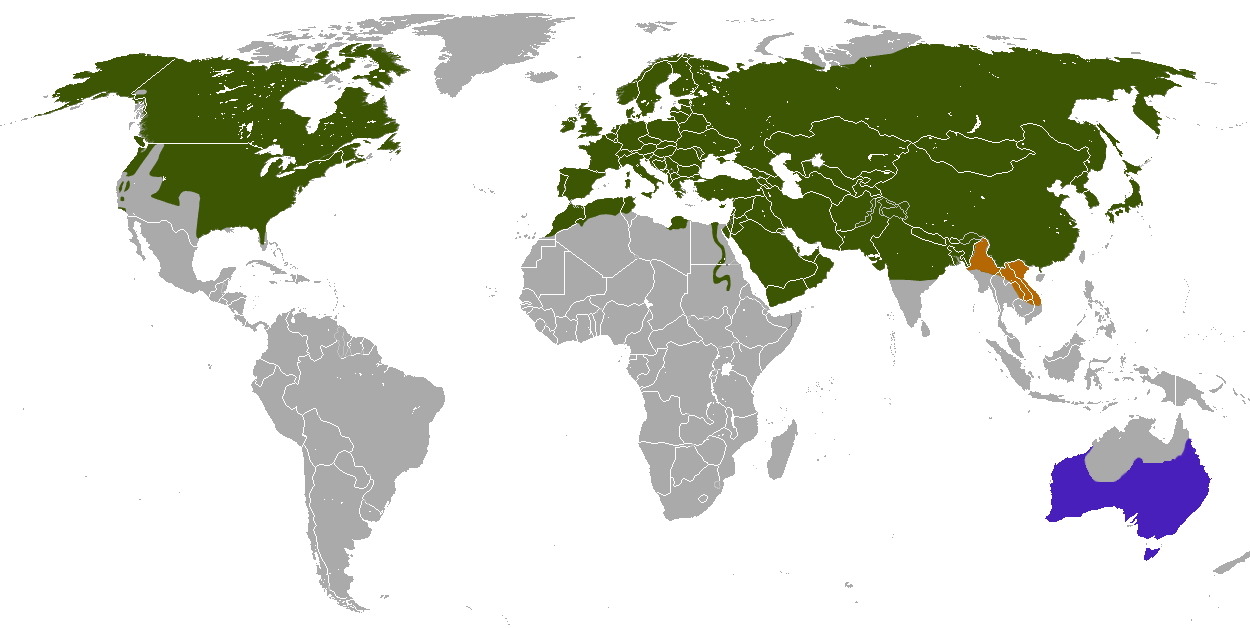
Red foxes (Vulpes vulpes) are the most common and widely distributed fox and one of the most common and widely distributed animals period. "The red fox has an extraordinary geographical range," Oxford biologist David Macdonald wrote in Smithsonian magazine, "spanning most of the Northern Hemisphere and embracing habitats ranging from desert to ice floe.” They range farther and have a terrestrial distribution that exceeds all mammal except humans and perhaps gray wolves. A male fox is called a reynard or dog. A female is called a vixen. Young are called kits, cubs or pups. A group is sometimes called a skulk [Source: David MacDonald, Smithsonian, William Stevens, New York Times, May 5, 1998]
Red foxes live 10 to 12 years in captivity but on average live only three years in the wild. Due to the vast area and niches they occupy, it has been suggested that there may be more genetic diversity within the species than has so far been described and perhaps a new species is lurking in some isolated place. The 3rd edition of Mammal Species of the World lists 45 subspecies of red fox. In 2010, a distinct 46th subspecies, the Sacramento Valley red fox (Vulpes vulpes patwin), which inhabits the grasslands of the Sacramento Valley, was identified through mitochondrial haplotype studies. Castello recognized 30 subspecies of the Old World red fox and nine subspecies of the North American red fox as valid. [Source: Wikipedia, David L. Fox, Animal Diversity Web (ADW) |=|]
Red foxes are found throughout much of the northern hemisphere in both Eurasia and North America, from the Arctic circle in the north to Central America, the steppes of central Asia, and northern Africa in the south. Red foxes have also been introduced to Australia and the Falkland Islands. They make their home in a wide range of habitats including boreal forests (taiga), temperate forests, tundra, deserts, dune areas, prairie, steppe, savanna, grasslands, chaparral forests, scrub forests, mountains, farms, urban and suburban areas and riparian habitats near water. They prefer mixed vegetation communities, such as edge habitats and mixed scrub and woodland. They are found at elevations from sea level to 4500 meters (14,764 feet).
Red foxes are not endangered. They are quite common in some areas and even found in cities like London. On the International Union for Conservation of Nature (IUCN) Red List they are classifies as species of “Least Concern” even though they have been widely hunted, trapped and poisoned. Three subspecies are listed in CITES (Convention on International Trade in Endangered Species of Wild) they are in Appendix III. Overall, red fox populations are stable and they have expanded their range in response to human changes in habitats. Red foxes have been raised on farms for their fur. They have been introduced to some places to control populations of rodents such rabbits but are also viewed as pest themselves, killing lambs, chickens and pets and possibly transmitting rabies and other disease to humans and other animals. |=|
RELATED ARTICLES:
FOXES: HISTORY, CHARACTERISTICS, BEHAVIOR, REPRODUCTION factsanddetails.com
CANIDS, CANINES AND CANIS: CHARACTERISTICS, BEHAVIOR AND REPRODUCTION factsanddetails.com
FOXES AND HUMANS: FOLKLORE, ATTACKS, PETS factsanddetails.com
ARCTIC FOXES: CHARACTERISTICS, COLD, BEHAVIOR AND REPRODUCTION factsanddetails.com
FOXES OF CENTRAL ASIA: CHARACTERISTICS, BEHAVIOR, SPECIES factsanddetails.com
BENGAL FOXES: CHARACTERISTICIS, BEHAVIOR, HUMANS factsanddetails.com
FOXES OF THE MIDDLE EAST AND NORTH AFRICA: CHARACTERISTICS, BEHAVIOR, SPECIES africame.factsanddetails.com
FENNEC FOXES: CHARACTERISTICS, BEHAVIOR, BIG EARS, REPRODUCTION africame.factsanddetails.com
DHOLES: CHARACTERISTICS, BEHAVIOR, HUNTING factsanddetails.com
GOLDEN JACKALS: CHARACTERISTICS, BEHAVIOR, ATTACKS africame.factsanddetails.com
DOGS: CHARACTERISTICS, BEHAVIOR AND INTELLIGENCE europe.factsanddetails.com
DOMESTICATION OF DOGS: THEORIES, EVIDENCE, WHY AND HOW europe.factsanddetails.com
WHEN AND WHERE DOGS WERE FIRST DOMESTICATED europe.factsanddetails.com
WOLVES: CHARACTERISTICS, HISTORY, SPECIES, NUMBERS factsanddetails.com
Red Fox Characteristics
Red foxes are the largest of the Vulpes (“true fox”) species. They range in weight from three to 14 kilograms (6.6 to 30.8 pounds) and have a head and body length that ranges from 45 to 90 centimeters (17.9 to 35.4 inches). Their tail is 30 to 55.5 centimeters (1 to 1.8 feet) long. Their average basal metabolic rate is 13.731 watts. Populations in southern deserts and in North America are smaller than European populations. Sexual Dimorphism (differences between males and females) is present: Males are larger than females. [Source: David L. Fox, Animal Diversity Web (ADW) |=|]
Red foxes generally have a rusty, red colored coat, a bushy, white-tipped tail, black-tipped ears and legs and snowy white chest. But coloration can range from pale yellowish red to deep reddish brown on the upper parts and white, ashy or grayish on the underside. Two color variants are common. Cross foxes have reddish brown fur with a black stripe down the back and another across the shoulders. Silver foxes range from strong silver to nearly black and are the most prized by furriers. Cross foxes make up about 25 percent of all red foxes and silver foxes make up 10 percent.
Like many other canid species, red foxes have tail glands. In red foxes they are located 7.5 centimeters (3 inches) above the root of the tail on its upper surface and sit inside the skin. The eyes of mature red foxes are yellow. The nose is dark brown or black. The dental formula is 3/3 1/1 4/4 2/3. The tooth row is more than half the length of the skull. The premolars are simple and pointed, with the exception of upper fourth premolars, the carnassials. Molar structure emphasizes crushing. The front paws have five claws each and the the rear paws four claws each. The first digit, or dew claw, is rudimentary but clawed. It does not contact the ground. |=|
Red Fox Food and Eating Behavior
Red foxes are essentially omnivores (eat a variety of things, including plants and animals). They mostly eat small rodents, rabbits, hares, insects, and fruit. They will also eat carrion, birds, eggs, reptiles and non-insect arthropods. Red foxes store food and are very good at relocating these caches. [Source: David L. Fox, Animal Diversity Web (ADW) |=|]

Red foxes have a characteristic way of hunting mice. They stand motionless, listening and watching intently for a mouse they have detected. When the mouse reveals itself the fox leaps high in the air and brings its forelimbs straight down, pinning the mouse to the ground. They eat between 0.5 and one kilogram of food each day.
In may places hares make up a large part of a red fox’s diet. According to one study in Hampshire, England, hares can make up to 30 percent of a fox's diet in the summer, and 16 percent in the winter. For the most part, foxes feed on young hares. A Polish study found that the foxes consumed six adult hares and 35 young.
Research in the former Soviet Union indicated red foxes consumes over 300 animal species and a few dozen plant species. They fed primarily small rodents like voles, mice, ground squirrels, hamsters, gerbils, woodchucks, pocket gophers and deer mice. Secondary prey species included birds such as waterfowl, rabbits, raccoon dogs, reptiles, insects, other invertebrates, flotsam and carrion. On very rare occasions, they attacked young or small ungulates. In some areas, fruit can amount to 100 percent of their diet in autumn. Commonly consumed fruits include blueberry, blackberry, raspberry, cherry, persimmon, mulberry, apple, plum, grape and acorn. Other plant material includes grass, sedge and tuber. [Source: Wikipedia]
Red foxes help to control populations of their prey animals, such as rodents and rabbits. They also may disperse seeds by eating fruit. Known predators of red foxes include eagles, gray wolves, bears, coyotes, mountain lions and humans. Most red foxes that are taken by natural predators are taken when they are young pups. Pups are kept in and near a den for protection. When adult red foxes are attacked by coyotes, wolves they are rarely done so in order to eat them.
Red Fox Behavior
Red foxes are terricolous (live on the ground), nocturnal (active at night), crepuscular (active at dawn and dusk), motile (move around as opposed to being stationary), sedentary (remain in the same area), solitary, territorial (defend an area within the home range) and social (associates with others of its species; forms social groups). The size of their range territory is five to 50 square kilometers depending on the quality of the habitat and the food supplu. Where the habitat is good ranges vary between five and 12 square kilometers. In poorer quality habitats ranges are larger, between 20 and 50 square kilometers. [Source: David L. Fox, Animal Diversity Web (ADW) |=|]
Red foxes are generally solitary animals and do not form packs like wolves. During some parts of the year adjacent ranges may overlap somewhat, but they can also be regularly defended, suggesting territoriality. Ranges are often occupied by an adult male and one or two adult females with their associated young.
Individuals and family groups have main dens and other emergency burrows in their home range. Dens of other animals, such as rabbits or marmots, are often taken over by foxes. Larger dens may be dug and used during the winter and during birth and rearing of the young. The same den is often used over a number of generations. Pathways throughout the home range connect the main den with other resting sites, favored hunting grounds and food storage areas.
Red foxes have a top speed of about 48 kilometers per hour and can leap over obstacles as high as two meters. In the autumn following birth, pups of the litter disperse to their own territories. Dispersal can be to areas as nearby as 10 kilometers and as far away as almost 400 kilometers. Animals remain in the same home range for life. |=|
Red Fox Senses and Communication
Red foxes sense and communicate with vision, touch, sound and chemicals usually detected by smelling. They also leave scent marks produced by special glands and placed so others can smell and taste them. Red foxes have excellent senses of vision, smell, and touch. They have binocular vision, but their sight reacts mainly to movement. Their auditory perception is acute, being able to hear the flight of crows at a quarter to half a kilometer (0.16–0.31 miles) and the squeaking of mice at about 100 meters (330 feet). They are capable of locating sounds to within one degree at 700–3,000 Hz, though less accurately at higher frequencies. Their sense of smell is good, but weaker than that of specialised dogs. [Source: Wikipedia +]
Red foxes use a variety of vocalizations to communicate among themselves. They also use facial expressions and scent marking extensively. Scent marking is through urine, feces, anal sac secretions, the supracaudal gland, and glands around the lips, jaw, and the pads of the feet. There have been 28 different kinds of vocalizations described in red foxes and individuals have voices that can be distinguished. Vocalizations are used to communicate with foxes that are both nearby and very far away. [Source: David L. Fox, Animal Diversity Web (ADW) |=|]
Red foxes have a wide vocal range, and produce different sounds spanning five octaves, which grade into each other. Recent analyses identify 12 different sounds produced by adults and 8 by kits. The majority of sounds can be divided into "contact" and "interaction" calls. The former vary according to the distance between individuals, while the latter vary according to the level of aggression. +
The most commonly heard contact call is a three to five syllable barking "wow wow wow" sound, which is often made by two foxes approaching one another. This call is most frequently heard from December to February. When greeting one another, red foxes emit high pitched whines, particularly submissive animals. A submissive fox approached by a dominant animal will emit a ululating siren-like shriek. During aggressive encounters with their own kind, they emit a throaty rattling sound, similar to a ratchet, called "gekkering". Gekkering occurs mostly during the courting season from rival males or vixens rejecting advances. +
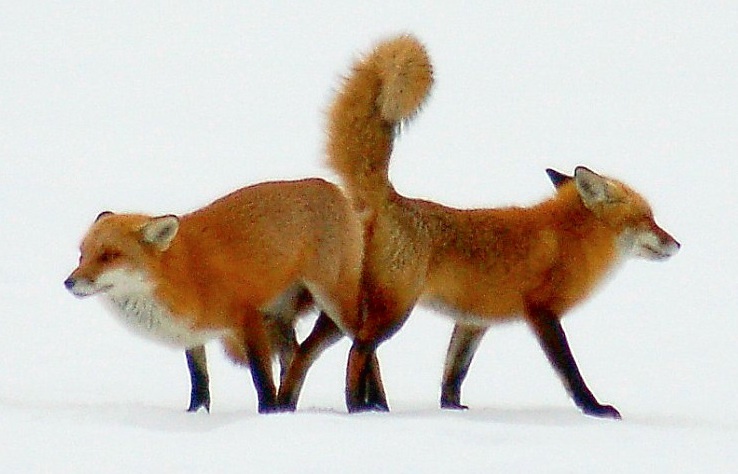
Red fox body language consists of movements of the ears, tail and postures, with their body markings emphasising certain gestures. Postures can be divided into aggressive-dominant and fearful-submissive categories. Inquisitive foxes rotate and flick their ears whilst sniffing. Playful individuals perk their ears and rise on their hind legs. Male foxes courting females, or after successfully evicting intruders, turn their ears outwardly, and raise their tails in a horizontal position, with the tips raised upward. When afraid, red foxes grin in submission, arching their backs, curving their bodies, crouching their legs and lashing their tails back and forth with their ears pointing backwards and pressed against their skulls. +
Red Fox Mating and Reproduction
Red fox are monogamous (have one mate at a time) and polygynous (males have more than one female as a mate at one time). They are also cooperative breeders (helpers provide assistance in raising young that are not their own). Red foxes engage in seasonal breeding. They breed once a year. Breeding season varies from region to region but usually begins in December or January in the south, January to February in the central regions, and February to April in the north. The gestation period ranges from 49 to 55 days, typically 51 to 53 days. The number of offspring ranges from one to 13, with the average number of offspring being five. [Source: David L. Fox, Animal Diversity Web (ADW) |=|]
Red fox mating behavior varies quite a bit. Often males and females are monogamous, but males and females with multiple maters are not unknown. Male-female pairs often have non-breeding female helpers that assist them in raising their young. Females mated to the same male fox may share a den. Red fox groups always have only one breeding male, but that male may also seek mating outside of the group. |=|
The annual estrus period of female red foxes last from one to six days. Ovulation is spontaneous and does not require copulation to occur. Males sometimes fight during the breeding season. Males have a cycle of fertility, with peak sperm production from November to March. Females may mate with a number of males but establish a partnership with only one male. Copulation usually lasts 15 or 20 minutes and is often accompanied by a lot of vocalizations. Implantation of the fertilized egg occurs between 10 and 14 days after a successful mating.
Sometimes it looks like foxes mate rear to rear or they get stuck in that position after mating. Usually mating begins in the usually doggie-style position. But then the male and female may align in a rear-to-rear position. This is a normal part of the mating process for foxes, and is often referred to as a "copulatory tie". After the initial pelvic thrusting, the male lifts his leg over the female's back, and they will remain locked together in various standing and lying positions for a period of time (usually around 30 minutes).
Red Fox Offspring and Parenting
Red fox kits (young) are altricial, meaning they are relatively underdeveloped at birth. Males take part in the rearing of offspring. During the pre-weaning stage and pre-independence stages of young provisioning and protecting are done by males and females. There is an extended period of juvenile learning. The post-independence period is characterized by the association of offspring with their parents. [Source: Wikipedia, David L. Fox, Animal Diversity Web (ADW) |=|]
Just before and for a time after giving birth the female remains in or around the den. The male partner provisions his mate with food but does not go into the maternity den. Birth weight is between 50 and 150 grams. The pups are born blind but open their eyes nine to 14 days after birth. Pups leave the den four or five weeks after birth and are fully weaned by eight to 10 weeks. Mother and pups remain together until the autumn after the birth. On average males and females reach sexual or reproductive maturity at 10 months. The young remain with their parents at least until the fall of the year they were born in and will sometimes remain longer, especially females. |=|
Red fox males and females, and sometimes their older offspring, cooperate to care for the pups. Young remain in the den for four to five weeks, where they are cared for and nursed by their mother. Solid food is provided by their parents and older siblings. Mothers remain with the kits for two to three weeks, as they are unable to thermoregulate. During this period, the fathers or barren vixens feed the mothers. Vixens are very protective of their kits, and have been known to even fight off terriers in their defence. If the mother dies before the kits are independent, the father takes over as their provider.
Around the time the kits' eyes open their ear canals open and their upper teeth erupt, with the lower teeth emerging 3–4 days later. Their eyes are initially blue, but change to amber at four to five weeks. Coat colour begins to change at three weeks of age, when the black eye streak appears. By one month, red and white patches are apparent on their faces. During this time, their ears erect and their muzzles elongate. Their woolly coats begin to be coated by shiny guard hairs after 8 weeks. By the age of three to four months, the kits are long-legged, narrow-chested and sinewy. They reach adult proportions at the age of 6–7 months. [Source: Wikipedia]
Foxes in Japan
Foxes in Japan are omnivorous. They eat nuts, fruits, insects, honey, leaves, acorns, other items from the forest and meat. Japanese Foxes are regarded as a subspecies.Kevin Short wrote in the Daily Yomiuri: The Japanese red fox, usually just called kitsune, feeds on all sorts of small to medium-size animal prey, including insects, crabs, frogs, birds and mice and other rodents. One of their favorite prey is the Japanese hare. Both these animals are speed demons, but the fox is just a wee bit faster. Foxes also eat a variety of fruits and berries, and will raid crops, and scavenge animal carcasses and even human garbage. [Source: Kevin Short, Daily Yomiuri, May 10, 2012]
“Foxes breed in underground dens, which they dig themselves. Litters usually consist of three to five pups, which stay with their mother, learning the tricks of survival, until their first autumn. Most of the pups then set out on their own, but some females may remain behind to help their mother raise a new set of pups the following spring.
“Zoologists recognize several dozen subspecies of red fox, two of which are found here in Japan. The Ezo red fox, or kita-kitsune (V.v. schrencki) lives on Hokkaido, and the Japanese red fox, or hondo-gitsune (V.v. japonica) on Honshu, Kyushu and Shikoku. The red fox (Red foxes) are one of the world's most widespread and successful carnivores. Their range includes almost all of the Eurasian and North American continents, and they live in habitats that vary from arctic tundra to full desert. The secret of their success is adaptability. They are intelligent, curious, and quick to take advantage of new feeding opportunities, especially in agricultural and even suburban landscapes.
Urban Foxes in the U.K and London
Britain's urban foxes have been described as being bold and brazen around humans, compared with their countryside cousins. They sometimes and stare at passers-by on the streets and even approach people with food. It is possible that human behavior in towns and cities has altered the behavior of individual foxes: if a fox grows accustomed to being fed by hand by one person, it may be more likely to approach another. However, this does not qualify them as tame. [Source: Lucy Jones, BBC, September 13, 2016]
Christopher Werth wrote in the Los Angeles Times: London is full of red foxes. The species began encroaching on British cities in the 1930s. Or rather, the city encroached on the foxes. In the years between the two World Wars, Britain’s suburbs pushed deep into the fox’s natural habitat in the English countryside, and in response, many foxes headed for the inner city. In the mid 2010s, Britain was home to about 33,000 urban foxes, according to the Mammal Research Unit at the University of Bristol. That’s about 14 percent of the country’s entire fox population, but it’s difficult to pin down just how many of those live in London. A number often bandied about in the British press puts the city’s fox population at about 10,000. However, Stephen Harris, an expert on urban foxes at Bristol, calls that number “complete rubbish.” [Source: Christopher Werth, Los Angeles Times, November 21, 2014]
He says no reliable figure has ever been calculated, although he once estimated the number at 5,000 to 6,000 for London’s boroughs. “That was years ago, so I wouldn’t quote that,” Harris said. That rough figure would make foxes about as common in London as pubs, which you’ll find on nearly every other corner. Come March, the fox population grows as birthing season hits. “Every pair will have four or five cubs,” Harris said. “So the population will suddenly triple and then, by the end of the next year, the population will be back at 33,000 or thereabouts.” That is to say, urban foxes live short, sometimes brutal lives. Harris said their average life span is a mere 18 months, even though foxes in general can potentially live as long as six to 10 years. Often, they are killed by dogs, die of disease or are hit by cars.
The trade-off, I suppose, is that urban foxes may lead far more exciting lives than their rural counterparts, partly because they’re less afraid of people. A fox was once spotted riding an escalator out of London’s Underground subway system. And in 2011, one was discovered roaming the top of the Shard, London’s tallest skyscraper, while it was under construction. A local pest control manager who helped rescue the animal was quoted in Britain’s Sun newspaper as saying, “The fox would have had to climb 71 sets of stairs and an old-fashioned ladder.”
Harris believes most Britons look favorably on foxes. After all, there have been TV shows here dedicated to watching foxes via hidden camera. But there has also been growing concern over whether the urban fox populations have grown too large and whether the animals have become too brazen. Foxes are regularly blamed for killing pets, including small dogs; sullying people’s gardens; even chewing through brake lines on parked cars.
Other charges are even more serious. In 2013, a 4-week-old baby was badly injured when he was dragged from his bed by a fox that had wandered into a home in South London. And in 2010, a fox reportedly attacked 9-month-old twin girls as they lay in their cribs in another London neighborhood. The debate over urban foxes is so contentious that the twins’ parents were accused of lying and received threats online, prompting police to provide protection to the couple. “Yes, occasionally they go into people’s houses. Occasionally they will bite someone,” said Harris, who explained that foxes sometimes bite something to help them identify whatever it is they’ve stumbled upon, be it a bone from the garbage or a small child’s hand. “The risk is very low, but when it happens, the hunting lobby like to jump all over it.
Two-Legged Fox Caught in Amazing Video
In December 2022, a British couple that live near Nottingham filmed a two-legged fox moving about “bolt upright like a human” in their yard. Catherine Lough wrote in The Telegraph: Phil and Jane Carter, who live in Ilkeston, said they spotted the fox and filmed it before it dashed off “like a rocket”. “It was fascinating," Mr Carter, 71, said. “It ran like a human being on two legs. It just had two little fairy stumps at the back..It was 3pm in the afternoon and I thought it could have been a trick of the light but no, there it was, bright as day walking about on just two legs.” [Source: Catherine Lough, The Telegraph, January 5, 2023]
Having spoken to experts from Derbyshire Nature Reserve, he said it was likely that the fox had been born with the disability. “The experts believe it was most likely born that way, because if it had been run over by a car or hit by a combine harvester then the whole of its back would have been damaged, which doesn't appear to be the case,” he added.
A spokeswoman for the charity the Fox Project said that the creature appeared to have adapted very well to its disability. “The way that the legs look, it looks more like it’s been a disability from birth and that's probably how it’s adapted to be on two legs — its overall condition for two legs looks quite good,” she said. “Potentially people around there would have supported it from birth,” she added.
Image Sources: Wikimedia Commons
Text Sources: Animal Diversity Web animaldiversity.org ; National Geographic, Live Science, Natural History magazine, CNTO (China National Tourism Administration) David Attenborough books, New York Times, Washington Post, Los Angeles Times, Smithsonian magazine, Discover magazine, The New Yorker, Time, BBC, CNN, Reuters, Associated Press, AFP, Lonely Planet Guides, Wikipedia, The Guardian, Top Secret Animal Attack Files website and various books and other publications.
Last updated May 2025