
FOXES
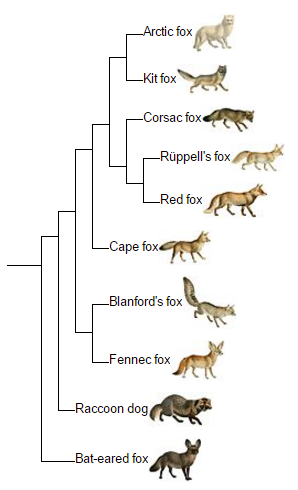
on theory on the phylogeny of fox-like canids
Foxes are canids like dogs, wolves and jackals. They are the most widely distributed meat-eating mammal on earth. They thrive in some of the world’s most inhospitable and remote areas, including the Arctic, as well in suburban neighborhoods. A male fox is called a reynard or dog. A female is called a vixen. Young are called kits, cubs or pups. A group is called a skulk.
Twelve species belong to the monophyletic "true fox" group — the genus Vulpes. Some species have a "foxy" odor arising mainly from a gland located on the dorsal surface of the tail, not far from the base. Another two dozen or so current or extinct species are sometimes called foxes — they are part of the paraphyletic group (that includes a common ancestor and some of its descendants, but not all descendants) of the South American foxes or an outlying group, which consists of the bat-eared fox, gray fox, and island fox.
Canids commonly known as foxes include the following genera and species:
Genus Vulpes (True foxes) contains: 1) Arctic fox, 2) Bengal fox, 3) Blanford's fox, 4) Cape fox, 5) Corsac fox, 6) Fennec fox, 7) Kit fox, 8) Pale fox, 9) Rüppell's fox, 10) Red fox, 11) Swift fox, 12) Tibetan sand fox
Genus Lycalopex contains the species: 1) Culpeo or Andean fox, 2) Darwin's fox. 3) South American gray fox. 4) Pampas fox. 5) Sechuran fox, 6) Hoary fox. They are found mainly in Sourh America.
Genus Urocyon contains the species: 1) Gray fox, 2) Island fox and 3) Cozumel fox (undescribed)
Crab-eating foxes (only member of the genus Cerdocyon) are a South American species
Bat-eared foxes (only member of the genus Otocyon) live in Africa
Ethiopian wolves (in the genera Canis along with other woves) are sometimes called Simien foxes or Simien jackal. They are native to the Ethiopian highlands.
“Vulpes” means fox in Latin. Foxes are distinguished from other canids by their small size, flattened skulls with pointed snouts, and a large bushy tail. Foxes in the wild have a lifespan of only two to four years. In captivity they live on average 10 to 12 years depending on the species. The oldest fox recorded in captive history lived to be 21.3 years old. Researchers have difficulty studying foxes. Their eating habits are determined by examining their dropping and their territorial habits are observed with the help of radio collars. Foxes are observed at night with light-amplifying and infra-red binoculars invented for military purposes. [Source: Tru Hubbard, Animal Diversity Web (ADW) |=|]
Dr. J David Henry, a Canadian Government ecologist based in Yukon,
RELATED ARTICLES:
CANIDS, CANINES AND CANIS: CHARACTERISTICS, BEHAVIOR AND REPRODUCTION factsanddetails.com
FOXES AND HUMANS: FOLKLORE, ATTACKS, PETS factsanddetails.com
RED FOX: CHARACTERISTICS, BEHAVIOR AND REPRODUCTION factsanddetails.com
ARCTIC FOXES: CHARACTERISTICS, COLD, BEHAVIOR AND REPRODUCTION factsanddetails.com
FOXES OF CENTRAL ASIA: CHARACTERISTICS, BEHAVIOR, SPECIES factsanddetails.com
BENGAL FOXES: CHARACTERISTICIS, BEHAVIOR, HUMANS factsanddetails.com
FOXES OF THE MIDDLE EAST AND NORTH AFRICA: CHARACTERISTICS, BEHAVIOR, SPECIES africame.factsanddetails.com
FENNEC FOXES: CHARACTERISTICS, BEHAVIOR, BIG EARS, REPRODUCTION africame.factsanddetails.com
DHOLES: CHARACTERISTICS, BEHAVIOR, HUNTING factsanddetails.com
GOLDEN JACKALS: CHARACTERISTICS, BEHAVIOR, ATTACKS africame.factsanddetails.com
DOGS: CHARACTERISTICS, BEHAVIOR AND INTELLIGENCE europe.factsanddetails.com
DOMESTICATION OF DOGS: THEORIES, EVIDENCE, WHY AND HOW europe.factsanddetails.com
WHEN AND WHERE DOGS WERE FIRST DOMESTICATED europe.factsanddetails.com
WOLVES: CHARACTERISTICS, HISTORY, SPECIES, NUMBERS factsanddetails.com
Fox History and Taxonomy
Scientists currently believe that modern mammalian carnivores evolved from a small tree-living mammal called a miacid (Miacidae). During the Middle Eocene Period (47.8 million to 38 million years ago) carnivores split into suborders that included Caniformia (dogs) and Feliformia, (cats). Caniforms diverged into three lineages or subfamilies: the Hesperocyoninae (western dogs), the Borophaginae (bone-crushing dogs), and Canidae (which includes dogs, wolves, coyotes and foxes), the only extant group. [Source: Tru Hubbard, Animal Diversity Web (ADW) |=|]
The canid group branched out on its own around 10 million years ago, most likely as a result of an open niche from past groups of canines dying out. Ultimately this was the rise of the three modern groups which can be further broken down: Canini (dogs and wolves), Urocyon (gray foxes and island foxes) and Vulpini (“true foxes”). This period marked the divergence of true foxes from the wolf-dog lineage.
The Urocyon genus has been present in North America since the Hemphillian land mammal age (Pliocene Period (5.4 million to 2.4 million years ago). Contemporary Urocyon are the only extant canid with a natural range through North and South America. It has been suggested that Urocyon should be included as a subgenus of Vulpes. However, genetic analyses of the fox-like canids confirmed that Urocyon is a distinct genus from Vulpes. Genetically, Urocyon often clusters with two other ancient lineages: the east Asian raccoon dog (Nyctereutes procyonoides) and the African bat-eared fox (Otocyon megalotis). [Source: Karen Yang, Animal Diversity Web (ADW) |=|]
Fox Habitat and Range
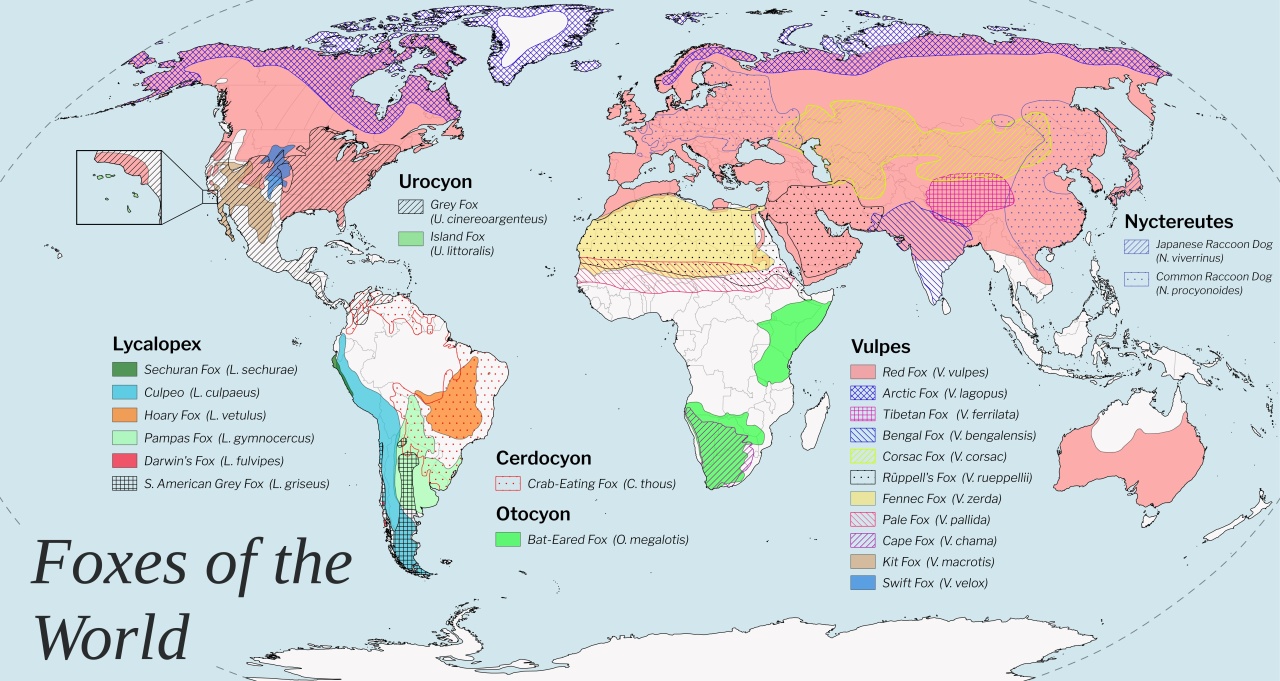
Vulpes — true foxes — are found throughout much of the northern hemisphere, in North America, Europe, and Asia. Several introductions of red foxes have resulted in non-native populations in Australia, and New Zealand . Some fox species have smaller ranges with more extreme climates such as in the northern tundra and Arctic regions. Others make homes for themselves in particular niches. [Source: Tru Hubbard, Animal Diversity Web (ADW) |=|]
True Foxes generally live in temperate and colder regions. Among the habitats they occupy are tundra, desert, dune areas, savannas, grasslands, forest., steppe, scrub forests, mountains, icecaps and urban, suburban and agricultural area. About the only places they are not found are wet, tropical regions.
Fennec fox (Vulpes zerda) can be found in the Sahara — one of the world’s hottest and driest places. Arctic foxes (Vulpes lagopus) live in some of the coldest places and environments that consist of ice and little else. Red foxes (Vulpes vulpes) occupy about half the globe. Other species can be found in some of the world’s highest mountains. Foxes are opportunistic and can thrive almost anywhere can find food and shelter. Foxes are common in suburban and urban areas and are skilled at taking advantage of human food sources.
Canids and Canines (Foxes, Jackals, Wolves, Coyotes, Dogs)

Foxes are canids. Canidae is a biological family of caniform carnivorans ("dog-like" carnivores). It constitutes a clade (group of organisms composed of a common ancestor and all of its descendants) Members of this family are called canids. The family includes three subfamilies: Caninae, and extinct Borophaginae and Hesperocyoninae. Caninae are known as canines,and include domestic dogs, wolves, coyotes, raccoon dogs, foxes, jackals and other species. [Source: Wikipedia]
The Canidae family is comprised of 13 genera and 37 species. Canids are widely distributed around the globe. They occur on all continents except Antarctica and are only member of the Order Carnivora that found in Australia (we’re talking about dingoes, introduced by humans during prehistoric times). Canidae fossils have been dated to the to the Oligocene Period (33 million to 23.9 million years ago) and Miocene Period (23 million to 5.3 million years ago), which makes them among the oldest extant groups of carnivores. Canids are probably an early offshoot of the caniform lineage (which includes mustelids (weasels),procyonids (raccoons and their relatives), ursids (bears), phocids and otariids (seals), and odobenids (walruses).[Source: Bridget Fahey and Phil Myers, Animal Diversity Web (ADW)]
Many species of canid are viewed as pests to humans, and populations of many species have been greatly reduced in some places. Coyotes and wolves have been blamed for killing sheep and cattle are have been killed by ranchers for this reason. Foxes, dingoes and jackals have been blamed for killing lambs and poultry are have been killed by farmers. Canids are also viewed as carriers of rabies (which they are but rarely). Some are hunted. Foxes in particular are valued for their pelts, which have been used in the fashion industry. Domestic dogs (C. lupus familiaris) have a long multi-dimensional relationship with humans.
Canid Characteristics and Behavior
Canids have deep-chested bodies and a long muzzle. Their legs and feet are moderately elongated. They move in a digitigrade fashion — on their toes, not touching the ground with their heels,. Usually, they five toes are found on the forefeet and four on the hindfeet. Their metapodials (long bones of the feet that connect the toes to the ankle bones) are long but not fused. Unlike the Felidae (cats), canids have non-retractile claws. This means that they are worn down by activity and are not used much as weapons as is the case with some other carnivores. All male canids have a well-developed baculum (penis bone). The skulls of canids have an elongated facial region. Canids have nearly a full set of teeth with the following dental formula: 3/3, 1/1, 4/4, 1-2/2-3 = 38-42. Canine teeth are large but unspecialized. Molars are of the crushing type. The carnassial pair (teeth used for shearing and cutting meat) are strongly built.
Canids are primarily medium-sized flesh eaters, but they more omnivorous (eat plants and animals) than many carnivores, consuming invertebrates, plant matter, and carrion as well as the prey they kill themselves. Canids are known more for endurance than for speed, although they be pretty fast. They typically catch prey by pursuit over long distances in relatively open terrain until the prey tires. Kills are made by grabbing for the nape of neck and tackling the prey to the ground. The neck grab is followed by a violent shake, which may dislocate the neck of the prey. Large prey may be immobilized by biting into the soft parts of the underbelly, often resulting in disembowelment and death from shock. [Source: Bridget Fahey and Phil Myers, Animal Diversity Web (ADW)]
Canid senses of smell and hearing are acute and important to these animals in hunting and socializing. Vision is less developed.Canids tend to very territorial. Territory marking occurs in many species through repeated urination on objects on the periphery and within territories. Other scent glands are also important in the social behavior of these species; these include anal glands and glands on the dorsal surface of the tail near the base.
Fox Characteristics
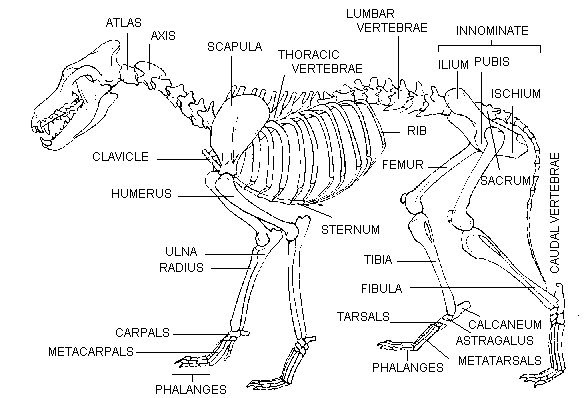
Foxes have a dog-like appearance, but on average are quite a bit smaller in size compared to most other canids. They have shorter legs with a slender body, a distinct flattened skull with a pointed snout known as a “fox face” and varying sizes of upright pointed ears. Like all canids, foxes have a muscular frame, strong jaws, and teeth for grasping prey. Blunt claws are primarily useful for gripping the ground when chasing down their meal. Sexual Dimorphism (differences between males and females) is present: Males are larger than females. [Source: Tru Hubbard, Animal Diversity Web (ADW) |=|]
Tru Hubbard wrote in Animal Diversity Web: Contributing to the foxes’ lengthy appearance is its long bushy tail that makes up about one third of its body length and in many species consists of a black tip or small accent at the end. The tail can also be used for the purpose of keeping warm by wrapping it around their bodies. Usually ranging in size from 92-107 centimeters in length and weighing around 4.5-5 kilograms, generally the males being larger.
Several traits vary to some extent depending on which species you are looking at and how they have adapted to survive in their habitat. For example, the Arctic fox (Vulpes lagopus) has a very dense, insulated coat to block out the harsh cold temperatures and small ears to prevent heat loss. On the other hand a species such as the fennec fox (Vulpes zerda) that lives in the desert has a very thin coat and large ears to help stay cool. A solid color coat is found in the majority of species, but there are instances where the coat color changes throughout the year to better camouflage against the current seasons landscape. |=|
Fox Diet and Eating Behavior
Foxes are in the order Carnivora but they are actually considered omnivores (eat a variety of things, including plants and animals). They eat nuts, fruits, insects, honey, leaves, acorns, other items from the forest as well as meat. Unlike wolves that wolf down one big meal. Foxes eat a lot of little meals. Foxes have been known to subsists on 95 percent fruit. In the suburbs, they frequently forage through garbage. Foxes have a relatively small stomach, which gives them increased mobility. They hide what they can't eat.
Foxes consume a wide range of food. including carrion, small rodents. berries, fruits and seeds. Some of the most commonly targeted prey are mice, voles, and hares. When they can foxes steal the eggs of birds, and turtles and, yes, raid the occasional chicken coup.
Earthworms come to the surface at certain times and when they do foxes gorge themselves silly. Earthworms can provide up to 60 percent of a fox's caloric intake. Describing how a fox collects and eats an earthworm, MacDonald wrote: "Skillfully, the fox avoids snapping its victim. It pauses, holding the worm taut before raising its muzzle in a slow but accelerating arc that eases the prey smoothly and intact from its hole. Then the fox deftly flips the animated spaghetti right down the chute."
Farmers don't like foxes because they feed on lambs and crops. In the late 1990s, in Hampstead Heath many people bought tiger and lion manure from the London Zoo with the belief that the smell of it would keep foxes from digging up their gardens.
Foxes on the Hunt and Prey
Foxes stalk birds like cats. Some of them jump up in the air in a distinctive way before dropping down on their prey. Describing the fox pounce, William Stevens wrote in the New York Times: ''the maneuver is similar to one displayed by cats...it crouches, leaps upward in an arcing motion, then comes down front paws first. In a longer version, the fox launches itself upward at a 45-degree angle and executes a leap." The purpose of the latter appears to surprise mice and rabbits without them detecting their presence on the ground.
The pouncing technique allows foxes to come down directly on their prey with force. Learned at an early age, it allows the fox to kill their prey quickly. This technique helps ensure the fight with prey is minimal, which save energy and reduces the chance of injury. Hunting is done for hunter unlsess he or she is raising young where both male and female will participate in providing food . In social groups foraging is shaped by competition with the dominant individuals taking advantage of the resources first. Foxes having such a broad diet is able to reduce the amount of competition seen in these groups. |=|
Foxes’ bushy tails provide balance which allows them to pounce on its prey with great accuracy. Gray foxes can reach speeds of 68 kilometers per hour (45 miles per hour) and leap over five meters (17 feet) in a single bound. Foxes tend to run in straight lines (perhaps one reason why they are favored by hunters on horseback).
Foxes have been seen with small deer in their mouths. Social groups may hunt cooperatively to surround prey. Individuals tend to cover an area over and over finding prey using their keen senses of smell and sound. If mice are plentiful a fox and is not starving it will eat the first few it encounters then bury the others and retrieve them later. Foxes usually eat the mice that they have buried for themselves.
Hares are a favorite prey. When a fox approaches a hare, the hare often stands on its hind legs and won't bolt unless the fox comes within ten or so meters. Naturalist Tony Holley believes that the hare doesn't stand on its hind legs to get a better view of the fox, which it knows is there, but rather to tell the fox that it has been observed and thus it doesn't have to waste energy trying sneak up on the hare. A hare can sprint at speeds up to 45 miles per hour, fast enough to outrun a fox. Most chases of adult hares by foxes are unsuccessful. The only way a fox can really catch an adult hare is sneak up on it from a downwind side and grab it before it escapes.
Foxes can be prey for coyotes, bears, and wolves. The largest threat comes from human hunting and trapping. Large birds of prey such as golden eagles take foxes. Foxes are the favored prey of the Kazakh golden eagle hunters of Mongolia.
Fox Behavior
Foxes are terricolous (live on the ground), diurnal (active during the daytime), nocturnal (active at night), motile (move around as opposed to being stationary), nomadic (move from place to place, generally within a well-defined range), migratory (make seasonal movements between regions, such as between breeding and wintering grounds), solitary social (associates with others of its species; forms social groups) and have dominance hierarchies (ranking systems or pecking orders among members of a long-term social group, where dominance status affects access to resources or mates). [Source: Tru Hubbard, Animal Diversity Web (ADW) |=|]
Field biologist have discovered that behavior-wise foxes are as much like cats as dogs. They stalk their prey and hunt alone likes cats (dogs like to hunt in packs), pounce on their prey and move like cats and have long whiskers like cats. Their long cat-like whiskers allow foxes to detect where to place the killing bite in their prey.
The majority of fox species are solitary or nomadic, spending most of their lives alone, except during breeding season when they have monogamous relationships with a mate. Some foxes live in small groups made up of one male fox, and four or five vixens and their cubs. A region might be populated by several groups that usually have their own territories, which are surprisingly small—around 100 acres. Fox groups defend their territories against strangers and neighbors. The foxes are able to live in such small territories because they feed primarily on insects and earthworms.
Foxes are primarily nocturnal animals that spend most of the day in their dens. Their dens are very difficult to find and the animals are known for their elusiveness. Foxes are more social than they are often given credit for. Often three vixens share responsibilities for rasing a group of five cubs. Foxes are territorial, usually staying within a certain area. Migratory movements may occur due to changing environments, primarily in the Arctic where sea ice conditions ate uncertain. Foxes characteristically stay in an area as long as food is available, but when resource abundance becomes depleted they are able to move short to very long distances to find new resources. As population density of fox species increases there is also an increase in the formation of social groups being established. These groups consist of one dominant pair and a few other subordinate adults that tend to be related .
Fox Senses and Communication
Foxes sense using vision, touch, sound and chemicals usually detected with smell. Foxes have excellent eyesight and night vision. Foxes communicate with sound and chemicals. They leave scent marks produced by special glands and placed so others can smell and taste them. Foxes communicate their identities using scent glands on their muzzle and tail. The tail itself is used as a signal to inform other foxes of their presence. [Source: Tru Hubbard, Animal Diversity Web (ADW) |=|]
Foxes don't howl but they make 40 different noises include a crow-like caw and a high-pitched bark. Mothers summon their young with "low, warbling calling" and the cubs respond with squeals and a throaty, stuttering noise called "gekkering." When foxes are lonely they "warble. Foxes play with each other in the same manner as dogs for session up to 30 minutes.
According to Animal Diversity Web: Unlike other canids foxes do not vocalize as a group. They use several different vocalizations to stay in contact with relatives because each individual has its own unique voice. A single voice is capable of spanning over a range of five octaves. The most well-known fox call is similar to a kind of bark that usually lasts for three to five syllables and resembles, “Wow-wow-wow”. This vocalization is used at all distances, is high pitched, and thought to be used as an identification system between individuals.
Another sound created by foxes is a basic alarm bark that consists of only one syllable. It is very sharp when heard at long distances, but is somewhat of a cough in close quarters. This is mainly used by parents to alarm pups of danger nearby. There is also a vocalization known as gekkering, which is a stuttering noise that resonates from the throat. This sound is mainly heard during mating season or during any aggressive interactions. Lastly there is the vixen’s wail or scream, a long, drawn-out, single note that is usually heard during breeding season. Thought originally to only be made by females in heat trying to call upon an available mate, it has also been observed being produced by males.
Fox Mating and Reproduction
Foxes are monogamous (have one mate at a time) and polygynous (males have more than one female as a mate at one time). They are also cooperative breeders (helpers provide assistance in raising young that are not their own). Foxes They engage in seasonal breeding — once a year. Foxes are often regarded as mostly monogamous. Sometimes they mate for life. Sometimes its only for the mating season and while raising young. Displays of affection between male and female include nipping, chasing and nuzzling their mate. Females carry their young for 52 days and give birth to an average litter of five.
Vixens sometimes try to mount each other and sometimes even try to mount male foxes. Vixens often fight among themselves to determine which will mate with the male. The dominant vixen is often the one who breeds while subordinate ones raise the young.
Foxes are usually solitary animals that spend most of their time alone, sometimes only coming together during the mating season and to raise young. Females have observed with several males following them, and in social groups with around ten individuals. These groups are thought to be extended families with a dominant breeding pair that gets assistance from the other subordinates when it comes to caring for the young. [Source: Tru Hubbard, Animal Diversity Web (ADW) |=|]
Fox species tend to breed from late December to late March, varying by species and habitat. Among solitary foxes males follow females that share or have overlaping territory with them. Glands primarily around the tail and muzzle regions secrete certain types of lipids that contain scents that females and males find attractive and use to find each other. The odor released by these musk glands are used for identification and choosing mates.
Fox Offspring and Parenting
Parental care by foxes is provided by both females and males. Litters are born in March and April after a gestation period lasting seven to eight weeks. Underground dens are built and lined with grass and other leaf litter to create a soft warm enclosure for the litter. These dens are randomly spaced, occupied year after year, and are located in highly vegetated and covered areas.
Females give birth to litters annually that average around six kits but but range in size from one up to 11. Foxes are born blind, opening their eyes after about nine days, and start out with a grey coat. The litter is often divided between several dens to help with predator avoidance, and the pups spend time playing with each other until around 12 weeks when they are fully weaned and ready to join the parents on trips outside the den. By early fall the pups are ready to begin life on their own and travel away from their family den to have litters of their own.[Source: Tru Hubbard, Animal Diversity Web (ADW) |=|]
According to Animal Diversity Web: Foxes provide a substantial amount of Parental investment , ensuring the survival of their young after they are old enough to become independent. Once a female has mated, the first goal is finding a warm and safe den to raise her young. The mating pair of foxes work as a team to raise the young, each parent playing a specific role. The female spends the majority of her time in the den nursing the litter so they are strong once fully weaned around the 12 week or three month mark . Generally the male plays the providing role, bringing food to the den for the mother and eventually the litter to feed on. Offspring are able to join the parents after 12 weeks on hunting excursions where they will learn the skills it takes to survive and not go hungry . Groups of foxes have shown signs of alloparental care, when other adult foxes assist with the care of young that are not their own. This has not been seen to increase the offspring survival, as it is possible that infanticide may occur in groups as well. Sometimes mother vixens are so rough with their cubs that they die. |=|
Breeding dens are where the cubs will first start to play with littermates and learn the basics of survival techniques from their parents . It is key for fox parents to be present at the den as much as possible, their absence increases the chance of cub mortality by predators. Parental behavior and experience is important to prevent predation and increase the success of the offspring after they leave the den on their own. Cubs develop a hierarchy within the den, sometimes leading to the actual death of a littermates. More dominant cubs have better access to food and often hold higher social status in the family or group.
Dogxim — Dog-Fox Hybrid
In 2021, people in Brazil discovered what they believed to be the world's first dog-fox hybrid, a finding confirmed in 2023 with genetic testing. Chris Malone Méndez wrote in Men's Journal: The hybrid is known as a "dogxim," a cross between a dog and a graxaim-do-campo, the Portuguese name for a Pampas fox. This specific female dogxim was hit by a car and taken to a wildlife rehabilitation facility. where the staff noticed she had a strange mix of different physical features and behaviors. [Source: Chris Malone Méndez, Men's Journal, October 3, 2023]
According to Dr. Jacqueline Boyd, a senior lecturer in animal science at Nottingham Trent University, the presence of the dogxim likely points to an increase in contact between wild and domestic species. That shouldn't come a surprise considering the expansion of human settlements in wild habitats. But besides displacing the animals and running the chance of making a non-endangered creature like the Pampas fox endangered, it also increases the risk of disease transmission between species.In the case of the original dogxim, she reportedly died in the months after her rehabilitation, making it harder for scientists to research questions about things like fertility.
The chances of creating dog-fox hybrids are very slim. Live Science reported: Pampas foxes are more closely related to dogs than some other foxes, such as the red fox (Vulpes vulpes). However, researchers think this was the first time a dog mixed with a species outside of the Canis genus. The hybrid also represented the first case of a domestic dog breeding with a wild canid of any kind in South America, according to an August 2023 study about the hybrid published in the journal Animals. [Source: Patrick Pester, Live Science, October 25, 2023]
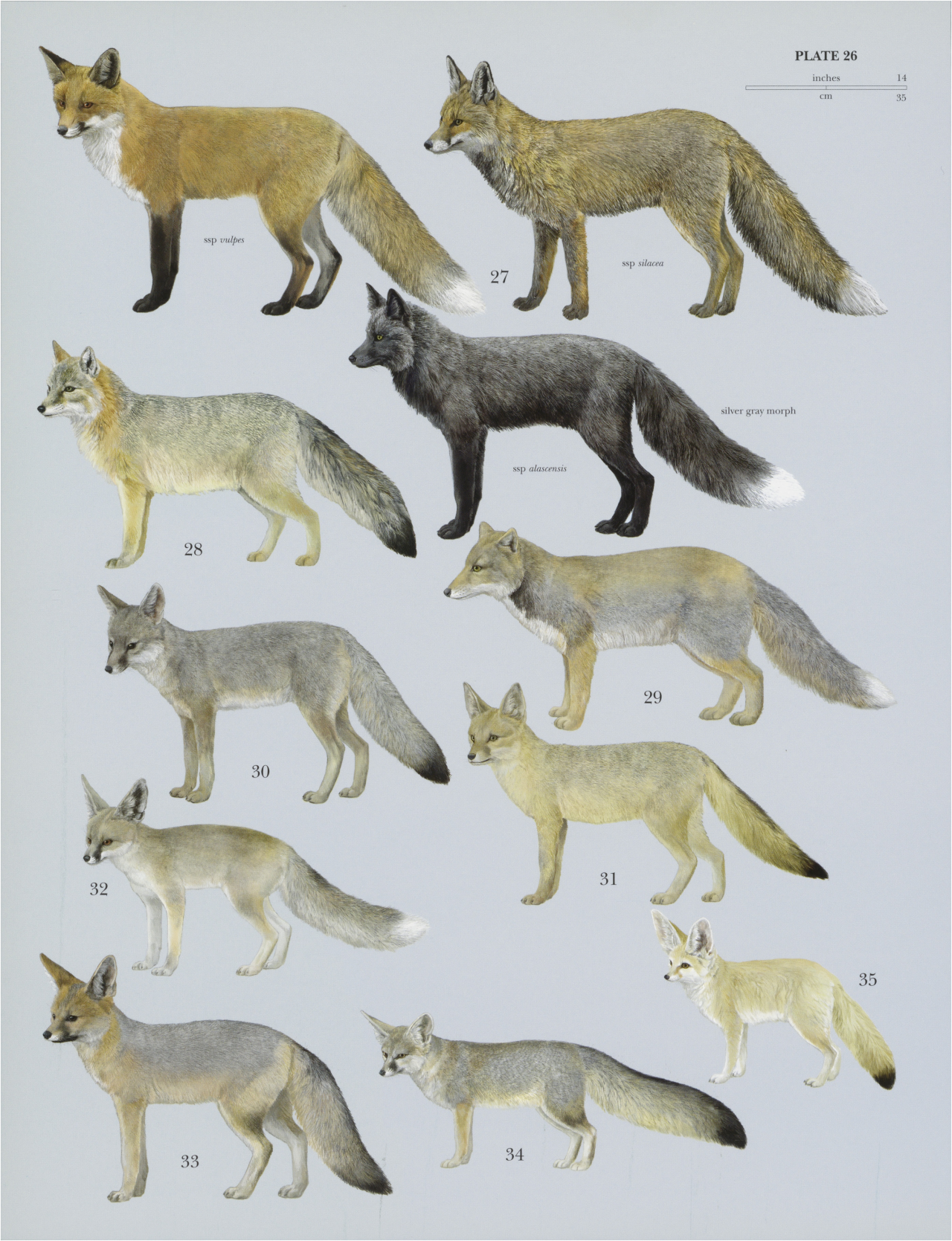
Some fox species: 27) red fox (vulpes vulpes); 28) Corsac Fox (Vulpes corsac); 29) Tibetan Fox (Vulpes ferrilata); 30) Indian Fox (Vulpes bengalensis); 31) Pale Fox (Vulpes pallida); 32) Riippell's Fox (Vulpes rueppellii; 33) Cape Fox (Vulpes chamal); 34) Blanford’s Fox (Vulpes cana); 35) Fennec Fox (Vulpes zerda)
Image Sources: Wikimedia Commons
Text Sources: Animal Diversity Web animaldiversity.org ; National Geographic, Live Science, Natural History magazine, David Attenborough books, New York Times, Washington Post, Los Angeles Times, Smithsonian magazine, Discover magazine, The New Yorker, Time, BBC, CNN, Reuters, Associated Press, AFP, Lonely Planet Guides, Wikipedia, The Guardian, Top Secret Animal Attack Files website and various books and other publications.
Last updated May 2025