
ARCTIC FOXES
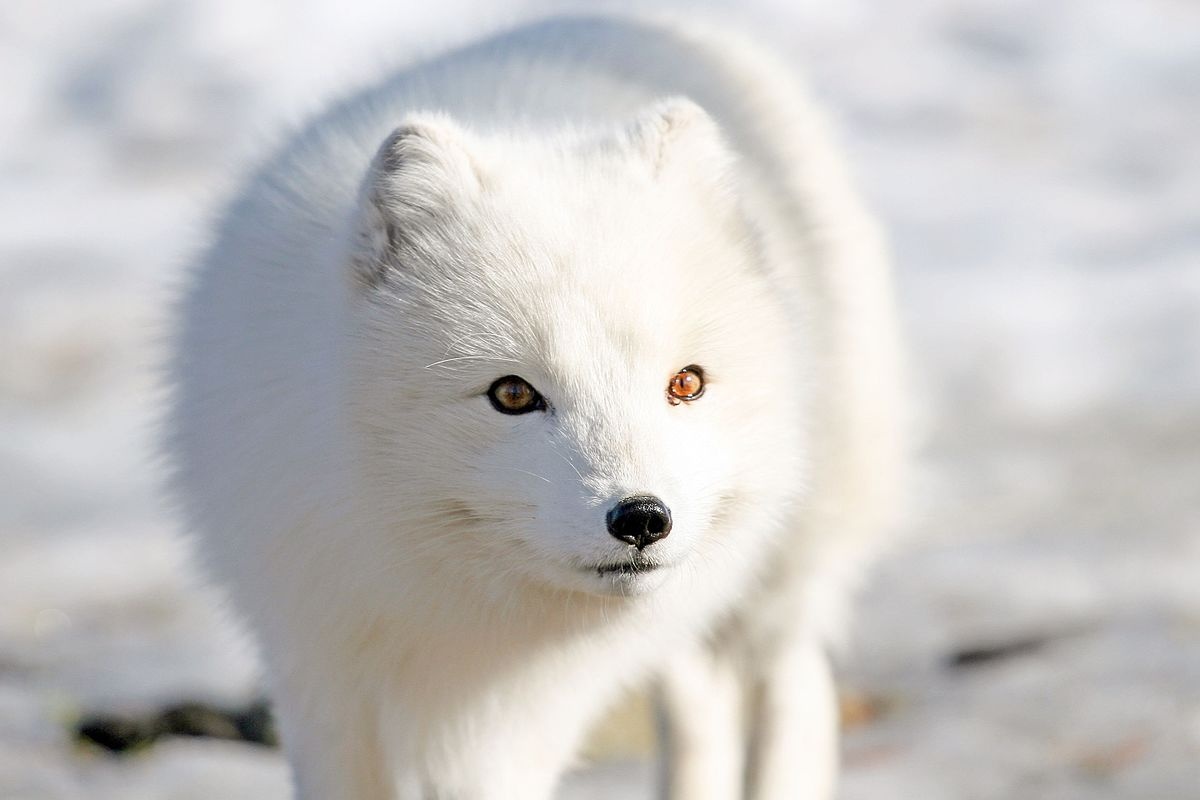
Arctic foxes (Vulpes lagopus) are also known as white foxes, polar foxes, and snow foxes. They make up their own small fox species and are native to the Arctic regions where they are fairly common in tundra environments. Their adaptions for cold environments include rounded body shape that minimize the escape of body heat and thick, warm, fur that serves as camouflage as it often matches their surroundings. In the wild, most individuals do not live past their first year but some hardy individuals survive up to 11 years. Arctic foxes have lived over 16 years in captivity. [Source: Wikipedia +]
Arctic foxes range farther north than any other land mammal and are the smallest wild canid found in northern latitudes. About the size of a large domestic cat, they hunt lemmings underneath the snow even though they can’t see them. Arctic foxes range across the entire Arctic region and probably total several hundred thousand but their numbers vary with wide fluctuations because of variations in the lemming populations. Most arctic foxes turn white in winter, but some have brownish blue fur. Many bluish one live in coastal areas, where they blend into dark backgrounds. Around July white foxes shed their winter coats for the brown and cream fur of summer. White foxes can be easily seen against the black earth in the summer. Blue foxes also turn dark brown that time of year. [Source: John L. Eliot, National Geographic, October 2004
Arctic fox preys on many small creatures such as lemmings, voles, ringed seal pups, fish, waterfowl, and seabirds. They also eats carrion, berries, seaweed, and insects and other small invertebrates. The origins of the Arctic fox appear to be "out of Tibet" hypothesis. Fossils of the extinct ancestral Arctic fox (Vulpes qiuzhudingi), dated to the early Pliocene (5–3.6 Million years ago) have been found on the Tibetan Plateau along with many other precursors of modern mammals that evolved during the Pliocene. Globally, the Pliocene was about 2–3 °C warmer than today, and the Arctic during the summer was 8 °C warmer. By using stable carbon and oxygen isotope analysis of fossils, researchers claim that the Tibetan Plateau experienced tundra-like conditions during the Pliocene and harbored cold-adapted mammals that later spread to North America and Eurasia during the Pleistocene Epoch (2.6 million-11,700 years ago). +
RELATED ARTICLES:
FOXES: HISTORY, CHARACTERISTICS, BEHAVIOR, REPRODUCTION factsanddetails.com
CANIDS, CANINES AND CANIS: CHARACTERISTICS, BEHAVIOR AND REPRODUCTION factsanddetails.com
FOXES AND HUMANS: FOLKLORE, ATTACKS, PETS factsanddetails.com
RED FOX: CHARACTERISTICS, BEHAVIOR AND REPRODUCTION factsanddetails.com
FOXES OF CENTRAL ASIA: CHARACTERISTICS, BEHAVIOR, SPECIES factsanddetails.com
FOXES OF THE MIDDLE EAST AND NORTH AFRICA: CHARACTERISTICS, BEHAVIOR, SPECIES africame.factsanddetails.com
FENNEC FOXES: CHARACTERISTICS, BEHAVIOR, BIG EARS, REPRODUCTION africame.factsanddetails.com
Arctic Foxes and the Arctic
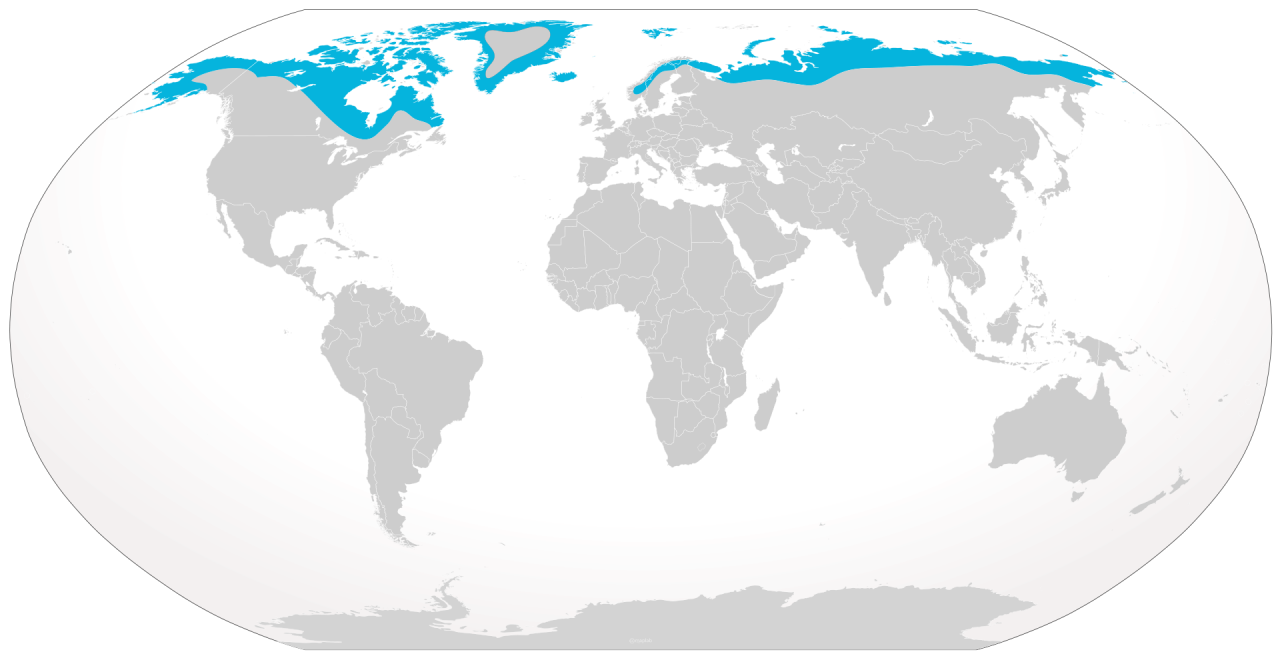
Arctic foxes are found in the treeless tundra extending through the Arctic regions of Scandinavia, Russia, North America, Greenland, and Iceland. They are found mainly in tundra and alpine tundra, usually in coastal areas on land but they do venture onto polar icecap areas. They are native to Arctic regions but have been introduced to other places. [Source: Tanya Dewey and Candice Middlebrook, Animal Diversity Web (ADW) |=|]
John L. Eliot wrote in National Geographic, “Patrolling vast expanses, this wanderer of the far north has adapted to cycles of feast or famine. Let a raven drop a bone onto the ice or the aromas from a hunter's cook tent waft from a mile away, and a small white shadow will soon materialize to investigate—an arctic fox. Near Hudson Bay a fox's curious nose pokes around a knifelike ridge of ice. "It is the friendliest and most trusting of the North American foxes, although it is characterized . . . as 'impudent,'" wrote naturalist Barry Lopez. ==
“In winter these small, almost delicate foxes range over huge areas seeking rodents or mammal carcasses. Some cross more than 600 miles (966 kilometers) of pack ice in 40-below-zero conditions. The species expanded in the Arctic at the end of the last warm inter- glacial period, about 120,000 years ago. Evolution equipped them with small ears, short muzzles, and thick fur to minimize heat loss. Their feet are fur-covered, like hares'—hence their scientific name, Alopex lagopus, or "hare-footed fox." ==
Arctic Fox Characteristics
Arctic foxes are about the size of cats. They stand 25 to 30 centimeters (9.8 to 11.8 inches) at the shoulder, and have an average weight of 5.2 kilograms (11.4 pounds). Their head body length ranges from 46 to 68 centimeters (18 to 27 inches). Sexual dimorphism (differences between males and females) is present: Males are larger than females. Males weigh between 3.2 to 9.4 kilograms (7.1 to 20.7 pounds), with an average of 3.5 kilograms (7.7 pounds), while females weigh 1.4 to 3.2 kilograms (3.1 to 7.1 pounds), with an average 2.9 kilograms (6.4 pounds). The head-and-body length of males ranges from 46 to 68 centimeters (18 to 27 inches), with an average is 55 centimeters (22 inches), while females range between 41 to 55 centimeters (16 to 22 inches), with an average of 52 centimeters (20 inches). In some regions, no difference in size is seen between males and females. The tail is about 30 centimeters (12 inches) long in both sexes. [Source: Tanya Dewey and Candice Middlebrook, Animal Diversity Web (ADW); Wikipedia]
Paws of Arctic foxes are are covered in dense fur during the winter. These are unlike the paws of any other canid and is the source their scientific name " lagopus". which means "rabbit footed". Arctic foxes have a large and very fluffy tail. To prevent heat loss, they curl up tightly tucking their legs and head under its body and behind its furry tail. This position gives the fox the smallest surface area to volume ratio and protects the least insulated areas. Arctic foxes also stay warm by getting out of the wind and residing in their dens.
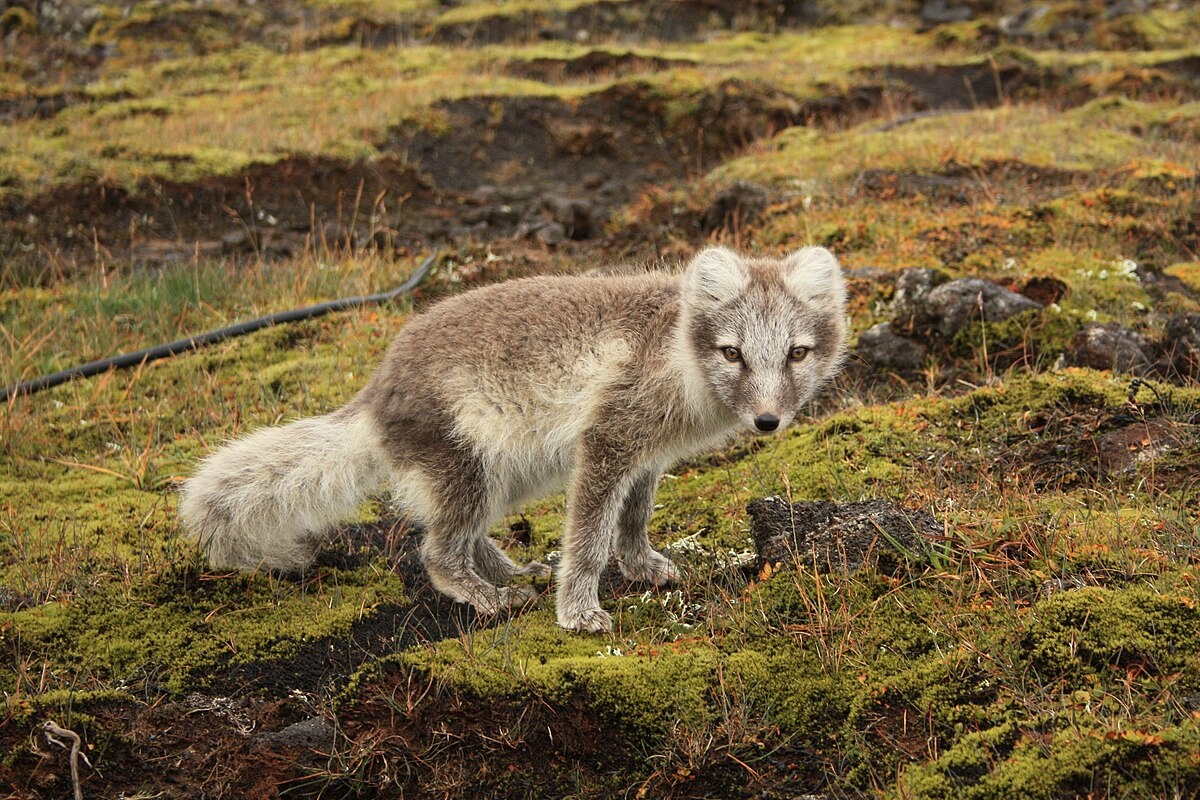
The fur of the Arctic fox changes twice every year. The winter fur of most of them is entirely white, and the summer coat ranges from grey to brown on the back, to somewhat lighter on the belly. Foxes may retain their darker coat throughout the year in areas of less severe climate.
There are two genetically distinct coat color morphs: white and blue. The white morph has seasonal camouflage, white in winter and brown and gray in summer. The blue morph is often a dark blue, brown, or grey color year-round. An allele is a type of a gene at a particular location on a chromosome. Although the blue allele is dominant over the white allele, 99 percent of the Arctic fox population is the white morph. Two similar mutations to MC1R gene cause the blue color and the lack of seasonal color change. +
One way that Arctic foxes regulate their body temperature is by utilizing a countercurrent heat exchange in the blood of their legs. Arctic foxes can constantly keep their feet above the tissue freezing point (−1°C (30°F)) when standing on the cold ground without losing mobility or feeling pain. They do this by increasing vasodilation (dilatating blood vessels, which decreases blood pressure) and blood flow to a capillary rete in the pad surface, which is in direct contact with the snow rather than the entire foot. A capillary rete is a specialized vascular structure that facilitates countercurrent exchange. It consists of closely arranged arterial and venous capillaries, where blood flows in opposite directions, allowing for efficient heat or gas exchange. Arctic foxes selectively constrict blood vessels in the center of the foot pad, which conserves energy and minimizes heat loss. Arctic foxes maintain the temperature in their paws independently from the core temperature. If the core temperature drops, the pad of the foot will remain constantly above the tissue freezing point.
Arctic Fox Adaptions to the Cold
Arctic foxes live in some of the world’s most frigid extremes. As well as low temperatures they must endure a temperature difference of up to 90–100°C (160–180°F) between their external environment and their internal core temperature. Like nearly all warm-blooded mammals they are endothermic (use their metabolism to generate heat and regulate body temperature independent of the temperatures around them). Their average basal metabolic rate is 7.665 watts. They do not start to shiver until the temperature drops to −70°C (−94°F). [Source: Tanya Dewey and Candice Middlebrook, Animal Diversity Web (ADW) |=|]
Among Arctic foxes’ adaptations for survival in the cold is its dense, multilayered pelage, which provides excellent insulation. The fur of the Arctic fox provides the best insulation of any mammal. The thermal conductivity of Arctic fox fur in the summer and winter is the same; however, the thermal conductance of the Arctic fox in the winter is lower than the summer since fur thickness increases by 140 percent. In the summer, the thermal conductance of the Arctic foxes body is 114 percent higher than the winter, but their body core temperature is constant year-round. [Source: Wikipedia]
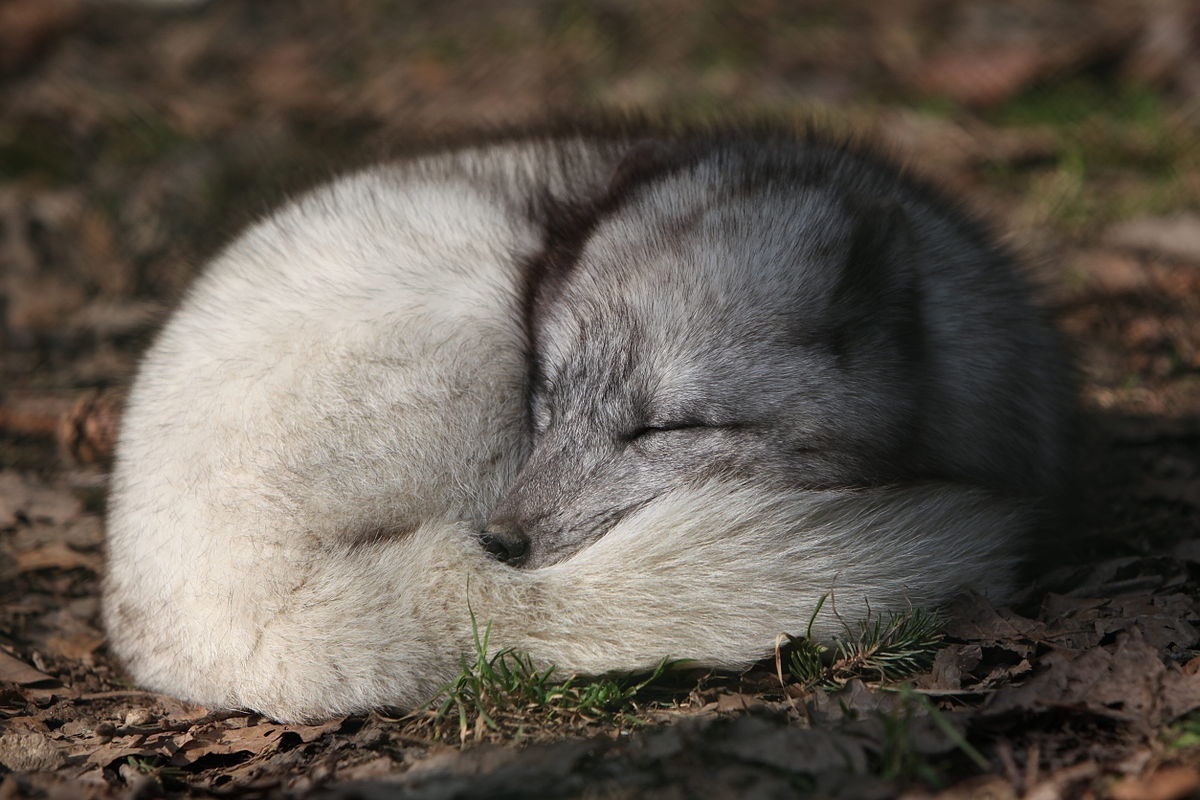
Their low surface area to volume ratio of their compact body shape, short muzzle and legs, and short, thick ears means that less heat escapes from their body since less surface area is exposed to the Arctic cold. About 22 percent of the total body surface area of the Arctic fox dissipates heat readily compared to red foxes at 33 percent. The regions that have the greatest heat loss are the nose, ears, legs, and feet, which is useful in the summer for thermal heat regulation. Also, the Arctic fox has a beneficial mechanism in their nose for evaporative cooling like dogs, which keeps the brain cool during the summer and exercise.
Arctic foxes decrease their basal metabolic rate (BMR) via metabolic depression in the winter to conserve fat storage and minimize energy requirements. The average specific mass BMR and total BMR are 37 percent and 27 percent lower in the winter than the summer. The lower critical temperature of the Arctic fox is at −7°C (19°F) in the winter and 5°C (41°F) in the summer. It was commonly believed that the Arctic fox had a lower critical temperature below −40°C (−40°F). Arctic foxes have two identified genes that help them overcome extreme cold and starvation periods: 1) Glycolipid transfer protein domain containing 1 (GLTPD1) and 2) V-akt murine thymoma viral oncogene homolog 2 (AKT2). GLTPD1 is involved in the fatty acid metabolism, while AKT2 pertains to the glucose metabolism and insulin signaling.
Arctic Fox Food and Eating Behavior
Arctic foxes are primarily or ideally carnivores but are are opportunistic feeders and technically omnivores (eat a variety of things, including plants and animals), eating practically any animal, alive or dead, and almost anything edible. They prefer small mammals, birds, fish and eggs but they will also eat insects, berries, seaweed, carrion, and even the feces of animals or humans. Generally, their winter diet consists of marine mammals, invertebrates, sea birds, fish, and baby seals. During the summer and for populations living more inland, their diet consists mostly of lemmings. A family of foxes can eat dozens of lemmings each day. They are also major bird-egg predator, consuming eggs of all except the largest tundra bird species. During the summer months, when food is more abundant Arctic foxes collect a surplus amount of store it in their dens, where it is stored under stones for later use. [Source: Tanya Dewey and Candice Middlebrook, Animal Diversity Web (ADW) |=|]
Arctic foxes also eat voles (similar to lemmings and mouses), other rodents and hares. They scavenge on carcasses left by larger predators such as wolves and polar bears, and when nothing else is available and they are very hungry they will eat their own feces. In some parts of northern Canada, where there are lots of breeding migrating birds, the foxes try eats lots of them. On the coast of Iceland and other islands, birds are also important food sources. During April and May, Arctic foxes also prey on ringed seal pups when the young seals are confined to snow dens and are relatively helpless. [Source: Wikipedia]
John L. Eliot wrote in National Geographic, “Hunting ringed seal pups born in small caves under the snow in Norway's Svalbard archipelago, a fox rears up, jumps on a den, and dives in head first. Pups often escape from the den into open water. The foxes' keen noses can detect such lairs more than a mile away. Near Hudson Bay, foxes tag along with polar bears in winter to scavenge leftover seal carcasses. “Arctic foxes' most vital food source—or lack thereof—is a little fur ball called the lemming. Problem is, the rodents aren't reliable. Some parts of the arctic foxes' range, though have no lemmings, so foxes there feed on seabirds, geese, and their eggs in summer. In winter the opportunist foxes scavenge seal and reindeer carcasses. Compared with Hudson Bay, Svalbard's fox population is more stable. "But because they rely on marine species, they have high concentrations of contaminants like PCBs," Eva Fuglei, a wildlife biologist at the Norwegian Polar Institute, who is studying the effect of the toxics on the foxes' disease resistance and reproduction, told National Geographic. [Source: John L. Eliot, National Geographic, October 2004 ==]
Arctic foxes survive harsh winters and food scarcity by either caching food or building up body fat when food is more available. At the beginning of winter, one Arctic fox has approximately 14,740 kilojoules (kJ) of energy storage from fat alone. An average sized fox of 3.5 kilograms (7.7 pounds) need s471 kJ/day during the winter to survive. In Canada, Arctic foxes acquire goose eggs at a rate of 2.7–7.3 eggs per hour and store 80–97 percent of them. Scats provide evidence that they eat the eggs during the winter after caching. Isotope analysis shows that eggs can still be eaten after a year.
Arctic Fox Behavior and Senses
Arctic foxes are terricolous (live on the ground), motile (move around as opposed to being stationary), fossorial (engaged in a burrowing life-style or behavior, and good at digging or burrowing), nomadic (move from place to place, generally within a well-defined range), and social(associates with others of its species; forms social groups). [Source: Tanya Dewey and Candice Middlebrook, Animal Diversity Web (ADW) |=|]
Although the Arctic foxes are active year-round and do not hibernate. They attempt to preserve fat and endure times with little food by reducing their activity level. They build up their fat reserves in the autumn, sometimes increasing their body weight by more than 50 percent. This provides greater insulation during the winter as well as being a source of energy when food is scarce.
Arctic foxes live a communal and nomadic life, often forming small bands to scavenge the countryside for food. Their main social unit is the family group — which consists of one adult male, two vixens (female foxes) and offspring — which live in a den together. One the vixens a nonbreeding animal born the previous year that stays to help care for the next litter. Dens are the focus of Arctic fox's attention in the spring when mating takes places and and a home is needed for their potential offspring.
Arctic foxes sense using touch and chemicals usually detected with smell. They have a keen sense of smell. They can smell carcasses that are often left by polar bears anywhere from 10 to 40 kilometers (6.2 to 24.9 miles) away. It is possible that they use their sense of smell to also track down polar bears. Additionally, Arctic foxes can smell and find frozen lemmings under 46 to 77 centimeters (18–30 inches) of snow, and can detect a seal lair under 150 centimeters (59 inches) of snow. Arctic foxes have a hearing range between 125 Hz–16 kHz — which is less sensitive than that of dog and kit foxes but still quite sensitive. Arctic foxes can easily hear lemmings burrowing under four to five inches of snow. When such prey is located, the foxes pounce and punches through the snow to catch the lemmings.
Arctic Fox Dens and Predators
Foxes construct dens, used as homes, often in cliffs at least 1.6 kilometers apart, in which family social groups live. An Arctic fox family generally makes its den in a low forst-free mound one to four meters high in the open tundra, or in a pile of rocks at the base of a cliff. It is hard to dig very deep in the Arctic region because of permafrost. Arctic fox dens generally have four to eight entrances and a system of tunnels covering about 30 square meters. Some of these dens have been used for centuries by generations of foxes. [Source: Tanya Dewey and Candice Middlebrook, Animal Diversity Web (ADW) |=|]
John L. Eliot wrote in National Geographic, “ Dens are often used by many generations—for as long as 300 years. The burrow complex may spread over 500 square feet (47 square meters) and have a hundred entrances, offering the pups quick escape from predators. [Source: John L. Eliot, National Geographic, October 2004 ==]
Complex systems of tunnels covering as much as 1,000 square meters (11,000 square feet) and are often in eskers, long ridges of sedimentary material deposited in formerly glaciated regions. Arctic foxes tend to select dens that are easily accessible with many entrances, and that are clear from snow and ice making it easier to burrow in. Arctic foxes build and choose dens that face southward towards the sun, which makes the den warmer.
Natural predators of the Arctic fox are golden eagles, Arctic wolves, polar bears, wolverines, red foxes, and grizzly bears. Owls and eagles prey on Arctic fox young and adults, as do red foxes, a species from the south that overlaps the arctic foxes' range. Red foxes, which are considerably larger, also compete with arctic foxes for denning sites. Arctic foxes prefer large, maze-like dens for predator evasion and a quick escape especially when red foxes are in the area. Natal dens are typically found in rugged terrain, which may provide more protection for the pups from predators. Parents also relocate litters to nearby dens to avoid predators. When red foxes have moved from a region, Arctic foxes use dens that the red fox previously occupied. Shelter quality is more important to the Arctic fox than the proximity of spring prey to a den.
Migration of Arctic Foxes
During the winter, 95.5 percent of Arctic foxes engage in commuting trips within their home range that generally last less than three days and occur between 0–2.9 times a month. Nomadism is found in 3.4 percent of the foxes, and loop migrations (where the fox travels to a new range, then returns to its home range) are the least common at 1.1 percent. Arctic foxes in Canada that undergo nomadism and migrations voyage from the Canadian archipelago to Greenland and northwestern Canada. The duration and distance traveled between males and females is not significantly different. [Source: Wikipedia]
Arctic foxes closer to goose colonies (located at the coasts) are less likely to migrate. Meanwhile, foxes experiencing low-density lemming populations are more likely to make sea ice trips. Residency is common in the Arctic fox population so that they can maintain their territories. Migratory foxes have a mortality rate more than 3 times higher than resident foxes. Nomadic behavior becomes more common as the foxes age.
Climate change is having an impact on Arctic fox migrations and their life in general. Eva Fuglei who has been working with Arnaud Tarroux of the Norwegian Institute for Nature Research to track how the foxes cope with the dramatic changes of the Arctic seasons, told Norway's NRK public broadcaster. "There's enough food in the summer, but it gets difficult in winter. This is when the Arctic fox often migrates to other geographical areas to find food to survive....The shrinking of the polar ice pack is having an impact on Arctic foxes — they can no longer visit Iceland, for example, and in due course the population in Svalbard [Norway] could become completely isolated. But Eva Fuglei told NRK that there is still hope, as "higher temperatures could mean more Svalbard reindeer, and the foxes scavenge off their carcasses".
Epic 3,500-Kilometer Transpolar Migration of an Arctic Fox
In July 2019, the Norwegian Polar Institute reported that a year-old Arctic fox female that had been fitted with a GPS tracking device and released from Spitsbergen in Norways’s Svalbard islands crossed the polar ice to Greenland in 21 days, a distance of 1,512 kilometers (940 mikes, and then moved on to Ellesmere Island in northern Canada, covering a total recorded distance of 3,506 kilometers (2,179 miles) in 76 days, before her GPS tracker stopped working. The fox averaged just over 46 kilometers (29 miles) a day and once traversed as 155 kilometers (96 miles) in a single day. “"The fox's journey has left scientists speechless," according to Greenland's Sermitsiaq newspaper.
What impressed the researchers was not so much the length of the journey as the speed in which it was done. "We couldn't believe our eyes at first. We thought perhaps it was dead, or had been carried there on a boat, but there were no boats in the area. We were quite thunderstruck," Eva Fuglei of the Polar Institute told NRK. [Source: BBC, July 1, 2019]
The Polar Institute produced a graph that shows how the fox made two breaks in her journey across northern Greenland. According to the BBC: “The scientists think she may have curled up in the snow to sit out bad weather, which is perfectly possible with such thick protective fur, or else found a source of food like seabirds in an open channel of water. We will never know what the little fox gets up to in Canada, as her transmitter stopped working in February, the Polar Institute reports. “But she will definitely have to change her eating habits — "Ellesmere Island foxes live largely on lemmings, rather than the mainly-marine diet of Svalbard," according to Eva Fuglei. But this fox went much further than most others we've tracked before — it just shows the exceptional capacity of this little creature," she says.
Arctic Fox Mating, Reproduction and Offspring
Arctic foxes are monogamous and may mate for life. However, When predators and prey are abundant, both males and females are more likely to be promiscuous and display more complex social structures. Monogamous pairs come together during the breeding season and stay together to raise their young in complex underground dens. Occasionally, other family members may assist in raising their young. The gestation period ranges from 46 to 58 days. The number of offspring ranges from one to 5, with the average number of offspring being 2.8. The age in which young are weaned ranges from 28 to 60 days. On average males and females reach sexual or reproductive maturity at about 10 months. |=|
Mating usually occurs from April to July, with births taking place from April through June for the first litter, and July or August for the second litter. The number of young per litter varies with the availability of food, especially lemmings. The usual litter size is five to eight cubs, but as many as 25 have been born (the largest litter size in the order Carnivora, which as about 290 species). The young emerge from the den for the first time at two to four weeks. In the spring, males mate again with females a few weeks after the first litter is born. [Source: Tanya Dewey and Candice Middlebrook, Animal Diversity Web (ADW) |=|]
Young Arctic foxes are altricial, meaning they are relatively underdeveloped at birth. Males are involved in the raising of offspring. Males parent stays with the cubs, helping to feed them. There is an extended period of juvenile learning. The post-independence period is characterized by the association of offspring with their parents. John L. Eliot wrote in National Geographic, young foxes from the second litter “emerge from dens in July as wildflowers replace ice and snow. When the pups were about two weeks old, their mother moved them one by one to a new den. Heavy rain may have prompted her decision, or she may have sought a cleaner site. [Source: John L. Eliot, National Geographic, October 2004 ==]
Larger packs of foxes consisting of breeding or non-breeding males or females can guard a single territory more proficiently to increase pup survival. When resources are scarce, competition increases and the number of foxes in a territory decreases. On the coasts of Svalbard, the frequency of complex social structures is larger than inland foxes that remain monogamous due to food availability. In Scandinavia, there are more complex social structures compared to other populations due to the presence of the red fox. In Iceland where monogamy is most prevalent. One-year-old offspring remain within their parent's territory even though predators are absent and there are fewer resources. This may indicate kin selection — natural selection in which an apparently disadvantageous characteristic (especially altruistic behaviour) increases in the population due to increased survival of individuals genetically related to those possessing the characteristic.
Arctic Fox Reproduction and Lemming Boom-and-Bust Cycles
The main prey of the Arctic foxes in the tundra are lemmings, which is why they are sometimes called "lemming foxes". The reproduction rates of Arctic foxes can reflect lemming population density, which cyclically fluctuates every three to five years. When lemmings are abundant, foxes can give birth to more pups, but they often do not reproduce when food is scarce. The "coastal fox" or blue fox lives in an environment where food availability is relatively consistent, and they will have up to five pups every year.
John L. Eliot wrote in National Geographic, “Lemming numbers have a huge impact on litter size. In 2002, when lemmings crashed in much of Canada, photographer Norbert Rosing found two sleepy pups in a den of only seven on Victoria Island in the Canadian Arctic. The following year, when lemmings were plentiful, "this den near Churchill had 13 pups", says Rosing, "and it was littered with lemming and bird carcasses." One of the den's adults for ages to feed its young.[Source: John L. Eliot, National Geographic, October 2004]
In good lemming years one female may have up to 20 pups, and local arctic fox populations boom. When lemming numbers plummet, many arctic foxes starve in winter, leading to fewer and smaller litters. Critical to foxes during lean lemming years, about 100,000 snow geese nest on La Pérouse Bay near Churchill. "I found 72 geese feet in one Churchill den," says ecologist James Roth In years when food is abundant, adults feed their young through the summer until autumn, when the pups disperse. In lean years the pups leave the den earlier, to hunt on their own in a land where success is never a sure thing.
Arctic Foxes, Humans and Conservation
Kathy B. Maher of National Geographic wrote: “In Finland the northern lights are called revontulet, or "fox fires," harking back to an old folk tale about an arctic fox running in the snow and touching the mountains with its fur, causing sparks to fly up and illuminate the sky. In another version of the story, the fox throws sparks into the sky by whipping snow upward with its brushlike tail. In northern Lapland, the aurora borealis can be seen more than 200 nights a year, making for some very busy foxes!” ==
Arctic foxes are not endangered. They are designated as a species of least concern on the International Union for Conservation of Nature (IUCN) Red List and have no special status on the Convention on International Trade in Endangered Species (CITES). However, the Scandinavian mainland population is acutely endangered, despite being legally protected from hunting and persecution for several decades. They have been driven out of some regions because of predators like the red fox. The estimate of the adult population in all of Norway, Sweden, and Finland is fewer than 200 individuals. In Finland, Arctic fox are even classified as critically endangered. This is even though the animal was declared a protected species in Finland in 1940.
Arctic foxes have hunted and trapped kept in fur farms for their pelts. Their fur is greatly prized in the fur industry. On the Pribiloff Islands of Alaska, Arctic foxes have been farmed for their fur since 1865, and they have long been important to the economy of the native people living withing their range. The pelts of Arctic foxes with slate-blue coloration are particularly valuable. They were transported to various previously fox-free Aleutian Islands during the 1920s. The program was successful in terms of increasing the population of blue foxes, but their predation of Aleutian Canada geese decreased their numbers. In Iceland, Arctic foxes sometimes take lambs from sheep flocks and farmers there have been encouraged to kill Arctic foxes to protect livestock since the late 13th century.
In some places Arctic foxes are being displaced by larger red fox. This has been attributed at lest in part to climate change because the camouflage value of Arctic fox’s white coat declines when there is less snow cover. Red foxes prey on Arctic foxes and where ranges of the two fox species overlap red foxes dominate. An alternative explanation for the domination of the red fox involves gray wolves. Historically, they kept red fox numbers down, but as the wolves have been hunted to near extinction in much of their former range, the red fox population has grown larger, and these foxes have become the niche of top predator. This may be the case in Scandinavia, where it is allowed to hunt red foxes in the Arctic fox's previous range.
Image Sources: Wikimedia Commons
Text Sources: Animal Diversity Web animaldiversity.org ; National Geographic, Live Science, Natural History magazine, David Attenborough books, New York Times, Washington Post, Los Angeles Times, Smithsonian magazine, Discover magazine, The New Yorker, Time, BBC, CNN, Reuters, Associated Press, AFP, Lonely Planet Guides, Wikipedia, The Guardian, Top Secret Animal Attack Files website and various books and other publications.
Last updated June 2025