
FOXES AND HUMANS

Foxes do well in suburban neighborhood and even urban environments because they thrive in edge-of-the-wood habitat, where their prey — mice, hares, rabbits, voles and other small mammals — also thrive. They have been known to make their homes in warehouses and sheds and make dens under houses. Sometimes they even chase bicycles like dogs. Even so, for the most part foxes are shy and try to avoid human contact the best they can. Foxes killed on the road are usually young ones who are not experienced
Humans utilize foxes for fur and the pet trade,. They can help control pests. Kinds of fox that are used to make fur garments include the blue fox and white fox from the Arctic region, and the platinum and silver fox from North America, Asia and Europe. Some of these colored foxes are red foxes who are colored to blend in with their native habitat or have been crossbred by humans for desired traits. Humans sometimes raise foxes for their fur. Farms often specialize in distinct color variants that are rarely found in the wild.
Foxes have traditionally not been viewed very positively by humans, who often regard them as clever but sneaky and deceitful eye, and blame them for killing lambs and pets — both dogs and cats — raiding chickeen coops and rumaging through trash heaps. Their ability to adapt to new areas and their prowess at hunting rodents viewed as pest has led to them being introduced for pest management on farms and agricultural areas. The introduction of foxes to Australia pushed many native species to near extinction. Foxes are also carriers of diseases such as rabies, canine distemper, and sarcoptic mange, which can be passed on to dogs and even humans. [Source: Tru Hubbard, Animal Diversity Web (ADW) |=|]
On the International Union for Conservation of Nature (IUCN) Red List most fox species are listed as species of least concern or not evaluated. Red foxes in particular are very common and widespread. Even so foxes are still threatened by habitat loss, fragmentation, hunting, trapping and poisoning. Foxes are regarded as pests in many places and are unprotected in most countries where trapping and hunting in only regulated with the use of seasons and restrictions on methods of capture. In some countries fox hunting is a sport. Farmers sometimes shoot and poison foxes viewed as threats to their livestock, pets and crops.
Foxes have featured prominently over a long period of time in the folklore, history and culture of many nations and cultural groups. One construct found in the literature of several cultures is that of the shape-shifting fox. In Japanese folklore, for example, there are many stories of foxes taking the form of humans to entrap other humans. This has also been seen in western literature and performances such as Janacek's opera, "The Cunning Little Vixen" from 1922. [Source: Animal Diversity Web]
RELATED ARTICLES:
FOXES: HISTORY, CHARACTERISTICS, BEHAVIOR, REPRODUCTION factsanddetails.com
CANIDS, CANINES AND CANIS: CHARACTERISTICS, BEHAVIOR AND REPRODUCTION factsanddetails.com
RED FOX: CHARACTERISTICS, BEHAVIOR AND REPRODUCTION factsanddetails.com
ARCTIC FOXES: CHARACTERISTICS, COLD, BEHAVIOR AND REPRODUCTION factsanddetails.com
FOXES OF CENTRAL ASIA: CHARACTERISTICS, BEHAVIOR, SPECIES factsanddetails.com
BENGAL FOXES: CHARACTERISTICIS, BEHAVIOR, HUMANS factsanddetails.com
FOXES OF THE MIDDLE EAST AND NORTH AFRICA: CHARACTERISTICS, BEHAVIOR, SPECIES africame.factsanddetails.com
FENNEC FOXES: CHARACTERISTICS, BEHAVIOR, BIG EARS, REPRODUCTION africame.factsanddetails.com
DHOLES: CHARACTERISTICS, BEHAVIOR, HUNTING factsanddetails.com
GOLDEN JACKALS: CHARACTERISTICS, BEHAVIOR, ATTACKS africame.factsanddetails.com
DOGS: CHARACTERISTICS, BEHAVIOR AND INTELLIGENCE europe.factsanddetails.com
DOMESTICATION OF DOGS: THEORIES, EVIDENCE, WHY AND HOW europe.factsanddetails.com
WHEN AND WHERE DOGS WERE FIRST DOMESTICATED europe.factsanddetails.com
WOLVES: CHARACTERISTICS, HISTORY, SPECIES, NUMBERS factsanddetails.com
Foxes in Japanese Religion and Folklore

Japanese fox mask In Japanese folklore foxes are regarded as clever and magical animal who act messengers for the gods, particularly the God of the Harvest, and are symbols of fertility. Killing one sometimes results in punishment by the gods. Small shrines for rice and harvest gods are found at Shinto shrines and some Buddhist temples. They are invariably guarded by foxes. Foxes are believed to have the power to change their forms, possess humans and cause people to have hallucinations so they can trick them. Their favorite entry point is under the fingernails. Their favorite food is said to be deep-fried tofu, which is often found in shrines next to fox statues. Foxes and tanukis are said to have the ability to cause hallucinations in people and trick them.
Kevin Short wrote in the Daily Yomiuri, “Foxes are among the great perennial stars of Japanese folklore. To begin with, they are considered to be familiar spirits serving the immensely popular rice deity Inari. A set of two stone foxes stand watch in front of every Inari shrine. Some folklorists believe that foxes became associated with rice farming because of their role in controlling mice, hares and other agricultural pests. In the past farmers would even leave out food to attract foxes to their rice paddies. Foxes are thought to be especially fond of abura-age, thin slices of deep-fried tofu soy bean paste. Pockets of abura-age stuffed with rice are known as Inari-zushi. [Source: Kevin Short, Daily Yomiuri, May 10, 2012]
“Yo-gitsune is the Japanese word for fairy foxes. “In contrast to the favorable agricultural image, foxes have also been traditionally imagined as clever tricksters and shape-shifters. These yo-gitsune can be encountered in a wide variety of shapes and sizes. Like cats and many other Japanese fairy animals, their magical powers grow stronger with age. After living for a century or two, yo-gitsune become able to possess people, causing illness or insanity, and also to temporarily shape-shift into incredibly glamorous women. Stories abound of men falling hopelessly in love with and marrying these "foxy ladies.”
“In one famous story, a 10th-century nobleman saves a fox from a mob bent on killing it for its liver. A few days later, a beautiful woman mysteriously appears at his door. They fall madly in love, get married and have a son. Three years later, the woman suddenly disappears, leaving a note explaining to her husband that she was really just the fox whose life he had saved. Their son grows up to be Abe no Seimei, the famous Onmyoji Yin-Yang wizard who protects the imperial court and the capital city from all sorts of wicked spells and disasters.
“After living for a full millennium, fairy foxes may attain a formidable style with nine tails. Nine-tail foxes, or Kyubi no Kitsune, are of Chinese origin, but have also been active in Japan as well. During the Edo period (1603-1867), motifs depicting heroes ridding the land of these often ill-tempered nine-tail foxes were widely adopted into traditional theater, literature and art.
“Until quite recently, mental illnesses and emotional instability were frequently attributed to possession by fox spirits, especially in isolated rural villages. Even more frightening, there are families, called tsukimono-mochi, which are rumored to keep tiny fox spirits in vases or bamboo tubes. These spirits can be sent out on various missions, such as searching for gold or treasure, stealing, spying on people, or just causing all sorts of trouble and misfortune. The secrets of caring for and controlling these fox spirits, or in some cases similar dog or weasel spirits, are passed down from generation to generation among women of the household. Families which are rumored to possess fox spirits are feared and shunned.
“Another peculiarity of fairy foxes is that they tend to emit strange lights at night. One very famous spot for kitsune-bi fox-fire is the Inari shrine at Oji in Kita Ward, Tokyo. Every New Year's Eve foxes from all over the Kanto region are believed to assemble here under an ancient hackberry tree. The local farmers predict the yields of the coming season's crops by the number of glowing lights they count.
Aesop's Fables with Foxes
There are 28 Aesop fables with foxes in them according to to aesopsfables.org. Some are short and some are long. Some they are the main characters; others they have supporting roles. They are: 1) “The Ass, the Fox, and the Lion”, 2) “The Dog, the Cock, and the Fox”, 3) “The Dogs and the Fox”, 4) “The Eagle and the Fox”, 5) “The Farmer and the Fox”, 6) “The Fox and the Cock”, 7) “The Fox and the Crow”, 8) “The Fox and the Goat”, 9) “The Fox and the Grapes”, 10) “The Fox and the Hedgehog”, 11) “The Fox and the Lion”, 12) “The Fox and the Lion”, 13) “The Fox and the Mask”, 14) “The Fox and the Monkey”, 15) “The Fox and the Stork”, 16) “The Fox and the Thorn Bush”, 17) “The Fox and the Woodsman”, 18) “The Fox without a Tail”, 19) “The Leopard and the Fox”, 20) “The Lion and His Three Councilors”, 21) “The Lion and the Fox”, 22) “The Lion, the Bear, and the Fox”, 23) “The Lion, the Mouse, and the Fox”, 24) “The Quack Frog”, 25) “The Sick Lion”, 26) “The Wild Boar and the Fox”, 27) “The Wolf, the Fox, and the Ape”.
Aesop’s fables are simple stories having a moral lesson, usually involving animals, which fit stereotypes such as the strong lion or sly fox. The stories are oriented towards children with words of wisdom they are expected to take to heart. Particularly Famous Aesop’s fables include “The Fox and the Grapes” and “The Fox and the Stork”.
In "The Fox and the Grapes", a fox spots a delicious-looking bunch of grapes hanging high above his reach. He repeatedly tries to jump and grab them, but fails each time. Dejected, he declares the grapes sour and walks away, seemingly dismissing them as not worth the effort. Moral of the Story: The story teaches that it is often easier to dismiss something as worthless when one cannot obtain it.
In the story "The Fox and the Stork," a sly fox invites a stork to dinner, serving soup in a shallow dish, which the stork, with its long beak, cannot easily eat. The stork retaliates by inviting the fox to dinner, serving fish in a tall jar with a narrow neck, which the fox cannot access with its snout. The moral of the story is that people should be treated as they treat others.
Candida Moss wrote in the Daily Beast: When the Life of Aesop took on literary shape in the first century CE collections of Aesopic fables were being re-written by people like Phaedrus and the Greek poet Babrius. The fables, like the Life, were in a state of interpretative flux. Writers like Phaedrus and Babrius saw themselves as participating in an unproblematic tradition of retelling that involved expansion and interpretation. The origin of these traditions was Aesop, but it was socially acceptable to re-tell those traditions. [Source: Candida Moss, Daily Beast, February 27, 2022]
Whether we are talking about Aesop and his story or the fables themselves we are encountering a cultural mishmash of ideas and influences. The Life of Aesop follows the literary conventions of the ancient romance novel and borrows from other stories. The most popular version uses elements of the Sayings of Ahiqar, an Aramaic text about a different fifth century B.C. sage. Some of the Fables, too, seem to come from non-Greek sources. What this means is that both the man and the text are composite of a variety of cultures and traditions. “What fascinates me most about Aesop” . Dr. Joseph Howley, an associate professor of classics at Columbia University, tolf the Daily Beast, “is that although the Greek tradition claims him and his fables, it always registers him as an outsider…The fact that some of his surviving fables appear in Akkadian, Egyptian, and other traditions leads me to think of Aesop as something of a fig leaf, a figure invented by the Greeks to mask their assimilation and co-opting of other, earlier traditions from West Asia and North Africa.”
People in Patagonia Kept Foxes as “Pets” 1,500 Years Ago
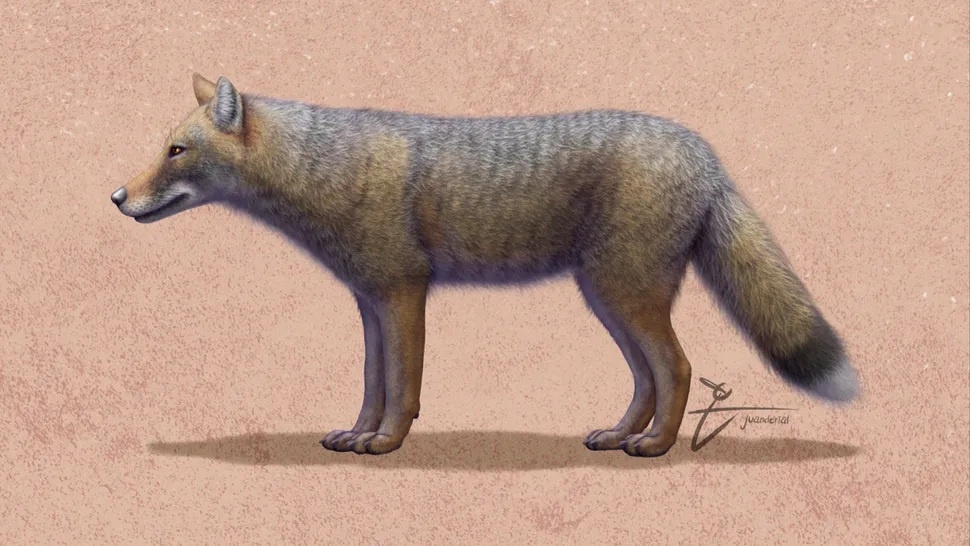
An extinct species of fox — Dusicyon avus, also known as the Falkland Islands wolf — appear to have been kept by humans as pets 1,500 years ago in Patagonia, according to an Oxford study of a grave site in the Atuel River valley in Argentina. Joe Pinkstone wrote in The Telegraph: While the researchers pointed out they were not necessarily “pets”, the historical evidence suggests a “close relationship” between animal and man. Analysis of the bones revealed a fox was buried alongside a person and it had a similar diet to the humans, which scientists say is indicative of “close relationship between the two species”. The fox species Dusicyon avus went extinct around 500 years ago but lived in South America for thousands of years beforehand. The continent has a rich diversity of canids, with 11 species currently alive. It is thought the species, which weighs up to 15 kilograms , likely went extinct due to climate change and also the introduction of domestic dogs into the area. [Source: Joe Pinkstone, The Telegraph, April 10, 2024]
The site, which is in modern-day Argentina, contained 21 human individuals (18 adults, two adolescents, one child) as well as the fox. “This is a very rare and unusual find,” study author Dr Ophelie Lebrasseur from the University of Oxford, who led the study alongside Dr Cinthia Abbona from CONICET, the main government agency for science and technology in Argentina, told The Telegraph. “Here, the presence of a near-complete skeleton suggests an intentional burial of the individual which we believe suggests a close relationship with the hunter-gatherer society. Its diet resembled that of the humans buried on the site rather than the diet of wild canids and this similarity in diets suggests it was either fed by the hunter-gatherers or it fed on the kitchen refuse. Finally, none of the animal bones present any traces of cut marks, which suggests the individual was not eaten.”
It was previously thought the Dusicyon avus species went extinct because breeding between the species and domestic dogs led to infertile offspring and the demise of the fox.But the study rebukes this because genetic analysis of the skull bones of the pet fox reveal it could likely breed with dogs as their genomes are just 3.4 per cent different and therefore the hybrid offspring were likely fertile, and not sterile as previously thought. Radiocarbon dating of the bones and teeth found at the Cañada Seca burial site revealed them to be around 1,505 years old. The species had not been seen this far west or north before, the scientists say, with this study expanding the range of the extinct fox by hundreds of kilometers.
The scientists were unable to see exactly how the fox and the humans were buried as much of the context had been lost following accidental damage caused by the clay mining operation discovering the site in the. “Nevertheless, it is possible that the fox was intentionally inhumated in this burial context, becoming the first record of a complete skeleton of this fox species buried alongside humans,” the scientists write in the study, published in Royal Society Open Science.
“Our study does not imply that hunter gatherers had domesticated foxes to keep them as pets,” Dr Lebrasseur added. “Rather, we’ve identified this one specimen at this one site, and found it very unique in the fact that its burial and its diet would suggest it could well have played a companion role to the hunter gatherer society.So it was a wild individual, but most likely tamed, though not domesticated.”
Difficulty Keeping Foxes as Pets

The Royal Society for the Prevention of Cruelty to Animals (RSPCA) does not recommend keeping of foxes as pets. "Because foxes are wild animals and do not fare well as domestic pets, they should not be kept as such. Even the most experienced fox experts have had difficulty in keeping adult foxes successfully in captivity as they have very specific needs," it says.
Lucy Jones of the BBC wrote: Biologist David Macdonald studied foxes at close quarters for years. For a time, he had foxes living at home, which he recounted in his 1987 book Running with the Fox. The foxes did not last long in Macdonald's house. He found that they would tear up the living area and create chaos. Others who have tried living with foxes report the same thing. [Source: Lucy Jones, BBC, September 13, 2016]
Richard Bowler, a wildlife photographer based in Wales, looks after a few foxes in a large outside space at his home. He reports that they are nervous and shy. The youngest fox, a vixen called Hetty, is extremely shy around people — even though she was captive-bred, and Bowler and his partner fed her through the night from when she was one week old. He describes the temperament of the foxes as "highly wired".
Occasionally people connected to wildlife rescue centres report that they have managed to tame foxes. However, usually these animals are recovering from toxoplasmosis, a parasitic disease that damages the brain, leaving the animals unafraid of human touch.
Belyaev Soviet-Era Experiments to Tame Foxes
Attempts to domesticate foxes have been going on since the 1950s as part of experiments in guided evolution. To show how domestication works Russian geneticist Dmitry K.Belyaev created a tame fox population in Russia by using a specific breeding program. By selecting for the trait of "tame-ability" a small population of tame foxes was produced with noticeable changes in friendliness and some physical characteristics such as floppier ears. [Source: Tru Hubbard, Animal Diversity Web (ADW) |=|]
The Russian fox farm where the experiments took place were was the first of its kind. Lucy Jones of the BBC wrote: Through the work of a breeding programme at the Institute of Cytology and Genetics at Novosibirsk, in Russia, Belyaev sought to trace the evolutionary pathway of domesticated animals. His test subjects were silver-black foxes, a melanistic version of the red fox that had been bred in farms for the color of their fur. Belyaev died in 1985, but the project is still ongoing. It is now overseen by Lyudmila Trut, in her 80s in the mid 2010s, who started out as Belyaev's intern. "There is archaeological data that people made individual attempts to domesticate the fox, but this process was not finished," says Anastasiya Kharlamova, one of Trut's research assistants. "Possibly the reason was that the cat was domesticated at a similar time, and supplanted the fox as a possible candidate to be domesticated." [Source: Lucy Jones, BBC, September 13, 2016]
Belyaev's experiment aimed to replay the process of domestication to see how evolutionary changes came about There are many unanswered questions relating to domestication. One is what traits or qualities Stone Age people selected for when they set out to domesticate animals. Belyaev believed that selection for just one trait — tameability — would be enough to create a domesticated population. The study of genetics had been essentially banned in the USSR, as the country's dictator Joseph Stalin sought to discredit the genetic principles set out by Gregor Mendel. Stalin's death in 1953 gave scientists more freedom, but in the early years Belyaev nevertheless worked under the cover that he was breeding foxes to make better fur coats.
First, Belyaev and Trut travelled to various fur farms in the Soviet Union, from Siberia to Moscow and Estonia. There, they chose foxes to take to their own farm in Novosibirsk. They selected the animals based on how they responded when their cage was opened. About 10 percent of the foxes displayed a weak "wild-response", meaning they were docile around humans. "The main task at this stage of selection was eliminating defensive reactions to humans," Trut wrote in 1999. Animals that were friendlier and tolerant to human touch, even to a small degree, were picked out. Those that hid in the corner or made aggressive vocalisations were left in the farm.
Of those friendly foxes, 100 vixens and 30 males were chosen as the first generations of parents. When the cubs were born, the researchers hand-fed them. They also attempted to touch or pet the foxes when they were two to two-and-a-half months old, for strictly measured periods at a time.
The aggressive and fear avoidance responses were eliminated from the experimental population If the cubs continued to show aggressive or evasive responses, even after significant human contact, they were discarded from the population — meaning they were made into fur coats. In each selection, less than 10 percent of tame individuals were used as parents of the next generation. "As a result of such rigorous selection, the offspring exhibiting the aggressive and fear avoidance responses were eliminated from the experimental population in just two to three generations of selection," Trut wrote in a study published in 2009.
The foxes at the fox-farm were never trained to become tame. They lived in cages and had minimal contact with humans. Belyaev's aim was to create a genetically-distinct population, so he simply selected for particular behavioral traits. "Belyaev had one main goal at the beginning of experiment: to reproduce the process of historical domestication at the experiment, during a short time," says Trut. "This goal didn't change. But during the experiment the understanding of evolutionary process changed."
The project continues to this day. As of August 2016, there are 270 tame vixens and 70 tame males on the farm. However, it has run into financial problems. In the 1990s, the institute supported itself by selling fox pelts. At the end of the 1990s, they started to sell the foxes as house pets. At present, a Florida-based company called the Lester Kalmanson Agency Inc imports foxes for those who want to keep them as pets. Each fox costs $8,900, because of the delivery costs.
Foxes Start Becoming Tame By the Fourth Generation
Lucy Jones of the BBC wrote: By the fourth generation, the scientists started to see dramatic changes. The cubs were beginning to behave more like dogs. They wagged their tails and "eagerly" sought contact with humans. They whined, whimpered and licked researchers just like puppies would. The foxes could 'read' human cues and respond correctly to gestures or glances The process was surprisingly quick. "By intense selective breeding, we have compressed into a few decades an ancient process that originally unfolded over thousands of years," wrote Trut in 1999.
These foxes were called the "elite of domestication", and as the generations passed the proportion of these elite cubs grew. By 2005-2006, almost all the foxes were playful, friendly and behaving like domestic dogs. The foxes could "read" human cues and respond correctly to gestures or glances. The vocalisations they made were different to wild foxes. "The proudest moment for us was creating a unique population of genetically tame foxes, the only the one in the world," says Trut. [Source: Lucy Jones, BBC, September 13, 2016]
Brian Hare is associate professor of evolutionary anthropology at Duke University and author of the 2013 book The Genius of Dogs. He travelled to Russia on the Trans-Siberian railroad to visit the farm, in order to compare fox cubs with dog puppies for a study published in 2005. "The fox farm experiment was crucial, in that it told us that domestication can happen relatively quickly in the right circumstances," he says. "The fact that in fifty generations, they were wagging their tails and barking, this is really incredible."
The key point is that the experiment offers a hint as to the stages by which domestication takes place. "Before, we knew that dogs and wolves were descended from the same ancestor, but we didn't know how," says Hare. "What came first? The fox experiment showed that just by selecting for friendliness, all these other changes, including an increase in social skills, happened by accident."
In fact, Belyaev and Trut soon found that it was not just the foxes' personalities that were changing. Their bodies were too. "The main surprise was that, together with changing of behavior, many new morphological traits in tame foxes start to appear from the first steps of selection," said Trut. The domesticated foxes had floppier, drooping ears, which are found in other domestic animals such as dogs, cats, pigs, horses and goats. Curlier tails — also found in dogs and pigs — were also recorded.
All these changes were brought on by selecting for one trait: tameability What's more, "in only a few generations, the friendly foxes were showing changes in coat color," says Hare. The process seems to be ongoing. "At the more advanced steps of selection, changes in the parameters of the skeletal system began to arise," Trut wrote. "They included shortened legs, tail, snout, upper jaw, and widened skull." The foxes started looking more delicate and, put simply, "cute".
Their reproductive habits also changed. The domesticated foxes became sexually mature about a month earlier than non-domesticated foxes. Their mating season was longer and they could breed out of season. On average, their litters had one more cub. The physical traits Belyaev and Trut found, like the floppy ears, were those you would expect in a juvenile. But the domestic foxes carried them through into adulthood, suggesting the selection process had slowed down aspects of their development. This might have something to do with chemicals in their bodies.
Belyaev reasoned that selecting for tameability changed the mix of hormones and neurotransmitters the foxes' bodies made. He believed behavioral responses were "regulated by a fine balance between neurotransmitters and hormones at the level of the whole organism". For example, the drooping ears of the domesticated foxes might be a result of slowing down the adrenal glands. This could arrest the cells before the ear has time to stand to attention. "Selection has even affected the neurochemistry of our foxes' brains," wrote Trut. One example she described was a drop in the "hormone-producing activity of the foxes' adrenal glands."
Domestic foxes also had higher levels of serotonin than farm-bred foxes. That is intriguing, because serotonin is "thought to be the leading mediator inhibiting animals' aggressive behavior." Serotonin, like other neurotransmitters, is critically involved in shaping an animal's development from its earliest stages. With the foxes now tame, the researchers are trying to identify the genes that change under selection for tameness. "The main current goals are focused on molecular-genetics mechanisms of domestic behavior," says Trut.
Fox Attacks
In 2011, there were a number o reports of foxes attacking humans in England. The Daily Mail reported: The “animals are losing their fear of humans.” In June 2011, “nine-month-old twins Lola and Isabella Koupparis were mauled in their cot in East London. Shortly afterwards, Jake Jermy, three, was bitten on the arm at a playgroup party in Brighton and earlier...an ambulance worker in Worthing, West Sussex told how a fox entered her house through the cat flap and bit off the end of her finger.” [Source: Daily Mail, September 2 2011]
In May 2011, animal control officers in Suffolk, England had to deal with two fox attacks in the the space of three days. David Macaulay wrote on dailypress.com, “On Saturday morning just after 1 a.m., a 67 year-old man reported that he was sitting in the back yard of a home on Tree Lane when he was attacked by a fox. The animal bit him on the calf and ankle. A cat at the address was also attacked by the fox, said Suffolk spokeswoman Debbie George. The victim is receiving medical treatment. Animal Control has set traps in an effort to catch the fox, George said. [Source: David Macaulay, dailypress.com, May 30, 2011]
“Animal control officers responded to a report of a fight between a fox and a dog on Bedford Place, George said. "That fox was caught. It will be euthanized and turned over to the health department for testing," George said. Police have urged all animal owners to vaccinate all pets against rabies and keep their shots up to date and to feed pets indoors and keep them on a leash or fenced in. "Pets allowed to roam, especially cats, are more likely to contract rabies and expose you and other pets in your home," George said.
In 2013, a 4-week-old baby was badly injured when he was dragged from his bed by a fox that had wandered into a home in South London. And in 2010, a fox reportedly attacked 9-month-old twin girls as they lay in their cribs in another London.
According to a report on wolf attacks by the Norwegian Institute for Nature Research:Red foxes have moved into urban settings in recent decades in many European cities. Although their ecology is widely studied there has been little systematic study of any conflicts resulting from this colonization. Bridge & Harris (2020) provide a preliminary media-based survey of events and documents multiple episodes of where urban foxes are involved in biting people, mainly children. The small size of foxes implies that injuries are minor, and in western Europe rabies is absent, so the conflict is not that serious. [Source: “Wolf Attacks on Humans: an Update for 2002–2020" by John D. C. Linnell, Ekaterina Kovtun and Ive Rouart, Norwegian Institute for Nature Research, 2021]
Fox Attacks Woman in Bed
In September 2011, the Daily Mail reported: “One moment she was fast asleep, the next she was awake with the realisation that an animal was sitting on her chest and clawing at her face. Mary Small, 68, at first thought it was a visiting cat that had climbed on to her duvet. But then she saw that the animal peering inquisitively down at her was a fox. The grandmother screamed and leapt from her bed. The intruder, a cub, fled and was eventually chased out of the house by her husband Tony. [Source: Daily Mail, September 2 2011]
“Mrs Small, a magistrate, said yesterday: “I thought it was a cat at first when I felt it clawing at my face. But when I opened my eyes and saw this fox, I was pretty shaken up to say the least. “Obviously things look bigger when they are closer to you, so it looked enormous when I came around. “I just leapt from the covers and screamed, I’ve never moved so quickly. The scariest thing was it just appeared to be so fearless.”
Mrs Small said she had been terrified by the incident at their Victorian property in Bournville, Birmingham. She added: “Tony’s first instinct was to grab his camera rather than see if I was okay. He got a good picture of the fox in our upstairs study. “You can see it peeping out from behind the leather chair, it was a cheeky so and so. Even when we finally got it out of the house, it was pawing at the windows to come back in. “They seem to have lost their fear of humans now, it is quite concerning. They carry diseases too so I had to disinfect the whole house afterwards.”
The fox had somehow crept into the couple’s kitchen, through their lounge and up the stairs at their home either around 6.15am on Sunday morning or the evening before, the family believe. “After seeing the stories about people being bitten in London, I think I was quite lucky in the end,” said Mrs Small. The fox must have got in when Tony went outside for his pipe or the night before. “It was very scary and I was pretty upset. “With the developments around here there seems less green space for them to roam about in, so they seem to be getting braver and braver when it comes to interaction with people.”
Her husband, 69, added: “Mary was terrified. She’s paranoid about foxes. We quite often get cats coming inside but not foxes.” He said the animal must have been only a few months old because it was only about 2ft long. The RSPCA said fox attacks on humans were extremely rare. A spokesman added: “Foxes are opportunists, searching for and defending areas with suitable food and shelter. They learn to trust people who are not causing them harm.”
Fox Attacks Girl in Her Bedroom
In September 2003, a young girl in the London borough of Islington was attacked by a fox while she slept. Rob McNeil wrote in the Evening Standard, “The animal bit four-year-old Jessica Brown after creeping through an open door at her home in Tufnell Park. Her parents Richard Brown, and his wife, Corinne Magnier, both 36, had been watching a video downstairs when they heard her screams. [Source:Rob McNeil, Evening Standard, September 4, 2003]
“Mr Brown, an English teacher, said: "It was about 9.30pm on Sunday. We'd left the back door open as we often do in the summer. We heard a loud cry from Jessica's room and my wife dashed up and screamed at me to come upstairs. She was shouting that there was a cat in the room and then she said, 'No, it's a fox'. I ran upstairs, saw the fox and managed to chase it out. "I went back upstairs and saw Jessica's arm, which had big, U-shaped teeth marks on it, and there was blood. "We got into the car and dashed to hospital. She was seen in about 15 minutes." He continued: "Jessica has recovered well. She slept in our room that night but has been back in her own bed since."
“He believed the smell of a roast chicken dinner the family had eaten earlier in the day lured the fox into the house. But Mr Brown branded Islington council's response to the fox attack "appalling". He said the fox's lair was in the garden of a council-managed house next door, which had not been cleared for five years and resembled "a jungle". He said: "We have a dangerous animal living next door. I phoned the pest control department and their response was to send me a leaflet." Mr Brown said he was considering buying a chemical to spray in his garden to deter foxes. But Islington council said it now planned to clear the garden and take advice on how to deal with urban foxes. Councillor Jyoti Vaja said: "I was shocked to hear what had happened and wish the girl well."
Pregnant Woman Bitten by Rabid Fox in New York
In June 2014, a pregnant woman in Syracuse, New York was repeatedly bitten by a rabid fox. Michelle Gabel and James T. Mulder wrote in Syracuse.com: “Shannon Edwards, 30, said the attack happened about 3 p.m. She had just returned home with her 3-year-old son from a doctor's appointment. Edwards said a grayish-red fox was chasing her cat in circles outside her house. Edwards, who was standing in her front yard, said the fox looked at her and started biting her legs. Edwards, who is six months pregnant, kicked the fox and started running up the driveway. She fell and the fox bit her right wrist. "I got to my feet and it was dangling from my arm," she said. "Its teeth were really sunk in." [Source: Michelle Gabel and James T. Mulder, Syracuse.com, July 7, 2014]
“Edwards said she grabbed the fox by the scruff of its neck with her other hand, ripped it off her arm and threw it into the road. She then ran to the front porch, grabbed her son and took him inside the house. The fox tried to follow them. "It was hurling itself against the screen door," she said. A sheriff's deputy and an ambulance arrived after a neighbor called 911. The fox attacked the wheels and the running board of the ambulance, according to Onondaga County Sheriff's Deputy Herb Wiggins. The deputy shot and killed the animal, he said.
Edwards said the fox bit her at least seven times. She was treated at Upstate University Hospital's emergency room where she received stitches and the first round in a series of four rabies vaccine shots. Her son, Silas, also had to be treated because he was exposed to the fox's saliva when she picked him up.
Quinn Bucktooth, who lives across the street from Edwards and saw the attack, said the fox was wandering around her yard before it bit Edwards. She said the fox was jumping against and biting the side of her above-ground pool while her children were swimming. She said the fox also bit a picnic table and other random objects. "You could tell it was sick," Bucktooth said.
She warned her children not to get out of the pool. She called 911 which sent a DEC officer and a sheriff's deputy to her house to check out the animal. By the time they arrived the fox had gone inside Bucktooth's garage. She said the DEC officer observed the fox in the garage and watched it go into the woods behind her house. "He said it's just a pup and it's playing," Bucktooth said. She said he told her if it returned and she wanted it removed to call a trapper. Bucktooth said she was upset the DEC officer did not kill or remove the fox. Edwards said if the DEC officer had taken the situation more seriously she might not have been attacked."I feel this was poor judgment on their part," she said.
Image Sources: Wikimedia Commons
Text Sources: Animal Diversity Web animaldiversity.org ; National Geographic, Live Science, Natural History magazine, David Attenborough books, New York Times, Washington Post, Los Angeles Times, Smithsonian magazine, Discover magazine, The New Yorker, Time, BBC, CNN, Reuters, Associated Press, AFP, Lonely Planet Guides, Wikipedia, The Guardian, Top Secret Animal Attack Files website and various books and other publications.
Last updated May 2025