
CANIDS AND CANINES (FOXES, JACKALS AND WOLVES)
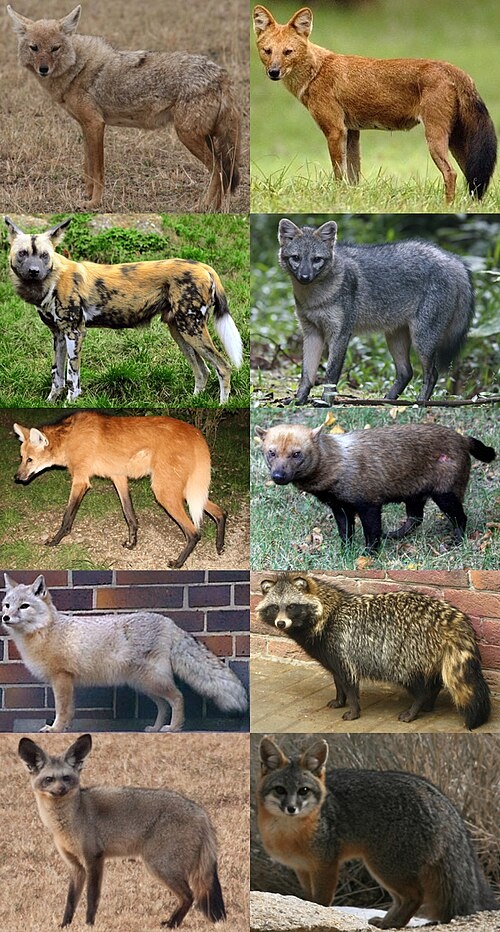
Golden jackal (canis), dhole
African wild dog, Crab-eating fox
maned wolf, Speothos
Corsac fox (vulpes), Japanese racoon dog (tanuki)
Bat eared fox, gray fox
Canidae is a biological family of caniform carnivorans ("dog-like" carnivores). It constitutes a clade (group of organisms composed of a common ancestor and all of its descendants) Members of this family are called canids. The family includes three subfamilies: Caninae, and extinct Borophaginae and Hesperocyoninae. Caninae are known as canines,and include domestic dogs, wolves, coyotes, raccoon dogs, foxes, jackals, African wild dogs and other species. [Source: Wikipedia]
The Canidae family is comprised of 13 genera and 37 species. Canids are widely distributed around the globe. They occur on all continents except Antarctica and are only member of the Order Carnivora that found in Australia (we’re talking about dingoes, introduced by humans during prehistoric times). Canidae fossils have been dated to the to the Oligocene Period (33 million to 23.9 million years ago) and Miocene Period (23 million to 5.3 million years ago), which makes them among the oldest extant groups of carnivores. Canids are probably an early offshoot of the caniform lineage (which includes mustelids (weasels),procyonids (raccoons and their relatives), ursids (bears), phocids and otariids (seals), and odobenids (walruses).[Source: Bridget Fahey and Phil Myers, Animal Diversity Web (ADW)]
Many species of canid are viewed as pests to humans, and populations of many species have been greatly reduced in some places. Coyotes and wolves have been blamed for killing sheep and cattle are have been killed by ranchers for this reason. Foxes, dingoes and jackals have been blamed for killing lambs and poultry are have been killed by farmers. Canids are also viewed as carriers of rabies (which they are but rarely). Some are hunted. Foxes in particular are valued for their pelts, which have been used in the fashion industry. Domestic dogs (C. lupus familiaris) have a long multi-dimensional relationship with humans.
WOLVES: CHARACTERISTICS, HISTORY, SPECIES, NUMBERS factsanddetails.com
CANIDS, CANINES AND CANIS: CHARACTERISTICS, BEHAVIOR AND REPRODUCTION factsanddetails.com
DOG AND WOLF HISTORY: ORIGIN, EVOLUTION, HYBRIDS AND RECORDS europe.factsanddetails.com
WOLF BEHAVIOR: PACKS, HIERARCHIES, MATING, PUPS factsanddetails.com;
GRAY WOLVES: CHARACTERISTICS, BEHAVIOR AND REPRODUCTION factsanddetails.com
WOLF FOOD: DIET, HUNTING: PREY, TACTICS, FEEDING HABITS factsanddetails.com;
WOLVES AND HUMANS: STORIES, LIVESTOCK, REWILDING factsanddetails.com
WOLF ATTACKS ON HUMANS: WHERE, WHY, WHEN, HOW factsanddetails.com
WOLF ATTACKS ON HUMANS IN ASIA AND THE FORMER USSR factsanddetails.com
WOLF ATTACKS ON HUMANS IN INDIA factsanddetails.com
DOGS: CHARACTERISTICS, BEHAVIOR AND INTELLIGENCE europe.factsanddetails.com
DOMESTICATION OF DOGS: THEORIES, EVIDENCE, WHY AND HOW europe.factsanddetails.com
WHEN AND WHERE DOGS WERE FIRST DOMESTICATED europe.factsanddetails.com
Canid Characteristics and Behavior
Canids have deep-chested bodies and a long muzzle. Their legs and feet are moderately elongated. They move in a digitigrade fashion — on their toes, not touching the ground with their heels,. Usually, they five toes are found on the forefeet and four on the hindfeet. Their metapodials (long bones of the feet that connect the toes to the ankle bones) are long but not fused. Unlike the Felidae (cats), canids have non-retractile claws. This means that they are worn down by activity and are not used much as weapons as is the case with some other carnivores. All male canids have a well-developed baculum (penis bone). The skulls of canids have an elongated facial region. Canids have nearly a full set of teeth with the following dental formula: 3/3, 1/1, 4/4, 1-2/2-3 = 38-42. Canine teeth are large but unspecialized. Molars are of the crushing type. The carnassial pair (teeth used for shearing and cutting meat) are strongly built.
Canids are primarily medium-sized flesh eaters, but they more omnivorous (eat plants and animals) than many carnivores, consuming invertebrates, plant matter, and carrion as well as the prey they kill themselves. Canids are known more for endurance than for speed, although they be pretty fast. They typically catch prey by pursuit over long distances in relatively open terrain until the prey tires. Kills are made by grabbing for the nape of neck and tackling the prey to the ground. The neck grab is followed by a violent shake, which may dislocate the neck of the prey. Large prey may be immobilized by biting into the soft parts of the underbelly, often resulting in disembowelment and death from shock. The senses of smell and hearing are acute and important to these animals in hunting and socializing. Vision is less developed. [Source: Bridget Fahey and Phil Myers, Animal Diversity Web (ADW)]
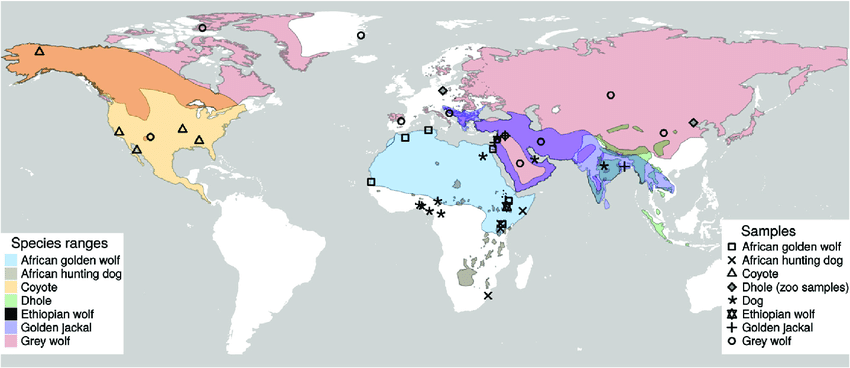
range of some canids
Some species of canids — generally those with larger body sizes — form packs with strict social hierarchies and mating systems. Hunting in packs allows canids to capture species much larger than themselves. In wolves, mating occurs only between the two dominant individuals in the pack.Pack-forming species, as well as less gregarious species such as foxes, are very territorial. Territory marking occurs in many species through repeated urination on objects on the periphery and within territories. Other scent glands are also important in the social behavior of these species; these include anal glands and glands on the dorsal surface of the tail near the base.
Canis (Dogs, Jackals, and Wolves)
Canis encompasses "dog like" canids. It is a diverse genera encompassing seven species of canids which include jackals, wolves, coyotes, and domesticated dogs. Canis means "dog" in Latin, "canine tooth" is also derived from Canis and refers due to the long fang-like teeth that all canids possess. Previously the Canis included foxes but they were removed and separated into their own Vulpes genera. African wild dogs are canids but not canis. They are classified into the genus Lycaon and are the only surviving member of this genus.[Source: Lydia Oliver, Animal Diversity Web (ADW) |=|]
Canis can be found dispersed throughout the Northern and Southern hemispheres and are found in every continent, even Antarctica if you count they domesticated dogs that are often there. In the wild they occupy many habitats, including deserts, dry open grasslands, shrublands, wetlands and rocky areas in temperate and tropical areas, in mountains up to 3,700 meters (12,140 feet), tundra and boreal forest in higher northern latitudes , and even suburban and urban environments.
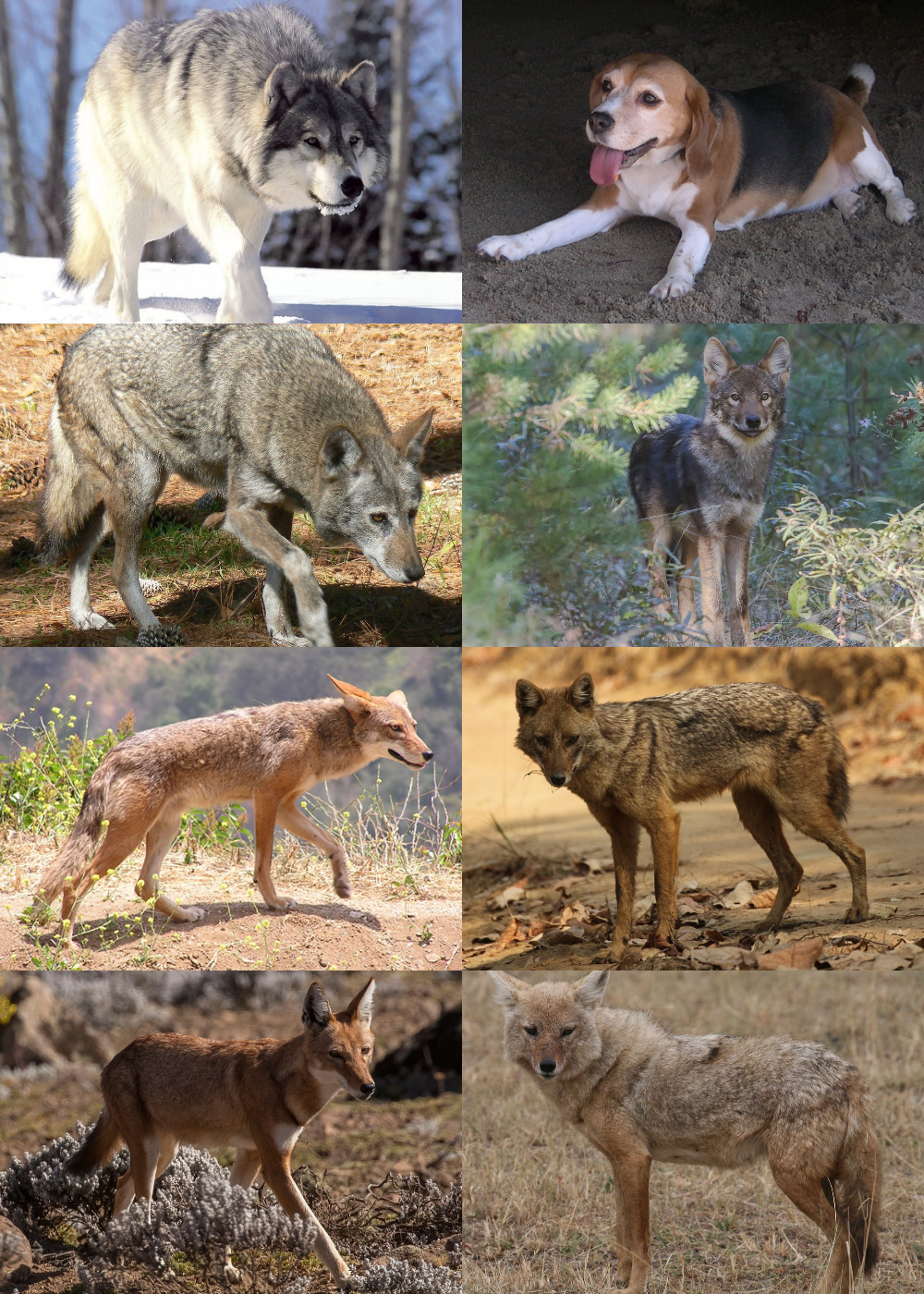
1st row: wolf (C lupus),
dog (C familiaris);
2nd row: red wolf (C rufus),
eastern wolf (C lycaon);
3rd row: coyote (C latrans),
golden jackal (C aureus);
4th row: Ethiopian wolf (C simensis),
African wolf (C lupaster)
Canis species are top predators in the ecosystems and generally live six to eight years in the wild. Canids are sometimes killed by other canids in disputes over territory or mates. Most mortality occurs within the first few years of life when young are more susceptible to disease, starvation and attacks by predators. Natural mortality of adults can be the result of injuries from hunting or defending territory. Many deaths of canids have been human-related, with many caused conflicts over livestock deaths.
On the International Union for Conservation of Nature (IUCN) Red List canis are listed as Not Evaluated. Humans have utilized them in the pet trade and for body parts. In some places they are an ecotourism draw. Ethiopian wolves (C. simensis) are labeled as endangered and decreasing in population. There are only a few hundred left in the wild. Red wolves (C. rufus) are have been designated as critically endangered, with 13 to 25 individuals left in the wild, mostly in eastern North Carolina, where they were reintroduced in the late 1980s. Issues with red wolves include hybridization with coyotes that also live within the area and habitat degradation.
Canis Characteristics and Diet
Canis can be distinguished from other canids generally by their relatively large size, long legs compared to body size. well developed skull, elongated rostrum (hard, beak-like structures projecting out from the head or mouth) and unique dentition, which includes enlarged canine teeth and a pronounced carnassial pair (molars used for sheering meat). They have traditionally been hunters, preying on everything from small rodents to large herbivores. But they also very opportunistic and can feed on a wide they also can consume plant matter making them facultative carnivores. Canids are top predators within the ecosystems they occupy — their diversity enables them to dominate desert, forest, and mountain habits. [Source: Lydia Oliver, Animal Diversity Web (ADW) |=|]
Canis species range in weight from 10 to 70 kilograms (22 to 154 pounds), with coyotes (Canis latrans) and jackals (Canis aureus and Canis adustus) being in the smaller size range and Ethiopian wolves (Canis simensis), red wolves (Canis rufus) and the grey wolves (Canis lupus) all being significantly larger in height and weight with males often weighing over 60 kilograms (132 pounds). Male and female canids look similar but males are slightly larger. Coat patterns and colors vary among species but common coat colors include: brown, black, grey, white, and red. Seasonal coat changes occur in canids that reside at high latitudes. Canids have a broad gait which makes covering long distances in search of prey more efficient. |=|
Canis are primarily carnivores (eat meat or animal parts) but can also be classified as omnivores (eat a variety of things, including plants and animals) and are described by some as falcultative carnivores (animals that primarily eat meat but can also consume non-animal food sources). They feed mainly on animal flesh, and supplement their diet with plant matter when food of that type that they like is available or when meat is not available. Canids have well developed carnassials (teeth), designed for shearing meat and crushing bone. Wolves can feed on large mammals including elk, moose, deer but will also eat small ones such as mice. medium-sized canids feed on smaller mammalian prey including mice and rabbits. Large and medium-sized canids supplem their diets by eating berries, fish, and some plant matter. They can also be scavengers, Weak or young prey are often targeted during hunts. Packs of canids try to flush prey out into the open and rush in to bite any possible part of the prey with the goal of exhausting the animal and taking it down the animal. Once down, prey is torn into and canids will then gorge themselves on the carcass. |=|
Canis Behavior and Communication
Canis are terricolous (live on the ground), crepuscular (active at dawn and dusk), motile (move around as opposed to being stationary), nomadic (move from place to place, generally within a well-defined range), territorial (defend an area within the home range), social (associates with others of its species; forms social groups), and have dominance hierarchies (ranking systems or pecking orders among members of a long-term social group, where dominance status affects access to resources or mates). [Source: Lydia Oliver, Animal Diversity Web (ADW) |=|]
Canis are very sociable animals. They live in groups called packs of three to 10 individuals with a strict social hierarchy. Living in groups gives canids protection, allows them to take down larger prey, and hold territory without expending too much energy. Packs defend a broad territory and move throughout that space. Top ranking males and females are the only individuals allowed to breed, and often times once the young reach sexual maturity, they leave their natal pack in search of new canids with which to form packs.
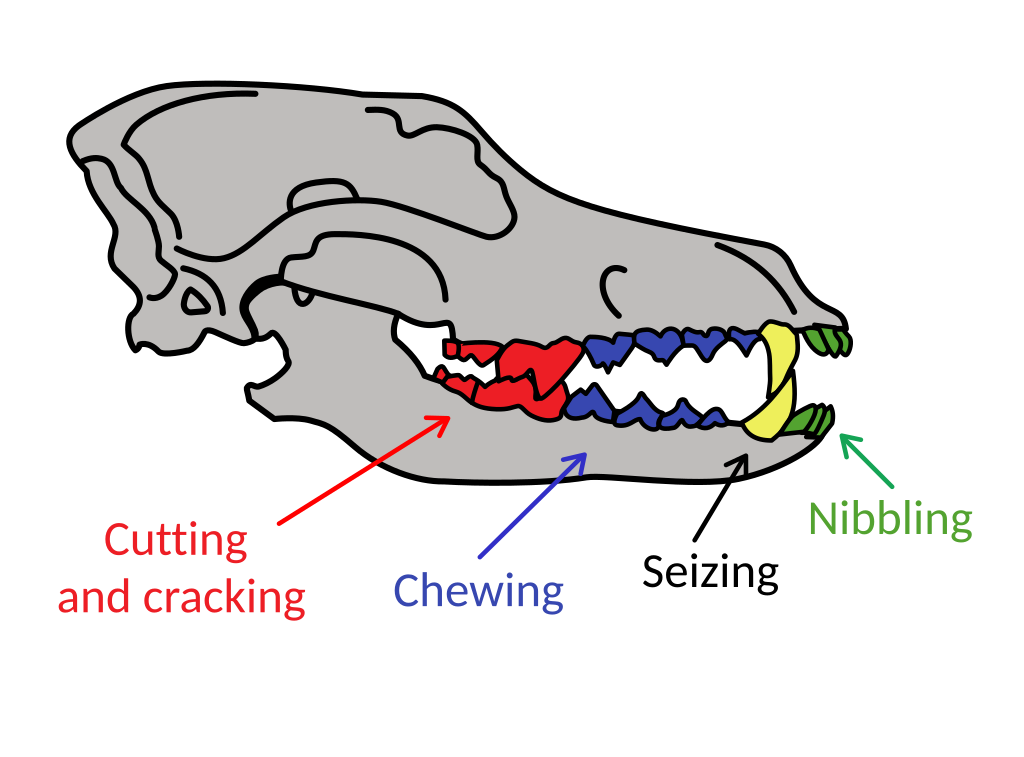
Canis sense and communicate with vision, touch, sound and chemicals usually detected by smelling, duets (joint displays, usually between mates, and usually with highly-coordinated sounds) and scent marks produced by special glands and placed so others can smell and taste them. Canis have an acute sense of smell and hearing, fairly good and employ broad range of vocal cues. They communicate through scent marking, body language, and vocalizations. Within close range, many canids use a variety of tail movements, ear positions, lip and jowl movements, piloerection (hair standing up), and entire body movements to send message to other members of their species that even other canids of other species can pick up.|=|
According to Animal Diversity Web: Canids also use tactile and physical contact to communicate positive and negative feelings with other members of their pack. Canids use their strong sense of smell the most — from finding food sources, identifying scent markings, and even to determine a new competitor, predator, or pack mate in the area. At a distance, canids rely on a variety of vocalizations to communicate to other canids, and most vocalizations are species specific. Canis lupus howls to communicate. Canis latrans, Canis adustus, Canis mesomelas, and Canis aureus produce a variety of yips and small howls in different tones and pitches to communicate. |=|
Canis Mating, Reproduction and Offspring
Canis species are unique among mammals because they have a high rate of monogamy (have one mate at a time). Most canids live in packs, where the dominant male and female pairs are the only ones to breed. Mates are first selected around the age of sexual maturity which typically occurs at 2-3 years of age. Male and female Canids both leave their natal pack in search of non related mates and to join a new pack. [Source: Lydia Oliver, Animal Diversity Web (ADW) |=|]
Most canis species are cooperative breeders (helpers provide assistance in raising young that are not their own). Not all canis species are monogamous all the time. Ethiopian wolves and red wolves rufus engage in polyandry and have multiple breeding pairs in a pack. On choosing partners, Minnesota biologist Craig Packer told National Geographic, “Size does matter” though more for male competitions than female preference
Mating occurs in spring and summer, generally from March to September. Canids in lower latitudes breed later in the summer months and higher latitudes breed in late spring. The gestation period of Canids is around 60 days and a typical litter size ranges from 2-6 pups. Young are born in a den with their eyes closed. After about a week their eyes open and and they develop skills within the first few weeks. After a few months, the pups slowly start to explore outside of the den but are not fully weaned from the mother until eight weeks of age. Around the age of sexual maturity (2-3 years) canids either stay in their natal pack or leave to join another one in the hopes of finding a mate. |=|
Young are altricial, meaning they are relatively underdeveloped at birth. Parental care is provided by both females and males. There is an extended period of juvenile learning. Pups are dependent on the mother for milk until the age of eight weeks, but other members of the pack begin to regurgitate food starting at four weeks of age. Males care for young by regurgitating food for the pups as well as bringing back food to the den for the alpha female to consume while she is still nursing. Pups are fully weaned by the age of eight weeks. Pups are dependent on the pack for the first year of life to bring food either in the form of regurgitated matter or a carcass to learn necessary hunting skills.
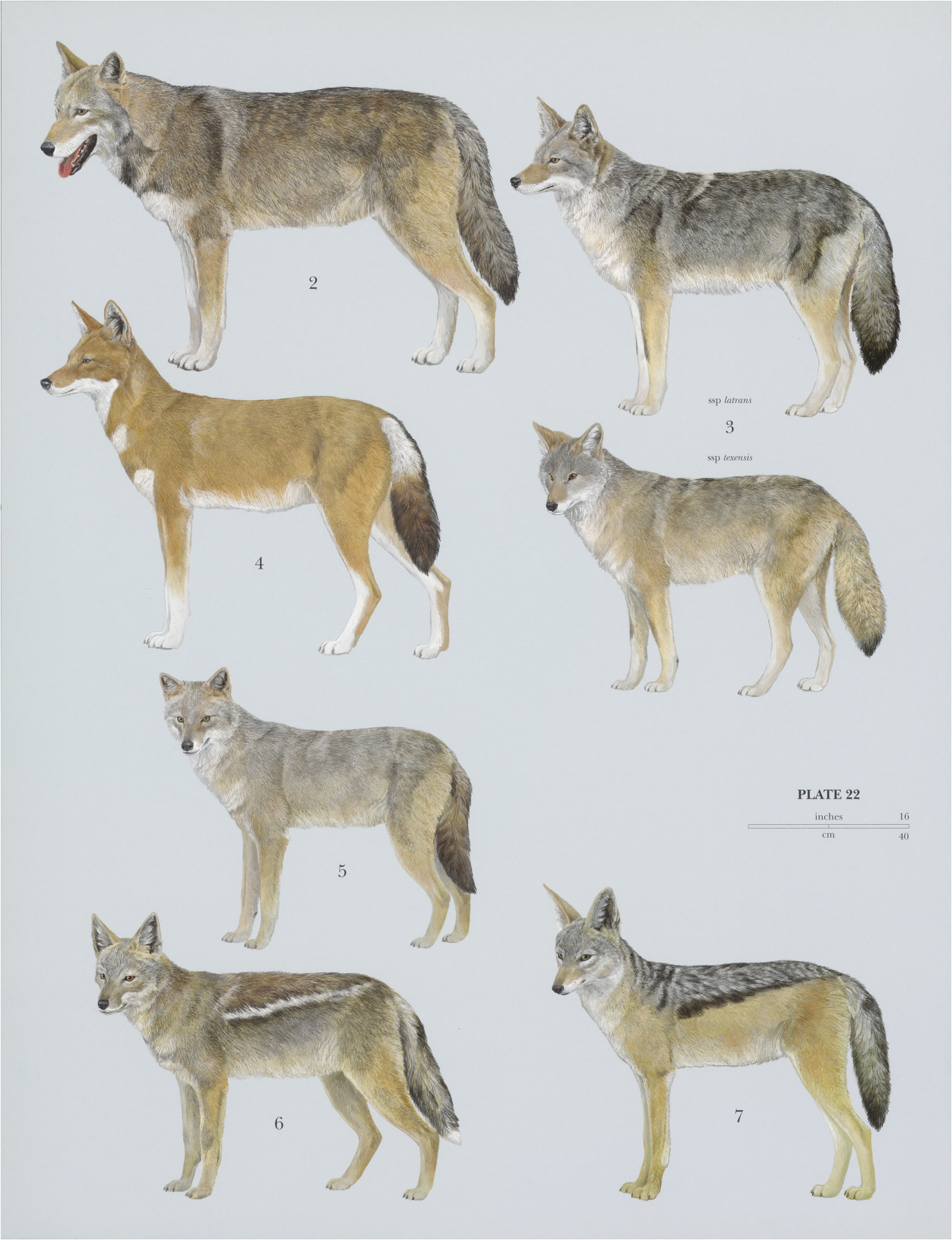
Some canis species: 2) Red Wolf (Canis rufus), 3) Coyote (Canis latrans), 4) Ethiopian Wolf (Canis simensis), 5) Golden Jackal (Canis aureus), 6) Side-striped Jackal (Canis adustus), 7) Black-backed Jackal (Canis mesomelas)
Image Sources: Wikimedia Commons
Text Sources: Animal Diversity Web animaldiversity.org ; National Geographic, Live Science, Natural History magazine, CNTO (China National Tourism Administration) David Attenborough books, New York Times, Washington Post, Los Angeles Times, Smithsonian magazine, Discover magazine, The New Yorker, Time, BBC, CNN, Reuters, Associated Press, AFP, Lonely Planet Guides, Wikipedia, The Guardian, Top Secret Animal Attack Files website and various books and other publications.
Last updated May 2025