
FUNERALS IN THE PHILIPPINES

Funeral rites are every important to Filipinos. At some funerals, Filipinos drop cash into boxes, biscuit cans and glass jars near or in the coffin. On Camigan island the dead are displayed under a glass sheet in a spray painted wooden coffin. Filipinos generally do not cremate the bodies of the dead; they must remain intact so they can resurrect. Tagalogs believe that the spirits of the dead remain hanging around for a considerable time before departing to the afterworld and hold that body returns to the four elements: earth, water, fire and air. They used to place the body in a grave and rebury the bones later in an ossuary.
As Catholics, Filipinos practice the religion’s ideologies concerning death and conduct their funeral services in accordance to Catholic theology. The basic format of death rituals and celebrations in provinces, where "funeral parlors" are not yet popular, are wake, vigils, burial, nine-day-novena, 40th day, and 'waksi' (death anniversary). However, many aspects that appear in Filipino burial practices involve cultural superstitions and traditions specific to regions of the country.
For Filipino Catholics twenty-four-hour vigil is held at the deceased person's home, and the body is escorted to the cemetery after the religious ceremony. The tradition is for mourners to walk behind the coffin. for those that can afford it, a mausoleum is built during the lifetime of the user. The size of the edifice indicates the position of the builder. Though the majority of Filipinos are Catholic, often ancient burial traditions are entwined with Christian ones. For example, the Apayaos of the Cordillera Administrative Region bury their dead family members under the kitchen in their home. Another example hails from the Benguet region where the deceased is blindfolded and set in a sitting position next to the main entrance of the house for eight days. The Ilongot bury their dead in a sitting position, often tying the hands and feet together to prevent the spirit from roaming. [Katharine Viola, Demand Media; [Source: “Encyclopedia of World Cultures Volume 5: East / Southeast Asia:” edited by Paul Hockings, 1993]
Professor Susan Russell at Northern Illinois University wrote: “ Death is always an occasion that marks a society's traditions, and in the Philippines funerals are usually accompanied by somber village processions and music, essential parts of Roman Catholic ritual practice. Filipino indigenous religious beliefs traditionally celebrated rice planting and harvesting times, the death anniversaries of departed ancestors, and these have been blended in meaning and timing with Catholic rites such as All Saint's Day and Fiesta de Mayo. [Source: Professor Susan Russell, Department of Anthropology, Northern Illinois University, seasite.niu.edu]
RELATED ARTICLES:
DEATH, BURIALS AND CEMETARIES IN THE PHILIPPINES factsanddetails.com
RELIGION IN THE PHILIPPINES factsanddetails.com
CATHOLICISM IN THE PHILIPPINES: LIFE. INFLUENCE, SAINTS, POPE VISITS factsanddetails.com
CATHOLIC PRACTICES IN THE PHILIPPINES: PRAYER LADIES, SANTOS, BAPTISMS factsanddetails.com
For articles on the Catholic Church in general see CATHOLICS factsanddetails.com
For Information in the Funerals and Afterlife Practices of Different Ethnic Group See the Ethnic Groups and Minorities listed Under the MINORITIES factsanddetails.com
HOLIDAYS IN THE PHILIPPINES: NEW YEAR'S, ALL SAINTS DAY, MAY AND MANILA AREA FIESTAS factsanddetails.com
HOLY WEEK AND LENT IN THE PHILIPPINES: VOWS, TABOOS, BLOODY PROCESSIONS, GETTING NAILED TO A CROSS factsanddetails.com
Philippine Vigils
Filipinos come together soon to commiserate upon learning of the death of a relative or friend. The family stands vigil over the body day and night, taking turns until the burial, which may occur up to three days later. The widow or widower, children, and other close family members receive guests who come to pay their last respects and offer condolences. It is customary to send flowers or a Mass card offering prayers. [Source: “Culture Shock!: Philippines” by Alfredo Roces and Grace Roces, Marshall Cavendish International, 2010]
Once a death has occurred, it is important that a priest bless the body to ensure the deceased will get into heaven. A Chinese-Filipino custom involves the hiring of professional mourners to expedite the process. In preparation for the wake, the body of the deceased is prepared and laid out in the home. Family members do not work or participate in activities during this time. [Source: Katharine Viola, Demand Media /*/]
Vigils are held all throughout the night until the burial of the dead to keep the deceased company. People usually kill time during the vigil by eating, drinking, gambling or just plain talking with one another. During the time of the wake, the nearest kin is expected to sit beside the body in order to receive contributions or ‘abuloy’ to the visitors. In return, the family in mourning is expected to prepare food and refreshments for their guests.
Philippine Wakes
Wakes are generally held around three days after death and may last anywhere from three to seven days, which allows friends and family to say their last goodbyes. Provincial wakes are usually held in the home, while city dwellers typically display their dead at a funeral home. Apart from spreading the news about someone’s death verbally, obituaries are also published in newspapers. [Source: thefuneralsource.org]
A Filipino wake is rarely completely solemn. Although people try to maintain a quieter and more respectful atmosphere than usual, the gathering is not entirely subdued. Conversation, shared memories, and the presence of relatives and friends create a social setting, even as a sense of loss defines the occasion. Immediate family members typically wear black as a sign of mourning, with widows and other women often wearing black veils. Men usually dress in dark trousers and a white shirt with a black armband. [Source: “Culture Shock!: Philippines” by Alfredo Roces and Grace Roces, Marshall Cavendish International, 2010]
During the wake, visitors sign a register listing their names and addresses. After the mourning period, the bereaved family usually sends prayer cards and expressions of thanks to those who attended. Among wealthier families, it is also customary to publish an obituary in the newspaper announcing the death and giving the time and place of the funeral rites. These notices carefully list the names of the immediate family, ensuring that no relative is omitted. After the burial, a separate notice of gratitude may also appear in the newspaper.
In rural communities, traditional wakes sometimes include activities intended to keep those holding vigil awake through the night. People may engage in poetic contests or parlor games such as riddles. After the burial, a series of nine days of Masses and religious services is held, attended by close relatives and friends. On the ninth day, the family serves food and drinks to thank those who have come to offer sympathy and support during the vigil. On this occasion, mourners may remove the visible signs of mourning, such as black clothing or the black ribbon or rectangular pin worn as a symbol of grief.
Aaron Simon Caparaz wrote: “A celebration in a wake of a dead relative may be offensive or improper to many cultures, but in the Philippines, especially in provinces, it is a norm that has been passed on from generations along with rituals and superstitious beliefs. The mourning and the weeping are still present, but a happy and welcoming atmosphere would usually envelop the place to help the deceased on his journey to the afterlife. Filipinos consider the deaths of relatives as opportunities to strengthen ties in the family. Long lost relatives, friends, and even relatives working abroad would re-unite to pay respect and honor the relationship they had with the deceased. [Source: Aaron Simon Caparaz, next.upi.com, September 27, 2010]
Filipino Funeral
After the wake, a funeral procession takes place, a Mass is given and a burial follows. A rosary is placed in the hands of the deceased and before the coffin is lowered into the ground, the casket is reopened for one last goodbye. Some Filipinos break the rosary to prevent another death in the family, and small children wear red so that the spirit of the dead will not haunt them.
As a rule, the casket is open and it is very normal for people to touch the body of the dead person. Filipinos don’t believe in cremation and feel a body should remain whole. Rosary sessions are held each night for thirty days to aid the deceased in getting to heaven. These sessions take place in the home of the deceased’s family and are another opportunity/obligation for family and friends to publicly pay their respects to the immediate family of the deceased. At this time and throughout the period of visitation and funeral, it is considered disrespectful to show emotions that are anything but “somber and depressed.” [Source: Sandi Clark, indiana.edu -]
Funeral arrangements — such as the casket and flowers — are very elaborate, since what occurs at the funeral is considered a reflection of the deceased’s life. The funeral itself is a long procession on foot (since towns are small enough for the cemetery to be close by), with participants singing parts of prayers all the way to the cemetery. The procession will take an indirect route to the cemetery and make its way around the town to give as many people as possible the last opportunity to pay respects to the deceased. -
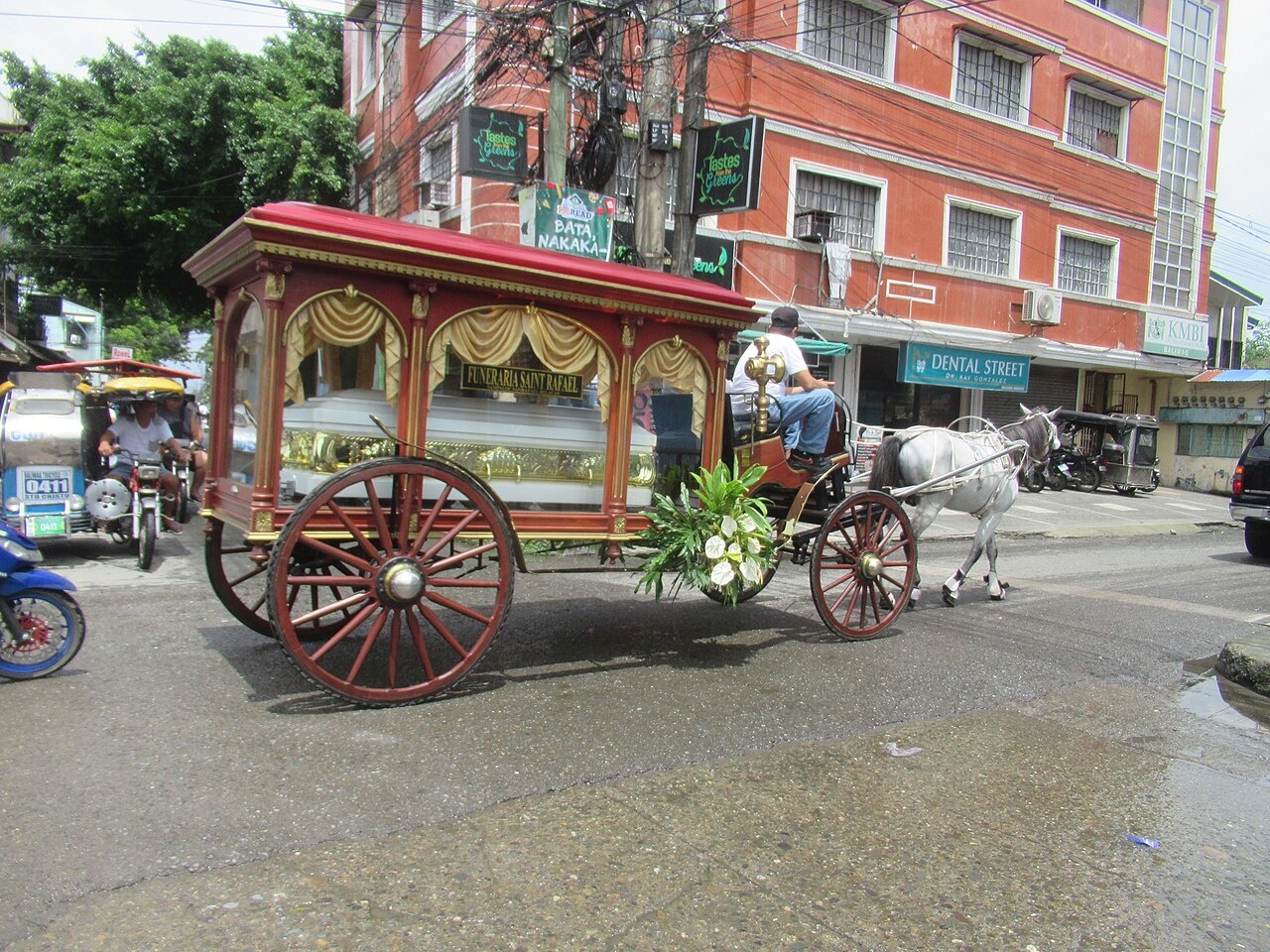
Aaron Simon Caparaz wrote: “The burial is a very solemn event. The family would view the body for the last moments and then the lid of the coffin is closed. Before the coffin is moved out of the house, members of the family say a prayer. The coffin is then carried out the main door feet first. This act symbolizes the exiting of a person, where if the head was to go out first, it is believed that the spirit of the deceased will not leave the house. The coffin is then loaded on a horse carriage, or carried by chosen individuals. The traditional funeral procession in the Philippines involves walking to the church and the cemetery, no matter how long the distance is. Today friends and other relatives who cannot participate in the parade can opt to ride a car during the procession. [Source: Aaron Simon Caparaz, next.upi.com, September 27, 2010]
Funeral Customs and Etiquette in the Philippines
In the Philippines, generally the deceased’s family publishes an obituary stating the time and place of the funeral and listing the names of the family members. Friends and acquaintances read the notice to learn when they can pay their respects. It is customary for people to send flowers or a Mass card, which is usually handed to the closest kin present. However, the obituary sometimes includes a note requesting that flowers be omitted, so it is important to check for this before sending any. [Source: “Culture Shock!: Philippines” by Alfredo Roces and Grace Roces, Marshall Cavendish International, 2010]
Guests generally wear black or other dark, somber colors at the wake, although white is also considered acceptable. Close family members typically wear black or white as a sign of mourning. Upon arriving at the funeral parlour, visitors sign a guest book placed near the entrance. They usually include their address so the family can conveniently send a thank-you card later. Guests then approach the widow or widower and the children to express their condolences; the immediate family is often distinguished by wearing black. A visit of about fifteen to thirty minutes is generally considered appropriate.
During the wake, visitors may be offered food or drinks by the family, although accepting them is optional. Friends and acquaintances sometimes gather outside the church or funeral parlour, where they share memories and reminisce about the life of the deceased. Attending both the wake and the funeral is not required unless the visitor had a close relationship with the person who died. After the wake and funeral, the family sends thank-you cards to those who attended and offered support.
If the family of the deceased is not well-off, it is customary for visitors to donate some money to help with funeral expenses. This contribution is called an abuloy. Since many relatives and friends are expected to come, refreshments are usually prepared. Food plays an important social role in Filipino culture, and hospitality requires that visitors be offered something to eat or drink even during times of mourning. Another related Filipino custom is pabaon, the practice of giving departing guests a small parcel of food as they leave a gathering or feast. This gesture symbolizes hospitality and a proper send-off, even for relatives leaving the country. Archaeologists also use the term pabaon to describe food offerings placed in pottery or porcelain vessels found in ancient gravesites, suggesting that the tradition has deep historical roots.
Death and Funeral Superstitions in the Philippines
Elements of Filipino superstitious beliefs connected to death and funerals entail the involvement of the sudden appearances of certain animals, particularly those that are black in color. Examples are the following: the appearance of a lingering black-colored butterfly around an individual is taken to indicate that a next of kin of that person died; the sighting of a black-hued cat by an ill individual heading toward a hospital would mean that he or she may not survive his or her disease; the detection of an owl near the home of a sick individual signifies imminent death for that person. [Source: thefuneralsource.org]
Death superstitions: 1) A black butterfly flitting inside the house will bring death in the household. 2) A dog barking or howling continuously signifies the impending death of its master. 3) A man without shadow will soon die. 4) Candles must be burned for the dead to protect them from evil spirits. 5) A picture falling from the wall on its own is an omen of the death of the person in the picture. 6) Sleeping in front of a mirror can cause the death of that person whose soul might get trapped in the mirror. 7) Trampling on a man’s shadow can cause his death. 8) Dreaming of an extracted tooth means death of a close relative. 9) Among the Ilocanos dreaming of the loss of a hat, broken earrings and clothes swept away by a river current will mean the death of a relative or close friend. Dreaming of a jar of money means impending death of a family member among Bicolanos. To Aklanons a boat ride is an omen of death in the family. [Source: felixfojas.wordpress.com , March 6, 2012 ^*^]
10) In Central Luzon it is believed that if it rains when a person dies is a sign that such a person was a good man since even the heavens weep for him. 11) Smelling the fragrance of flowers for the dead means someone will die. 12) The spirit of a person who dies a violent day will become earthbound. 13) A dead person who is buried with his shoes on will haunt his relatives and, during his arrival, his loud footsteps will be heard. 14) Before a dead person is buried his shoes or slippers must be removed and placed beside his legs so that St. Peter will welcome him at Heaven’s gate. For a relative to assist in carrying the coffin to the grave will mean another death in the family. ^*^
15) The Ilocanos break a plate as an offering to the dead. 16) No kin should look back or attempt to go back to the house after the funeral procession has started. 17) Leytenos bring out the coffin from the house through the window to make it easier for the newly departed to rest in peace. 18) If a rosary is placed in the hand of the dead prior to burial, its string should be snapped because continuity in the beads will mean another death in the family. 19) A person who sneezes in front of a corpse will also die. 20) Many Filipinos bury precious items with the dead for use in the afterlife. 21) Right before the coffin is lowered in the grave, the children of the dead person are made to step across the coffin while adults throw flowers into the open grave so the spirit of the departed kin will not haunt them. ^*^
Superstitious rules during the wake and the burial: 1) Feed the mourners, but don't walk them to the door when they leave. 2) Don’t sweep the floor while the body is still lying in state or else other deaths in the family may follow. 3) No tears should fall on the dead or the coffin as it would make a person's journey to the afterlife difficult. 4) When someone sneezes at the wake, pinch him. 5) During the wake the dead person's relatives must not take a bath. 6) Food from the wake should not be brought home because it's believed that the dead touches all of it. 7) After a funeral service, guests should not go directly home. This way the spirit of the dead won't follow them to their house. 8) When carrying a coffin out for burial, it should be carried head first as it prevents the soul of the dead from coming back. 9) Before a man comes home from a funeral he should light a cigarette from a fire at the cemetery gate to shake off spirits of the dead. 10) The corpse should be positioned facing the door - the feet should be facing toward the door so it will allow the spirit or depart easily. 11) Family members should wear black or white, colors are prohibited. 12) Weddings, birthdays, and other social activities should not be celebrated for one year. 13) The widow, children, and immediate family members are prohibited from carrying the coffin or else they will become ill and die. 14) While the casket is on its way to the cemetery or the church, relatives who preferred to stay at home should not have a glimpse of the casket or else someone in the family would die. [Source: Aaron Simon Caparaz, next.upi.com, September 27, 2010]
Funeral Traditions of Different Philippines Ethnic Groups and Regions
The Apayao, also known as the Isnegs or Isnags, of the Cordillera Administrative Region bury the deceased person under the kitchen area of their homes. The Ilongot are buried in a sitting position, and if a woman, has her hands tied to her feet, to prevent her "ghost" from roaming. The Bilaan people of Mindanao wrap their dead inside tree barks. Being enveloped as such, the dead person's body is then suspended from treetops. [Source: thefuneralsource.org +++]
For eight days, the indigenous people from Benguet blindfold the dead and then sit it on a chair that is placed next to a house’s main entrance. The arms and legs are held in the sitting position by means of tying. A bangil rite is performed by the elders on the eve of the funeral, which is a chanted narration of the biography of the deceased. During interment, the departed is directed towards heaven by hitting bamboo sticks together. +++
Some rural area residents in Cavite use of trees as burial places. The dying person chooses the tree beforehand, then when it becomes evident that person is going to die soon, either through sickness or old age, a hut is constructed close to the chosen tree. When that person dies, they is entombed vertically inside the hollowed- out tree trunk. +++
Filipinos in the Ilocos regions of the Philippines also have their own funeral and burial traditions, known as the pompon or "burial rites". An example would be how a dead husband is prepared by the wife for the wake, known in Ilocano as the bagongon. Typically, only the wife will cloth the corpse, believing that the spirit of the spouse can convey messages through her. Placement of the coffin is also important, which is to be at the center of the home and must be corresponding to the planks of the floorboards. Lighting a wooden log in front of the house is also customary because the smoke assists the spirit of the dead towards heaven. This log is kept in flames during the wake to repel wicked spirits. The ceremonial attire of the female family members for the vigil is clothing with black coloration. Their heads and shoulder area are shrouded with a black handkerchief known as the manta. +++
Funeral Burial superstitions of the Ilocano people include closing all windows first before taking the casket out of the home, preventing any part of the coffin to hit any part of the dwelling (to prevent the spirit of the dead from loitering to bring forth dilemmas to the household; to some Filipinos, a coffin hitting any object during a funeral means that another person will soon die, and washing the hairs of family members with a shampoo known as gogo (to remove the influence of the spirit of the departed). rice cakes and basi to attendees after each prayer offering session. On the ninth night, a feast is held after the praying or novena. They will again recite prayers and a feast after one year. +++
One of the ancient customs for burying the dead in the Philippines is through the use of burial jars known as Manunggul jars. These ancient potteries were found in the Manunggul Cave at the island of Palawan. A characteristic of the jars for the dead is the presence of anthropomorphic human figures on the pot covers. These figures embody souls riding a boat for the dead while seafaring towards their sanctuary in the afterlife. These containers have been dated to be from 710 BC to 890 BC. There are also figures of boating people steering paddles, wearing headbands, jaw-bands, and persons with hands folded across the chest area. The latter is a method of arranging the remains of the dead. +++
Superstitions in Davao City include cutting rosaries that are placed within the hands of the departed (to sever the possibility of having a series of deaths), placement of a chick on the coffin during wakes, preventing teardrops from reaching coffins (in case of brutal deaths), breaking plates prior to taking the coffin out of any edifice, making children walk under a hoisted coffin before loading the latter into the hearse, and smoking feet with smoke coming from burning dried leaves or paper when leaving the burial ground. +++
For Information on the Funerals and Afterlife beliefs of Different Ethnic group See the different groups under MINORITIES factsanddetails.com
Mourning Period After a Filipino Funeral
Aaron Simon Caparaz wrote: “After the burial a nine day groups prayers offered to the dead, must take place. These group prayers are held to help the deceased enter the gates of heaven. The fourth and ninth days are said to be the time where the soul of the deceased comes back. A food offering is left outside the door of the family’s house during these days to offer to the soul of the deceased. The 40th day after the death of the person is celebrated because it is said that on that day the spirit of the deceased ascends to heaven. Exactly one year from the day of the death, a final mourning called ‘waksi’ is celebrated. In a waksi, the family prepares a feast and, together with the visitors, offers prayers to the deceased. Some provinces consider this as the day where the family can go back to wearing colored clothes. [Source: Aaron Simon Caparaz, next.upi.com, September 27, 2010]
During the early period of mourning, family members wear signs of grief for about six weeks after the death of a relative. This may take the form of a black pin attached to a blouse or shirt, or the wearing of black clothing. Such attire signals respect for the deceased and publicly expresses the family’s loss. For one year or more, grieving family members wear black. Men wear black ribbon around their arms, and women dress entirely in black. Often, women who lose a child wear black for the rest of their lives.
Formal mourning usually ends after one year. At that time, the family often holds a commemorative meal or small gathering for close relatives and friends. This event marks the transition from mourning to remembrance and serves as a way to honor the life and memory of the person who has passed away. It is customary for family members to frequently visit the grave, especially on All Saints’ Day and All Souls’ Day. The grave sites are cleaned, adorned with flowers and candles are lit to assist with prayer. Food is also served during this time. /*/
Traditionally, mourning clothes are worn for an entire year after the death of a loved one. The ceremony marking the first anniversary of the death signals the end of formal mourning. This rite, known as babang luksa, allows the immediate family to set aside their mourning attire and return to wearing normal, colorful clothing. In recent times, attitudes toward mourning clothes have become more relaxed. Even so, the community generally expects widows and close family members to observe a respectful period of mourning before returning to ordinary dress. Today, the novena—nine days of prayer often accompanied by Mass after the burial—is commonly regarded as the point when the formal period of mourning ends. [Source: “Culture Shock!: Philippines” by Alfredo Roces and Grace Roces, Marshall Cavendish International, 2010]
Families continue to remember the deceased through annual commemorations. On the anniversary of a person’s death, relatives often hold a Mass or visit the grave together. These gatherings usually bring together family members and friends for a small reunion in which they pray and recall the life of the departed. Wealthy families sometimes mark the occasion by publishing In Memoriam notices in newspapers to honor the memory of the deceased. The remembrance of prominent individuals may also be maintained through organized groups formed by relatives and supporters. These associations, often called “Friends of …,” gather around the immediate family and hold commemorative ceremonies on the person’s birthday or death anniversary. Through these activities, the individual’s legacy and public contributions continue to be remembered. [Source: Sally E. Baringer, Countries and Their Cultures, Gale Group Inc., 2001]
Image Sources: Wikimedia Commons
Text Sources: “Encyclopedia of World Cultures Volume 5: East/Southeast Asia:” edited by Paul Hockings, 1993; “Culture Shock!: Philippines” by Alfredo Roces and Grace Roces, Marshall Cavendish International, 2010; National Geographic, Live Science, Philippines Department of Tourism, New York Times, Washington Post, Los Angeles Times, Smithsonian magazine, Encyclopedia.com, Library of Congress, The Conversation, The New Yorker, Time, BBC, CNN, Reuters, Associated Press, AFP, Lonely Planet Guides, Google AI, Wikipedia, The Guardian and various websites, books and other publications.
Last updated March 2026