
HOLY WEEK IN THE PHILIPPINES
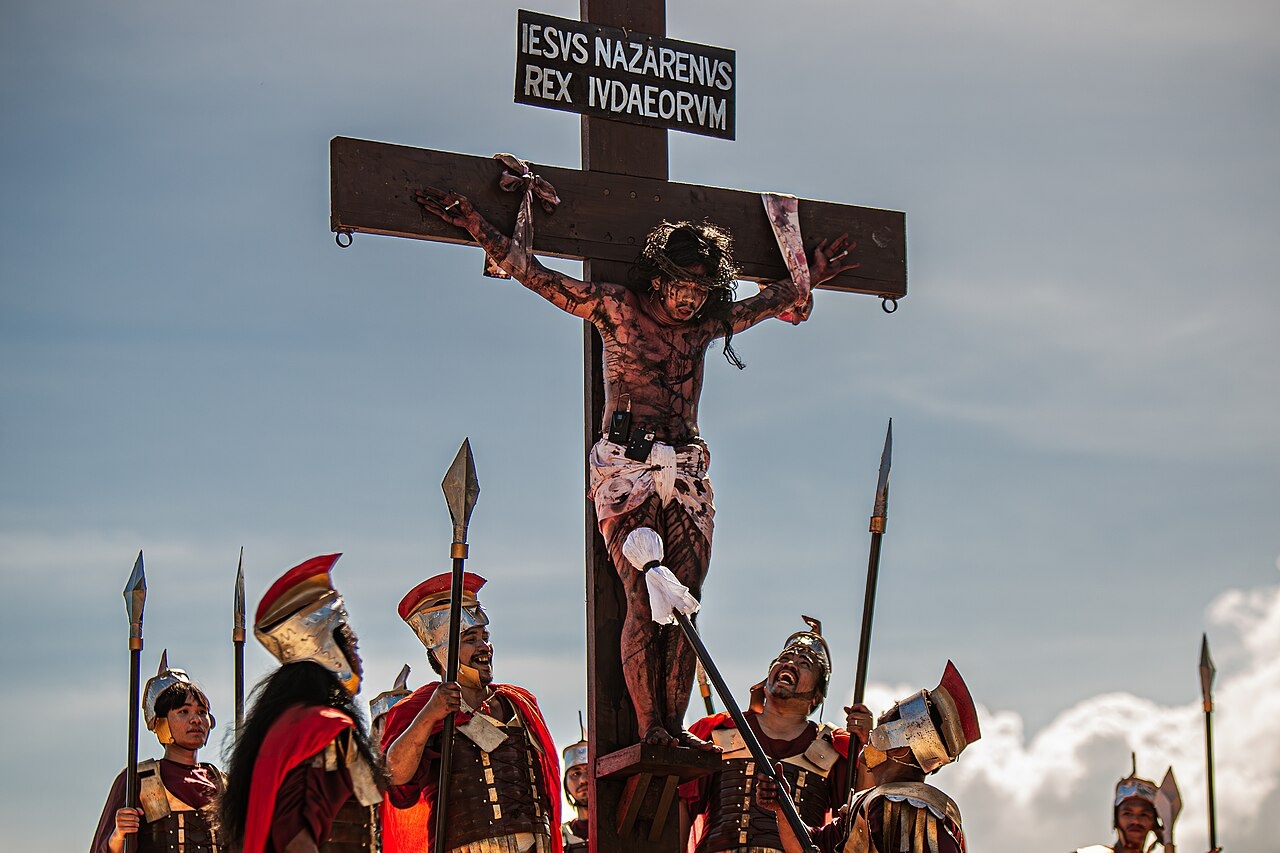
Holy Week, the week before Easter in Late March or April, is celebrated by Christians with a series of events that usually start slowly on Palm Sunday (the day Christ triumphantly entered Jerusalem), builds up to the solemn and gloomy processions on Good Friday (the day Jesus was crucified) and climaxes with joyous feasting and festivities Saturday at midnight and Easter Sunday (when Christ was resurrected from the grave). During the week, in some places, passion plays (dramas that depict the suffering of Christ), re-enactment of Christ's Trial and his journey to Cavalry (where Christ was crucified) are performed. Often entire towns participate in elaborate Holy Week ceremonies that include elaborate processions and dramas.
Holy Week rites are celebrated with religious passion plays, processions, solemnity and pageantry in almost every Philippine town. Maudy Thursday is three days before Easter. Good Friday, two days before Easter, is a somber affair marked across the Philippines with people, including children, walking barefoot through dusty vilage streets beating their backs with ropes and pieces of wood and soaking spectators with their blood. Passion plays are featured all over the country. Castelloejos hosts a a brutally realistic reenactment of the crucifixion called the Balaybay Calvary that features penitents, followed by flagellants, lugging wooden crosses to a hilltop. In Sant Antonio on Siquijor sorcerers gather to perform animist tang-alap rituals.
Maundy Thursday focuses on the "Visita Iglesia," where families visit seven or more churches to pray. It commemorates the Last Supper. Good Friday is regarded as a day of strict fasting and silence, often marked by the Senakulo (passion plays), processions of, and the veneration of the cross. Black Saturday, teh day before Easter, is a quiet, reflective day marking the time between Christ's death and resurrection.
The celebration of Jesus' suffering and death is a bigger event than Christmas Anne C. Kwaantes wrote in Christian Classics Etheral Library: “ On Palm Sunday, cleverly woven palms are bought and blessed at church, and then later brought home. Many rituals are observed as Holy Week continues. The passion story is chanted from booths temporarily constructed along the streets. In the cities some people drag heavy crosses along the road. Others walk along the streets whipping themselves to fulfill a vow to God or to do penance. On Thursday, all those who can, return to their home town. Every year on Good Friday, some individuals allow themselves to be publicly and openly crucified for some minutes. The country comes to a standstill. The people sleep. [Source: Anne C. Kwaantes, Fourum, Winter 2000, Christian Classics Etheral Library, pages 6, 7]
RELATED ARTICLES:
HOLIDAYS IN THE PHILIPPINES: NEW YEAR'S, ALL SAINTS DAY, MAY AND MANILA AREA FIESTAS factsanddetails.com
CHRISTMAS SEASON IN THE PHILIPPINES: PRE-DAWN MASSES, PAROLS, EVENTS factsanddetails.com
FIESTAS IN THE PHILIPPINES: HISTORY, PURPOSE AND WHAT THEY ARE LIKE factsanddetails.com
FAMOUS FESTIVALS IN THE PHILIPPINES: BLACK NAZARENE, ATI ATIHANS, MASSKARA factsanddetails.com
RELIGION IN THE PHILIPPINES factsanddetails.com
CATHOLICISM IN THE PHILIPPINES: LIFE. INFLUENCE, SAINTS, POPE VISITS factsanddetails.com
CATHOLIC PRACTICES IN THE PHILIPPINES: PRAYER LADIES, SANTOS, BAPTISMS factsanddetails.com
For articles on the Catholic Church in general see CATHOLICS factsanddetails.com
For Information in the Festivals of Different Ethnic Group See the Ethnic Groups and Minorities listed Under the MINORITIES factsanddetails.com
FUNERALS IN THE PHILIPPINES factsanddetails.com
Lent in the Philippines
The weeks leading up to Easter are called Lent. Lent takes place over the 40 day period from Ash Wednesday to Easter. Devout Catholics abstain from eating meat on all Fridays after that.Traditionally marked by fasting and prayer, Lent commemorates the 40 days and nights that Jesus spent in the wilderness after his baptism. Lent is derived from the Old English word “lencten”, meaning 'lengthen' or 'spring.'. Lent is observed in spring, when the days begin to get longer. Lent is preceded by Shrove Tuesday, which has traditionally been the biggest day of Mardi Gras and Carnival,
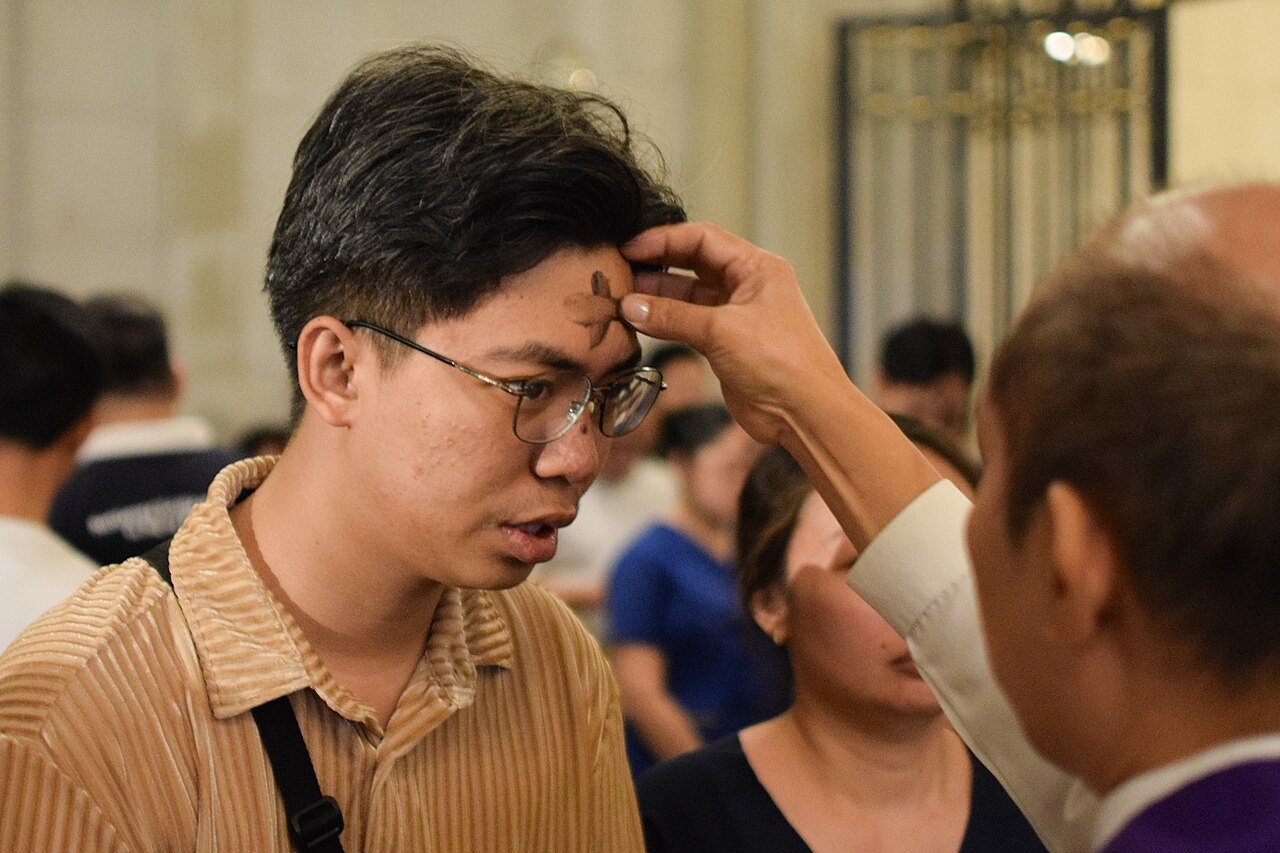
Filipinos normally go to mass on Ash Wednesday and receive ashes on their forehead from the officiating priest. During the Lenten season, most communities do a reading of the Passion narrative and a performance of a popular Passion play. The custom of reading or chanting of the Passion could be an adaptation of a pre-Spanish practice of chanting lengthy epics, but its continuing importance in Philippine life probably reflects the popular conception of personal indebtedness to Christ for His supreme sacrifice. At least one observer has suggested that Filipinos have, through the Passion, experienced a feeling of redemption that has been the basis for both millennial dreams and historical revolutionary movements for independence. [Source: Library of Congress]
The Lenten season is associated with many traditional taboos and beliefs. Some people avoid traveling or bathing on Holy Thursday and Good Friday. Others test the supposed power of their anting-anting during this period. A folk belief also says that if children jump high during the offertory at Mass on Holy Saturday, they will grow taller.[Source: “Culture Shock!: Philippines” by Alfredo Roces and Grace Roces, Marshall Cavendish International, 2010]
Lenten Rites in the Philippines
Lenten observances in the Philippines have often blended with older folk traditions, incorporating elements of elaborate Spanish Catholic ceremonies into local beliefs and practices. In some areas, people believe that supernatural power can be gained on the night of Good Friday by performing special rituals. One belief holds that a person may receive a magical talisman by standing beneath the clustered blossoms of a banana plant at midnight, waiting for the charm to drop into the mouth. Others travel to the mystical slopes of Mount Banahaw to test or empower amulets believed to possess spiritual potency. [Source: “Culture Shock!: Philippines” by Alfredo Roces and Grace Roces, Marshall Cavendish International, 2010]
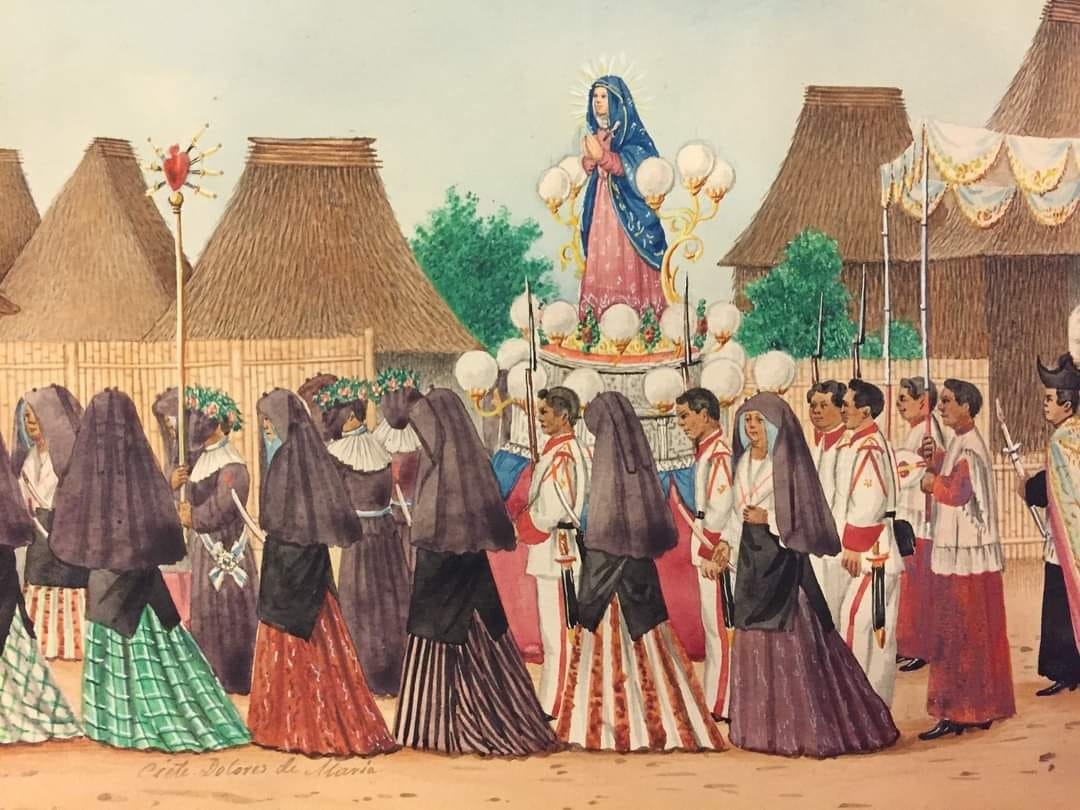
A hallmark of many religious celebrations, including town fiestas and Lenten rites, is the solemn evening procession. Devotees walk through the streets carrying lighted candles while women often wear veils as a sign of reverence. Religious images are borne through the town before being returned to the church. Such ceremonies illustrate the distinctive character of Filipino folk Catholicism, which combines orthodox Christian beliefs with elements drawn from earlier indigenous traditions. This blending reflects the enduring influence of pre-Christian values and the Filipino tendency to adapt and reinterpret religious symbols according to local beliefs.
Folk Catholicism remains an important feature of Filipino society and offers insight into the Filipino worldview. Clergy members have sometimes complained that many Filipinos attend church only on major occasions—baptisms, weddings, funerals, Christmas, or fiestas—though this criticism is often exaggerated. In rural communities especially, religious participation frequently revolves around social and family events rather than regular church attendance. Nevertheless, these occasions reinforce community bonds and sustain long-standing religious traditions.
During Lent, some penitential rituals become particularly visible. In certain areas, women cover their heads with leaves, wear dark robes, and walk barefoot in acts of devotion. Men may take part in public acts of penance, stripping to the waist and flagellating themselves with bamboo whips. Small cuts are made on the skin so that the blows cause bleeding, creating a dramatic expression of repentance and sacrifice. Although such practices persist in some communities, they are generally discouraged by modern church authorities, who regard them as extreme interpretations of religious devotion.
These acts are often performed as panata, or sacred vows, in which a person promises to carry out a ritual if a prayer or request is granted. The concept reflects the Filipino cultural value of utang na loob, a deep sense of gratitude and obligation to repay a favor. Someone who recovers from illness, succeeds in an examination, or receives another blessing may fulfill a vow by participating in a procession, performing a penitential act, or donating money to the church. Participation in the religious portion of fiestas is frequently motivated by such vows.
Historically, wealthy landowners also expressed devotion by dedicating part of their harvest or the income from certain lands to a patron saint. These lands were symbolically regarded as belonging to the saint, and selling them was often considered sacrilegious. Many affluent families even owned large religious statues of their patron saints, complete with decorated carrozas, which joined the grand processions during town fiestas. Through such practices, religious devotion, social status, and community traditions became closely intertwined in Philippine cultural life.
Easter in the Philippines
During Easter weekend, entire Christian communities shut down from noon on Holy Thursday until morning on Black Saturday. Black Saturday is so named because it commemorates the day Jesus was crucified. Although international flights continue to operate and hospitals remain open, restaurants, shops, national television broadcasts, and church services stop, and transportation is scarce. Special events take place on Good Friday. Religious processions take place, such as parades of statues of saints throughout communities. [Source: Kathleen M. Nadeau, Worldmark Encyclopedia of Religious Practices, Thomson Gale, 2006]
On Easter morning, the meeting of Jesus and his mother, Mary, is acted out in church services and in public dramas. Yet, in the Filipino setting, the resurrection of Jesus is far less important than his suffering and death. Paradoxically, at the same time that people remember the suffering Christ, they also gather with their families to eat and drink in a festive mood. A further paradox is found in the crucifix, a cross with Christ hanging on it. The typical Protestant cross, in striking contrast is empty. It eloquently declares that Christ is risen. [Source: Anne C. Kwaantes, Fourum, Winter 2000, Christian Classics Etheral Library, pages 6, 7]
On Easter Sunday, many towns in the Philippines perform the Lenten ceremony called Salubong. Statues of the Blessed Virgin, wearing a black shroud of mourning, and the Risen Christ are taken from churches in procession on opposite routes to meet at the plaza under a bunting-decorated bamboo arch erected for the occasion. A young couple dressed in white and pink perform a dance with two flags, which is said to symbolize a struggle between life and death and Christ’s triumph over death. A little girl dressed as an angel sits in a box suspended from the top of the bamboo arch and is lowered by a pulley. Singing a song announcing that Christ has risen, she removes the veil covering the image of the Blessed Virgin. [Source: “Culture Shock!: Philippines” by Alfredo Roces and Grace Roces, Marshall Cavendish International, 2010]
Moriones Festival of Marinduque
The Moriones Festival is a folk-religious event held annually during Holy Week on the island of Marinduque, considered the geographical heart of the Philippines. The word "Morion" refers to the visor of the helmet that is associated with the armor of Roman soldiers. The word "Moriones" refers to the local inhabitants who dress up in costumes and masks of Roman soldiers during Biblical times. These costumed locals are farmers and fishermen who engage in the street theater as a form of penitence. For seven days, from Holy Monday to Easter Sunday, the masked and costumed Moriones march around town scaring children and making a ruckus in a reenactment of the search for Longinus, the Roman centurion who pierced the side of the crucified Christ. The locals' reenactment of the story climaxes on Easter Sunday, when Longinus is beheaded. Marinduque is a heart-shaped island surrounded by islets. It is part of the MIMAROPA regional group of island-provinces (Mindoro, Marinduque, Romblon, Palawan), a tourist destination south of Luzon.
The Moriones Festival is centered in three towns on Marinduque island —Mogpog, Gasan, and Boac. During Holy Week they are transformed into a vibrant open-air theater. Townspeople there don wooden masks crowned with paper helmets and colorful flowers, portraying Roman soldiers from the time of Christ. These masked moriones wander through the streets, sometimes rhythmically clacking together small wooden sticks as they move among the crowds. They participate in solemn evening processions that blend religious devotion with dramatic pageantry, turning the towns into living stages where faith, folklore, and community celebration merge. [Source: “Culture Shock!: Philippines” by Alfredo Roces and Grace Roces, Marshall Cavendish International, 2010]
On Easter Sunday, the drama centers on a masked figure representing Saint Longinus—locally called Longino—the Roman soldier believed to have pierced Christ’s side with a spear. According to popular legend, Longinus was blind in one eye but was miraculously healed when the blood of the crucified Jesus Christ touched it. Assigned to guard Christ’s tomb, he later witnessed the Resurrection and proclaimed the miracle to others. For declaring his faith in the Risen Christ, legend says he was executed by fellow Roman soldiers, making him remembered in local tradition as the first Christian martyr.
The character of Longino runs through the town announcing Christ’s resurrection while the other moriones pursue him. He is captured three times—escaping twice before his final capture—when he proclaims to the spectators what he has witnessed. A morion then symbolically strikes him down in a mock beheading, after which the masked soldiers solemnly carry his “body” through the town to the church, marking the climax of the ritual. In recent years, because of the festival’s growing popularity, the chase and execution are often staged in a designated performance area with viewing stands for visitors.
The masks worn by the moriones have traditionally been carved from wood. They are painted bright red and shaped with exaggerated features—bulging eyes, wide mouths, and large noses—reflecting how Filipino folk imagination once pictured Romans or Westerners. Over time, creativity has expanded the designs beyond historical imagery. Some masks show fantastical elements such as one-eyed or multi-faced figures influenced by science fiction and popular culture, including films like Star Wars and E.T. the Extra-Terrestrial. Others are fashioned from natural materials such as coconut shells, feathers, plant fibers, baskets, seashells, and sago-sago seeds, giving the festival an ever-evolving blend of tradition, artistry, and playful imagination.
Holy Week Observances in the Philippines
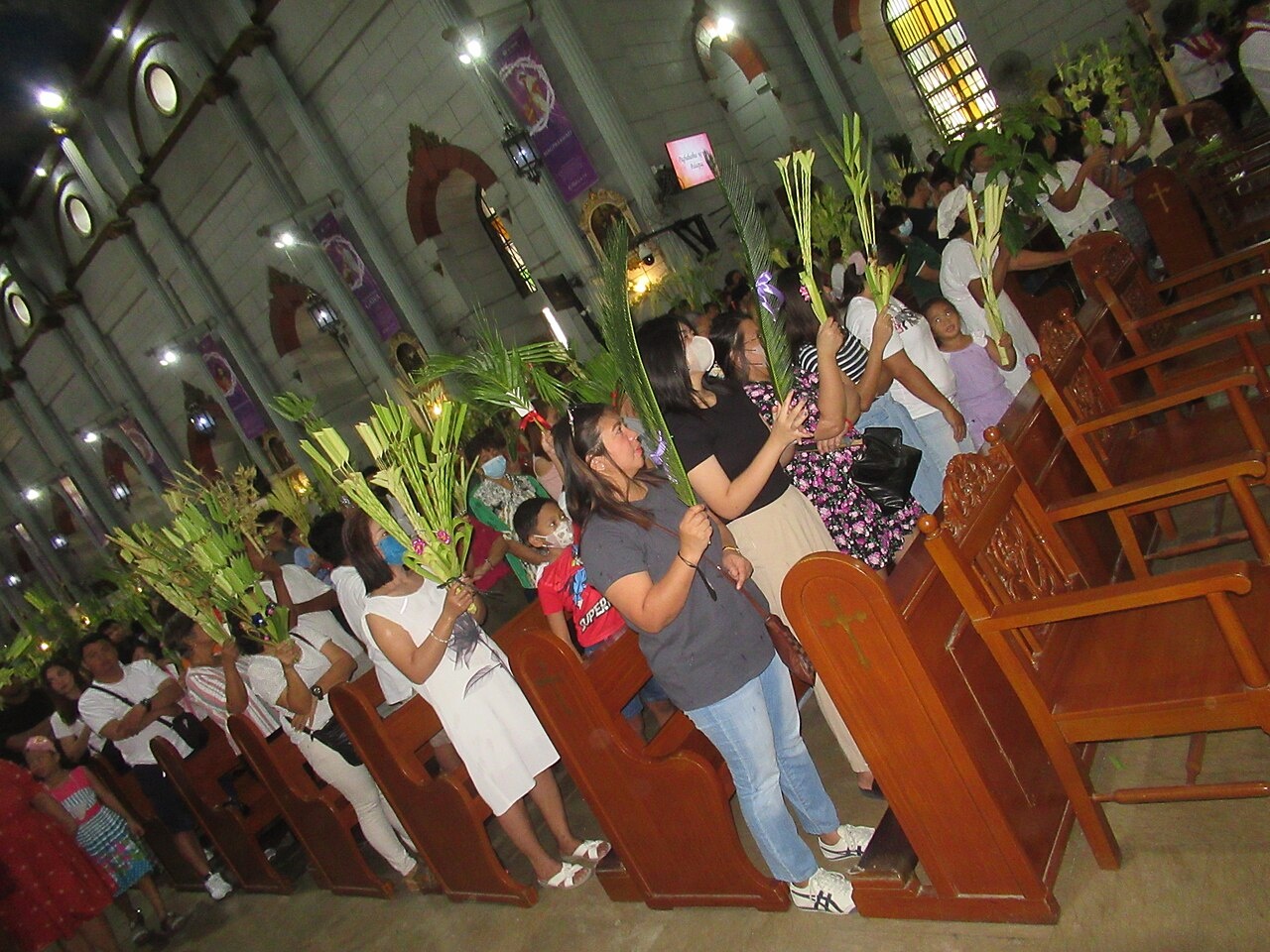
Palm Sunday marks the beginning of the Holy Week. The faithful attend at churches and wave blessed palm fronds (palaspas) as a priest sprinkles holy water on them and light candles to commemorate Jesus' entry into Jerusalem. Most Filipinos observe Holy Week by attending church services or spending time with family, but some devotees carry out intense rituals they believe will atone for sins, bring healing to loved ones, or secure divine intervention. These practices, although widely known, are discouraged by the Catholic Church. [Source: Allison Jackson, AFP, April 7, 2023]
Spanish missionaries introduced rituals such as public flagellation and dramatic reenactments of events from the life and death of Jesus Christ, including the washing of the apostles’ feet, the Stations of the Cross, and reflections on the Seven Last Words. Numerous processions are held during Holy Week, often featuring many religious images displayed on decorated carrozas (carts). [Source: “Culture Shock!: Philippines” by Alfredo Roces and Grace Roces, Marshall Cavendish International, 2010]
In many towns, biblical stories are dramatized in short theatrical performances known as the Senakulo, which recount episodes from the life of Christ. One popular scene depicts the betrayal of Jesus by Judas in exchange for thirty pieces of silver. Members of the local community are chosen to perform the roles, and the selection of actors for figures such as Jesus and the Virgin Mary is often influenced not only by acting ability but also by reputation and personal standing within the town. In some cases, well-known film or television personalities are even invited to portray the principal characters, drawing larger audiences to the performances.
The more devout frown upon boisterous behavior. Usual solemn rituals in church are the ‘washing of the feet’, ‘stations of the cross’ and ‘seven last words’. In San Fernando, Pampanga and some neighboring towns of Manila, Christ’s crucifixion is re-enacted literally, and some over-zealous devotees volunteering to have themselves actually nailed to a cross. Self-flagellation is also a common religious ritual.
Bloody Filipino Holy Week and Good Friday Rituals
Many Filipino devotees perform religious penance during the week leading up to Easter Sunday, especially on Good Friday, as a form of worship and supplication, a practice discouraged by Catholic bishops, but widely believed by devotees to cleanse sins, cure illness and even grant wishes.
The dramatic acts of penance include self-flagellation and ritual crucifixion.
From Mabalacat in 2012, Reuters reported: “Hundreds of barefoot Filipinos marched on roads, carrying heavy wooden crosses and whipping their backs until they bled on Thursday in an annual gory religious ritual as the mainly Catholic Philippines observed near the end of the Lenten season. "I do this penance out of my free will because I believe that God will help relieve my sickness," Corazon Cabigting, a domestic helper and the only woman in a group of about 50 men carrying wooden crosses on their backs. [Source: Reuters, April 5, 2012 /=]
“Like the men, Cabigting wore a maroon robe and covered her face with a veil, held on her head by a crown of stainless wire, dragging a 30-kg (66-lb) wooden cross and stopping every 500 meters (546 yards) in makeshift roadside chapels. Elderly women chant the passion of Jesus Christ at some of the chapels, while the penitents, with their hands tied to the cross, are beaten by sticks and hemp. "Priests often tell us that we should not be doing this," Melvin Pangilinan, an organizer of the annual Lenten ritual who carried cross in his younger days, told Reuters. "But, it has been our tradition for decades and we have to honor it." /=\
For many participants, the acts are performed as a panata, or sacred vow, in gratitude for blessings received or in hopes of divine help. One devotee explained that he undertook the ritual to pray for the health of his family, saying that prayer allowed him to endure the pain. The climactic moment occurs when several men portraying Christ and other biblical figures are escorted by actors dressed as Roman soldiers to a hill-like stage. Two are tied to wooden crosses, while the man playing Jesus is briefly nailed through the hands and feet before being taken down after a few minutes and examined by medical workers. [Source: Allison Jackson, AFP, April 7, 2023]
One well-known participant, a former fisherman who has portrayed Christ for many years, said he continued the ritual out of gratitude for what he believes was a second chance at life after overcoming personal struggles. Another longtime participant, who has been crucified dozens of times, described the experience as spiritually cleansing and said he hoped to continue as long as his health allowed. The ritual performances in villages such as San Pedro Cutud were suspended for several years during the COVID-19 pandemic but later resumed, drawing both local spectators and foreign tourists.
These practices, although widely known, are discouraged by the Catholic Church. Monsignor Pedro Quitorio, spokesman for the Catholic Bishops Conference of the Philippines, described the practices as "inappropriate". "What happens here is that we want God to grant us what we wish for," Quitorio told Reuters, saying it is enough for true Catholics to pray, fast and give alms during the Lenten season. Medical authorities caution that participants risk infections such as tetanus from wounds caused by nails and whips.
Good Friday Self-Flagellation Rituals in the Philippines
In villages north of Manila—particularly around San Fernando—large crowds of residents and visitors gather to witness reenactments of the final moments of Jesus Christ. Hundreds of penitents, some wearing crowns made from vines and cloth covering their faces, walk barefoot through narrow streets while repeatedly striking their backs with bamboo whips. The blows draw blood that runs down their bodies as they move through the procession. At times, some penitents lie face down on the ground while assistants strike their backs with slippers or pieces of wood. When bleeding slows, their skin may be pricked with blades or other sharp objects to reopen the wounds so the ritual can continue. [Source: Allison Jackson, AFP, April 7, 2023]
Near a church in the poor Tondo district of Manila, masked participants strike their backs rhythmically with bamboo whips while walking barefoot. With their backs exposed and bloodied from repeated blows, participants whip themselves while walking in solemn devotion, believing the practice to be a form of atonement for sins. One devotee, 25-year-old Melvin Devibar, said he prayed for the health of his parents and expressed gratitude that they had remained free from illness, adding that he believed prayer would protect them even during the pandemic. [Source: Reuters, April 2, 2021]
Reuters reported from Angeles City in 2012: "Bloody gashes from repeated strikes of whips could be seen on the backs of devotees as they walked barefoot along the streets, believing that their sacrifice would somehow grant salvation for their sins. Devotees, begin the ritual by tying a rope around their arms and legs and inflicting wounds on their backs with a blade marching for about four to five hours under a scorching sun.Carlito Santos, a pastor at a local Methodist Church, said the practice cannot be easily relinquished as it has already been embedded in the local culture. "It is easy to change these religious practices by asking these devotees to refrain from practicing it, but, because of culture and tradition, it does not always work," he said. [Source: Reuters, April 5, 2012 /=]
People who whip and flagellate themselves on Good Friday. say they believe it can cure illnesses and grant salvation from their sins. "This is important for us because this is for our loved ones and those who are sick, we can include them in our prayers," 50-year-old flagellant, Wendell dela Cruz, told Reuters. "Those illnesses and grievances, we can pray for them through our penitence." According to Reuters: The Catholic Church has expressed disapproval of these self-punishments as misinterpretations of faith, saying prayers and sincere repentance are enough to commemorate the observance of Lent, but devotees believe the rites will cleanse away their sins, cure illnesses and even grant wishes. [Source: Reuters Videos, April 15, 2022]
Nailing People to the Cross in San Pedro Cutud
Good Friday is marked in San Pedro Cutud, near the City of San Fernando, Pampanga in Central Luzon, by people who have nails driven completely through the palms of their hands and are fastened to crosses like Christ during his crucifixion. Some crosses are lifted and carried around with the people nailed to them. People are also sometimes nailed to crosses in Kapitangan in Bulacan Province and San Fernando, Pampanga, north of Manila. On the same day in certain places such as Cainta in Rizal penitents carry heavy wooden crosses and wear crowns of thorns. In other Manila suburbs flagellants whip themselves until they bleed.
San Pedro Cutud is a farming town in Luzon near Mount Pinitabo. Every year a handful of Filipinos and some foreigners are nailed to crosses there as part of a Good Friday crucifixion re-enactment. The Catholic Church generally discourages such practices but generally does not try to stop them. San Fernando Archbishop Florentino Lavarias has discouraged the bloody practice, saying there are other ways to profess one's faith. "Our acts should be geared toward good works. Christian life is not something that is done overnight," he said. However San Fernando Mayor Edwin Santiago openly conceded that the religious ritual has vast economic benefits for the community. "We don't have the exact record of the money... but for sure the Good Friday activities help our locals in their businesses," he said. [Source: Telegraph, AFP, April 4, 2015^^]
Prior to the crucifixions, devotees carry heavy crosses on their backs for about one kilometer (more than half a mile) to the top of a hill. During the ritual, 10-centimeter (4-inch), alcohol-cleansed, stainless steel nails are pounded through the participant’s palms with ordinary hammers into wooden crosses. A few also have nails hammered in their feet. The crosses are then lifted by men dressed as Roman centurions to a vertical position. Ropes around the participant’s arms and body bear the weight not the stainless steel nails, but even so the ritual is quite painful. The barbed-wire-crowned participants scream and wail through much of it. After hanging from the cross for about two minutes they are taken down and attended by doctors afterward. Their wounds are treated with alcohol and their hands are bandaged. In 2023, eight men did it. They were left on the cross under the sun for about 10 minutes.
In 2015, The Telegraph reported: Five men had nails hammered through their palms and feet while four others, some with fake beards drawn on their faces to resemble Christ, were tied to the crosses. They wailed in pain as attendants, costumed as Roman centurions, pounded the nails through their palms. "My faith got me through my illness. I will continue doing this for as long as I live," one of the men, Wilfredo Salvador, explained after he was taken down from a cross, his hands and feet wrapped in bandages. "It was painful up there, but I felt light. I can't explain it. I would say my faith is very strong," added the 50-year-old, who said he had recovered from a nervous breakdown several years ago. ^^
The Good Friday event in San Pedro Cutud also features a parade of penitents, who march down the streets beating their bare backs with ropes and throwing blood at spectators. Some have their backs cut open with a glass instrument before they begin whipping themselves The ritual began in 1955 and almost came to end in 1991 when San Pedro Cutud was covered by more than three feet of volcanic mud after the eruption of Mount Pinitabo. All the props and costumes used in the ceremony were buried by mud. But villagers worked to make new props and sew new costumes so the ritual could continue.
People Who Have Been Nailed to the Cross
People who are nailed onto the crosses in San Pedro Cutud typically stay on the crosses for only a few minutes. Most are performing the ritual for some cause and believe that their act of penitence will help get their prayers answered. Over the years visitors have had themselves nailed to the crosses to help homeless children and relatives with diseases. Some local people said their pain and sacrifice might have spare their town from mudslides from the volcano.
Most of the participants are men but not always. In 2002, two of the 13 people who were nailed to crosses were women. In 2001, one woman and 11 men did it. In 1993, a Belgian woman tried it and fainted on the cross. She was revived with guava leaves, a local herbal medicine. In 1995, a dozen Filipinos and a 30-year-old Japanese were nailed to crosses. The Japanese man said that he hoped to help his ailing 24-year-old brother by participating in the ritual. The woman who did in 2001 was a faith healer. She told Reuters, “I am the actress of Jesus on Good Friday” and said she did it “because Jesus is the one that has called me for this kind of position.” She told Reuters she had go through the ritual 14 times. After she was nailed to the cross in 2001 she chatted, laughed and answered questions.
One of the participants is sign painter Ruben Enaje, who was 62 in 2023 and has reportedly participated in the crucifixions a total of 34 times. To be honest, I always feel nervous because I could end up dead on the cross,” Enaje told The Associated Press before his crucifixion. “When I’m laid down on the cross, my body begins to feel cold. When my hands are tied, I just close my eyes and tell myself, ‘I can do this. I can do this.’” The sign painter said he chose to devote his life to Christ after surviving what he described as a miracle. In 1985 he said he survived uninjured after falling from a three-story building. He then kept on performing the ritual after his loved ones recovered from serious illnesses. [Source: Michelle De Pacina, Nextshark, April 8, 2023]
After he had been nailed to the cross 15 times as of the early 2000, Enaje told told Associated Press, "It's a form of sacrifice, of penitence. I'm also praying as I do it so that the mud flows will not come here again so the community can return.” He has played the role of Christ in a re-enactment of the original crucifixion that features men dressed as Roman Centurions and Pontius Pilate.
Wilfredo Salvador, a former fisherman who played the role of Jesus Christ, said he began participating in the crucifixion in the late 2000s years ago after suffering a mental breakdown. [God] gives me physical strength unlike others who cannot bear it,” said Salvador, according to Digital Journal. “I do this by choice. I thank Him for giving me a second life.” He was still participating in the ritual at age 66 in 2023. "I started doing this when my mother got sick - kidney problem. I vowed and prayed to God so she could be cured," Marvin Tao, who took part in the self-flagellation, told AFP.
San Pedro Cutud Crucifixions as Tourist Attractions
The bloody San Pedro Cutud crucifixions has become quite well known and every year several thousand tourists show up to watch. The event in 2015 attracted a crowd of 60,000, roughly the same number as 2014
In 2015, The Telegraph reported: While organisers tried to keep the event solemn, the general mood appeared more festive with dozens of hawker stalls selling food and souvenirs, giant streamers of mobile phone companies set up in various places and crowds taking photos with their smartphone and tablet cameras. Above the crucifixion hill, a huge brown kite in the shape of a cross flew overhead. [Source: Telegraph, AFP, April 4, 2015]
Foreign tourists who flocked to the spectacle reacted with both shock and fascination even as blood from the flagellants splattered their clothing. "I have never gone that far with religion but it's amazing, you know, that people have that much faith to do something like this. It's amazing," said tourist Tyler Pritchard. Waldemar Traczyk, 50, a history professor from Poland, said he saved up for seven years so he and his wife could fly to the Philippines to witness Friday's events. "This is too much blood... but it is interesting to know why a 17th century practice in Europe still persists in the Philippines," he said.
The event experienced a decline during Covid-19 pandemic and took a while to get back on track. In 2023, organizers said more than 15,000 Filipino and foreign tourists gathered in Cutud and two other nearby villages. Johnson Gareth, a British tour organizer, brought 15 tourists from eight countries to watch the crucifixions. They like this because there is really nothing like this on earth. It’s less gruesome than people think. They think it’s going to be very macabre or very disgusting but it’s not. It’s done in a very respectful way,” Gareth told The Associated Press, adding that the tourists were “genuinely inspired.” For me, it is an exceptional experience and chance to see such a cultural thing, which is unique in the world,” said Milan Dostal, a tourist from the Czech Republic. “I respect it, I’m very open-minded.” A Filipina nurse who showed up to watch told Reuters, “ When I first saw people waking around with blood on their backs it felt weird.” [Source: Michelle De Pacina, Nextshark, April 8, 2023]
Filipino Holy Week — A Manifestation of Cultural Masochism?
Neal Cruz wrote in the Philippine Daily Inquirer, “Why do Filipinos inflict pain on themselves? The penitents believe that by hurting themselves in imitation of Jesus, they would be forgiven their sins — the more painful, the more forgiveness. Others do so to keep vows (panata) made to God — to do the masochistic act every Good Friday in exchange for making a sick family member get well, or to get a job in the Middle East, etc. They believe that if they break the vow, God would punish them. So they do it year after year against common sense. [Source: Neal Cruz, Philippine Daily Inquirer, April 4, 2010 ==]
“And the voyeurs, Filipinos and foreigners alike, lap it up. They flock to the places where penitents have themselves nailed, literally, to crosses; or on the roads where lines of penitents pass while flogging themselves silly, or plod bearing heavy wooden crosses while being flogged by assistants. Tourists find it so quaint, so weird, so curious, so exciting, so primitive; and local government officials (and perhaps also the Department of Tourism) encourage the masochism to attract tourists every year. It is no different from white tourists ogling black tribesmen dancing to the beat of tom-toms in “Darkest Africa.” All that is missing is Tarzan’s ape-cry reverberating through the treetops. And mass media plaster the spectacle on their news pages and television screens. ==
“Because of Christ’s sufferings (to atone for the sins of mankind, the Bible tells us), masochism and superstition are embedded in the Christian religion. Old folks walk on their knees from the door to the altar of Quiapo Church in exchange for favors they are asking from God. The superstitious rub their sweepstakes and lotto tickets on the statue of the Black Nazarene in the belief that would make the tickets win. During the Feast of the Black Nazarene, thousands of barefoot devotees flock to the procession, vying with one another to hold on to the rope pulling the Nazarene’s carroza, and climbing over the heads of fellow devotees to be able to kiss, or even just touch, the statue of the Nazarene. Some of them are injured or get killed doing this. ==
“Why do they do it? Panata, a vow, say the devotees, among them our incumbent Vice President. Alas, this is not the correct way to practice the Christian religion, or even to atone for and ask forgiveness for one?s sins. If one is truly sorry for his sins and resolves never to commit them again, he does not have to flog or hurt himself or get himself nailed to a cross. In the first place, that masochistic practice is bad for the health. The wounds can get infected, especially since the penitents bathe afterwards in a river that, in the Philippines, is most likely polluted. Worse, the penitents can die of tetanus from dirty nails that pierce their hands and feet. ==
“To guide its faithful followers, the Catholic Church should educate and wean them away from this form of masochism. True, some bishops and priests issue press statements during Holy Week, advising penitents not to continue the practice. But they have little effect because the Church does not warn, preach and advise strongly enough as much as it fights, for example, the reproductive health bill and divorce. To have any effect, the warning should be preached from the pulpits and discussed in Catholic schools, not only during Holy Week but as often as possible. Churches should have pamphlets distributed after the Sunday Masses. Local government officials should be told by the Church and the national government to discourage and ban the practice. Likewise, mass media should not play up this barbaric practice because the penitents like to see their pictures in media. It gives them celebrity status and makes them heroes of their villages. Instead of teaching the out-of-school youth of their villages, Filipinos hungry for recognition just have themselves nailed to a cross once a year and they achieve the near-immortality that they hunger for.” ==
Image Sources: Wikimedia Commons
Text Sources: “Encyclopedia of World Cultures Volume 5: East/Southeast Asia:” edited by Paul Hockings, 1993; “Culture Shock!: Philippines” by Alfredo Roces and Grace Roces, Marshall Cavendish International, 2010; National Geographic, Live Science, Philippines Department of Tourism, New York Times, Washington Post, Los Angeles Times, Smithsonian magazine, Encyclopedia.com, Library of Congress, The Conversation, The New Yorker, Time, BBC, CNN, Reuters, Associated Press, AFP, Lonely Planet Guides, Google AI, Wikipedia, The Guardian and various websites, books and other publications.
Last updated March 2026