
IDEAS ABOUT DEATH IN THE PHILIPPINES

Alongside standard Christian teachings, at least two broader beliefs about death and the afterlife persist in the Philippines. One views the body as returning to the four elements: earth, water, fire, and air. The other holds that the spirit (kaluluwa) remains near the living for a time before journeying to the afterworld. Secondary burial has been common, involving initial interment followed by the later transfer of bones to an ossuary. All Souls' Day (Araw ng mga Kaluluwa) is marked by visits to cemeteries. [Source: Encyclopedia of World Cultures, Volume 5: East/Southeast Asia, edited by Paul Hockings, 1993 ~]
After death twenty-four-hour vigil is held at the deceased person's home, and the body is escorted to the cemetery after the religious ceremony. Mourners traditionally walk behind the coffin. A mausoleum is built during the lifetime of the intended occupant. The size of the edifice indicates the builder's status. [Source: Sally E. Baringer, Countries and Their Cultures, Gale Group Inc., 2001]
Ifugao believe deities may take a person's soul, causing their body to fall ill. If the deities do not return the soul, the person dies. After a person dies the orifices of the body are plugged and the corpse is placed in a death chair. The body lies in this state by a fire and is “awakened” each night by a corpse tender. ~
RELATED ARTICLES:
FUNERALS IN THE PHILIPPINES factsanddetails.com
RELIGION IN THE PHILIPPINES factsanddetails.com
CATHOLICISM IN THE PHILIPPINES: LIFE. INFLUENCE, SAINTS, POPE VISITS factsanddetails.com
CATHOLIC PRACTICES IN THE PHILIPPINES: PRAYER LADIES, SANTOS, BAPTISMS factsanddetails.com
For articles on the Catholic Church in general see CATHOLICS factsanddetails.com
For Information in the Funerals and Afterlife Practices of Different Ethnic Group See the Ethnic Groups and Minorities listed Under the MINORITIES factsanddetails.com
HOLIDAYS IN THE PHILIPPINES: NEW YEAR'S, ALL SAINTS DAY, MAY AND MANILA AREA FIESTAS factsanddetails.com
HOLY WEEK AND LENT IN THE PHILIPPINES: VOWS, TABOOS, BLOODY PROCESSIONS, GETTING NAILED TO A CROSS factsanddetails.com
Death and Loss in the Philippines: One Woman’s Story
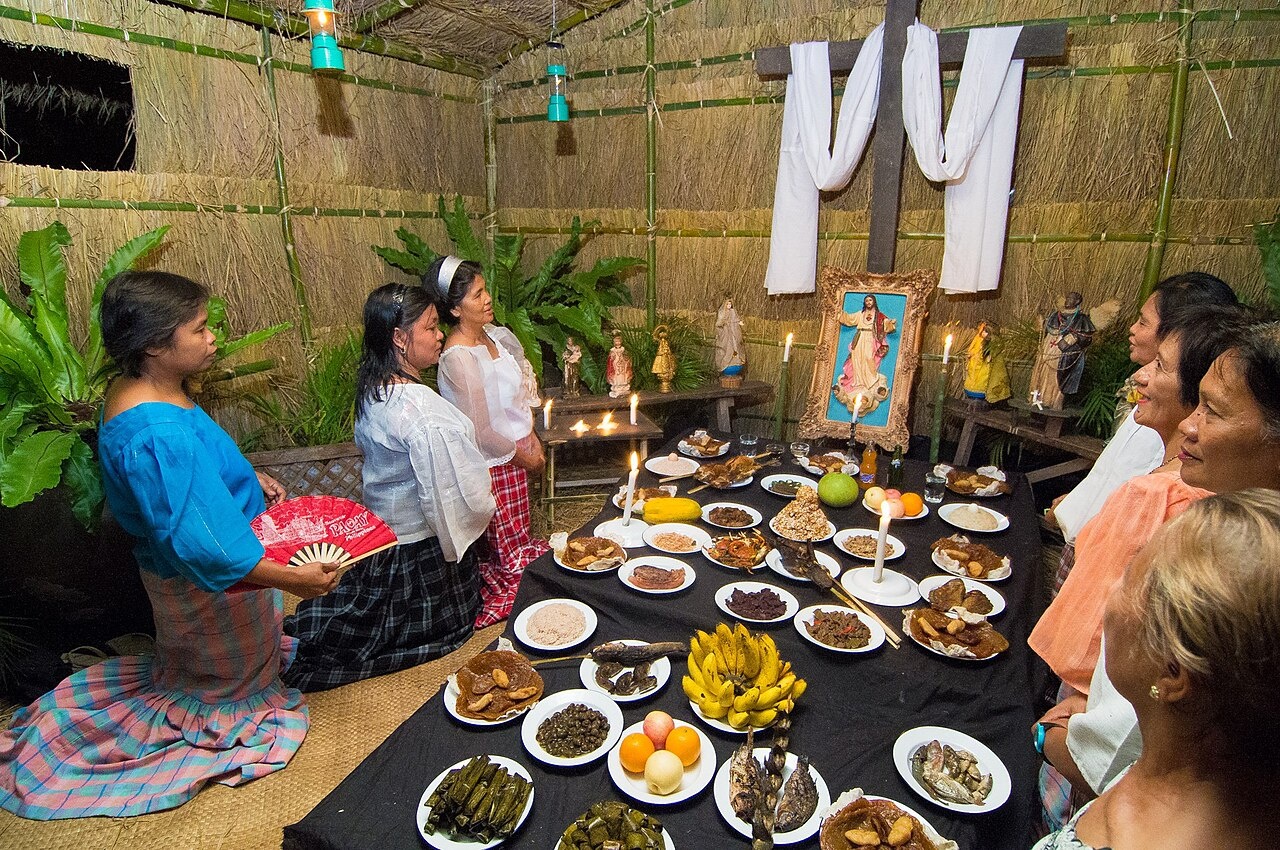
Sandi Clark of the University of Indiana wrote: “Maria (a pseudonym) is a 38-year-old woman who was born in the Philippines. Her family is very close- knit and strongly Catholic. Maria began our conversation about the customs surrounding death and grieving by describing Filipinos as “very Catholic.” She stated that even families who do not go to church regularly or who aren’t strongly religious will fall back on Catholic traditions at the time of a death. While Filipinos will seek medical advice and use medical technology, apparently their fundamental belief is that a person’s death is “an act of God” and that strong faith can thwart a death. When it doesn’t, however, there can be guilt that one’s faith wasn’t strong enough to save a loved one. [Source:Sandi Clark, indiana.edu ^^]
“Maria described many of the rituals surrounding death as very “showy.” Women are expected to grieve very openly — publicly sobbing, swooning, fainting, and/or hugging the casket of the dead person — while men are typically more reserved. Maria was raised to believe that obvious, public grieving indicates how much the griever cared for the deceased and, also, lets God know how heavy the griever’s burden is. She said that the Filipinos believe that the “more emotion shown, the more respect shown.” Maria felt that another showy, public tradition surrounding death is the family’s spending of lots of money — on the food offered during visitation, the casket, the flowers, the service, the burial place — to make sure that the deceased is seen as loved and esteemed. It is usual for families to talk openly and with pride about the debt they incurred as a result of a funeral — the greater the debt, the greater the family’s standing. ^^
“Since Filipino society is very close, people are expected to come together to grieve in groups rather than do so privately. Maria said that family and friends are expected to come forward to support to the grieving family and that not doing so is considered an offense. Filipinos judge the life and stature of the deceased by the number of people gathered for the visitation or funeral; and when people gather during visitation, there is very open discussion about the deceased and one’s grief. ^^
“Maria said that when she lived in the Philippines there were no nursing or funeral homes. People might visit hospitals briefly for acute conditions, but most people are cared for and die at home. (In the case of the elderly, the tradition is that the person would be cared for by the oldest child.) Once a death has occurred, it is considered very important for the deceased to be blessed by a priest to ensure he or she will get to heaven. The body is both prepared for burial and laid out for visitation in the home. Word of mouth is the main source of news about the death and burial. In the period after the death and before the burial — which is between three and seven days, depending on how long it might take certain family members to travel to the town of burial — the family stops all personal business. Instead of working or resuming normal activities, the family cooks and makes other preparations for the visitation that is ongoing until the burial. ^^
“Maria mentioned that Filipino culture holds that the “longer the grief, the better.” For up to a year and often beyond, men will wear a black ribbon and women will dress in black to indicate they are in mourning. It would not be unusual for a widow or a woman who has lost a child to death to dress in black the rest of her life. Other rituals that extend the period of mourning include holding masses for a specific dead person at several local churches over the weeks following the death. (Again, family and friends are expected to attend.) Families also visit the deceased’s grave often for months after the burial (particularly on major holidays) and hold a special mass on the first anniversary of the death. In the case of relatives of Maria who recently lost a young adult, the mother, father, and two brothers slept in the bedroom of the deceased for six months after her death in order to be closer to her. This was considered only slightly unusual. ^^
All Saints Day in the Philippines
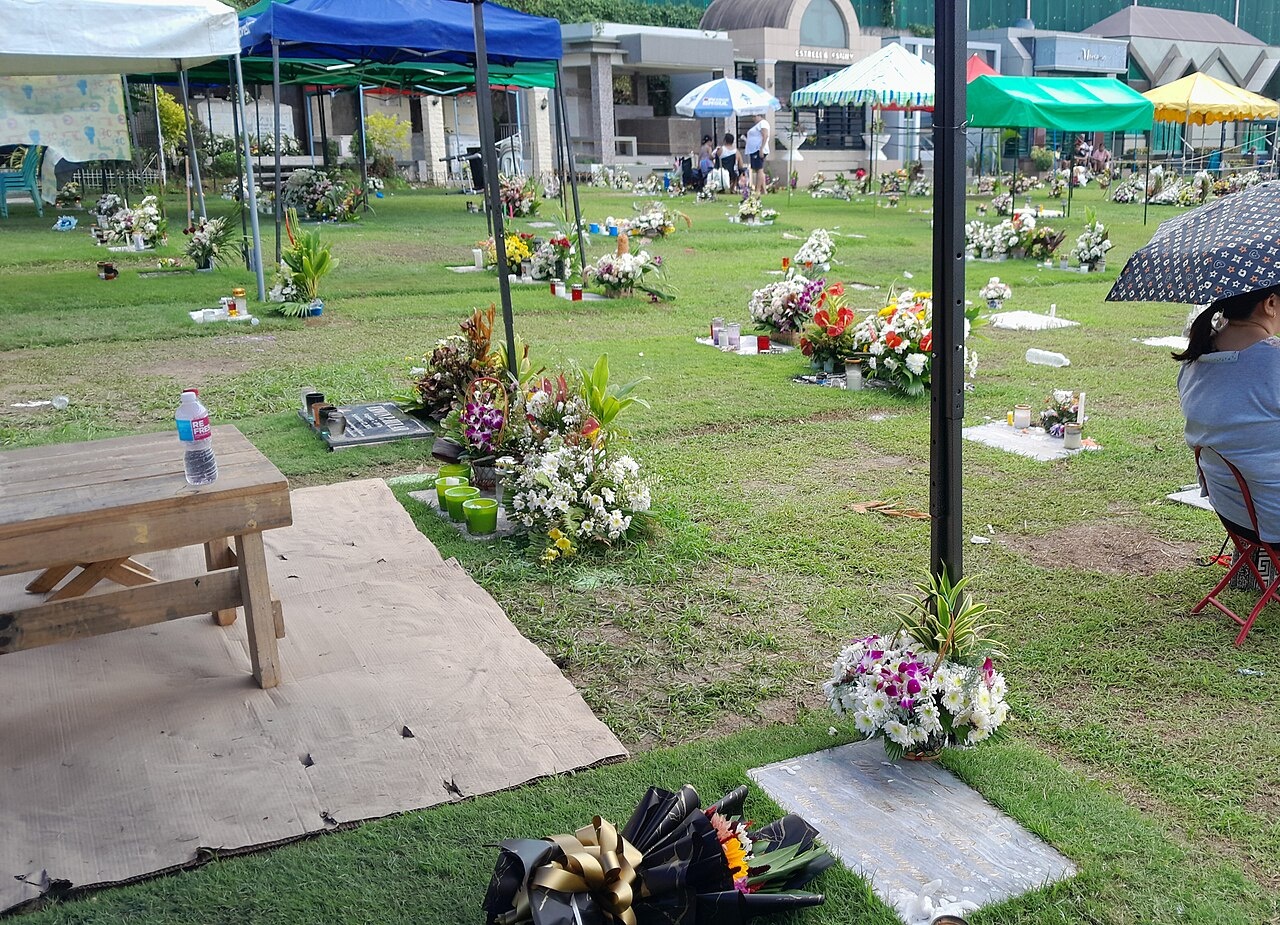
Christian Filipinos customarily remember, honor, and pay respect to the dead on All Saints Day (November 1) and All Souls Day (November 2). Families gather at the cemetery where their ancestors are buried to hold a 24-hour vigil. The grave sites are cleaned, visited, and adorned by family members, relatives and friends on the eve of November 1, to stay at the cemetery, to light candles, to pray, to lay flowers, and bring food for the consumption of the attendees. Others, like the Ilocano’s, offer food for the dead. Some children habitually gather candle wax during this time for the purpose of play or reselling to candle makers.
All Saint's Day is a national holiday to honor the dead. Families meet at the cemetery and stay throughout the twenty-four hours. Candles and flowers are placed on the graves. Food and memories are shared, and prayers are offered for the souls of the dead. When a family member visits a grave during the year, pebbles are placed on the grave to indicate that the deceased has been remembered. On October 31 children in rural villages in the Philippines often go house to house asking for small sums of money — a traditional almsgiving. Filipino families also spend much of the evening visiting their ancestral graves, showing respect and honor to their departed relatives by feasting and offering prayers.
All Saints Day has its roots in celebrations that stretch back to ancient Rome and traditionally honored saints. In the Philippines it a day to pray for — and most importantly remember — the deceased. According to AFP: The annual pilgrimage to the cemeteries triggers a mass exodus from the capital, with millions travelling back to their home provinces where relatives are buried. Bus stations, airports and roadways were thick with travellers, while police were deployed in large numbers across the country. [Source: AFP, November 2, 2019]
See Separate Article: HOLIDAYS IN THE PHILIPPINES: NEW YEAR'S, ALL SAINTS DAY, MAY AND MANILA AREA FIESTAS factsanddetails.com
Hanging Coffins of Sagada
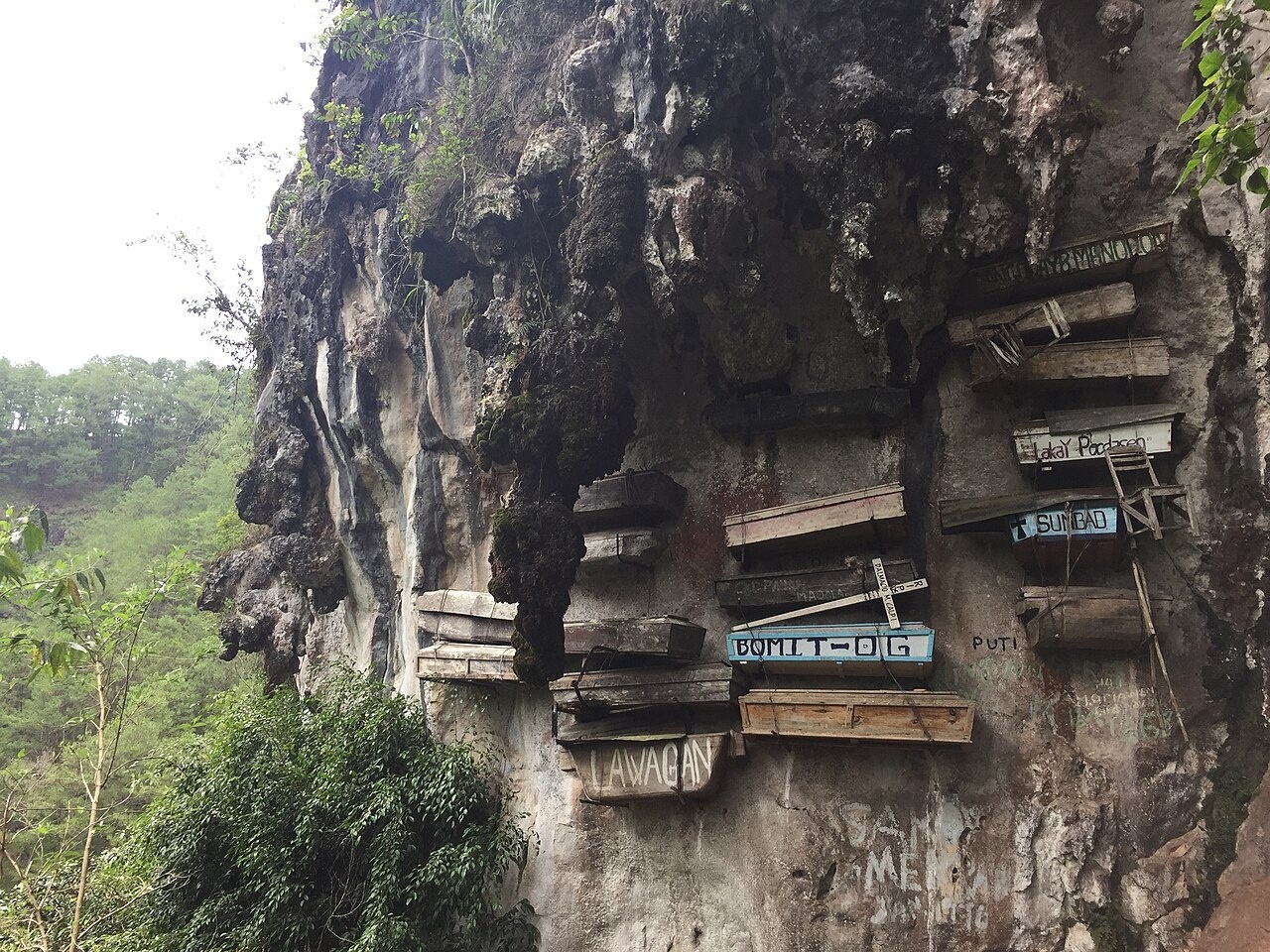
Sagada (9 hours from Manila) is a small town in Mountain Province in north-central Luzo. Its main draws are its relatively cool temperatures, interesting caves and hanging coffins set in an area of beautiful mountains. Hanging coffins are an ancient funeral tradition in northern Luzon of the Kankanaey people an, Igorot tribe in which the elderly carve their own coffins and the dead are suspended from the sides of cliffs. In several areas, coffins of various shapes can be seen hanging from vertical mountain faces, in caves, or on natural rock projections. The coffins are small because the deceased are placed in the fetal position. This is because they believe that people should leave the world in the same position as they entered it. The coffins are high off the ground because the Kankanaey want the spirits of the dead to go up to Heaven, and the closer they are to heaven the better. [Source: Karl Grobl, CNN, May 5, 2012]
Angel Bautista, an archeology student at the University of Santo Tomas Graduate School, wrote: For the Kankanaey, the ethnic group to which the people of Sagada belong, death is both dreadful and mysterious. It is dreadful because it permanently removes a family member from the physical world, yet mysterious because it allows the spirit of the dead to continue social relations with the living. This belief is shaped by filial piety, faith in the power of ancestors, and a polytheistic worldview in which bodily decomposition and preservation are spiritually significant. Hanging or cave burials may also preserve remains longer than burial in the ground. [Source: Angel Bautista, University of Santo Tomas Graduate School, March 16, 2013]
See Separate Article: SAGADA: HANGING COFFINS, MUMMIES, CAVES factsanddetails.com
Frank Malabed: the Philippines’ Mortician to the Stars
Before former dictator Ferdinand Marcos and many other notable Filipinos met their Maker, they first passed through the hands of Frank Malabed. Among those he prepared for burial were an assassinated democracy hero, a soft-porn actress, high-profile socialites, and prominent political figures. Malabed, the country’s most well-known—and perhaps most devoted—mortician, took pride in his work. Speaking from his home office in a working-class neighborhood of Manila, the bespectacled grandfather with a sparse walrus moustache told AFP that his job demanded perfection. “I make people beautiful even in death,” he said. For him, embalming had to be done completely: “It is either 100 percent or zero. It cannot be 99 percent. A dirty carpet or scratched casket can be changed, but if you botch the job you cannot tell the family you will replace the body.” [Source: Cecil Morella, Agence France-Presse, November 8, 2012 :/]
As a child, Malabed dreamed of becoming an engineer. However, his father was a mortician, and during his teenage years Malabed learned the craft of caring for the dead. In the 1960s he accompanied his father to work at Clark Air Base, then a major American military installation in the Philippines that played a key role in the Vietnam War. When his father retired as the conflict intensified, the 18-year-old Malabed took over much of the embalming work. At the time, thousands of American soldiers killed in Vietnam passed through the base before being returned home. Malabed recalled that Filipino and American morticians often handled 30 to 40 casualties a day, working in a hangar where bodies arrived on gurneys from the nearby runway.
Later, Malabed married into a family that operated a chain of provincial mortuaries, and he found that caring for the dead provided a comfortable livelihood. Although it was not his first career choice, he discovered he had a natural skill for the profession. A devout Catholic, Malabed said a prayer before beginning his work, yet he did not believe in ghosts, witches, or evil spirits. Long hours spent alone with the dead—armed with hypodermic syringes and makeup kits—never gave him nightmares.
Malabed’s most famous client was Ferdinand Marcos, whose two-decade rule ended in 1986 when millions of Filipinos joined the peaceful uprising known as the People Power Revolution. Earlier in the 1970s, after moving to Manila to work for a large mortuary, Malabed embalmed relatives of Marcos’s wife, Imelda Marcos. Impressed by his work, the family entrusted him with preparing other relatives, including the president’s mother. In 1987, a year after Marcos was forced into exile in Hawaii, Malabed opened his own business offering luxury bronze caskets from the United States and personalized mortuary services.
His business expanded significantly after Marcos died in exile in 1989. The Marcos family wanted the body preserved for an eventual return to the Philippines, so Malabed traveled monthly between Manila and Honolulu to care for it. In 1993 the Philippine government allowed the body to be flown back to Batac, Marcos’s hometown in northern Luzon. Because the government refused a hero’s burial in Manila, Malabed injected special preservation fluids so the remains could last for decades. The body was placed in a glass case in a mausoleum at the Marcos family’s provincial home, where it remained on public display. Malabed maintained friendly relations with the family and even attended Imelda Marcos’s 82nd birthday celebration.
Less widely known was the fact that Malabed also embalmed Benigno Aquino Jr., the Marcos regime’s most famous political opponent. Aquino’s assassination at Manila airport in 1983 became a turning point in Philippine history. Malabed said he did not concern himself with politics: anyone who needed his services could simply call him. He prepared Aquino’s body and dressed it in the same blood-stained jacket the opposition leader wore when he returned from exile. The viewing of Aquino’s body became a powerful symbol for the protest movement that eventually toppled Marcos. Aquino’s widow, Corazon Aquino, later led the People Power movement and became president.
Malabed’s other clients included Jesse Robredo, who died in a plane crash, the parents of former president Fidel Ramos, and actress Claudia Zobel, who was killed in a 1984 car accident. Known for his meticulous attention to detail, Malabed said some wealthy clients even arranged his services while they were still alive. He insisted on taking his time: bodies had to be washed and disinfected by hand, and blood carefully massaged out of the veins to prevent chemical discoloration. He criticized some fellow embalmers for taking shortcuts to handle more bodies and earn higher profits.
Malabed also prided himself on treating the deceased with dignity. Unlike some morticians, he refused to cut open the back of a corpse’s clothing to make it easier to dress the body. “Those are the last clothes they will ever wear on earth,” he said, “so they must remain intact.” Despite his reputation, he worked on only about five bodies a month and charged roughly half the professional fees quoted by leading Manila funeral homes, which ranged from hundreds of thousands to over a million pesos.
A mild stroke reminded Malabed of his own mortality, but it did not slow him down. He continued his work with dedication and remained confident that when his time came, he would receive the same careful treatment he gave others. His two daughters were also licensed embalmers, and he trusted that they would know exactly what to do.
Cemeteries in The Philippines
Filipinos are usually buried in their village, town, or city cemeteries that range from quiet fields of white crosses to dense "apartment" tombs in Manila stacked meters high. In recent decades, landscaped “memorial parks” have become increasingly popular. These parks are partly inspired by the American Forest Lawn Memorial Park model, with well-kept lawns and orderly surroundings. Yet this style does not always match Filipino preferences for more visible and elaborate grave markers. Many families favor large, above-ground tombs and spacious family mausoleums where the remains of relatives can be placed and where visitors may gather during commemorations. [Source: The Guardian, South China Morning Post “Culture Shock!: Philippines” by Alfredo Roces and Grace Roces, Marshall Cavendish International, 2010]
Public cemeteries in the Philippines often present a very different scene. Large burial grounds such as Manila North Cemetery are dense and lively places rather than quiet, secluded landscapes. Rows of stacked, “apartment-type” tombs rise closely together because of limited space. In some areas, mausoleums and tomb structures also serve as homes for families from the urban poor who live within the cemetery grounds.
These communities create an environment that is surprisingly active and social. Small shops, food stalls, basketball courts, and karaoke gatherings sometimes appear among the graves, particularly during major commemorations like All Saints' Day. On such occasions, families visit the graves of relatives, clean and decorate them, share meals, and sometimes stay overnight as they honor the dead.
Cemeteries also function as small economic centers. Many residents earn a living by maintaining graves, carving tombstones, or selling food and flowers to visitors. Living conditions can be difficult, however, with limited access to electricity, clean water, and sanitation. Despite these challenges, Philippine cemeteries reflect a distinctive cultural outlook on death in which the deceased remain closely connected to the everyday lives of the living.
Dead in Philippines Buried in Graves with Leases That Expire Unless Fees Are Paid
Human remains in some public cemeteries in Manila are placed in rows of cinder-block niches stacked as high as five stories. The openings are sealed with cement and often painted in pastel colors such as blue, yellow, or pink. Families who can afford it attach plaques bearing the names of the deceased, while others simply write the names in black ink on the cement surface. At times, especially when heat and humidity rise, the smell of decomposition drifts across the grounds, where trash and scattered bones sometimes lie uncollected. [Source: David Pierson, Los Angeles Times, March 3, 2021]
For many of the poor and those killed in violent circumstances, burial brings little dignity. At a cemetery near Manila Bay, many victims of the controversial anti-drug campaign launched by Rodrigo Duterte were buried in such niches. The campaign, widely known as the “Tokhang” operations—derived from the phrase meaning “knock and plead”—began in 2016 and resulted in thousands of deaths, most of them among the urban poor. Because so many victims were buried at the Navotas Cemetery, the area came to be informally known as “Tokhang Village.”
Overcrowding in Manila’s cemeteries means that remains can usually stay in a niche for only about five years. After that period, families must pay for a permanent burial space or a bone crypt if they want to keep the remains there. For many families, this expense is beyond their means. With average monthly incomes relatively low—and with poverty increasing during the COVID-19 pandemic—many relatives struggle to gather enough money before the deadline for exhumation.
When families cannot pay, the remains are often removed and placed in sacks or transferred to crowded charnel houses, sometimes mixed with other bones and debris. Clergy and social workers have pointed out that this fate usually affects only the poor, while wealthier families can afford permanent graves in private cemeteries. As the deadline for exhumations approaches, relatives visit the cemetery anxiously, checking whether a gravedigger has marked the tomb with an “X,” the sign that the remains will soon be removed. For many families who have already lost loved ones to violence, the possibility of losing even their graves adds another painful burden.
Living in Manila’s Largest Cemetery
About 50,000 poor Filipinos live in Norte, or the Manila North Cemetery, the country’s largest public burial ground. Life there is difficult. Without plumbing or running water, narrow paths often fill with foul wastewater dumped from household buckets. Illegal electricity lines are strung between tombs and mausoleums, but city officials frequently cut them. Despite these hardships, many residents consider the cemetery preferable to the conditions in Manila’s poorest districts. In a metropolitan area where a large portion of the population lacks stable housing, some of the most destitute people live in slums such as Tondo, where overcrowding, crime, and disease are widespread. Compared with those areas, life in Norte is often quieter and somewhat safer. [Source: John M. Glionna, Los Angeles Times, October 31, 2006]
Few places in the world show such a striking coexistence of the living and the dead. Similar arrangements exist elsewhere, such as in City of the Dead in Cairo, where hundreds of thousands of people reside among centuries-old tombs. In the Philippines, scholars note that the large number of residents in Norte is not only a result of poverty and housing shortages but also reflects a cultural outlook in which the dead remain closely connected to the everyday lives of the living.
Not everyone approves of this arrangement. During election campaigns, some Manila politicians promise to “clean up” the cemetery, arguing that it has become a national embarrassment. Critics claim that a burial ground should remain a sacred space for the dead. Others, however, defend the residents. Some commentators point out that the cemetery provides shelter for families with few alternatives and that the residents themselves often see their presence as a form of caretaking rather than disrespect. Living among the tombs, they maintain the graves and watch over the mausoleums that might otherwise be neglected.
Both the living and the dead have occupied the cemetery since it opened in 1884. Originally a burial place for wealthy and prominent Filipinos, the site required caretakers to guard valuables sometimes buried with the deceased. Over time, as more graves were added, the number of caretakers and their families also increased. Eventually, additional squatters moved into the 135-acre cemetery, settling in empty mausoleums or setting up shelters between the tombs. With the nation facing a chronic shortage of housing, authorities often tolerate the situation despite official policies against settlement in the cemetery.
For many residents, the mausoleums serve as both shelter and living space. Families may install tin roofs to protect against rain and use the marble tombs as beds, tables, or places where children study. Chickens and cats roam through narrow lanes lined with crypts, and daily life unfolds among the gravestones. Yet residents often insist that they still treat the burial site with respect, carefully observing certain limits in how the tombs are used. In this unusual environment, everyday life and remembrance of the dead exist side by side.
Attitude Towards the Dead Among Those Living in Manila Cemetery
John M. Glionna wrote in the Los Angeles Times, “Manila — Sometimes on the hottest nights, when the air inside her shanty barely stirs, Mellie Soliman lays her head on the cool, black marble surface of the living-room crypt and finds relief. Yet the nights are not always restful in this place called Norte. In the quietest hours, spirits emerge. Soliman sees them mostly after midnight, the hour she once found a mother and son standing at her door. "The woman was all white," she said. "She couldn't talk, but motioned that they were thirsty, so I went to get them water. When I came back, they were gone." She explains such apparitions with a near-mystical calm: "There are some here in Norte who have left us but still do not think they are dead." [Source: John M. Glionna, Los Angeles Times, October 31, 2006 -]
“Soliman is familiar with the habits of the deceased. The barefoot grandmother and her extended family are among 50,000 poor but stubborn Filipinos who carve out an unorthodox existence in North Manila Cemetery. Each day in Norte is marked by life and death. New family members marry in, old ones die off. Often, as many babies are delivered as people are buried. The children are soon taught respect for the departed, and instructed not to play or make noise near the slow-moving funeral processions. "The dead don't scare me so much," said Soliman, 62. "It's the living I'm afraid of." "Many Filipinos don't use the word 'dead,' " historian Alejandro Roces said. "Rather, they're referred to as 'the departed,' the ones who just happened to go ahead of us. For many, they're seen as just as alive as you and I." -
“Although there are few official records, Hermogenes Soliman says his extended clan of 60 is among the oldest of the graveyard families. Soliman was born in Norte in 1931, and says his parents lived here for years before that. As a boy, he played among the tombstones. When it was time to take a wife, he brought the reluctant Mellie to his graveyard home. At first I was afraid of the spirits," she recalled of that moment 25 years ago, leaning against the pink-rimmed marble crypt where seven relatives lie. "But eventually this place became home."” -
Working in Manila’s Largest Cemetery
Four generations of the Soliman family lived across the Manila North Cemetery, where they worked to make life as comfortable as possible. The family patriarch, Hermogenes Soliman, earned a living as a contractor supervising maintenance work on tombs, including painting, masonry, and clearing brush funded by the families who owned the graves. October was the busiest month because workers hurried to clean the cemetery before visitors arrived for religious holidays. Streets were swept, mausoleums were repainted, and abandoned children who begged among the graves were driven away. Food offerings left at graves—such as cooked meat and fruit—were often collected by poor cemetery residents so that nothing went to waste. [Source: John M. Glionna, Los Angeles Times, October 31, 2006 -]
Throughout the year, the cemetery functioned almost like a small city. Makeshift kiosks sold noodles, rice, and phone cards, while street vendors walked the narrow paths offering ice cream and bottled drinks. Motorized scooter drivers waited at the cemetery gates to transport workers to jobs outside as maids or restaurant employees. The community even had its own informal government, with neighborhood leaders assigned to different sectors to settle disputes and maintain order among residents.
For some residents, life inside the cemetery seemed safer than life in the surrounding slums. Mellie Soliman believed that many tragedies occurred outside the cemetery gates; three of her grandsons had been killed while working in Manila’s poor neighborhoods, including one who died while selling flowers to visitors. He was later buried in the family crypt so his grandmother could keep watch over him. Although no one paid rent in the cemetery, a social hierarchy existed. Families who worked and had long-established ties there, such as the Solimans, were respected, while jobless squatters were often shunned.
Despite the sense of community, tensions occasionally arose. Some cemetery officials were accused of corruption when graves were exhumed to make space for new burials, leaving exposed coffins that angered residents. The controversy prompted renewed calls from authorities to remove the families living in the cemetery. A number of households were relocated, and officials discussed installing fences and cutting electricity to discourage settlement. Nevertheless, Hermogenes Soliman remained determined to stay. He believed that when he died, he would be buried in the family crypt, where his grandchildren could continue to visit and care for him.
Filipinos Traumatized as Covid-19 Forces Them to Cremate Family Members
Filipinos generally do not cremate the bodies of the dead as we said before; Bodies should remain intact so they can resurrect. During the COVID-19 pandemic, many Filipino families were unable to perform traditional funeral rites for relatives who died from the virus. Authorities required rapid cremations and strict health precautions, which prevented families from viewing the bodies of their loved ones. The restrictions created a painful and confusing experience for grieving families and for crematory workers who had to enforce the rules. [Source: Ron Lopez, AFP, May 3, 2020]
In the Philippines, where most people are Roman Catholic, burial had traditionally been the common practice. Normally, an embalmed body would be displayed for several days in a home or chapel so relatives and friends could pay their respects during a wake. During the pandemic, however, suspected or confirmed COVID-19 victims were sealed in plastic by hospitals and sent directly to crematories or funeral homes, with wakes prohibited and only quick burials sometimes permitted.
Crematory workers found the situation emotionally difficult as well. Romeo Uson, an employee at a crematorium in Manila, explained that staff members had to tell grieving families they could not view the deceased because of the risk of infection. “We tell them we can't do it because it's dangerous. We could all get infected,” he said. The crematorium was performing six or seven cremations a day, roughly double its normal workload as infections spread.
Families often struggled with the impersonal nature of the process. Leandro Resurreccion IV was not allowed to visit his father while he was dying in the hospital and never saw his body except for the sealed plastic wrapping. “I think the fact that... my family wasn't able to say goodbye could probably be the second most tragic thing that happened after my dad's death,” he said. The lack of a final viewing and the identical body bags even led some relatives to doubt whether the ashes they received truly belonged to their loved one.
Crematory workers tried to offer comfort despite the restrictions. They encouraged families to pray and sometimes shared stories or smiles to ease the grief. At the same time, the workers feared becoming infected themselves and took precautions such as hot baths, vitamins, and careful cleaning after their shifts. For many, prayer also remained an important source of reassurance during a time when the usual rituals of mourning had been disrupted.
Image Sources: Wikimedia Commons
Text Sources: “Encyclopedia of World Cultures Volume 5: East/Southeast Asia:” edited by Paul Hockings, 1993; “Culture Shock!: Philippines” by Alfredo Roces and Grace Roces, Marshall Cavendish International, 2010; National Geographic, Live Science, Philippines Department of Tourism, New York Times, Washington Post, Los Angeles Times, Smithsonian magazine, Encyclopedia.com, Library of Congress, The Conversation, The New Yorker, Time, BBC, CNN, Reuters, Associated Press, AFP, Lonely Planet Guides, Google AI, Wikipedia, The Guardian and various websites, books and other publications.
Last updated March 2026