
FILIPINO AMERICAN MUSICAL ARTISTS
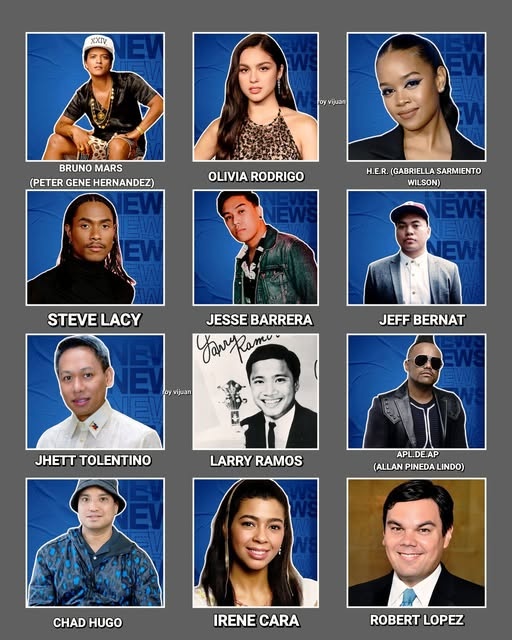
Filipino American artists have made their presence felt in the global music industry, producing chart-topping songs in pop, R&B, hip-hop, and independent scenes. Among the most prominent are Grammy-winning superstars like Olivia Rodrigo, Bruno Mars, and H.E.R., whose success has brought Filipino heritage into the international spotlight. Alongside them are widely recognized names such as Nicole Scherzinger, Hailee Steinfeld, Bella Poarch, Saweetie, and apl.de.ap of the Black Eyed Peas.
Beyond mainstream pop stardom, a new generation of Filipino American artists has emerged through digital platforms and independent music scenes. Early internet pioneers like AJ Rafael built loyal audiences on YouTube, paving the way for others such as Tim Atlas and Kiyomi, who blend genres like indie pop, R&B, and funk. Behind the scenes, creatives like Jesse Barrera have also shaped the sound of contemporary pop and R&B through songwriting and production.
Filipino American contributions to music, however, stretch back decades. Trailblazing acts like Fanny—featuring Filipina sisters June and Jean Millington—broke barriers in the 1970s as one of the first all-female rock bands signed to a major label. Earlier still, artists such as Sugar Pie DeSanto and Joe Bataan helped shape the sounds of R&B and Latin soul in the mid-20th century. Larry Ramos won Grammy Award in 1962. In recent years, digital platforms have accelerated the rise of Filipino American talent. Artists like Bella Poarch gained global fame through TikTok before transitioning into music, while others continue to build careers through streaming and social media. Together, these artists—past and present—highlight the depth, diversity, and growing influence of Filipino Americans in shaping the sound of modern music.
Richie Traktivist is a Filipino American music archivist, dj, music licensing manager, event organizer, and founder of TRAKTIVIST — a platform whose mission is to bring visibility and sustainability to Asian American artists. At the heart of his work is the website/archive — www.traktivist.com in which you can search by ethnicity, genre, role and instrument. As of 2021 there were over 1,500 artists spanning from the early 1900’s to the present.
RELATED ARTICLES:
MUSIC FROM THE PHILIPPINES: ARTISTS, GOOD SINGERS, POP, ROCK factsanddetails.com
TRADITIONAL MUSIC IN THE PHILIPPINES: INSTRUMENTS, DRUMS, NOSE FLUTES, factsanddetails.com
FLIP TOP AND BALAGTASAN (DEBATE POETRY) factsanddetails.com
FILIPINO BANDS: THEIR TALENT,VERSATILITY, HARD LIVES AND WHERE THEY PLAY factsanddetails.com
FOREIGN MUSICAL ARTISTS IN THE PHILIPPINES: THE BEATLES, AIR SUPPLY, LADY GAGA factsanddetails.com
PHILIPPINES CULTURE: HISTORY, MERGING TRADITIONS, THREATS factsanddetails.com
CATHOLIC, ASIAN, SPANISH AND AMERICAN INFLUENCES ON FILIPINO IDENTITY AND CULTURE factsanddetails.com
Filipino Americans and Music
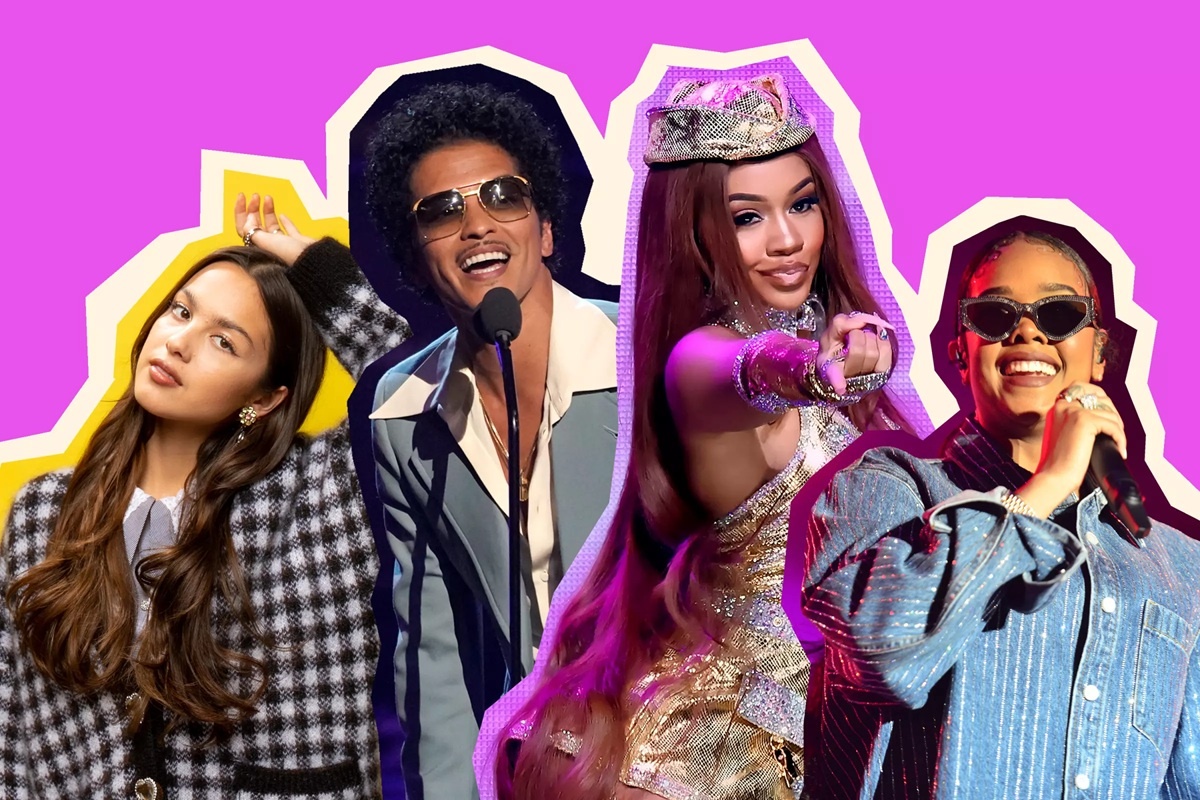
In recent years, a new wave of Filipino American artists has become more open and intentional about embracing their heritage. As James Zarsadiaz observed, “There’s been a groundswell of Filipino American artists who talk about their background more than earlier figures like Enrique Iglesias or Nicole Scherzinger.” He added that artists today are able to speak more freely about how their identity shapes their work “because Filipinos have truly permeated mainstream American culture and consciousness.” [Source: August Brown, Los Angeles Times, March 30, 2022]
This growing visibility is rooted in a long and complex shared history between the United States and the Philippines. After the Spanish-American War, control of the Philippines shifted from Spain to the United States, leading to the Philippine-American War and eventual U.S. colonial rule. Although the Philippines gained independence in 1946 following World War II, decades of political and military ties fostered a deep cultural exchange—especially in music.
“There’s always been a connection between the U.S. and the Philippines when it comes to music,” Zarsadiaz explained. He pointed to the enduring strength of the Filipino diaspora and the idea of kababayan—a shared sense of identity and support. “There’s power in that community,” he said. “They’re one of us, and their success is our success.”
Filipino American artists have, in fact, shaped American music for generations. Performers like Sugar Pie DeSanto found success touring with James Brown in the mid-20th century, while the “Pinoy Rock” movement drew inspiration from Elvis Presley and the British Invasion. Later, Lea Salonga became the singing voice of Disney heroines, apl.de.ap helped power the global success of the Black Eyed Peas, and Darren Criss rose to fame on Glee.
Culturally, Filipino Americans have also been deeply connected to genres like hip-hop and R&B. “Filipino Americans listen to everything, but they’re major consumers of hip-hop and R&B,” Zarsadiaz noted, adding that many are also active in dance communities such as breakdancing crews. This influence is especially strong on the U.S. West Coast, particularly in Los Angeles and the Bay Area, where diverse communities intersect. Reflecting on her upbringing, H.E.R. said, “In the Bay Area, you’re forced to know so many different cultures—I loved that camaraderie between Black people and Filipino people.”
Filipino/Filipino-American Grammy Winners
Olivia Rodrigo: won three Grammys in 2022: Best New Artist, Best Pop Solo Performance ("Drivers License"), and Best Pop Vocal Album (Sour).
H.E.R. (Gabriella Sarmiento Wilson) won multiple Grammys, including Best Traditional R&B Performance ("Fight for You") in 2022 and Best R&B Album in 2019.
Bruno Mars has won 16 Grammy Awards as of early 2026, including major honors such as Album of the Year, Record of the Year, and Song of the Year, with wins spanning from 2011 to 2025. His most notable victories include Record of the Year for “Uptown Funk” (2016), “24K Magic” (2018), and “Leave the Door Open” (2022); Album of the Year for 24K Magic (2018); and Song of the Year for “That’s What I Like” (2018) and “Leave the Door Open” (2022). He has also received awards for Best R&B Performance and Best R&B Song for both “That’s What I Like” and “Leave the Door Open,” Best Pop Vocal Album for Unorthodox Jukebox (2014), Best Male Pop Vocal Performance for “Just The Way You Are” (2011), and Best Pop Duo/Group Performance for “Die With a Smile” (2025). His 2018 wins marked a major sweep with six awards, while his collaboration with Anderson .Paak as Silk Sonic earned four Grammy Awards in 2022.
Steve Lacy: won Best Progressive R&B Album for Gemini Rights in 2023. Jesse Barrera & Jeff Bernat won their first Grammy in 2025 as songwriters for DOE's "Heart of a Human" (Best Contemporary Christian Album). Apl.de.ap (Allan Pineda Lindo) is a member of the Black Eyed Peas, which has won multiple Grammys.
Larry Ramos was the first Filipino-American to win a Grammy in 1963 with The New Christy Minstrels. Jhett Tolentino is a Grammy-winning producer and a 3-time Tony winner. Chad Hugo is a member of The Neptunes and N.E.R.D., which has won multiple Grammys.
Irene Cara won a Grammy in 1984 for Best Female Pop Vocal Performance for "Flashdance... What a Feeling". Robert Lopez is an EGOT winner with multiple Grammys for his work on Frozen and Coco.
2022 — A Banner Year Filipino American Artists at the Grammys
Filipino American artists made a powerful showing at the 2022 Grammys, with performers of Philippine heritage earning nominations across major categories. Stars like Olivia Rodrigo, Saweetie, and H.E.R. were recognized for top honors including Best New Artist, as well as Album, Song, and Record of the Year. Meanwhile, Bruno Mars—a longtime Grammy favorite—earned multiple nominations with his band Silk Sonic for “Leave the Door Open.” Elle King, daughter of Filipino American comedian Rob Schneider, also received a nomination for her duet with Miranda Lambert. Altogether, these artists accounted for 22 nominations. [Source: August Brown, Los Angeles Times, March 30, 2022]
Despite their shared heritage, these performers come from diverse cultural backgrounds and musical styles, reflecting the breadth of Filipino American influence. Beyond the Grammys, artists like Dominic Fike also experienced breakout success, further highlighting this moment of visibility. For the millions of Filipino Americans in the United States—especially those in California, where many of these artists were raised—it marks a rare spotlight on a community whose musical contributions have often blended seamlessly into mainstream sounds.
Looking ahead, scholars like James Zarsadiaz are curious about how Filipino American identity will continue to evolve in music. Unlike the global rise of K-pop, which arrived with a strong cultural infrastructure and distinct aesthetic, Filipino American artists have largely grown up immersed in American genres. “Filipino Americans were often encouraged to assimilate,” Zarsadiaz noted, “and part of that meant embracing English and mainstream culture.”
Still, traces of identity remain present. “When I read interviews, I see artists sprinkling in references to their Filipino-ness,” Zarsadiaz said, adding that this isn’t about hesitation but about navigating a broader sense of identity. Rather than producing overtly “Filipino” music, artists may express pride in subtler ways—through shout-outs, cultural references, or a sense of kababayan in their work.
For artists like Elle King, that connection can be deeply personal. “I’m not very good at making adobo or lumpia; I’m a little Filipina and a whole lot of hillbilly,” she joked. Yet during a visit to the Philippines, she felt a strong sense of belonging. “If they know you have any amount of it in you… I felt so welcomed,” she said. Performing in Manila, the city her grandmother came from, filled her with pride—an experience that reflects how heritage continues to resonate, even across generations and borders.
Bruno Mars
Bruno Mars is a global pop icon known for his powerful three-octave vocal range, electrifying performances, and genre-blending style. He was born Peter Gene Hernandez in 1985 in Honolulu Hawaii to a Puerto Rican- Jewish father and Filipina mother. His family was very musical and he gained early attention as a child performer, especially for his Elvis Presley impersonations, before moving to Los Angeles in 2003 to pursue a professional career. Mars gave $100,000 to a typhoon relief fund in the Philippines during a 2013 tour stop in Manila, and said onstage, “I’m so proud and so happy to be Filipino.” [Source: Wikipedia, Los Angeles Times]
Mars first made his mark behind the scenes as a songwriter and producer, co-founding the Smeezingtons and helping craft hits for other artists. His breakthrough came when he was featured on B.o.B.’s “Nothin’ on You,” which topped the charts. He soon established himself as a solo star with albums like Doo-Wops & Hooligans, Unorthodox Jukebox, and 24K Magic, producing a string of global hits including “Just the Way You Are,” “Grenade,” and “Uptown Funk.”
In the 2020s, Mars continued his success by forming Silk Sonic with Anderson .Paak. Their album An Evening with Silk Sonic featured the hit “Leave the Door Open.” He also achieved major chart success with collaborations like “Die with a Smile” and “APT.,” and released his fourth solo album, The Romantic (2026), which included his first song to debut at number one in the U.S.
Over his career, Mars has sold more than 150 million records worldwide, making him one of the best-selling artists of all time. He has earned numerous accolades, including 16 Grammy Awards, and holds records such as being the first artist with six RIAA Diamond-certified songs. His 24K Magic World Tour also ranks among the highest-grossing tours in history.
Mars’s early life played a crucial role in shaping his artistry. He was immersed in music from a young age, performing regularly with his family’s band. Influenced by artists like Elvis Presley and Jimi Hendrix, he learned multiple instruments and developed his signature stage presence. Despite facing hardships—including poverty and family struggles after his parents’ separation—Mars remained determined to succeed. After moving to Los Angeles, he adopted his stage name to stand out and avoid being stereotyped. His journey from a child performer in Hawaii to an international superstar reflects both his talent and resilience, cementing his place as one of the defining artists of his generation.
Olivio Rodrigo
Olivia Rodrigo is an American singer, songwriter, and actress who rose from child performer to global pop sensation. She was born on February 20, 2003 in Murrieta, California, to Jennifer, a schoolteacher, and Chris, a family therapist. She is an only child and grew up in neighbouring Temecula. Rodrigo was born with partial hearing loss in her left ear. She is half-Filipina and identifies as Filipino American. Her paternal grandparents and great-grandparents emigrated from the Philippines, and her family follows Filipino traditions, including the preparation of traditional cuisine. Her mother has German and Irish ancestry. She grew up listening to her parents' favourite alternative rock music, such as the bands No Doubt, Pearl Jam, the White Stripes and Green Day. [Source: Wikipedia]
Rodrigo began her career appearing in commercials and made her film debut in An American Girl: Grace Stirs Up Success. Rodrigo gained wider recognition through her roles in the Disney Channel series Bizaardvark and the Disney+ hit High School Musical: The Musical: The Series, where her acting and musical talents stood out. She transitioned into music with remarkable success, signing with Geffen Records and releasing her breakthrough single Drivers License in 2021. The song topped the charts for eight weeks and launched her into international fame. Her debut album Sour followed, producing hits like Good 4 U, “Deja Vu,” and “Traitor.” She continued her success with her second album Guts in 2023, led by the chart-topping single “Vampire.”
Rodrigo’s achievements have been significant in a short time. She has earned multiple number-one hits and albums, along with numerous awards, including three Grammy Awards and several Billboard and MTV honors. She was also named Time’s Entertainer of the Year and Billboard’s Woman of the Year, cementing her status as one of the defining artists of her generation. In 2022, Rodrigo was nominated for all four top categories at the Grammys, where, according to the Los Angeles Times, her range of punky pop and grand balladry made her one of the year’s biggest new acts.
Her interest in music began early. She took vocal lessons as a child, learned piano at age nine, and later picked up the guitar. Inspired by Taylor Swift, she started writing her own songs as a preteen. Alongside music, she pursued acting, eventually moving to Los Angeles to further her career. Rodrigo’s early acting success helped pave the way for her music career. On High School Musical: The Musical: The Series, she not only starred but also showcased her songwriting with tracks like “All I Want.” After three seasons, she left the show to focus fully on music—a decision that quickly paid off, as she emerged as one of the most influential young artists in contemporary pop.
Olivia Rodrigo on Being Filipina
Rodrigo has been outspoken about her Filipina background, and how meaningful it is for her when young Asian Americans see her career as aspirational. She told the Los Angeles Times: “It’s been so amazing to hear, especially from young girls, that they see someone like them out there. Breaking down barriers isn’t just about me, it makes others feel seen as well.” In an interview on Good Morning America, Rodrigo said, "I feel so proud to be a part of the Filipino community. They have been so lovely and are so welcoming and supportive of me." [Source: GMA Network, March 22 2022; Wikipedia]
Rodrigo has also spoken openly about her identity as an Asian American artist and the importance of representation. After being nominated for the grammys in 2022, Rodrigo “I sometimes get DMs from little girls being like, ‘I’ve never seen someone who looked like me in your position,'” she shared. “And I’m literally going to cry, like just thinking about it. I feel like I grew up never seeing that. Also, it was always like, ‘Pop star,’ that’s a white girl.” [Source: Jazz Tangcay, Variety, November 24, 2021]
In October 2025, Olivia Rodrigo talked about her trip to Manila in 2024 in an interview with Elle. She said: “I had just never been to the Philippines and I wasn’t born there. I don’t speak Tagalog very well. I kind of had a chip on my shoulder like, oh gosh, I hope that they accept me and they see me as a Filipino and I’m a source of pride for them. I always wanted that to be the case. And then being able to go there and visit and just see how warmly they embraced me and welcomed me, it really meant so much to me.”
Olivia Rodrigo Donates All Ticket Profits From Her Manila Concert
In October 2024, Olivia Rodrigo played for the largest audience of her career up to that time — 55,000 people at the Philippine Arena in Manila — as part of her Guts World Tour and donated all the ticket sale profits to charity. “Been dreaming of this show for a whileeeee," Rodrigo wrote on Instagram. "My first time in the Philippines and also my biggest venue ever!!!!! thank you to everyone Manila for welcoming me so generously and making me feel so loved.” [Source Ashleigh Carter, Teen Vogue, October 7, 2024]
As part of her nonprofit initiative Fund 4 Good, Olivia Rodrigo announced that proceeds from one of her concerts would be donated to Jhpiego, an affiliate of Johns Hopkins University. The organization works to improve women’s health worldwide, providing access to reproductive care, HIV/AIDS prevention, and education in countries such as the Philippines, Tunisia, Brazil, Kenya, Nigeria, and Thailand.
“I’m so stoked that all the net ticket sales from last night could be donated to Jhpiego through my Fund 4 Good,” Rodrigo shared. She added that she had the opportunity to visit the organization during her time in Manila and was deeply moved by its efforts to support women and girls through accessible healthcare.
Reflecting on the experience, Rodrigo described the trip as especially meaningful. “It was the most special show and the most meaningful trip,” she said. “To say I’m grateful doesn’t even cut it. Mahal kita.” Her words underscored both her emotional connection to the Philippines and her appreciation for the impact of the organization’s work.
Rodrigo also shared photos from her visit, including moments spent with Jhpiego on the ground. During her performance, she paid tribute to her Filipino heritage by wearing a “Miss So Filipina” sash and a “Pinoy Pride” tank top—symbols of her cultural pride and connection to the audience.
Her efforts are part of a broader mission through Fund 4 Good, a global initiative aimed at promoting equity and reproductive health access for women and marginalized communities. During the U.S. leg of her tour, Rodrigo partnered with the National Network of Abortion Funds to help expand access to care for those most affected by systemic barriers.
H.E.R.
H.E.R.—born Gabriella Sarmiento Wilson on June 27, 1997—is an American R&B singer-songwriter whose stage name stands for “Having Everything Revealed.” Widely acclaimed for her soulful sound and musicianship, she has earned numerous honors, including an Academy Award, a Children’s and Family Emmy Award, and five Grammy Awards, along with multiple nominations from major award bodies. [Source: Wikipedia]
Born in Vallejo and raised in the San Francisco Bay Area, H.E.R. is of Filipino and African American heritage. Music surrounded her from an early age—her father played in a cover band, often rehearsing at home, while members of her mother’s family were also musicians who performed at gatherings and karaoke events. These early experiences helped shape her musical identity and passion.
She first recorded music under her real name before adopting the moniker H.E.R. in 2016 and signing with RCA Records. That same year, she released her debut EP, H.E.R. Volume 1, followed by a series of projects that built her reputation as a rising force in R&B. Her self-titled compilation album gained both commercial success and critical acclaim, winning Grammys for Best R&B Album and Best R&B Performance for “Best Part,” her collaboration with Daniel Caesar. Her follow-up compilation, I Used to Know Her (2019), further cemented her standing, earning multiple Grammy nominations.
In 2021, H.E.R. reached new heights, winning Song of the Year at the Grammys for “I Can’t Breathe,” a track inspired by protests following the killing of George Floyd. That same year, her song “Fight for You,” featured in the film Judas and the Black Messiah, won the Academy Award for Best Original Song as well as a Grammy. This milestone made her the first Oscar winner from Generation Z. Her debut studio album, Back of My Mind (2021), debuted strongly on the charts and was praised for its depth and artistry. Beyond music, she also contributed to We the People, a children’s animated series produced by Barack Obama and Michelle Obama, earning her a Children’s and Family Emmy Award in 2022.
On her Filipino roots she said: “We love hip-hop and we love a really powerful ballad. There’s always music happening. I should be careful here, but Filipinos are kind of like the Black people of Asia. I love all our commonalities. When my mom married a Black man, our cultures meshed” adding, “Color-ist beauty standards could make you not proud of where you’re from,” she said. “Now, we can more openly appreciate those differences and diversity and celebrate those skin tones. We’re becoming the people we wanted to see growing up.” [Source: August Brown, Los Angeles Times, March 30, 2022]
Saweetie
Saweetie (pronounced “suh-WEE-tee,” often simply “sweetie”) is an American rapper, singer, and actress who rose to prominence with her 2017 breakout single Icy Grl. The track achieved double platinum certification from the RIAA and helped secure her a deal with Warner Records. She followed up with her debut EP High Maintenance (2018), which received a modest response, before gaining wider recognition with her second EP Icy (2019). The project featured My Type, her first major hit, which reached the top 40 of the Billboard Hot 100 and earned quadruple platinum status. Her momentum continued with singles like “Tap In” (2020) and Best Friend (2021), a collaboration with Doja Cat that became one of her biggest songs and earned a Grammy nomination for Best Rap/Sung Performance. She was also nominated for Best New Artist at the same ceremony. [Source: Wikipedia]
Born Diamonté Quiava Valentin Harper on July 2, 1993, in Santa Clara, California, Saweetie is of Filipino, Chinese, and African American heritage. She grew up in Hayward and later Sacramento, where she attended high school and began writing music at the age of 13. After graduating, she pursued higher education at San Diego State University before transferring to University of Southern California, where she earned a degree in communications. Following her graduation in 2016, she fully committed to her music career, quickly establishing herself as a rising figure in contemporary hip-hop.
Saweetie who made her “Saturday Night Live” debut in November 2021. H.E.R. guested on Saweetie's song “Closer." "We got to know each other on the video shoot, and even though we have really different sounds we had such a similar story,” H.E.R. said. “It made the world feel smaller.” Saweetie paid homage to her roots when she wore a Christian Cowan gown to the Met Gala. Cowan wrote, “@saweetie’s crystal trains for her @christiancowan MET gala gown were a homage to her heritage. One the Black American Heritage flag, the other the Filipino flag. In the words of Saweetie, “That’s what makes me an American girl.”[Source: Jazz Tangcay, Variety, November 24, 2021]
Fanny
Fanny was a groundbreaking all-women rock band—made up largely of Filipino Americans—that electrified the music scene in the early 1970s. Emerging from San Francisco, they quickly earned the admiration of major artists like The Kinks and David Bowie, who famously praised them as one of the finest rock bands of their era. Their rise was especially remarkable not only for their musical talent, but for how they challenged the barriers faced by women of color in rock music at the time. Bowie said,”They were one of the finest rock bands of their time, in about 1973. They were extraordinary.” [Source: Lakshmi Gandhi, NBC News, October 13, 2021]
At the heart of Fanny were sisters June Millington and Jean Millington, both born in the Philippines to a Filipina mother and an American father. Proud of their heritage, the sisters brought a distinct cultural identity into a genre that rarely made space for Asian American voices. Alongside fellow Filipino American Brie Darling, they formed a band whose roots were deeply tied to the Filipino diaspora, even as they navigated an industry that often overlooked such backgrounds.
Their story, from their Philippine beginnings to their rise in American rock, is explored in the documentary Fanny: The Right to Rock by Bobbi Jo Hart. The film highlights not only their musical achievements but also their lasting influence, with artists like Bonnie Raitt, Lowell George, Sly Stone, The Go-Go's, The Runaways, and Todd Rundgren citing them as inspirations. They also earned recognition from John Lennon and George Harrison.
Lead guitarist June Millington later reflected on their discipline and passion: “The thing about Fanny is that we delivered at every single gig we did… We were completely prepared.” That commitment helped them stand out, whether performing at small school events or iconic venues like the Fillmore.
The band’s early lineup brought together a diverse group of young musicians, including the Millington sisters, Darling, keyboardist Nickey Barclay, and drummer Alice de Buhr. Many were still teenagers, united not only by talent but by a shared drive—and, for several members, a common Filipino heritage that quietly shaped their bond.
For the complete article from which the material here is derived see yahoo.com
Early History of Fanny
The story of Fanny traces back to the early 1960s, when the Millington sisters moved with their family from the Philippines to Sacramento. Their father served in the US Navy and met their mother just after World War II. They married in Manila in ’47. Being both biracial and bicultural, the girls found it hard to integrate Stateside, so they turned to music both as a release and in an attempt to make new friends according to Louder Sound. [Source: Geoff Barton, Classic Rock, December 31, 2025]
By 1965, the Millington sisters had formed their first band, The Svelts, with June on guitar and Jean on bass. The group included future Fanny members Brie Darling and Alice de Buhr. Their sound was heavily influenced by Motown, whose strong rhythms helped them develop tight musical chemistry and confidence as performers.
As their paths diverged, de Buhr briefly left to form another all-female group, Wild Honey, while the Millingtons continued with The Svelts. Eventually, however, the musicians reunited, choosing to move forward under the name Wild Honey. With ambition and little to lose, they headed to Los Angeles, determined to pursue a recording career—even agreeing they would return to school if success didn’t come.
That turning point came just in time. While performing at The Troubadour, they were discovered by a representative connected to producer Richard Perry. After a brief audition at Wally Heider Studios, they secured a recording deal with Reprise Records. Perry saw something rare: a group of young women who could genuinely rock at a time when female bands were often treated as novelty acts.
As Jean Millington later recalled, the band had to prove they were serious musicians in an era when all-female groups were often judged more for image than skill. While bands like Goldie and the Gingerbreads and The Pleasure Seekers existed, few had been given the opportunity to record full albums with a major label.
By 1970, now joined by keyboardist Nickey Barclay, the group that would become Fanny entered the studio to record their debut album with Perry producing. Though the early sessions were tentative, the collaboration strengthened over time. As de Buhr later reflected, Perry’s patience allowed the band to grow into their sound—while their own determination pushed them to meet the high standards they had set for themselves.
Fanny released their debut album in 1970, followed by four more records in just five years, leaving a lasting mark on rock history. While their Filipino identity was not something they openly emphasized at the time, it remains a powerful part of their legacy today—representing a generation of Filipino American artists who broke through cultural and industry barriers to redefine what rock music could look and sound like.
For the complete article from which the material here is derived see
Up and Coming Filipino American Music Artists
Kajo is a genre-bending songwriter and producer worth watching. Now signed to Def Jam Recordings, he first gained attention through collaborations with Logic and later joined BobbyBoy Records. Blending deep musical awareness with an imaginative edge, his solo work feels fresh, unpredictable, and ready to challenge expectations. [Source: Richie Traktivist, Nextshark, October 16, 2021]
Ashley Mehta made a name for herself with viral cover of Butter. Her ability to reinterpret pop, R&B, and EDM with a distinctive flair has earned her a growing following. Drawing from both her Indian and Filipino heritage, her sound is vibrant, genre-fluid, and undeniably captivating.
Mndsgn explores questions of identity, beauty, and authenticity in his music. His experimental fusion of R&B, jazz, and psychedelia has helped solidify Stones Throw Records as a powerhouse in independent music. Beyond his solo work, he has collaborated with artists like Doja Cat, Danny Brown, and Tyler, The Creator.
Kiyomi has carved out her own space in modern R&B. With a rich cultural background—Filipino, Japanese, Black, and white—and strong ties to Bay Area influences, her music feels both personal and contemporary. Still in her teens, she has already secured a deal with EMPIRE and amassed millions of streams.
Tim Atlas blends indie pop, R&B, and funk with smooth, soulful vocals. The half-Filipino artist from Oakland has steadily built a loyal fanbase, evolving significantly since his appearance on The Voice. His sound is polished yet experimental, appealing to listeners across genres.
((( O ))) was formerly known as June Marieezy and has gone through profound artistic transformations over the years. Collaborating early on with FKJ, she later redefined herself while reconnecting with her Filipino roots. Now an audio-visual artist, she views music as an extension of identity and a pathway to self-realization.
Yeek is a boundary-breaking creative whose work spans music, fashion, and visual art. As a singer, songwriter, and producer, he crafts deeply personal songs that defy genre conventions. His DIY approach and artistic vision have made him a standout voice in the new wave of independent musicians.
Elle King, of “Ex’s and Oh’s” fame, grew up in Ohio where her main connection to Filipino culture was through her paternal grandmother Pilar, who was born in the Philippines. She told the Los Angeles Times she must have been in her 60s, but she’d fly from San Francisco to Columbus and fly me back for the weekend, it was such dedication of love,” King said. “My Filipino family is deeply rooted in being together. Every house has karaoke, they’re so warm and friendly and don’t care how much of me was Filipina: ‘She’s one of us!’" [Source: August Brown, Los Angeles Times, March 30, 2022]
Image Sources: Wikimedia Commons
Text Sources: “Encyclopedia of World Cultures Volume 5: East/Southeast Asia:” edited by Paul Hockings, 1993; “Culture Shock!: Philippines” by Alfredo Roces and Grace Roces, Marshall Cavendish International, 2010; Metropolitan Museum of Art; National Geographic, Live Science, Philippines Department of Tourism, New York Times, Washington Post, Los Angeles Times, Smithsonian magazine, Encyclopedia.com, Library of Congress, The Conversation, The New Yorker, Time, BBC, CNN, Reuters, Associated Press, AFP, Lonely Planet Guides, Google AI, Wikipedia, The Guardian and various websites, books and other publications.
Last updated March 2026