
TRADITIONAL FILIPINO MUSIC
Traditional Filipino music reflects a rich tapestry of influences—indigenous, Spanish, and American—shaped by centuries of cultural exchange. In the highlands and southern regions, particularly in areas like the Cordillera and Mindanao, music is deeply rooted in ethnic traditions. Gong ensembles dominate these soundscapes, with the kulintang in the south featuring a row of small, bossed gongs, while the gangsà is widely used in the north. These are often accompanied by bamboo percussion instruments like the tongatong, stringed lutes such as the kudyapi, and various flutes, creating music closely tied to rituals, storytelling, and community life.
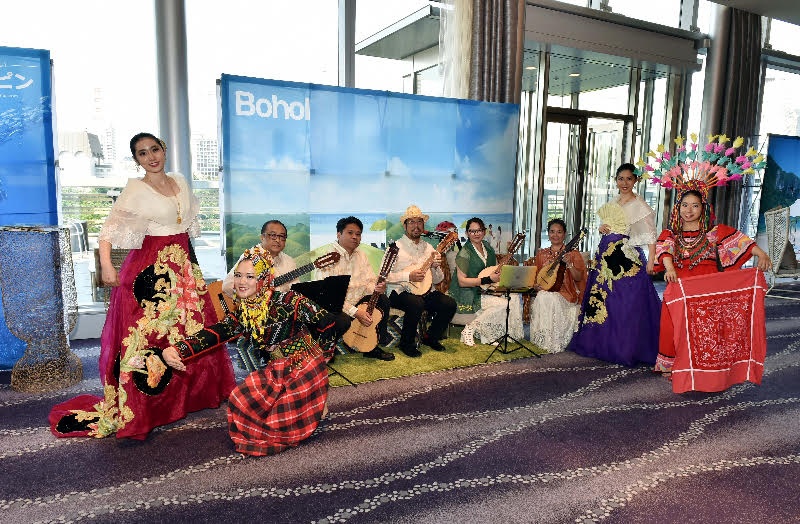
In the lowland, largely Christianized regions, Spanish influence gave rise to more melodic and structured forms. The rondalla—featuring instruments like the bandurria, guitar, laúd, and octavina—became a staple of Filipino musical expression. Vocal traditions also flourished, including the kundiman, known for its heartfelt romantic themes, and the harana, a traditional form of courtship serenade. Meanwhile, the sarsuwela combined music, theater, and storytelling into a popular dramatic form.
Folk songs and dances remain central to Filipino cultural identity, often reflecting everyday life and shared values. Well-known songs such as Bahay Kubo, Leron, Leron Sinta, Magtanim ay Di Biro, and Pamulinawen highlight themes of nature, farming, and love. These are often paired with traditional dances like Tinikling, Cariñosa, and Pandanggo sa Ilaw, which add a visual dimension to musical storytelling.
A defining feature of traditional Filipino music is its strong oral tradition. Many songs and practices have been passed down through generations without written notation, preserving not just melodies but also the stories and values embedded within them. Across regions and styles, the music continues to express themes of community, resilience, and a deep connection to both land and heritage.
Ingo Stoevesandt wrote in in his blog on music in Southeast Asia:“Speaking about traditional Philippine music, most people think of the Kulintang, an instrument similar to the gamelans played in Indonesia. It is an interesting fact that the Spanish missionaries were the first ones who tried to describe the music of the local Filipino people in letters and travelogs. It is not more than 50 years ago that serious scientific research for the indigenous music of the 7000 islands started. As many of the ethnic tribes still remain unresearched we have to admit that the state of research on this topic still is young. [Source: Ingo Stoevesandt ]
Looking at the gong sets and ensembles of gangsa in the Cordilleres, we are reminded of Vietnam and Indonesia. Even the famous kulintang seems to reflect many traditions of Gamelan ancestors in Indonesia, China and Vietnam. The vocal traditions stand a little outside. Like in every country we find the most “indigenous” aspects in the pieces sung solo or with an instrument. Separations from north to south show two different styles: The northern style uses a special rhythmical pronunciation of vowels and expressive pauses. In the southern style we find melisma, tremoli and long melodic phrases reminding of the Islam singing style. Some vocal genres reflect a significant form of music for an ethnicity, like the Marano bayok which is a kind of creating language out of music, or the epics stand for one local group like the Marano “Darangen”.
RELATED ARTICLES:
MUSIC FROM THE PHILIPPINES: ARTISTS, GOOD SINGERS, POP, ROCK factsanddetails.com
FLIP TOP AND BALAGTASAN (DEBATE POETRY) factsanddetails.com
FILIPINO BANDS: THEIR TALENT,VERSATILITY, HARD LIVES AND WHERE THEY PLAY factsanddetails.com
FOREIGN MUSICAL ARTISTS IN THE PHILIPPINES: THE BEATLES, AIR SUPPLY, LADY GAGA factsanddetails.com
FILIPINO AMERICAN POP-ROCK STARS: OLIVIA RODRIGO, BRUNO MARS, FANNY, H.E.R. factsanddetails.com
PHILIPPINES CULTURE: HISTORY, MERGING TRADITIONS, THREATS factsanddetails.com
CATHOLIC, ASIAN, SPANISH AND AMERICAN INFLUENCES ON FILIPINO IDENTITY AND CULTURE factsanddetails.com
Spanish Influence on Filipino Music
Ingo Stoevesandt wrote in in his blog on music in Southeast Asia: “It was in 1521 when the first Spanish missionaries arrived. Only few decades later, around 1600, churches and schools have been installed and the secular musical tradition of Spain was taught. We can assume that mainly only such music was taught as it was used in the Christian liturgia, for example the Gregorian solo chant and the first roots of polyphony from the canto organo and gymel. [Source: Ingo Stoevesandt ]
The instrumental praxis joined the indigenous one, so that there was no problem to establish for example an early form of the viola da gamba or the Spanish guitar. The Spanish priests have mostly been satisfied by the fastly growing skills of the Filipino people. On the other side the indigenous sources were soon mixed with Christian habits and divine rituals nowadays know both saints, holy mother Maria as indigenous demons and angels, for example in the kagong ritual in Banaan.
The life and suffering of Jesus Christ is replayed in many songs and processions called senaculo. These processions are another location for the interaction between Spanish/Catholic and indigenous habits, even in music. As Professor Corazon Canave-Dioquino points out in her article: “The welding of folk traditions and practices into Catholic rituals and celebrations continued. This gave rise to many extra-liturgical music genres, many of which were connected to the church calendar year. Some of these include the Christmas carols and the more elaborate outdoor-re-enactment of the Holy Couple's search for lodging called the pananawagan, panunuluyan, or kagharong.”
During Spanish occupation most of the music was joined in the major cities of Luzon or Manila, but it spread out over the islands until today. Nowadays we find nearly every kind of medieval European folk or dance music and its ensembles, for example the rondalla with its plucked string instruments playing dance pieces like the Polish polka, which tries to imitate the murzas. Starting after 1898, the Filipino music faced another impact by Western music, this time coming from the American neoclassicism. First attempts to compose for the Western symphonic orchestra were made in the 1930s or even earlier. This was accompanied by a reinstallation of the village band in the semiclassical music which was successful even in times of radio and television.
Traditional Filipino Musical Instruments
There are a number of xylophone-like instruments in the Philippines. The bangibang is set of at least seven wooden bars made of hard wood. Each bar has its own pitch and is hit by the player with a short stick of hard wood. Players have one stick each and play their own rhythmic pattern, which fall together ('interlocking'). [Source: patongastig.blogspot.jp ~]
The Afiw is a brass instrument horizontally with the metal tongue in front of the opened mouth. The left end is either hit by the thumb of the right hand or plucked. This makes the metal tongue vibrate which causes a sound. The mouth serves as a resonator and by changing the shape and size of the mouth opening, the tones can be changed, thus creating a melody. By strongly breathing in or out the volume can be changed as well. The string is made of wool. Dimensions: length: 11.5 centimeters , width: 1.3 centimeters. ~
Tanggunggu is set of eight small gongs made of iron, usually hanging on a rest of rope. The lower right gong is played as an ostinato while the melody is played on the other gongs, around the ostinato. Tongkaling brass bells are used as an amulet or as a musical instrument. Fourteen brass bells are fixed to a metal girdle. Nine of these bells have a particular design (a tiger's face). The girdle is used during a particular dance. The Agung gong is made of iron. The gong is part of the Kulintang ensemble Dimensions: diameter: 45 centimeters depth: 21 centimeters. ~
Filipino Drums
The Dadabuan is an hourglass-shaped drum made of wood with a membrane made water buffalo skin. Decorated with carvings and painted, the drum is part of the Kulintang ensemble. Dimensions: height: 59 centimeters; diameter (membrane): 19 centimeters. The gandang ia cylindrical drum made of wood with a membrane made of water buffalo skin on each side. Decorated with 'okiran' motives and painted, the drum is part of the Kulintang ensemble. [Source: patongastig.blogspot.jp ~]
The K-hon is big wooden box used as drum with metal strings inside. Depending on where and how you hit it can sound like a bass drum, a snare drum, bongos or congas. The strings, which can be tuned, give it a distinctive sound. It gets its name the Philippine word for box—kahon—which comes from the Spanish “cajon”. The instrument was first created by pair of drummer-carpenters after seeing a Spanish flamenco performer pounding on a box at 2001 performance. The K-hon is regarded as a poor man’s drum kit. One can be purchased for about $50, compared for $500 for drum kit. Among the foreign groups have heard them and been intrigued enough order some are Boyz II Men, the Lotus Eaters and China Crisis.
Bamboo Musical Instruments in the Philippines
Bamboo musical instruments come in all shapes and sizes in the Philippines. The Palipal is a bamboo tube with one end open, cut open in the middle and the upper part cut into two halves. The instrument is played by shaking: one half swings up and down and in the down swing hits the lower half. The Serongagandi is decorated bamboo tube, closed by a node at both ends. Two strings are lifted by bamboo sticks and connected by a wooden bridge (or 'platform'). The bridge is situated over a hole which makes the tube a resonator. [Source: patongastig.blogspot.jp ~]
The Sludoy is tube a zither made of bamboo; five strings cut from the tube; the tube is cut open with one full length crack and held together by bamboo strips at both ends. In this way the tube forms the resonating body of the instrument. Usually a piece of dried leaf is placed in the top end of the tube of which the function is not clear. The Tagutok is decorated bamboo scraper, length: 46 centimeters , diameter: 9 centimeters ~
The Gabbang is xylophone with 17 keys made of bamboo, separated by metal nails. The resonating case is decorated with floral motives. At the sides are two mirrors. The beaters are made of wood with a piece of tube rubber. Dimensions: length: 102 centimeters , width: 51 centimeters height: 37 centimeters. ~
The Balingbing is a bamboo tube, one side closed, two tongues and a crack up to the node and a hole. The instrument is played by beating one of the tongues against the arm or wrist. The sound can be changed by closing and opening the hole. Usually played by at least seven individuals, each with one buzzer. Players play their own rhythmic pattern, all patterns fit together ('interlocking'). Players can form long rows while dancing in an open space (such as a central meadow). Dimensions: vary from 30 to 50 centimeters depending on desired tonal height. ~
The Bansiq is slightly curved bamboo tube, closed on one side by a node and cut off under an angle. On the cut off surface an extra piece of bamboo is tied. Dimensions: length: 31,5 centimeters , diameter: 1,5 centimeters. The Courting flute is short bamboo tube, cut off on the node and closed with a piece of wood. The lower part of the hole is half covered, with a burnt in hole. Dimensions: length: 14,7 centimeters , dimater: 1,6 centimeters The Saunay is a tube with six fingerholes, a mouth piece of bamboo with a cut out reed, a mouth shield made of coconut shell, and a bell made of leaf (probably bamboo) and blue plastic ribbon. ~
Traditional Visaya Musical Instruments
This section focuses on the musical instruments of the Visaya’s but many are also found in other parts of the Philippines with different local names, or in some cases, the same name. There are basically eight kinds of Visayan musical instruments. Four are very quiet instruments and so are played indoors at night time: a small lute, bamboo zither, nose floot, and reed jew’s harp. The other four are very loud, and therefore suitable for war, dancing, and public gatherings: bamboo or seashell bugle, metals gongs, skin-headed drums, and bamboo resonators. [Source: pinoy-culture.tumblr.com, Barangay: 16th Century Philippine Culture and Society by William Henry Scott, pages 108-109.=]
The kudyapi is a kind of small lute carved out of a single piece of wood with a belly of a half a coconut shell added for resonance, with two or three wire strings plucked with a quill plectrum, and three of four frets, often of metal. The body is called sungar-sungar or burbuwaya; the neck, burubunkun; the strings, dulos; the fretboard, pidya; and the tuning pegs, birik-birik. The scroll is called apil-apil or sayong, the same as the hornlike protrusions at the ends of the ridgepole of a house. The kudyapi is only played by men, mainly to accompany their own love songs. The female equivalent is the korlong, a kind of zither made of a single node of bamboo with strings cut from the skin of the bamboo itself, each raised and tuned on two little bridges, and played with both hands like a harp. A variant form have a row of thinner canes with a string cut from each one. =
Tolali or lantuy is a nose flute with three or four finger holes, and is played in imitation of a mournful human voice with shakes and trills though appropriate to wakes and funerals. Subing is a Jew’s harp—a twanging reed plucked between the lips or teeth with the open mouth as a variable resonating chamber, and since its sound could be shaped into a kind of code words understood only by the player and his sweetheart, it is considered the courting instrument part excellence. Bodyong is a conch shell or section of bamboo played against the lips like a bugle, used as a signal in war or as part of a babaylan’s paraphernalia during a paganito. Babaylan also kept time with tambourines called kalatong, a term which included war drums (gadang or gimbal), with the huge ones that are carried on mangayaw cruisers being fashioned out of hollow tree trunks with a deerskin head. Tibongbong is a node of bamboo pounded on the floor as a rhythm instrument. =
Gongs in the Philippines
The most important instrument at the time the Spanish arrived was the agong, a bronze gong Spanish explorers encountered wherever they went ashore. Pigafetta noted an ensemble in Cebu—a pair suspended and struck alternately, another large one, and two small ones played like cymbals—and in Quipit, three different sizes hanging in the queens quarters. The natives of Sarangani buried theirs in a vain attempt to avoid looting by Villalobos; and thirty Samerenos boarded Legazpi’s flagship in Oras Bay and danced to the rhythm of one, after his blood compact with their chief. Mindanao epics provide a few details of their use. Agong were played either on the edge or on the navel (that is, the center boss or knob), slowly to announce bad news, faster (by the ruling Datu himself) to summon the people. Warships approached the enemy with all gongs sounding. [Source: pinoy-culture.tumblr.com, Barangay: 16th Century Philippine Culture and Society by William Henry Scott, pages 108-109 =]
Gongs were given a larger vocabulary than any other instrument. Alcina (1668a, 4:129) considered it an evidence of the elegance of the Visayan language that there were special terms “even for the cord with which they fasten and hang it, which it would be improper to apply to anything else.” Munginungan was the boss or teat. A flat gong, or one from which the boss have been worn off by long use, was panas, including the plate like Chinese ones (mangmang). The largest one in an ensemble was ganding. Hototok was to play them on the edge with a simple stick, or sarawisaw if more than one player alternated strokes. Pagdanaw or pagbasal was to strike them on the boss with a padded drumstick called basal. (A governor or chief was also called basal, presumably because of his prerogative of sounding a gong to assemble his people.) Actual bells from Spain or Asia were linganay, and little jingle bells—like those the epic hero Bantungan have on the handle of his kampilan—were golong-golong. =
Chinese gongs were little valued: ones from Sangir were worth three or four times as much, and those from Borneo three or four times that—4 or 5 pesos in 1616. Huge ones said to reach a meter and a half in diameter could fetch one or two slaves. The Bornean gong was a standard of value when bargaining for expensive goods—for example, “Pakaagongonta ining katana [Let’s price this Japanese sword] (Sanchez 1617, 9v). Indeed, assessments like pinipito or pinakapito (both referring to the number seven) were understood by themselves to mean seven gongs. =
Gongs were one of four items—along with gold, porcelain, and slaves—required for any Datu-class dowry, or bride-price, and men mortgaged themselves to borrow one for this purpose. The bargaining between the two families was done with little wooden counters placed on top of a gong turned boss-up on the floor, and the gong itself became the property of the mediating go-between upon the conclusion of a successful settlement. =
Nose Flutes and Other Instruments from Luzon
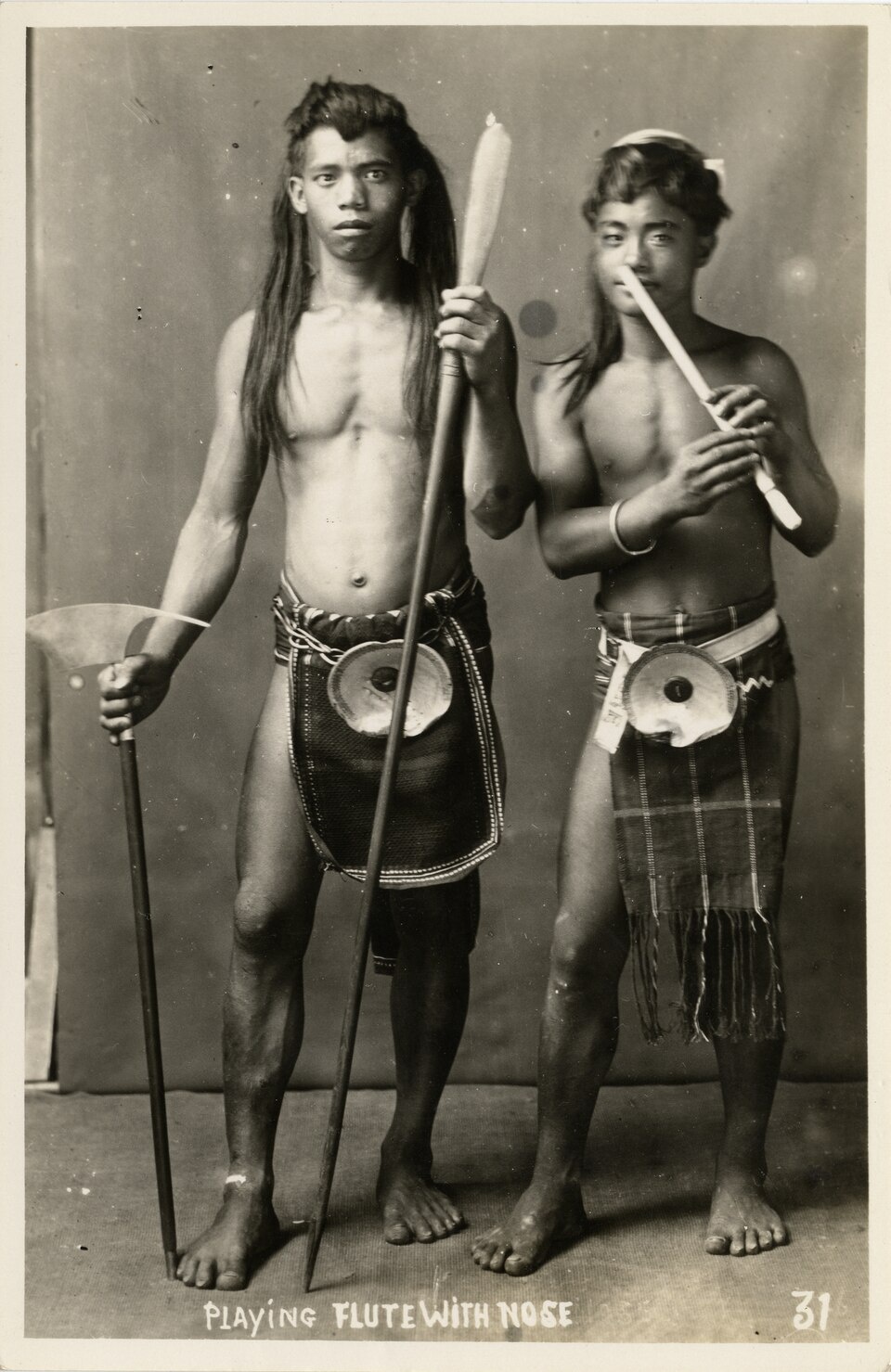
The traditional nose flute from the island of Luzon is held like a symphony flute but is played with one nostril. The pitung ilong (nose flute in Tagalog), or the kalaleng of the northern Bontok people, is played with the extreme forward edge of the right or left nostril. Because the kalaleng is long and has a narrow internal diameter, it is possible to play different harmonics through overblowing—even with the rather weak airflow from one nostril. Thus, this nose flute can play notes in a range of two and a half octaves. Finger holes in the side of the bamboo tube change the operating length, giving various scales. Players plug the other nostril to increase the force of their breath through the flute. [Source: Wikipedia]
The tongali is a four holed nose flute (one hole in the back) from northern Philippines and played by the Kalinga and other peoples of Luzon. The tongali is made of a long bamboo tubes closed at one end by the node in which the blowing hole is burnt. The flute has three finger holes. The blowing hole is placed under an angle against the nose and the player gently blows into the tube.
The tongali is one of the few nose flutes in the world that is still actively taught, thanks to the work of Jose Maceda at the University of the Philippines and the ongoing effects of the music department of UP Quezon. The tongali is one of numerous traditional instruments that students can study at UP. There are stories from this region that say that the nose flute was used to help rice grow when it was young, as the rice was attracted to the soft sounds of the flute, and would grow to put its ear above the water to hear it better. Gangsa are handmade by the Kalinga tribe of the Northern Philippines (in the Cordillera mountain range) they are used in traditional dances andd used to summon the gods for good fortune. Baliing is a nose flute. [Source: aikahodan.blogspot.jp]
Tongatong is a bamboo percussion instrument used by the people of Kalinga to communicate with spirits during house blessings. It is made of bamboo cut in various lengths. When you hit it against soft earth a certain drone reverberates though the instrument's open mouth. When an entire set of Tongatong is played in interloping rhythm and prolonged with the tribal chanting, it could put the audience and the dancers in a trance. Diwdiw-as is one of he Cordillera instrument.It is 5 or more different size of slender bamboo that is tied together. Saggeypo is a Stopped pipes found in northern Philippines are the saggeypo (Kalinga) and the sagayop (Bontok). The bamboo pipe is closed on one end by a node with the open end held against the lower lip of the player as he blows directly across the top. The pipe can be played individually by one person or in ensembles of three or more. [Ibid]
Image Sources: Wikimedia Commons
Text Sources: “Encyclopedia of World Cultures Volume 5: East/Southeast Asia:” edited by Paul Hockings, 1993; “Culture Shock!: Philippines” by Alfredo Roces and Grace Roces, Marshall Cavendish International, 2010; Metropolitan Museum of Art; National Geographic, Live Science, Philippines Department of Tourism, New York Times, Washington Post, Los Angeles Times, Smithsonian magazine, Encyclopedia.com, Library of Congress, The Conversation, The New Yorker, Time, BBC, CNN, Reuters, Associated Press, AFP, Lonely Planet Guides, Google AI, Wikipedia, The Guardian and various websites, books and other publications.
Last updated March 2026