
FILIPINO BANDS

Filipino musicians are common sights at hotel bars across Asia. Anthony Bourdain wrote for CNN: For years now, in hotel bars in Chiang Mai, in lobbies in Singapore, cocktail lounges in Colombo and Kuala Lumpur and Hong Kong, wherever I go, I find a Filipino cover band able, on request, to play "Dark Side of the Moon" note for note — before moving on to Happy Birthday (in English, German or Cantonese), Patsy Cline, Celine Dion — and then "Welcome to the Jungle"...Where do they all come from? [Source: Anthony Bourdain, CNN, April 22, 2016]
For decades, entertainers from the Philippines have performed across Asia, earning a reputation for their skill in interpreting Western pop music. This tradition traces back to the period of American colonial rule in the Philippines, when American cultural influence—along with the spread of record players—introduced generations of Filipino musicians to global music trends. [Source: Mike Ives, New York Times, May 7, 2020]
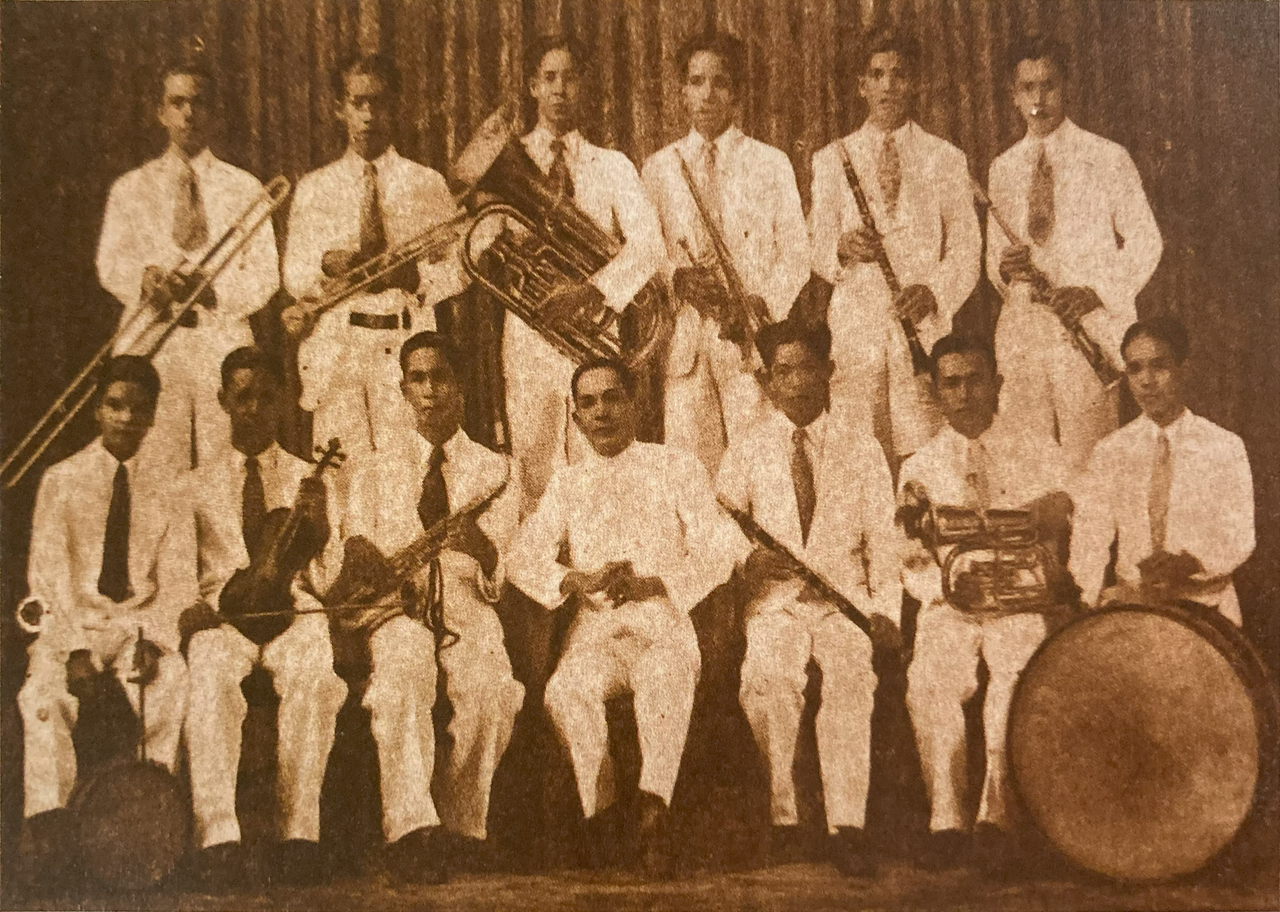
Throughout Asia— particularly Southeast Asia—one will find Filipino artists making music in hotels, jazz clubs, at concerts and churches, and leading singing in karaoke clubs and bars. But, Filipino musicians and bands are not just found in Asia. They are famous are around the world. It is hard to find a country that doesn't have a Filipino band doing covers of Western standards and fashionable pop songs of the moment in the hotel bar or nightclub. The tradition goes back a long time. Filipino bands entertained guests on verandas at official dinners throughout colonial Asia in the 1920s and 30s.
RELATED ARTICLES:
MUSIC FROM THE PHILIPPINES: ARTISTS, GOOD SINGERS, POP, ROCK factsanddetails.com
TRADITIONAL MUSIC IN THE PHILIPPINES: INSTRUMENTS, DRUMS, NOSE FLUTES, factsanddetails.com
FLIP TOP AND BALAGTASAN (DEBATE POETRY) factsanddetails.com
FOREIGN MUSICAL ARTISTS IN THE PHILIPPINES: THE BEATLES, AIR SUPPLY, LADY GAGA factsanddetails.com
FILIPINO AMERICAN POP-ROCK STARS: OLIVIA RODRIGO, BRUNO MARS, FANNY, H.E.R. factsanddetails.com
PHILIPPINES CULTURE: HISTORY, MERGING TRADITIONS, THREATS factsanddetails.com
CATHOLIC, ASIAN, SPANISH AND AMERICAN INFLUENCES ON FILIPINO IDENTITY AND CULTURE factsanddetails.com
Skill of Filipino Musicians
Filipino musicians can do credible imitations of American rhythm and blues and country singers and musicians . They are such good imitators they have a phrase for it: “plakang-plaka” , or “sounds just like the recording.” Describing a Filipino band called Smokey Mountain, John Clewey wrote in the Rough Guide to World Music, "impish but safe in trendy denims, they sing in English; the song sounds like a cross between Miss World-type theme tune and east-listening US rock/pop." [Sources: Rough Guide to World Music]
One musicians who worked in Japan, Guam and Saipan settled in Beijing, where he gets $1,000 a month plus food and lodging at the hotel where he works. Describing a group at the Jungle Bar in Bangkok, a reporter for the Thai newspaper the Nation wrote: “A silk viced Philippine crooner fronting a four-piece band, is doing covers such as the Eagles’ “Hotel California”, Whitney Houston’s “I Will Always Love You” and Celine Dion’s “My Heart Will Go On”. The renditions are invariably pitch perfect, interspersed with jokes and inducements to drink up, and are almost always well received by the audience.”
A recommendation for Strumm's sports bar in Singapore in Virtual Tourist goes: “Strumm's has a very good filipino live band that play from Tuesday till Sunday. They typically play from 7 pm till 4 am. The bartenders, and waitresses are friendly, all filipino's, and very helpful. The only bad thing is that the beers are a little warm and cost around S$38. The bar has a dj and dance floor for when the band is not playing and on the weends (which start on a thursday) the place gets really full with patrons. So wear your dancing shoes, bring your rythym, and enjoy a good night in Strumm's.
Filipino Kids Do a Spot On Version of Led Zeppelin's “Whole Lotta Love”
Missioned Souls is a family band from Cebu City whose performances have captured widespread attention online, amassing more than eight million views on YouTube. In one of their standout videos, the young group delivers a spirited cover of Whole Lotta Love by Led Zeppelin. The lineup features Stacey (12) on rhythm guitar and vocals, Neisha (14) on lead guitar, Naces (15) on bass, and their youngest member, Ice (10), on drums—together recreating the song’s iconic sound with impressive precision and youthful energy. [Source Fraser Lewry, Louder Sound, September 3, 2024]
The band describes itself as more than just a musical act. “We are a family commissioned to propagate the importance of family unity,” they explain, emphasizing love, respect, and togetherness. Through their music, they aim to share joy while putting their “God-given gifts” into action, turning each performance into both entertainment and a message of family values.
Their repertoire is remarkably diverse, spanning classic rock and pop across generations. Alongside their Led Zeppelin cover are performances of songs by Muse, Bon Jovi, Heart, and Foo Fighters. At the same time, they explore pop classics from artists like Bruno Mars, ABBA, Whigfield, and Boney M.—all performed with clear respect for the original recordings.
Behind the scenes, the project is guided by their parents, Secan and Sheena. Secan handles sound engineering, ensuring the band’s polished audio quality, while both parents occasionally join performances in expanded versions of the group. Sheena, in particular, stands out vocally—her rendition of Heart’s “All I Wanna Do Is Make Love To You” showcasing a powerful presence that complements the family’s already impressive musical dynamic.
Filipino Entertainers Abroad
Floyd Whaley wrote in New York Times, “Thousands of musicians from the Philippines who are prominent in bars, lounges and clubs around Asia and the Middle East. In 2002 alone, more than 40,000 entertainers left the Philippines to work overseas, primarily in Japan. Musicians, can make as much as $2,000 a month working in five-star hotels, or $800 to $1,500 a month working on a cruise ship, according to performers and government officials. But they are also vulnerable to exploitation, said, and some earn $400 per month.[Source: Floyd Whaley, New York Times, January 31, 2013 ^*^]
“After allegations of prostitution among some entertainers, however, the Japanese government found that many of the female musicians could not actually play a musical instrument, and that many of the vocalists did not have much of a voice. After the crackdown, the number of performers who left the Philippines to work overseas dropped to 4,050 in 2006, from 43,818 in 2004. The figure now hovers around 1,500 to 2,000 a year, government statistics show, with Japan remaining the top destination, followed by Malaysia, South Korea and China. ^*^
“In the past, the Philippine Overseas Employment Administration held auditions to verify the legitimacy of musicians seeking to work overseas, said Celso J. Hernandez, the head of the agency’s operations and surveillance division. After the Japanese crackdown, however, the Philippine government discontinued the practice. These days, the government relies on vetting by licensed recruitment agencies, although it still examines the musicians’ paperwork.“We only allow musicians and entertainers to work in legitimate establishments such as cruise ships and major hotels,” said Yolanda E. Paragua, a senior official with the Philippine Overseas Employment Administration. “Not in honky-tonk type places.” ^*^
Life of a Overseas Filipino Musician
Floyd Whaley wrote in New York Times, “For more than 30 years, Josetoni Tonnette Acaylar has been singing and playing the piano throughout Asia. He has provided relaxing background music and taken requests for pop and jazz standards in more five-star hotel lobbies and smoky lounges than he can recall, in Brunei, China, Dubai, Hong Kong and other locales. In one job in Japan, he was told to take off his tuxedo and work in the kitchen, washing dishes and scrubbing floors. “Sometimes they would pull me out of the kitchen, give me a jacket and yell, ‘Play the piano!’ and I would have to perform,” Mr. Acaylar recalled with a laugh. [Source: Floyd Whaley, New York Times, January 31, 2013 ^*^]
“Domingo Mercado Jr., who goes by the stage name Jojo, wrote and performed original music when he left high school, as part of a nine-piece band called Music and Imagination. Some of his friends have had a taste of fame, but he went in another direction. “I resigned from the band and took a job in Korea,” said Mr. Mercado, 45. “I gave up on my dream.” Mr. Mercado has performed across Asia as a singer and guitarist since 1994. He recently returned from a six-month job on a cruise ship.^*^
“Although singers and musicians from the Philippines can be found performing in many hotel lounges around Asia, the field is actually quite specialized and highly competitive. “A hotel might need many waiters, cooks and housekeepers,” Mr. Hernandez of the overseas employment agency said. “But they only need one or two musicians.” However musicians from the Philippines are in demand, said Maria Victoria Kinpanar, a booking agent. ^*^
“But she noted that the improved economy in the Philippines had created some lucrative options for musicians who wanted to stay or return home. “Overseas work is short-term contract work. It’s not stable,” Ms. Kinpanar said. “Some high-quality musicians are now able to find long-term work here in the Philippines.” Indeed, after spending 30 years working across Asia, Mr. Acaylar now has a regular job playing the piano in the lounge of the Hyatt Hotel & Casino in Manila. But he is still uncomfortable with the suggestion that he is a traveling lounge musician. “I don’t categorize myself as a lounge singer or lobby pianist,” he said. “That requires formal training. I just play the piano and sing songs.” ^*^
Filipino Bands in Dubai
For decades, Filipino show bands have been a fixture of Dubai’s nightlife, fueling its reputation as a cosmopolitan hub. Rooted in a long musical tradition shaped by centuries of Spanish and later American influence, Filipino performers became known for their ability to recreate Western hits—from jazz to rock—with uncanny precision. By the late 20th century, they were fixtures in clubs across Asia and the Gulf, helping transform Dubai from a quiet port into a global party destination. [Source: Isabel Debre, Associated Press, November 15, 2020]
But beneath the bright lights, the reality has long been uneven. Filipino musicians are often paid far less than Western performers and housed in cramped, substandard conditions. The pandemic exposed and intensified these inequalities. When venues shut down, many artists were evicted from dormitories, left without income, and in some cases forced to sell personal belongings just to eat. Advocacy groups estimate that a majority never received promised pay, while many had their visas abruptly canceled under the UAE’s sponsorship system.
Some turned to online performances to survive, livestreaming music and dance for small donations. Others endured extreme conditions. One performer described being locked inside a dormitory for months with fellow musicians, surviving on basic food supplies while continuing to rehearse and sing. Eventually, even that fragile stability collapsed, as landlords cut power and forced them out.
Filipino Bands in Dubai Suffer During the Covid-19 Pandemic
In November 2020, Associated Press reported: Eric Roman strides onto the stage in ripped jeans and grips the microphone. It’s midnight on a Friday, and in another time the small hotel bar along Dubai Creek would be roaring—packed with Filipino workers, Arab businessmen, and mall employees unwinding after long shifts. The dance floor would pulse as he belted out Don't Stop Believin' with his nine-piece band. [Source: Isabel Debre, Associated Press, November 15, 2020]
Now, the room is quiet. Pandemic restrictions have erased the crowds and sidelined his bandmates, banning dancing and limiting performers onstage. Roman returned to work after lockdown with a 65 percent pay cut, while many musicians—guitarists, drummers, bassists—lost their jobs entirely. “Dubai is dead,” he says. “Every day we wonder how we’ll survive.”
For many, leaving Dubai has proven just as difficult as staying. Thousands of Filipino workers remain stranded, unable to afford repatriation or secure flights home. One guitarist, unable to find work when clubs reopened with limited acts, sold his instrument—the very thing that defined his livelihood—to get by.
Those still performing face a drastically altered scene. Clubs are half-empty, shows end early, and strict health inspections loom over every performance. Some nights, singers perform to near-empty rooms, their only audience the staff waiting for customers who never arrive. Despite all this Roman continues to sing, sending what little he earns back to support his family in the Philippines. Despite everything, he holds on to hope. “This is the worst time of my life,” he says quietly. “But I have to believe it won’t last forever.”
Filipino Musicians in Hong Kong
Even before World War II, Filipino performers were already making their mark abroad, particularly in Shanghai, where they played in lively nightclub scenes. After the war, many continued their careers in Hong Kong, performing in big bands and contributing to the soundtracks of Cantonese-language films, further cementing their presence in the region. [Source: Mike Ives, New York Times, May 7, 2020]
Over time, Filipino musicians became deeply woven into Hong Kong’s cultural life. Their versatility is a defining trait, with cover bands capable of performing an astonishing range of genres—from rock and reggae to R&B and classic pop—often within a single set. Their ability to replicate and reinterpret diverse musical styles has made them a staple in the city’s bars and entertainment venues.
One example is Icebox, a long-running house band at a Wan Chai bar, whose performances can jump effortlessly from Frank Sinatra to Iron Maiden. Frontman Spike Cazcarro credits his wide musical range to growing up in the Philippines listening to artists like The Beatles, Bee Gees, AC/DC, and Bruce Springsteen. Through nightly performances and constant practice, Filipino bands have not only entertained audiences but also helped elevate the standards of local musicians throughout Hong Kong’s music scene.
Life of Filipino Musicians in Hong Kong
Filipino musicians abroad are often seen—and sometimes market themselves—as more affordable alternatives to their Western counterparts. A skilled drummer might earn around $650 for a wedding or corporate event, yet many Filipino performers are willing to take the same job for half the pay. “Sad to say, but that’s true,” said Paul Sapiera, a veteran multi-instrumentalist who has spent over a decade in Hong Kong. [Source: Mike Ives, New York Times, May 7, 2020]
For many migrant Filipino musicians, their earnings don’t just sustain their own lives abroad—they support entire families back home. One of Sapiera’s bandmates, Charles Tidal, typically sent a significant portion of his monthly income to the Philippines to provide for his five children.
Filipino performers form the backbone of Hong Kong’s nightlife—singers, guitarists, pianists, drummers, and bassists. Jezrael Lucero is a respected session player in Hong Kong. Blind since birth and raised in Cebu, he began performing as a child, playing multiple sets a day for minimal pay to support his family. After moving to Hong Kong in 2006, he built a steady career collaborating with local artists and performing regularly at hotels like the Grand Hyatt Hong Kong.
That steady piano gig has helped him weather downturns. Pianists, he noted, are often the last to be cut when bands are downsized. Still, the uncertainty lingers. After softly playing The Days of Wine and Roses, he reflected on the precariousness of life in the city. “I’m just thankful I’m still here,” he said, before adding a stark reminder: Hong Kong can be a difficult place to survive without enough money to pay the rent.
Filipino Musicians in Hong Kong Suffer From Protests and Covid-19
In May 2020, the New York Times reported: Hong Kong — Jazz melodies echoed across polished wood, glass, and marble as Jezrael Lucero played through a set of standards in a luxurious hotel lobby. Yet the performance unfolded in near silence—there was no audience, and even his usual bandmates, a drummer and bassist, had been sent home as part of cost-cutting measures. [Source: Mike Ives, New York Times, May 7, 2020]
“I’m lucky to still have this gig,” said Lucero, a 35-year-old keyboardist from the Philippines who performs six nights a week at the Grand Hyatt Hong Kong. Once a hub for international business travelers, the hotel now struggles to fill its rooms amid the pandemic. Despite his steady work, Lucero knows how fragile the situation is. “I’m also aware this could disappear too,” he said.
The city’s live music scene had already been weakened by months of antigovernment protests before being nearly silenced by the coronavirus outbreak. Some early infections were traced to a “bar and band” cluster in nightlife venues, prompting strict restrictions. Although local transmission later declined, prolonged closures—especially of bars—left stages empty. Even when venues reopened, live music remained banned.
For many Filipino performers in Hong Kong’s nightlifethe shutdown meant months without income. According to Manuela D. Lo of the Hong Kong Musicians Union, the crisis followed nearly a year of setbacks. “It started with the protests, then the pandemic,” she said, describing a prolonged period of hardship.
With no steady work since early in the crisis, Tidal fell behind on bills and struggled to make ends meet, even after taking a part-time job as a clerk. “It’s hard,” he said. “I owe money to lots of people right now just to survive and feed my kids.” His situation reflects the broader reality for many overseas Filipino performers who suddenly found themselves without income or security.
The downturn has also exposed a deeper reality: much of Hong Kong’s entertainment scene depends on migrant labor. Anjeline de Dios noted that Filipino musicians, long essential to venues catering to expatriates, are now among the most vulnerable. As opportunities vanish, their livelihoods have become increasingly uncertain—revealing just how vital their presence has always been.
Image Sources: Wikimedia Commons
Text Sources: “Encyclopedia of World Cultures Volume 5: East/Southeast Asia:” edited by Paul Hockings, 1993; “Culture Shock!: Philippines” by Alfredo Roces and Grace Roces, Marshall Cavendish International, 2010; Metropolitan Museum of Art; National Geographic, Live Science, Philippines Department of Tourism, New York Times, Washington Post, Los Angeles Times, Smithsonian magazine, Encyclopedia.com, Library of Congress, The Conversation, The New Yorker, Time, BBC, CNN, Reuters, Associated Press, AFP, Lonely Planet Guides, Google AI, Wikipedia, The Guardian and various websites, books and other publications.
Last updated March 2026