
EVERYDAY LIFE IN THE PHILIPPINES
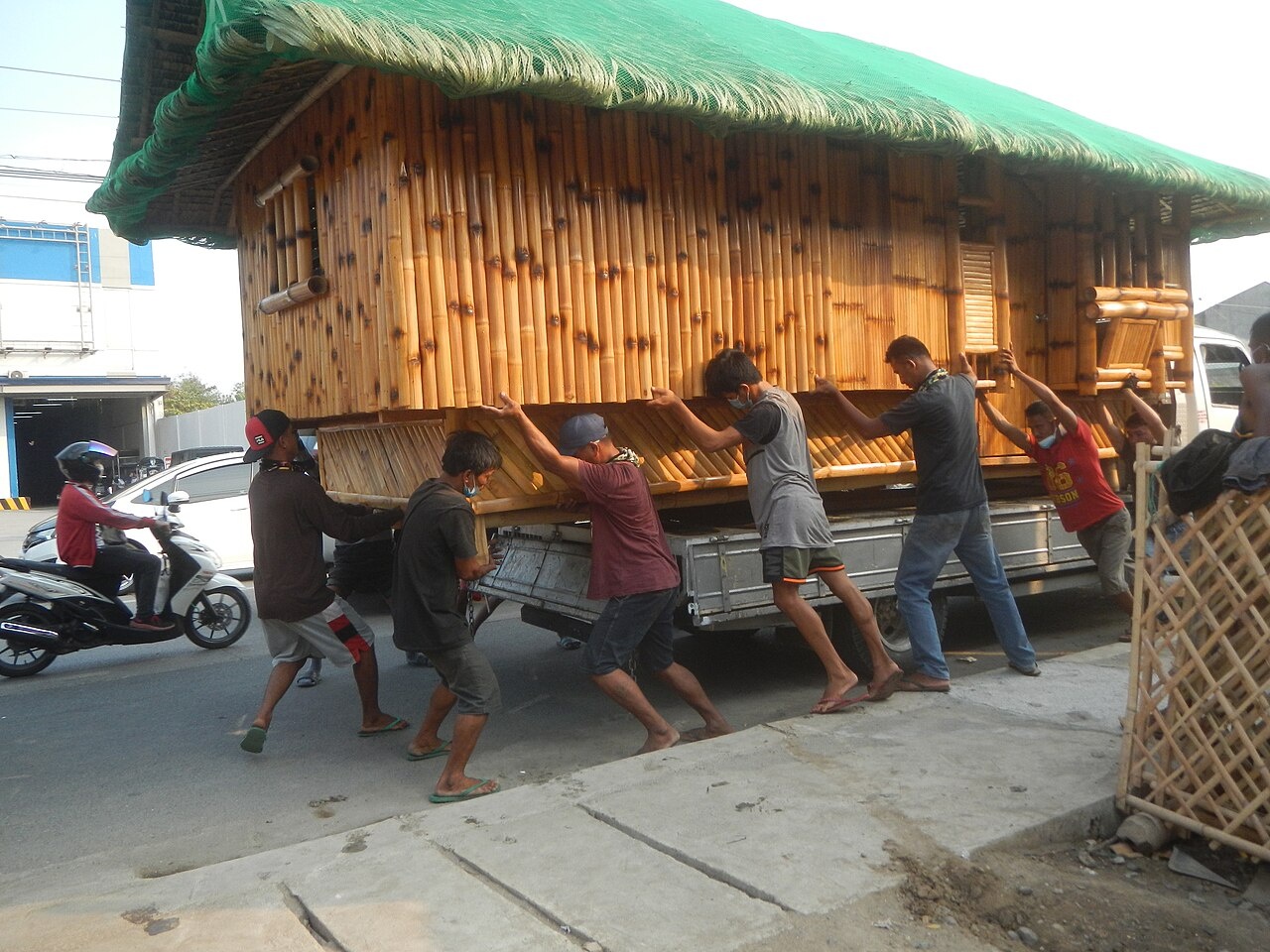
Poor people in the Philippines often only have a small piece of matting to sleep on. Upper-class Filipinos on the other hand are known for their love of "oriental" furniture, with the "plastic" covers, and "plastic rug runners". Such Filipinos are also found of "rose gardens and orchids". Outside the Philippines you can tell if you are walking by a Filipino’s house is you see a plentiful amount of them or smell them.
There have traditionally been more Western style toilets in the Philippines than in other Asian countries. Public restrooms are called "CRs" (comfort rooms). Women's restrooms often have urinal for women. Women use them by facing the wall and squatting.
One of the best places to observe everyday life in the Philippines is the local market. Markets in large cities and regional towns are usually busy, colorful, and full of activity. Vendors of all ages operate small stalls and are generally friendly toward visitors. Many are happy to chat, even if a person is simply looking around and not planning to buy anything. Communication is also relatively easy because many Filipinos speak English.
Fish markets are especially interesting and offer very inexpensive products. Small salted anchovies are commonly sold in small containers, while hipon—tiny shrimp that are ground and mixed with salt and coloring—are also widely available at low prices. Because it is often hot there is strong demand for refreshing drinks. Vendors sell a variety of freshly made juices and shakes made from fruits such as mango, green mango, pineapple, watermelon, apple, orange, and even sweet corn. These drinks are inexpensive, often just a few pesos.
RELATED ARTICLES:
HOUSES IN THE PHILIPPINES: HISTORY, TRADITION, NIPA PALM HUTS, CUSTOMS, SECURITY factsanddetails.com
For Information in the Daily Life and Houses of Different Ethnic Group See the Ethnic Groups and Minorities listed Under the MINORITIES factsanddetails.com
FAMILIES IN THE PHILIPPINES: GODPARENTS, KINSHIP, TIES, STRUCTURE factsanddetails.com
FILIPINO SOCIETY factsanddetails.com
POVERTY IN THE PHILIPPINES: POOR, HUNGRY, INEQUALITY, CAUSES factsanddetails.com
TONDO — MANILA'S LARGEST SLUM AND HOME TO SMOKY MOUNTAIN factsanddetails.com
SOCIAL RELATIONS IN THE PHILIPPINES: UTANG NA LOOB, BAYANIHAN AND PAKIKISAMA factsanddetails.com
ETIQUETTE AND MANNERS IN THE PHILIPPINES: CUSTOMS, PUBLIC ACTIONS, RESPECT factsanddetails.com
PEOPLE OF THE PHILIPPINES: FILIPINOS, IDENTITY, CHARACTERISTICS factsanddetails.com
Villages in the Philippines
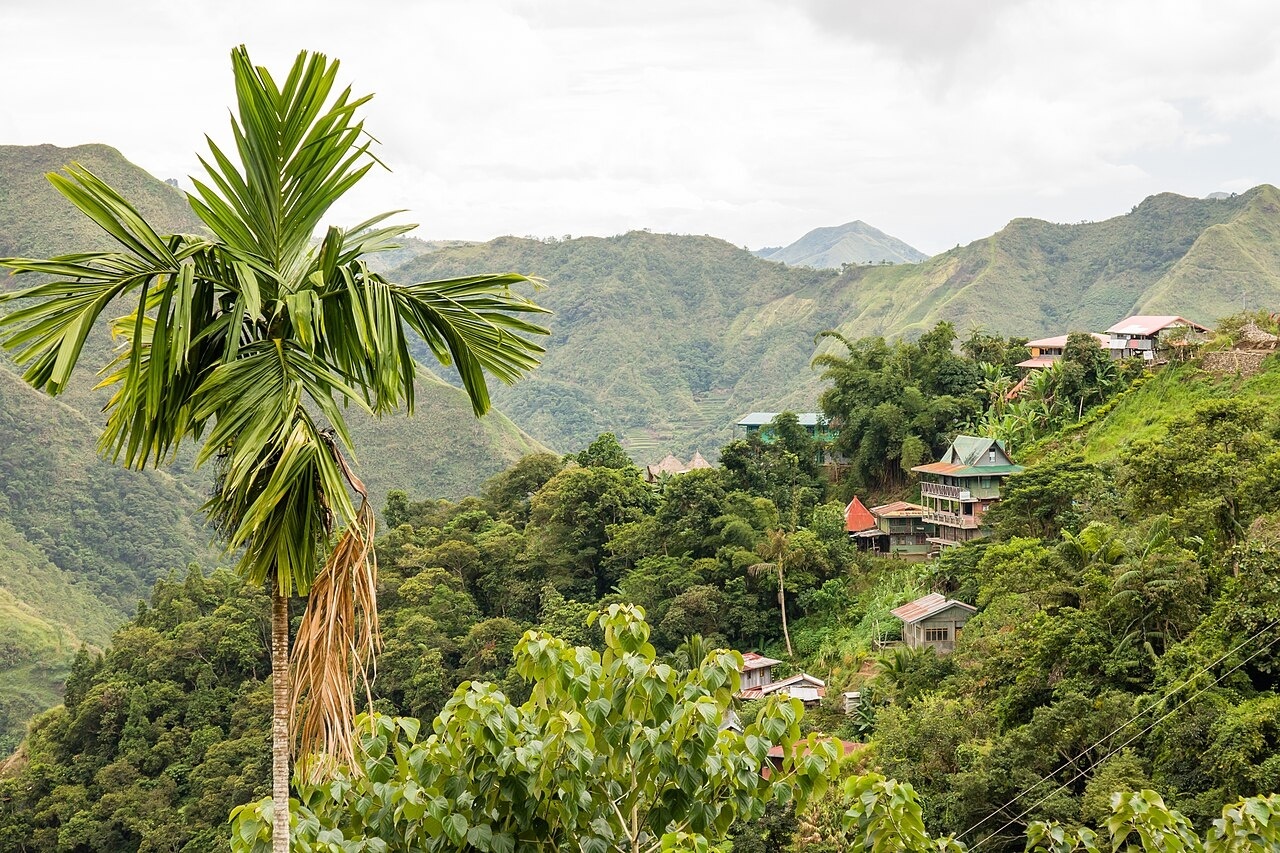
Villages in the Philippines have traditionally been called “barrios”. In the old days they were made up of grass-roofed houses set up along unpaved roads. Now they are often comprised of cement and metal roof houses on unpaved roads. Thickets of bamboo and nipa palms (See Below) provide material for housing. Most villages now have electricity. In the old days settlements were often set up along waterways and ports but now some are organized around roads and drinking water supplies.
Tagalogs are the largest ethnic group in the Philippines, making up about 28 percent of the country’s population. In the lowlands, where irrigated rice farming sustained communities, Tagalog settlements were originally established along rivers and waterways. Before the Spanish introduced highways and railroads, these waterways served as the main routes of transportation and trade. As roads and rail lines spread during the colonial period, homes began to cluster along them, even in upland regions where houses had typically been scattered in small groups near fields and water sources. In both lowland and upland areas, larger communities functioned as marketplaces and religious centers. Coastal villages likewise formed near reliable sources of fresh water. [Source: Charles Kaut, “Encyclopedia of World Cultures Volume 5: East / Southeast Asia:” edited by Paul Hockings, 1993 |~|]
Filipinos have a strong sense of belonging to a place. A family that has lived in metropolitan Manila for two generations still regards a municipality or province as its home. New Year's Day, Easter, and All Saint's Day are the most important family holidays. Bus traffic from Manila to the provinces increases dramatically at these times, with hundreds of extra buses taking people home to their families.
Towns in the Philippines
Towns have traditionally served as market and religious centers. Many towns are centered around a Spanish-style church and perhaps a statue of Jose Rizal or some other national hero. Large towns cites are built along the Spanish model with a large central plaza. Large Spanish brick churches, built during the colonial era, dominate the towns. These churches are large and differ from traditional construction. It's hard to imagine how the indigenous population was able to build them in the seventeenth century. Seaports and government centers had a higher concentration of Spanish buildings with wide verandas and tiled roofs.
Under Spanish rule settlements became more centralized, often organized around a church, chapel, or shrine—possibly continuing earlier precolonial patterns of sacred centers. By the early nineteenth century, major towns featured developed central plazas surrounded by dense populations. Manila and several provincial capitals grew into important urban centers. While still deeply connected to Tagalog society, Manila also emerged as a focal point linking many regions of the country.
In their efforts to convert the population, Spanish missionaries encouraged Filipinos to settle in organized communities, a system known as bajo las campanas (“under the church bells”). This policy led to the creation of towns centered around the church, ensuring that residents remained within hearing distance of its bells—a symbol of both spiritual and communal life. Typically, the size of the church bells reflected the size of the community itself. [Source: “Culture Shock!: Philippines” by Alfredo Roces and Grace Roces, Marshall Cavendish International, 2010]
The structure of many Philippine towns today still reflects this Spanish influence. At the heart of the town lies a central plaza, with the church positioned at one end and the municipio, or government building, at the other. Flanking the plaza are the homes of prominent residents. Both traditional indigenous houses and Spanish colonial homes shared certain features: they were often single-storey but elevated, with space beneath used for storage, and designed with high ceilings and wall openings to allow for ventilation in the tropical climate.
Towns destroyed during the liberation campaign of World War II, especially those in central and northern Luzon, were rebuilt with wood. Areas of Manila that were destroyed during World War II have been restored to their historical Spanish appearance. Newer buildings in Manila range from standard multistory offices and Western-style gated housing areas for the affluent to tenements and shacks. [Source: Sally E. Baringer, Countries and Their Cultures, Gale Group Inc., 2001]
Why Filipinos Have Two Kitchens
In many Western homes the kitchen is a central gathering place, where the person who does most of the cooking—traditionally the wife—spends a great deal of time. As a result, the kitchen often connects directly to a breakfast nook or a casual dining or family room where the household naturally gathers. [Source: “Culture Shock!: Philippines” by Alfredo Roces and Grace Roces, Marshall Cavendish International, 2010; [Source: Rosalinda Morgan, January 16, 2014]
In the Philippines the arrangement is often different, especially in middle- and upper-class homes where a hired cook is common. In these households the kitchen is usually treated as a work area rather than a social space, and the main kitchen inside the house may be used only occasionally. Unlike many modern Western kitchens, these spaces are often simpler and may lack extensive ventilation, decoration, or large numbers of appliances.
Many Filipino houses therefore have two kitchens. One, located inside the main house, is a cleaner and more presentable kitchen that may contain modern appliances and is sometimes used by the homeowner for special cooking. The second, commonly called the “dirty kitchen,” is located at the back of the house or sometimes outdoors. This smaller, more practical space is where everyday cooking is done, usually by the household cook.
The dirty kitchen typically uses simpler equipment such as gas-cylinder burners or even wood stoves. Locating it at the back of the house helps keep cooking smoke, grease, and strong odors—especially from fish or frying—from spreading throughout the home. It also reflects a practical response to local conditions.
Another advantage of the dirty kitchen is that it continues to function during frequent power outages. Since gas or wood stoves do not rely on electricity, cooking can continue even when electric ovens or ranges stop working. For this reason, many households rely on the simpler back kitchen for daily use, reserving the main kitchen for occasional cooking or entertaining.
Rural Life in the Philippines
In the early 20th century the vast majority of the population of the Philippines lived in rural areas and worked the land. Today the figure is about 50 percent. Improved roads, communications and expansion of electricity and the switch from animals to machines has dramatically changed the rural life.
Rural peasant have traditionally woken up and dawn and gone to bed not long after it gets dark. They have traditionally taken a siesta during afternoon heat. With the electricity, television, the Internet and smart phones there is now more for them to do at night. People wear straw hats for protection from the sun.
In rural families, young boys have traditionally taken care of the water buffalo or other large animals and girls have helped with chores like collecting water and washing clothes. Young people also help their elders to thresh and winnow and pound grain in a mortar or hollow stump and then toss it on a bamboo tray so the breeze can scatter the husks.
In the rural Philippines, traditional values have remained strong. The family was central to a Filipino's identity, and many sitios were composed mainly of kin. Kin ties formed the basis for most friendships and supranuclear family relationships. Filipinos continued to feel a strong obligation to help their neighbors — whether in granting a small loan or providing jobs for neighborhood children, or expecting to be included in neighborhood work projects, such as rebuilding or reroofing a house and clearing new land. The recipient of the help was expected to provide tools and food. Membership in the cooperative work group sometimes continued even after a member left the neighborhood. Likewise, the recipient's siblings joined the group even if they lived outside the sitio. In this way, familial and residential ties were intermixed. [Source: Library of Congress, 1991]
Barrio Life in the Philippines
Many Filipinos live in rural communities known as barrios, where farming and fishing are the main sources of livelihood. Life in these areas follows the rhythms of the sun and the agricultural seasons rather than strict schedules. Basic services such as running water and electricity have historically been limited, with water often taken from nearby streams and electricity arriving only gradually in many villages. Medical care is also limited, and traditional herbal healers often serve as the primary source of treatment. [Source: “Culture Shock!: Philippines” by Alfredo Roces and Grace Roces, Marshall Cavendish International, 2010]
Economic life in many barrios is centered on subsistence. People produce much of what they need themselves, and cash may be used less frequently than in cities. A Tagalog expression, isang kayud, isang tuka—literally referring to chickens that “scratch and peck” for their food—captures the idea of earning just enough each day to survive. Work follows the demands of farming or fishing, and the routine of the seasons is broken mainly by community celebrations such as local fiestas.
Traditions are strongly preserved in barrio life. The family is the center of social organization, and behavior is often guided more by family relationships and community expectations than by formal law enforcement. Educational opportunities may be limited because schools can be far away, books are costly, and children are often needed to help with farm work. As a result, many residents spend their entire lives within or near their home community, traveling only occasionally to nearby towns for markets or festivals.
Despite this continuity, some rural residents move to cities in search of work, education, or new opportunities. Many of these migrants are young people seeking a different life. A significant number settle in informal urban communities built on unused public or private land. These settlements are often made up of small, improvised homes known locally as barong-barong, reflecting the challenges faced by migrants adjusting to urban life.
Changes in Rural Life in the Philippines Since World War II
Before World War II, when landlords and tenants normally lived in close proximity, patron-client relationships, often infused with mutual affection, frequently grew out of close residential contact. In the early 1990s, patron-client reciprocal ties continued to characterize relations between tenants and those landlords who remained in barangays. Beginning with World War II, however, landlords left the countryside and moved into the larger towns and cities or even to one of the huge metropolitan centers. By the mid-1980s, most large landowners had moved to the larger cities, although, as a rule, they also maintained a residence in their provincial center. Landowners who remained in the municipality itself were usually school teachers, lawyers, and small entrepreneurs who were neither longstanding large landowners (hacenderos) nor owners of more than a few hectares of farmland.[Source: Library of Congress, 1991 *]
In the urban areas, the landowners had the advantages of better education facilities and more convenient access to banking and business opportunities. This elite exodus from the barangays, however, brought erosion of landlord-tenant and patron-client ties. The exodus of the wealthiest families also caused patronage of local programs and charities to suffer. *
The strength of dyadic patterns in Philippine life probably caused farmers to continue to seek new patron-client relationships within their barangays or municipalities. Their personal alliance systems continued to stress the vertical dimension more than the horizontal. Likewise, they sought noninstitutional means for settling disputes, rarely going to court except as a last resort. Just as the local landlord used to be the arbiter of serious disputes, so the barangay head could be called on to perform this function. *
The traditional rural village was an isolated settlement, influenced by a set of values that discouraged change. It relied, to a great extent, on subsistence farming. By the 1980s, land reform and leaseholding arrangements had somewhat limited the role of the landlords so that farmers could turn to government credit agencies and merchants as sources of credit. Even the categories of landlord and tenant changed, because one who owned land might also rent additional land and thus become both a landlord and a tenant. *
In many barangays, the once peaceful atmosphere of the community was gone, and community cohesion was further complicated by the effects of the New People's Army (NPA) insurgency. If residents aided the NPA, they faced punishment from government troops. Government troops could not be everywhere at all times, however, and when they left, those who aided the government faced vengeance from the NPA. One approach that the government took was to organize the villagers into armed vigilante groups. Such groups, however, have often been accused of extortion, intimidation, and even torture. *
Rural Life in the Philippines in the 1990s
In 1990, nearly six out of every ten Filipinos lived in villages or barangays. Each barangay consisted of a number of sitios (neighborhoods), clusters of households that were the basic building blocks of society above the family. Each sitio comprised 15 to 30 households, and most barangays numbered from 150 to 200 households. As a rule, barangays also contained an elementary school, one or two small retail stores, and a small Roman Catholic chapel. They were combined administratively into municipalities. [Source: Library of Congress, 1991 *]
In the larger center, one could find a much more substantial church and rectory for the resident priest, other non-Roman Catholic churches, a number of retail stores and the weekly marketplace, a full six-year elementary school and probably a high school, a rice and corn mill, a pit for cockfights, and the homes of most landowners and middle-class teachers and professionals living in the municipality. This urban concentration was not only the administrative center but also the social, economic, educational, and recreational locus. This was particularly so where the center was itself a full-scale town, complete with restaurants, cinemas, banks, specialty stores, gas stations, repair shops, bowling alleys, a rural health clinic, and perhaps a hospital and hotel or two. Television sets were found in most homes in such towns, whereas some barangays in remote areas did not even have electricity. *
Economic organization of Philippine farmers has been largely ineffective. This fact has worked to the disadvantage of all of the farmers, especially the landless farm workers who were neither owners nor tenants. These landless farmers remained in abject poverty with little opportunity to better their lot or benefit from land reform or welfare programs. *
Even in the 1990s, the pace of life was slower in rural than in urban areas. Increased communication and education had brought rural and urban culture closer to a common outlook, however, and the trend toward scientific agriculture and a market economy had brought major changes in the agricultural base. Scientific farming on a commercialized basis, land reform programs, and increased access to education and to mass media were all bringing change. In spite of migration to cities, the rural areas continued to grow in population, from about 33 million in 1980 to nearly 38 million in 1985. Rural living conditions also improved significantly, so that by the early 1990s most houses, except in the most remote areas, were built of strong material and equipped with electricity and indoor plumbing. *
Urban Life in the Philippines
Neighborhoods in Philippine cities tend to be divided economic class but you can also find slums right next to ritzy condominium highrises. Exclusive middle- and upper-class neighborhoods — especially gated “villages” — tend to group people of similar income levels together. In earlier urban neighborhoods in Manila, social classes were often less physically separated. Large houses sometimes stood next to modest bungalows or even small shanties. [Source: “Culture Shock!: Philippines” by Alfredo Roces and Grace Roces, Marshall Cavendish International, 2010]
One fixture of urban life in the Philippines and many towns and villages is the neighborhood sari-sari store, a small corner shop that sold everyday items in small quantities—such as single cigarettes, cooking oil, or vinegar—often on informal credit.
Whether in poor squatter and slum communities or in middle class sections of cities, values associated primarily with rural barangays continued to be important in determining expectations, if not always actions. Even when it was clearly impossible to create a warm and personal community in a city neighborhood, Filipinos nevertheless felt that traditional patterns of behavior conducive to such a community should be followed. Hospitality, interdependence, patron-client bonds, and real kinship all continued to be of importance for urban Filipinos. [Source: Library of Congress, 1991]
Still another indication that traditional Philippine values remained functional for city dwellers was that average household size in the 1980s was greater in urban than in rural areas. Observers speculated that, as Filipinos moved to the city, they had fewer children but more extended family members and nonrelatives in their households. This situation might have been caused by factors such as the availability of more work opportunities in the city, the tendency of urban Filipinos to marry later so that there were more singles, the housing industry's inability to keep pace with urbanization, and the high urban unemployment rates that caused families to supplement their incomes by taking in boarders. Whatever the reason, it seemed clear that kinship and possibly other personal alliance system ties were no weaker for most urban Filipinos than for their rural kin. *
<
p class="linkbox"> See Separate Article: CONSUMER CUSTOMS AND HABITS IN THE PHILIPPINES factsanddetails.com ; POVERTY IN THE PHILIPPINES: POOR, HUNGRY, INEQUALITY, CAUSES factsanddetails.com; TONDO — MANILA LARGEST SLUM AND HOME TO SMOKY MOUNTAIN factsanddetails.com
Water Pressure, Electricity, Heat and Rain Issues in the Philippines
Power outages, commonly called “brownouts,” occur frequently and can damage electrical appliances when electricity returns with a sudden surge. Metro Manila also faces longstanding water supply problems that date back to the end of World War II, when much of the city’s infrastructure was destroyed. Since 1945, the expansion of water pipes and services has not kept pace with the city’s rapid population growth. Even decades later, the Metropolitan Waterworks and Sewerage System continues extensive work to expand and repair pipelines while trying to supply running water to more than 15 million residents of Metro Manila. [Source: “Culture Shock!: Philippines” by Alfredo Roces and Grace Roces, Marshall Cavendish International, 2010]
To cope with limited water pressure, many higher income households install electric booster pumps that draw water from the aging pipe system and store it in rooftop or ground tanks. As more homes adopted these pumps, houses without them often received even less water from the main lines. Despite this widespread use of pumps, water pressure in many residential areas remains low, especially during peak daytime hours. In addition, because the pumps depend on electricity, water flow may stop completely during brownouts.
Severe weather can worsen these problems. Typhoons sometimes bring strong winds, heavy rain, and flooding that can damage power lines and disrupt electricity. During such events, homes may experience flooding at ground level while still having no running water from the taps because the electric pumps are not functioning.
Seasonal weather also affects everyday life. During the dry season, intense heat can quickly raise the temperature inside parked cars, often faster than air-conditioning systems can cool them. In the wet season, prolonged rains can soak vehicles and surrounding areas for months at a time. Because people frequently have to enter or leave their homes in heavy rain, many houses are designed with covered driveways or sheltered walkways between the car and the entrance.
Manila
Manila is a strange, decaying place that brings together tropical heat, busy, sociable people poverty, and Latin-American machismo with a few well-heeled neighborhoods and business districts. It gets more than its share of bad raps. In his novel “Ghosts of Manila, for example, James Hamilton-Patterson wrote, "Nothing had prepared me for the sheer ugliness of this city, much of which looked like a parody of the grimmer parts of Milwaukee." The Valley Fault System, a group of faults, running through the western section of Metro Manila, can produce strong earthquakes with a magnitude of 7 or greater. Typhoons often strike the city and many areas are flood-prone. April and May are the hottest months. Typhoons are most likely to strike from July to September. Sometimes it is hard to believe it was once called the “Pearl of the Orient.”
The first thing you notices when you step out of the air-conditioned airport terminal into Manila is the oppressive humidity. The next thing that grabs your senses is the smell of diesel fumes from thousands of jeepneys — the local mode of transportation — lurching through the city. Most traces of the colonial charm that the city must have once possessed have been swallowed up by concrete offices, unmaintained buildings, strip malls, decrepit barrios, street corner hustlers, piles of garbage, cigarette-selling children, massage parlors, hostess bars and cheap karaokes. The concrete and asphalt roads are constantly in a state of disrepair, and get worse in the rainy season; side streets are often narrow and dangerous. Traffic is slowed slowed by potholes of all sizes and it seems like it always congested, not just during rush hours. Driving is not orderly. Air pollution is unavoidable. People have died because ambulances could get through the traffic to the hospital.
See Separate Article: MANILA factsanddetails.com
Making Charcoal in a Smoky Manila Slum
In a smoky slum area of Manila, a thin man covered in soot stands beside a slow-burning pile of wood, watching the charcoal fire that provides his livelihood. Thick smoke hangs in the air from crude furnaces where scraps of wood are burned to make charcoal. Nearby, under the same grey haze, undernourished children play dice, using pieces of charcoal instead of money. [Source: Sarah Taguiam, AFP, June 16, 2013]
The settlement, known locally as Ulingan, is home to more than 1,500 people who work in a makeshift charcoal industry. Residents collect discarded wood from a nearby garbage dump and burn it in simple pits or furnaces. After about a week, the charcoal is packed into sacks and taken to market. Although many wealthier households in the city use electricity or gas, charcoal remains an essential cooking fuel for poorer families.
This harsh reality exists alongside the Philippines’ recent economic growth. Since Benigno Aquino III became president in 2010, the country has attracted international attention for rising investment, record highs in the stock market, and rapid construction of high-rise buildings. Yet the benefits of this growth have not reached everyone. A large gap between rich and poor remains, and many residents of Manila still live in extreme poverty.
For people in Ulingan, charcoal work offers one of the few ways to earn money. Thirty-four-year-old Rose Mingote, her face streaked with black powder after a night of filling charcoal sacks, says the work leaves little hope for the future. “I am not sure if I can bring a child into this kind of world,” she says. “This is as good as it gets for me.”
Despite the dangers and unhealthy conditions, some residents depend on the income the work provides. Smoke from the charcoal pits causes frequent health problems such as asthma, bronchitis, and lung disease. Yet many workers remain because the earnings can reach about 2,000 pesos a week—more than other jobs available to them. As one worker, Madelyn Rosales, explains, “To everyone else, this is dirty, but to poor people like me, it’s our source of life.” Even children sometimes help their families, like 13-year-old Biboy Amores, who says simply, “It’s hard but I need to pay for school.”
Migration to the Cities in the Philippines
Rapid population growth in the Philippines fueled significant internal migration. Hope of better life has caused a mass migration of Filipinos from overcrowded areas such as southern Luzon and the Visayas to less populated areas on Mindanao, Palawan and Mindoro. Many of the immigrants are members of the Ilocano ethnic group, a people originally from Luzon and the Hiligayon and Cebuano groups within the Visayan Islands.
On Luzon, settlers moved into more remote, frontier-like areas, while the islands of Mindoro and Palawan attracted new migrants. Hundreds of thousands of land-seeking Filipinos also relocated to less densely populated Mindanao. At the same time, people from all over the Philippines and from every class have flocked to Manila in pursuit of economic opportunities. [Source: Worldmark Encyclopedia of Nations, Thomson Gale, 2007]
Overseas emigration has also beem substantial. In the late 1980s and early 1990s, more than 500,000 Filipinos were working abroad, mainly in the Middle East, as well as in Hong Kong and Singapore. Migration to the United States was especially significant. According to the 2000 U.S. census, 1,369,070 Americans—about 0.85 percent of the U.S. population—claimed Filipino ancestry, most residing in California and Hawaii.
In spite of all this and partly because of all this urban and rural Filipinos remain closely connected. Many city residents still have family ties in rural communities, and migrants often support relatives in their home villages. Informal settlements sometimes act as a transition point for newcomers adjusting to city life. While urban living and traditional barrio life may appear very different, the interaction between the two continues to shape Filipino society.
Image Sources: Wikimedia Commons
Text Sources: “Encyclopedia of World Cultures Volume 5: East/Southeast Asia:” edited by Paul Hockings, 1993; “Culture Shock!: Philippines” by Alfredo Roces and Grace Roces, Marshall Cavendish International, 2010; Metropolitan Museum of Art; National Geographic, Live Science, Philippines Department of Tourism, New York Times, Washington Post, Los Angeles Times, Smithsonian magazine, Encyclopedia.com, Library of Congress, The Conversation, The New Yorker, Time, BBC, CNN, Reuters, Associated Press, AFP, Lonely Planet Guides, Google AI, Wikipedia, The Guardian and various websites, books and other publications.
Last updated March 2026