
HOUSES IN THE PHILIPPINES

Tagalog houses have traditionally fallen into two main types: movable and permanent. Movable dwellings were typically raised on stilts and constructed from bamboo and wood, with thatched or metal roofs. More durable masonry houses were once found mainly in towns and cities, though urbanization has since expanded their presence. Today, Manila and other urban areas in the Tagalog region are evolving into fully metropolitan districts.
People in rural areas have traditionally lived in wooden houses with thatch or metal roofs. People in the cities live in houses of different types — sometimes in government-built housing projects. A traditional Filipino hut is called a nipa hut (See Below), which were made of materials light enough that the hut could be carried. Unmovable houses are typically made of masonry and have traditionally been associated with urban areas, but they are now found all over. A typical house is made from concrete blocks and has a tin roof, four small rooms, and linoleum floors, and costs a couple thousand US dollars to build.
Traditional houses in rural areas are constructed of bamboo and roofed with leaves from palm trees or corrugated metal. Cinder blocks are the most common building material used. The blocks are plastered and painted on the inside and outside when funds permit. Plasterers often add decorative touches to the exterior. The roof is pitched so that rain will run off. Middle-class houses and commercial buildings have tiled roofs.
Filipino houses have traditionally had two kitchens — “dirty” and “clean” ones. Older houses have a “dirty” open-air kitchen for food preparation. Newer, larger houses designate a room as a dirty kitchen in contrast to the “clean” kitchen, which has an eating area where utensils are stored. Enclosed kitchens have a roof over the cooking area and something to keep dogs and chickens from wandering into the cooking area.
RELATED ARTICLES:
EVERYDAY LIFE IN THE PHILIPPINES: URBAN, RURAL, BARRIOS, TWO KITCHENS factsanddetails.com
For Information in the Daily Life and Houses of Different Ethnic Group See the Ethnic Groups and Minorities listed Under the MINORITIES factsanddetails.com
FAMILIES IN THE PHILIPPINES: GODPARENTS, KINSHIP, TIES, STRUCTURE factsanddetails.com
FILIPINO SOCIETY factsanddetails.com
POVERTY IN THE PHILIPPINES: POOR, HUNGRY, INEQUALITY, CAUSES factsanddetails.com
TONDO — MANILA LARGEST SLUM AND HOME TO SMOKY MOUNTAIN factsanddetails.com
SOCIAL RELATIONS IN THE PHILIPPINES: UTANG NA LOOB, BAYANIHAN AND PAKIKISAMA factsanddetails.com
ETIQUETTE AND MANNERS IN THE PHILIPPINES: CUSTOMS, PUBLIC ACTIONS, RESPECT factsanddetails.com
PEOPLE OF THE PHILIPPINES: FILIPINOS, IDENTITY, CHARACTERISTICS factsanddetails.com
Nipa Huts

Nipa huts, known in the Philippines as Bahay Kubo, are traditional indigenous stilt houses built mainly from bamboo, nipa palm leaves, and other natural materials. Designed for the tropical climate, they provide simple, sustainable housing commonly found in rural areas. They are light, practical, and well suited to village life and can be physically moved and thus are sometimes called movable houses.[Source: Wikipedia]
Although many Filipinos today live in modern houses or urban apartments, the nipa hut remains an important cultural symbol. The materials used in constructing a nipa hut are almost entirely organic. Bamboo is typically used for the frame and walls, often woven into panels called sawali, while the roof is thatched with dried nipa palm leaves. These materials are inexpensive, widely available, and well adapted to the environment. Variations of the traditional design are still used in rural areas, and the style has inspired eco-friendly architecture, resort cottages, and rustic tourist accommodations throughout the Philippines.
It represents the rural lifestyle that characterized much of Philippine society for centuries and reflects the value placed on cooperation within the community. The image of neighbors physically carrying a house to a new location—a practice associated with bayanihan—has become a widely recognized symbol of unity and mutual help.
The design of the bahay kubo is both practical and environmentally responsive. The house is raised on stilts, which allows air to circulate beneath the floor and through the structure, keeping the interior cool. Elevating the house also helps protect it from flooding and keeps insects and other pests away. The lightweight construction and flexible materials enable the house to withstand strong winds during tropical storms. Although traditional nipa huts built with untreated materials may last only about four years, structures made with treated bamboo and properly maintained thatch can endure for as long as twenty years. Their simple design also makes them easy to repair or rebuild when damaged by storms.
Characteristics of Nipa Huts and Nipa Palms
A nipa hut is typically raised less than a meter (two or three feet) above the ground on piles for protection from the wet ground and flooding. It has a bamboo pole frame and a floor made of split bamboo. The poles are lashed together with rattan, and nipa palm leaves are used as thatch for the roof and woven with bamboo strips to form the walls. There are plenty of cracks to let air circulate and breezes flow in.
The term "nipa hut" is probably derived from Spanish cubo (cube). The prehispanic architecture was perfectly adapted to the climate and could be easily repaired or rebuilt after the frequent typhoon, flood or earthquake using simple tools and native materials. Antonio Pigafetta, who accompanied Magellan, wrote in 1521: "Their houses are constructed of wood, and are built on planks and bamboo, raised high from the ground on large logs, and one must enter them by means of ladders. They have rooms like ours; and under the house they keep their swine, goats and fowl."

Nipa palms (Nypa fruticans) are a distinctive, trunkless species of palm native to the mangrove regions of the Indian and Pacific Oceans. Often referred to as a “mangrove palms,” they grow directly in brackish mudflats and estuaries. Instead of an above-ground trunk, the plants have an underground rhizome from which large, feathery leaves emerge. These leaves can reach heights of up to nine meters, forming dense stands that help stabilize coastal environments and protect shorelines from erosion. [Source: Wikipedia]
Nipa palms are highly valued for many practical uses. The large leaves are widely used as durable roofing material for traditional houses and shelters. Sap tapped from the flower stalk is processed into vinegar, alcoholic beverages, and palm sugar. In addition, the soft, immature seeds of the fruit are edible. Because the sap has a high alcohol content, the nipa palm has also attracted growing interest as a potential source for sustainable biofuel production.
Housing in the Philippines
Construction of housing in the Philippines has largely been undertaken by the private sector, with support from government agencies. The Ministry of Human Settlements (MHS), created in 1978 during the administration of Ferdinand Marcos, launched several housing initiatives. Its first major program was the Bagong Lipunan Improvement of Sites and Services (BLISS), which implemented 445 projects consisting of 6,712 housing units that accommodated about 40,272 people. As with many programs begun during the Marcos era, however, the projects later became associated with scandals and allegations of corruption. [Source: Worldmark Encyclopedia of Nations, Thomson Gale, 2007]
More widely regarded as successful was the Pag-IBIG Fund, which was established to encourage savings for housing and to provide long-term, low-interest housing loans. The fund draws contributions from individuals, banks, industries, and the government. By the end of 1985, 98 million in loans had been extended to 171,585 members. During the administration of Corazon Aquino, additional incentives were introduced, including tax exemptions for domestic corporations and partnerships with at least 300 employees that invested in housing. Between 1981 and 1990, more than five million housing units were built in the country.
According to the 2000 Philippine Census, there were 15,278,808 households in the Philippines, with an average household size of five people. Most housing units were single-family detached homes, and about 71 percent were owner-occupied. Access to basic services remained limited for many households: only about 27 percent had a community service-connected faucet for drinking water, while a majority relied on wells, rivers, lakes, and other natural water sources. In addition, only about 41 percent of households had a privately used septic system.
Filipino Houses as a Reflection of Filipino Life and Culture
The Filipino house reflects important aspects of Filipino lifestyle and social values. At the entrance to many homes are two swinging metal gates that open to allow a car to enter from the street. One of these gates usually contains a smaller door for pedestrians. This door often has a narrow viewing slot so that someone inside—typically a domestic helper—can check the identity of a caller before opening it. Filipinos generally discourage unannounced visits from strangers, door-to-door salespeople, creditors, and other unwanted callers. However, once a visitor has been identified and welcomed inside the gate, he or she is usually received with warmth, graciousness, and generous hospitality. [Source: “Culture Shock!: Philippines” by Alfredo Roces and Grace Roces, Marshall Cavendish International, 2010]
Most Filipino homes include a large living room because receiving visitors properly is considered important. Considerable effort is made to ensure that the public areas of the house—where guests are entertained—look their best. One example of this approach is the use of two kitchens: a modern, well-equipped kitchen that may appear almost like a showroom, and a secondary “dirty kitchen” at the back of the house where the everyday cooking actually takes place. Similarly, the backyard—where laundry is hung and other practical chores are carried out—is kept separate from the front yard, which is carefully maintained and often decorated with flowers. In this way, the house reflects a broader cultural pattern: a polished exterior presented to the public and a more private interior space where everyday life unfolds.
This distinction is closely connected with Filipino ideas about the self. Filipinos often differentiate between the inner self, called loob, and the outward or public self, sometimes associated with mukha (“face”). The expression utang na loob, often translated as a deep debt of gratitude, emphasizes that the obligation comes from one’s inner self rather than from superficial courtesy. Other common expressions illustrate this concept: someone who cannot withstand pressure is said to have mahina ang loob (a weak inner self); a bold or daring person has malakas ang loob (a strong inner self); a generous person is described as having magandang loob (a beautiful inner self); and someone who harbors resentment may say masama ang loob (his inner self feels hurt or offended). These phrases highlight the clear cultural distinction between a person’s outward appearance and inner feelings.
For the outward self—the public façade—Filipinos use many colorful terms such as porma (form), pustura (posture), mukha (face), arte (artifice), papel (image or role), pasiklab (dazzle), palabas (a show), moro-moro (a theatrical farce), pakulo (a scheme meant to impress), and pabongga (eye-catching extravagance). These expressions reflect an awareness of the difference between the image one presents publicly and the deeper, private self.
The design of many Filipino homes mirrors this distinction. Areas intended for receiving guests are clearly separated from the private parts of the house. Visitors typically remain in the living room unless they are specifically invited to go farther inside. Even something as simple as using the toilet may require asking permission to enter the more private spaces. Before guests are allowed into these areas—such as the kitchen, bedrooms, study, bathrooms, backyard, or servants’ quarters—there may be a quick burst of cleaning and rearranging. In this way, the home becomes a physical expression of a cultural value: the desire to present oneself to others in the best possible light while keeping everyday life within the privacy of the inner space.
Traditional Houses in the Philippines
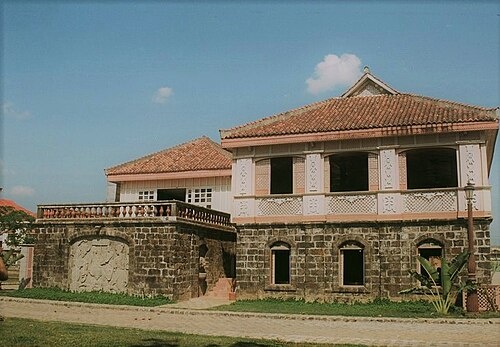
Robert Gardner wrote in “From Bahay Kubo to Bahay na Bato”: Wherever I traveled in the Philippines, I always enjoyed the old wooden houses that lined the streets especially in out-of-the-way provincial towns...After colonization, the Spanish brought their architecture but quickly learned that stone buildings didn't last very long in an earthquake-prone country. As towns and plantations grew, more substantial homes were being built by the rising upper-class. These principalia and ilustrados combined the structural features of the bahay kubo with stylistic elements from Europe and Asia. The result was the bahay na bato, literally "house of stone", that served as the model for townhouses from the 19th century until World War II and for many is considered the quintessential Filipino house.
"The final stage in the development of the Spanish-Filipino domestic architecture retained the wooden supporting structure but restricted the use of brick and stone to the lower level; the upper level consisted of an enclosure in vertical wooden siding which left ample openings for sliding windows. Capiz shells were often used as window panes. What emerges is a Spanish-Filipino house."
The old houses are as unique as the families that lived under their roofs and there are a wide range of styles between the bahay kubo and the mansions of the hacenderos. There are also some regional differences but they all have some features in common. Typically raised or two-story, the main living area is on the upper level. To take advantage of cooling breezes, large windows surround the upper floor. The window sashes commonly have capiz shell panes and can be opened wide or closed for privacy or in stormy weather. Vents above the windows, protected by the roof eaves, let air in even when it's rainy. Small shuttered windows below the large windows, called ventanillas, are screened with balusters or grillwork and can be left opened when the large windows are closed such as at night.
As the name implies, the lower walls of the classic bahay na bato were traditionally finished in stone or masonry. More modest homes have wood walls for both levels and in more recent times, cinder blocks have been used to enclose the lower level. This space, the zaguan, was used to store the family carriage and processional cart in the old days and nowadays often function as office, shop or the family's sari-sari store.
I find it interesting that the word bahay, "house", is similar to the word buhay, "life". And that the word bahay-bata, "house-child", is the word for uterus; where life begins. It wasn't long ago that a baby was delivered with the help of a midwife in the home of her parents. She would grow up there and her love interest would make a "house-calling" (umaakyat ng bahay) to seek permission of her parents to court her. Even in death, the wake is often held in the home of the deceased with black and yellow curtains hung in the windows.
"The dinner was being given in a house on Anloague Street which may still be recognised unless it has tumbled down in some earthquake. Certainly it will not have been pulled down by its owner; in the Philippines, that is usually left to God and Nature. In fact, one often thinks that they are under contract to the Government for just that purpose ."
Decline of Traditional Houses
Robert Gardner wrote in “From Bahay Kubo to Bahay na Bato”: “Years ago I began to notice that many of these houses were either abandoned or disappearing altogether — victims of changing family fortunes, good and bad — and the ravages of nature and time. In their places, new houses are being built of concrete, cinder block and stucco. The dwindling use of wood in construction can be blamed on the loss of the great forests that once covered the islands with a seemingly endless supply of lumber. Along with the change in building materials, the shift in architecture has moved toward western influences — both European and American. I've seen subdivisions that could have been named "California-kitsch".
Like an endangered species, wood and stone houses are vanishing toward certain extinction. What once embodied the character of the urban landscape and the heart of Filipino life will be blown away by the winds of progress. Already many towns are looking like cluttered strip malls and subdivisions provide homes without character. The capiz, that naturally filtered light, has given way to glass and the large open windows have been replaced with air-conditioning. Homes that shared a street or square are now isolated in gated compounds. Such is progress and it's no wonder that a modern-day Rip Van Winkle wouldn't recognize his surroundings upon awakening twenty years from now.
The book "Philippine Ancestral Houses", Zialcita and Tinio, 1980, which covers the subject in wonderful detail. This is a book to peruse with its many photos and drawings if you're interested in the subject. Another good book is "Filipino Style" with a chapter about traditional houses also written by Zialcita. You can find good examples of these homes in the quieter provincial towns. A few towns have made an effort to preserve their architectural heritage. One such place is Vigan in Ilocos Sur. The National Museum in Manila has a display of photos and architectural drawings of Vigan's ancestral homes (as of July 2000). The town of Taal, Batangas, is also notable for its preserved buildings. Good examples of the hacendero lifestyle can be found at the Balay Negrense in Silay, Negros and Villa Escudero in San Pablo, Laguna. There are still some fine old homes in Quiapo and Binondo; parts of Manila that weren't destroyed in World War II.
Filipino New House Superstitions
In rural areas, the first item brought into a new home is a pot of rice. These beliefs all revolve around hopes for prosperity for the young couple as they establish their own nuclear family in their new home. If the house has been specially built for the homeowners, silver coins are placed in the main posts before construction begins. They also ensure that the number of steps in the main stairway is not divisible by three. The owner counts the steps saying, "oro, plata, mata, oro, plata, mata" (gold, silver, death); it is considered a bad omen if it ends in "mata." [Source: “Culture Shock!: Philippines” by Alfredo Roces and Grace Roces, Marshall Cavendish International, 2010]
Other house superstitions and beliefs include: 1) Palm fronds consecrated by a priest are placed in the different corners of the house to prevent the entry of evil spirits. 2) In the Tagalog region, house plans in the shape of a cross are supposed to be a jinx. 3) The owner of a new house that has been superimposed on an old house will have a short life. 4) A sunken living room brings bad luck and sickness to the house. 5) Doors that face west will bring quarrels, diseases and death in the family. [Source: felixfojas.wordpress.com , March 6, 2012 ^*^]
6) A mirror placed on the wall facing the main door of a house will deflect good luck that enters the house. 7) The foundation of a post should be bathed with the blood of a pig or white chicken to appease the spirits presiding on the land on which the house was erected. This is based on an ancient Filipino tradition. 8) To make a house typhoon-resistant, the posts should be turned clockwise before being permanently cemented and secured. 9) Allowing the shadow of a post to fall on you while erecting it is a bad omen. Shadows falling in the holes dug for securing the posts also bring bad luck.
See House Building Superstitions Under SUPERSTITIONS IN THE PHILIPPINES factsanddetails.com
Filipino House-Blessing Ritual
Filipinos have a house blessing when they move into a new house. They believe it is improper to live in a house until it has been blessed in the presence of friends who wish them prosperity. Friends and relatives are invited. A religious ritual is performed where prayers are said and a priest sprinkles holy water in every corner of the house. Important guests hold candles provided by the host. Sometimes, an elder guest will throw coins for good luck. After the blessing, a feast is held. [Source: “Culture Shock!: Philippines” by Alfredo Roces and Grace Roces, Marshall Cavendish International, 2010]
While the house blessing ceremony is usually led by a Catholic priest, many people see it as more than just a church ritual. It is believed to bring good luck, protect the home, and drive away harmful spirits such as ghosts or supernatural beings that might be lingering in the house. For many families, it is also simply a respected tradition that marks the start of life in a new home. [Source: Chloe Evans, written when she was a a second year Social Anthropology student at the London School of Economics]
Preparations for the blessing often begin days or even weeks ahead of time. The family schedules the ceremony with a priest and prepares for a large gathering. Food is an important part of the event, so relatives may come early to help cook, or the family may hire caterers. Sharing a generous meal with friends, relatives, and neighbors is an essential part of the celebration and reflects the Filipino value of hospitality and community.
On the day of the blessing, the priest usually arrives in the morning. The ceremony begins outside the house with prayers and Bible readings. The priest then sprinkles holy water on the exterior and moves through each room inside the house, blessing the entire building. Once the religious part is finished, the celebration turns into a social gathering. Guests eat together, talk, and spend time catching up with one another. Men often gather to drink or play cards, while women chat about family and neighborhood news. The party usually continues until late afternoon or early evening.
Many people believe the blessing helps clear the house of spirits such as duwende (dwarflike supernatural beings) or multos (ghosts). Some think these spirits may cause bad luck or disturbances, so the ritual helps make the house spiritually clean and safe for the new occupants. Others say they simply follow the custom because it has long been part of Filipino life, whether or not they strongly believe in the spirits themselves.
Things To Consider with Filipino Housing
When choosing a place to live in the Philippines, location is one of the most important factors to consider. Traffic, particularly in Metro Manila, is extremely heavy, and commuting can take a long time. With more than a million registered vehicles on the roads, it is common for people to lose hours of their day simply traveling between home and work. [Source: “Culture Shock!: Philippines” by Alfredo Roces and Grace Roces, Marshall Cavendish International, 2010]
The character of the neighborhood also matters. Filipinos are generally friendly and sociable, and good relations with neighbors are important. However, small disputes can arise, such as problems with rubbish left on the street, neighbors frequently asking to use the telephone, or disagreements between household helpers from different homes.
Weather and flooding are another concern. During the rainy season, heavy downpours can easily flood streets and houses. It is wise to study the layout of the property and the condition of nearby roads, and if possible inspect the area after heavy rain. Low ground areas, watermarks, poor drainage, or damaged gutters may indicate flooding problems, while roofs should also be checked for leaks because typhoons can loosen roofing materials.
Construction quality should also be examined carefully. Building codes and enforcement can be less strict than in many countries, so it is important to check things such as electrical wiring, which is a common cause of fires. In addition, road repairs near the house can be a major inconvenience, as public works projects sometimes take years to finish and can disrupt traffic in the surrounding area.
Utilities are another key consideration. Power outages, known as “brownouts,” are common. and can damage electrical appliances when electricity returns with a surge. Water pressure should also be tested carefully, especially in upstairs bathrooms. Turning on several taps at once and flushing a toilet can help determine whether the water supply is strong enough to handle normal household use.
House Security in the Philippines
Alfredo Roces and Grace Roces wrote in Culture Shock!: Philippines”: Walls are high, windows barred and there are locks on front and back doors. The reason for this is security. Sorry to say, porch climbers, burglars and even armed criminals are part of the landscape. Leaving washed clothes overnight on the backyard washing line, or the garden hose and tools unsecured, are invitations to petty thieves. It will be just a matter of time before carelessly abandoned items in a garden are stolen. [Source:“Culture Shock!: Philippines” by Alfredo Roces and Grace Roces, Marshall Cavendish International, 2010]
The enclave-type villages of Manila’s suburbs, surrounded by high walls and protected by uniformed security guards, are manifestations of the magnitude of the problem, and not signs of paranoia among suburban residents. Most city folk would be happy to dispense with these architectural features, especially since barred windows make firetraps, but they are there for a purpose. It is best for the foreigner to know this from the start.
When choosing and maintaining a house, security is an important consideration. Homes located on corner lots or bordered by several streets are more exposed and may be easier targets for intrusion. It is generally safer to have neighboring houses that also appear secure, especially if they employ private security guards. Homeowners often check that perimeter walls and gates are strong, that doors have reliable locks, windows have bars, and sliding doors have safety devices. Good outdoor lighting that illuminates the yard and surrounding areas is also an important deterrent to crime.
Many residential areas in the Philippines are organized as private subdivisions or “villages.” These communities usually have a homeowners’ association that works to maintain safety by controlling public access. The streets inside these villages are typically privately owned and maintained by the residents, allowing them to regulate traffic and limit entry to outsiders.
To manage access, vehicles belonging to residents usually carry identifying stickers on their windshields. Visitors may be required to register at the gate when entering and leaving. In some villages, drivers—including taxi drivers—must leave their driver’s license with the gate guards and retrieve it when they depart. These procedures are intended to create a safer environment and discourage theft or other crimes.
The suburban “village” lifestyle began in the late 1950s and expanded rapidly in the 1970s as Metro Manila’s population grew and businesses concentrated in the area. Although gated communities provide a sense of security, they have not completely eliminated crime. Even with uniformed and armed private guards on duty, residents sometimes still experience burglaries or other incidents.
Security guards themselves can be a mixed blessing. While they are hired through private agencies to protect property, there have been cases where guards have been involved in crimes such as burglaries or robberies. Because guards often know the routines of the households they protect—such as how many people live there and when the owners are away—they can sometimes have access to information that could be misused.
Image Sources: Wikimedia Commons
Text Sources: “Encyclopedia of World Cultures Volume 5: East/Southeast Asia:” edited by Paul Hockings, 1993; “Culture Shock!: Philippines” by Alfredo Roces and Grace Roces, Marshall Cavendish International, 2010; Metropolitan Museum of Art; National Geographic, Live Science, Philippines Department of Tourism, New York Times, Washington Post, Los Angeles Times, Smithsonian magazine, Encyclopedia.com, Library of Congress, The Conversation, The New Yorker, Time, BBC, CNN, Reuters, Associated Press, AFP, Lonely Planet Guides, Google AI, Wikipedia, The Guardian and various websites, books and other publications.
Last updated March 2026