
BEAR ATTACKS IN JAPAN
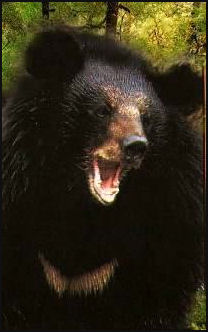
Asian black bears are known for having short tempers. Each year they kill at least one or two people in Japan and injure many more. Many attacks occur in the spring when people collect wild bamboo shoots, which the bears also fancy. People have been killed by bears in Hokkaido and the Tohuku region of northern Honshu. A record 219 people were victims of bear attacks, six of them fatal, in the 12 months between April 2023 and March 2024,. In that same period more than 9,000 black and brown bears were trapped and culled according to Japan's environment ministry. [Source: Sakura Murakami, Adolfo Arranz and Han Huang, Reuters, December 3, 2024]
At least 522 people were attacked by bears from 2012 to 2017, with a dozen fatalities, according to Japan’s Ministry of the Environment. Between 2007 and 2017, the ministry said, there have been 880 bear attacks and 24 human fatalities. In 2021 four people were killed in incidents involving bears and 10 were injured — a record number. [Source: AFP, Nathanial Gronewold, E&E News, Politico, July 5, 2018]
A lot of bear attacks occur in northern Japan is Akita, Aomori and Iwate Prefectures. Kazuhiko Maita, head of the Institute for Asian Black Bear Research and Preservation, a nonprofit organization based in Hatsukaichi, Hiroshima Prefecture told the Mainichi Shimbun that it is possible the number of bears in the Tohoku region has increased due to an abundance of food, such as acorns and beech, available to mother bears. It is thought that the plentiful food resulted in the healthy growth of bear cubs in the region. Subsequently, these cubs became independent, and are now "likely to come in contact with people." [Source: Mainichi Shimbun, “June 11, 2017]
In June 2024, a 58-year-old man — construction worker Yasuhiro Kobayashi — was killed in a bear attack in Japan in a forest in Nagano Prefecture. The BBC reported: He had large wounds on his head and back, a spokesperson from Nagano Central Police Station confirmed. Mr Kobayashi was found by a colleague who went looking for him when he failed to return to work after visiting a construction site, Japanese broadcaster NHK reported. According to newspaper Asahi Shimbun, four people were injured in bear attacks in Nagano this month. Authorities in the prefecture have issued severe warnings to residents not to venture into the mountains at dawn or dusk when bears are most active. In May 2024, a 68-year-old woman was attacked by a bear in Akita Prefecture, and a man in his 50s was attacked in Ishikawa Prefecture In April 2024, a bear attacked a truck on a forest road in Hokkaido [Source: Vicky Wong, June 22, 2024]
RELATED ARTICLES:
ASIATIC BLACK BEARS (MOON BEARS): CHARACTERISTICS, BEHAVIOR factsanddetails.com
NORTH AMERICAN BLACK BEAR ATTACKS factsanddetails.com
BEARS IN JAPAN: CHARACTERISTICS, BEHAVIOR, SPECIES, HUMANS factsanddetails.com
DEALING WITH BEARS IN JAPAN: CONTROL, ROBOTS, DEFENSES, KILLING THEM factsanddetails.com
BROWN BEAR ATTACKS IN JAPAN: VICTIMS, HOKKAIDO, SANKEBETSU factsanddetails.com
BEARS: HISTORY, EVOLUTION, HABITAT, HUMANS, PIZZLIES factsanddetails.com
BEAR CHARACTERISTICS: PHYSIOLOGY, DIET, LIFESPAN factsanddetails.com
BEAR HIBERNATION, REPRODUCTION, CUBS factsanddetails.com
BEAR BEHAVIOR: TERRITORIALITY, HABITUATED TO HUMANS, OPENING CARS factsanddetails.com
Causes of Bear Attacks in Japan
Many of the bear attacks have been blamed on a shortage of acorns due to typhoons and other bad weather which forced the bears into populated areas in search of food. A campaign organized by a group called the Bear and Forest Association aimed to collect acorns from parks in the cities to help feed the bears.
Some attribute the problem to: 1) a shortage of nut-bearing trees and berry-producing shrubs created as a result of artificial cedar and pine forests that don’t produce food the bear can eat; and 2) the exodus of people from the countryside, leaving inviting, quiet villages filled with lots of crops and food — often left unharvested in fields, which attracts bears — but few young people to scare them off. In areas where there a plentiful supply of nut- and acorn-bearing oaks and beech there have been no attacks.
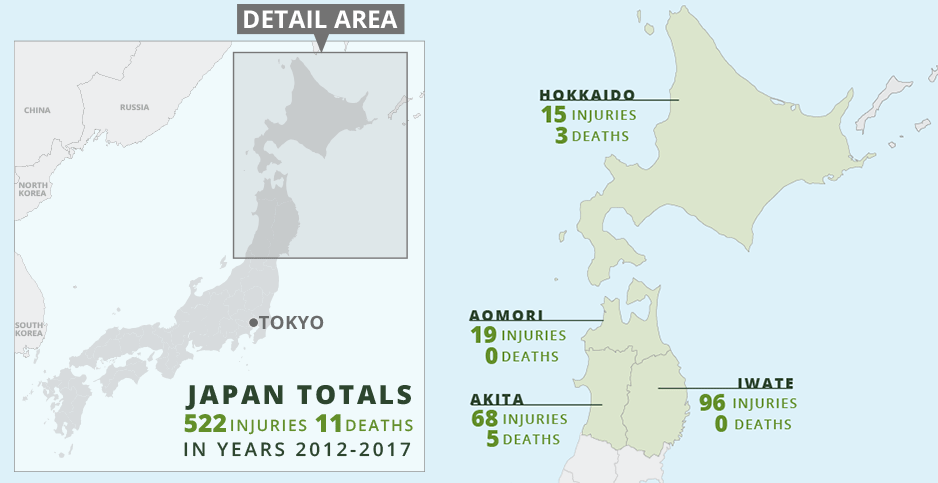
Nathanial Gronewold wrote in E&E News: Authorities in Japan blame the high rate of bear attacks on the shrinking number of people living in the countryside, an aging demographic, and the Japanese affinity for harvesting edible plants in the wild during the spring and fall as bears are either exiting or preparing for hibernation. "In bad years, you’ll see 150 people injured," said Toshio Tsubota, a wildlife biologist at Hokkaido University in Sapporo. "People’s knowledge of bears is limited. Education is not enough." [Source: Nathanial Gronewold, E&E News, Politico, July 5, 2018]
Allowing fields to become fallow and overgrown and the blurring of the areas of the region that demarcated the forest and farms have also contributed to the problem. This has encouraged bears to move nearer to where people live. Brown bears in Hokkaido have been observed going after deer after the emerge from hibernation in part because supplies of other kinds of food are in short supply. In 2005 there were plentiful food supplies in the mountains and relatively few bears caused mischief in places with large human populations. The number of bears trapped or killed because they were deemed as pests was less than 1,000.
Disturbing a hibernating black bear can be dangerous. Describing one such encounter during a research trip with Maita, Terry Domico wrote in “Bears of the World”: “The bear was inside a fallen tree trunk that lay on the ground at a 45 degrees angle. By using a radio locator to pinpoint the exact location if the bear, we calculated that it was asleep some 10 feet or so from the entrance at the high end of the log...As Maita’s team cautiously approached th den entrance with their equipment, a very large (485 pound, 225 kilogram) male Asian black bear exploded from the entrance in attack. The team dropped everything and scattered, but the bear had singled out one of the graduate students who had fallen through the snow crust while trying to escape. In a moment the bear closed in on him. That was when I sprayed the animal with a blast from my can of deterrent. The graduate student scampered away, and the bear immediately turned on me, face to face, I hit him with another blast of spray. This time the bear wheeled around and ran down the mountains out of sight.” The active ingredient in the spay was red pepper oil.
Record Number of Bear Attacks in Japan in 2023 — Many Victims Elderly
There were a record 193 black bear attacks in Japan in 2023, six of them fatal, the highest number since counting began in 2006. Additionally, residents reported an increased number of sightings in urban areas. Elizabeth Palmer of CBS News wrote: It was fall 2023, in the northern Japanese forest of Iwate, when forager Satoshi Sato set out to make a YouTube video for mushroom pickers. Suddenly, he heard something near him in the woods and grabbed a stick. A bear, whose cub was up a tree nearby, charged Sato and didn't stop. He was finally able to drive the bear off, but now he never ventures out without pepper spray, bells and a whistle. [Source: Elizabeth Palmer, CBS News, December 29, 2023]
The high number of attacks is blamed at least in part on the fact it was “a lean year for bears. In the forests, a dry summer left fewer acorns and beech nuts — their main food — so hunger has made them bold....they do things like visit cattle feeding troughs looking for sustenance, according to farmer Sadao Yoshizawa. "I tried an electric fence, but it didn't work. They just follow me when I come into the barn," Yoshizawa says. But hunger isn't the only reason for the rising number of close bear encounters. As Japan's population shrinks, humans are leaving rural areas, and bears are moving in,” plus is often elderly people that are left behind in rural areas,
Hannah Getahun wrote in Business Insider: The hardest hit region is Akita, a north-east rural prefecture surrounded by forests and mountains, where the Ministry of Environment said a third of the bear attacks have occurred. Per CNN, the increasing elderly population, coupled with the fact that younger people are moving away from the countryside, means that there are fewer capable hands to tend the land. [Source: Hannah Getahun, Business Insider, December 9, 2023]
Tsutomu Mano, a senior research fellow at the Hokkaido Research Organization told the outlet that "abandonment of cultivated land and overgrowth along riversides" can attract bears. There are numbers to indicate that elderly populations are also facing the brunt of these bear attacks — in October, 61 of the 71 bear attacks reported included people over the age of 60, CNN reported, citing NHK statistics. Mano also told CNN climate change is likely affecting the bear's food supply of beech nuts and acorns, making it more necessary for them to scavenge new areas — including human settlements — for food.
Bear Attacks in Japan in the 2000s
In May 2001 in southern Hokkaido, a 53-year-old man was killed and buried by a bear. In 2003, a man was badly mauled in the face by a bear in the Okayama area. Two deaths from bear attacks were recorded in both 1985 and 2004.
In the summer and autumn of 2004 there was an unusually high number of bear attacks. Newspapers ran headlines like “Bear Injures Four in Kimono Shop” and “Five Elderly People Injured in Three Prefectures.” Bears were caught in hen houses eating chickens and spotting in persimmon trees munching on the orange fruit. One person was killed and almost a 100 were injured, almost 10 times the usual number. There was a particularly high number of attacks in Toyama on the Sea of Japan.
In June 2004, a hiker in Nikko National Park was seriously injured in an attack by a black bear. In the same area two men were seriously injured by bear as they walked along a plank path on Ozegahara marsh. In Toyama two school children were attacked and scratched on their upper torsos. In Iwate Prefecture three people were attacked in three towns, and one person was seriously injured. In July, an 81-year-old woman suffered a broken cheek bone after she was attacked by bears as she was gathering butterburs in Akita Prefecture.
In October 2004, two people were attacked and hurt in separate attacks by bears in Hyogo and Hiroshima prefectures. In Hyogo, a bear attacked an 82-year-old woman as she gathered flowers. She suffered serious injuries in her head. The same month a pair of bears attacked three different people in separate incidents in Toyama. A 77-year-old woman and a 76-year-old woman suffered facial scratched. A 90-year-old man broke his arm.
In May 2005, a 57-year-old old was seriously injured after being mauled by a bear while picking edible plants with his brother in the mountains in Nanto, Toyama Prefecture. The man was attacked from behind about 9:15 in the morning by a 1.5-meter-long bear and fell about 10 meters down a mountains slope.
In 2006, three people were killed by black bears and 136 were injured. This the highest number of deaths by bear attacks ever, recorded. Bears showed up in many residential areas where they had never been seen before. In September 2006, a male middle school student in Otrimura, Nagano Prefecture was seriously injured in an attack by a bear on his way to school. In October a 71-year-old man was attacked and killed in Toyama Prefecture.
In November 2008, a bear attacked a woman at a vacation home in Karuizawamachi, Nagano Prefecture, leaving her with minor back injuries. The beare attacked the woman after jumping out of thicket of bushes and is believed to have been a cub that had just left his mother. In September 2009, a black bear attacked nine people at a bus terminal in a mountainous area of Takayama in Gifu Prefecture. Four people were hospitalized with injuries such as bite marks to the face but none were in serious condition. More than 100 people were at the bus terminal at the time.
Bear Attacks Four People in Iwate in 2001
In the 2000s, black bears began terrorizing the forest-surrounded town of Iwaizumchi in Iwate Prefecture. The problem started when the animals began raiding cow barns in search of food. By 2009, about 40 bear-related problems were being reported a month. Farmers that suffered the most were given bear detecting devices and bear repellants that produced loud noises to scare the bears away. High voltage electric fences were also installed and hunters were hired to kill the bears.
In September 2001, the Mainichi Shimbun reported from Hanamaki, Iwate Prefecture: “Four people, three of them elderly, were injured after a berserk black bear attacked them here Monday before it disappeared back into the woods. None of the injuries sustained were serious, but local officials are urging people in the area to be on the alert. Members of the Hanamaki Municipal Government and a local hunting club are currently searching for the bear, which could be the same animal spotted near a hot springs resort over the weekend. [Source: Mainichi Shimbun, September 24, 2001]
"When I first saw it, I thought it was a big black dog. But then I noticed a tuft of white hair on its chest and realized that it was a bear," said Hisako Morikawa, 71, the first of the bear's victims, who was bitten on the knee as she cut the grass in the garden of her home. "I've lived here for decades, but it's the first time I've ever seen a bear come this close to the city."
Morikawa said the bear was about 1.4 to 1.5 meters long. She said she had just picked up some chestnuts shortly after 6 a.m. and was heading into her house when she noticed the bear about 50 meters away in some nearby woods. The bear suddenly rushed at the old woman, who vainly tried to flee. The bear slammed into her back, knocking her to the ground. As Morikawa lay in terror, the bear nipped her knee before fleeing. Moments later, it attacked a 31-year-old woman in the neighborhood before again making its escape. About an hour later, it set upon a 67-year-old woman about 1.3 kilometers away from the scene of the earlier attacks. It was another hour before the bear struck again, this time assailing a 75-year-old man. Having completed its rampage, the bear fled to the safety of the woods.
Bear Attacks in 2010
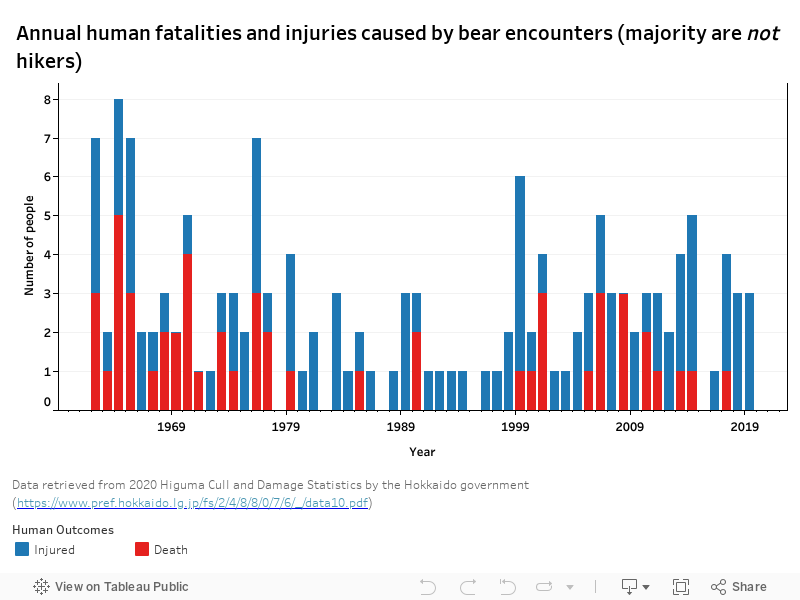
Between April and September 2010, 82 bear attacks with 84 victims were reported in Japan. This is higher than the 52 bear attacks with 64 victims in 2009 but not as high as the 113 attacks in 2004 and 150 attacks in 2006. Of the 84 people attacked by bears, four — two in Hokkaido, one in Fukushima Prefecture and one in Tottori Prefecture — were killed.
Most of the attacks were like this one. In October 2010, in Kitaakita, Akita Prefecture, a 63-year-old man gathering mushrooms ran into three bears, apparently a family. The youngest bear bit the man on the leg, inflicting light injuries, before all three ran into the woods. [Source: Hiromasa Takeda and Takahiro Komazaki, Yomiuri Shimbun, October 24, 2010]
Encounters between bears and humans are often just as scary for the bears as the people. Toshiaki Shiraishi, an official of Toyama Municipal Family Park Zoo, said, "Usually making a noise or saying 'hey' or something will make a bear run away." But if a bear is agitated, taking more defensive measures could be required. "If you can't escape, squat down and curl up into a ball," Shiraishi said. "Covering your neck and the back of your head with your hands could help save you from a deadly wound." [Source: Yomiuri Shimbun, October 24, 2010]
Reasons for Bear Attacks in Japan in 2010
Reasons for the attacks include shortages of food in mountainous areas and a reduction in hunting. The Yomiuri Shimbun reported: “Some experts have suggested changes in forests and farmland are also behind the spate of bear encounters. Forests in mountainous areas were once maintained by forestry workers, but this work has been increasingly neglected in recent years as people drift away from these areas. More and more farmland is being left unattended, and plants have grown among the abandoned crops. These plots are often close to residential areas and provide bears with food with cover from prying eyes.” [Source: Yomiuri Shimbun, October 24, 2010]
Iwate University Prof. Toshiki Aoi, a researcher of wild animal controls, told the Yomiuri Shimbun bears are no longer afraid of people. "With fewer hunters around, bears are no longer afraid to approach people. The current situation is basically an open invitation to bears to come into areas where people live," Aoi said.
Acorn Shortage Behind Wandering Bears
The Yomiuri Shimbun reported: “Many experts have agreed that this year's dearth of acorns — on which bears feed — explains why dozens of the creatures have come out of forests and into towns and cities across the country in recent months. These bears have wandered into human settlements this year to look for food before going into hibernation, they said... A mature black bear usually weighs about 100 kilograms. But a mature bear captured in Nagaoka, Niigata Prefecture, on Oct. 10 weighed only 45 kilograms.” [Source: Yomiuri Shimbun, October 24, 2010]
"This year, oak trees didn't grow enough buds due to unusually low temperatures in spring," an official of the Nagano prefectural government's wildlife problem section told the Yomiuri Shimbun. "And then the scorching weather in summer made the acorns fall from the trees before they had grown to full size." Kazuhiko Maita, head of the Institute for Asian Black Bear Research and Preservation, a nonprofit organization based in Hatsukaichi, Hiroshima Prefecture, believes a baby boom three years ago is partly to blame for the spate of bear sightings. "In autumn 2007, acorns were plentiful and bears were healthy and gave birth to many cubs," Maita said. He said there was an abundance of acorns the following autumn, too. "Bears born in these years have now become very active, partly because acorns are in short supply," Maita said. There were also a high number of attacks in 1986 when there was a failure of the acorn crop.
However, some experts disagree that an acorn shortage has caused the bears to wander into residential areas. Manabu Miyazaki, who has filmed wild animals in the Central Japanese Alps, believes the bears do not rely on acorns for their diet. "Acorns aren't the only food bears eat," he said. "Bears are food connoisseurs who select and eat only tasty nuts." In fact, an Ishikawa prefectural government analysis of the stomach contents of 141 bears captured since September 2004 found 55 had eaten persimmons.
Bear Attacks in Northern Japan in 2017 and 2018
Nine people were attacked and injured by black bears in Aomori in 2017. In May 2017, a 61-year-old woman was killed in an bear attack while picking wild bamboo shoots in the mountains of Akita. Danielle Demetriou wrote in The Telegraph: “The body of Masako Oishi, 61, a nursing assistant, was reportedly found with gashes to the back of her head in a mountainous forest, which is known to be populated by bears. The incident comes just weeks after local police issued warnings to residents living in remote mountainous areas of northern Japan to look out for bears. Leaflets were reportedly circulated to warn locals of bear attacks in rural areas of both Akita and neighbouring Aomori Prefecture, advising residents not to enter forests where bears have been spotted foraging for mountain vegetables. [Source: Danielle Demetriou, The Telegraph, May 30, 2017]
“Bamboo shoots have long been a popular seasonal staple in Japanese cuisine at this time of year, with a number of residents living in northern mountains earning a living by selling them. However, they are also a springtime staple in the diet of local bears, resulting in growing calls for caution among locals who go out to pick them in the wild. “Climate change has also been attributed to the surge in bear attacks in Japan in the past, as a growing number of the creatures reportedly leave their natural habitat in search of food.
The Mainichi Shimbun reported: “ The 61-year-old woman attacked by a bear in the city of Semboku in Akita Prefecture subsequently died as a result of blood loss. The woman was wearing "bear deterrent" bells at the time, designed to ward off the animals, but they ultimately proved to be ineffective. According to Akita Prefectural Police, the woman who died was out collecting bamboo shoots with a friend in a mountainous area in Semboku, early in the morning on May 27, 2017. The woman later became separated from her friend, and is thought to have been attacked afterwards by a bear about 30 meters away from a national road. When she was found, she had scratches and bite marks on her head, face and left arm. At the time of the attack, the woman was carrying two "bear deterrent" bells. However, associate professor Kazuhiko Hoshizaki of Akita Prefectural University explains that there have been numerous cases in which people have come into contact with bears, despite carrying bells. "The bears' hearing range for picking up the sound of the bells is limited," Hoshizaki points out. Furthermore, an official from Akita Prefectural Police says that, "If you crouch down to pick some wild vegetables, then the bells won't make a sound."
Nathanial Gronewold wrote in E&E News: The body found in June 2018 in Akita has only been identified in media reports as that of a 78-year-old man who was on a wild vegetable foraging mission before he was reported missing. With rising bear reports, sansai-tori (wild vegetable collecting) clubs recommend that people enjoy the hobby only in groups. [Source: Nathanial Gronewold, E&E News, Politico, July 5, 2018]
In early May 2018, a black bear mauled a man in Iwate prefecture. His injuries were so severe, he had to be airlifted to the hospital. More sightings and news alerts followed — from Gunma prefecture, Sapporo and again from Tomakomai in Hokkaido. The Tomakomai conservation office investigated one area where frequent bear sightings were reported and later determined they were multiple sightings of the same bears, two cub siblings seemingly unafraid of people.
Four People Killed — One Eaten — by Bears Akita in 2016
In May and June 2016, four people were killed and three seriously injured within two weeks in the northeastern corner of Akita. Pieces of human flesh were found in the stomach of one of the bears that attacked the victims. Before that, there had been only eight bear-related deaths in the region since 1979. The Yomiuri Shimbun reported: Five people were killed or injured on a mountain in Kazuno in the prefecture. The municipal government asked the prefectural government on May 23 for permission to kill bears after a second fatal attack was confirmed. On May 30, a third victim’s body was found, and on June 10, a fourth victim’s body was discovered.[Source: Teruo Miyazawa and Eimi Sakurai, Yomiuri Shimbun, July 30, 2016]
“Members of a local hunters association found a female bear, which was assumed to have attacked the people, near the fourth victim’s body. They fatally shot the bear. The bodies of the third and fourth victims were severely damaged, and it was pointed out that multiple bears had fed on them. A necropsy performed on the female bear revealed pieces of human flesh in its stomach. “About 2,600 sightings of bears were reported from April to June 2016 in the Tohoku region (northern Honshu), nearly double the figure for the corresponding period in 2015. And in Akita, Yamagata and Miyagi prefectures, the number of sightings was the highest in the past 10 years.
The Guardian reported:“Suzuki, who lived in neighbouring Aomori prefecture, had gone to the area alone to pick edible wild plants, according to public broadcaster NHK. Her death comes soon after three men — two in their seventies and one in his sixties — died from what have been described as “severe” injuries sustained in separate attacks in the same area. The men were foraging for bamboo shoots when they were attacked, Japanese media reported. Takeshi Komatsu, a local vet, said it was possible that the four were killed by the same bear. “After tasting human flesh (for the first time), the bear may have realised that it can eat them,” Komatsu told Kyodo news agency.
“Bear attacks are usually blamed on food shortages that send the animals straying out of their habitats into towns and villages. The recent attacks, however, appear to have been sparked by an abundance of beechnuts, which has led to a boom in the number of surviving cubs. “From summer to after autumn, people risk being attacked by mature cubs,” Kazuhiko Maita, chief director of the Institute for Asiatic Black Bear Research and Preservation, told the Yomiuri Shimbun. “Yohei Sasaki, chairman of the national hunters association, told the newspaper that female Asiatic black bears with cubs can be particularly aggressive towards humans. [Source: Justin McCurry, The Guardian, June 13, 2016]
Victim Eaten by a Bear in Akita in 2016
The BBC reported: “Human flesh and hair were found inside the stomach of a black bear shot dead in Japan after a series of deadly attacks, say local officials. The bear is suspected of killing a 74-year-old woman whose badly mauled body was found near Kazuno. Three men also died in apparent bear attacks in the area in recent weeks. All had been foraging for wild plants. Locals have been warned to stay away from the area. [Source: BBC, June 14, 2016]
“The female black bear was shot dead a short distance from the spot where the woman's body was found. Hideki Abe, an Akita prefectural official, told AFP a "piece of human flesh" was found inside the bear's stomach when it was examined. "Two thirds of the stomach was filled with bamboo shoots," he said, which indicated that little human flesh was consumed by the bear, and that it may not have been alone in carrying out the attacks.
“Normally, bears in nature are afraid of humans. But the experts said that some have become man-eaters and tend to regard humans as prey. In 1988, a bear killed and fed on three people. Prof. Toru Oi of Ishikawa Prefectural University, who specializes in the protection and management of wild animals told the Yomiuri Shimbun. “Bears eat mainly plants, and normally do not attack humans. However, because they are highly adaptable, they could come to regard humans as prey.” [Source: Teruo Miyazawa and Eimi Sakurai, Yomiuri Shimbun, July 30, 2016]
The female bear found with human remains in her stomach measured 1.2 meters in length and weighed about 70 kilograms. The Asahi Shimbun reported: “The dissection of the bear revealed human flesh and hair at the entrance of the bear’s stomach. Digestion had progressed in the intestines and there was little left to examine. As human flesh was found in the upper part of the stomach, the bear likely attacked the woman, but there was no evidence to suggest it was responsible for the deaths of the three men found dead. Fabric and other traces of clothing would have helped officials identify the person consumed by the bear, but none were found. [Source: Shigehiro Saito, Asahi Shimbun, June 14, 2016]
Could the 2016 Attacks in Akita That Killed Four People Been Avoided
The Yomiuri Shimbun reported: “Local government measures criticized Prof. Koji Yamazaki of the Tokyo University of Agriculture, who is in charge of research conducted by the Tokyo-based Japan Bear Network, said, “Entry into the areas where the incidents took place should have been strictly limited, and utmost efforts should have been made to kill bears suspected to have attacked people.” An official of the city government said: “The area where the incidents occurred is vast. Privately owned land plots as well as roads for residents’ daily use are located in the area. There are also access paths to mountain areas. It would be unrealistic to totally ban entry into the area.” Commenting on the view that permission to kill the bear came too late, the official said: “We didn’t recognize how serious the situation was. We didn’t assume the bear might have fed on the bodies of the victims.” [Source: Teruo Miyazawa and Eimi Sakurai, Yomiuri Shimbun, July 30, 2016]
“The sounds of bells and radios have long been assumed to be effective in frightening bears away. But experts point out this may no longer be true. Veterinarian Takeshi Komatsu, 48, director of Ani Kuma Bokujo Kumakuma-en, a zoological park specializing in bears in Akita Prefecture, said: “I have recently heard that bears may even be attracted by the sounds of radios. They may have learned to associate the sounds with the presence of bento boxes or drinks around humans.”
“The Institute for Asian Black Bear Research and Preservation, a nonprofit organization based in Hiroshima Prefecture, conducts research on damage caused by bears in Akita Prefecture. Kazuhiko Maita, head of the institute, spotted a bear about 80 centimeters long in the morning of July 12 near the site where the bodies of the first and second victims were found. While he took about 10 photos of the bear, it did not appear to be frightened and casually walked away.
How to Avoid Bear Attacks
Yellowstone National Park is bear country. There, park officials strongly encourage hikers to: 1) travel in groups of three or more; 2) carry bear spray which they know how to use and can easily grab; and 3) make noise or wear bells or some other noise maker so they don't accidentally startle a bear. If you encounter a bear do not run. Back away slowly. The park requires that people stay at least 100 yards from bears and wolves, and at least 25 yards from other large animals. [Source: CNN]
“If you come across a bear, never push a slower friend down … even if you feel the friendship has run its course,” the U.S. National Park Service wrote in a tweet in 2023. The tweet garnered more than 17,000 retweets and over 146,000 likes within a few days. Brooke Baitinger wrote in the Sacramento Bee: “In fact, if you do come face-to-face with a bear, you really shouldn’t run at all. That includes pushing your slower friend toward the bear to make a break for it. That’s because they’ll act like dogs and chase fleeing animals. You also don’t want them to see you as a prey animal. Here’s what you should do instead, according to the National Park Service:
Identify Yourself as a Human and Not a Prey Animal by talking calmly, and stay put. Slowly wave your arms. The bear might come closer or stand up on its back legs to get a better look or to smell you, which is usually a sign of curiosity and not aggression. Walk away slowly: Move sideways so you appear less threatening to the bear. This also lets you keep an eye out. [Source: Brooke Baitinger, Sacramento Bee, March 2, 2023]
Don’t Scream or Make Any Loud or High-pitched Noises since the bear might think it’s the sound of a prey animal. Screaming could trigger an attack. Pick up smaller children. Don’t let kids run away from a bear. It could think they’re small prey. Also, make yourself look as big as possible, including moving to higher ground if you can. Don’t make any sudden movements. Dogs have pluses and minuses. On one hand they can alert you to a bear's presence and drive it off. On the other hand dogs can also also startle bears, annoy and aggravate them and be seen as prey.
Stay Calm and remember that most bears do not want to attack you; they usually just want to be left alone. Talk slowly and with a low voice to the bear. Bears might bluff to avoid an encounter by charging and turning away at the last second.
Don’t Try Climbing a Tree. Black bears and grizzlies can both climb trees. Don’t drop your bag: A bag on your back can keep a bear from accessing food, and it can provide protection. If a bear attacks you deploy spray if you have it or strike the animal with anything: a rock, stick or hiking pole. Some say you should try to jab its eyes or punch it in the nose as you are told to do with sharks.
Hike in Groups: A group is noisier and smellier, the National Park Service said. Bears like to keep their distance from groups of people. Hikers in bear country are encouraged to keep their distance, especially with a mother and her cubs. Alaskan bear expert Larry Aumiller, who spends much of time escorting tourist around bears, told Smithsonian, "Sometimes it can get a little complicated depending on things like how many people we have, how loud or aggressive they are, which bears are present that day and how they're getting along with each other. If we seem to be making a bear nervous, I get the group to act more submissive. We may move closer together, which make the group's size appear less formidable. We stop making noise, we may sit down, we say even slowly move away. If, on the other hand, a bear starts acting assertive, we may do the opposite—spread out and stand up on logs or rocks, talk loudly, maybe even wave our arms around. Every interaction is different and it's up to us to read the people and the bears, and respond appropriately to each other."
One Russian guide told the New York Times, "Never look the bear on the eyes. And don't move. Just yell Russia swear words at it." If you surprise and are attacked by a brown bear some advise you to play dead since most of the time the bear is defending itself. If it stalks you fight back and don’t make yourself easy pray. In some places hikers carry pepper spray to ward off bears. Pepper spray may work in a close encounter.The jury is out on whether this really works. Some say pepper spray may actually attract bears. If sprayed at a campsite bears can get a whiff of it a quarter of a mile away.
Troublesome grizzly bears are driven away by loud yelling, firing shotgun blanks, throwing bean bags, igniting flares, or firing rubber bullets. Other measures employed to keep bears away include electric fencing around garbage sites, replacing conventional trash cans with bear-proof models and educating people on how to keep their trash stored out of harms way. In the United States, troublesome grizzly bears are driven away by chasing them with specially trained Finnish dogs and dealt with using the three-strikes-your-out policy in which troublemakers are caught and taken to a wilderness area. If they show up two more times and cause trouble they are killed.
Image Sources: 1) Wikimedia Commons, 2) Politico
Text Sources: Animal Diversity Web animaldiversity.org ; National Geographic, Live Science, Natural History magazine, David Attenborough books, Daily Yomiuri, Yomiuri Shimbun, Japan National Tourist Organization (JNTO), New York Times, Washington Post, Los Angeles Times, Smithsonian magazine, Discover magazine, The New Yorker, Time, BBC, CNN, Reuters, Associated Press, AFP, Lonely Planet Guides, Wikipedia, The Guardian, Top Secret Animal Attack Files website and various books and other publications.
Last updated March 2025