
CAVES OF EASTERN EAST TIMOR
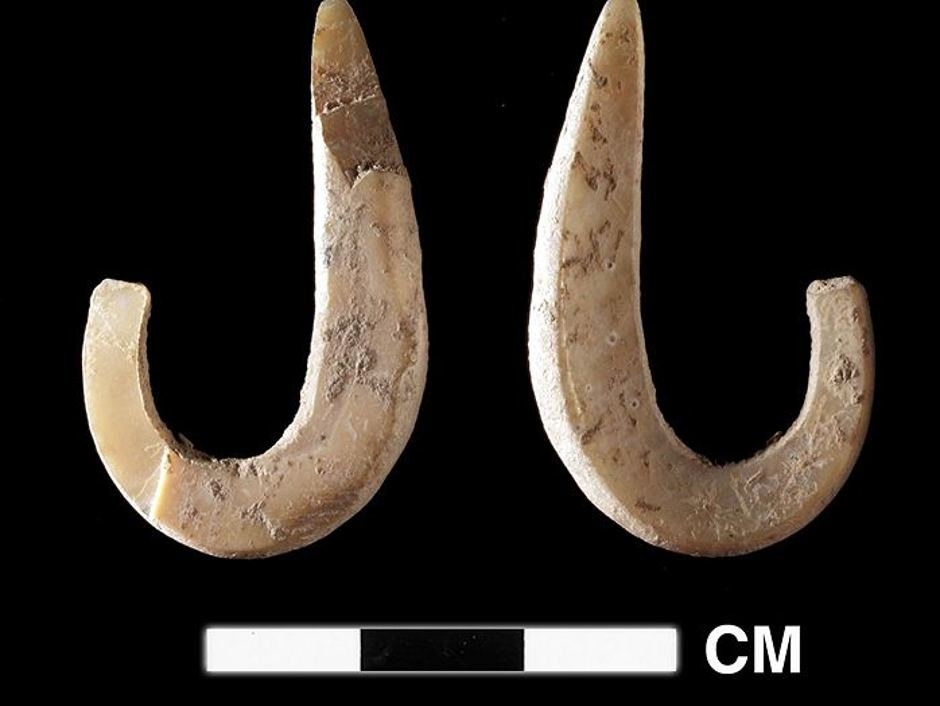
world's oldest fish hooks, from East Timor
The far eastern coast of East Timor is riddled with caves. Ancient people at least passed through here at last 42,000 and 30,000 years ago. Shells found in cave have been radio-carbon dated to that time. Pleistocene fishermen and Neolithic farmers took shelter in the caves. In the jungles nearby are some ancient cave paintings. Stark limestone cliffs, jagged terrain characterize the area. Fishermen who use outrigger canoes today stay in the caves. Off the coast are some dazzling coral reefs.
The most notably caves are Jerimalai Cave and Lene Hara Cave, which are important archaeological sites. Jerimalai Cave has provided evidence of some of the oldest fishing technology and modern human occupation in the region, with artifacts dating back over 40,000 years. Lene Hara Cave is known for its ancient rock art, including hand stencils that may date back to the Pleistocene epoch.
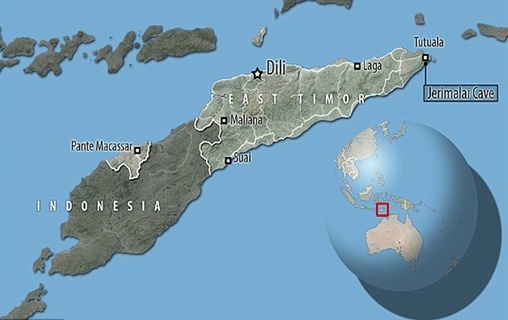
Jerimalai Cave is on the eastern tip of East Timor, near Tutuala. Considered one of the oldest sites of modern human occupation in the region, it has yielded ancient stone tools, shell ornaments, and evidence of sophisticated fishing. Fish remains and fish hooks suggest advanced fishing techniques were used at least 42,000 years ago. The oldest recovered fish hooks date to between 23,000 and 16,000 years ago.
Lene Hara Cave is also located on the eastern tip of the island, near Tutuala. Significance: Contains some of East Timor's most important archaeological evidence, including ancient cave paintings. The rock art there includes 16 hand stencils that are potentially the oldest rock art found in Timor-Leste, possibly dating to the Pleistocene epoch.
Matja Kuru 1 and 2 (MK1 and MK2) located inland near Lake Ira Laloro have also yielded marine resources from the Pleistocene era. Ili Kere Kere Caves also contain ancient cave paintings.
The east coast of East Timor is a rugged, mountainous area that includes the administrative district of Lautem and borders the Timor Sea. This coastline is marked by the Ombai Strait to the north, includes uninhabited Jaco Island at its easternmost point. The area features a tropical climate with a wet season from December to April and has some beaches and is rich in marine life. Eastern East timor is home to the highest peaks on the island, including Mount Tatamailau, located in the center of the island.Climate: A tropical climate with a wet season from December to April and a dry season from May to November. Coastal temperatures can range from 25 to 35̊C (77 to 95̊F)
RELATED ARTICLES:
JAVA MAN AND HOMO ERECTUS IN INDONESIA factsanddetails.com
HOMO FLORESIENSIS: HOBBITS OF INDONESIA factsanddetails.com
ORIGINS AND ANCESTORS OF HOMO FLORESIENSIS (HOBBITS) factsanddetails.com
EARLY MODERN HUMANS IN INDONESIA factsanddetails.com
EARLY HUMANS IN SULAWESI, INDONESIA AND THEIR 45,000-YEAR-OLD CAVE ART factsanddetails.com
EARLY HUMANS IN BORNEO: NIAH CAVES 40,000-YEAR-OLD ROCK ART factsanddetails.com
EARLIEST PEOPLE OF INDONESIA: NEGRITOS, PROTO-MALAYS, MALAYS AND AUSTRONESIAN SPEAKERS factsanddetails.com
OLDEST CULTURES IN INDONESIA AND PEOPLE THERE BEGINNING 10,000 YEARS AGO factsanddetails.com
Evidence of Deep-Sea Fishing in East Timor 42,000 Years Ago
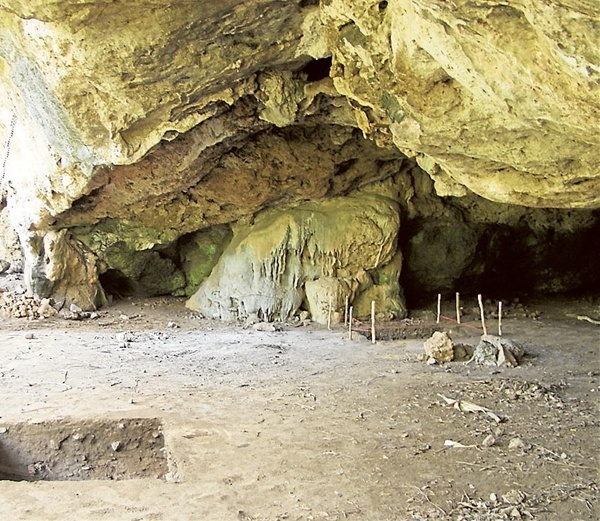
More than 40,000 years ago, prehistoric humans living in what is now East Timor ago possessed the skills necessary to catch deep ocean fish such as tuna. Discovery News reported: “In a small cave at the eastern end of East Timor, north of Australia, archaeologist Sue O’Connor from the Australian National University has unearthed the bones of more than 2,800 fish, some of which were caught as long as 42,000 years ago. [Source: Discovery News, November 28, 2011 |^|]
“The find shows that the people living in the region had the sophisticated cognitive skills needed to haul in such a difficult catch, O’Connor says. Her findings appeared in the journal Science. “What the site has shown us is that early modern humans in island Southeast Asia had amazingly advanced maritime skills,” she said. “They were expert at catching the types of fish that would be challenging even today — fish like tuna. It’s a very exciting find.” |^|
“It isn’t clear exactly what techniques the people living in the area at the time used to catch these fish. Tuna can be caught using nets or by trolling hooks on long lines through the water, O’Connor said. “Either way it seems certain that these people were using quite sophisticated technology and watercraft to fish offshore. She said it also demonstrated prehistoric man had high-level maritime skills, and by implication, the technology needed to make the ocean crossings to reach Australia.|^|
“The site where the discoveries were made, known as Jerimalai cave, is a small rock overhang hidden behind in foliage, a few hundred meters from the shore. “When I discovered it in 2005, I didn’t think that Jerimalai would tell us about the very early occupation of Timor,” O’Connor said. “I was quite surprised when I found all these fish bones and turtle bones.” So far, she and her colleagues have only excavated two small test pits at the cave, which contained a number of stone artifacts, bone points, animal remains, shell beads and fish hooks. In just one of those pits, 1 meter square and 2 meters deep, they found 39,000 fish bones. . “I think Jerimalai gives us a window into what maritime coastal occupation was like 40,000 to 50,000 years ago that we don’t really have anywhere else in the world,” said O’Connor. |^|
O’Connor said: “They were expert at catching the types of fish that would be challenging even today - fish like tuna. It's a very exciting find. Simple fish aggregating devices such as tethered logs can also be used to attract them. So they may have been caught using hooks or nets,' she said. 'Either way it seems certain that these people were using quite sophisticated technology and watercraft to fish offshore.” [Source: Simon Tomlinson, Daily Mail, November 25, 2011]
According to the Daily Mail: “She added that the finds may shed light on how Australia's first inhabitants arrived on the continent, with the implication that seaworthy boats would have been used to fish in the deep ocean. “Ee have known for a long time that Australia's ancient ancestors must have been able to travel hundreds of kilometres by sea because they reached Australia by at least 50,000 years ago,' said O'Connor. 'When we look at the watercraft that indigenous Australians used at the time of European contact, however, they are all very simple, like rafts and canoes.”“
World’s Oldest Fish Hooks Also Found in East Timor
O’Conner’s team also unearthed another rare find — a small piece of fishing hook made from a shell, which dates to between 23,000 and 16,000 years ago. This is the earliest example of a fishing hook that has ever been found, the researchers say. [Source: Discovery News, November 28, 2011 |^|]
Nikhil Swaminathan wrote in Archaeology magazine: “Two 11-square-foot pits dug in Jerimalai Cave on the east end of East Timor have provided some of the earliest evidence of fishing technology. Though there is little evidence of fishing activity beyond 10,000 years ago, fragments of fish hooks found in the cave date to between 16,000 and 23,000 years ago, making them the oldest ever recovered. A more complete hook dating to 11,000 years ago was also found at the site. [Source: Nikhil Swaminathan, Archaeology, Volume 65 Number 2, March/April 2012 ]
“The inch-long hooks, all of which were made of shells from sea snails, would have been used to catch shallow-water fish, such as grouper and snapper, says Sue O'Connor, an archaeologist at Australian National University, who coauthored a study on the finds in Science. "They would have had a fiber line attached to the shank, and bait put on the hook," she explains. "Then, they would be cast or lowered into the water and left stationary."
“Fish bones were also found in the deposits. Offshore species, such as tuna, account for nearly 50 percent of the remains dating to earlier than 7000 B.C. After that, shallow-water and reef species start to dominate, likely due to warmer climate and the proliferation of reef habitat. The variety of the bones depicts the humans of the time as skilled seafarers capable of fishing many species in both shallow and deep water.”
O’Conner’s team discovered fish bones from 2,843 individual fish of 23 different taxa, including tuna and parrotfish. Sandra Bowdler at the University of Western Australia in Perth, who was not involved in the study, is convinced that those colonising East Timor 42,000 years ago had “fully formed” fishing skills. “By this time, modern humans are assumed to have the same mental capacities as today,” she says. “There is nothing like this anywhere else in the world,” says Ian McNiven of Monash University in Melbourne, who was not a member of O’Connor’s team. “Maybe this is the crucible for fishing.” [Source: Wendy Zukerman, Newscientist, November 24, 2011]
East Timor hosts few large land animals, so early occupants would have needed highly developed fishing skills to survive. “Necessity is the mother of invention,” says O’Connor. “Apart from bats and rats, there’s nothing to eat here.” But that doesn’t necessarily mean that fishing began in the region. At the time, sea-levels were around 60 to 70 metres lower than today. Any sites of former human occupation that were located on the Pleistocene shore – rather than in coastal cliffs like the Jerimalai shelter – are now submerged.
Some of the World's Oldest Jewellery Found in East Timor
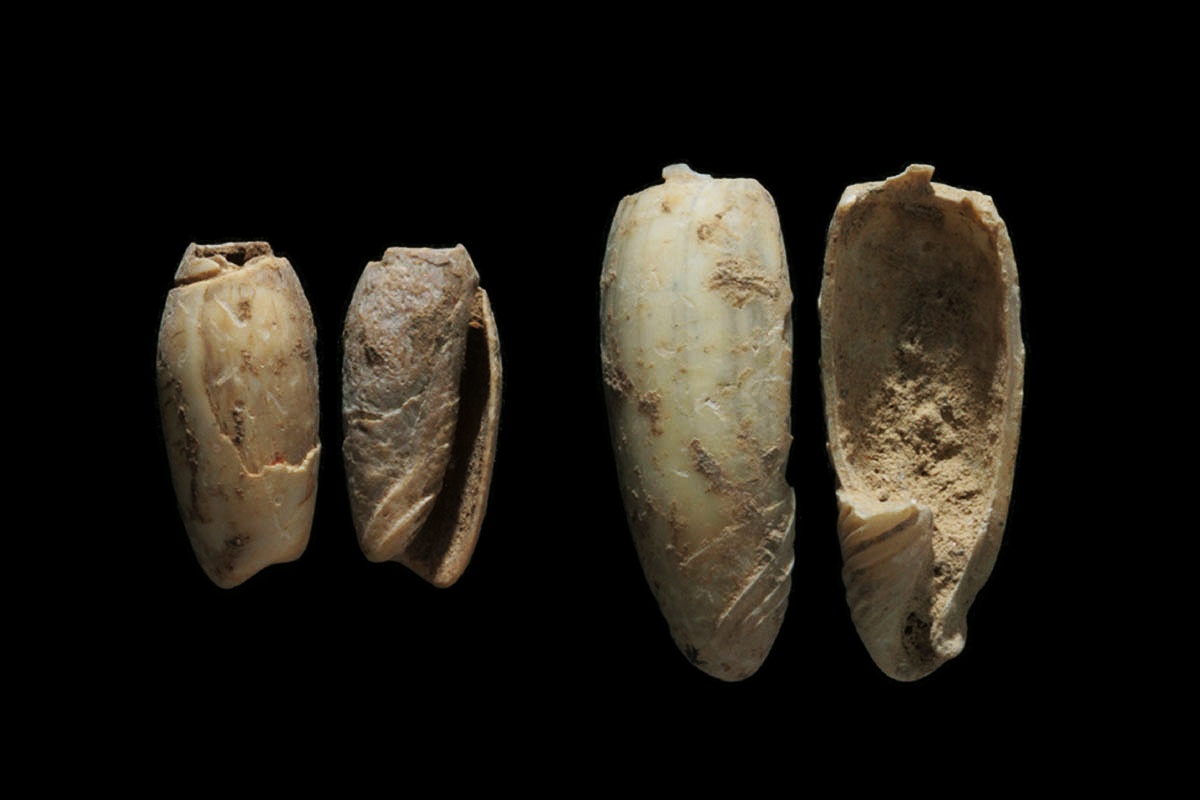
In the mid 2010s, scientists announced that they had found shell jewellery and ornaments dating from 37,000 to 42,000 years ago in Jerimalai cave, , overturning earlier assumptions that the first inhabitants of Island Southeast Asia were culturally unsophisticated. The finds — including a drilled Oliva sea snail shell and worked, red-ochre–stained Nautilus shell pieces — represent the oldest known personal ornaments in East Asia. [Source: Bradshaw Foundation, August 19, 2016; Alice Klein, New Scientist, August 17, 2016
Microscopic analysis shows deliberate manufacturing techniques such as drilling, pressure flaking, grinding, and the application of pigment. Experiments confirmed that the perforations could not have formed naturally. These artefacts indicate a long-lived tradition of shell working and demonstrate that early coastal peoples in the region were not only exploiting marine resources for food but also incorporating them into symbolic and social practices.
Researchers note that the scarcity of earlier East Asian ornaments likely reflects limited archaeological excavation rather than cultural “backwardness.” Similar evidence — such as a 30,000-year-old shell necklace from Australia and 40,000-year-old cave art in Sulawesi — underscores the cultural sophistication of early humans in this region.
Movements Between Indonesian Islands 12,000 Years Ago
According to Archaeology magazine: Although separated by miles of ocean, three island communities in Southeast Asia shared the same fashion trends 12,000 years ago. The islands’ inhabitants drilled holes into pieces of Nautilus shell and sewed them onto textiles. Not only did the shells boast aesthetically pleasing yellowish and white patterns, they also had reflective properties that made them resemble sequins. Microscopic analysis of hundreds of fragments from Makpan Cave on Alor Island revealed that they were similar to examples found on Timor and Kisar, suggesting there was communication among the islands during the late Ice Age. [Source: Archaeology, November 2024]
Early seafarers carried wallabies in their canoes when they set sail across the seas of Southeast Asia from the paleocontinent of Sahul. In one of the earliest known examples of animal translocation, these ancient travelers introduced the marsupials to areas where they were not native. Evidence from Mololo Cave in the Raja Ampat Islands, near New Guinea, reveals that people were butchering and cooking brown forest wallabies as long as 13,000 years ago. The animals were also used for their pelts and as a source for making bone tools. [Source: Archaeology magazine, September-October 2025]
World’s Oldest Funerary Fish Hooks Found on the Alor Islands
Archaeologists from the Australian National University have uncovered five Pleistocene-era fish hooks—about 12,000 years old—on Indonesia’s Alor Island. The set includes one shaped hook and four circular rotating hooks, all crafted from sea-snail shell. They were discovered as part of a ritual burial, arranged beneath the chin and around the jaws of a female individual. [Source: heritagedaily.com, Ancientfoods, March 3, 2018]
According to Professor Sue O’Connor, the find overturns the long-held assumption that men were primarily responsible for fishing on these islands. “These are the oldest known fish hooks associated with mortuary practices anywhere in the world and may suggest that fishing equipment was considered essential for the transition to the afterlife in this region,” she said.
The discovery highlights how deeply the Pleistocene inhabitants of Alor were connected to the sea; the placement of hooks in a grave underscores the cosmological significance of fishing in their island environment. The only other known burial featuring fish hooks as funerary items dates to around 9,000 years ago in Siberia’s Mesolithic-era Ershi cemetery. While fish hooks as old as 22,000 years have been found in Japan and Europe, none have been linked to burial practices.
Professor O’Connor noted that the early appearance of Alor’s rotating hooks on an isolated island suggests independent technological innovation. The hooks strongly resemble rotating types found in Japan, Australia, Arabia, California, Chile, Mexico, and Oceania. “We argue that similar tools were developed independently because they best suited local ecological conditions, rather than through cultural diffusion,” she said.
Image Sources: Wikimedia Commons
Text Sources: Archaeology National Geographic, University of Woolongong, The Guardian, AFP, BBC, Los Angeles Times, The Independent, New York Times, Ministry of Tourism, Republic of Indonesia, National Geographic, Smithsonian magazine, Reuters, Wikipedia, CNN, and various books, websites and other publications.
Last updated December 2025