
HOBBITS OF INDONESIA
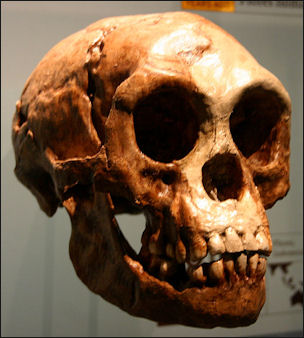
Homo floresiensis In 2004, scientists announced the discovery of the remains of seven hominins on the island of Flores, east of Bali, dated to 95,000 and 50,000 years ago. The bones were first thought to be children but were later confirmed to be a new hominin species, considerably smaller than modern humans, and thus nicknamed Hobbits. The finding received headlines around the globe and caused jaws to drop in astonishment throughout the scientific community. [Source: Mike Norwood, Thomas Sutikna and Richard Robert, National Geographic, April 2005]
Discovered in 2003,the new hominins were given the name the “ Homo floresiernsis”. About 1.1 meters tall, they had unusually long, flat feet and a brain the size of a grapefruit. They existed at the same time as modern humans and are thought to have descended from “ Homo erectus” and arrived in Flores perhaps as long as 840,000 years, the period in which stone stools found on Flores have been dated. Hominins on the island had to have arrived by sea because even during ice ages reaching Flores required a 15 mile sea crossing. Dating was done with carbon dating of charcoal found near the fossils and luminescence dating of the sediments in which the fossils were found.
Remains dated to be 18,000 years old were found in September 2003 in a cave in eastern Flores known to the local Manggarai people as Liang Bua. The remains included the skull, pelvis, leg, arm and foot bones of a female; the lower jaw from another adult; and flaked stone tools, perhaps arrow heads or spear points. Wear on the teeth indicated the creatures were adults not children. The presence of a number of individuals the same size indicated the remains weren’t from modern human stunted by disease, malnutrition or dwarfism.
The bones were unearthed by a team of Australians and Indonesian scientists, led by Michael Morwood, an archaeologist at Australia’s University of New England, who later got into disputes over possession of the fossils, and their meaning. At one point excavations were stopped when the Indonesian Institute of Science banned digging in the cave. The bones were found 20 feet under the floor of the cave. One Indonesia scientist, Teuku Jacob, commandeered the bones and had them shipped to his house in Yogyakarta, in the process breaking some of the other bones and denying other team members access to them.
Websites and Resources on Hominins and Human Origins: Smithsonian Human Origins Program humanorigins.si.edu ; Institute of Human Origins iho.asu.edu ; Becoming Human University of Arizona site becominghuman.org ; Hall of Human Origins American Museum of Natural History amnh.org/exhibitions ; The Bradshaw Foundation bradshawfoundation.com ; Britannica Human Evolution britannica.com ; Human Evolution handprint.com ; University of California Museum of Anthropology ucmp.berkeley.edu; John Hawks' Anthropology Weblog johnhawks.net/ ; New Scientist: Human Evolution newscientist.com/article-topic/human-evolution
RELATED ARTICLES:
ORIGINS AND ANCESTORS OF HOMO FLORESIENSIS (HOBBITS) factsanddetails.com
WESTERN FLORES: ISLANDS, TRADITIONAL VILLAGES AND HOMO FLORESIERNSIS (HOBBITS) factsanddetails.com
FIRST HOMININS IN SOUTHEAST ASIA factsanddetails.com
DENISOVANS: CHARACTERISTICS, DISCOVERY AND DNA factsanddetails.com
WHERE DENISOVANS LIVED: MOSTLY IN ASIA IT SEEMS factsanddetails.com
EARLY MODERN HUMANS MIGRATE TO ASIA factsanddetails.com
EARLIEST MODERN HUMANS IN ASIA factsanddetails.com
EARLY MODERN HUMANS IN SOUTHEAST ASIA factsanddetails.com
LIFESTYLE OF EARLY HUMANS IN SOUTHEAST ASIA factsanddetails.com
DNA EVIDENCE ON THE FIRST HUMANS IN EAST ASIA factsanddetails.com
EARLY HUMANS IN BORNEO: NIAH CAVES 40,000-YEAR-OLD ROCK ART factsanddetails.com
EARLY HUMANS IN SULAWESI, INDONESIA AND THEIR 45,000-YEAR-OLD CAVE ART factsanddetails.com
RECOMMENDED BOOKS:
“Little Species, Big Mystery: The Story of Homo Floresiensis” by Debbie Argue Amazon.com;
“Homo Floresiensis: Diving Deep into our Evolutionary Past” by Austin Mardon, Catherine Mardon, et al. Amazon.com;
“A New Human: The Startling Discovery and Strange Story of the "Hobbits" of Flores, Indonesia” by Mike Morwood, Penny van Oosterzee (2007) Amazon.com;
“Ancestral DNA, Human Origins, and Migrations” by Rene J. Herrera (2018) Amazon.com;
“Asian Paleoanthropology: From Africa to China and Beyond” (Vertebrate Paleobiology and Paleoanthropology) by Christopher J. Norton and David R. Braun Amazon.com;
“Emergence and Diversity of Modern Human Behavior in Paleolithic Asia” by Yousuke Kaifu, Masami Izuho, et al. Amazon.com;
“Paleoanthropology and Paleolithic Archaeology in the People's Republic of China” by Wu Rukang, John W Olsen Amazon.com;
“In search of Homo erectus: a Prehistoric Investigation: The humans who lived two million years before the Neanderthals” by Christopher Seddon (2017) Amazon.com;
“Peking Man” Amazon.com;
“Java Man : How Two Geologists' Dramatic Discoveries Changed Our Understanding of the Evolutionary Path to Modern Humans” by Roger Lewin , Garniss H. Curtis, et al. Amazon.com;
“Evolution: The Human Story” by Alice Roberts (2018) Amazon.com;
“Perspectives on Our Evolution from World Experts” edited by Sergio Almécija (2023) Amazon.com;
“Discovering Us: Fifty Great Discoveries in Human Origins” By Evan Hadingham (2021) Amazon.com;
“Who We Are and How We Got Here: Ancient DNA and the New Science of the Human Past” by David Reich (2019) Amazon.com;
“Stone Tools in Human Evolution”
by John J. Shea (2016) Amazon.com;
“Our Human Story: Where We Come From and How We Evolved” By Louise Humphrey and Chris Stringer, (2018) Amazon.com;
“Lone Survivors: How We Came to Be the Only Humans on Earth” by Chris Stringer (2013) Amazon.com;
Features and Body of the Hobbits in Indonesia
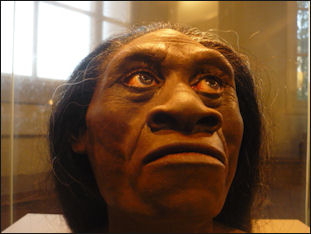
The small hominins found on Flores stood only three feet tall and weighed only 55 pounds, about a third of the size of a modern human adult, and had brains considerably smaller than any other hominin, and even smaller than most chimpanzee adults. Their pelvis was wider than modern humans and homo erectus; their arms hung almost below the knees but their wrists bones were delicate implying that it was not a tree climber. The skull was pinched in at the temples like “ Homo erectus” skulls found in Dmanisi, Georgia.
The anthropologist Matt Tocheri wrote: “The skeletal evidence suggests that adults of this species had extremely small brains (400 cubic centimeters), stood only about 1 meter (3'6") tall, and weighed around 30 kg (66 lbs). For their height, these individuals have large body masses, and in this regard appear more similar to earlier hominins like "Lucy" (Australopithecus afarensis) than they do to modern humans, including small and large-bodied people. The proportions between the upper arm (humerus) and upper leg (femur) also appear more similar to those in Australopithecus and Homo habilis than those of modern humans.
Researchers who reexamined the Homo floresiensis concluded in 2009 that LB1’s anatomy is far more primitive than originally thought, prompting a reconsideration of early human evolution and migrations. Although LB1 is similar in height and brain size to the 3.2-million-year-old Australopithecus “Lucy,” new evidence shows even deeper similarities: many parts of LB1’s skeleton resemble pre-Homo erectus hominins and even apes. LB1’s wrist, clavicle, pelvis, and other bones all show unexpectedly primitive forms, more consistent with australopithecines than with Homo erectus. Yet the skull is a mosaic: although the brain is tiny, certain cranial features clearly place LB1 within the genus Homo. Altogether, the findings suggest H. floresiensis may represent a far more ancient and unusual lineage than previously believed, rather than simply a dwarfed form of H. erectus. [Source: Kate Wong, Scientific American, November 2009 -]
“ Homo floresiernsis” are thought to have become so small through the process of island dwarfism, which cause some large species to grow smaller because food sources are limited and there is no threat from predators and causes some smaller animals to become larger because they lack competitors. On Flores scientists have also found the remains stegodons — extinct elephant ancestors which were about the size of a cow, or about a tenth of the size of an Asian elephant — and Flores giant rats, which are about five times the size of brown rats. Komodo dragons are found on islands near Flores. The stegodons are thought to have arrived by swimming. The rats and Komodo dragons perhaps hitched rides on flotsam.
Hobbit Feet

Homo floresiensis skeleton
Homo floresiensis had a small body and brain, but it feet were exceptionally long, and they were flat. After completing the first detailed analysis of the hominid’s foot bones, scientists, who reported their findings in a May 2009 issue of Nature, said the feet show that the Hobbits belonged to a primitive population distinct from modern humans John Noble Wilford wrote in the New York Times: “The examination of lower limbs and especially an almost complete left foot and parts of the right, the researchers reported, shows that the species walked upright, like other known hominids. There were five toes, as in other primates, but the big toe was stubby, more like a chimp’s. [Source: John Noble Wilford, New York Times, May 6, 2009 /=]
Stranger still was the size of the feet — more than seven and a half inches long, out of proportion to its short lower limbs. The feet are long and flat, with curved toes and no arch, forcing an awkward, high-stepping gait despite upright walking. The s foot-to-femur ratio is unlike any known human fossil. The imbalance evoked the physiology of some African apes, but it has never before been seen in hominids. And then there were those flat feet. Humans sometimes have fallen arches and flat feet, but scientists noted that this was no human foot. The navicular bone, which helps form the arch in the modern foot, was especially primitive, more akin to one in great apes. Without a strong arch — that is, flat-footed — the hominid would have lacked the springlike action needed for efficient running. It could walk, but not run like humans. /=\
William Jungers and colleagues reported that the Homo floresiensis foot displays numerous primitive traits absent in modern humans of any size. Combined with earlier evidence—such as the hobbit’s small brain and archaic shoulders and wrists—the researchers argue these features cannot be explained by island dwarfism alone. Instead, they suggest H. floresiensis likely descended from a more primitive ancestor than Homo erectus. In a commentary, Daniel Lieberman notes that many scientists had withheld judgment about the hobbits’ status, but the new foot evidence strengthens the case that they represent a distinct, non-modern hominin. Lieberman adds that the foot hints at a hominid adapted for efficient walking before the evolution of human-style endurance running. William Harcourt-Smith agrees, saying the anatomy makes it clear that the hobbits were “nothing like us.”
Hobbit Tools, Brain Size and Growth
Kate Wong wrote in Scientific American, ““Artifacts left behind by the hobbits support the claim that H. floresiensis is a very primitive hominin. Early reports on the initial discovery focused on the few stone tools found in the hobbit levels at Liang Bua that were surprisingly sophisticated for a such a small-brained creature—an observation that skeptics highlighted to support their contention that the hobbits were modern humans, not a new species. But subsequent analyses led by Mark W. Moore of the University of New England in Australia and Adam R. Brumm of the University of Cambridge have revealed the hobbit toolkit to be overall quite basic and in line with the implements produced by other small-brained hominins. The advanced appearance of a handful of the hobbit tools at Liang Bua, Moore and Brumm concluded, was produced by chance, which is not unexpected considering that the hobbits manufactured thousands of implements. [Source: Kate Wong, Scientific American, November 2009 -]
“To make their tools, the hobbits removed large flakes from rocks outside the cave and then struck smaller flakes off the large flakes inside the cave, employing the same simple stone-working techniques favored by humans at another site on Flores 50 kilometers east of Liang Bua called Mata Menge 880,000 years ago—long before modern humans showed up on the island. (The identity of the Mata Menge toolmakers is unknown, because no human remains have turned up there yet, but they conceivably could be the ancestors of the diminutive residents of Liang Bua.) Furthermore, the Liang Bua and Mata Menge tools bear a striking resemblance to artifacts from Olduvai Gorge in Tanzania that date to between 1.2 million and 1.9 million years ago and were probably manufactured by H. habilis. -
For decades, scientists believed human evolution was defined by steadily increasing brain size. This view was overturned with the discovery of Homo floresiensis. Research on hobbit skulls and teeth offers a fresh explanation for how they evolved such small bodies and brains. By analyzing molar and brain size across 15 fossil species, researchers found a general pattern in human evolution: larger brains correlate with proportionally smaller wisdom teeth. H. floresiensis is the only exception—its wisdom teeth are small, like other Homo species, yet its brain is also small. Because teeth form early in gestation, this suggests hobbit brain development proceeded normally in the womb and slowed only after birth. [Source: Tesla Monson and Andrew Weitz, Western Washington University, The Conversation September 24, 2025]
The findings indicate that H. floresiensis likely shrank from a larger-bodied Homo ancestor through reduced childhood growth—a pattern also seen in some modern short-statured human populations. This downsizing fits a well-known evolutionary pattern called insular dwarfism, common in island environments with limited food and few predators. On Flores, the hobbits shared the landscape with other dwarfed species, including pygmy elephants they hunted. Although small-bodied and small-brained, the hobbits were cognitively capable. Their reduced size reflects ecological adaptation, not diminished intelligence.
Lifestyle of the Hobbits in Indonesia
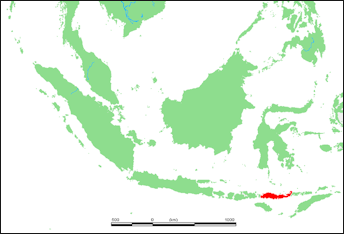
Flores “Homo floresiernsis” is thought to have hunted and cooked giant rats and stegodons. The only predators they faces were Komodo dragons, which may have been hunted as well. Fireplaces, charred bones and thousands of stone tools have been found. The presence of spear points with cut marks if offered as evidence of hunting. Hunting 800-pound stegodons would have required some form of group hunting or incredible bravery for a 55-pound creature. Giant rats are still hunted by local people on Flores today.
A large volcanic eruption that occurred on Flores 11,000 years may have wiped out “ Homo floresiernsis”. They and modern humans lived at the same time but there is no evidence that they met. Maybe some survived. Local islanders tell folk stories about hairy, pint-size people with flat foreheads called “Ebu Gogo” (“Grandmother who eats everything”) that stole their crops and moonshine and were “so greedy they even ate the plates.” Locals say the creatures were last seen about 300 years ago. The cave where “ floresiernsis” was found is regarded as burial places of sinners who drowned in the biblical Great Flood.
The “Homo floresiernsis” brain was 380 cubic centimeters in size, compared to 1,350 cubic centimeters for a modern human and 900 cubic centimeters for homo erectus. CT scans of the skull reveal that even though it was the size of a chimpanzees brain it had features that are human-like and distinctive. There is evidence the Hobbit brain was wrinkled and had expanded temporal lobes like those of modern humans. To build boats and carry out group hunts, it has been reasoned that they possessed language.
Liang Bua, the Cave Where the Hobbits Were Found
Liang Bua (14 kilometers from Ruteng) is a cave where archaeologists discovered fossils of the Flores hobbit, or homo floresiensis, a hitherto unknown prehistoric hominid species that lived 95,000 to 12,000 years ago and whose remains were found in the caves of Liang Bua. Situated in a limestone hill in Manggarai District, the cave has long been familiar to the local community due its huge size (50 meters long, 40 meters wide, and 25 meters tall). Because of its large size it was once used as a religious worship place and school.
Many stone flake tools, dated between 800,000 and 900,000 years ago and ascribed to Homo Erectus, have been found on the island of Flores. The anthropologist Matt Tocheri wrote: “Flores is one of many Wallacean islands, which lie east of Wallace's Line and west of Lydekker's Line. Wallacean islands are interesting because they have rarely, if ever, been connected via land bridges to either the Asian continent to the west or the Greater Australian continent to the east. This longstanding separation from the surrounding continents has severely limited the ability of animal species to disperse either into or away from the Wallacean islands. Thus, on Flores there were only a small number of mammal and reptile species during the entire Pleistocene. These included komodo dragons and other smaller monitor lizards, crocodiles, several species of Stegodon (an extinct close relative of modern elephants), giant tortoise, and several kinds of small, medium, and large-bodied rats. [Source:Matt Tocheri, humanorigins.si.edu]
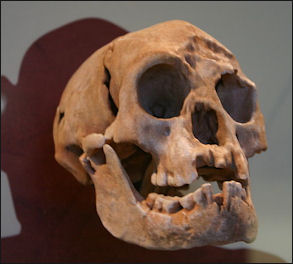
Homo floresiensis “In 2001, an Indonesian-Australian research team began excavations at a large limestone cave located in west central Flores. This cave, known as Liang Bua (which means "cool cave"), was first excavated by Father Verhoeven in 1965. Professor Raden Soejono, the leading archeologist in Indonesia, heard about Liang Bua from Verhoeven and conducted six different excavations there from the late 1970s until 1989.
All of this early work at Liang Bua only explored deposits that occurred within the first three meters of the cave floor. These deposits are dated to within the last 10,000 years and contain considerable archeological and faunal evidence of modern human use of the cave, as well as skeletal remains of modern humans. However, in 2001 the new goals were to excavate deeper into the cave's stratigraphy to explore if modern or pre-modern humans were using Liang Bua prior to 10,000 years ago. In September of 2003, they got their answer.
See Separate Article with Liang Bua Archeology Sites on the Island of Flores factsanddetails.com
Discovery of Homo floresiensis
The first discovery, in 2003, was the 18,000-year-old bones of a woman whose skull was less than one-third the size of our own. As of 2008, the team had recovered bones from as many as nine such people, all about a meter, the most recent of whom lived about 12,000 years ago. Matt Tocheri wrote: “ On Saturday, September 6, 2003, Indonesian archeologist Wahyu Saptomo was overseeing the excavation of Sector VII at Liang Bua. Benyamin Tarus, one of the locally hired workers, was excavating the 2 x 2 meter square when all of a sudden the top of a skull began to reveal itself. Six meters beneath the surface of the cave, Wahyu immediately joined Benyamin and the two of them slowly and carefully removed some more sediment from around the top of the skull. Wahyu then asked Indonesian faunal expert Rokus Due Awe to inspect the excavated portion of the skull. Rokus told Wahyu that the skull definitely belonged to a hominin and most likely that of a small child given the size of its braincase. Two days later, the team returned to the site and Thomas Sutikna, the Indonesian archeologist in charge of the excavations, joined Wahyu at the bottom of the square. After several days, enough of the cranium and mandible had been exposed for Rokus to realize that this was no small child; instead, all of its teeth were permanent meaning that this was a fully grown adult. A few weeks later, the team had recovered the rest of this hominin's partial skeleton, the likes of which had never been discovered before. Today, this specimen is referred to as LB1 (Liang Bua 1), and is the holotype specimen for the species Homo floresiensis. [Source: Matt Tocheri, humanorigins.si.edu]
“At the time of the discovery, the Liang Bua Research Team included specialists in archeology, geochronology, and faunal identification, but there was no physical anthropologist. Dr. Mike Morwood, the co-leader of the project, invited his colleague at the University of New England in Australia, Dr. Peter Brown, to lead the description and analysis of the skeletal remains. Dr. Brown is an expert on cranial, mandibular, and dental anatomy of early and modern humans and he agreed to apply his expertise to the study of the new bones from Liang Bua. This important scientific work resulted in the first descriptions of these skeletal remains in the journal Nature on October 28, 2004. This work also gave the scientific name, Homo floresiensis, to the hominin species that is represented by the skeletal material from the Late Pleistocene sediments at Liang Bua.
“Just before the two Nature articles on Homo floresiensis were published in 2004, the Liang Bua Research Team uncovered additional skeletal material. This included the arm bones of LB1, and several bones of another individual, LB6, including the mandible and other bones of the arm. Drs. Morwood and Brown, and other Indonesian and Australian members of the Liang Bua Research Team, described and analyzed these new skeletal remains of Homo floresiensis and again published their results in Nature on October 13, 2005.
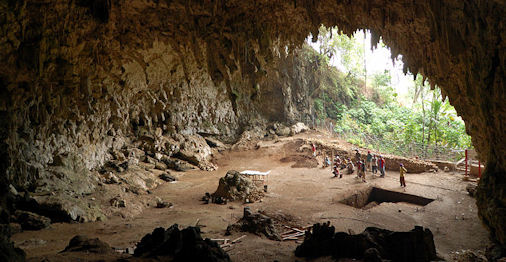
Homo floresiensis cave
Implications and Doubts Regarding the Hobbits in Indonesia
The discovery of “Homo floresiernsis” had a profound impact on the study of ancient man and showed that the evolution of man was far more complex than previously thought and may have produced a whole menagerie of human creatures that resulted in dead ends. Before the discovery it was thought that Neanderthals were the only hominins that existed at the same time as modern humans. Another surprising thing is that “ floresiernsis” fossils don’t resemble 1.6-million-year-old “Homo erectus” fossils found in Indonesia. They more closely resembles homo erectus 1.7-million-year-old fossils found in Dmanisi, Georgia. Some dismiss this interpretation of the fossils because it would represents a case of reverse-evolution, something regarded as impossible or at least unlikely.
Homo floresiensis crossed the Wallace Line — a deep-water barrier in the Indonesian archipelago separating Asian fauna from the distinct, isolated species of Australia and nearby islands (Wallacea). Homo floresiernsis either had to an extremely good swimmer or a boat builder or a descendant of a good swimmer or boat builder to cross the strait between Flores and Komodo, the nearest large island, and the straits between Komodo, Sumbawa, Lombok and Bali, which were never connected by land bridges during the ice ages. The most likely explanation is that “ floresiernsis” built boats, a surprisingly achievement for a creature with a brain smaller than a chimpanzee. One implication of this is that maybe a large brain isn’t as important as it has been made out to be.
Some critics have doubted that a hominin with a grapefruit-sized brain could have produced the sophisticated stone tools found at Liang Bua, arguing they must have been made by modern humans not hobits. But supporters of the separate-species view modeled the hobbit’s brain and concluded it was capable of making the tools. Further support came from an analysis of the hobbit wrist by Matthew Tocheri and colleagues, which revealed a primitive, wedge-shaped trapezoid bone seen in great apes and early hominins but absent in Neanderthals and modern humans. This suggests H. floresiensis may be more closely related to H. erectus than to H. sapiens. Morwood also uncovered crude H. erectus–type tools on Flores dating to about 840,000 years ago. Skeptics counter that such wrist traits could stem from disease; one study proposed hypothyroidism (cretinism), which is relatively common in Indonesia and can cause stunted growth and primitive-looking bones. [Source: Guy Gugliotta, Smithsonian Magazine, July 2008 ==]
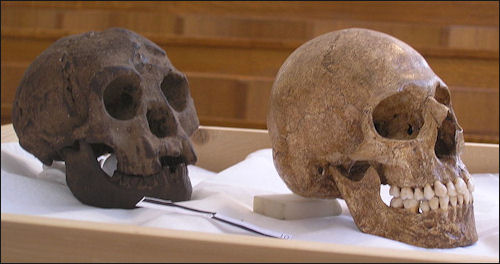
H-floresiensis versus Cretan-microcephalic
Are "Hobbits" Small Humans or a Different Species?
Other finds show that small-bodied hominins are not unique to Flores. A 900,000-year-old skull fragment in Kenya may represent a diminutive offshoot of H. erectus. In Palau, remains of at least 25 short individuals (4 feet tall, 1,400–3,000 years old) share some traits with Flores hominins but have near-modern brain sizes—evidence that extreme body-size reduction can occur within Homo sapiens. Modern pygmies and Negrito groups offer similar examples.
Morwood and Peter Brown argue that H. floresiensis is a distinct species, pointing to multiple primitive traits that do not match known pathologies. Dean Falk’s brain study found no signs of microcephaly and noted healthy cerebellar structure and enlarged frontal and temporal lobes. Bernard Wood adds that the Flores fossils possess an unusual mix of archaic features best explained by a separate hominin line.
Critics maintain the remains might be from diseased modern humans—microcephaly, pituitary disorders, and cretinism have all been proposed. Indonesian paleoanthropologist Teuku Jacob searched Flores for living people who might resemble the ancient skeletons. Others argue that certain skull features still hint at developmental abnormalities. Rick Potts, director of the Smithsonian’s Human Origins Program, once doubted the hobbits represented a distinct species but now sees Flores as “a wing in the building of human evolution that we didn’t know about,” adding that hundreds of thousands of years of isolation could easily produce “a small but advanced brain.”
It is now generally accepted that Homo floresiensis are a genuinely distinct species and archaic human species.
Hobbits Died Out 50,000 Years Ago: Because of Drought and Modern Humans?
A study published in 2016 showed that Homo floresiensis died out at least 50,000 years ago — earlier than thought and around the same time modern humans were moving through Southeast Asia. Researchers like Matthew Tocheri note that extinctions repeatedly followed the spread of Homo sapiens, making it plausible that modern humans contributed to the hobbits’ disappearance, even if indirectly. If modern humans had reached Australia by 50,000 years ago, they must have passed through the islands near Flores earlier. That timing coincides suspiciously with the hobbits’ extinction. Chris Stringer argues that after surviving on Flores for over a million years, H. floresiensis likely succumbed not to warfare but to competition for food, animals, and habitats once modern humans arrived. [Source: Nicola Davis, The Guardian, March 30, 2016]
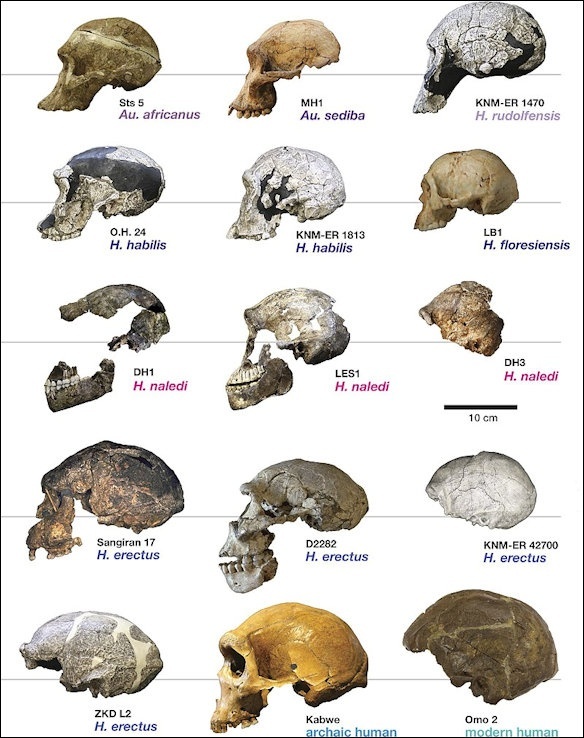
comparison of skulls of hominins
Homo floresiensis may have disappeared around 50,000 years ago after declining rainfall reduced the availability of prey, forcing the species into areas where they likely encountered and competed with modern humans, according to new research. The researchers emphasize that drought alone was not the only stressor. A volcanic eruption around the same time may also have played a major role in their extinction. [Source: Owen Jarus, Live Science, December 8, 2025]
In a study published December 8 in Communications Earth & Environment, scientists report that rainfall on Flores dropped sharply prior to 50,000 years ago. They also found that populations of Stegodon—a now-extinct elephant relative hunted by the hobbits—declined and ultimately disappeared from the island around the same time. To track rainfall patterns, the team analyzed a stalagmite from Liang Luar, a nearby cave. Stalagmites grow more slowly during dry periods and incorporate higher levels of magnesium relative to calcium carbonate. By measuring these mineral ratios, the researchers reconstructed past rainfall.
They found that average annual rainfall fell from 61.4 inches (1,560 millimeters) 76,000 years ago to 40 inches (990 mm) by 61,000 years ago, and remained low through 50,000 years ago. A volcanic eruption then blanketed the island in debris. Analysis of Stegodon teeth shows that their numbers declined between 61,000 and 50,000 years ago and disappeared entirely after the eruption. As these animals formed a major part of the hobbits’ diet, their dwindling numbers would have created severe food stress.
According to study co-author Nick Scroxton of University College Dublin, reduced river flow may have driven Stegodon toward the island’s coasts—and the hobbits likely followed. Moving into coastal areas may have brought H. floresiensis into contact and competition with expanding Homo sapiens groups. Intergroup conflict is also possible, Scroxton noted. The subsequent volcanic eruption would have further devastated the already stressed hobbit populations.
Experts not involved in the study praised the work. Julien Louys, a palaeontologist at Griffith University, noted that even moderate drying can have major impacts on small islands like Flores, where habitats are limited and refuges quickly disappear or become overcrowded. Debbie Argue of the Australian National University added that the study provides valuable insight into shifting environmental conditions on Flores and represents a significant contribution to understanding the world the hobbits inhabited.
Image Sources: Wikimedia Commons
Text Sources: National Geographic, New York Times, Washington Post, Los Angeles Times, Smithsonian magazine, Nature, Scientific American. Live Science, Discover magazine, Discovery News, Times of London, Natural History magazine, Archaeology magazine, The New Yorker, Time, BBC, The Guardian, Reuters, AP, AFP and various books and other publications.
Last updated December 2025