
JAVANESE CULTURE
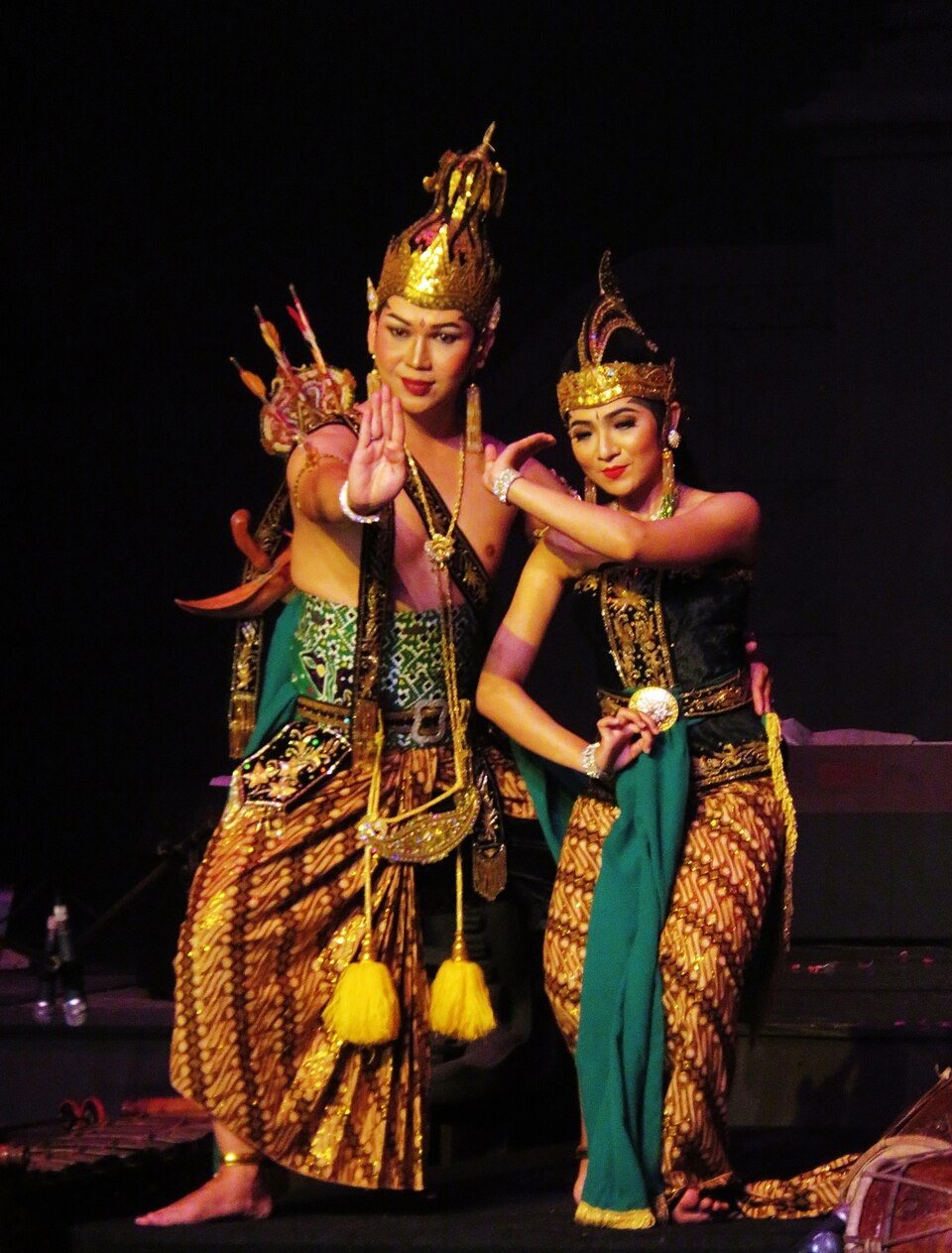
Rama and Shinta in Ramayana Ballet performance near Prambanan temple complex
Clifford Geertz (1964) identified three Javanese art “complexes,” each encompassing distinct forms of music, drama, dance, and literature. The most celebrated is the alus (refined) complex, whose centerpiece is the Javanese shadow play, wayang, renowned worldwide. Wayang uses puppets to dramatize stories drawn from the Indian epics—the Mahabharata and the Ramayana—as well as episodes from Java’s precolonial past. Performances are accompanied by gamelan percussion orchestras, which have also gained international recognition. Batik textile production is another major art form within the alus complex. This classical, tradition-oriented complex has historically been associated with the prijaji elite. By contrast, the other two art complexes are more popular in character, shared nationally, and shaped by Western influences. [Source: M. Marlene Martin, “Encyclopedia of World Cultures Volume 5: East / Southeast Asia:” edited by Paul Hockings, 1993; A. J. Abalahin, “Worldmark Encyclopedia of Cultures and Daily Life,” Cengage Learning, 2009]
Alongside gamelan and wayang, batik textiles are among Java’s most distinctive artistic expressions. Batik designs are created through repeated dyeing, with areas meant to resist color coated in wax. This wax is applied either with copper stamps or, more painstakingly and artistically, by hand using a canting. Batik styles vary sharply by region: kejawen batik from Yogyakarta and Surakarta favors dense geometric patterns in brown, indigo, and white, while pesisir batik from coastal areas such as Pekalongan emphasizes delicate floral motifs in red and other bright colors. Other notable Javanese crafts include leatherwork (especially wayang puppets), woodcarving for masks, furniture, and screens, as well as pottery, glass painting, and ironsmithing—most famously the forging of kris daggers.
Overall, many urban middle-class Javanese now prefer national and international popular culture for leisure, often encountering traditional performing arts only through television. By contrast, court circles—and those who seek to associate themselves with them—as well as rural communities and much of the urban poor, remain strongly attached to these older artistic traditions.
Historically, parents used wayang stories to teach moral values to children. The characters offered a wide range of models and anti-models of behavior: the virtuous but flawed king Yudistira; the refined Arjuna, ideal warrior and lover; the powerful and irreverent Bima; and female exemplars such as the bold Srikandi and the gentle Sumbadra. Comic relief and social commentary came from the clown-servants—Petruk, Gareng, Bagong, and their father Semar, an ungainly, rotund figure who is in fact the supreme god in disguise and guardian spirit of Java. Two female clown-servants, the tall and thin Cangik and her short, plump daughter Limbuk, complete this cast of humorous yet meaningful figures.
RELATED ARTICLES:
JAVANESE PEOPLE: HISTORY, DEMOGRAPHICS, LANGUAGE factsanddetails.com
JAVANESE RELIGION: ISLAM, MYSTICISM, FESTIVALS, BELIEFS, PRACTICES factsanddetails.com
JAVANESE SOCIETY: FAMILY, MARRIAGE, GENDER, CUSTOMS, CLASSES factsanddetails.com
JAVANESE LIFE: VILLAGES, HOUSES, FOOD, CLOTHES, WORK factsanddetails.com
CENTRAL JAVA factsanddetails.com
EAST JAVA factsanddetails.com
Javanese Folklore and Literature
Javanese belief recognizes a rich hierarchy of supernatural beings. Memedis are frightening spirits, including figures such as sundal bolong and the mischievous gendruwo. Gendruwo are said to appear as familiar relatives in order to abduct people and render them invisible; anyone who accepts food from a gendruwo is believed to remain invisible forever. Lelembut are spirits that possess humans, while tuyul are spirit familiars that can be acquired through fasting and meditation. Demit inhabit eerie or dangerous places, and danyang serve as guardian spirits of villages, palaces, and sacred sites. Above all stands Ratu Kidul, the Queen of the South Sea, believed to be the mystical consort of Java’s rulers. Her favored color is green, and young men are warned not to wear green along the southern Indian Ocean coast, lest they be drawn into her underwater realm. [Source: A. J. Abalahin, “Worldmark Encyclopedia of Cultures and Daily Life,” Cengage Learning, 2009]
Another revered group in Javanese tradition is the wali songo, the Nine Saints credited with bringing Islam to Java. Of diverse origins—Arab, Egyptian, Persian, Central Asian, and Chinese—they are remembered not only for their piety but also for their legendary powers, such as flying. They are also said to have spread Islam through Javanese cultural forms. Sunan Bonang, for example, used Javanese sung poetry and gamelan music to convey Islamic teachings. Their tombs along Java’s north coast remain major pilgrimage destinations, especially those of Sunan Giri in Gresik near Surabaya, Sunan Kudus in Kudus, and Sunan Gunung Jati in Cirebon. Another figure who attracts pilgrims is Zheng He, known locally as Sam Po Kong; both Muslim Javanese and non-Muslim Chinese visit his shrine and temple in Semarang.
Although Javanese today is written mainly with the Latin alphabet, older scripts remain in limited use. These include hanacaraka, an Indian-derived script dating back to the eighth century, and pegon, a modified Arabic script. Javanese literary traditions reach to the eleventh century, beginning with Kawi (Old Javanese) adaptations of the Ramayana and Mahabharata. By the fourteenth century, original works such as the Nagarakretagama, which describes a royal tour of Majapahit, had appeared. The earliest surviving literature in modern Javanese dates from the Islamic period and includes babad, semi-mythical poetic chronicles such as the Babad Tanah Jawi. Once-common practices like the singing of tembang macapat verse are now fading, while novels and short stories continue to be written in Javanese, competing with more commercially dominant works in Indonesian.
Javanese Music and Dance
An essential element of ritual, celebration, and theater, the classical Javanese orchestra, or gamelan, is made up of bronze gongs, keyed metallophones, drums, a flute, a spike fiddle (rebab), and a zither (celempung), accompanied by male and female singers. The music relies little on modern notation systems and encompasses hundreds of named compositions (gending) performed in either soft or loud styles. [Source: A. J. Abalahin, “Worldmark Encyclopedia of Cultures and Daily Life,” Cengage Learning, 2009]
Beyond the courts, street performers adapt the tradition using simpler instruments such as bamboo-tube gongs and box-and-rubber-band zithers. Other ensembles, including kroncong groups, perform langgam jawa—folk and contemporary songs set to Javanese scales—while modern popular genres such as pop and dangdut are also sung in Javanese.
Traditional Javanese dance is marked by restraint, precision, and highly controlled movement, especially in the subtle and graceful articulation of the hands. Once performed exclusively in royal courts, these dances are now widely taught. The most revered are the bedoyo and srimpi, court dances in which young women perform highly stylized scenes of combat. Other female dances include the flirtatious golek and gambyong, refined versions of the performances of taledek or ronggeng, itinerant dancers historically associated with social marginality. These latter traditions often involve tayub, in which the dancer flirts with a male audience and invites individual men to join her. Male dance forms include tari topeng, in which masked solo dancers portray both refined and violent characters from the Panji stories. One of the most popular and widely seen forms today is the trancelike kuda lumping (or jaran kepang), featuring dancers mounted on woven hobby horses and emphasizing dramatic, often ecstatic movement.
Wayang Kulit Shadow Puppetry
Java’s most celebrated art form is wayang kulit, the shadow-puppet theater that accompanies life-cycle ceremonies and also stands on its own as ritual or entertainment. In a performance, a dalang sits behind a backlit screen from evening until nearly dawn, manipulating flat, stylized leather puppets. Without leaving his seat, he voices every character, delivers narration, sings, and directs the gamelan orchestra that provides the musical backdrop.
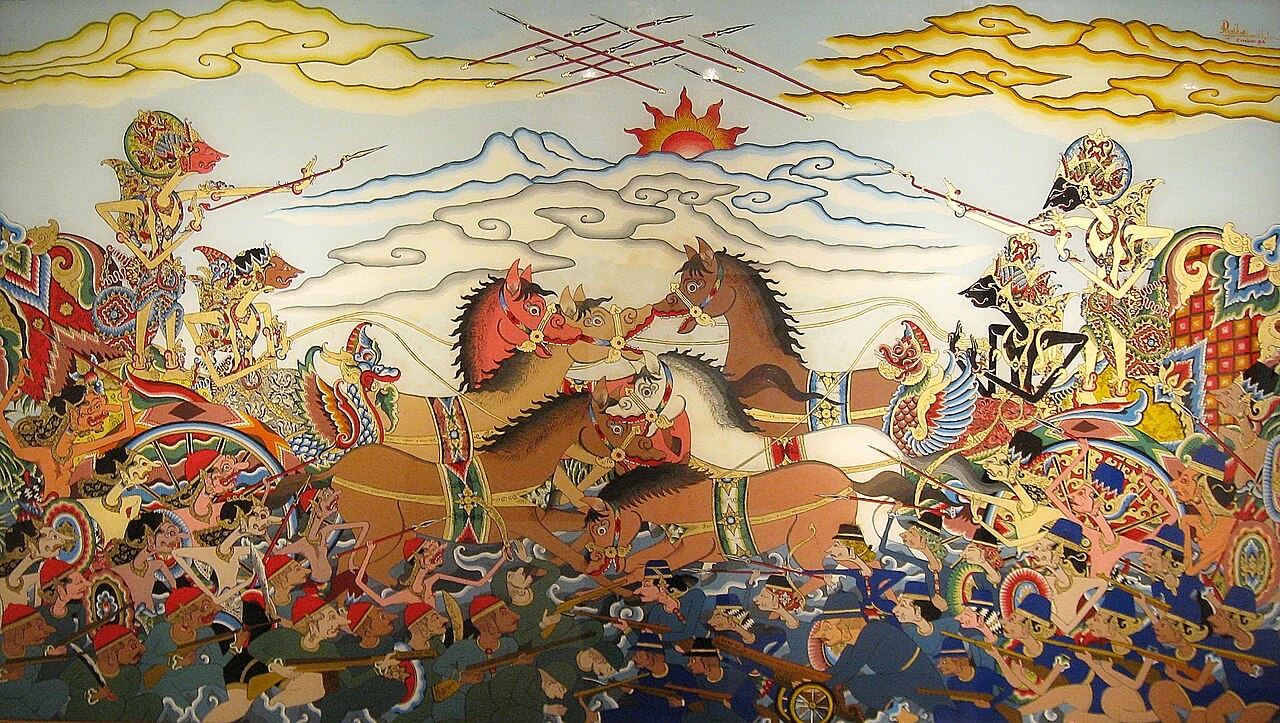
Drawing mainly on the Hindu epics Mahabharata and Ramayana and improvised within established conventions, wayang performances range widely in tone and content. They include court intrigue, romance, philosophical reflection, comic interludes, sharp social commentary, dramatic battles, and profound tragedy. Audiences may watch either the puppets themselves or their shadows and come and go as particular scenes catch their interest. Today, wayang is also heard on radio broadcasts, played loudly in roadside eateries, or presented through recorded performances at celebrations to recreate the atmosphere of a live all-night show.
The oldest theatrical form related to wayang is wayang orang, which replaces puppets with human actors and dancers. More popular in contemporary central Java is ketoprak, a genre that favors spoken comedy and melodrama over music and dance and draws its stories from Javanese history as well as Chinese and Arab traditions. In eastern Java, ludruk is even more down-to-earth and topical, using male actors for both male and female roles and focusing on everyday social concerns.
Image Sources: Wikimedia Commons
Text Sources: “Encyclopedia of World Cultures Volume 5: East/Southeast Asia:” edited by Paul Hockings, 1993; National Geographic, Live Science, Metropolitan Museum of Art, Natural History magazine, Australian Museum, New York Times, Washington Post, Los Angeles Times, Smithsonian magazine, Encyclopedia.com, Times of London, Library of Congress, The Conversation, The New Yorker, Time, BBC, CNN, Reuters, Associated Press, AFP, Lonely Planet Guides, Google AI, Wikipedia, The Guardian and various websites, books and other publications.
Last updated December 2025