
PIKAS
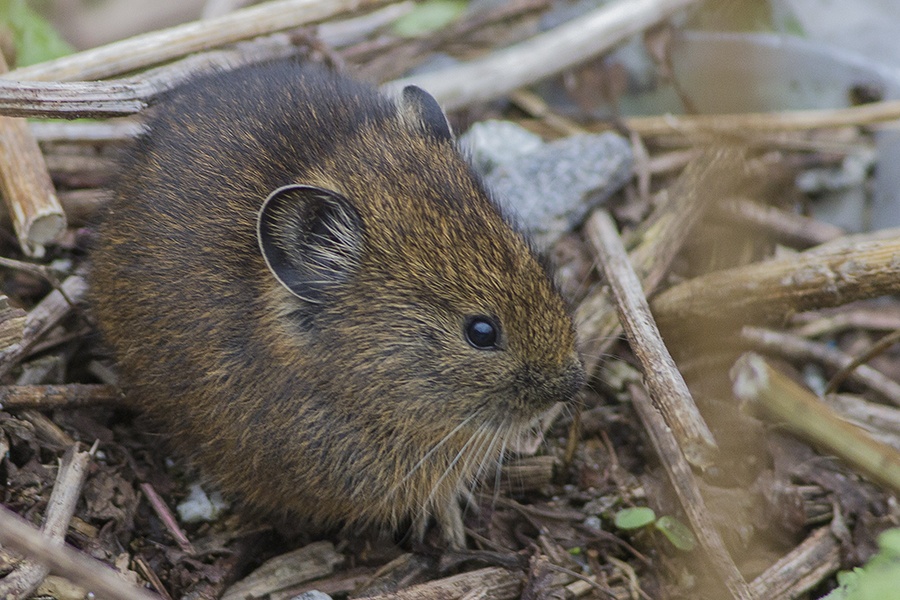
Pikas are small, mostly mountain-dwelling mammal native to Asia and North America, with most of the 30 species in Asia. They have short limbs, very round bodies, even coats of fur, and no external tail. They resemble their close relatives rabbit, but have short, rounded ears. Pikas are among the highest-dwelling mammals. They have been observed on high slopes of Mt. Everest. According to the Guinness Book of Records in the 1980s, they were the highest living animal in the world. A pika has been observed at an elevation of 6,130 meters (20,113 feet).
Pikas belong to the family of Ochotonidae. Today, Ochotonidae make up a third of lagomorphs, the mammalian order that also includes rabbits and hares.The name pika is derived from the Tungus word pika and the scientific name Ochotona is derived from the Mongolian word ogotno, which means pika. According to Encyclopædia Britannica: “Despite their small size, body shape, and round ears, pikas are not rodents but the smallest representatives of the lagomorphs. [Source: Aspen Reese, Animal Diversity Web (ADW) /=]
Pikas range in weight from 70 to 300 grams (2.5 to 10.6 ounces) and are usually less than 28.5 centimeters (11.2 inches) in length. Sexual dimorphism (differences between males and females) is present. Both sexes look the same and are the same size. The differ from leporids (hares and rabbits) in that they are smaller in size and lack supraorbital processes (bony extensions above the eye sockets (orbits) of the skull) and have small, rounded ears, concealed tails, and two. rather than three upper molars.
RELATED ARTICLES:
PIKAS: CHARACTERISTICS, BEHAVIOR, DIET, CALLS factsanddetails.com ;
PIKAS IN CENTRAL ASIA, MONGOLIA AND RUSSIA factsanddetails.com ;
PIKAS IN CHINA: SPECIES, CHARACTERISTICS, BEHAVIOR, RANGES factsanddetails.com
Pika Ecotypes
There are two main pika ecotypes: talus-dwelling ones that live mainly in rocky habitats and meadow-dwelling ones which reside mainly in meadow, steppe, forest, and shrub habitats. Each ecotype is associated with specific life history traits as well as behavior. Most species fall within one of these ecotypes, although there are some species which exhibit intermediate characteristics. The average mortality of talus-dwelling species is low and many are relatively long- lived compared to other small mammals. For example, American pikas live on average three to four years but have been known to live up to seven years. Meadow-dwelling species experience have high annual mortality as many are prey for animals such as foxes and wolves and few live more than two years. /=\

Ranges of the six pika species found in Tibet and the Himalayas: 1) Large-eared pika (O. macrotis); 2) Royle's pika (O. roylei); 3) Ladak pika (O. ladacensis); 4) Plateau pika or black-lipped pika, (O. curzoniae); 5) Sikkim pika (Ochotona sikimaria); 6) Nubra pika (O. nubrica)
Talus-dwelling pikas inhabit the crevices between rocks on mountain slopes. They like rocky mountainsides, where numerous crevices are available for shelter and forage in the alpine meadows that abut the rocks or from the vegetation that grows between the rocks. They are found across a wide altitudinal range from below 90 meters to above 6000 meters (20,000 feet). Among the talus-dwellers are Himalayan pikas, alpine pikas, collared pikas, silver pikas, Glover’s pikas, Chinese red pikas, northern pikas, Ili pikas, large-eared pikas, Royle’s pikas, Turkestan red pikas and American pikas. /=\
Meadow dwelling pikas are found in a variety of vegetated habitats where they forage and produce burrows. The meadows they occupy are also typically at high elevation. Among these are steppe pikas, black-lipped pikas, Gansu pikas, Kozlov’s pikas,, Daurian pikas, Muli pikas, Nubra pikas, Ladakh pikas Moupin pikas, and Thomas’s pikas. Some species, including Pallas's pikas and Afghan pikas are known to occur in both habitat types and are referred to as intermediate species. Although intermediate in habitat, these species exhibit the life-history traits and behavior of meadow-dwelling pikas. /=\
Large-Eared Pikas
Large-eared pikas (Ochotona macrotis) live in mountainous regions of Tibet, Bhutan, India, Kazakhstan, Kyrgyzstan, Nepal, Pakistan, Tajikistan and Afghanistan where it makes its home among boulders and scree on rocky slopes. They have brownish-grey fur tinged, with a reddish tinge on their cheeks, forehead and shoulders which is more pronounced in summer. Their underparts are greyish-white and their feet, including the soles, are covered with fur. Adults are is 15 to 20.4 centimeters (6 to 8 inches) in length. [Source: Wikipedia]
In the past, large-eared pikas and Royle’s pikas were classified by taxonomists as the same species. However, fairly recent DNA analysis genetics suggests that they are different species. Large-eared pikas occurs at a higher elevation than Royle's pikas.[Source: Dana Jordan, Animal Diversity Web (ADW) /=]
Large-eared pikas are talus-dwelling pikas (pikas that live in rocky areas as opposed to alpine meadows). Such pikas generally have a lifespan of one to three years. Large-eared pikas are one of the highest-living animals. They have been documented at altitudes of 6,130 metres (20,113 feet) in the Himalayas. Like most talus-dwelling pikas, large-eared pikas do not make burrow but rather reside nests in crevices among the shattered rock and scree.
See Separate Article: LARGE-EARED PIKAS: CHARACTERISTICS, BEHAVIOR AND REPRODUCTION factsanddetails.com
Plateau Pikas
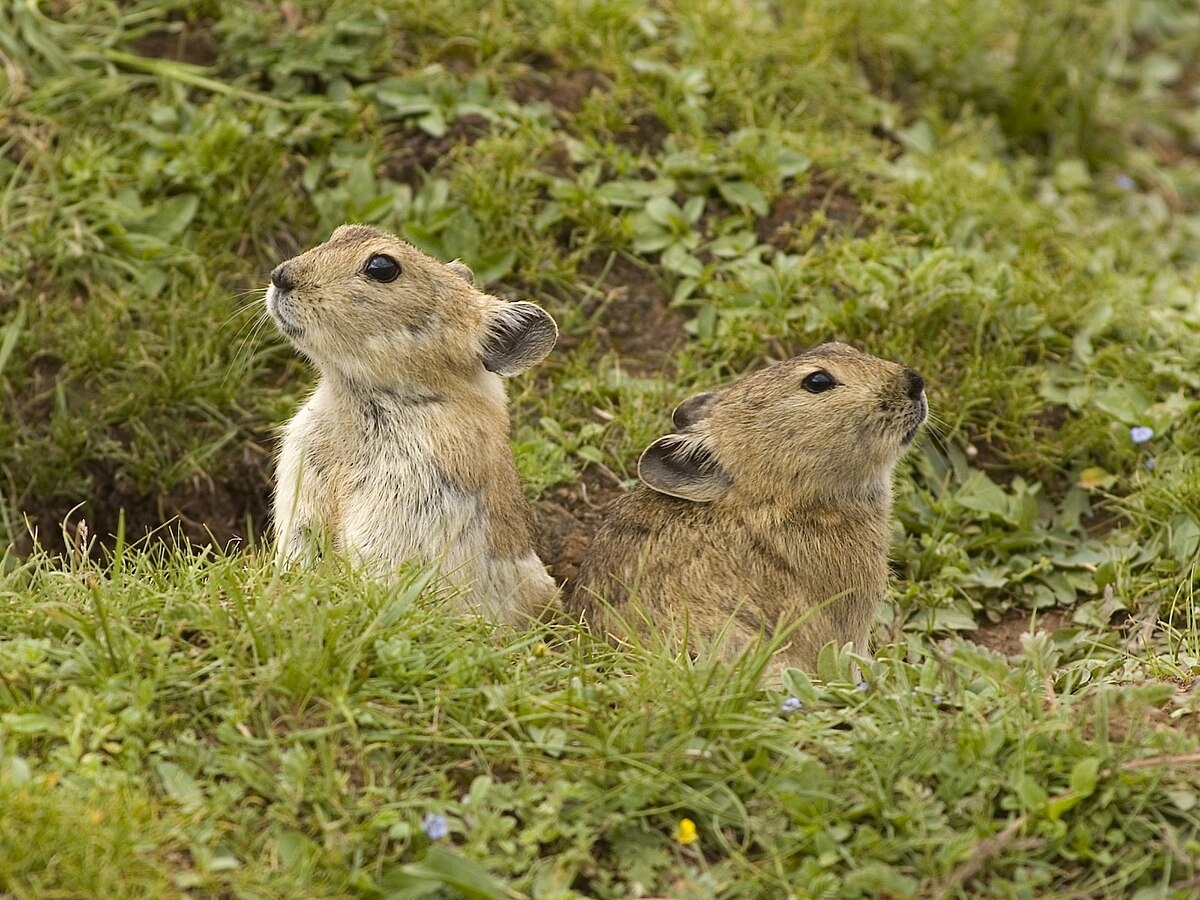
Plateau pikas (Ochotona curzoniae) are also known as black-lipped pikas. They are small pikas. weighing only about 140 grams (4.9 ounces) when fully grown. Their fur is reddish tan on their backs and whitish yellow on their under-bellies. They live in elevations between 3,100 to 5,000 meters (10,200 to 16,400 feet), mostly in the Tibetan Plateau but also found in India and Nepal in high alpine deserts, steppe and meadows, as well as tropical and subtropical montane forests. [Source: Wikipedia]
There are two main pika ecotypes: talus-dwelling ones that live mainly in rocky habitats and meadow-dwelling ones which reside mainly in meadow, steppe, forest, and shrub habitats. Each ecotype is associated with specific life history traits as well as behavior. Plateau pikas are meadow-dwelling pikas, which are found in a variety of vegetated habitats where they forage and produce burrows. The meadows they occupy are also typically at high elevation. The average mortality of talus-dwelling species is low and many are relatively long- lived. Meadow-dwelling species experience have high annual mortality as many are prey for animals such as foxes and wolves and few live more than two years. /=\
For the reasons describes above and because they faces harsh winters and high parasitosis, the life expectancy of Plateau pikas is very short. Few members of each family group survive to the next spring. About 15.7 percent survive to breed during first year after birth, and only 1.5 percent survive to breed during their second year. [Source: Cara Ocobock, Animal Diversity Web (ADW) /=]
See Separate Article: PLATEAU PIKAS: CHARACTERISTICS, BEHAVIOR, REPRODUCTION, POISONING factsanddetails.com
Nubra Pikas
Nubra pikas (Ochotona nubrica) are found in India, Nepal, Pakistan, Bhutan and Tibet in China. They live at elevations of 3000 to 4500 meters (9843 to 14764 feet) in rocky alpine scrubland. And have observed throughout the upper elevations of the Himalayan Range. In India, they have been documented in Tuggur, the Nubra Valley, Ladak, Jammu and Kashmir. Nubra pikas are considered meadow-dwelling pikas even though dwell close to cliff sides and other rocky outcroppings and utilize these and the scrub as shelter. Nubra pikas are herbivores (primarily eat plants or plants parts), without strong preferences for any particular plant species. They eat leaves, flowers and grasses and store and cache food like other pikas. They make their homes in areas where plants such as Lonicera and Caragana grow. [Source: Casmera Gendernalik, Animal Diversity Web (ADW) /=]
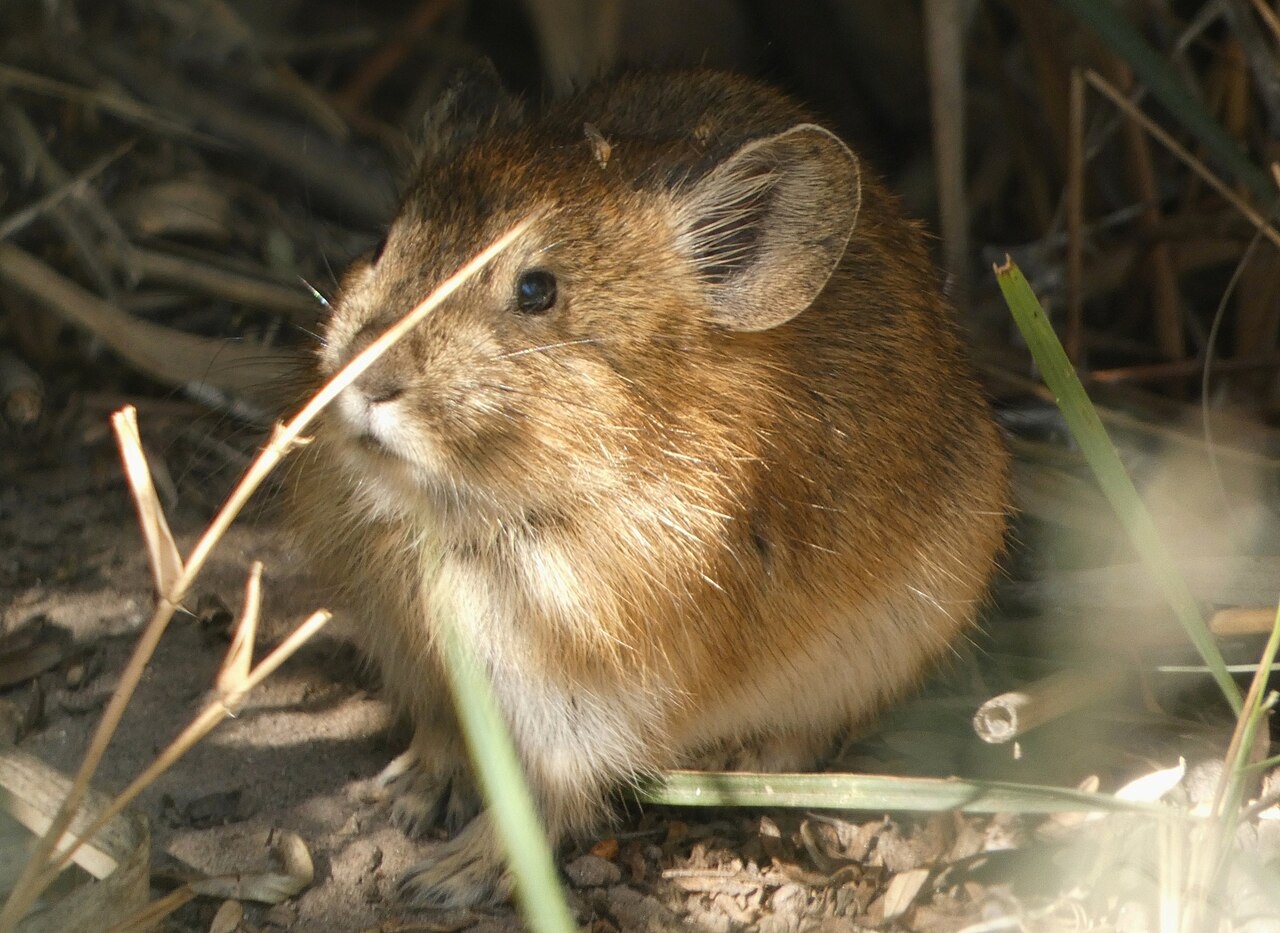
Nubra pikas range in weight from 96 to 135 grams (3.38 to 4.76 ounces) and have a head and body length that ranges from 14 to 18.4 centimeters (5.51 to 7.24 inches). Like all pikas they don’t have an external tail. The ears of Nubra pikas are of average size for a pika, and have a whitish patch at the base. The back of the ears is black and the edges of the ears are whitened. The back side fur of Nubra pikas is generally grey interspersed with short red or black hairs. The base of the grey hairs is predominantly a charcoal color that is darker than the tips. Their undersides are white or a dull yellow. Their feet are similar in color to theor backside. As one moves from west to east across the species’ range the coat become increasingly darker. Nubra pikas maintain the same coat thickness and color year round unlike their close relative, the Royle’s pika. Sexual Dimorphism (differences between males and females) is not present: Both sexes are roughly equal in size and color and look similar.
Nubra pikas are not endangered. On the International Union for Conservation of Nature (IUCN) Red List they are listed as a species of Least Concern. The species may be impacted by climate change which is warming their high elevation habitats and causing ecosystem changes there. No specific predators of Nubra have been reported but it is believed they are probably prey upon birds of prey and carnivores, such as the Himalayan wolves, Himalayan griffons and Tibetan foxes. The lifespan of Nubra pikas has been not been studied but is presumed to be three to four years, the lifespan of other similar pika species.
Nubra Pika Behavior, Communication and Reproduction
Nubra pikas are fossorial (engaged in a burrowing life-style or behavior, and good at digging or burrowing), diurnal (active during the daytime) and motile (move around as opposed to being stationary), They live in knit family groups and don’t appear to interact much with individuals from outside their family group. They dig burrow in the scrub and create dens there where they sleep. They also have seen running to shelter such as rocks or scrub plants while outside of their burrow. For this reason they are sometimes categorized as semifossorial. it is not known whether Nubra pikas defend a territory.
Communication involving Nubra pikas is not well known, but it may be similar to that of Pallas’s pika (See Below) as the two species are closely related. Little is also known about Nubra pika reproductive behavior other than that they tend to stay in defined family groups. This suggests that they might have a mating system that is similar to that of Pallas’s pikas, which are monogamous.
It is believed that Nubra pikas engage in seasonal breeding like other pikas and give birth in late summer to between one and 12 young, which is the case with Pallas's pikas As Nubra's pikas are known to hang out in family groups this suggests both males and females care for young.
Ladak Pikas
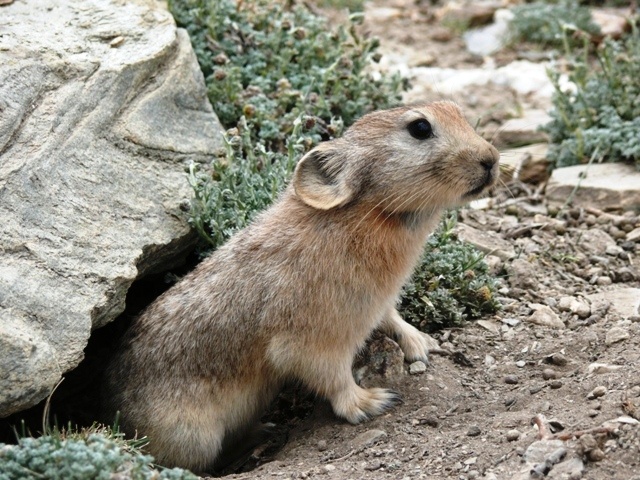
Ladak pikas (Ochotona ladacensis) are also known as the Ladakh pika. Found in the mountain ranges of northern India, northeastern Pakistan, and western China in Qinghai, Tibet and Xinjiang, as well as across the Tibetan Plateau, they were regarded as a subspecies of plateau pika before they were identified as a separate species. They are named after the Ladakh region of India and are commonly found in valleys of the mountain ranges spanning from Pakistan through India to China at an elevation between 4,300 and 5,450 meters (14,110 and 17,880 feet). [Source: Wikipedia]
Specimens of the Ladak pika were originally identified as plateau pikas because of similarities in color and the narrow interorbital region around the eyes on skull of each species. Later, differences were found between the two including the smaller auditory bulla found in the Ladak pika and a differently arched skull shape and based on these traits they designated a separate species.
Ladak pikas have a light brown to grey fur on their backs and yellow to white undersides. The head and body length of adults rnages between 18 and 23 centimeters (7 and 9 inches)cm).[4] The outside areas of the ears are a rusty color. Their skull has a high arch.
Ladak reproduce during late June and early July and lives in territorial family groups. They are herbivorous and do not hibernate like other pikas and live in burrows. They are thought to eat roots such as those from family Primulaceae family to survive in the winter. They have been recorded in healthy numbers when surveys have been done in the regions they live.
Royle's Pikas
Royle's pikas (Royle’s pikas) are also called Himalayan hares and hui shutu. The most common pika species in the Himalayas, they live in Bhutan, Nepal, northern Myanmar, Punjab, Kashmir and the Himalayas and Karakorum regions Pakistan and India and in Tibet, Sichian and Yunnan in China. The subspecies, the Himalayan pika, was considered a distinct species for a brief period, but was reclassified as a subspecies of Royle's pikas in 2014. Some taxonomists regard large-eared pika as a Royle's pika, subspecies but now is generally regarded as separate species. [Source: Liz Ballenger, Animal Diversity Web (ADW) /=]
Royle’s pikas are talus-dewlling pikass. They prefers rocky areas and often nests in stone heaps.They make their nests in areas where there are sufficient subterranean cavities formed by the accumulation of scree. Occasionally, where forests grow on rocky areas, pikas use the subterranean spaces around root systems and below fallen trees. They generally live at lower elevations than the large-eared pika in areas in or near rhododendron, deodar and spruce forests. Royle's pikas are primarily herbivores. They eat a variety of grasses, sedges, weeds, and woody plants. They also eat lichens and mosses and generally utilize whatever plants they can find near their burrows. They sometimes make nests in rock wall huts of local people living the Himalayan region.

Royle’s pikas are 15 to 22 centimeters (5.9 to 8.6 inches) in length. They have a slightly arched head and sparse hair in front of its ears. Their fur is long, dense, soft and fine, and generally more rufous-colored along the head, shoulders, and fore part of the body in the summer. Their back is dark grayish rufous and their bottom side coloration ranges from white to grayish-white to dark gray. Their winter coat is similar to their summer coat but may have more rufous colorations. /=\
Royle's pikas are not endangered and fairly common in the regions where they live. On the International Union for Conservation of Nature (IUCN) Red List they are listed as a species of Least Concern. In CITES (Convention on International Trade in Endangered Species of Wild) they have no special status. Royle's pikas for the most part live in areas far removed from human settlements but sometimes when they inhabit the dwellings of local they steal and nibble on food, particularly geains and baked goods. /=\
Royle's Pikas Behavior
Royle’s pikas are diurnal (active during the daytime), semi-fossorial (engaged in a burrowing life-style or behavior, and good at digging or burrowing), motile (move around as opposed to being stationary) and social (associates with others of its species; forms social groups). They sense using touch and chemicals usually detected with smell. Royle's pikas are less vocal than other pika species. Their warning calls are sharp barks or whistles. When they make these calls they jerk their body forward forward and upward with each call.
Royle's pikas dig tunnels under the snow in areas where show is at least 20 centimeters deep. Unlike other pikas, they do not usually collect and store hay for consumption during difficult winter months when they do not hibernate. Royle's pikas are active mainly during morning and evening. They often sun themselves on rocks matching the color of their coats. They live in family groups composted of an adult male and a female and their offspring. As with many lagomorphs,Royle's pikas eat the feces they produce at night in order to maximize the nutrients they obtain from their food. /=\
The pika breeding season is between late spring and summer. At this time a of plant material is built where females give birth to one or two litters per season. The average gestation period is 30 days. The number of offspring ranges from two to six, and is generally three to four. Young are altricial. This means that they are born relatively underdeveloped at birth but they develop very quickly and are weaned after about 50 days. Sexual maturity is reached at seven to 10 months. Life span is thought to be from one to three years. /=\
Moupin Pikas
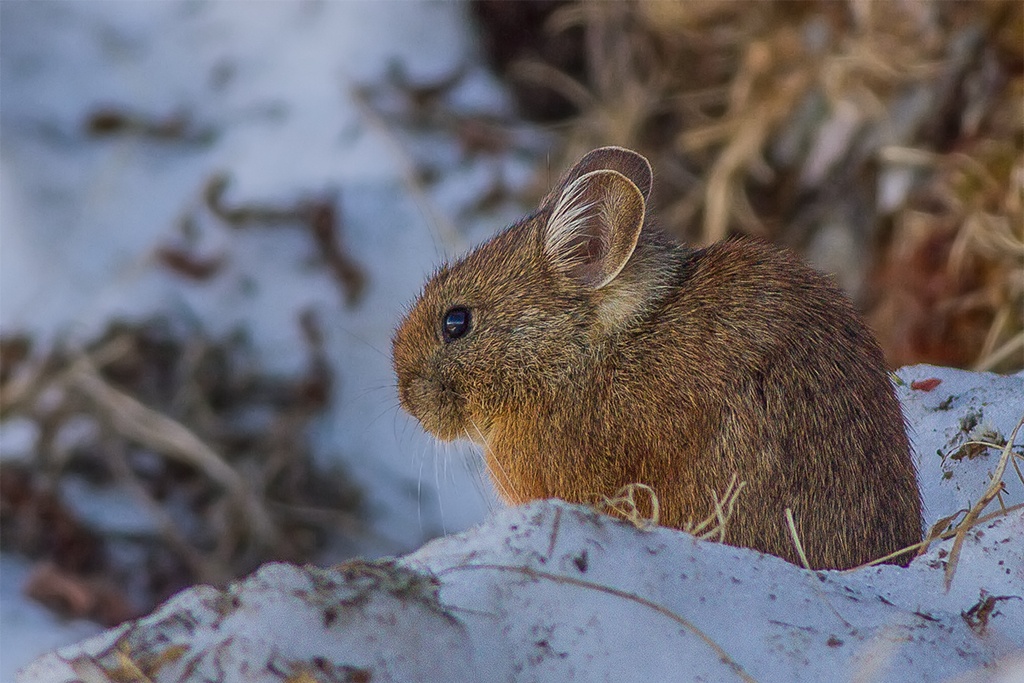
Moupin pikas (Ochotona thibetana) are also known as Moupin-pikas and Manipuri pikas. Generalist herbivores, they are is found in the mountains of Bhutan, India, northern Myanmar and in the mountains of the eastern Tibetan Plateau in China in Gansu, southern Qinghai, Yunnan, and Sichuan. The pikas live in rocky regions near Rhododendron and bamboo forests at lower elevations, and in subalpine forests at higher elevations. They have been documented at altitudes as low as 1,800 meters (5,900 feet) but prefer between 2,400 to 4,100 meter (7,900 to 13,500 feet). Both the IUCN Red List and the Red List of China's Vertebrates list Moupin pikas as a species of least concern. [Source: Wikipedia]
Moupin pikas have have many subspecies, some of which may be distinct species, which is the case of the Sikkim pika described below which for a long time was regarded as a Moupin pika subspecies. The Gansu pika (Ochotona cansus) and Forrest's pika (Ochotona forresti) were also previously treated as subspecies of the Moupin pika but are now considered separate species based, in the case of the Gansu pika, on skull characteristics.
Moupin pikas are fairly small pikas. They measure 14 to 18 centimeters (5.5 to 7.1 inches) in length, and weigh 71 to 136 grams (2.5 to 4.8 ounces). Their skull is 3.6 to 4.2 centimeters (1.4 to 1.7 in) in length, and is larger than the skull of Gansu pikas, which otherwise look almost eexactly alike Moupin pikas. The frontal bone of Moupin pikas is flat and low, and has no alveolus above it. The auditory bullae are small, and the posterior processes of the cheek bone are almost parallel. The pika’s summer, backside coat is dark russet-brown in color with some light spots. The winter backside coat is buff to dull brown. Moupin pikas have dark brown ears, measuring 1.7 to 2.3 centimeters (0.67 to 0.91 inches) in length, and have narrow white borders along their edges. The soles of their feet are furred. The hindfeet are 2.4 to 3.2 centimeters (0.94 to 1.26 inches) long.
Moupin pikas are mainly diurnal (active during the daytime), it can be active at night. They are social animals that sometimes live in colonies and dig burrows and create haypiles for food storage. The breeding season starts lasts from least April to July. Litters sizes range from one to five young.
New Species of Pika — the Sikkim Pika — Discovered in India
In October 2016, scientists announced the discovery of a new pika species — Sikkim pika (Ochotona sikimeria) — that has been previously classified as a sub-species of the Moupin pika (Ochotona thibetana), which lives mountains of the eastern Tibet and in Himalayas in China, India, Myanmar, and Bhutan. By analyzing the pika’s genetic data sampled from its poop, and comparing it with the DNA of other related pikas, researchers found that not only is the Sikkim pika a distinct species, but it is not even closely related to the Moupin pika with which it shares many morphological similarities. Presently, Sikkim pikas are fairly plentiful in Sikkim, which is relatively small in size and part of India. [Source:Shreya Dasgupta, Mongabey, October 5, 2016
“Many people have photographed O. sikimaria and there are several specimens in museum collections of India,” lead author Nishma Dahal, a PhD student at the National Centre for Biological Sciences in Bangalore, India, told Mongabay. “It is also the most common pika species in Sikkim. So it’s not as if no one had seen this animal before. However, because it looked like O. thibetana, it was classified as a subspecies of this species.”
“This is a solid study and one that was much needed,” Andrew Smith, a pika expert from the Arizona State University who was not involved in the study, told Mongabay. “It made no sense that O. sikimaria was classified within O. thibetana, but without an investigation, it could not be identified as an independent form. The work was very well done, and addressed the pressing need to determine the status of the pikas found in Sikkim.”
Shreya Dasgupta of Mongabey wrote: So far, the new species is known only from the state of Sikkim, the researchers say. Field work in other Himalayan regions of Arunachal Pradesh, Central Nepal (Annapurna and Langtang), Ladakh and Spiti has failed to uncover this species, but further surveys in Bhutan and eastern Nepal are being considered.
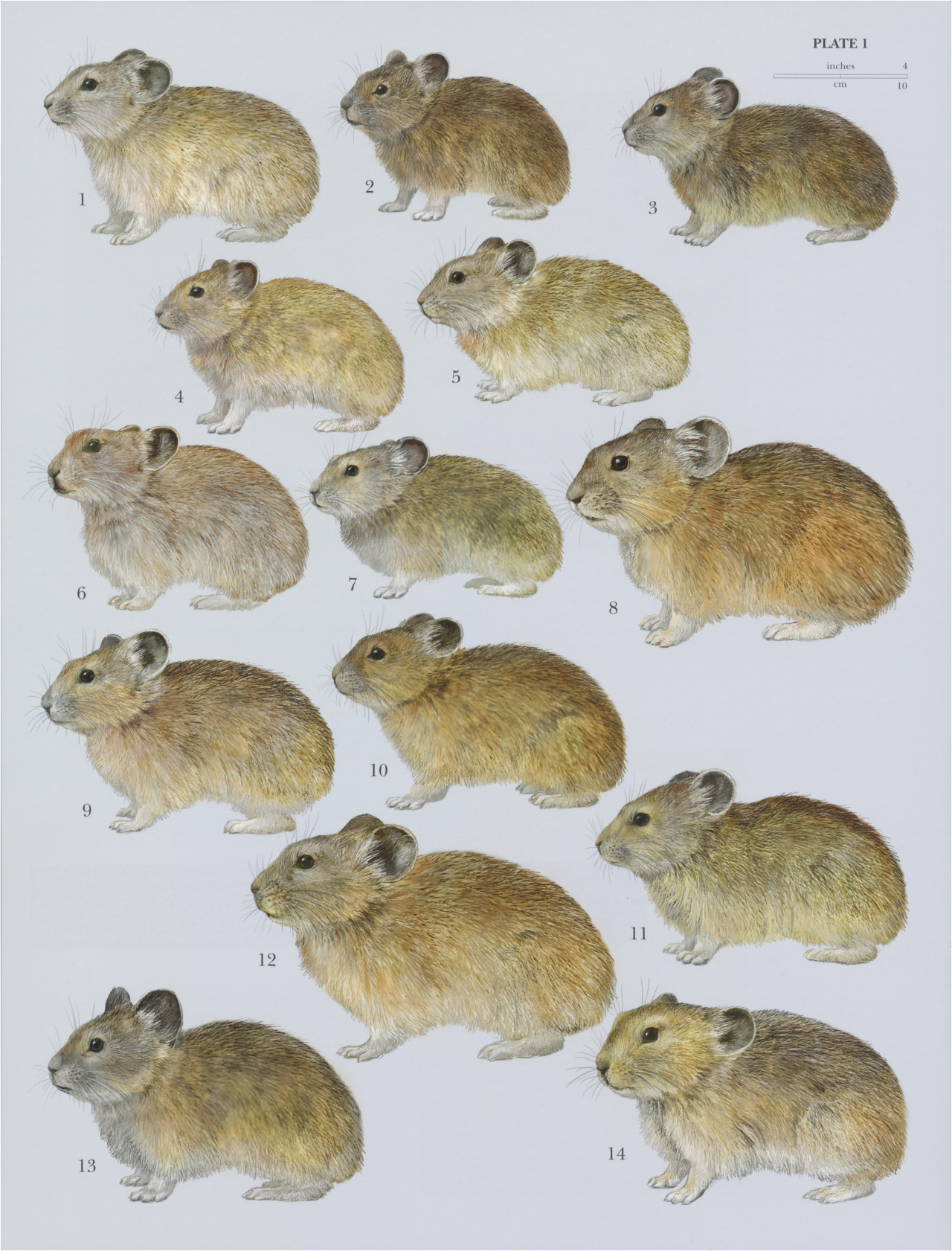
Pika species: 3) Tsing-ling Pika (Ochotona syrinx); 4) Gansu Pika (Ochotona cansus); 5) Nubra Pika (Ochotona nubrica); 6) Plateau Pika (Ochotona curzoniae); 7) Thomas's Pika (Ochotona thomasi); 8) Alpine Pika (Ochotona alpina); 9) Turuchan Pika (Ochotona turuchanensis): 10) Northern Pika (Ochotona hyperborea); 11) Manchurian Pika (Ochotona mantchurica); 12) Hoffmann's Pika (Ochotona hoffmanni); 13) Korean Pika (Ochotona coreana), 14) Pallas's Pika (Ochotona pallasii)
Image Sources: Wikimedia Commons
Text Sources: Animal Diversity Web animaldiversity.org ; National Geographic, Live Science, Natural History magazine, CNTO (China National Tourism Administration) David Attenborough books, New York Times, Washington Post, Los Angeles Times, Smithsonian magazine, Discover magazine, The New Yorker, Time, BBC, CNN, Reuters, Associated Press, AFP, Lonely Planet Guides, Wikipedia, The Guardian, Top Secret Animal Attack Files website and various books and other publications.
Last updated April 2025