
PLATEAU PIKAS
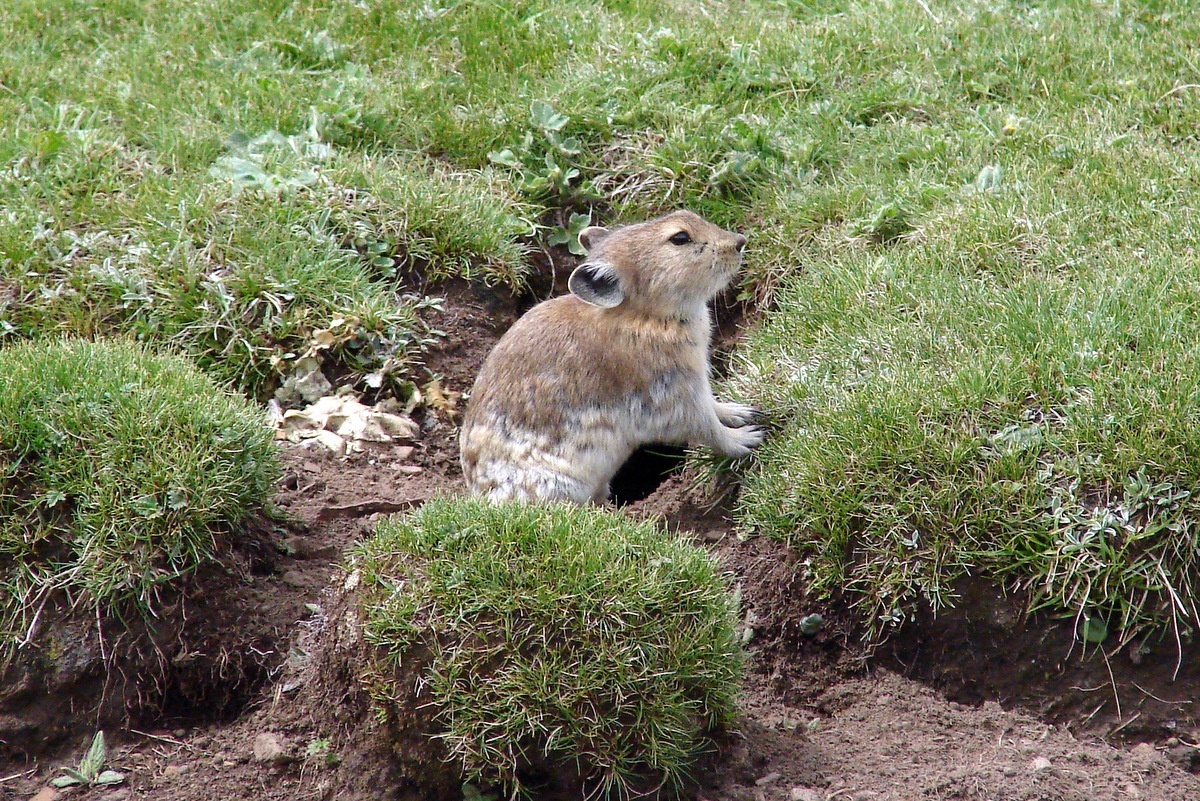
Plateau pikas (Ochotona curzoniae) are also known as black-lipped pikas. They are small pikas. weighing only about 140 grams (4.9 ounces) when fully grown. Their fur is reddish tan on their backs and whitish yellow on their under-bellies. They live in elevations between 3,100 to 5,000 meters (10,200 to 16,400 feet), mostly in the Tibetan Plateau but also found in India and Nepal in high alpine deserts, steppe and meadows, as well as tropical and subtropical montane forests. [Source: Wikipedia]
There are two main pika ecotypes: talus-dwelling ones that live mainly in rocky habitats and meadow-dwelling ones which reside mainly in meadow, steppe, forest, and shrub habitats. Each ecotype is associated with specific life history traits as well as behavior. Plateau pikas are meadow-dwelling pikas, which are found in a variety of vegetated habitats where they forage and produce burrows. The meadows they occupy are also typically at high elevation. The average mortality of talus-dwelling species is low and many are relatively long- lived. Meadow-dwelling species experience have high annual mortality as many are prey for animals such as foxes and wolves and few live more than two years. /=\
For the reasons describes above and because they faces harsh winters and high parasitosis, the life expectancy of Plateau pikas is very short. Few members of each family group survive to the next spring. About 15.7 percent survive to breed during first year after birth, and only 1.5 percent survive to breed during their second year. [Source: Cara Ocobock, Animal Diversity Web (ADW) /=]
Plateau pikas are found in the Alpine meadows and steppes at elevations of up to 5300 meters (17,388 feet). They prefers to make burrows in flat to gently sloping terrain and silty to sandy-soiled meadows with few rocks and good drainage. Simon Denyer wrote in Washington Post: “The plateau pika occupies an almost identical ecological niche to the United States’ prairie dog. A pika warren can stretch underground for up to 20 yards and have several small openings, from which the nervous animals poke their heads, scanning the grasslands for predators and emitting a faint, high-pitched alarm call on any sign of trouble. [Source: Simon Denyer, Washington Post, July 22, 2016]
RELATED ARTICLES:
PIKAS: CHARACTERISTICS, BEHAVIOR, DIET, CALLS factsanddetails.com ;
PIKAS IN CENTRAL ASIA, MONGOLIA AND RUSSIA factsanddetails.com ;
PIKAS IN CHINA: SPECIES, CHARACTERISTICS, BEHAVIOR, RANGES factsanddetails.com
PIKAS IN TIBET AND THE HIMALAYAS factsanddetails.com
LARGE-EARED PIKAS: CHARACTERISTICS, BEHAVIOR AND REPRODUCTION
factsanddetails.com
Plateau Pika Characteristics and Diet
Plateau pikas are small and chubby-looking. They range in weight from 0.1 to 0.2 kilograms (0.22 to 0.44 pounds). Sexual Dimorphism (differences between males and females) is not present: Both sexes are roughly equal in size and color and look similar. It is difficult to tells males and females apart even by external genitalia. [Source: Cara Ocobock, Animal Diversity Web (ADW) /=]
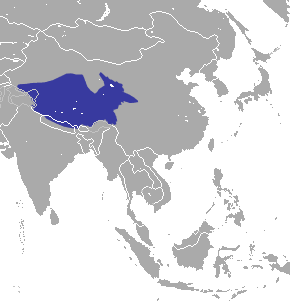
plateau pika range
Plateau pikas have characteristic black lips and thick fur which is brown to reddish tan on their backs and light gray or whitish on the bottoms. Physiological adaptations for the extremely cold and harsh environments they live in a high resting metabolic rate and non- shivering thermogenesis along with the production of leptin which is a thermogenesis regulatory hormone. Unlike hibernating mammals, which plateau pikas are not, they do not only rely on excess body fat to keep them warm. One important physiological adaptation they have is an ability to alter and type of body fat from white to brown, which promotes non-shivering thermogenesis. [Source: Wikipedia]
Plateau pikas are primarily herbivores (primarily eat plants or plants parts) but are also recognized as folivores (eat leaves) and granivore (eats seeds and grain). Among the plant foods they eat are nuts and flowers. They store and cache food. Plateau pikas spend the majority of their time foraging for food. Those that live in meadows store large amounts of forage in hay piles, for later consumption. Desert dwelling plateau pikas cannot easily create haypile as high winds blow theim away, and less cohesive social structures make it more difficult to protect caches. /=\
Plateau Pika Behavior
Plateau pikas are terricolous (live on the ground), fossorial (engaged in a burrowing life-style or behavior, and good at digging or burrowing), diurnal (active during the daytime), motile (move around as opposed to being stationary), sedentary (remain in the same area), territorial (defend an area within the home range) and social (associates with others of its species; forms social groups). Their average territory size is 1000 square meters (10,760 square feet) for adults and about 900 square meters (9,690 square feet) for juveniles.
Plateau pikas do not hibernate even those that live in some of the harhest, coldest places in the world. Foraging activity usually begins at sunrise continues throughout much of the day with periodic breaks. Females spend over 62 percent of their time foraging to maintain the high energy level necessary for almost constant gestation and lactation.
Plateau pika families usually consist of one adult male, one adult female and five to ten juveniles from at least two litters. They live in burrows comprising several tunnels and entrances that allow access to a broad foraging area and quicks escapes from potential predators. Burrows also have many openings to above ground latrines. Tunnels can stretch for over eight meters (26 feet) and are generally 20 to 40 centimeters (8 to 16 inches) below the ground. /=\
Burrow and family structures are more cohesive on the plateau meadow lands than they are on the plateau desert. It is suggested that the greater abundance of food on the meadow makes it easier for a large family to live together without competing for resources. Families are generally territorial (defend an area within the home range), and males chase off members of other families. /=\
Plateau pikas communicate with touch and sound and sense using touch, sound and chemicals detected by smelling. They socially engage with family members by grooming, play-fighting and other means. There are also frequent calls to inform the family of their locations and potential dangers.
Plateau Pika Mating and Reproduction
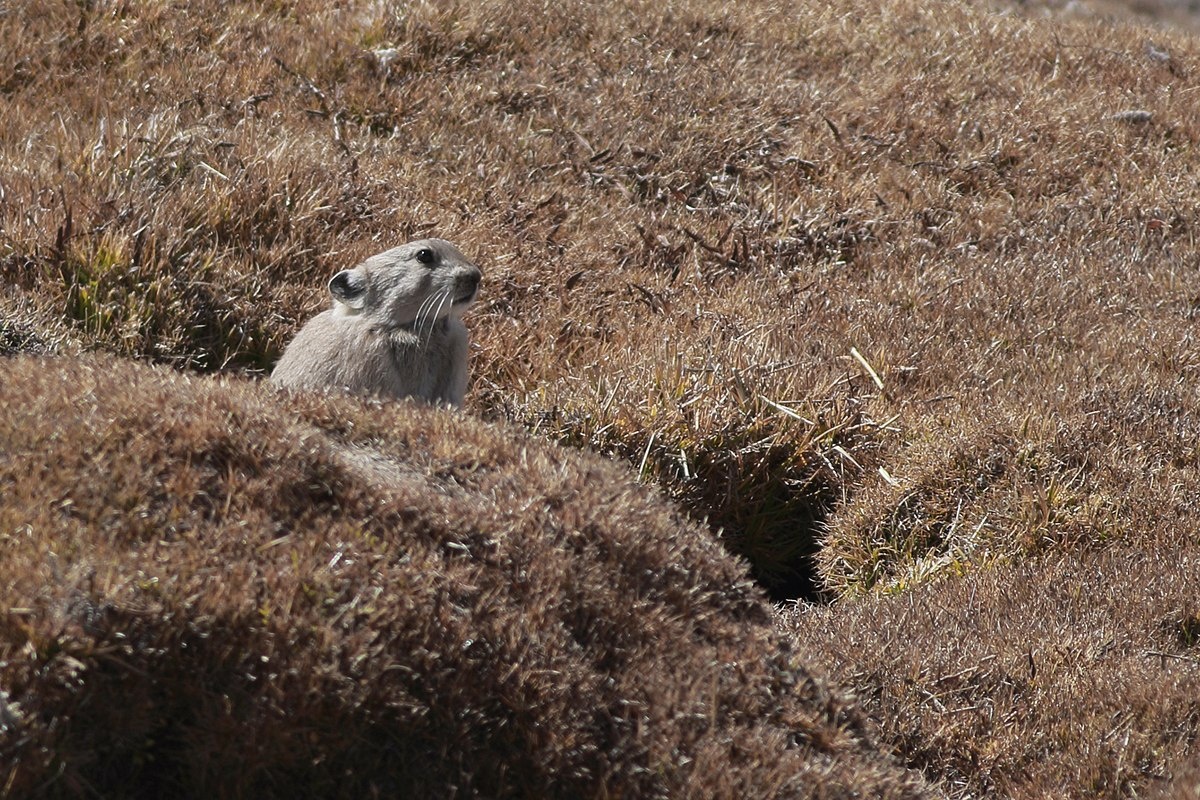
Plateau pikas employ several mating systems. They are monogamous (having one mate at a time), polyandrous (with females mating with several males during one breeding season) and polygynous (males have more than one female as a mate at one time). Mostly, plateau pikas live in monogamous family groups made up of an adult male and female, juveniles, and younger siblings. Both polygamy (a male with multiple female mates) and polyandry (a female with multiple male mates) have been documented among Plateau pikas. This most commonly occurs when an adult plateau pika dies and its mate joins another family group. Promiscuity has also been recorded but is not common. Polygynandrous groups typically contain about three males and three to four females per family along with their offspring. [Source: Cara Ocobock, Animal Diversity Web (ADW) /=]
Plateau pikas engage in seasonal breeding during a long breeding season from April to August in which females may give birth more than once. Breeding can occur every three weeks during the summer months. The female is in estrous for one day during the week that copulation occurs. The number of offspring ranges from one to eight, with the average number of offspring being four to five. The gestation period ranges from 21 to 24 days.
Ar the beginning of mating season litters for plateau pikas are relatively small. As the summer progresses and more food becomes available each successive litter becomes larger. During the mating season, there is intense male-male competition for females. Once family groups are formed aggression between groups helps families bond together. Communication peaks during the weaning period of a new litter, which helps strengthen bonds between juveniles and parents. Female plateau pikas often within the same summer of their own birth. /=\
It was once thought because family ties were so strong plateau pikas practiced a fair amount. This idea has been dismissed since been discovered that roughly 97 percent of males leave their family range during the spring just before mating season. These males usually move to neighboring family groups. Some females also disperse from their natal family groups to join neighboring ones. This behavior reduce inbreeding and its negative impacts; however, the most successful matings usually occur between family members.
Plateau Pika Offspring and Parenting
Plateau pikas are altricial. This means that young are born relatively underdeveloped and are unable to feed or care for themselves or move independently for a period of time after birth. In some ways males are more engaged in raising offspring than females. Pre-weaning provisioning is done by females and protection is done by males. Pre-independence protection is provided by males at which time females have relatively little direct engagements with their offspring. [Source: Cara Ocobock, Animal Diversity Web (ADW) /=]
The post-independence period is characterized by the association of offspring with their parents. After weaning, males that interact with the juveniles during the learning process leading up to adulthood. Males also protect and maintain the burrow and home range of the family. /=\
The average weaning age is 21 days, with independence occurring on average at three weeks.
The period of learning is generally presided over by an adult male. Females have limited interactions with offspring outside of nursing. Mother spends the majority of their time foraging so that they have provide enough energy to feed their young and prepare for the next litter, which quickly follows. Care provided by adult males consists of vigilance and awareness of the surroundings. They look out for potential predators as well as help maintain home range boundaries. Litters usually remain with their family for the first winter and disperse in spring before the reproductive season.
Predators and Ecosystem Roles of Plateau Pikas
On the Qinghai-Tibetan plateau, almost all the major carnivores depend on pikas for food. They are preyed upon by birds of prey, including such as kestrels, saker falcons, owls, black kites and upland buzzards as well as carnivorous mammals such weasels, One way to spot a pika colony on the grasslands is to look for a buzzard flying overhead or perched on a power pylon. Tibetan foxes, steppe polecats, Pallas’s cats, foxes, wolves and bears. They avoid predation primarily through their vigilance, camouflage, escaping quickly to nearby burrows and the habit of remaining under cover of foliage or rocks when when foraging. [Source: Cara Ocobock, Animal Diversity Web (ADW) /=\, Simon Denyer, Washington Post]
Plateau pikas are considered to be a keystone species, meaning their presence or absence strongly affects populations of other animal and plant species in area where they live. They play a role in recycling nutrients in soil, dispersing seeds, providing food to predators and providing microhabitats by increasing plant richness and their burrows provides nests for small birds and reptiles. [Source: Wikipedia]
According to the Chinese biologists who have studied the wildlife of the Hoh Xil (northern part of the Tibetan Plateau), plateau pikas are the favorite food of the area's brown bears. There they also are also important for soil health in meadows; the burrowing of the species helps to aerate the soil. Plateau pikas feed on seeds but their seed dispersal impact is a limited as they usually stay close to home and don’t disperse seed very far from where they were collected.
Plateau pikas are hosts for parasitic species such as fleas that can be spread to other animal species. Poisoning of Plateau pikas by local people to reduce the destruction created by burrows has lead to the death of several bird species, including Montifringilla, Pyrgilauda and as well as Pseudopodoces humilismore than. These birds sometimes nest in plateau pika burrows and were harmed by poisons used to cull the pika population.
Plateau Pikas, Humans and Conservation
Plateau pikas currently considered threatened in some places, mainly as aggressive poisoning campaigns by the Chinese government and local herders to eliminate competition for food with livestock and reduce percived damage by the burrows to areas where livestock graze. But overall their populations seem to be healthy. On the International Union for Conservation of Nature (IUCN) Red List plateau pikas are listed as a species of Least Concern. In CITES (Convention on International Trade in Endangered Species of Wild) they have no special status.
Plateau pikas help humans by producing fertilizer, aerating soil and helping some plant species to grow. Their excrement fertilizes the plants that livestock eat. But plateau pikas have been blamed for soil erosion caused by burrowing and eating the vegetation normally fed upon by livestock. As a rule, though, soil erosion is present before burrows have been created. At high densities, Plateau pikas populations do compete with livestock for vegetation.
Simon Denyer wrote in Washington Post: Burrows of plateau pikas, it is now believed, play an important role in absorbing the heavy rains that fall during the summer monsoon, allowing water to percolate slowly through the earth rather than cause dangerous downstream flooding and erosion. “The pika is very important for the food chain and for the grassland ecosystem,” Hashi Tashi Dorjee, founder of the Snowland Great Rivers Environmental Protection Association and one of the Tibetan region’s most respected environmentalists, told the Washington Post. “Poisoning them sets off a very bad cycle.” [Source: Simon Denyer, Washington Post, July 22, 2016]
Efforts to Poison and Get Rid of Plateau Pika — and the Consequences
Pastoralists and the Chinese government have used sodium fluoroacetate, botulinum toxin and zinc phosphate to poison plateau pikas. Simon Denyer wrote in Washington Post: “For decades, across hundreds of thousands of square miles of the Qingai-Tibet plateau, a relentless extermination campaign has been undertaken to wipe out the plateau pika, with thousands of people fanning out as spring arrives to poison their burrows. Across vast swaths of grassland, the pika has been virtually eliminated.
Starting in 1962, the government sowed pika burrows, first with sodium fluoroacetate and then zinc phosphide, across nearly 140,000 square miles of grassland. In 2006, it stepped up the campaign across huge parts of the vast, newly created Sanjiangyuan National Nature Reserve, now using botulinum toxin. The Qinghai government boasts of exterminating “rats,” although pikas are not actually rodents. It says yields of grass have improved in areas where pikas have been wiped out.
“The parallels with the prairie dog and the European rabbit are striking. Prairie dogs have been widely blamed for eating grass upon which livestock depend, and building burrows that cause cows and horses to break their legs. A mass extermination campaign brought them to the brink of extinction across much of the United States. But scientists say that, just like the pika, they supported prairie falcons, eagles, badgers and bobcats, while their presence helps increase the richness and diversity of plant species on the grasslands. Their extermination brought the black-footed ferret to the brink of extinction, with only 18 left in 1986. The extermination of the rabbit from its native habitat in Spain and Portugal has made the Iberian lynx, which depends on European rabbits, the most endangered cat on the planet.
“As pikas have disappeared from broad stretches of this grassland, so have many of these unique animals, said Andrew Smith, an Arizona State University expert who has been studying the ecology of the Tibetan plateau since 1984. “For brown bears, what we call grizzly bears in the United States, 60 to 80 percent of their food is pikas,” he said. “Where the pikas have been poisoned, the bears go on the move to search for food, and they have been breaking into Tibetan houses.”
“On the largely treeless grasslands, birds such as snow finches and Tibetan ground-tits nest in pika burrows. But, where pikas have been poisoned, the burrows collapse within a couple of years and these birds disappear or become scarcer, Smith said.
Unfairly Blaming the Plateau Pika for Grassland Degradation
Reporting from Yushu County on the Qinghai-Tibetan Plateau, Simon Denyer wrote in Washington Post: “As he gazes out across the rolling grasslands of the Tibetan plateau, where hundreds of his yaks are grazing, 70-year-old Awang Chumpey is less than happy. The land he shares with his neighbors is dotted with thousands of tiny burrows, home to a colony of plateau pika that he blames for eating his animals’ grass. “Over the years the grass has become very bad,” Awang said. “They dig holes and eat the grass. I hope the government can kill them.” [Source: Simon Denyer, Washington Post, July 22, 2016]
“Indeed, the plateau pika is the scapegoat for much deeper, man-made problems, a symptom, some Western scientists say, of decades of environmental mismanagement by China’s Communist Party, which threw out the natural balance that had endured on these grasslands for thousands of years. Justifying the government’s extermination campaign, some Chinese scientists have blamed the pika for grassland degradation and erosion.
“But a growing body of Western conservationists say they have it all wrong. Far from causing grassland degradation, pikas tend to colonize areas where the grassland is already damaged by overgrazing or has dried out as a result of climate change. Not surprisingly, they prefer areas where the grass is short, so they can spot predators from farther away. “Villagers see the pika, and they see the grassland getting degraded, and they connect the two problems,” Tashi Dorjee said. “They see the surface problem, but they don’t see the root of the problem.”
“Rather than causing soil erosion, pika burrows dramatically improve drainage on the plateau, according to a 2014 study by Smith and Maxwell Wilson in the journal Ambio, published by the Royal Swedish Academy of Sciences. Without them, water runoff creates more erosion and heightens the potential of dangerous floods downstream. Most of Asia’s great rivers originate on the Tibetan plateau, and 20 percent of the world’s population lives in their downstream watersheds. “The chances of downstream flooding, the chances of loss of life and property, are much greater as a result of this animal having been poisoned upstream,” Smith said.
“In fact, Western conservationists say, the overgrazing and degradation of the grasslands should be blamed not on the pika but more on the government’s own social and environmental policies, stretching back to the imposition of communal animal husbandry in the 1960s, and later moves to erect fences throughout the grasslands and resettle nomads into permanent houses.
“It is clear that the antagonism of government and ranchers towards prairie dogs was in part based on purposeful ignorance, even when accurate knowledge was available, and on vested interests in continuing a well-funded killing program no matter how outdated and harmful,” leading conservationist George Schaller wrote in his book “Tibet Wild.” “The story of the pika has been remarkably similar.”
Image Sources: Wikimedia Commons
Text Sources: Animal Diversity Web animaldiversity.org ; National Geographic, Live Science, Natural History magazine, CNTO (China National Tourism Administration) David Attenborough books, New York Times, Washington Post, Los Angeles Times, Smithsonian magazine, Discover magazine, The New Yorker, Time, BBC, CNN, Reuters, Associated Press, AFP, Lonely Planet Guides, Wikipedia, The Guardian, Top Secret Animal Attack Files website and various books and other publications.
Last updated April 2025