
PIKAS
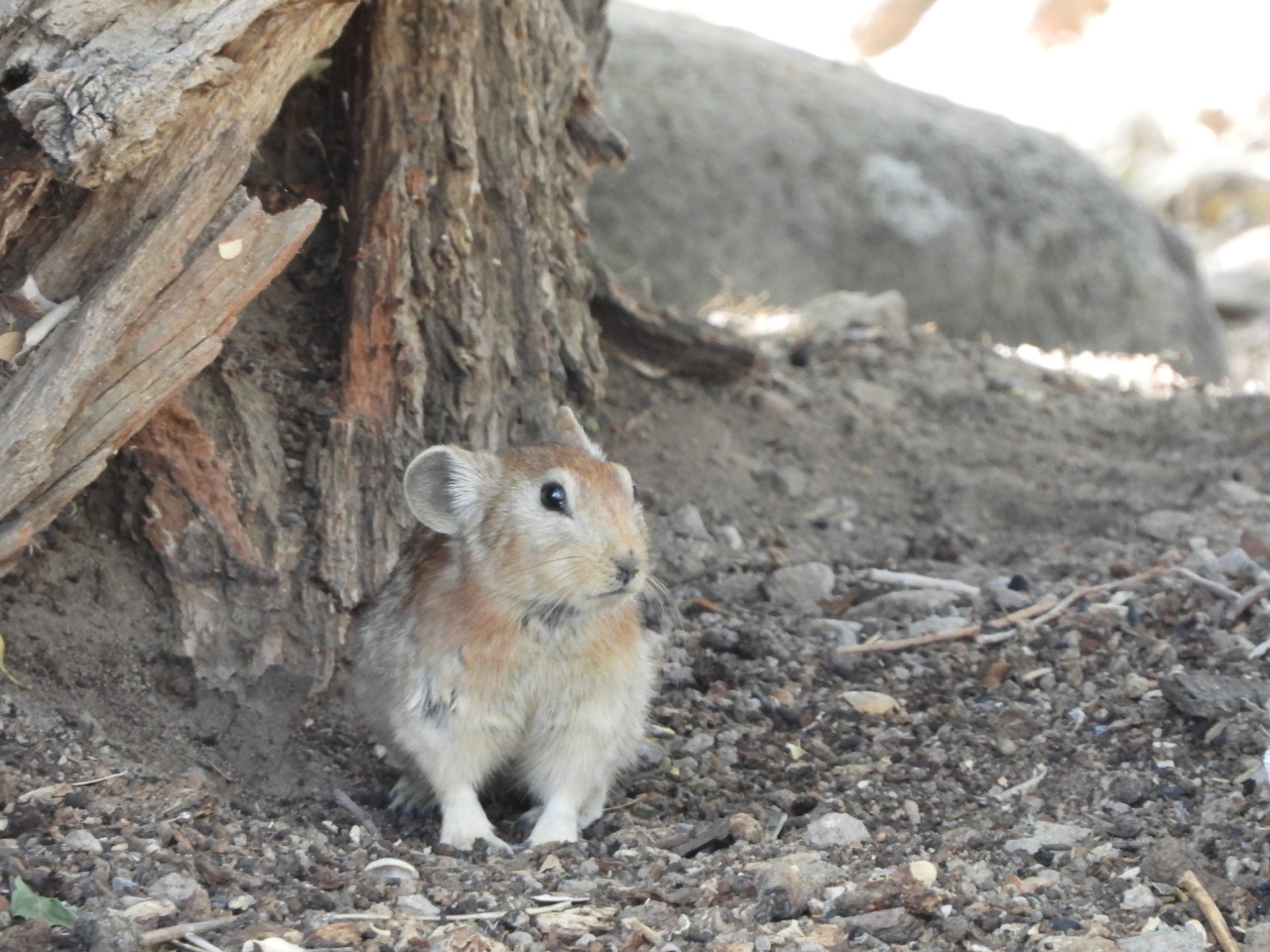
Pikas are small, mostly mountain-dwelling mammal native to Asia and North America, with most of the 30 species in Asia. They have short limbs, very round bodies, even coats of fur, and no external tail. They resemble their close relatives rabbit, but have short, rounded ears. Pikas are among the highest-dwelling mammals. They have been observed on high slopes of Mt. Everest. According to the Guinness Book of Records in the 1980s, they were the highest living animal in the world. A pika has been observed at an elevation of 6,130 meters (20,113 feet). [Source: Wikipedia]
Pikas belong to the family of Ochotonidae. Today, Ochotonidae make up a third of lagomorphs, the mammalian order that also includes rabbits and hares.The name pika is derived from the Tungus word pika and the scientific name Ochotona is derived from the Mongolian word ogotno, which means pika. According to Encyclopædia Britannica: “Despite their small size, body shape, and round ears, pikas are not rodents but the smallest representatives of the lagomorphs. [Source: Aspen Reese, Animal Diversity Web (ADW) /=]
Pikas range in weight from 70 to 300 grams (2.5 to 10.6 ounces) and are usually less than 28.5 centimeters (11.2 inches) in length. Sexual dimorphism (differences between males and females) is present. Both sexes look the same and are the same size. The differ from leporids (hares and rabbits) in that they are smaller in size and lack supraorbital processes (bony extensions above the eye sockets (orbits) of the skull) and have small, rounded ears, concealed tails, and two. rather than three upper molars.
RELATED ARTICLES:
PIKAS: CHARACTERISTICS, BEHAVIOR, DIET, CALLS factsanddetails.com ;
PIKAS IN CHINA: SPECIES, CHARACTERISTICS, BEHAVIOR, RANGES factsanddetails.com
PIKAS IN TIBET AND THE HIMALAYAS factsanddetails.com
LARGE-EARED PIKAS: CHARACTERISTICS, BEHAVIOR AND REPRODUCTION
factsanddetails.com
PLATEAU PIKAS: CHARACTERISTICS, BEHAVIOR, REPRODUCTION, POISONING factsanddetails.com
Pika Ecotypes
There are two main pika ecotypes: talus-dwelling ones that live mainly in rocky habitats and meadow-dwelling ones which reside mainly in meadow, steppe, forest, and shrub habitats. Each ecotype is associated with specific life history traits as well as behavior. Most species fall within one of these ecotypes, although there are some species which exhibit intermediate characteristics. The average mortality of talus-dwelling species is low and many are relatively long- lived compared to other small mammals. For example, American pikas live on average three to four years but have been known to live up to seven years. Meadow-dwelling species experience have high annual mortality as many are prey for animals such as foxes and wolves and few live more than two years. /=\
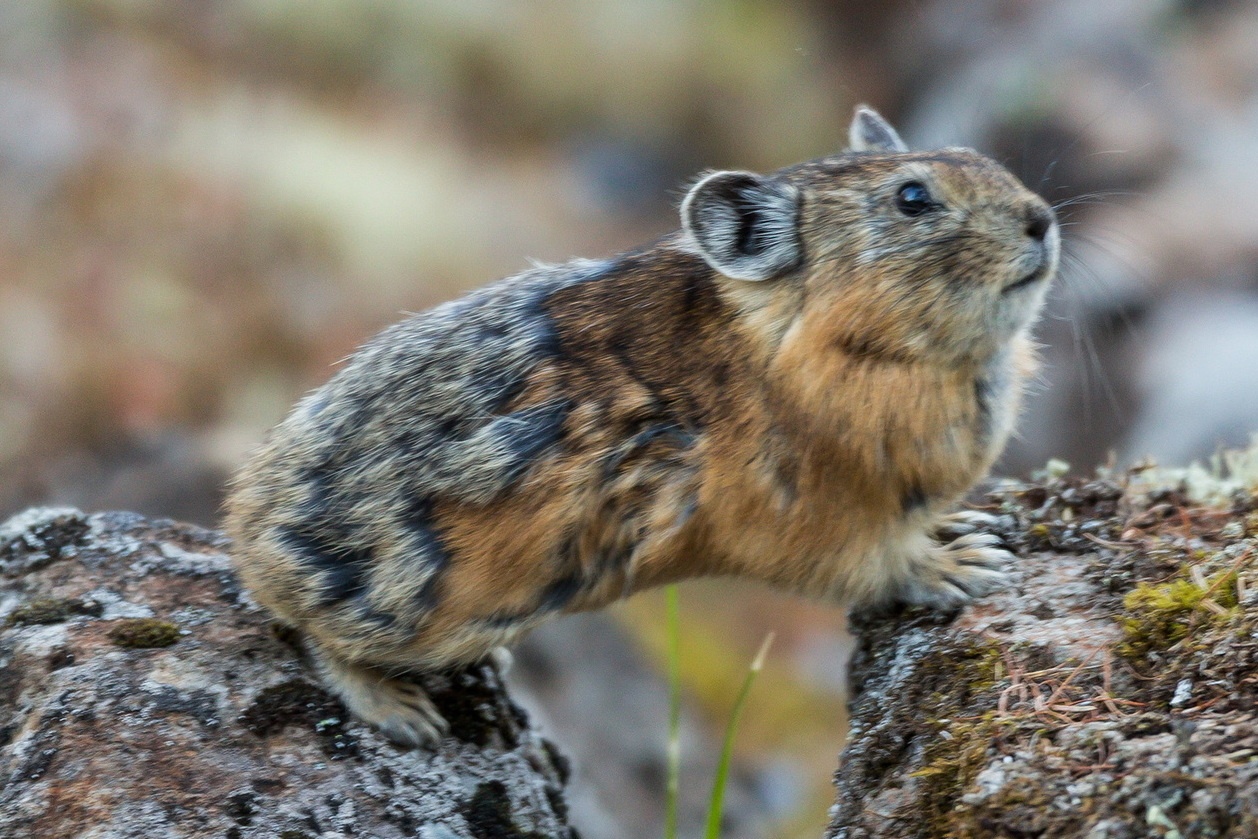
Talus-dwelling pikas inhabit the crevices between rocks on mountain slopes. They like rocky mountainsides, where numerous crevices are available for shelter and forage in the alpine meadows that abut the rocks or from the vegetation that grows between the rocks. They are found across a wide altitudinal range from below 90 meters to above 6000 meters (20,000 feet). Among the talus-dwellers are Himalayan pikas, alpine pikas, collared pikas, silver pikas, Glover’s pikas, Chinese red pikas, northern pikas, Ili pikas, large-eared pikas, Royle’s pikas, Turkestan red pikas and American pikas. /=\
Meadow dwelling pikas are found in a variety of vegetated habitats where they forage and produce burrows. The meadows they occupy are also typically at high elevation. Among these are steppe pikas, black-lipped pikas, Gansu pikas, Kozlov’s pikas,, Daurian pikas, Muli pikas, Nubra pikas, Ladakh pikas Moupin pikas, and Thomas’s pikas. Some species, including Pallas's pikas and Afghan pikas are known to occur in both habitat types and are referred to as intermediate species. Although intermediate in habitat, these species exhibit the life-history traits and behavior of meadow-dwelling pikas. /=\
Pikas in Central Asia
Alpine Pikas (Ochotona alpina) are also called the Altai pikas. They inhabit very cold, mountainous regions in western Mongolia, eastern Kazakhstan, Russia (Tuva, Irkutsk, Altai, and Krasnoyarsk) and northern in China (northern Xinjiang and Heilongjiang). Their summer coat varies quite a bit is generally dark or cinnamon brown, turning to grey with a yellowish tinge during the winter. They mainly forages on mosses, tree branches, pine nuts, and plant stems and can emit three series of different vocalizations: a long call, a short call, and an alarm call. [Source: Wikipedia]
Hoffmann's Pika (Ochotona hoffmanni) are endemic to Mongolia. They are currently listed as endangered by the International Union for Conservation of Nature (IUCN). They are founds in a limited area in northern Mongolia near the Russian border. There have been some reports of them in southeast Russia.
Kazakh Pikas (Ochotona opaca) are endemic to Kazakhstan and found at the elevation of 400 to 1,000 meters (1,300 to 3,300 fet) in semi-desert areas with rocks and shrubs. It was previously regarded as a subspecies of Pallas's pika before being designated as its own species. The Kazakhstan part of the Pallas's pika range is now assigned to Kazakh pikas. Kazakh pikas are medium-sized and have ocherous gray backside fur and sandy or whitish fur on theor undersides. During the winter, the backside fur is long, soft, and yellowish gray, and its belly is whitish.
Turuchan Pikas (Ochotona turuchanensis) are found in isolated regions in the Central Siberian Plateau. The are small talus dwelling pikas active during the day in part because it is so cold at night. They were previously thought to be a subspecies of the Northern pika. Little is known about them, but theu are locally abundant.
Pallas's Pikas
Pallas's pikas (Ochotona pallasi) are also known as the Mongolian pika. Found mainly in the mountains of western Mongolia, they range in weight from 0.18 to 0.2 kilograms (0.40 to 0.44 pounds) and can reach lengths of 25 centimetres (9.8 inches). They pikas have round bodies, short limbs, and small rounded ears. Their coat color changes depending on the time of the year — from lighter in the summer to much darker in the winter. Sexual Dimorphism (differences between males and females) is not present: Both sexes are roughly equal in size and look similar. It is believed their maximum lifespan is around three years. [Source: Wikipedia]
Pallas’s pikas are mainly found in in mountain and steppe regions of eastern Kazakhstan and western Mongolia and are found in few spots in southern Siberia in Russia and northwestern China. They range from the southern parts of the Karkaralinsk Mountians in Kazakhstan south into Xinjiang, in northeastern China and are also found in the Altai Mountains in Kazakhstan and Mongolia north to Tuva in Russia. The areas in which they reside have cold, arid or semi-arid climates with mean annual precipitation of approximately 13 centimeters (5.1 inches). Among the most common plants in their habitat are spiraea (Spiraea hypericifolia), yellow pea trees (Caragna pygmaes) and wild roses (Rosa spp.).[Source: Anna DeMers, Animal Diversity Web (ADW) /=]
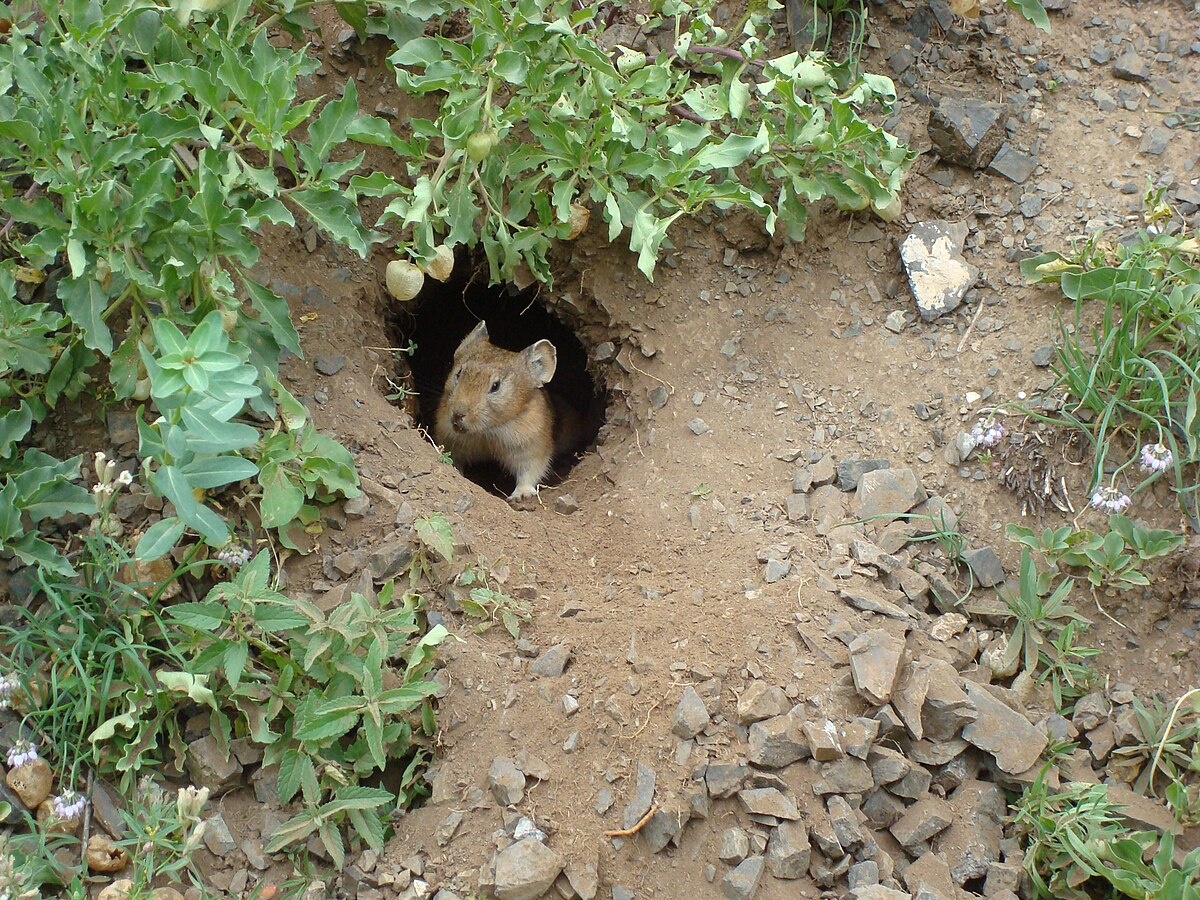
Pallas’s pikas are herbivorous. They eat mostly east grasses from the Stipa, Agopyron and spireas (Spiraea) genera and collect grasses and other forage and form "haypiles" inside their burrows, covering them with stones and scat and feed from these piles during the winter food is in short supply. Pallas’s pikas eat their herbaceous food to ground level. This give them a competitive advantage over livestock because they can eat the whole plant, not just the top of it like cattle and sheep do.. Occasionally, Pallas’s pikas eat their own dung. This is done in part to maintain a balance of salt in their bodies when there's a lack of free water. There is little information on predators of Pallas’s pikas but it is likely they are preyed up by raptors and carnivorous mammals such as wolves, foxes and wesels. Pikas in general are often on the look out for predators and emit high-pitched whistles to warn of danger. They also stay close to their burrows in case they have to make a quick dash to escape predation. /=\
On the International Union for Conservation of Nature (IUCN) Red List Pallas’s pikas are listed as a species of Least Concern. In CITES (Convention on International Trade in Endangered Species of Wild) they have no special status. They are the most abundant mammal in Gobi Guran Saykhan National Park in Mongolia and live in high densities elsewhere,. In parts of their range they coexist with livestock and compete with them for forage. While pikas sometimes eat plants to soil level, they also aerate the soil and help water drainage with their burrows. Pallas's pikas are hosts for fleas, which carry the plague (Yersinia pestis) and other diseases.
Pallas's Pika Behavior and Reproduction
Pallas's pikas are diurnal (active during the daytime), semi-fossorial (engaged in a burrowing life-style or behavior, and good at digging or burrowing), motile (move around as opposed to being stationary), sedentary (remain in the same area), territorial (defend an area within the home range) and solitary and remain close to their burrow systems. Pallas' pikas are active during the winter and do not hibernate. On a daily basis, they emerge from their burrows at sunrise and return by dusk. During the day, Pallas' pikas burrow, gather food, eat, and socialize. During peak daylight hours, they lay near the mouth of the burrow with the head towards the hole, the nose elevated and the front feet slightly extended. Young bask in the sun more often than adults. Pallas' pikas can be quite aggressive towards members of their own species. Young of the same litter may fight to the death. In the wild, young have usually dispersed from their birth nests before this can happen. [Source: Anna DeMers, Animal Diversity Web (ADW) /=]

Pallas's pikas sense and communicate with vision, touch, sound and chemicals usually detected by smelling. They also leave scent marks produced by special glands and placed so others can smell and taste them. They have scent glands under their lower jaw, which in adults is a rust color. They use these scent glands to mark legdes and twigs. They also use high-pitched whistles to communicate with other pikas and to warn of the presence of predators.
Pallas's pikas are monogamous, with males and females forming mating pairs. They engage in seasonal breeding and reproduce during the summer months. They have an average of 2.7 litters per year. The number of offspring ranges from one to 12, with the average being five. The average gestation period is 25 days. The age in which young are weaned ranges from 20 to 22 days. On average males and females reach sexual or reproductive maturity at four weeks. Both parents care for their young in nests until they reach independence, within three to four weeks after birth. /=\
Pallas's pikas are altricial. This means that young are born relatively underdeveloped and are unable to feed or care for themselves, but the develop quickly. Young weigh about seven grams. At birth. They eat their first solid food around day 19, and are weaned soon after. During the pre-weaning stage provisioning is done by females and protecting is done by males and females. Pre-independence protection is provided by males and females. Pallas’s pika populations occur at higher denisties in the summer than in the winter because of their high reproductive rate during warm months. There are an average of 70 pikas per hectare in the summer, while there are only 30 pikas per hectare in winter months.
Daurian Pikas
Daurian pikas (Ochotona dauurica) are found throughout Mongolia, in the Altai region, in, Tuva and Transbaikal and a few other parts of southern Russia and Manchuria, Qinghai and several provinces of China. They live in mountainous regions at elevations of 400 to 6000 meters (1,312 to 19685 feet) but are generally found at altitudes between 3,000 and 4,000 meters (9,842 and 13,123 feet) and burrow and cache grass and herbaceous vegetation in hay piles that they eat in the winter. Their expected lifespan in the wild is approximately 2.3 years Plateau pikas, which are native to the Qinghai-Tibetan Plateau, are similar ecologically and morphologically to Daurian pikas, who sometimes share burrows with Pallas’s pikas and Campbell's dwarf hamster (only in the steppes and semi deserts of northern Manchuria).
Daurian pikas are mainly found in grasslands, steppes, and semi-deserts but also live in tundra habitats around mountain steppes.. In southeastern Altai they tend to live in depressions, valleys of small rivers, and shrub thickets from the foothills to the summits of mountains In Tuva they can be found in river flood plains, agricultural areas and grassy-wormwood, cinquefoil-wormwood, grassy-herbage hillocks. In Mongolia they are found in area dominated by pea shrub bushes and rivers or streams. Daurian pika burrows can be 30 to 40 centimeters (11.8 to 15.7 inches) deep with some reaching a depth of 1.5 meters (4.9 feet). Tunnels can have anywhere from four to 40 entrances and can cover an area from four to 700 square meters (7,500 square feet. [Source: Erin Ciwko, Animal Diversity Web (ADW) /=]
Populations of Daurian pikas are fairly large and extensive. On the International Union for Conservation of Nature (IUCN) Red List they are listed as a species of Least Concern. In CITES (Convention on International Trade in Endangered Species of Wild) they have no special status. Isolated groups around the northern and southern edges of the Gobi Desert sometimes experience sharp population declines. Pika fur was used in the Soviet Union before World War II to make warm clothing. Today, Mongolian herdsmen sometimes take their livestock to areas with pika hay piles for the livestock to feed on. However, Daurian pikas are sometimes considered a pest species as they compete with livestock for the same forage.
See Separate Article: PIKAS IN CHINA: SPECIES, CHARACTERISTICS, BEHAVIOR, RANGES factsanddetails.com
Afghan Pikas
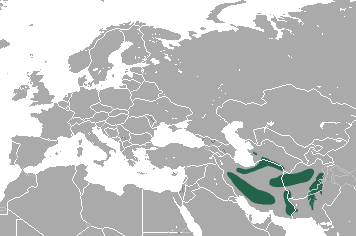
Afghan pikas (Ochotona rufescens) are found in Afghanistan, Iran, Pakistan and Turkmenistan. They are talus-dwelling pikas found in mountainous areas, often on talus slopes or in other areas with rocks. They also construct burrows in dry soils. Afghan pikas are considered agricultural pests on crops and orchards in some parts of their range. On the International Union for Conservation of Nature (IUCN) Red List they are listed as a species of Least Concern. In CITES (Convention on International Trade in Endangered Species of Wild) they have no special status. [Source: Michael Triepke, Animal Diversity Web (ADW) /=]
Afghan pikas are relatively small, weighing 125 to 400 grams. Sexual Dimorphism (differences between males and females) is not present: Both sexes are roughly equal in size and look similar. During the summer, they have cream colored collars that are outlined with a russet fur. Afghan pikas have small heads with small round ears. They have very short legs with dense fur covering the bottoms of their paws for added insulation. Afghan pikas primarily eat thistles and other xeric plants but are also known to consumer leaves of other plants, wood, bark, stems, seeds, grains, and nuts. They make hay piles that, after drying in the sun, are cached in burrows. Caches are typically restocked twice a year — during the spring and during in the fall. Afghan pikas sometimes steal food and bedding material from the burrows of other pikas.
Afghan pikas are terricolous (live on the ground), diurnal (active during the daytime), nocturnal (active at night), motile (move around as opposed to being stationary), sedentary (remain in the same area), territorial (defend an area within the home range) and social (associates with others of its species; forms social groups). They generally live in small family groups and share duties such as watching for predators and gathering food. Density is up to 70 animals per hectare(30 per acre). They do not hibernate and use their “haypiles” as food sources during the winter. They also use hay for bedding.
Afghan pikas sense use vision, touch, sound and chemicals usually detected with smell and communicate with sound and chemicals. They leave scent marks produced by special glands and placed so others can smell and taste them. Most pikas use whistling sounds to communicate with each other. Afghan pikas don’t have have well developed larynxs used to make such vocalizations. They still make noises though.
Afghan pikas are monogamous (having one mate at a time) and polygynous (males have more than one female as a mate at one time). They engage in seasonal breeding and have very high reproduction rates. They breed during the warm months can breed up to five times a year. The number of offspring ranges from one to 11, with the average number being nine. The average gestation period is 30 days. Young are altricial, meaning they are born relatively underdeveloped, weigh as little as nine grams, but develop very quickly The average weaning age is 30 days, with independence occurring around the same time. days. Females reach sexual or reproductive maturity at four to five weeks. On average males reach sexual or reproductive maturity at one year.
Turkestan Red Pikas
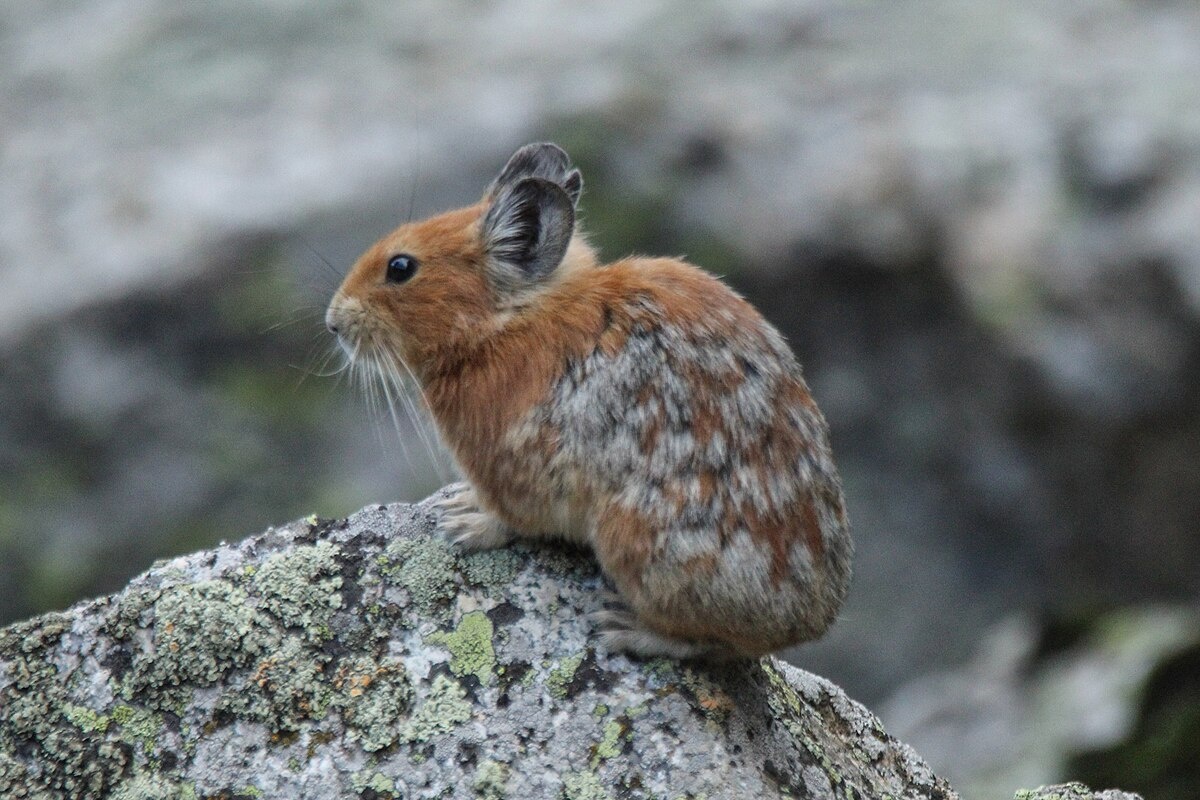
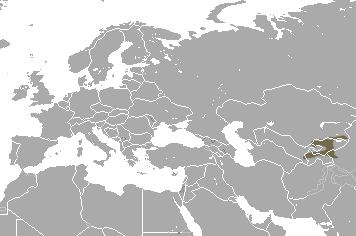
Turkestan red pikas (Ochotona rutila) are also called The Turkestani red pikas. They are found in the mountains of western Xinjiang in China, and sporadically also in the central Asian mountains in Kazakhstan, Kyrgyzstan, Tajikistan, Uzbekistan, southeast Russian Turkestan and northern Afghanistan. The get their name from the reddish fur. In the summer the fur on the animal’s its back is bright rufous and fur on its undersides are white or ochre-colored. The winter back fur is pale brown and the ventral fur is white or light ochre. [Source: Wikipedia]
Turkestan red pikas are talus-dwelling pikas that live for approximately three years, maybe longer. Other talus-dwelling species have been found to live for up to six years. Approximately 22 percent of juveniles survive their second winter. Turkestan red pikas live at elevations of 2000 to 3000 meters (6,562 to 9843 feet and occurs east of the Caspian Sea within the Tien Shan, Pamir, Kyrgyz, and Gissar mountain rangers in habitat such as spruce forests and sub alpine meadows. Their preferred habitat is a moderate, rocky slope with vegetation growing between large stones A breeding pair use the largest stones for their shelter. Turkestan red pika distribution is patchy, with individuals or pair groups occupying large home ranges. The climate in their range is characterized by cold and rainy summers and snowy winters. Snow depth can have a significant effect on winter survival rates of red pikas, possibly affecting the range at which they are found. This would explain why red pikas are not found at elevations greater than 3,000 meters as snow levels above this elevation may become too deep to access food. However, some snow is needed for insulation during winter months.[Source: Anna Maguire, Animal Diversity Web (ADW) /=]
Turkestan red pikas appear to have healthy-sized populations in their fragmented range. On the International Union for Conservation of Nature (IUCN) Red List they are listed as a species of Least Concern. In CITES (Convention on International Trade in Endangered Species of Wild) they have no special status. As non-burrowing pikas that do not graze on agricultural crops and competer with livestock for forage and thus do not have the negative impact on humans that some pikas have. Turkestan red pikas tend to live in places where they are few humans and thus are not impacted by them. The home ranges of red pikas tend to be larger than those of other talus-dwelling pikas because of their particular food habits, feeding only on vegetation found within two meters of a rocky substrate, resulting in red pika populations with have very low densities.
Among the animals that prey on red pikas are birds of prey, canids such as foxes and wolves, and weasels. One species that specializes on the predation of red pikas is the short-tailed weasels. Where they overlap with red pikas, 19 percent of short-tailed weasel scat has been found to contain red pika fur. Possibly in response to predation, red pikas do not forage farther than two meters from the edge of the talus.
Turkestan Red Pika Characteristics and Diet
Turkestan red pikas range in weight from 100 to 400 grams (3.52 to 14.10 ounces) and have a head and body length that ranges from 21.5 to 23 centimeters (8.46 to 9.06 inches). Like other talus-dwelling pika, red pikas have relatively long vibrissae, ranging in length from 80 to 94 millimeters Sexual Dimorphism (differences between males and females) is not present: Both sexes are roughly equal in size and look similar. Females are only slightly heavier than males while carrying their young. Both males and females have a cloaca that must be everted in order to determine their gender. [Source: Anna Maguire, Animal Diversity Web (ADW) /=]
Turkestan red pikas go through two molts each year that affect their seasonal color variations. The summer coats of red pikas was described by Andrew Smith as being “a rich rust-reddish dorsally with a more yellow cinnamon-buff tinge on the flanks". Their winter coat is gray with dark brown spots. Red pika have a distinctive wide, cream colored collar behind the ears that narrows dorsally. The fur of juvenile red pikas is indistinguishable from their parent's 20 days after birth. Chinese red pikas can be distinguished from Turkestan red pikas based on the presence of frontal fenestrae (openings in the skull located in front of the eye sockets. Turkestan red pika skulls do not have frontal fenestrae, which are usually found on birds, crocodilians and some dinosaurs..
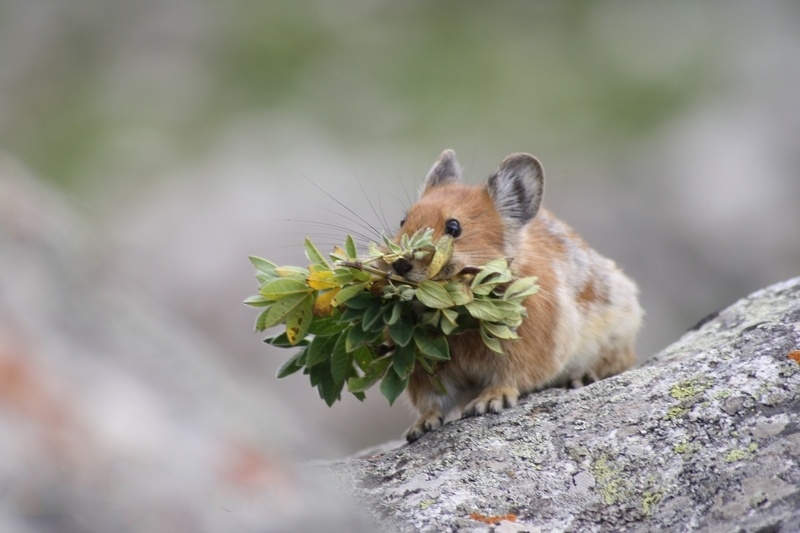
Turkestan red pikas are primarily herbivores (primarily eat plants or plants parts) but are also recognize as folivores (eat leaves) and lignivores (eat wood). Foraging They store and cache food mainly so they have food during the winter when they do not hibernate. Among the plant foods they eat are blossoms, green leaves, wood, bark, stems and young shoots of grasses and other plants when they are available. Red pikas have been observed eating Epilobium and wild cranesbill . In the autumn, when green food is scarce, they switch their diets to more woody foods. For their winter cache, they collect grasses in haypiles throughout the late summer and early fall that they eat during winter months. They feed mainly from small outcroppings of vegetation growing between stones. In order to have an adequate food supply, red pikas have larger home ranges than other talus-dwelling pikas.
Turkestan Red Pika Behavior
Turkestan red pikas are terricolous (live on the ground), crepuscular (active at dawn and dusk), motile (move around as opposed to being stationary), sedentary (remain in the same area), territorial (defend an area within the home range) and social (associates with others of its species; forms social groups). They typically have a large home range compared to other talus-dwelling pikas. This is because red pikas only feed on vegetation that is less than two meters from the talus edge. As a result they occupy large home ranges to ensure an adequate food supply. [Source: Anna Maguire, Animal Diversity Web (ADW) /=]
Turkestan red pikas can be found in pairs or family groups, but never form large congregations or colonies. Territories are commonly maintained by a breeding pair rather than individually . Red pikas use naturally occurring crevices between rocks for their shelter. A breeding pair may use the same shelter and food cache site for life. Individuals, pairs, or family groups, maintain a distance of 50 to 100 meters from their neighbors, with each territory having only one shelter and food cache.
The behavior of pikas can be greatly affected by temperature. Pikas generally have relatively high body temperatures (40.1̊ C, 104.2̊F) and having a low tolerance to any increase in body temperature. As a result, pikas regulate their body temperature by changing behavior. During hot summer days, pikas may become inactive in order to minimize any increase in body temperature.
Red pikas generally avoid activity during the daytime and are most active at dusk
During summer months and early fall, pikas busily collect food for the winter. Red pikas have been observed adding plants to their hay stacks 20 to 30 times per hour. During winter months, pikas do not hibernate but may decrease their activity levels. During this time they rely strongly on their hay-stacks for food.
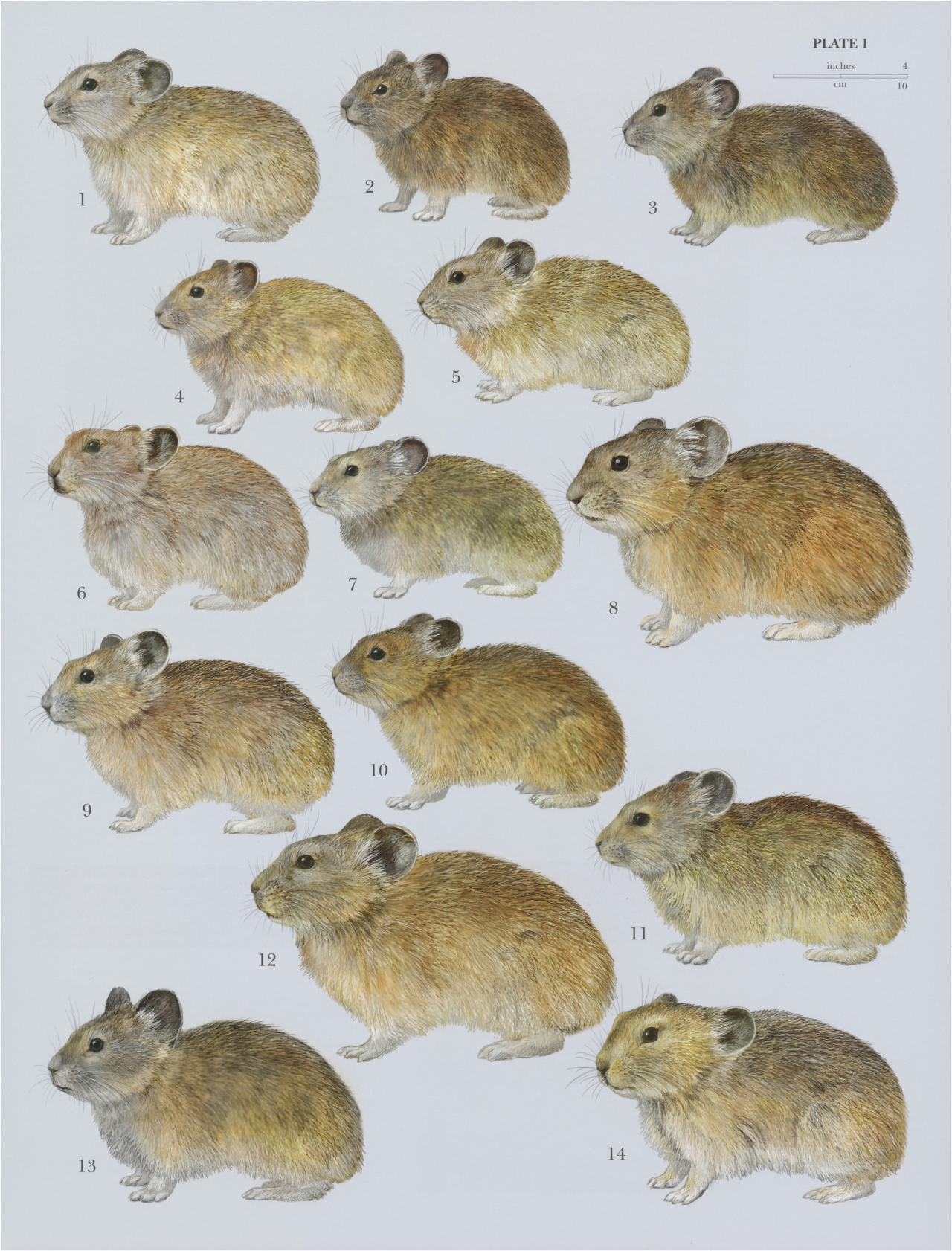
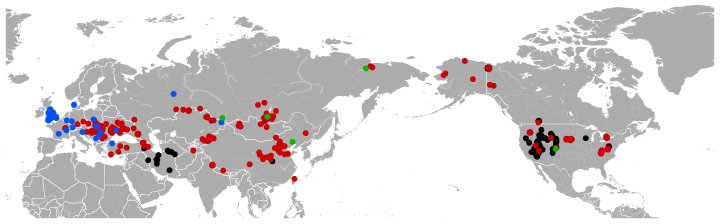
Pika species: 3) Tsing-ling Pika (Ochotona syrinx); 4) Gansu Pika (Ochotona cansus); 5) Nubra Pika (Ochotona nubrica); 6) Plateau Pika (Ochotona curzoniae); 7) Thomas's Pika (Ochotona thomasi); 8) Alpine Pika (Ochotona alpina); 9) Turuchan Pika (Ochotona turuchanensis): 10) Northern Pika (Ochotona hyperborea); 11) Manchurian Pika (Ochotona mantchurica); 12) Hoffmann's Pika (Ochotona hoffmanni); 13) Korean Pika (Ochotona coreana), 14) Pallas's Pika (Ochotona pallasii)
Turkestan red pikas sense and communicate with vision, touch, sound and chemicals usually detected by smelling. They also leave scent marks produced by special glands and placed so others can smell and taste them. Unlike, most pikas which rely heavily on vocalizations for communication, red pikas are not very vocal. They do not have a typical alarm call to warn of approaching predators. Instead, red pikas hide under rocks from their predators. In some cases they have been heard making chattering sounds, similar to the call of northern pikas, while hiding from a predator. Mates have been observed make chirping sounds when they meet.
Turkestan Red Pika Mating, Reproduction and Offspring
Tukestan red pikas are monogamous (having one mate at a time) and engage in seasonal breeding. It is not known whether they are monogamous for life. They breed two to three times per year during the spring to summer season. The number of offspring ranges from two to six, with the average being 4.2. The average time to independence is 20 days. On average females and males reach sexual or reproductive maturity at one year. [Source: Anna Maguire, Animal Diversity Web (ADW) /=]
Once sexually active, pikas often pair with individuals in nearby territories. Interactions between partners can be very physical, appearing as long boxing sessions. Asian talus-dwelling pikas differ from those found in North American in that a breeding pair defend a shared territory instead of having individual territories .
Young are precocial, meaning they are relatively well-developed when born, and develop very quickly. Young are born covered with hair. They gain their hearing after nine days and are able to see after 13 to 14 days. They are weaned and become independent of their parents after 20 days and become sexually mature the following spring.
Both males and females participate in rearing of offspring. During the pre-weaning stage provisioning is done by females and protecting is done by males and females. Pre-independence provisioning is done by females and males. Young may remain on their parents’ territory during their first summer, feeding on their parents’ food stores. However, after dispersing, juveniles can be challenged by adults and may therefore try to avoid all contact with adults until after they have established their own territories. /=\
Steppe Pikas
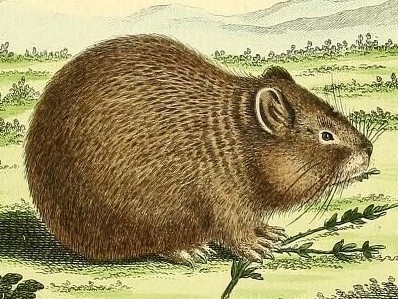
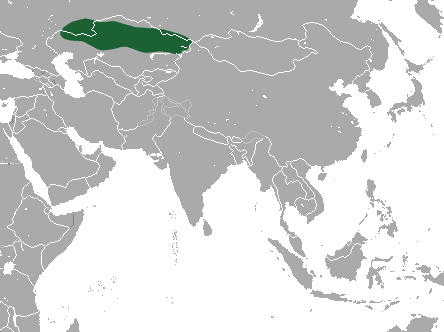
Steppe pikas (Ochotona pusilla) are found in the steppes of southern Russia and northern Kazakhstan from the Volga River and southern Ural Mountains in the north to the Irtysh River in the south. They steppes where they live and make their burrows are grasslands with occasional bushes. They are not endangered or threatened. On the International Union for Conservation of Nature (IUCN) Red List they are listed as a species of Least Concern. In CITES (Convention on International Trade in Endangered Species of Wild) they have no special status. They are protected in at least protected nature reserve, the Orenburgskiy reserve in the Belayevskiy region of the South Urals. [Source: Brianne Ordway, Animal Diversity Web (ADW) /=]
Steppe pikas have an average weight of 262.5 grams (9.25 ounces) and an average length of 15 centimeters (5.91 inches). Sexual Dimorphism (differences between males and females) is not present: Both sexes are roughly equal in size and look similar. Males and females have the same fur coloring — grayish brown on the back and white on the belly. Their tail is not visible. The head is short, with ears that are small and rounded. All four legs are approximately the same length, although the back are slightly longer than the front pair. The five fingers and toes on each foot are well insulated by a dense covering of fur on the bottom of the feet. They have twenty-six teeth. The diet of a steppe pika consists primarily of different types of grasses. They cache dried grass in "haystacks". There have been reports of individuals sometimes "raiding" the haystacks of others. These caches of food are not enough to sustain an individual over the winter, so these animals are forced to forage at all times of the year.
Steppe pikas are terricolous (live on the ground), fossorial (engaged in a burrowing life-style or behavior, and good at digging or burrowing), diurnal (active during the daytime), nocturnal (active at night), crepuscular (active at dawn and dusk), motile (move around as opposed to being stationary), sedentary (remain in the same area), social (associates with others of its species; forms social groups), and colonial (live together in groups or in close proximity to each other). Steppe pikas are unique among pikas in that they are active at night and call throughout the night. They do not hibernate and active throughout the winter. When there is a layer of snow and the wind speed is low, they climb to the surface of the snow and forage for food buried by the snow.
Steppe pikas are gregarious. Large colonies and family groups are common among the species. They sense communicate with vision, touch, sound and chemicals usually detected by smelling. They also leave scent marks produced by special glands and placed so others can smell and taste them. Steppe pikas emit vocalizations that sound like whistles and could be the source of name pika — which in English means "whistling hare".
Steppe pikas are monogamous (having one mate at a time) and polygynous (males have more than one female as a mate at one time). They engage in seasonal breeding and have relatively high reproductive rates. They breed three to five times during the spring and summer breeding season. The number of offspring ranges from three to 13, with the average number of offspring being eight. The gestation period ranges from 20 to 24 days.Young are altricial, meaning they born relatively underdeveloped. Newborn picas weigh about nine grams. They are naked and helpless at birth, but grow quickly. In some species, The age in which young are weaned ranges from 20 to 22 days. Parental care consists mainly of nursing by mothers and providing protection in the form of a burrow. Soon after being weaned, young are forced to fend for themselves. Females reach sexual or reproductive maturity at four to five weeks; males do so at one year.
Northern Pikas
Northern pika (Ochotona hyperborea) are the most widespread and have the largest range of all pika species. Also known as Siberian pikas and Japanese pikas in Japan, the are found mountainous regions across northern Asia, from the Ural Mountains to northern Japan and south through Mongolia, Manchuria and northern Korea. In the past the fur of Northern pikas was used to make high quality felt but trapping of pikas for their fur for the most part is no longer done. Northern pikas appear to be common throughout their range. On the International Union for Conservation of Nature (IUCN) Red List they are listed as a species of Least Concern. In CITES (Convention on International Trade in Endangered Species of Wild) they have no special status. [Source: Wikipedia, Allison O'Brien, Animal Diversity Web (ADW) /=]
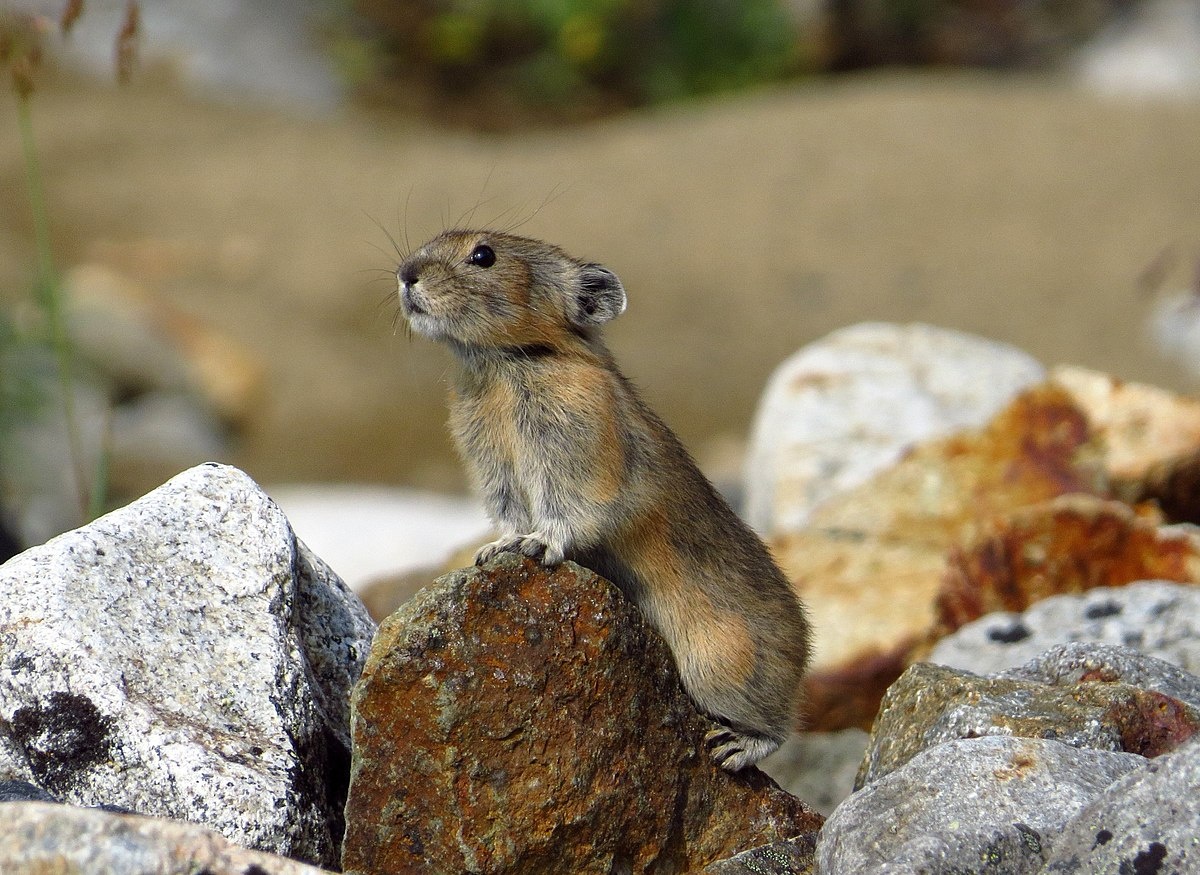
Northern pikas most often inhabit talus areas of rocky terrain in moist coniferous forests. Sometimes they burrow under or near tree stumps or fallen logs. They can be found in much of the eastern half of Russia — in the Ural, Putorana, and Sayan mountains, east of the Lena River to Chukotka, Koryatsk and Kamchatka, upper Yenesi, Transbaikalia and Amur regions. They also live in southern Siberia, northern Mongolia, Manchuria, North Korea, Sakhalin Island (Russia) and Hokkaido (Japan).
Northern pikas They have a head and body length that ranges from 12.7 to 18.6 centimeters (5 to 7.3 inches). Unlike most pikas they have an external tail, which is 0.5–1.2 centimeters (0.20–0.47 inches) long. Sexual Dimorphism (differences between males and females) is not present: Both sexes are roughly equal in size and look similar. The average lifespan of Northern pikas is two years. It is rare from them to live longer than three years. Northern pikas sheds their fur twice annually. They have a reddish-brown coat in the summer and grayish-brown coat in winter. Their belly is reddish-white. The fur is long, dense, soft and fine. Pikas have rounded ears that are about as wide as they are high. Their legs are short; the hind legs are only slightly shorter than their forelimbs. They have five fingers and toes and the feet are heavily furred on the underside.
Northern Pika Behavior, Communication and Feeding Habits
Northern pikas are terricolous (live on the ground), diurnal (active during the daytime), crepuscular (active at dawn and dusk), motile (move around as opposed to being stationary), sedentary (remain in the same area), territorial (defend an area within the home range) andsocial (associates with others of its species; forms social groups). Northern pikas are active at all times of the day, but are most active in the morning and evening. They do not hibernate and have been observed sunning themselves on exposed rocks. During the summer months they also accumulate hay piles. They sometimes steal hay from pikas in other territories. Males and females have separate territories and defend them throughout their lifespan. Females tend to stay within their territory, but males trespass onto nearby territories. It is rare for male and female partners to have physical contact with one another. Occasionally, in areas of high density, territories may contain one male and two females. [Source: Allison O'Brien, Animal Diversity Web (ADW) /=]
Northern pikas are primarily herbivores (primarily eat plants or plants parts) but are also recognized as folivores (eat leaves) and coprophage (eat dung). Among the plant foods they eat are leaves seeds, grains, nuts flowers, mosses and lichens. They also eat dung their own dung and stores and cache food. During the summer and early autumn months northern pikas gather as well as eat grasses, sedges, weeds, and many flowering and woody plant parts. They sometimes climb a few meters into trees and onto limbs to cut twigs. Grasses are often placed in exposed locations to be cured by the sun. Once dried, vegetation is stored in hay piles. Hay piles are made within each individual's territory and are consumed by a mating pair in the winter. During the winter, northern pikas make tunnels in the snow to harvest nearby vegetation. Northern pikas defecate small green droppings, typically during the day. At night, they defecate black droppings which are often encased in a gelatinous substance. The black droppings have higher energy values and are reingested. /=\
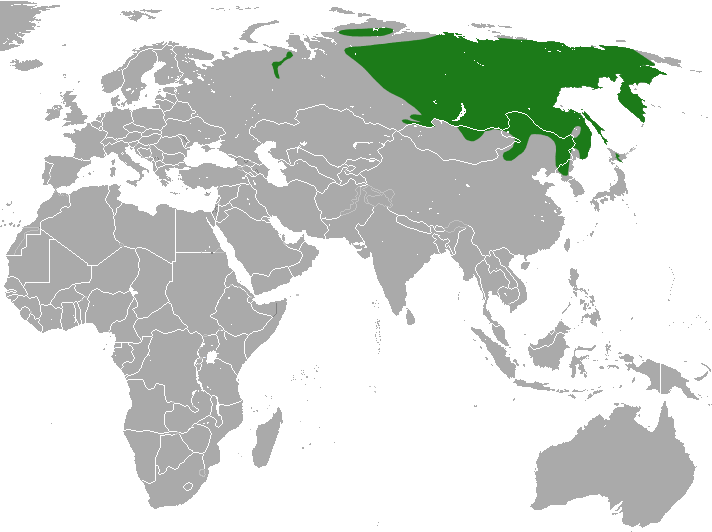
Northern pikas don’t hibernate, this makes them more vulnerable to predation from middle-sized mustelid, felid or canid carnivores. They are an important food source for some mustelids, such as ermine and sables. Pikas avoid predation by using pathways in their talus habitats to avoid being out in the open. They are also cryptically colored (well camouflaged) and may emit warning whistles when predators are detected. During the winter months, ungulates such as reindeer and snow sheep eat the food stores of northern pikas. Hares, marmots and voles also feed on pika food stores. Pikas compete with other small herbivores for foliage resources. Remnant pika food stores may promote plant growth in the area. Nitrophylic plants grow well in piles of pika fecal pellets. Northern pikas may also change nearby habitat by overgrazing, which alters the composition of plant communitites.
Northern pikas sense using vision, touch, sound and chemicals usually detected with smell and communicate with sound and chemicals by leaving scent marks produced by special glands and placed so others can smell and taste them. They mark their territories by rubbing their neck glands on the corners of stones. This occurs more often in the spring. Territory may also be marked by urination. From summer to fall, both sexes frequently give short calls. A song is used by males during the breeding season. This long call is composed of a chattering sounds followed by a sequence of loud sharp whistles. It is possible to distinguish individuals by their calls. Northern pikas do not respond to calls of northern pikas from other territories. A short call is used between mated pairs to announce presence or to warn others of an approaching predator. In the spring only females use the short call. In the fall, a short call can be heard from either sex. Different dialects of the short call have been observed in different parts of their range. /=\
Northern Pika Mating and Reproduction
Northern pikas have stable populations but low reproductive rates. They engage in seasonal breeding — in the summer. In the northern parts of their range the usually have one large litter a year. In the southern parts of their range they breed twice a year, with slightly smaller litters. Litter size ranges from one to nine young, with average litter size being three to four. Gestation period is 28 days. Thos that breed once do so in the spring. If they breed twice a year they so so in the spring and again in the summer. There is some debate as to whether northern pikas breed as yearlings or if females are unable to breed until their second year. [Source: Allison O'Brien, Animal Diversity Web (ADW) /=]
Northern pikas are polygynandrous (promiscuous), with both males and females having multiple partners. While northern pikas typically live as mated pairs, males may breed with three females. During the mating season males frequently give successive calls to declare their possession of territory and may travel over 200 meters to mate with another female. Occasionally, females are visited by multiple males at the same time.
Northern pikas are altricial. This means that young are born relatively underdeveloped and are unable to feed or care for themselves but the develop very fast. Both parenst are involved in rearing young. During the pre-weaning stage provisioning is done by females and protecting is done by males and females. Pre-independence provisioning is done by the female and the male. When young leave their natal territory varies geographically. In the southern parts of their range young disperse and form pairs in their first summer. In the northern part of their range, young that are born in the summer remain with their parents throughout the winter before dispersing. Northern pikas in the Ural Mountains contribute to their parent’s food stores while in their territory. Females nurse and care for their young in a summer nest. The mated pair or family group contribute to gathering food stores for the winter. /=\
Image Sources: Wikimedia Commons
Text Sources: Animal Diversity Web animaldiversity.org ; National Geographic, Live Science, Natural History magazine, CNTO (China National Tourism Administration) David Attenborough books, New York Times, Washington Post, Los Angeles Times, Smithsonian magazine, Discover magazine, The New Yorker, Time, BBC, CNN, Reuters, Associated Press, AFP, Lonely Planet Guides, Wikipedia, The Guardian, Top Secret Animal Attack Files website and various books and other publications.
Last updated April 2025