
LARGE-EARED PIKAS
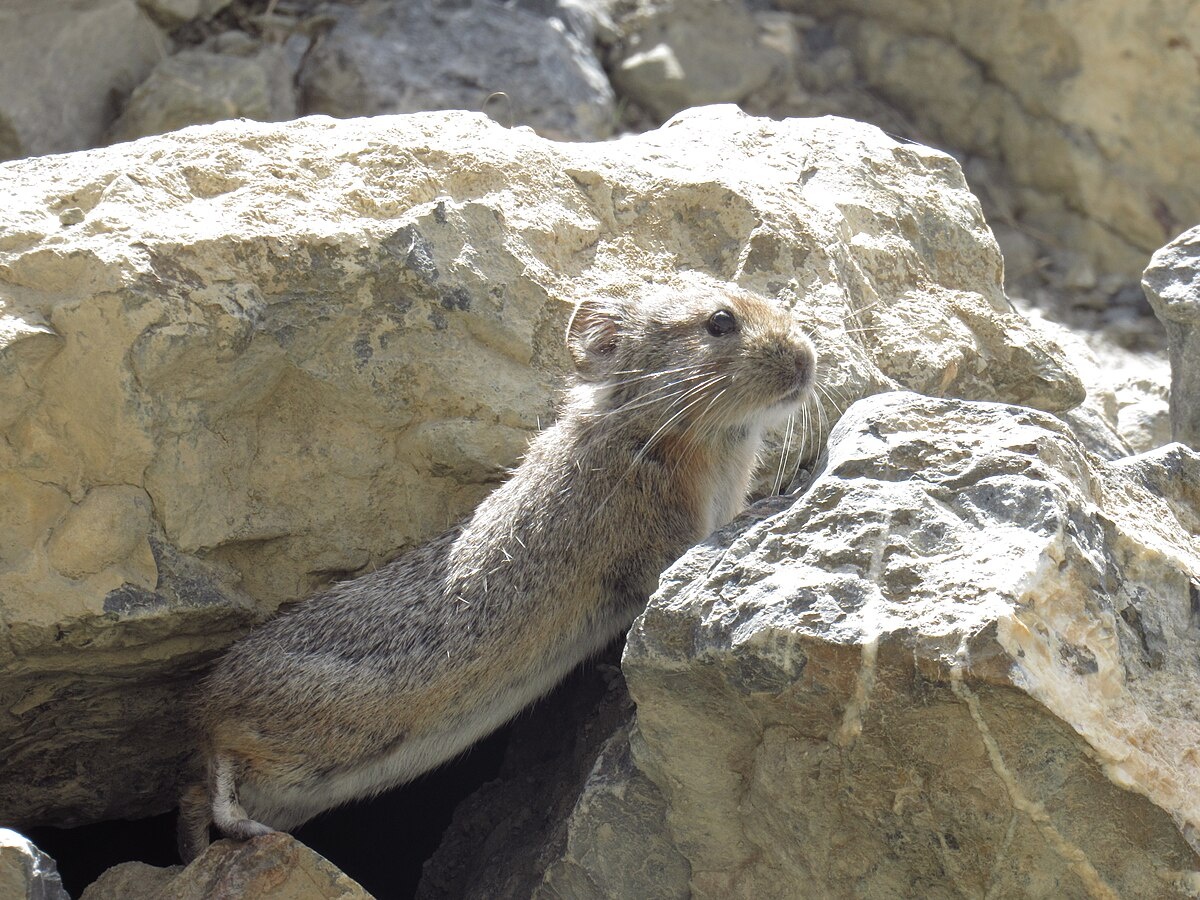
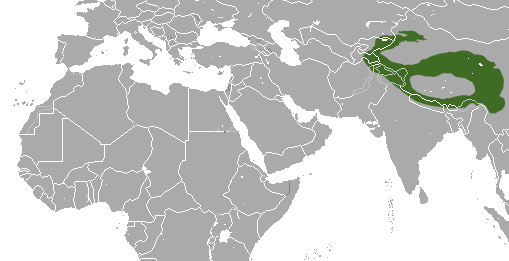
Large-eared pikas (Large-eared pikas) live in mountainous regions of Tibet, Bhutan, India, Kazakhstan, Kyrgyzstan, Nepal, Pakistan, Tajikistan and Afghanistan where it makes its home among boulders and scree on rocky slopes. They have brownish-grey fur tinged, with a reddish tinge on their cheeks, forehead and shoulders which is more pronounced in summer. Their underparts are greyish-white and their feet, including the soles, are covered with fur. Adults are is 15 to 20.4 centimeters (6 to 8 inches) in length. [Source: Wikipedia]
In the past, large-eared pikas and Royle’s pikas were classified by taxonomists as the same species. However, fairly recent DNA analysis genetics suggests that they are different species. Large-eared pikas occurs at a higher elevation than Royle's pikas.[Source: Dana Jordan, Animal Diversity Web (ADW) /=]
Large-eared pikas are talus-dwelling pikas (pikas that live in rocky areas as opposed to alpine meadows). Such pikas generally have a lifespan of one to three years. Large-eared pikas are one of the highest-living animals. They have been documented at altitudes of 6,130 metres (20,113 feet) in the Himalayas. Like most talus-dwelling pikas, large-eared pikas do not make burrow but rather reside nests in crevices among the shattered rock and scree.
Large-eared pikas are not endangered. On the International Union for Conservation of Nature (IUCN) Red List they are listed as a species of Least Concern. In CITES (Convention on International Trade in Endangered Species of Wild) they have no special status. It is not known how many large-eared pikas there are but they have an extensive range and seems to be common in their rocky habitats, which are not commonly utilized by humans. They have been known however to creep into houses near their territory and live among the walls. In such cases, unattended food may be nibbled on or stolen and taken away to the pikas’ nests.
RELATED ARTICLES:
PIKAS: CHARACTERISTICS, BEHAVIOR, DIET, CALLS factsanddetails.com ;
PIKAS IN CENTRAL ASIA, MONGOLIA AND RUSSIA factsanddetails.com ;
PIKAS IN CHINA: SPECIES, CHARACTERISTICS, BEHAVIOR, RANGES factsanddetails.com
PIKAS IN TIBET AND THE HIMALAYAS factsanddetails.com
PLATEAU PIKAS: CHARACTERISTICS, BEHAVIOR, REPRODUCTION, POISONING factsanddetails.com
Large-Eared Pika Range and Habitat
Large-eared pikas, are most frequently found on the Qinghai-Tibet Plateau but also live in the in the Tienshan and Pamir mountain ranges of Central Asia and have been spotted in the Nepal Himalayas, Punjab, and Kashmir and in Xinjiang in western China.[Source: Dana Jordan, Animal Diversity Web (ADW) /=]
Large-eared pikas live at elevations of 2,300 to 6,100 meters (7,550 to 20,013feet) at an average elevation of 4,000 meters (13,123 feet). One can often identify the presence of pikas by the presence of their pellet-like droppings, which are are usually found in consistent piles among the rocks. Rocks with crusty white urine stains also suggest pikas are around. /=\
Talu-swelling pikas like the Large-eared pikas generally establish nests among rocky debris on talus slopes formed by glaciers. The rocks serve as both a home and a place to escape from predators. Rock size is important for pikas. They use the natural crevices between them as tunnels to travel from one place to another. Spaces that are too small are unsatisfactory because the pikas can not fit into the, Those are too large may allow predators to reach the pikas. /=\
Large-Eared Pika Characteristics
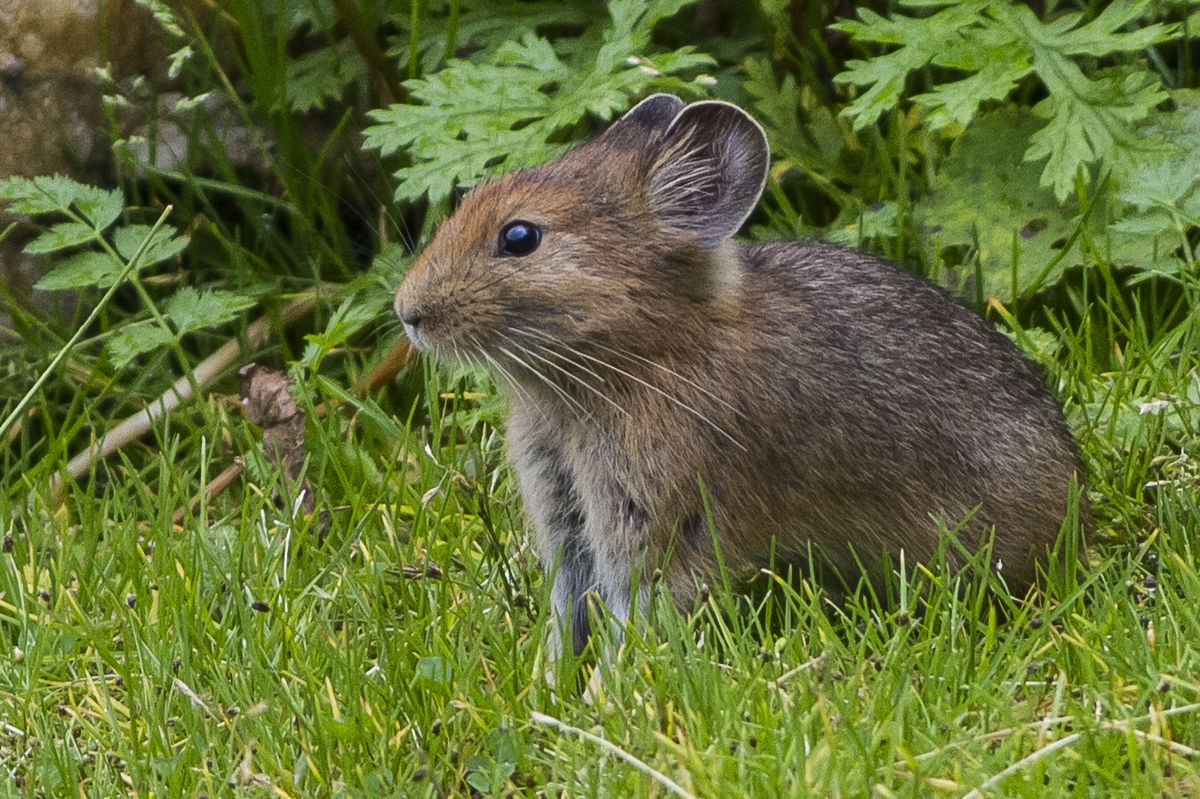
Large-eared pikas have an average weight of 0.12 kilograms (0.26 pounds). Their a head and body length ranges from 15 to 25 centimeters (5.9 to 9.8 inches). Like all pikas they don’t have an external tail and sexual Dimorphism (differences between males and females) is not present. The metabolic rate of pikas is high, particularly those, like large-eared pikas, which live in very cold and harsh conditions. [Source: Dana Jordan, Animal Diversity Web (ADW) /=]
Large-eared pikas look like Royle’s pikas and are of similar size but have larger ears. Large-eared pikas have has the largest pinnae (external part of the ear) of any pika. Like other lagomorphs, pikas have an extra pair of insisors behind the first. The fur is thick, soft, and slightly silky. Unlike rabbits and hares, pikas have visible toe pads surrounded by well furred feet. /=\
Among pikas in general, two molts occur yearly which vary in color, due to seasonal changes. Females often lose their fur later in the season than male pikas. It has been suggested that sexual differences in timing of molt is related to reproduction. /=\
Large-Eared Pika Food, Eating Behavior and Predators
Large-eared pikas are primarily herbivores (eat plants or plants parts), and may also be classified as folivores (eat leaves). Among the plant foods they eat are stems, seeds, grains, nuts, leaves, wood, bark, flowers, mosses and lichens. They also eat dung and store and cache food. Two types of feces are produced, including a gelatinous, green excrement which the pikas eat to obtain vitamin B and other nutrients — a trait shared by all lagomorphs (rabbits, hares and pikas). [Source: Dana Jordan, Animal Diversity Web (ADW) /=]
Like all pikas, large-eared pikas eat all available plant vegetation in their surrounding such as grasses, sedges, twigs, and flowers. During the early months after there is considerable competition to consume new vegetation. Often they will consume of grasses and other plant-foods that have already has been bitten off. Lichens and mosses are eaten if they are present and near the pika’s nest, especially in the winter whwn other food sources are scarce.
Pikas use pathways to travel between feeding grounds. Because pikas do not hibernate and food storage often runs low during late winter, they typically forage continuously during the winter months. When snow cover is heavy, pikas dig tunnels from their burrows to tree trunks and nibble on bark when no other food is available. pikas may nibble away the tree bark. /=\
Pikas are preyed up by weasels, foxes, wolves, hawks, and owls. Weasels can be be especially deadly because they can often squeeze into pika tunnels. As a defense pikas have a number of calls used to alert other pikkas of approaching danger. Among groups of pikas, often there is a sentinel who looks out for dangers and os on the alert for strange sounds and movements. This individual is often perched on a slope with a good view of the surroundings and a nearby crevice to which it can flee for safety. Barks are issued when danger is sensed. Pikas usually quickly take cover in the rocky debris when two short, distinctive calls of an aerial predator are given by the sentinel. When weasels are spotted, vocalization is more restrained. Pikas hearing this call quietly escape and take cover in tunnels too small for the weasels to crawl through. With avian predators the idea is to seek cover from an attack from the sky and runways and tunnels different from those to escape weasels are used.
Large-Eared Pika Behavior
Large-eared pikas are terricolous (live on the ground), diurnal (active during the daytime), motile (move around as opposed to being stationary), sedentary (remain in the same area), solitary, territorial (defend an area within the home range). [Source: Dana Jordan, Animal Diversity Web (ADW) /=]
Like other pikas, large-eared pikas do not hibernate during the winter. Whole other pika species are active throughout the day, large-eared pikas are the most active around mid-day. The remainder of the day is spent crouching on prominent rocks, sun-bathing, or watching for predators. If temperatures get too high, they take refuge for extended periods of time in the shade underneath rocks. Unlike other pikas, large-eared pikas do not engage in hay-gathering ritual that often comes to be associated with pikas. Hay-gathering involves the cutting and drying of grasses, which are stacked in piles among the rocks for later use as bedding and food. /=\
According to Animal Diversity Web: Pikas are typically more alert of their surroundings after the snow has melted than at any other time of the year because of their prolonged absence from the outside world. The loss of the snow, which provides temporary protection, makes the pikas more accessible to predators. Behavior also changes through the course of the season, from the time of the breeding season to after the offspring are born. Trespassers are often allowed to cross boundaries during certain times of the year, but not during others. /=\
Large-Eared Pika Senses and Communication
Large-eared pikas sense and communicate with vision, touch, sound and chemicals usually detected by smelling. They also leave scent marks produced by special glands and placed so others can smell and taste them. As is the case with most species that are active during the daytime, visual communications, including body postures, are probably important in exchanging certain kinds of information. Tactile communication occurs between mates, rivals, and between mothers and their young. /=\
Pikas typically employ sharp, high-pitched whistles to communicate with each other. Such calls are often used to alert othern when predators are closeby. Calls vary in range and pitch for different classes of predators. Vocalizations are also used to express territorial boundaries. Barks against invasive males are frequent during the mating months.
Like other Asiatic species, large-eared pikas sometimes emit nocturnal calls. Large-eared pikas and Royle’s pikas are not as vocal as other pika species. Because thse animals rely less on vocalizations as a means of communication, it has been suggested that they uses other methods of communication, such as pheromones (chemicals released into air or water that are detected by and responded to by other animals of the same species). /=\
Large-Eared Pika Mating, Reproduction and Offspring
Large-eared pikas are polygynous (males have more than one female as a mate at one time), They engage in seasonal breeding and employ sexually-induced ovulation (release of a mature egg from the ovary triggered by sexual intercourse). Large-eared pikas breed once a year, with mating generally occurring in late spring and early summer. The average gestation period is 30 days. The number of offspring ranges from one to seven, with the average number being two to four. The average weaning age is 30 days and independence usually occurs at around 50 days. Females and males reach sexual or reproductive maturity at seven to 14 months, with the average being around 12 months, [Source: Dana Jordan, Animal Diversity Web (ADW) /=]
Most of the mating action with pikas occurs in their crevice nests and is not known whether courtship rituals exists. Males can be very aggressive, especially when it comes to territoriality but surprisingly this aggressiveness often subsides with the onset of female reproduction. It is not until the young are slightly grown that males become territorial. The most severe period of male aggressiveness occurs in the fall, after young are born. During mid-summer, males are highly territorial and and aggressive male-male chases occur at a rate of once per hour.
Mating takes place during a short period in the early summer. It has been theorized that the low reproductive capacity of two to four pups per little is linked to the short mating season of large-eared pikas. As with most mammals, male pikas do not extend any care to their offspring. Instead, females provide their young with protection, food, and grooming.. (Orr, 1977) /=\ Most of the parenting duties are performed by females. Young are altricial, meaning they are born relatively underdeveloped and are unable to feed or care for themselves or move independently for a period of time after birth but after that brief period they mature quickly. By one week of age, young pikas are walking and making vocalizations Around one year of age, males stake out new territories and often trespass onto the territories of adjacent males. Females usually remain in one area until a mate is chosen.
Image Sources: Wikimedia Commons
Text Sources: Animal Diversity Web animaldiversity.org ; National Geographic, Live Science, Natural History magazine, CNTO (China National Tourism Administration) David Attenborough books, New York Times, Washington Post, Los Angeles Times, Smithsonian magazine, Discover magazine, The New Yorker, Time, BBC, CNN, Reuters, Associated Press, AFP, Lonely Planet Guides, Wikipedia, The Guardian, Top Secret Animal Attack Files website and various books and other publications.
Last updated April 2025