
BACTRIAN CAMELS
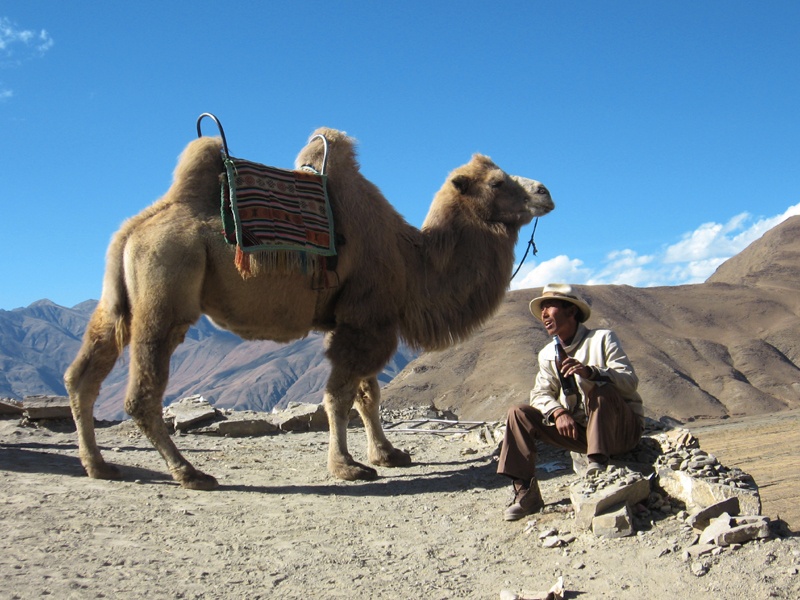
Bactrian camels (Camelus bactrianus) are hairy double humped camels. Found primarily in Central and East Asia, they are adapted for cold regions and have heavy bodies. Their calloused feet can handle ice, rocks and snow. They can drink salt water and swim for short distances. Their hair may reach a length of foot in winter. Wild Bactrian camels are still found in China and Mongolia.
Widely domesticated and capable of carrying 250 kilograms (600 pounds), Bactrian camels are native to cold-in-the-winter Central Asia deserts, where a few wild ones still live, and seem no worse for wear when temperatures drop to -29 degrees C (-20 degrees F). The fact they can endure extreme hot and cold and travel long periods of time without water has made them ideal caravan animals.
All camels are believed to have evolved from Bactrian camels.to Central Asia. The one-humped dromedaries of the Middle East are believed to have evolved from them although their origin is still somewhat of a mystery. The Bactrian camel is believed to have been domesticated in Central Asia 5,000 years ago. The Dromedary camel is believed to have been domesticated in Arabia 3,000 years ago.
Bactrian camels move at about five kilometer per hour and produce five kilograms of wool, 600 liters of milk, and 250 kilograms of dung a year. In the winter they sometimes die because they are unable to scrape away snow from the grass and plants they eat. A Bactrian camel lived to be 36 in Britain. One of that age was still living in a Yokohama zoo in Japan in 2011. Females reach sexual maturity at three to four years, males at five to six years.
The International Union for Conservation of Nature (IUCN) classifies the wild species of Bactrian camel as Camelus ferus.. The domesticated form of this species is classified as Bactrian camels. Grubb (2005) considers ferus a subspecies of bactrianus. Bactrian camels have been known to live for as long as 50 years in the wild. However, domesticated camels have never been recorded to live for more than 35.4 years. The average life expectancy for wild Bactrian camels is 30 years. [Source: Emily Cutshall, Animal Diversity Web (ADW) /=]
See Separate Articles: BACTRIAN CAMELS AND THE SILK ROAD factsanddetails.com ; CARAVANS AND CAMELS factsanddetails.com; CARAVANS AND TRANSPORTATION ALONG THE SILK ROAD factsanddetails.com; SILK ROAD factsanddetails.com; SILK ROAD EXPLORERS factsanddetails.com; SILK ROAD: PRODUCTS, TRADE, MONEY AND SOGDIAN MERCHANTS factsanddetails.com;
Camels
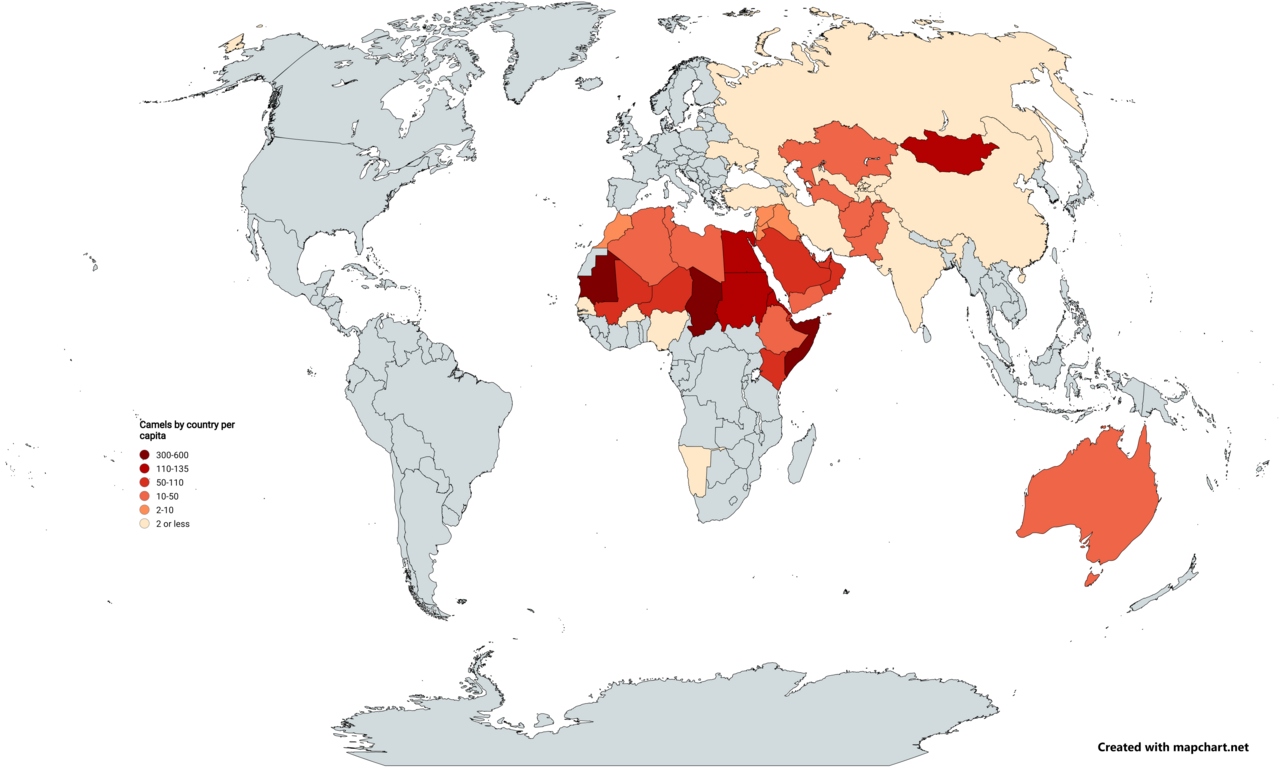
Camels are one of the most useful animals to humans. Particularly in the desert areas of the Middle East and the steppes of Central Asia, they are used primarily as pack animals but also are useful as mounts and as sources of milk, meat and wool. They could be employed in high mountains, cold steppes and inhospitable deserts.
Camels are mentioned in the Koran and regarded by Bedouins as “God’s gift.” In the desert some people worry more about the well-being of their camels than they do of their own children. But camels are not necessarily pleasant animals. They make screechy noises, have smelly bodies and always seem to be dozing off or refusing to cooperate but are the fastest animals in the desert and steppes, and have incredible endurance.
Male camels are often castrated. White camels are regarded as auspicious. There are fewer camels than there used to be. Sometimes they are eaten for meat. Mostly they are not as useful as they once were. Truck now carry tents, goods and products that used to carried by camels.
See Separate Articles: CAMELS: TYPES, CHARACTERISTICS, HUMPS, WATER, FEEDING factsanddetails.com
Wild Bactrian Camels
Wild Bactrian camels inhabit parts of Eurasia and western China. Their geographic range has been steadily decreasing. They are now only found in isolated regions of the Gobi and Taklamakan Deserts of Mongolia and Xinjiang. There are fewer than 900 wild Bactrian camels remaining in the wild. They live in three small populations: 1) one on the Mongolian-China border; 2) far western China; and 3) in the Kum Tagh desert. In their native range, population densities of five camels per 100 square kilometers has been estimated. There are noticeable genetic differences (3 percent) between the wild and domestic groups.
young wild Bactrian camel Ancestors of domestic camels, wild Bactrian camels are slimmer and less woolly and have smaller conical humps than domesticated Bactrian camels. They stand 1.72 meters (5.6 feet) at the shoulder. Males weigh 600 kilograms (1,323 pounds) and females weigh 450 kilograms. (992) pounds) They eat grasses, leaves and shrubs.
Wild Bactrian camels are currently a critically endangered species (See Below). The live on the arid plains, hills and desert in Mongolia and China. They can survive on shrubby plants and no water for 10 days. They follow migratory paths across the desert to oases and feed on tall grasses.
Female Bactrian camels travel in small groups with six to 20 members. Males are often solitary but will unite with a female group in the mating season if strong enough to fend off rivals. During the rutting season males puff out their cheeks, toss their heads, slobber and grind their teeth. Mother Bactrian camels give birth alone. The gestation period is 13 months. Usually one calf, sometimes two, are born. Young can walk almost immediately. After about a month of seclusion mother and young join the group with other females. Young nurse for one to two years.
Bactrian Camel Characteristics
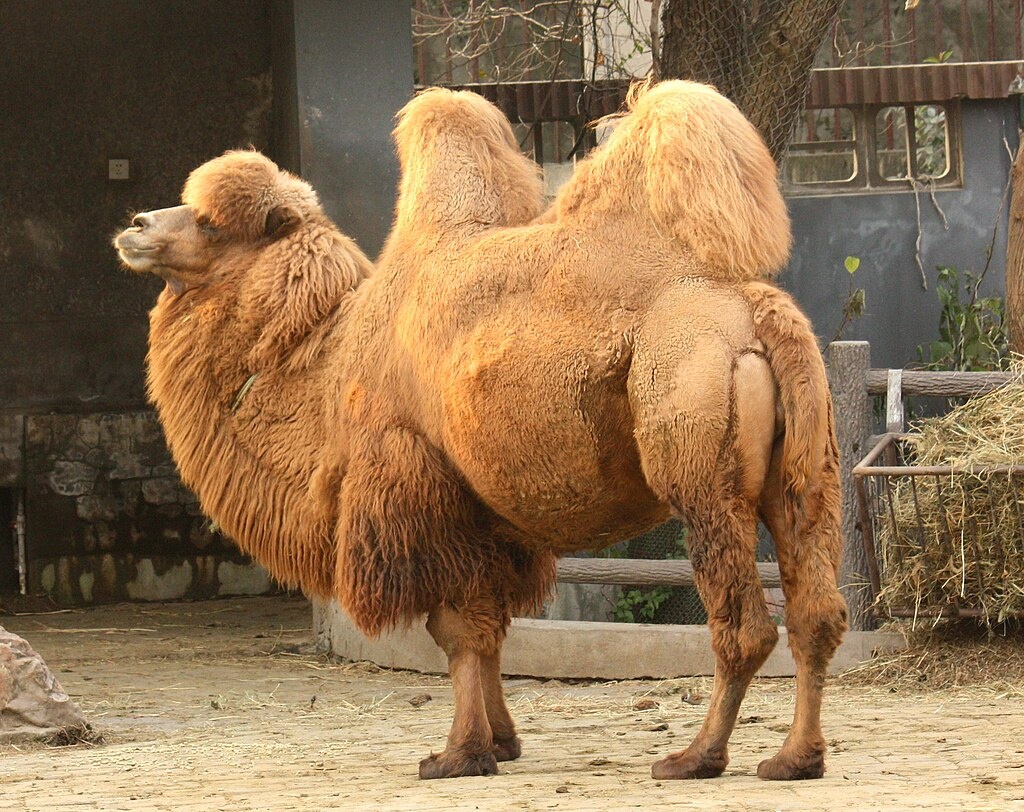
Bactrian camels are large animals with two humps and two coats of hair. They range in weight from 300 to 690 kilograms (660 to 1520 pounds) and have a head and body length that ranges from 2.25 to 3.45 meters (7.4 to 11.3 feet). The tail is 0.35-0.55 meters (1.1 to 1.8 feet) long. Their shoulder height is from 1.60 to 1.8 meters (5.2 to 5.9 feet) with their overall height — from the ground at the top of their humps — ranging from 2.3 to 2.5 meters (7.5 to 8.2 feet). Sexual Dimorphism (differences between males and females) is present: Males are larger than females. [Source: Emily Cutshall, Animal Diversity Web (ADW) /=]
Bactrian camels have a long, woolly outer coat that varies in color from brown or beige to reddish brown or black T their long hair (255 metersm long). The coat is thicker and heavier on the head, neck, humps, forelegs, and tail area. Hairs can measure up to 25 centimeters (9.8 inches) long. Those that live in deserts that get hot in the summer shed their heavy coat when the temperatures rise.
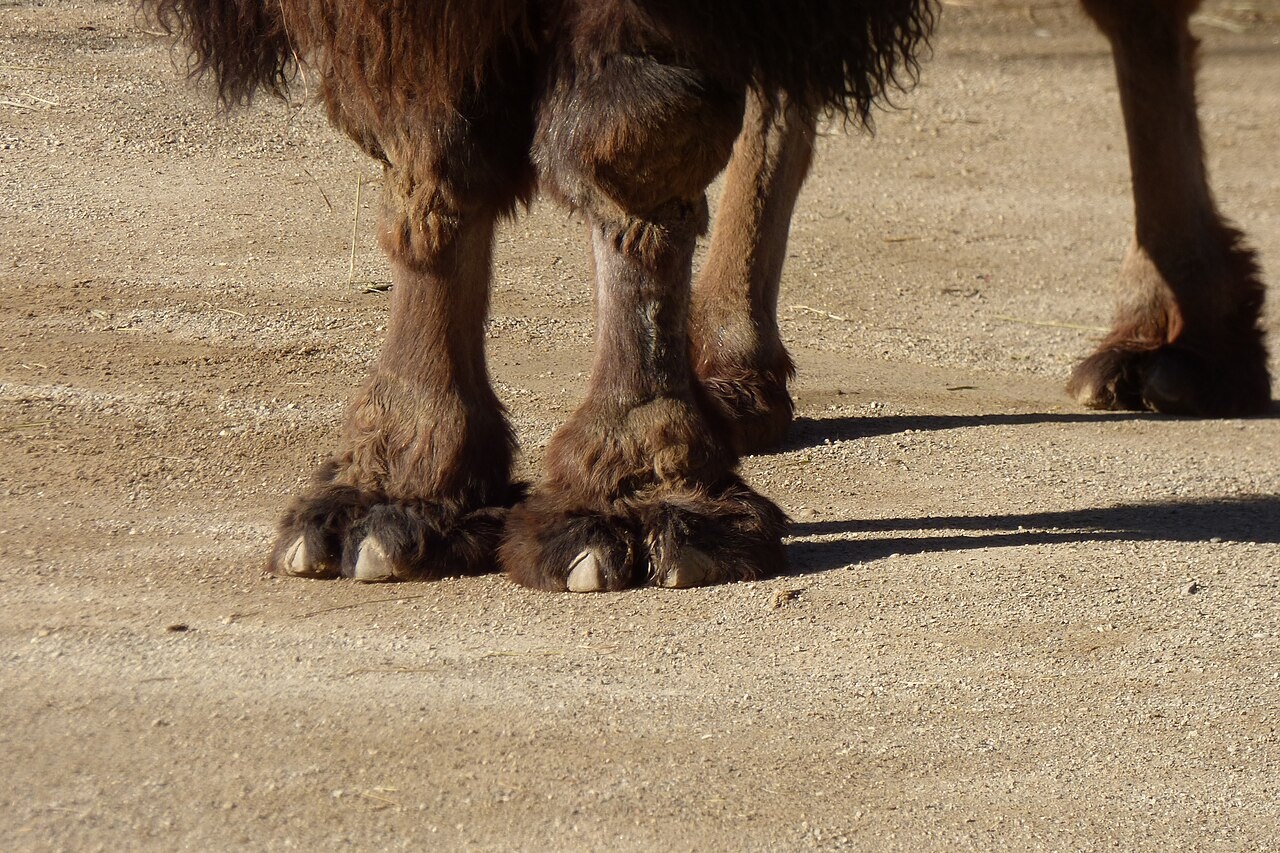
Bactrian camels have relatively thin, short legs, and heavy bodies. The animals have a mane and beardlike hair on their throat. The camels' even toed feet are tough and the soles are undivided. Their feet are broad and adapted for walking on sandy terrain and snow. Their calloused feet can handle ice, rocks and snow. Bactrian camels slobber a lot when they get horny (See Camel Wrestling). Their ears are also lined with hair and their top lip is divided.
Bactrian Camel Humps and Adaptions to the Desert
What distinguishes Bactrian camels apart from dromedary camels (Camelus dromedarius) is that they have two humps on their backs (dromedary camels have just one). The humps do not store water; they store energy in the form of fat and can reach a height of half a meter (18 inches) and individually hold as much as 45 kilograms (100 pounds). A camel can survive for weeks without food by drawing on the fat from the humps for energy. The humps shrink, go flaccid and droop when a camel doesn’t get enough to eat and the humps lose the fat that keeps them erect.
The humps are made up of fatty tissues and store energy for times when nutrients aren't available. The energy reserves in the camels hump can be used in place of both water and food. Camels that are well nourished have humps that stand erect and appear plump and firm. Malnourished camels have smaller and sideways leaning humps. [Source: Emily Cutshall, Animal Diversity Web (ADW) /=]
Bactrian camels can go a week without water and a month without food. A thirsty camel can drink 100 to 110 liters (26 to 29 gallons) of water in ten minutes. Even though they may endure high temperatures in the desert summers, Bactrian camels have minimal sweat glands. Instead, they have the ability to tolerate an internal temperature increase of six degrees Celsius before perspiring, which prevents water loss. /=\
For protections against dust and sandstorms, Bactrian camels have two sets of eyelids and eyelashes. The long eyelashes block harsh winds that often blow sand and dust into the camels' eyes. The extra eyelids can wipe sand like windshield wipers. Their nostrils can shrink to a narrow slit to keep out blowing sand and dust. There is a connecting indent that runs along each nostril to the cleft top lip so that any extra water or moisture can be trapped in the mouth.
Bactrian Camel Food, Diet and Eating Behavior

Bactrian camels are omnivores (eat a variety of things, including plants and animals), but are primarily herbivores that constantly graze on grasses. As ruminants, they have four separate stomachs, one of which is a three-chambered ruminating stomach. Ruminants eat their food followed by regurgitation, allowing them to chew it up a second time. Among the plant foods they eat in addition to grasses are leaves, wood, bark, stems, seeds, grains, nuts and flowers. Animal foods include birds, mammals, reptiles. [Source: Emily Cutshall, Animal Diversity Web (ADW) /=]
Camels are adapted to eat all kinds of desert vegetation, which includes many salty, dry, thorny, and bitter plants. Halophytic plants, which are plants that have been growing in water with a high saline concentration, are a necessary part of Bactrian camel's diet. Their dietary needs and preferences make them ideal candidates for desert life. In times of environmental stress — when there is little or no available vegetation — camels may eat fish, different types of flesh, bones, skin, and even shoes and clothes. In the winter months, camels often push and dig under the snow to find food, a practice observed only in Bactrian camels. /=\
Emily Cutshall wrote in Animal Diversity Web: Along with the energy reserves that reside in the fatty tissues of the camel's hump, the stomach is enclosed by chambers filled with water. They can also drink saline water, which in turn causes them to urinate concentrated salt. The camels' kidneys efficiently eliminate the unwanted surplus of salt before returning the water back to the bloodstream. Camels can almost be fully sustained from the water in the vegetation that they consume. They can withstand a large amount of water loss, up to 40 percent of their body weight. Camels can consume up to 57 liters of water to fully restore their body fluid levels. When camels come across an abundant water source, they will drink large amounts of water within a matter of minutes, to refill their water storage. This water storage will become useful during times of drought. /=\
Wild Bactrian Camel Behavior
Wild Bactrian camels are terricolous (live on the ground), diurnal (active during the daytime), motile (move around as opposed to being stationary), nomadic (move from place to place, generally within a well-defined range), migratory (make seasonal movements between regions, such as between breeding and wintering grounds), social (associates with others of its species; forms social groups), and have dominance hierarchies (ranking systems or pecking orders among members of a long-term social group, where dominance status affects access to resources or mates). The size of their temporary home range territories is 50 to 150 square kilometers (19 to 58 square miles). Yearly ranges can cover several thousand square kilometers.[Source: Emily Cutshall, Animal Diversity Web (ADW) /=]
Bactrian camels are social animals and aren't territorial. Herds have traditionally often crossed paths to form a large assembly, which in the past could have over 500 individuals. However, the alpha male of each herd will continue to defend and protect the females in the herd from bachelor males. Males tend to not eat during the rutting season, and use their energy reserves to sustain them during this period. It is not known why they do this.
Wild Bactrian camels typically live in herds with six to 20 members, although they can occasionally be solitary or in groups up to 30 individuals. Camel herds spend the majority of their days moving from one place to another grazing. During the snowy winter months Bactrian camels in Mongolia migrate to the Gobi desert steppe, a broad ecotone that borders many rivers. When the snow melts in the spring, they migrate back to the desert. /=\
Wild Bactrian camel herds consist of one alpha adult male leading adult females and their calves. Once young males reach sexual maturity, the alpha kicks them out of the group, forcing the young males to join a group of bachelor males. If a female in the group is approached by a wandering bachelor male, the intruding male is chased away by the dominant male. When the dominant male and a bachelor male come in contact, they both engage in intimidation displays, which include: defecation, urination, spreading their hind legs and slapping their tail against their backs,. If these displays don’t work, the males may resort to fighting, which may include biting, beating the ground with their feet and slamming their necks against each other. /=\
Bactrian Camel Senses and Communication
Bactrian camels sense using vision, touch, sound and chemicals usually detected with smell. They communicate with vision, sound and chemicals. They also employ pheromones (chemicals released into air or water that are detected by and responded to by other animals of the same species). [Source: Emily Cutshall, Animal Diversity Web (ADW) /=]
Bactrian camels have a well-developed vision — the main way they perceive their environment. Numerous anatomical studies that have shown that camels have exceptional eyesight in part because of the unique organization of their retinas. Camels also have well-developed snses of smell extraordinarily strong and sensitive and can detect odors over long distances, up to three kilometers away. /=\
Research on ungulates somewhat similar to camels indicates they use pheromones to communicate and send signals and it is thought that camels may also use them. Vocalizations made camels, include high pitch squeaks, deep moans and groans. Zoos report that camels are very vocal.
Bactrian Camel Mating, Reproduction and Offspring
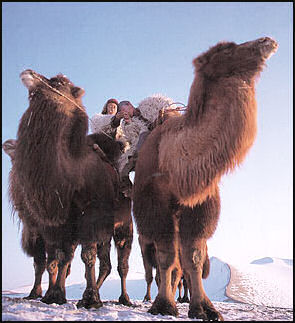
Bactrian camel Bactrian camels are polygynous (males have more than one female as a mate at one time) and
engage in seasonal breeding. Camels reproduce once every two years. The breeding season is in March and April. The number of offspring is usually one. Twins are rare. The gestation period ranges from 360 to 440 days. Young are precocial, meaning they are relatively well-developed when born. Parental care is provided by females. There is an extended period of juvenile learning. The age in which young are weaned ranges from 12 to 24 months and the age in which they become independent ranges from three to six years, with the average time to independence being five years. Females reach sexual or reproductive maturity at three to five years and males do so at three to eight years. [Source: Emily Cutshall, Animal Diversity Web (ADW) /=]
All camel species are polygynous. Typically, the dominant male in a group mates with any of the females in the herd. The rutting seasons lasts about three months. The dominant male often protects and defends the females within the group from wandering bachelor camels. It is not clear exactly dominate males come to dominate their group. Throughout the mating season males may fight, bite, spit, and snort to intimidate and scare away intruding males.
Camels are induced ovulators, which means they only ovulate when stimulated by mating. If a female does not have the opportunity to mate, her ovarian follicles degenerate. Their estrus cycle of a female camel is about 13 to 40 days, with receptivity usually lasting between three and four days. Female produce an average of 12 offspring in their lifetime.
Calves weigh about 37 kilograms at birth and are fully mobile within the first 24 hours. Calves in the wild are typically weaned within the first two years, but this can happen within one year in captivity. Calves live close to their mothers for three to five years, and completely separate once sexually mature. In their fiver or so years with their mothers calves learn how to interact with other members of the herd and how to foraging for food and migrate. Female camels are protective of their young, and may become violent if their young are threatened. Mother camels have been observed mourning the loss of a calf for as long as three months.
Bactrian Camels and People
Bactrian camels are very useful to humans. They are commonly used for transportation and as beasts of burden throughout the primarily desert and semi-arid regions where they live. The shape of their feet aids in their ability to go long distances in harsh desert conditions. Their ability to go extended periods of time without food or water makes them ideal caravan animals. Male camels are often castrated. White camels are regarded as auspicious. It is not unusual for mother camels to reject their calves and refuse to give them milk. When this happens in Mongolia sometimes a musician is called in to play music to induce the camel to weep and accept the calf.
For the most part camels have very few negative impacts on humans. Occasionally, camels can become hostile. An aggravated out-of-control camel can injure a human being because of their enormous size, but this is very unlikely. A hungry camel can become a nuisance by eating personal possessions and by spitting.
When a Bactrian camel is ridden a saddle is placed between the camel’s humps. The saddle has a large wooden frame and is difficult to make. One saddle can be traded for one camel. Riding a saddled Bactrian camel is surprisingly comfortable. It is much more comfortable than riding a Sahara-style dromedary camel.
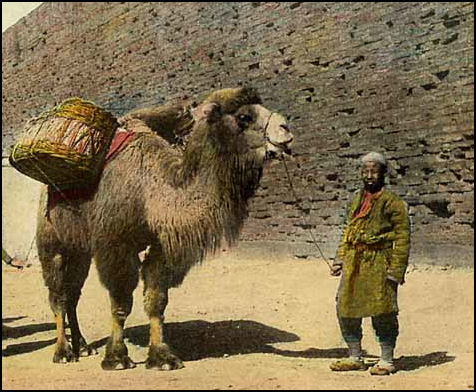
camel outside old Beijing
There are fewer Bactrian camels than there used to be. Sometimes they are eaten for meat. Mostly they are not as useful as they once were. Trucks now carry tents, goods and products that used to carried by camels.
See Separate Articles: CAMELS AND HUMANS factsanddetails.com
Bactrian Camels as Pack Animals
According to Columbia University’s Asia for Educators: “The Bactrian or two-humped camel permits” its users “to transport heavy loads through the desert and other inhospitable terrain. The camel is invaluable not only for transporting the folded gers and other household furnishings when the Mongols move to new pastureland, but also to carry goods designed for trade. A camel could endure the heat of the Gobi desert, could drink enormous quantities of water and then continue for days without liquid, required less pasture than other pack animals, and could extract food from the scruffiest shrubs or blades of grass — all ideal qualities for the daunting desert terrain of southern Mongolia. In addition to the camel's importance for transport,” the animal was valued for its wool, milk (which can also be made into cheese), and meat. [Source: Asia for Educators, Columbia University afe.easia.columbia.edu/mongols ]
Daniel C. Waugh of the University of Washington wrote: “The camel's great virtues include the ability to carry substantial loads — 400-500 pounds — and their well-known capacity for surviving in arid conditions. The secret to the camel's ability to go for days without drinking is in its efficient conservation and processing of fluids (it does not store water in its hump[s], which in fact are largely fat). Camels can maintain their carrying capacity over long distances in dry conditions, eating scrub and thorn bushes. When they drink though, they may consume 25 gallons at a time; so caravan routes do have to include rivers or wells at regular intervals. The use of the camel as the dominant means of transporting goods over much of Inner Asia is in part a matter of economic efficiency — as Richard Bulliet has argued, camels are cost efficient compared to the use of carts requiring the maintenance of roads and the kind of support network that would be required for other transport animals. In some areas though down into modern times, camels continue to be used as draft animals, pulling plows and hitched to carts. *\ [Source: Daniel C. Waugh, University of Washington, depts.washington.edu/silkroad *]
Camel Wrestling
Camel wrestling tournaments with Bactrain camels are held in southwest Turkey during the winter time. The fights are between large, muscular, shaggy males camels stirred up by the presence of an estuarine female that is paraded around the arena within whiffing distance of the males. A pair of wrestling males respond to this by locking necks and trying to knock their opponents down or forcing him to run away..
In most fights the camels lock into a position in which their heads are barely above the ground and they stay in that position until the match is called a draw. Very few fights have a decisive winner. A good crowd is usually on hand, and there is a lot of music and partying. The sport doesn't seem cruel, the only thing that is really off-putting is the huge, disgusting globs of saliva that accumulates on lips of the excited male camels.
There are about 30 camel wrestling festivals a year. The sport is popular in all the provinces of the Aegean from Canakkale in the north to Antalaya in the south. In this region there are more than a thousand wrestling camels, which are bred especially for the sport. The camels participate in around a dozen wrestling competitions a year. The most valuable ones are worth around $100,000. Much of the money raised during the competition goes to charity.
Bactrian Camel Products
Camels provide humans meat, milk, hides, sinews, and bone. The milk is made into cheese of fermented to make shabat enjoyed by many people in Central Asia. The fat in the humps can be melted down and used for cooking purposes. Camel hair is used to make clothes, blankets, tents, and other fabric containing items. Camel dung is used as a fuel and even a building material. . Their hides are made into into leather products. Camels are valued possessions and are bought, sold, and traded at special markets.
Bactrian camels have a shaggy outer coat that yields soft, highly sought-after "camel hair." The hair is usually plucked in the summer when the camels shed. An average camel yield 2½ pounds of hair a year. The hair is brushed and exported and woven into fine camel hair suits and coats. In hot places, Bactrian camels are sheered in the summer.
Describing the milking of a camel, Thomas Allen wrote in National Geographic: The woman “wrapped a rope around the camel's back legs and tightened the rope by bracing her knee against the camel's rump. She led a nursing camel up to the female and, as soon as the baby camel began nursing, yanked it away. The woman then began milking the camel, squirting the milk into a dirty tin can."
The film “The Story of the Weeping Camel” (2004) was nominated for an Academy Award for Best Foreign Language film in 2005. It is about a group of Mongolian nomads who use a musical ritual to get a mother camel to weep and accept and nurse her rare white calf, which she previously rejected. As the musician plays his cello-like lament the mother camel appears to weep. The film was directed by Byambasuren Davaa, a Mongolian woman film maker, and financed with German money.
Endangered Wild Bactrian Camels
Wild Bactrian camels are currently a critically endangered species. On the International Union for Conservation of Nature (IUCN) Red List they are listed as No special status. On the US Federal List they are classified as Endangered. In CITES (Convention on International Trade in Endangered Species of Wild) they are in Appendix I, which lists species that are the most endangered among CITES-listed animals and plants. [Source: Emily Cutshall, Animal Diversity Web (ADW) /=]
Wild Bactrian camels are threatened by poaching, wolves and illegal mining. Some illegal miners have placed explosives at water holes to blow up camels. Because of hunting and predators such as wolves there is an expected loss of 25 to 30 animals a year for the Mongoloian subpopulation. Based on these trends, the future of wild Bactrian camels is questionable. /=\
Bactrian camels face few predators due to their large size and the harsh environment in which they live is unfit for the majority of predators. However, leopards and wolves are sometimes found roaming around the colder regions of Asia and occasionally prey on young or sick camels. Wild Bactrian camels are predicted to decrease in population size by more than 80 percent within the next three generations. The subpopulation in Mongolia is estimated to have had a 46 percent decrease in population size since 1985, although exact population size was not identified in scholarly research. /=\
Efforts to help wild camels have been focused on the isolated populations of them in China and Mongolia and making sure they don't breed with the domestic camels. Hybridization is a major worry in terms of the health of the entire population of wild camels
Image Sources: Wikimedia Commons, Silk Road Foundation; Shanghai Museum, CNTO, camel photos.com
Text Sources: Animal Diversity Web animaldiversity.org ; National Geographic, Live Science, Natural History magazine, CNTO (China National Tourism Administration) David Attenborough books, New York Times, Washington Post, Los Angeles Times, Smithsonian magazine, Discover magazine, The New Yorker, Time, BBC, CNN, Reuters, Associated Press, AFP, Lonely Planet Guides, Wikipedia, The Guardian, Top Secret Animal Attack Files website and various books and other publications.
Last updated April 2025