
PITCHER PLANTS
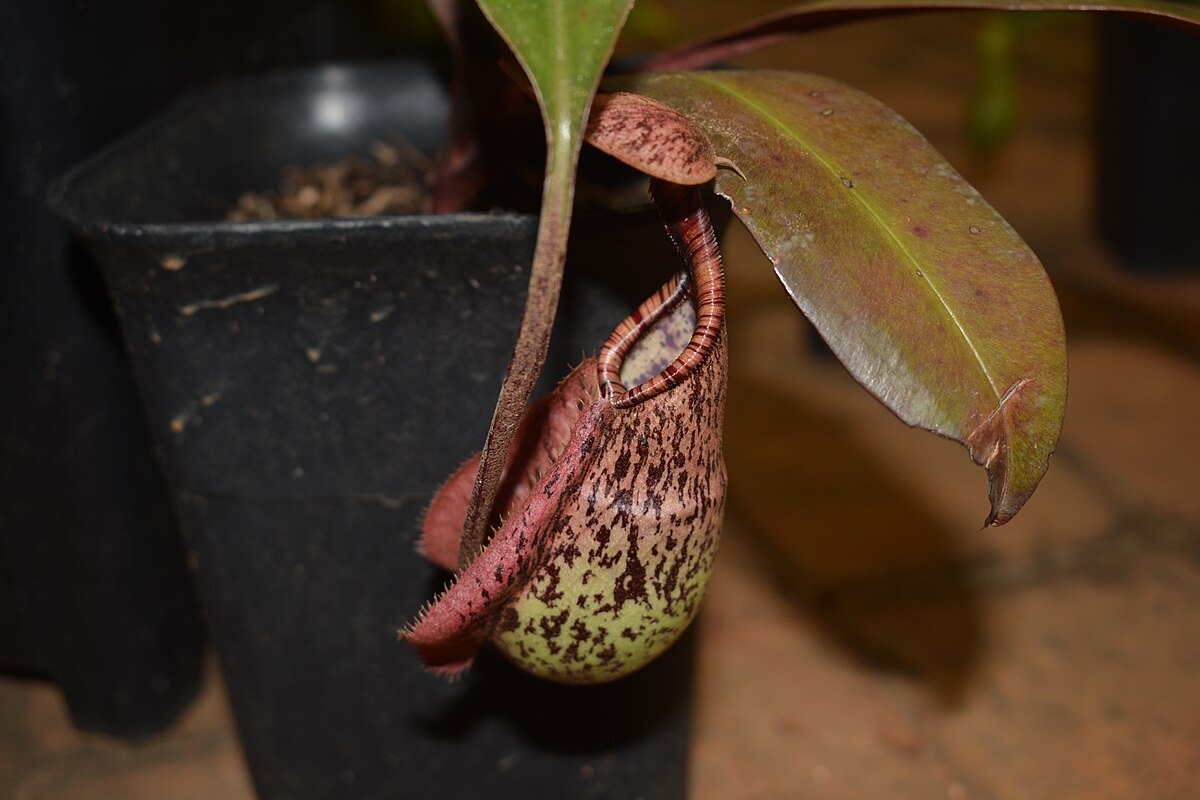
Pitcher plants are carnivorous plants that have a sack-like, toilet-shaped pitcher that has fluid inside that it used to catch insects. They often grow as climbing vines. The pitchers have entrapped ants, spiders, flies mosquitos, cockroaches, centipedes and even tadpoles, scorpions and mice. The plants consume insects and other creatures to get nitrogen which is often deficient in regions where they grow. Pitcher plants are not just hunters they are also prey. A number of animals feed on them despite their high acidity and powerful enzymes.
Pitcher plants (the genus Nepenthese) are found as far west as Madagascar, as far east as New Caledonia, as far south as northern Australia and as far north as coastal China. Many species can be found in southern Malaysia, Indonesia, China, Vietnam, Cambodia, the Philippines, and New Guinea. A few species are found in Madagascar, Australia. New Caledonia, India, Sri Lanka, and the Seychelles. Many of most interesting and spectacular species reside in peninsular Malaysia, the islands of Sumatra and Borneo. Their greatest diversity is found on Borneo where more than 50 species make their home. Altogether there are over 100 species of pitcher plant. Overseas, pitcher plants are coveted by collectors. There is a large profitable market to supply them. Some varieties sell for hundreds — even thousands — of dollars a piece.
According to Cambridge University: Pitcher plants are able colonize nutrient-poor habitats where other plants struggle to grow. Prey is captured in specialized pitcher-shaped leaves with slippery surfaces on the upper rim and inner wall, and drowns in the digestive fluid at the bottom. Under humid conditions, the wettable pitcher rim is covered by a very thin, continuous film of water. If an insect tries to walk on the wet surface, its adhesive pads (the 'soles' of its feet) are prevented from making contact with the surface and instead slip on the water layer, similar to the 'aquaplaning' effect of a car tire on a wet road. [Source: Cambridge University, June 14, 2012]
Pitcher plants range in sizes from 2.5 to 30 centimeters (one inch to one foot) and can carry anywhere from one teaspoon of water to over half a liter (a pint). A rare species in Brunei is the largest. As far as color is concerned, they range from bright red to pale green to almost black. According to Natural History magazine: it was assumed they were passive generalists that rely only on the most basic enticement — nectar — to capture hapless insects that stumble into their pitcher.” But in reality the plants “display a wide range of feeding strategies, some of which are exquisitely fine-tuned for trapping specific prey. [Source: Natural History magazine, October 2006]
See Separate Article: PITCHER PLANTS: CHARACTERISTICS, PREY-CATCHING, DIGESTION, SPECIES factsanddetails.com
Websites and Resources: Rainforest Action Network ran.org ; Rainforest Foundation rainforestfoundation.org ; World Rainforest Movement wrm.org.uy ; Wikipedia article Wikipedia ; Forest Peoples Programme forestpeoples.org ; Rainforest Alliance rainforest-alliance.org ; Nature Conservancy nature.org/rainforests ; National Geographic environment.nationalgeographic.com/environment/habitats/rainforest-profile ; Rainforest Photos rain-tree.com ; Rainforest Animals: Rainforest Animals rainforestanimals.net ; Mongabay.com mongabay.com ; Plants plants.usda.gov
World's Largest Flower
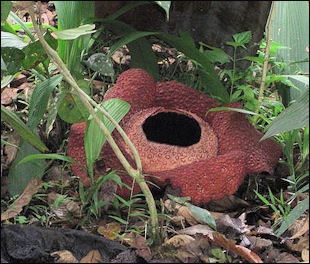
The rafflesia is the world's largest flower. It can measure 42 inches across and weigh 15 pounds, much large than the plant that produces it. The five thick, leathery, red and orange pedals are a foot long and covered with molted, cream-colored warts. The cup-like diaphragm the pedals surround can hold six quarts of water. Within the cup are spiky sex organs. The flower has no visible leaves or stems and sits directly on the ground.. [Source: William Meijer, National Geographic, July 1985]
Rafflesia was discovered and named after Sir Thomas Stamford Raffles, an influential early 19th century British colonial leader in Southeast Asia. A famous hotel in Singapore is also named after him. Today the rafflesia is found only in western Borneo and Sumatra. Elephants, tigers and a little blue snake with a red head with a bite that kill you within minutes also live in the jungles where rafflesia is found.
There are several species of rafflesia . The largest is found in Sumatra. The plant of this species regularly produces a flower that is about 36 inches across. It is not known why the flower is so big. Perhaps it is because the plant gets all of its food from its host and can pour all its energy into making the flower.
See Separate Article: WORLD'S LARGEST FLOWERS factsanddetails.com
Titan Arum Flower
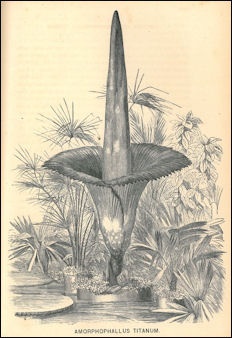
Aru titan beccari
The titum arum plant, which produces a huge trumpet-shaped bloom, is also regarded as the world largest and smelliest flower. The titan arum bloom is larger than the rafflesia but is officially an inflorescence not a flower because it consists of a spathe with many small flowers.
Describing the flower he saw, David Attenborough wrote in “The Private Life of Plants”, "Its spathe was shaped like an inverted bell with its point close to the ground. It was strengthened by long white ribs, like the spokes of a half-opened upside-down umbrella. Its upper margin was frilled. Outside, it was creamy green, but inside an intense and glowing crimson. From the center of this rose the huge spandix, like a wrinkled greyish spire. It was so out of scale with every other plant around it that its seemed to belong to another world."
The titan arum plant grows only in the rain forests of Central Sumatra. The six-foot-high, three-foot-wide bloom appears every four to seven years or so. The plant reproduces with the help of flies that are attracted by a smell released from the bloom that has been likened to a "dead crab on the beach with a sweet edge of burning sugar mixed with the sour smell of urine and ammonia." The smell is usually released in sudden burst at night.
The Arum Titan flowers for just three days. One bloomed at the Botanical garden in Basel, Switzerland produced a yellow pistol that was 2.27 meters high and tuber that weighed 13.6 kilograms. What was unusual was th the second blooming in November 2012 occurred less than 20 months after he first. One that bloomed in Meise near Brussels in July 2013, measured 2.44 meters
Orchids and Fig Trees
The world's largest orchid is the “Grammatophyllum speciosum Blume”. Discovered in 1825 by botanist Carl Blume, it is found in rain forests in Southeast Asia, Borneo and Pacific islands such as the Solomon islands. One specimen found growing 150 feet above the ground in Borneo boasted of 25-foot-wide "crow's nest” with 50 spikes, five to 8 feet long, with each spike with 50 to 100 flowers.
Describing a fruiting fig tree un Borneo, David Attenborough wrote: "Monkeys scamper about in the branches sniffing every fig individually to decide from its perfume, whether it has reached perfection, and then if it is to their liking, cramming it into their mouths...Whole families of gibbons turn up and venture out on he furthest, most thinnest twigs, where heavy creatures find it difficult to move, fruit-eating birds flutter and squawk."
"The banquet doesn’t stop at the end of the day. New customers arrive at night. perhaps a loris, nocturnal primitive primate, plane-furred and wide eyed, will emerge from its hiding place, and giant fruit bats land and the branches with the a rustle of leathery wings."
RELATED ARTICLES:
TROPICAL RAINFORESTS: HISTORY, COMPONENTS, STRUCTURE, SOILS, WEATHER factsanddetails.com ;
BIODIVERSITY AND THE NUMBER OF SPECIES factsanddetails.com ;
RAINFOREST TREES, FRUITS, PLANTS AND BAMBOO factsanddetails.com ;
RAINFOREST LIANAS, FIGS, EPIPHYTES, FERNS, BROMELAIDS AND FUNGI factsanddetails.com ;
RAINFOREST ORCHIDS AND FLOWERS factsanddetails.com
Lotus Plants
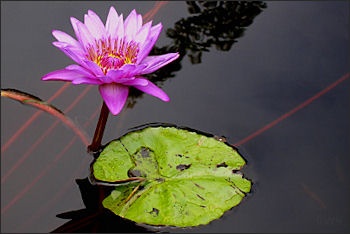
Hans Christian von Baeyer, a professor of physics at the College of William and Mary, wrote in The Science: The lotus flower name “is actually shared by a number of different plants with blossoms of various colors, but the most celebrated in art and literature is the sacred white lotus of the Hindus: Nelumbo nucifera. Its huge, almond-shaped petals form a shallow bowl around a seedpod that is vaguely reminiscent of the nozzle of a sprinkling can. This magnificent blossom, rising on a tall stalk from a flat base of large, round leaves, is endowed with an exotic aura.” [Source: Hans Christian von Baeyer, The Sciences, January/ February 2000]
Nymphaeceae is a family of water plants which includes the water lilies, the sacred lotus (Nelumbo) and the spectacular Queen Victoria water lily (victoria amagorica). It is a family of 8 genera with 90 species found in fresh waters throughout the world. Where there are ponds, lakes and streams these plants are found. Common species in Asia include the: 1) European White Water Lily (Nymphaea alba); 2) Indian Water Lily (N. Nouchali Burmf); 3) Indian Blue Water Lily (N. Stellata Willd); 4) Barclaya longi folia Walld; 5) Pygmy Water Lily (N. tetra gona Georgi); 6) Nymphaea Stellata Willd; and 7) Sacred Lotus or Egyptian Lotus (Nelumbium speciosum Willd). The Sacred Lotus, is believed to bloom only in sunlight and the white lily, is said to bloom only with moonlight. [Source: Kyi Kyi Hla]
As food the lotus was known to the Greek Homer and was widely used by the Chinese, Japanese and Southeast Asians. Its seed may be eaten fresh or dried and used in sweet soups and deserts. The root may be used in salad, boiled in soup, or preserved in sugar and used as desert. From the root may also be extracted a fine starch used by the inhabitants of that area for certain special foods. Lotus seeds are green and resemble large peanuts and come embedded in a cup-like bulb. stalk. It is a very tasty ingredient in steamed duck or as part of the stuffing in duck roast. They can also be eaten raw. Before the era of plastics lotus leaves were used to wrap fresh fish and meat in bazaars.
See Separate Article: LOTUS PLANTS factsanddetails.com
Bamboo
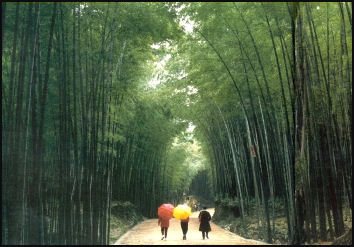
Bamboo is a kind of grass that can grow to size of a tree. The stems are, hollow, polished and jointed and sometimes reach three feet across. Some flower and seed every year; other only do so one every 60 years or so. Some species of bamboo die off en masse after a single flowering. One such die off killed hundred of giant pandas in China in the 1980s. Depending on the species, the die off can occur everywhere from one every dozen year or so to once every century.
In the short term bamboo reproduce by sending up new stems rather than by producing seeds. A single root may produce as many as 100 stems. These stems breaks the soil with it nodes already formed and can grow as much as a meter in a single day. Bamboo doesn't have rings like a tree. The hollow nodes are already developed when they emerges in the spring and grows like an uncoiling party favor.
There are more than 500 species of bamboo. Some species of bamboo — such as “Bambusa Arundinacea” of India and “Phyllostacys” and China — reach heights of 100 feet. Bamboo is both flood- and drought resistant. Hikers who run out of water in the Malaysian rainforest can get about a canteen's worth by boring a hole right above the joint of large stalks of bamboo.
Bamboo Ecosystems
Some plants have entire ecosystems with a variety of animals living in them. Scientists have discovered a species of thick guadua bamboo that supports large populations of ants, beetles and roaches and even snakes and frogs, that actually live within the bamboo's stalks. [Source: Adele Conover, Smithsonian magazine]
The bamboo is dived into sections, called nodes, which collect water that is naturally pumped through the plant. The females of a particular kind of katydid digs holes in the bamboo with long knifelike ovipositors so that they can squeeze their abdomen into the bamboo to lay eggs. Guanda bamboo grow at amazing speeds — sometimes a meter a day — and as it grows the holes made by the katydids expand and elongate creating entry points for rainforest creatures.
Mosquitos, crane flies and other aquatic insects enter the stalks and lay eggs in the water. Their larvae feeds off rotting bamboo sediments and katydid eggs. Birds like the rufous-headed woodpecker drill rectangular holes into the stalks to extract insects, and monkeys "unzip" the elongated katydid cavities to gather food. Eventually the openings are large enough for poison-arrow frogs, finger-size rhinoceros beetles and lizards to enter and feed on the insects and larvae, and lay their eggs. Last but least are tree snakes which climb into the holes to feed on frogs and lizards.
Uses of Bamboo
Bamboo is used for all kinds of things: homes, musical instruments, food, scaffolding, Bamboo has been made into a fabric used to make denim trousers. Surprisingly soft, it is naturally antimicrobial and odor resistant.
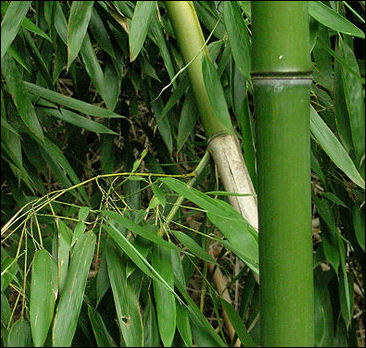
Simon Velez, a Colombia-based architect is leading a global crusade for new uses of bamboo as a strong, eco-sustainable, aesthetically pleasing material that can substitute for wood and
concrete in many building projects. Chris Kraul wrote in the Los Angeles Times, “Velez's dramatic bamboo structures won the 2009 Principal Prince Claus Award in the Netherlands, which cited his "progressive approach to culture and development." His designs have materialized in projects as far-flung as Chinese resorts, the Expo 2000 Hanover trade fair and in Mexico City's Zocalo, or historic central square.Construction on his most ambitious project yet, a bus terminal the length of three football fields, begins early next year in the Aguablanca barrio of Cali in southwestern Colombia. The design features an enormous tile roof that takes advantage of bamboo's sturdiness. [Source: Chris Kraul, Los Angeles Times, November 29, 2011]
Swiss architectural historian Pierre Frey describes Velez as a leader in the "vernacular" movement in architecture, a school of design using local materials and anchored firmly in a designer's surrounding "context." His tile-roofed, bamboo-supported structures, often with monumental overhangs, are a trademark, reflecting the sheltering function in a country with an equatorial sun and monsoon rains.
"In Colombia, there is a stigma attached to bamboo as being the 'wood of the poor,' and many architects turn their noses up at it," Velez told the Los Angeles Times, adding that bamboo traditionally has been used in housing and communal structures built by indigenous and impoverished communities. "But I've discovered it has a lot of advantages."
Those advantages include its beauty and inherent strength, which, when figured as a weight-to-resistance ratio, is twice as strong as steel, according to Velez. Unlike most woods, bamboo is easily and rapidly replaceable; it grows like a weed in Colombia and many other tropical countries, as fast as 30 yards in six months. Given the world's environmental imperatives, including climate change, deforestation and endangered aquifers, Velez said it is only a matter of time before bamboo makes its own case as a logical replacement for traditional woods in construction projects. Velez advanced that process by inventing a kind of tension joint with steel bolts set in concrete that enables builders to fuse bamboo beams end-to-end, expanding the material's design possibilities.
Uses of Bamboo in China, See: PLANTS IN CHINA: ANCIENT TREES, BAMBOO AND ORIGINAL GARDEN PLANTS factsanddetails.com
Sago
The starchy, pith-like center of the sago palm is a staple for many people, especially in New Guinea and the south Pacific. It is rich in carbohydrates (starch and sugar) and is easy to digest. It is consumed by local people in soups, cakes and other foods and is used commercially to make puddings, thicken soups and stiffen textiles.
The sago palm grows to a height of 30 feet or more in low, marshy soils. The starchy pulp is found inside the trunk under a two-inch-thick outer layer. The tree only flowers once, when it is about 15 years old. It dies after producing its seed.
There is virtually no difference between planted and natural sago palm. Large amounts are grown commercially in Malaysia and Indonesia. A single tree may yield 700 pounds of starchy pith.
To make sago the trees are cut down just before they flower. If they are allowed to flower, the energy used to create the flower and seed uses up the stored starch. The pith is chopped out of the tree and grated into a powder, which is mixed with water and filtered with a sieve. The starch mixes with the water and the fiber is left behind. When the water evaporates the sago is pressed with a sieve into “pearl sago.”
Rattan
Rattans are climbing palms native to southeast Asian. The have tough and slender stems as thick as a man’s finger and tendrils with hooks sharp enough to rip a shirt or scrape skin. The hooks are used to attach to trees so the plants can climb upwards. In the forest they flourish as parasitic vines that cling to the forest with “multiple throned tentacles — hundreds of feet long.
Rattan palms yield a fiber called, obviously enough, rattan that is prized for making furniture, baskets, mats, brushes, hampers, and even canes. The strongest and most valuable part of the vine is the skin. The fibers are covered with spines which are used for climbing up the trunks of trees.
Once a rattan establish itself on a tree it can climb to the top of the canopy and sprout huge palm-leaves that can block out the sun on its host plants. Rattans continue to grow vigorously even if their weight overwhelms branches and brings the host plants crashing to the ground. They can grow to length of over 500 feet, giving them longer stems than any other plant, and thereby, by some standards, making them the world’s longest plants. .
Like other palms, rattans are nearly always unbranched and grow only from the bud at their end. If something happens to the bud, the plant can die. The crown is often very tasty and animals like to eat it. Their sharp spines for protection.
Rattan palms have some very complicated relationships with other forms of life. The tips of some species of rattan are protected by small black ants that produce a loud hissing noise by banging their heads on dry husks when disturbed and mass together and viciously bite any intruders. In return the rattan provides the ants with a place to nest and raise aphids, which turn feed on sap in the rattan and in turn excrete a liquid called honey dew that the ants feed on. [Source: David Attenborough, The Private Life of Plants, Princeton University Press, 1995]
Other Plants
On Borneo you can find a species of glowing green mushrooms which are so bright you can see them at night from 40 yards away.
The blue flowers of the “kangkung welanda” bloom only after dark.
Elephant grass is found all over tropical Asia. It is usually what grows best when the tropical rain forest has been cut down and is so named because elephants like to eat it and it is a giant among grasses, growing over 30 feet high. There are a dozen or different species of elephant grass and it is a relative of wild sugarcane. Rhino also eat the grass but humans have a hard time walking through it. In addition to not be able to see anything, the sharp edges of the grass easily cut through human skin.
Image Sources: Wikimedia Commons
Text Sources: Animal Diversity Web animaldiversity.org ; National Geographic, Live Science, Natural History magazine, David Attenborough books, New York Times, Washington Post, Los Angeles Times, Smithsonian magazine, Discover magazine, The New Yorker, Time, Reuters, Associated Press, AFP, Lonely Planet Guides, Wikipedia, The Guardian, Top Secret Animal Attack Files website and various books and other publications.
Last updated February 2025