
WORLD'S LARGEST FLOWER
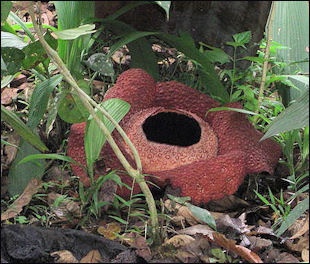
The rafflesia is the world's largest flower. It can measure 42 inches across and weigh 15 pounds, much large than the plant that produces it. The five thick, leathery, red and orange pedals are a foot long and covered with molted, cream-colored warts. The cup-like diaphragm the pedals surround can hold six quarts of water. Within the cup are spiky sex organs. The flower has no visible leaves or stems and sits directly on the ground.. [Source: William Meijer, National Geographic, July 1985]
Rafflesia was discovered and named after Sir Thomas Stamford Raffles, an influential early 19th century British colonial leader in Southeast Asia. A famous hotel in Singapore is also named after him. Today the rafflesia is found only in western Borneo and Sumatra. Elephants, tigers and a little blue snake with a red head with a bite that kill you within minutes also live in the jungles where rafflesia is found.
There are several species of rafflesia . The largest is found in Sumatra. The plant of this species regularly produces a flower that is about 36 inches across. It is not known why the flower is so big. Perhaps it is because the plant gets all of its food from its host and can pour all its energy into making the flower.
RELATED ARTICLES:
TROPICAL RAINFORESTS: HISTORY, COMPONENTS, STRUCTURE, SOILS, WEATHER factsanddetails.com ;
BIODIVERSITY AND THE NUMBER OF SPECIES factsanddetails.com ;
RAINFOREST TREES, FRUITS, PLANTS AND BAMBOO factsanddetails.com ;
RAINFOREST LIANAS, FIGS, EPIPHYTES, FERNS, BROMELAIDS AND FUNGI factsanddetails.com ;
RAINFOREST ORCHIDS AND FLOWERS factsanddetails.com
Websites and Resources: Rainforest Action Network ran.org ; Rainforest Foundation rainforestfoundation.org ; World Rainforest Movement wrm.org.uy ; Wikipedia article Wikipedia ; Forest Peoples Programme forestpeoples.org ; Rainforest Alliance rainforest-alliance.org ; Nature Conservancy nature.org/rainforests ; National Geographic environment.nationalgeographic.com/environment/habitats/rainforest-profile ; Rainforest Photos rain-tree.com ; Rainforest Animals: Rainforest Animals rainforestanimals.net ; Mongabay.com mongabay.com ; Plants plants.usda.gov
Rafflesia Plant and Seeds

The rafflesia is a parasitic plant that digs invisibly into a host vine that is a member of the grape family. The host vine hangs down from the rain forest. In places where it hits the ground, during a predictable time, a lump appears in the vine's bark that gets bigger and bigger until it emerges as an orange globe. The globe continues growing until it becomes a cabbage-lik bud. When a bud opens into a flower the image is reminiscent of the film Invasion of the Body Snatchers. Except when the flower is blooming the entire Rafllesia is underground.
Rafflesia is called the "corpse flower" by locals because it smells like rotting flesh. Guides usually track it by smell not sight. The fetid odor is used to attract carrion flies which are the flower’s chief pollinator. There are fewer females flowers than males and the females are rarely fertilized. The fruit has been observed even less frequently than the flower. It is about six inches across and has a woody brown surface, and an oily, cream-colored flesh filled with thousands of red-brown seeds.
The vines on which the rafflesia grow are common but finding ones with rafflesia is a more difficult proposition. You need to look for a row of a half dozen or so buds of increasing size, bulging from the ground where the vines are covered by a thin layer of soil. Even if you find a bud that is no guarantee that you will see a flower. The timing of the bloom varies. Many animals eat the buds before they become flowers. Other rot on the vine. The flower wilts into a black gooey mess within four days after it blooms.
No one knows for certain how the seeds are transported so they can infect new vines. Some scientist believe that tree shrews and squirrels eat the fruit and distribute the seeds in their excrement. Others believe they are carried in the feet of large animals that puncture the vines by stepping on them, allowing the parasite to enter. They have speculated that one reason there are so few Rafflesia is that there are so few large animals to distribute the seeds.
Spikes at the center of the "Rafflensia kerrii"flower may help dispense the odor of rotting meat. Seeds for the "Rafflesia arrnoldii" and the slightly smaller "Rafflesia keithii" are distributed by treeshews and squirrels that eat the flower's cantaloupe-size fruit and excrete the seeds in their dropping as they scampers around on the vines that play host to the parasitic flowers.
Titan Arum Flower
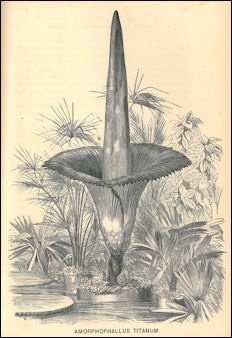
Aru titan beccari
The titum arum plant, which produces a huge trumpet-shaped bloom, is also regarded as the world largest and smelliest flower. The titan arum bloom is larger than the rafflesia but is officially an inflorescence not a flower because it consists of a spathe with many small flowers.
Describing the flower he saw, David Attenborough wrote in “The Private Life of Plants”, "Its spathe was shaped like an inverted bell with its point close to the ground. It was strengthened by long white ribs, like the spokes of a half-opened upside-down umbrella. Its upper margin was frilled. Outside, it was creamy green, but inside an intense and glowing crimson. From the center of this rose the huge spandix, like a wrinkled greyish spire. It was so out of scale with every other plant around it that its seemed to belong to another world."
The titan arum plant grows only in the rain forests of Central Sumatra. The six-foot-high, three-foot-wide bloom appears every four to seven years or so. The plant reproduces with the help of flies that are attracted by a smell released from the bloom that has been likened to a "dead crab on the beach with a sweet edge of burning sugar mixed with the sour smell of urine and ammonia." The smell is usually released in sudden burst at night.
The Arum Titan flowers for just three days. One bloomed at the Botanical garden in Basel, Switzerland produced a yellow pistol that was 2.27 meters high and tuber that weighed 13.6 kilograms. What was unusual was th the second blooming in November 2012 occurred less than 20 months after he first. One that bloomed in Meise near Brussels in July 2013, measured 2.44 meters
Adrian Higgins wrote in the Washington Post, “The titan arum, a plant type known as an aroid and distinguished by having the largest unbranched inflorescence on the planet. That’s botany-speak for one helluva flower, with a central column surrounded by a pleated ruff. It was a freak show of sorts — the thing is just big and otherworldly. When it was brought center stage to the conservatory on July 11, it was four feet high. When it opened on Sunday evening, it was eight feet high, and soon began pulsating heat and a notorious stench that was so nauseating that plant curator Bill McLaughlin said he couldn’t face dinner until about 11 p.m. that night. [Source: Adrian Higgins, Washington Post, July 22, 2013]
The obvious allure of this flower is its bizarre, exotic form taken to extreme size, no doubt. Subconsciously, it’s about sex and death, and I can’t look at Amorphophallus titanum without thinking of the old British Hammer horror films of the ’60s and ’70s. When will the bat fly out of enveloping spathe, I wonder? When will Christopher Lee be found standing behind it, flashing those fangs?
Titan Arum Plant
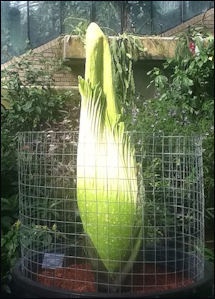
The titum arum belongs to the arum family of plants, Another arum plant, found in Southeast Asia and Borneo, features the world’s largest undivided leaf (See Rain Forest). Like other arums, the titan arum has a trumpet-shaped spathe with a spandix at its center.
The spathe of the titum arum is three feet across with its lip four feet above the ground. The spadix is nine feet tall. The titan arum produces a single leave that looks more like a small tree than a single leaf. Rising up to 20 feet and forming a canopy 15 feet across, the leaf produced food for the corm, a food storage organ formed from a hugely swollen underground stem, and every year its shrivel up and grows again. When the leaf decays, the plant rest for around six months and produces a flower.
The flower sprouts from the corm. It is roughly spherical in shape and has a circumference of five feet. It breaks easily because it is comprised mostly of vegetable fat, has little internal structure and has a delicate skin.
The flower can sprout any time of the year. Before it does the plant is hard to find because the corm is underground. At an unpredictable moment a giant bud emerges from the ground. It may rest above the ground for several days. Then suddenly at flow springs forth and grows several inches a day until t reaches its full height. After two days the flower collapses.
Titum Arum Smell
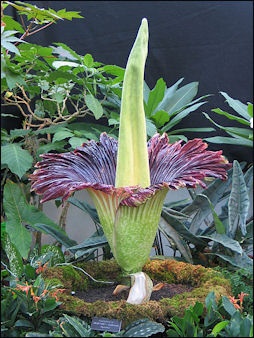
The flower produces the rotting-fish-like smells by raising its temperature several degrees above the surroundings area so and releasing oils that produce the smell when they vaporize in the heat. This attracts pollinators. It is not clear what the pollinators are. They may be carrion beetles or sweat bees. Scientist believe it has to be an animal that can cover the larger distances between flowers.
Higgins wrote: “The flower mimics death in the alchemy of its odor. “I can’t specify which dead animal,” McLaughlin said. (The smell wanes soon after the initial blooming). In its native Sumatra, the titan arum lures carrion beetles to pollinate its many pistils. Beyond the campy stage death, there’s the actual mortality of the flower. It opens for a day or two, ages rapidly and withers. We don’t know when its 90-pound tuber will flower again; perhaps in another eight years.
Titum Arum Smell and Seed
The spateh contracts inwards and twist around the lower pat of the spadix in such a way that a huge water-filled bag is created. Inside are the ovaries of the fertilized female flowers. The flower begins to swell at the basal stem, which increases in size and lifts the water-filled, pear-shaped bag higher and higher.
After a while the bag decays it reveals several thousand six-inch-long stems that form around a tall pillar. At the end of the stems are berries. After they turn bright read they are fed on by hornbills who distribute the seeds in their droppings.
The plant usually dies after its flower, which make it difficult to raise in botanical garden and explains why the plant is very rare and difficult to find in their natural habitat. The first European to record the titum arum was the Italian botanist Odoardo Beccaro who found it in 1878 while collecting plants in Sumatra. His team dug up the corm, which broke when two men carrying slipped and fell. Other corms were found and one was sent to Kew Gardens. In 1996, the flower from the plant bloomed for the first time in 30 years and 6,000 visitors came each day to see it.
Text Sources: Animal Diversity Web animaldiversity.org ; National Geographic, Live Science, Natural History magazine, David Attenborough books, New York Times, Washington Post, Los Angeles Times, Smithsonian magazine, Discover magazine, The New Yorker, Time, Reuters, Associated Press, AFP, Lonely Planet Guides, Wikipedia, The Guardian, Top Secret Animal Attack Files website and various books and other publications.
Last updated February 2025