
WHITE-TAILED EAGLES
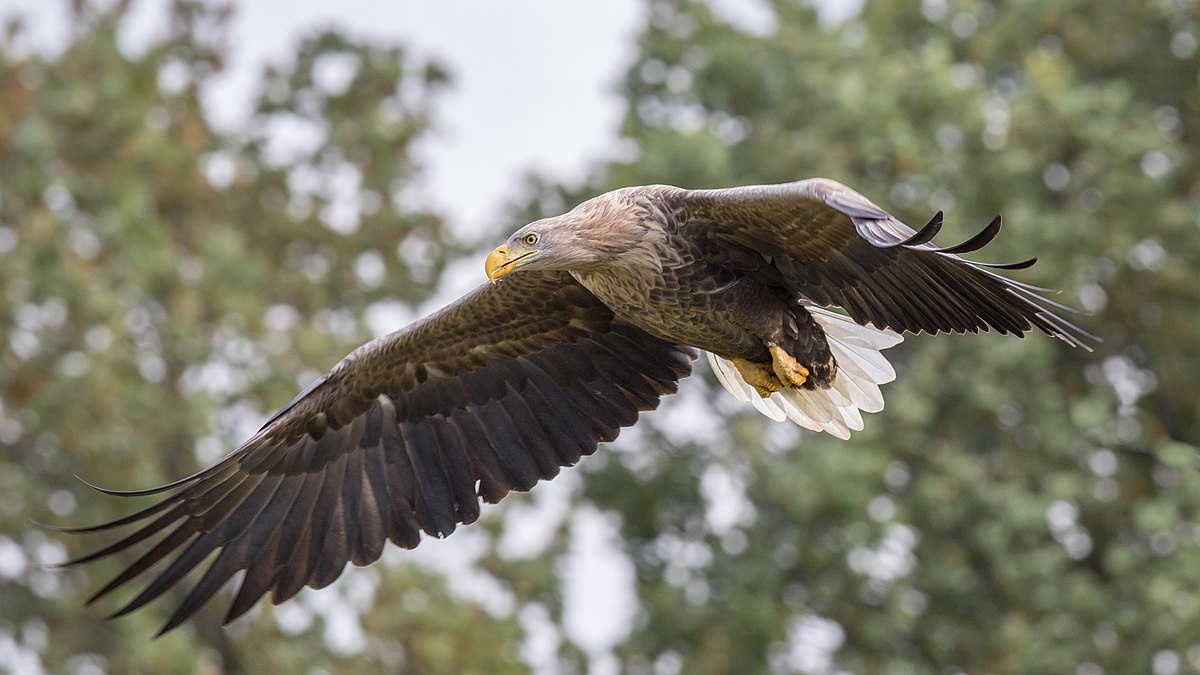
White-tailed eagles (Haliaeetus albicilla) are a large birds of prey widely distributed across temperate Eurasia. Like all eagles, they are members of the family Accipitridae (or accipitrids) which also includes other diurnal raptors such as hawks, kites, and harriers. They are also one of eleven members in the genus Haliaeetus, which are commonly called sea eagles. White-tailed eagles are also referred to as the white-tailed sea-eagles, ern or erne, gray sea eagles, Eurasian sea eagles or simply sea eagle.
While they are found across a wide range, from Greenland and Iceland in the west to Hokkaido in Japan, they are often scarce and spottily distributed as a nesting species within this range, mainly due to human activities such as wetlands, a long history of hunting and systematic persecution by humans, inadvertent poisonings and epidemics of nesting failures due to various manmade chemical pesticides and organic compounds. Despite all this white-tailed eagles are currently classified as a species of Least Concern on the International Union for Conservation of Nature (IUCN) Red List. Successful reintroduction programs, particularly in Scotland, have led to a population increase and wider distribution. The species is now considered stable and widespread across northern Eurasia.
White-tailed eagles usually live most of the year near large bodies of open water, including coastal saltwater areas and inland freshwater lakes, wetlands, bogs and rivers. They require old-growth trees or ample sea cliffs for nesting, and an abundant food supply of fish and water birds. They are both powerful apex predators and opportunistic scavengers and are similar in size and behavior and occupy similar niches as bald eagles (Haliaeetus leucocephalus) in North America.
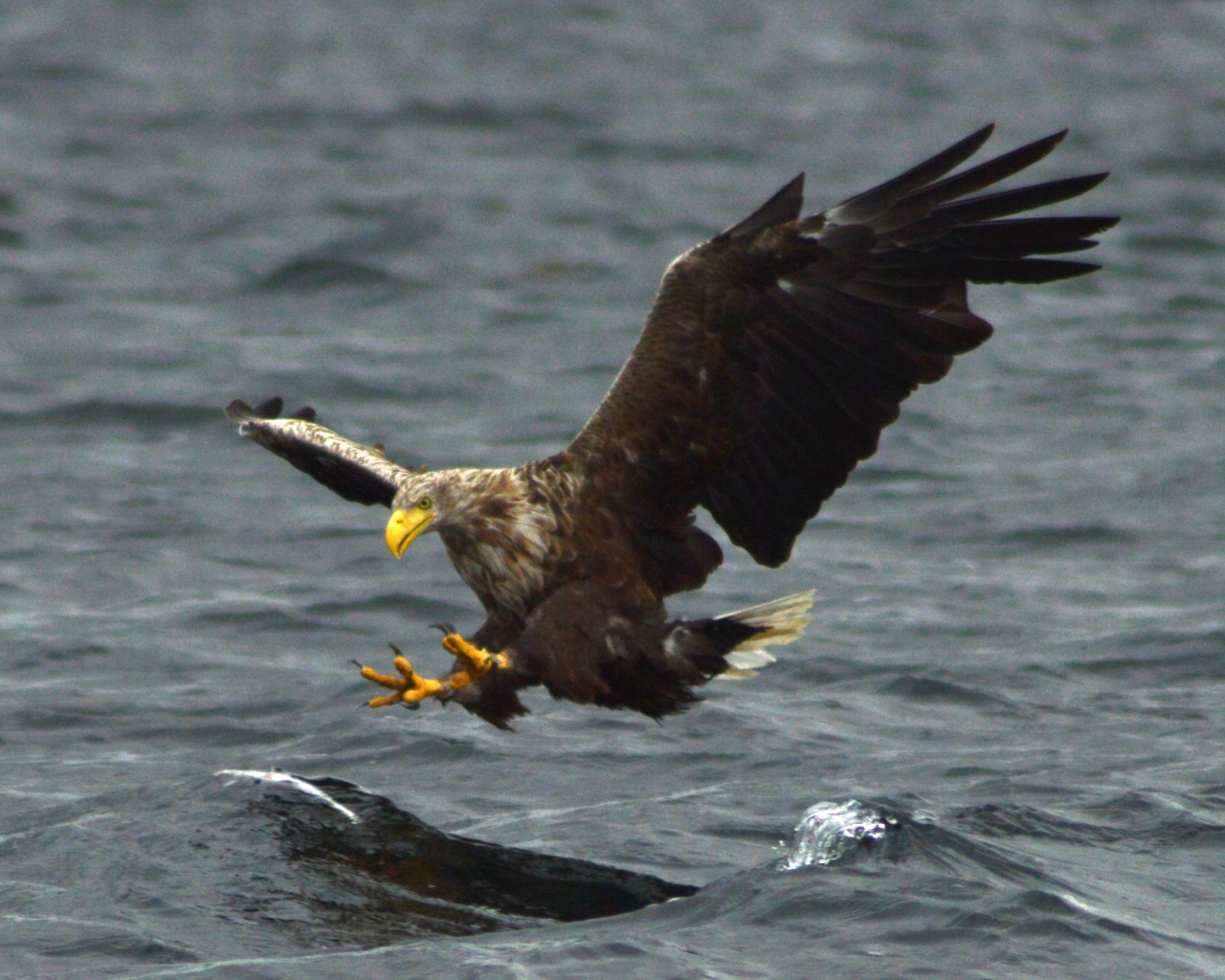
The diet of white-tailed eagle's is varied, opportunistic and seasonal. Prey often includes fish, birds and to a lesser degree mammals. They are powerful predators and capable of attacking large prey of considerable sizes but, like most predators, prefer prey that is vulnerable and easy for them to capture. Especially during the winter (and opportunistically in all seasons), many birds of the species live largely as scavengers, usually by coming across available carrion or watching for the activity of corvids, vultures or other raptors. White-tailed eagles in northeastern Germany were shown to hunt mostly from perches, in a "sit-and-wait" style, usually from a prominent tree perch. Like other sea eagles, they can only capture fish near the water surface. Fish tend to be grabbed in a shallow dive after a short distance flight from a perch, usually with the eagles only getting their feet wet. Occasionally, though, white-tailed eagles have been recorded plunging right into water, usually while hunting on the wing at a height of at least 200 meters (660 feet).
RELATED ARTICLES:
NORTHERN BIRDS factsanddetails.com
GREAT OWLS OF THE NORTH factsanddetails.com
PTARMIGANS: COLOR CHANGES, DIRT AND THE SLOW MALE TRANSITION factsanddetails.com
CRANES: CHARACTERISTICS, BEHAVIOR, SPECIES factsanddetails.com
CINEREOUS VULTURES: CHARACTERISTICS, BEHAVIOR AND REPRODUCTION factsanddetails.com
PUFFINS: CHARACTERISTICS, BEHAVIOR AND REPRODUCTION factsanddetails.com
White-Tailed Eagle Range and Habitat
White-tailed eagles breeds in northern Europe and northern Asia. Their range extends to as far west as southern Greenland and northern and western Iceland, and reintroduced populations in some areas of England, Ireland and Scotland. Europe's largest population breeds in coastal Norway, northern and southwestern Finland, eastern Sweden, broadly in Denmark. They are also found on islands of the Baltic Sea, western Austria, northeastern Germany, northern and eastern Poland the Czech Republic, much of the east Baltic countries, Ukraine, eastern Slovenia, central and southern Hungary, sporadically in Greece and the Danube sections of Romania and Bulgaria to the Black Sea.
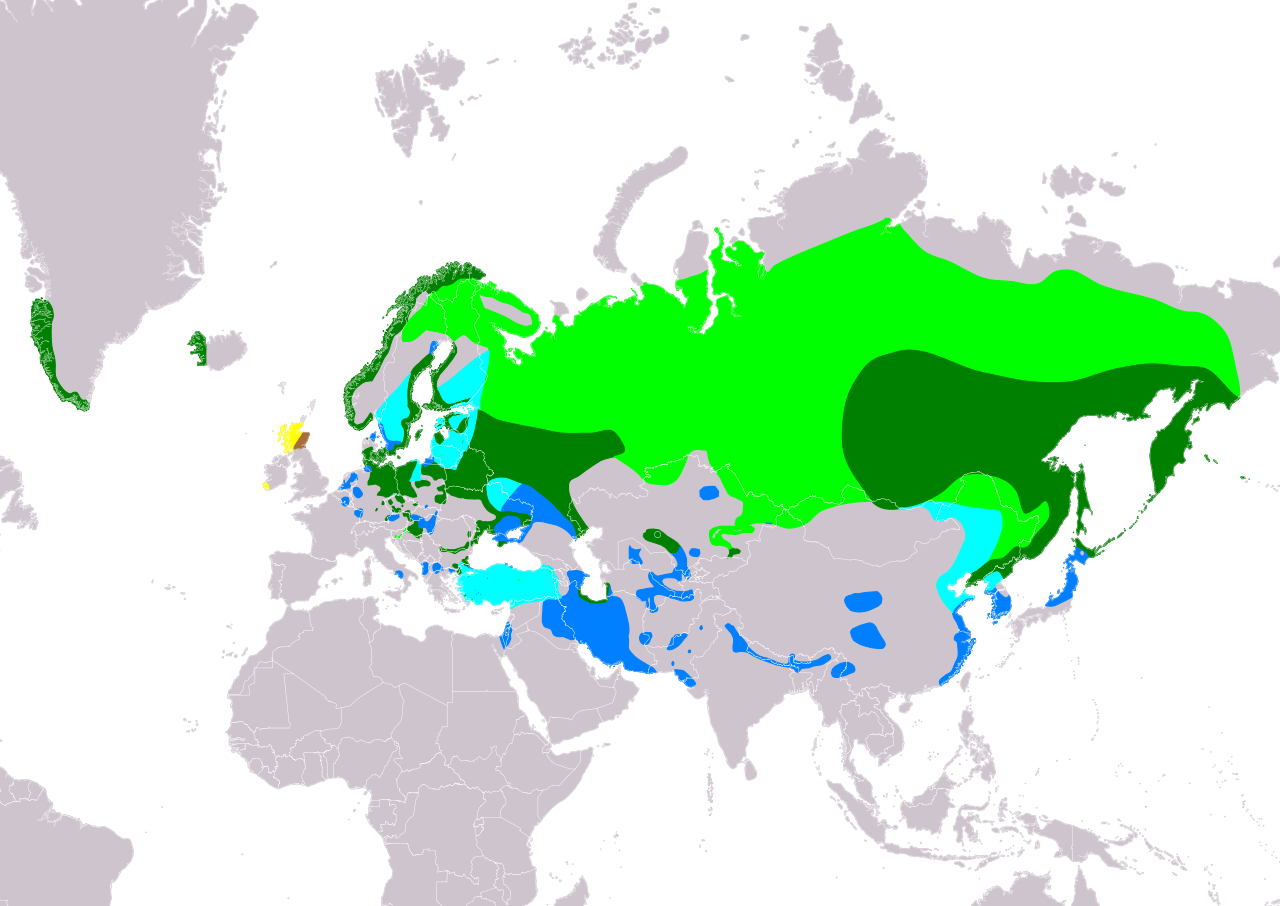
The only country in which white-tailed eagles are found over a continuous and extremely large area is Russia. They are are found broadly everywhere in Russia from European Russia in the west to the Bering Sea in the east, only being fully absent as a nester as far as is known from the high Arctic regions and a section bordering westernmost Kazakhstan, although it breeds to south of this in the Russian coastal part of the Caspian Sea. From Russia, breeding populations spill somewhat into northernmost Mongolia, extreme northwestern China and northern North Korea. The white-tailed eagle also breeds on Sakhalin Island, the Kuril Islands and Hokkaido, the northernmost island of Japan. They are are found here are there in Central Asia, Anatolia and the Middle East.
The wintering range for the white-tailed eagles is less well understood. Small number winter on pockets in Lorraine, France, the border of France to Germany around Strasbourg, Spain, Portugal and Malta. There are better defined wintering populations in the Netherlands, west-central Italy, northern Austria, and fairly broadly into southern Slovakia and northern Hungary.
Healthy numbers winter in much of South Korea and Japan down to as far as Honshu and broadly and regularly in much of Northeast China. White-tailed eagles dispersing from their breeding grounds or natal sites in the Russian Far East are known to occasionally disperse across the Bering Sea to North America in several parts of the Aleutian Islands, the Pribilof Islands and some of mainland coastal Alaska down to Kodiak Island. Some white-tailed eagles even bred in Alaska on Attu Island in the late 1970s to the early 1980s. Intermittent forms of vagrancy and migration (most from eagles that breed in or disperse from Russia) are known to occur in several areas of Turkey, the Levant countries, Azerbaijan and Iran down to even the Persian Gulf,. A few small, pockets have been reported in Turkmenistan, Afghanistan, Uzbekistan, Tajikistan, Pakistan, Nepal, Bhutan, extreme northern Bangladesh and northeastern Myanmar.
White-tailed eagles live in varied habitat and are often associated with wooded areas but are usually found near water in lowland areas. Especially in winter, many white-tailed eagles often frequent low coastal spots, estuaries and coastal marshes. In some places, they seem to switch freely between usually cliff habitat and wooded spots for nesting sites. In some areas, such as Japan, they occur in regions with intensive human fishing activity and have become unusually partially habituated to humans. They readily visit commercial fish farms, carp ponds and similar areas with easily accessible food but they will usually avoid areas where human disturbances especially noisy construction, water sporting and heavy boating activities and hunting commonly occur.
White-Tailed Eagel Characteristics
White-tailed eagles are the largest eagles in Europe and most of their Asian range. They are among the the largest living birds of prey and are recognized the fourth heaviest eagle in the world after Steller's sea eagles, harpy eagles and Philippine eagles. White-tailed eagle weigh between four to 6.9 kilograms (8.8 to 15.2 pounds) and range in length from 66 to 94 centimeters (26 to 37 inches), with wingspan of 1.78 to 2.45 meters (5.9 to 8 feet). This is the largest wingspan of any living eagle. [Source: Wikipedia]
Adult white-tailed eagles are a greyish, mid-brown in color overall. Their plumage is fairly uniform over most of the body and wings, but the upper wing coverts are typically somewhat paler. In the adult, the head, neck and upper breast have a distinctly paler appearance than the rest of the plumage and most often have a buff colouration. In worn or bleached plumages these light areas can be even paler at times, ranging to almost whitish, which can render a resemblance in such eagles to a washed-out bald eagle. The brownish hue of the adult overall makes the somewhat wedge-shaped white tail stand out in contrast. All the bare parts of the adult's body are yellow in colour, including the bill, cere, feet and eyes. Juvenile and immature white-tailed eagles are a much darker brown than the adults and are more unevenly marked, with whitish feather edgings variably showing, mostly manifesting in some small areas of the underside and under-wing, with a narrow white axillary strip usually apparent.
White-tailed eagles of all ages typically perch in quite upright positions on exposed branch, rock or other vantage point, but tend to sit more horizontally on the ground or other level surfaces. They have an ample bill with a relatively high culmen, helping to impart a rather narrow and high crowned facial look, especially compared to Aquila eagles. The neck is at times unusually long-looking, more so than in the bald eagle, which can give the upper body a vulturine appearance. The tail is relatively short, and in some adults it can appear disproportionately stubby in relation to the massive body, and slightly wedge-shaped. All ages have a well-feathered tibia but bare tarsi.
In flight, the wings of white-tailed eagles are extremely broad and deeply fingered, with the usual tendency for at least six fingers to be visible. Juveniles are longer tailed than adults, which is usually more evident in flying than perched birds, with sometimes a slightly bulging section of feathers manifesting on the wing secondaries. The species tends to fly with shallow wing beats; at times the wing beats can be fairly fast for a bird of this size, but interspersed at times with gliding. At a great distance, this flight style may be suggestive of a large brown heron. The wings are held flat or slightly upraised at the tip in flight and the white-tailed eagle is well known to soar extensively. This species can be surprisingly maneuverable on the wing, usually during aerial displays or dogfights with other birds. These eagles may also maneuver by half-closing both wings or fully closing one wing.
Eagles have tongues with backward-facing barbs called "rear-directed papillae," which help them swallow prey, according to the Center for Conservation Biology, a research group at the College of William and Mary and the Virginia Commonwealth University. When eagle parents are feeding their young, they use their tongues to help keep away large bones, furry chunks and sharp fins that could cause the chicks to choke, according to the Raptor Resource Project, a nonprofit bird group based in Iowa. [Source Laura Geggel, Live Science, July 11, 2024]
White-Tailed Eagle Behavior
White-tailed eagles spend much of their day perched on trees or crags, and may often not move for hours. As much a 90 percent of their day is spent perched, especially if weather is poor. Also, they alternate periods of soaring with perching, especially flying over water or well-watered areas, but do considerably less soaring on average than do golden eagles. Pairs regularly roost together, often near to their nest, either on a crag or tree or crevices, overhung ledges or small isolated trees on a crag.
Territory size in white-tailed eagles may vary from 52 to 415 square kilometers (20 to 160 square miles), but is usually less than 130 square kilometers (50 square miles) according to one estimate. Birds of prey tend to more territorial than other birds because they need make sure they have a large enough hunting ground to get enough food. White-tailed eagles are considered relatively gregarious especially among wintering birds and juveniles and immature birds, but adult males especially can be strongly territorial and vigorously fight and dend their territory.
White-tailed eagles are considered a vocal birds of prey during the breeding season. Males make a gri-gri-gri or krick-krick-krick call while the female make a deeper gra-gra-gra-gra or krau-krau-krau-krau sound. These increase in tempo and pitch, with about 15–30 calls in a sequence. Often pairs duet during early spring, in flight or from a perch. When perched, the male calls kyi-kyi-kyi-kli-kliek-yak with the head thrown back and upwards in the last call ended with a lower ko-ko-ko, the perched call of females is similar but deeper, a krau-krau-krau-uik-ik. Typically, the perched version of their calls tend to be shriller and higher than those issued in flight.
White-tailed eagles are considered inconsistent and partial migrants. They seldom migrate in the western part of their range, with even those breeding as far north as Greenland, Iceland and coastal Norway not moving at all for winter. Juveniles are more migratory and dispersive and leave natal areas sooner that older eagles.
White-Tailed Eagle Mating, Reproduction and Offspring
The breeding season for white-tailed eagles is from January to July in the south of their range, and from April to September in the northern part of their range. They pair for life, though if one dies and replacement can occur quickly. Pairs frequently engage during early spring in soaring, sky-dancing and other aerial displays, all with much loud calling, often performed by pair members together, including spectacular mutual cartwheel downwards where talons touch or interlock. Courtship often begins with a bird, often the male, "sky pointing" or "long calling" by throwing their head back. Soaring by pairs follows, with either partner leading by 1 to 6 metes (3.3 to 19.7 feet) or soaring opposite directions. One may swoop upon the other who responds by tilting to one side or may roll over to touch talons momentarily before separating. This may be repeated or gain intensity until they are talon-grappling or "mutual cartwheeling".
White-tailed eagles most often nest in large trees, with perhaps coniferous trees preferred and nests may be in a high main fork, on the canopy or a large side branch. Access to food is a key consideration in the nest's location. Nest heights are between 15 to 25 meters (49 to 82 feet) off the ground. Nests are usually huge, constructed of sticks and branches, averaging roughly one meter (3.3 feet) across and up to 2 meters (6.6 feet) deep, but can be several metres in width & depth, lined variously with moss, greenery, seaweed or wool. The nest must have easy access for the eagles with a clear view of the surrounding environment, shelter from the elements and protection from nest predators.
Individual white-tailed eagles tend to be remarkably consistent on egg-laying times from year to year, seemingly regardless of surrounding weather conditions. The eggs are a broad oval shape and dull white in color and weigh from 120 to 148 grams (4.2 to 5.2 ounces). Clutches usually conists of two eggs although as mant as four have been reported. Incubation starts as soon as the first egg is laid. The female does up to 80–90 percent of incubation and all known nighttime incubating. The makes does some but his primary duty is to capture prey. The time range for incubation can vary from 34 to 46 days, but usually are between 38 and 42 days.
New hatchlings will weigh about 90 to 100 grams (3.2 to 3.5 ounces( and are born with creamy white down which is longest and whitest on the head. The nestlings first become audible at around two to three days and have become active enough to move around the nest and excrete over the nest edge by 10 days old. The initial down is replaced by a thick woolly coat of longer, coarser greyish down, which is usually darker on the crown, underparts and flanks. By about 30 days the first feathers poke through the down. The eaglets can feed themselves starting at 35–40 days. Wing flapping begins only when the wings are partially feathered at 42 days.[35] Around seven weeks of age, the eaglet is more alert and stronger and frequently manipulates sticks and walks more so. At eight weeks, only the long feathers of the wing and tail have yet to develop fully and eaglets tend to start exploring the surrounding branches. The eaglets will attempt their first flight at about 70 days and will usually be flying well by about 90 days of age.
The female of the white-tailed eagle pair seems to do all the brooding early on and will be especially reluctant to leave the nest as well.Thereafter, at 14 to 28 days, brooding behaviour by the female gradually declines. The male may start to brood occasionally around this time period but will not do so at night. Young in nest call a shrilly piieh-piieh, while the female when receiving food from male calls out with tschie-tschie or vueee-vueee. Single or repeated krlee or similar component of calls used in other circumstances, can be variable. Alarm calls tend to be 3–4 short, loud klee or klek notes. Sometimes a different call of alarm or anger, a deep gah-gah-gah or jok-jok-jok, similar to alarm calls of a large gull, is also uttered when a nest is approached (usually recorded while directed towards humans). The young let out a monotonous veee-veee when hungry (or "bored") which intensifies if the eaglets are not fed or brooded immediately.
Image Sources: Wikimedia Commons
Text Sources: Animal Diversity Web animaldiversity.org ; National Geographic, Live Science, Natural History magazine, David Attenborough books, New York Times, Washington Post, Los Angeles Times, Smithsonian magazine, Discover magazine, The New Yorker, Time, BBC, CNN, Reuters, Associated Press, AFP, Lonely Planet Guides, Wikipedia, The Guardian, Top Secret Animal Attack Files website and various books and other publications.
Last updated June 2025