
PTARMIGANS
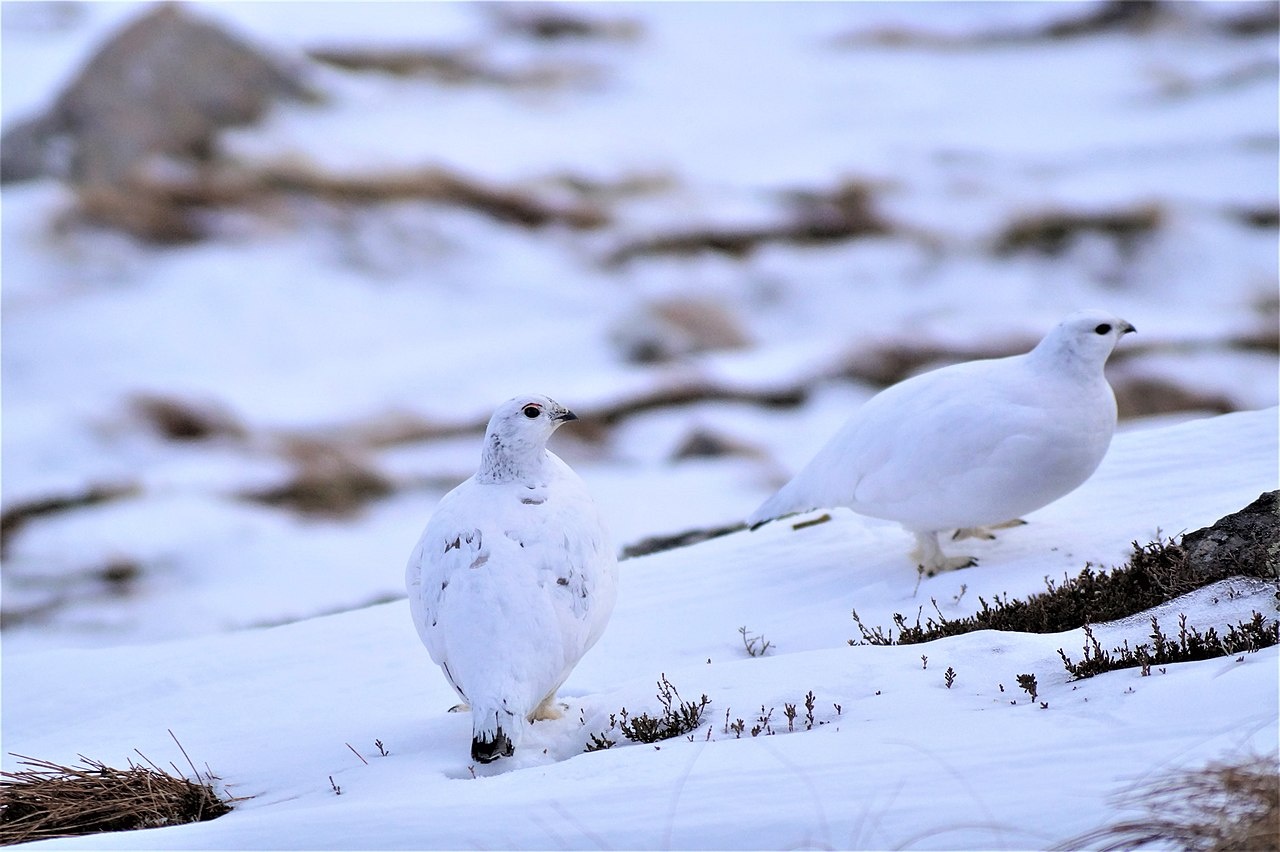
Ptarmigans, also known as rock ptarmigans, are a kind of grouse. There are 17 species of grouse and ptarmigan. They live in the temperate and colder regions of the Northern Hemisphere and are typically found in forests, mountains, tundra or moorlands. Ptarmigans look sort of like pigeons and are of similar size. They are a popular game bird sought out by hunters.
Ptarmigans are a sedentary species which mean they don’t migrate and tend to say in the same area. They breed across Arctic and Subarctic Eurasia and North America on rocky mountainsides and tundra. They are widespread in the Arctic mountains and is found in isolated populations in the mountains of Norway, Sweden, Scotland, the Pyrenees, the Alps, Bulgaria, the Urals, the Pamir Mountains, the Altai Mountains, and Japan. Because of the remote habitat where they lives they have only a few predators —such as golden eagles and gyrafalcons—and are surprisingly approachable.
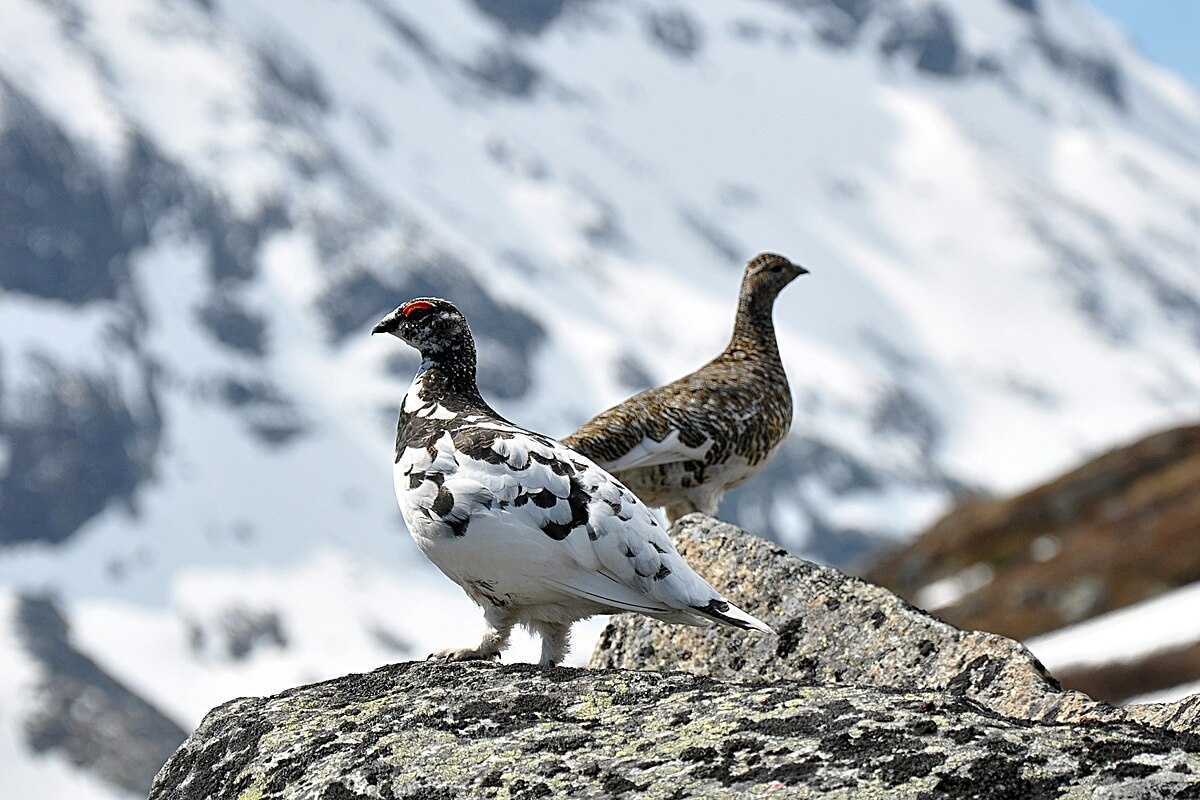
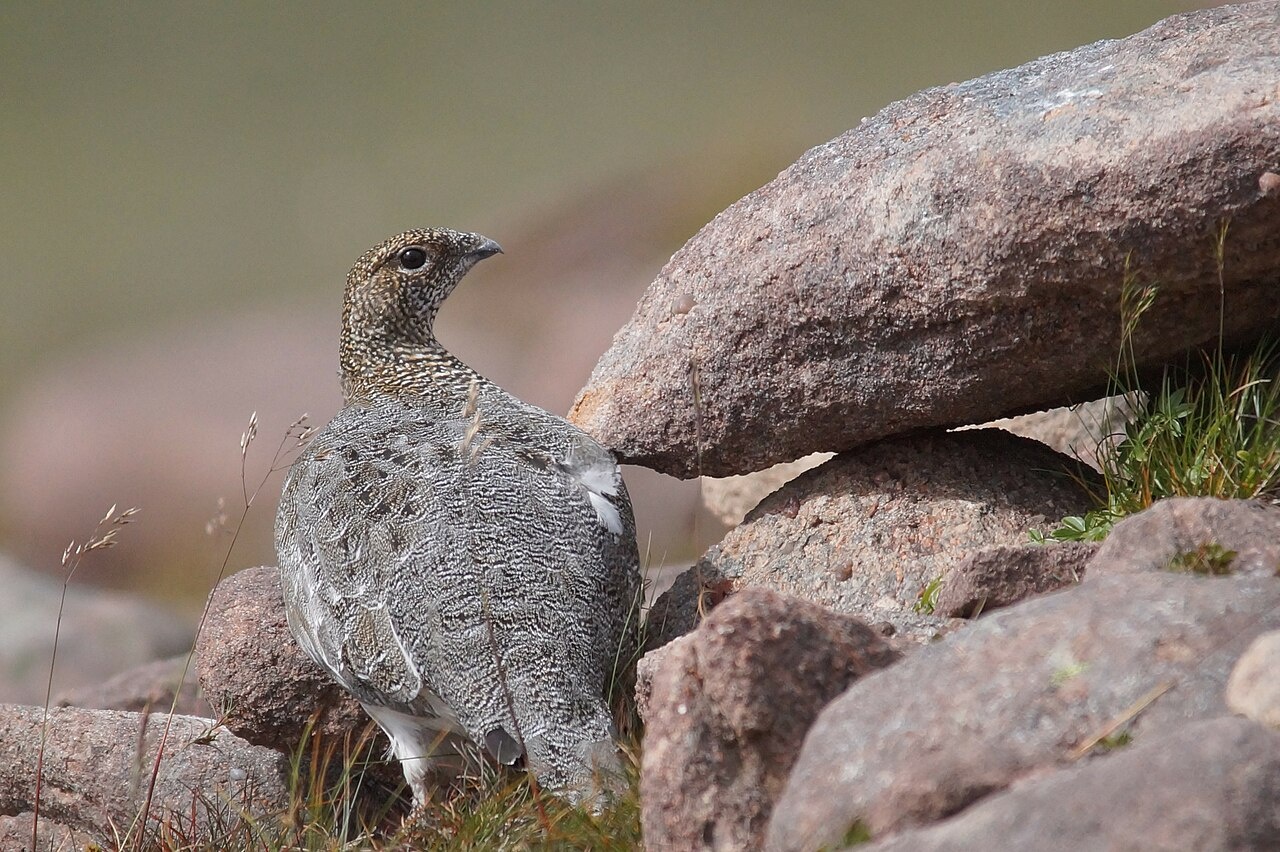
Ptarmigans are well-known for their plumage which is white in winter and brown in summer. The white plumage of the ptarmigan provides good camouflage in the High Arctic winter, but stands out after the snow melts in the spring. During the transition from white to brown, they present an easy target for sharp-eyed gyrfalcons, one of the main predators of ptarmigan. Male ptarmigans change color more slowly than females. They often cover themselves in dirt — the "quick and dirty" way of blending in. The stain, a temporary, transitional camouflage, is adopted when his mate begins to lay her eggs. Females are very adept at sitting motionless so they can blend into their surroundings. They are almost undetectable. It is still not understood why the hens change from white to brown so much quicker than males, who are left vulnerable to attacks.
RELATED ARTICLES:
NORTHERN BIRDS factsanddetails.com
GREAT OWLS OF THE NORTH factsanddetails.com
WHITE-TAILED EAGLES: CHARACTERISTICS, BEHAVIOR AND REPRODUCTION factsanddetails.com
CRANES: CHARACTERISTICS, BEHAVIOR, SPECIES factsanddetails.com
CINEREOUS VULTURES: CHARACTERISTICS, BEHAVIOR AND REPRODUCTION factsanddetails.com
PUFFINS: CHARACTERISTICS, BEHAVIOR AND REPRODUCTION factsanddetails.com
Ptarmigan Characteristics, Diet and Behavior
Ptarmigans are 34 to 36 centimeters (13 to 14 inches) long with an eight-centimeters (3.1-inch) tail and a wingspan of 54 to 60 centimeters (21 to 24 inches). They weigh of 440–640 grams (15.5 to 22.5 ounces). Ptarmigans are smaller than willow ptarmigans by about ten percent. They can be distinguished from winter willow ptarmigans by habitat. Ptarmigans prefers higher elevations and more barren habitat. They are also have a slender bill; males additionally have black lores (skin on the side of a bird's head between the beak and the eye), which are absent in the willow ptarmigan, though they are also absent in female rock ptarmigan.
The diet of ptarmigans varies quite a bit depending on where they the live. In they Alaska, they consume aspen buds, dwarf birch and willow buds and catkins as a staple winter diet. They transition their diets over to crowberries and lingonberry shrubs during the spring. The greatest variety in its diet occurs during early summer, when it feeds on willow leaves, as well as the leaves and flowers of Dryas and locoweed. It also feeds on berries, bistort seeds, and birch buds from late summer to autumn. Insects, larvae and snails are eaten by chicks. [Source: Wikipedia]

Male rock ptarmigans emit a repertoire of guttural snores and rattles, most often directed to other males during breeding season. On open leks, single or multiple males also carry out displays on the ground and in the air to assert their territory, including chasing other males while flying. Aerial courtship rituals involve fast forward flight with rapidly-beating wings followed by an upward glide, tail fanned out. The male, at the peak of the display, belts out a rasping "ah-AAH-ah-AAAAH-a-a-a-a-a-a!", with the sung latter part coinciding with a gliding descent afterwards.[14] The sound is often described as that of a stick being pulled rapidly across the slats of a picket fence.
On the ground, male ptarmigans defend their space by calling and giving chase to other males. Physical conflicts between territorial males rarely occur, while confrontations between the former toward subordinate males are intensified. Other signals via fanning their tails, extended necks, lowered wings and circling a receptive female are also utilized.
Ptarmigan Ability to Change From Brown to White
Ptarmigan turn from brown to white in the winter and back to brown again after the snow melts. They have white feathers in the winter so they blend in with their snowy background. In the spring the white feathers fall out and are replaced with brown mottled ones so can hide in the forest or tundra. Females molt first, several weeks before the males. Males often do it after they breed. Some seem to wait dangerously long and hasten the transformation by rolling their white feathers in the dirt.
Female ptarmigans acquire their mottled coloration at the very start of spring. They have a good chance of escaping the notice of raptors, Arctic foxes, and other predators. The low-growing tundra vegetation otherwise offers little protective cover. Males lags about a month behind female in changing their appearance.
Darwin wrote about the ptarmigan and its ability to change from white to brown in his discussion of natural selection and noted the birds suffer higher rates of predation in the spring when they are still white but their world has started to turn brown. Rock ptarmigan are the favored prey of gyrfalcons who like to fly high above the tundra to spot their prey swoop down and make a final attack. One study of ptarmigans showed that third of all males were taken by gyrfalcons.
Darwin probably was referring to the willow ptarmigan, which winters in the boreal forest and flies north in the spring to breed in the Arctic. Bruce Lyon and Robert Montgomerie wrote in Natural History magazine: He argued that the species' superb camouflage — white in winter, brown in summer — supported his idea that natural selection shapes the traits that increase an animal's ability to survive. To buttress his case, he noted that the birds often suffer intense predation in the spring, when the snow melts and the once-camouflaged white plumage stands out dazzlingly against the brown tundra. [Source: Bruce Lyon and Robert Montgomerie, Natural History magazine, June 2004]
Ptarmigan Camouflage
Bruce Lyon and Robert Montgomerie wrote in Natural History magazine: The Arctic spring is brief and intense — the transition from a snowy winterscape to the brown tundra of summertime seems to happen overnight. When the color of the landscape changes, females shed their white plumage as brown replacement feathers grow in. This transformation makes good sense, because the females are entirely responsible for incubating the eggs and tending the chicks. The low-growing vegetation on the treeless tundra provides nothing in the way of protective cover, and the Arctic has many predators that find ptarmigan tasty. From overhead, nests and chicks are vulnerable to ravens and jaegers, and adults are exposed to gyrfalcons and peregrines. From the ground, Arctic foxes, ground squirrels, and people are a persistent threat. The mottled brown summer plumage of females helps conceal the nest and chicks from those unfriendly eyes. [Source: Bruce Lyon and Robert Montgomerie, Natural History magazine, June 2004]
We moved on our hands and knees in a small patch of tundra to rediscover a ptarmigan nest we had found only a few minutes earlier. Motionless and blending almost perfectly into the surrounding heather and lichen, the female was as close to undetectable as an animal can get. Her mate, though, nervously watching us from atop a nearby boulder, was anything but cryptic. His white plumage practically glowed against the dark tundra.
The effectiveness of the female's spring camouflage is as uncanny as that of her white plumage in winter. We once found ourselves crawling on breeding season, often changing their colors through a feather molt. Although the male ptarmigan also acquires special breeding colors, in this case the colors come tree of charge, because it is the background that changes. Then, a few weeks later, well after the snow has melted, the male's color finally does change, but not just by molting. All the males in our study population changed color during a two-week period simply by getting dirty: literally bathing in dirt.
The biologist and writer Julian Huxley, grandson of Darwin's great friend and supporter Thomas Henry Huxley, thought that the white plumage of the male ptarmigan might distract a predator away from the female. But when we tested that idea, pretending to be predators ourselves, the ptarmigan males led us toward the females rather than away. Of course, even though people have been serious ptarmigan predators for centuries, we might not be the best stand-ins for natural predators.
Ptarmigan Males Get Dirty
Bruce Lyon and Robert Montgomerie wrote in Natural History magazine: Most birds act as if cleanliness really is next to godliness. Watch any bird for a while, and you will see that it spends a lot of rime preening its feathers and bathing in water or dust. Feathers are essential for flight, waterproofing, and insulation, so it is not surprising that maintaining them is a vital part of a bird's daily routine. [Source: Bruce Lyon and Robert Montgomerie, Natural History magazine, June 2004]
How to explain, then, the bizarre sartorial metamorphosis we have observed in the male rock ptarmigan? In just a couple of days in early summer, the male ptarmigan suddenly transforms himself from an immaculate, pugnacious white bird that stands tall on large boulders, to a filthy, bedraggled creature that skulks about on the tundra. Why do these birds get so dirty?
It is well known (at least among ornithologists) that grouse and many other birds bathe in dust, a practice that discourages feather parasites and keeps the feathers in good condition. But dust-bathing does not necessarily lead to a color change, or to soiling. Studies of chickens have shown that dust-bathing cleans feathers by removing excess oils. And we have often seen male ptarmigan emerge from dust-bathing without soiling their plumage — though not during the two-week spring period before they molt.
Birds that get soiled seem to be exercising an option. Could this be their quick and — as it were — dirty method of camouflaging themselves without undergoing a feather molt? Certainly, dirty males evaded our detection until we were within twenty yards, whereas we could easily sight clean males from more than one 50 yards away — or even from as much as a mile away when the air was clear.
Ptarmigan as Gyrafalcon Prey
Bruce Lyon and Robert Montgomerie wrote in Natural History magazine: Detecting prey from far away is an essential element in the unique hunting strategy of gyrfalcons. These predators typically spot potential prey from high above the tundra and then swoop down to within a few feet of the ground to launch a surprise attack. Gyrfalcons specialize in ptarmigan across much of the Arctic; in fact, they are the main cause of ptarmigan mortality. Because the gyrfalcon's vision is much more acute than human vision, gyrfalcons should be able to see a white male ptarmigan on the brown tundra from many miles away. For the ptarmigan, getting dirty could be a lifesaver. [Source: Bruce Lyon and Robert Montgomerie, Natural History magazine, June 2004]
Several studies confirm the high cost of conspicuousness. In the early summer, when males are at their most conspicuous and females are cryptic, male ptarmigan often suffer much higher predation rates. Sometimes the casualty rates are extreme. During May and June, on the island of Hrisey in Iceland, Arnthor Gardarsson, an ornithologist at the University of Iceland in Reykjavik, found that a third of all breeding males are killed by gyrfalcons. If this predation rate continued year-round, a thousand males would be reduced to fewer than ninety within a year — strong natural selection indeed!
Mating and the Male Ptarmigans Slow Transition from White to Brown
Bruce Lyon and Robert Montgomerie wrote in Natural History magazine: If predation is so high, why do males stay conspicuous while females molt to a safer brown? One possible reason, suggested by the Danish ornithologist Finn Salomonsen, is that males cannot molt because their blood carries extra-high levels of testosterone during breeding season. The hormone not only plays an important role in regulating male aggression and territoriality in early spring, but it also inhibits molting. In other words, delayed molting may be an unavoidable side effect of being a good contender in the mating game. Even if this should prove to be true, however, it would not explain why males maintain their gleaming white plumage for so long. Our findings show they do not need to molt to become cryptic: getting dirty does the job just fine. [Source: Bruce Lyon and Robert Montgomerie, Natural History magazine, June 2004]
Our close look at what was going on when individual males became dirty has, we think, shown why the transition to protective coloration is delayed. As do many other male birds, the male ptarmigan seems to gain mating advantages from conspicuous plumage. Perhaps females find such plumage more attractive, or perhaps it somehow helps a male prevail in competition with other males. Either way, more mating opportunities lead to greater reproductive success, or fitness. As a result, the trait of sporting bright plumage is passed on to the male offspring of bright-plumaged males.
We wondered what would happen if a female lost her eggs or nestlings to predators and began the nesting cycle anew. Would her now-dirty mate have a mating disadvantage? Although such re-nesting is extremely rare at our site, simply because the breeding season is so short, two intriguing cases suggest the answer. Within a day after their mates lost their nests to predators, two males cleaned up their act and went from "medium dirty" to immaculate. The reason, presumably, was that their mates became sexually receptive again. Thus plumage soiling not only provides instant camouflage but, unlike molting, is easily reversible.
Darwin’s Sexual Selection and the Male Ptarmigans Slow Transition from White to Brown
Bruce Lyon and Robert Montgomerie wrote in Natural History magazine: Darwin distinguished this kind of natural selection by the term "sexual selection." In general, and more commonly, natural selection favors traits that enhance the survival of the individual in its environment, enabling it to reproduce. In the more specific case of sexual selection, selected traits directly enhance mating success (the male peacock's showy tail is a classic example). Such traits may actually reduce the individual's chances of long-term survival. Indeed, the mortality data suggest that among male ptarmigan, conspicuous plumage can lead to untimely death, but bright white plumage might still confer greater fitness, in the sense that males sporting white plumage father more offspring than less conspicuous birds do. [Source: Bruce Lyon and Robert Montgomerie, Natural History magazine, June 2004]
White plumage may be critical for attracting a mate, but even after pairing with a female during the breeding season, a male that keeps a clean profile may have an advantage. Adulterous matings appear to be common in ptarmigan, and so by remaining conspicuous the male may be able to better defend his territory against philandering neighbors and unmated males, or he may simply remain attractive to his mate when she is tempted by these intruders. So by staying white, a male could enhance his reproductive success. Once his mate's eggs are fertilized, though, he would have little to gain by maintaining his sexually alluring appearance.
What evidence can we offer that this account is correct? Within a given breeding season, the tinting of transformation from clean to dirty often varies dramatically among males, but it is tightly linked to the timing of his mate's reproductive schedule: males get dirty when their mates are laying their eggs and will soon have no more eggs to fertilize. We have also observed a few males that obtained two mates in rapid succession. These polygamists got dirty later than monogamous males, remaining clean until their second female began laying.
Although conspicuous plumage appears important for mating success, we do not yet know which of Darwin's two main mechanisms of sexual selection are at work — female choice of mate, or competition among males. If the females are calling the shots, their choice may merely ensure that their own male offspring will also be attractive to females and, therefore, have higher fitness. But it's also possible that at the same time their offspring win be inheriting some strong survival skills. By "strutting his stuff" with clean, white plumage, a male could be advertising his ability to avoid predation despite being highly conspicuous. And such open risk-taking would be an honest signal, not a deception or a bluff, because staying alive while bearing such conspicuous plumage is proof of good survival skills.
The other possibility is that clean white plumage mainly helps keep male competitors at bay. Perhaps it functions as an aggressive signal between males, serving notice to would-be philanderers to keep away while the female is fertile. One way to distinguish between female choice and male-male competition would be to create dirty males experimentally, early in the season, and examine the consequences with respect to mate choice and interactions with other males. That experiment is much trickier than it sounds, however. On several occasions we actually tried to "dirty" some males with so-called indelible marker pens, but we failed miserably: the males were just too good at keeping their feathers clean. Those experiments highlighted the importance of clean white plumage for these birds, but they have also taught us just how hard it can be to get at all of the rock ptarmigan's dirty little secrets.
Studying Ptarmigan in the Arctic
Bruce Lyon and Robert Montgomerie wrote in Natural History magazine: For thirteen springs in the 1980s and 1990s, we headed for Sarcpa Lake, on the remote Melville Peninsula at the top end of Hudson Bay. To get there we had to hop and skip from place to place on commercial and chartered airlines. Some years we could take a six-hour commercial flight from Montreal that would land more than 1,800 rules to the north, at Hall Beach (population about 625), in what is now the territory of Nunavut. From there we would charter a Twin Otter to fly us the final sixty-mile leg of our journey, transporting all the gear and food needed for a six-to eight-week stay. Our field station was a former Distant Early Warning Line radar site, abandoned in the 1960s. [Source: Bruce Lyon and Robert Montgomerie, Natural History magazine, June 2004]
We usually arrived at the end of May, when the treeless tundra was still covered with snow. At that time, flocks of migratory shorebirds and waterfowl are yet to arrive, but small coveys of rock ptarmigan are already roaming about, looking for exposed seed heads to eat. Dressed in white ever since the preceding September, they have spent the winter on the snowy tundra as far south as the tree line and are all but invisible against the snow.
Once settled on their territories, ptarmigan were spread thinly over our five-square-mile study area. A typical day of fieldwork involved walking for miles as we followed and watched the birds. Our first priority each year was to find out which banded birds had returned from the preceding year and which birds needed to be captured and banded for the first time. The ptarmigan at our site were ridiculously tame, making it easy to catch them with a noose at the end of a twenty-foot-long pole. We found it hard not to giggle while slipping a wobbly noose over a walking but oblivious target. Once birds were individually color-banded, we spent our days recording the color and condition of their plumage and documenting the birds' daily activities to see which males were successful at attracting females. The hard part was that the birds are active twenty-four hours a day, since the summer sun never sets in the High Arctic.
Image Sources: Wikimedia Commons
Text Sources: Animal Diversity Web animaldiversity.org ; National Geographic, Live Science, Natural History magazine, David Attenborough books, New York Times, Washington Post, Los Angeles Times, Smithsonian magazine, Discover magazine, The New Yorker, Time, BBC, CNN, Reuters, Associated Press, AFP, Lonely Planet Guides, Wikipedia, The Guardian, Top Secret Animal Attack Files website and various books and other publications.
Last updated June 2025