
JOSEPH "ERAP" ESTRADA
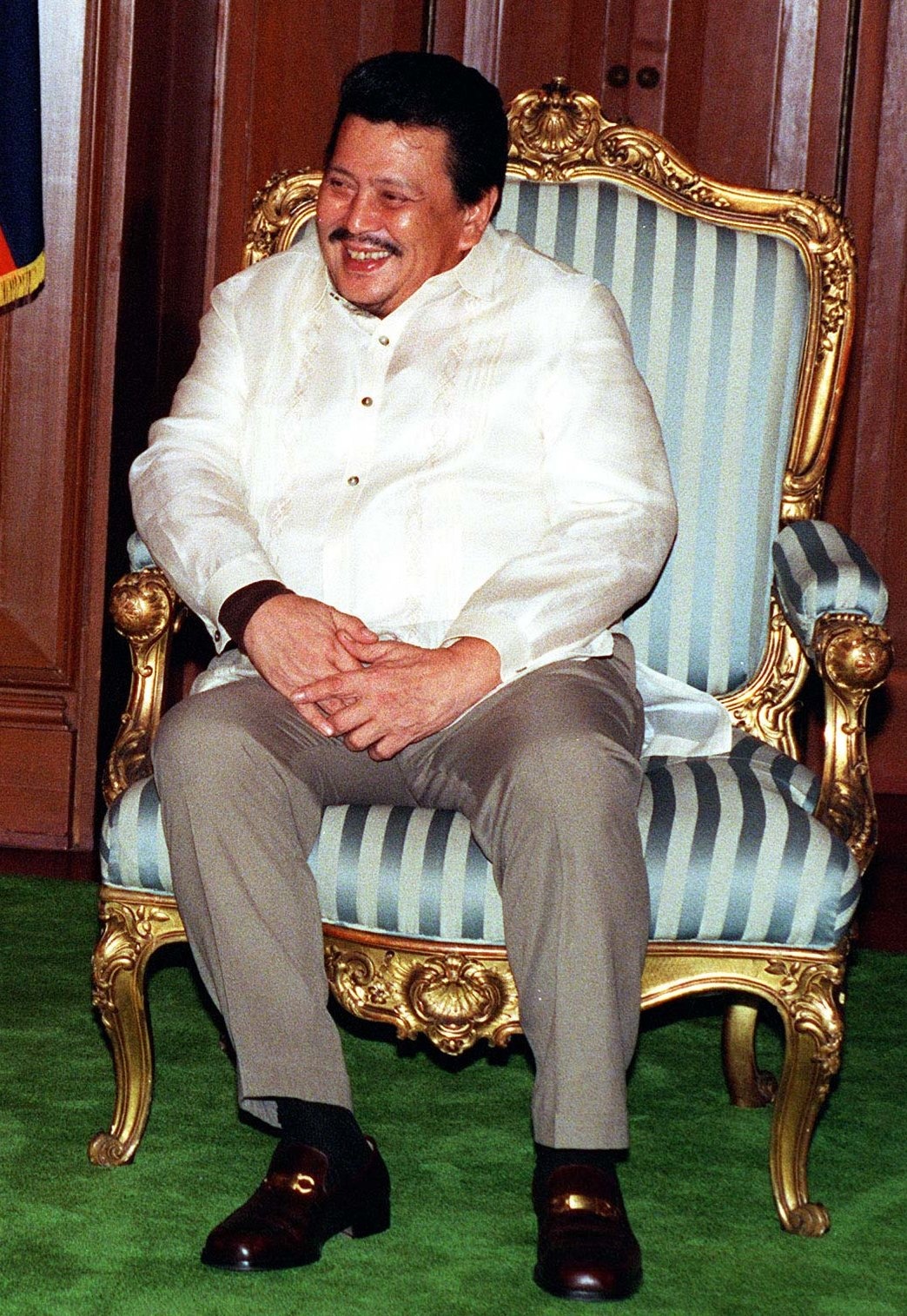
Joseph "Erap" Estrada was elected president of the Philippines in 1998 and served for 31 months until he was ousted after the People Power II protests in January 2001. A former college dropout, movie actor and vice president, he was known for his short and stocky physique, greasy Elvis Presley pompadour and thin mustache. He was notorious for his womanizing, hard drinking, gambling and less than perfect English. His nickname “Erap” is a Tagalog word for “buddy: spelled backwards.
Estrada was well known as an actor in the Philippines before he entered politics. He called the presidency “the greatest role of my life.” Even so he sometimes acted if politics was all a big joke. Once he said, "Why do we pass all these laws when nobody seems to follow them." His trademark was a white wristband.
Why was Estrada so popular when he seemed like such a buffoon. Many said it was because his supporters believed his on screen personality was for real. Others disagreed and argued that his popularity was based more on using symbols and gestures that appealed to the poor and disenfranchised that supported him. The fact that the upper classes made fun of him only solidified his standing in the eyes of his base supporters.
Ellen Nakashima wrote in the Washington Post: “He hobnobbed with President Bill Clinton at the White House. He shook Nelson Mandela's hand when Mandela became South Africa's president. Vilified by his opponents mainly among the Philippines political and business elite he is a near deity to his supporters among the millions of poor Filipinos. Estrada has built his career on appealing to the underclass, playing squatters and farmers and rebels in the movies, then capitalizing on that film persona in politics.” [Source: Ellen Nakashima, Washington Post, June 14, 2005]
According to The Guardian “Estrada, attained superhero status by playing swashbuckling characters in more than 100 films. Estrada rose to stardom in his early 20s, playing tough guys with a soft spot for the needy and weak, roles that endeared him to the many poor people in the Philippines. He parlayed this and his "outsider" status into political success, first as a mayor then a senator and in May 1998 as president. Within months allegations emerged that he had embezzled millions of dollars from gambling syndicates and tobacco taxes. In January 2001, after prosecutors were barred from presenting "crucial" evidence, huge street protests broke out as the influential Catholic bishops allied with the political elite and army top brass to demand his resignation. He quit four days later, was arrested and put on trial in October 2001. In his 1998 inaugural address he vowed that his family would not benefit by one cent from his post. He even set up the Sandiganbayan, the anti-corruption court that convicted him of corruption in 2007 and have him a life sentence (to which he was a pardoned a month later).
RELATED ARTICLES:
JOSEPH ESTRADA AS PRESIDENT OF THE PHILIPPINES (1998-2001) factsanddetails.com
GLORIA MACAPAGAL-ARROYO — PHILIPPINES PRESIDENT 2001-2010 — HER LIFE, CAREER AND PROBLEMS factsanddetails.com
FIDEL RAMOS — PHILIPPINES PRESIDENT (1992-1998) — HIS LIFE, CAREER AND GENERALLY POSITIVE IMPACT factsanddetails.com
PEOPLE POWER AND THE FALL OF MARCOS factsanddetails.com
FERDINAND MARCOS: HIS LIFE, LIES, EDUCATION, WAR RECORD, POLITICAL RISE factsanddetails.com
FERDINAND MARCOS AS PRESIDENT: EARLY PROMISE, RESISTANCE, WASTE factsanddetails.com
MARTIAL LAW YEARS UNDER FERDINAND MARCOS factsanddetails.com
CORAZON (CORY) AQUINO: HER LIFE, CHARACTER, FAMILY, NINOY AND MARCOS factsanddetails.com
CORAZON AQUINO AS PRESIDENT factsanddetails.com
Estrada's Early Life
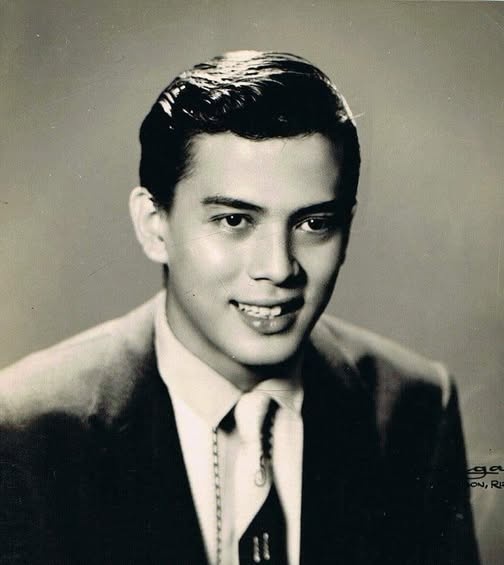
Although characterized himself as a man of humble origins and a friend of the poor, Estrada was born into an upper middle class family in 1937 in Tondo, a district of Manila. His parents were from the families of prosperous landowners.
Estrada attended the prestigious Jesuit school the Ateneo, where he was once expelled after getting into a fight with an American boy in school's restroom. One of his classmates later told Time, "He is bright enough, but he does not study. He can absorb sound bites, but sit him down in a discussion that is longer than 20 minutes and he turns off."
Estrada graduated from high school but he dropped out of college. He briefly attended MIT (the local Mapping Institute of Technology) but dropped out, much to his parents dismay to pursue a career in acting. In the 1990s, Estrada’s passion was the NBA and the Chicago Bulls. He walked easily between the worlds of the poor and the rich and said he was just as comfortable eating with his hands as dining on filet mignon at a VIP banquet.
Estrada's Film Career
As a young man, Estrada became a popular action movie actor, playing uneducated but strong- willed underdogs—roles that common people could identify with—who prevailed over much stronger and more powerful bad guys. When he was running for president in 1998, Estrada said, "I've played fishermen, farmers and jeepney drivers. I've studied these people. I understand their problems."
Estrada appeared in 80 films in the 1950s and 60s, some which are regarded as classics in the Philippines. In his first film, Estrada appeared as a gangster who stole from the rich and gave to the poor. he also appeared in romantic comedies and action films like “You’re Only Worth One Bullet”. His most popular movie was film about a bunch of overweight gangsters called "The Low-Waist Gang."
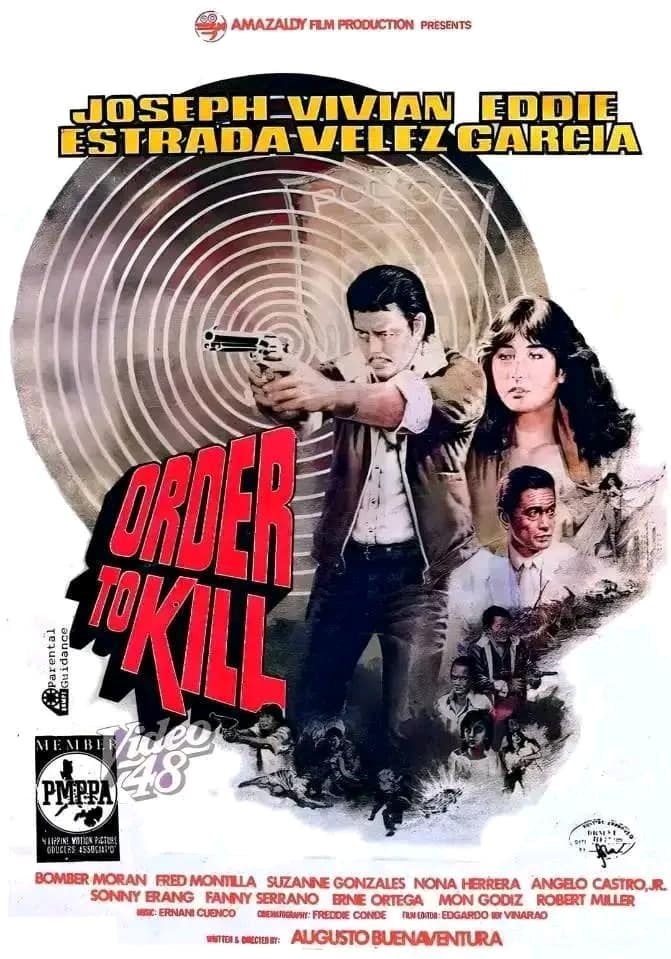
Estrada won the Filipino-equivalent for an Oscar for best actor five times and won five more such awards as producer of the best film. He is credited with changing the image of leading men in the Philippines from handsome light-skinned aristocratic types to darker skinned, working-class mestizos. His enemies were often landlords, the educated classes and corrupt politician supported by the rich.
In 1998 Estrada told Time, "My idol is Ronald Reagan. He was really underestimated when he ran for President because he was a mere actor. But he proved all those intellectual snobs wrong." He also once said, "actors make the best managers" because "make things happen." Gloria Diaz, the 1969 Miss Universe and one of co star said of Estrada, “He was a gentleman on and off the set, making sure that his leading ladies were taken care of. He wouldn’t eat until he was sure that everybody had food. During the kissing scenes, he wasn’t satisfied with just brushing his teeth; he’d rinse with mouthwash, undiluted with water. He respected his leading ladies.”
Estrada's Political Career
Estrada has spent more than 40 year in politics as a mayor, senator, vice president and president. He continued to act in movies even after he was elected mayor in 1967 of the municipality of San Juan within metropolitan Manila, where he was known for disciplining corrupt policemen by punching them. His biggest accomplishment as senator was passing a bill to protect water buffalos.
Estrada won a seat in the Senate in 1987 and became the vice president under Ramos in 1992. Popular among common people, he was initially a presidential candidate in the presidential election but opted for the vice president race when he realized he didn't have much of chance against the likes of Ramos. The Philippines has separate ballots for the president and Vice President. Estrada won easily in a seven-way race.
Once called Manila's Dan Quail, Estrada was not a strong ally of Ramos. As vice president he was put in charge of a Presidential Anti-Crime Commission. The agents under his command, however, were criticized for their gun-happy ways. In their first year they shot down 48 suspects, including two policemen in a shootout with drug dealers during rush hour traffic (one policeman was shot point blank in the head by another policeman).
Jokes About Estrada
One of the best selling books in the Philippines in 1994, was collection of Erap jokes called “ERAPtion: How to Speak English Without Really Trial” written by a news paper columnist who has yet to live down the fact that he was Estrada's English teacher. [Source: William Branigin, the Washington Post, November 12, 1994]
Among the jokes in the book are: 1) Once Corazon Aquino turned Estrada and said, "Erap, rice please." He promptly stood up. 2) When asked why he liked a certain restaurant, he said, "I like the ambulance." 3) When asked what impressed him the most after a visit to Sea World, he said, "It's the first time I've seen an octopus up close. I never realized it had so many testicles." And that, as Erap would say, is only the tip of the ice cream. He prefers to speak in Tagalog. Once he said “I will stop speaking in English. From now on I will just speak in the binocular." [Source: William Branigin, the Washington Post, November 12, 1994. I took some of Branigin's jokes]
Estrada in reality speaks English just fine, although he prefers Tagalog. Recounting a meeting with Hillary Clinton and Vice President Gore at the inauguration of Nelson Mandela, he said, "We talked for more than five minutes and we understood each other."
Estrada's Shortcomings and Appetites
Estrada seemed proud of his lack of education, poor English and loose management style. He was known for dozing through meetings, showing up in his office in the afternoon, nursing a hangover, and showing up two hours late for campaign rallies.
His attention span was so short that he had trouble sitting through cabinet meetings. He ordered that none of his briefings or documents be more than two or three pages, and insisted that his speeches he printed in extra-large print he didn't have to wear glasses when he was speaking. While serving as president he occasionally personally called into radio talk shows to defend himself against accusations of corruption. One critic called him a bull that charges at any red flag.
Estrada was a man of enormous appetites. He reportedly ate five meals a day and smoked three packs of filterless Lucky Strikes for years. Before he became president Estrada claimed he had given up cigarettes and alcohol. He said he quit smoking cold turkey. In 1999, Estrada denied that he resumed his heavy drinking. "I have not tasted a drop of Scotch since I assumed office...I drink only red wine."
Estrada is said to have played million dollar mahjong games and was linked with gangster and drug traffickers. A 1996 security video tape from a casino showed Estrada gambling and serving coffee to a well known gangster. According to one of Estrada's friend, Estrada plotted to assassinate Ramos in 1992 so he could become president.
Estrada and Women
A notorious womanizer, Estrada has had numerous affairs and is said to have fathered at least 10 children with five women other than his wife, including three with te former actress Laarni Enriquez.. When Estrada's love life was compared with that of Clinton's during the Lewinsky scandal in the 1990s, Estrada remarked. "Both President Clinton and I have sex scandals. But Clinton has the scandals and I have the sex." Asked about his opinion of Viagra, he waved off his hand and “I don’t need it.”
Describing the appearance of Vice President Estrada before a group of women journalists, one columnist said, "Much of what we remember at the lunch was him smiling and making goo-goo eyes."
During a confession before Cardinal Sin, Estrada reportedly said, “Forgive me, Sin, I have fathered.” When asked if he was the father of a child given birth by a teen beauty queen, Estrada said in February 1999, "Many women want to bear my children. It's O.K. They all are welcome."
Estrada's wife is a doctor and psychiatrist who seems to accept his philandering. She even defended him when he confessed an infatuation with Miss Columbia at the Miss World contest and joked he was thinking about having his wife assassinated. They had three children together.
Ellen Nakashima wrote in the Washington Post in 2005: Estrada “has no regrets about his former libertine lifestyle. "I'd do it over again," he said. "Except maybe . . . have children outside my marriage." As he spoke, a 9-year-old son, one of eight children he says he has had by former mistresses, romped happily about the saloon. He said he accepts his responsibility and is ensuring the children are provided for. [Source: Ellen Nakashima, Washington Post, June 14, 2005]
Estrada Shoots Comeback Movie in 2009
In 2009, filming began on Joseph Estrada’s first movie since he had been removed from office on corruption charges. “I am back. I am happy,” Estrada told ABS-CBN, the sister company of film producer Star Cinema. “This is where I came from, where I became known.” At age 72, he started work on a comedy about a minibus driver struggling to accept his daughter’s plan to marry her Filipino-American boyfriend. His spokeswoman, Margaux Salcedo, explained that Estrada believed poor audiences who were already burdened by hardship should not be made to cry at the movies, and instead hoped to give them moments of happiness. [Source: Oliver Teves, Associated Press, July 29, 2009]
Estrada, recognized for his trademark mustache, pompadour, and wristband, had long been considered a hall-of-fame figure in Philippine cinema, having appeared in more than 100 films. His previous movie, Sa Kuko ng Agila (“In the Eagle’s Claws”), released in 1989 while he was serving as a senator, featured him once again as a minibus driver, this time opposing U.S. military bases in the Philippines.
He admitted that he felt somewhat uncomfortable using the modern high-tech equipment on the set. Actress Toni Gonzaga, who portrayed his daughter, said she felt honored to work with the former president and described him as a classic actor. The cast filmed scenes inside a jeepney, the common Filipino minibus originally adapted from surplus World War II American jeeps. Director Wenn Deramas praised Estrada’s professionalism, noting that he rarely needed second takes and had requested that he be treated no differently from the rest of the cast.
Estrada Runs for President in 2010
In October 2009, Joseph Estrada announced that he would run again for president, with Jejomar Binay, then mayor of Makati City, as his running mate. He had earlier indicated in interviews that he was willing to represent the opposition if it failed to unite behind a single candidate. One of his lawyers, Rufus Rodriguez, argued that the constitutional one-term limit did not bar Estrada from seeking the presidency again because the prohibition on re-election applied only to a sitting president. [Source: Wikipedia +]
In the 2010 presidential election, Estrada placed second but trailed far behind the winner, Benigno Aquino III, who became president that year. Aquino won 15,208,678 votes (42.08 percent), while Estrada received 9,487,837 votes (26.25 percent). Other candidates included Manny Villar, Gilbert Teodoro, Eddie Villanueva, Richard Gordon, Nicanor Perlas, Jamby Madrigal, and John Carlos de los Reyes. Estrada’s candidacy had been made possible by the pardon granted to him by former president Gloria Macapagal Arroyo, which removed his political disqualification. His defeat marked the first electoral loss of his career, and he later suggested that Aquino’s surge in support following the death of his mother, former president Corazon Aquino, had influenced the outcome.
In October 2010, the magazine Foreign Policy included Estrada in a list of five former world leaders who, in its view, had failed to make a positive difference and had faded into obscurity. Others on the list included Thaksin Shinawatra, José María Aznar, and Gerhard Schröder. The following month, Estrada announced that he would sell his 3,000-square-meter home in San Juan, Metro Manila, for nearly $7 million in order to focus on his real estate ventures. Reports noted that he had already developed two high-rise residential condominium buildings and was planning to construct a third.
Estrada: Mayor of Manila from 2013 to 2019
In May 2012, Joseph Estrada announced that he intended to run for mayor of Manila in the 2013 midterm elections in order to revive his political career. In May 2013, he won the mayoral race, defeating incumbent mayor Alfredo Lim by around 35,000 votes. Estrada received 349,770 votes, while Lim garnered 307,525. The victory marked Estrada’s return to elective office for the first time since he was ousted from the presidency in 2001. His running mate, Isko Moreno, also won by a wide margin. [Source: gmanetwork.com, May 14, 2013; Cris Larano, Wall Street Journal, May 14, 2013]
After being proclaimed winner by the Commission on Elections, Estrada declared that he would restore Manila to its former glory. He described his victory as a form of redemption and vindication, saying that the public continued to trust him despite past controversies, including his impeachment. During the campaign, he criticized Manila’s decline compared to neighboring cities and highlighted the capital’s high levels of poverty, unemployment, and crime. Following his victory, he pledged to improve the city’s image and asked political rivals to set aside differences for the good of Manila.
The election revived a long-standing rivalry between Estrada and Lim, who had also faced each other in the 1998 presidential race, which Estrada won decisively. Known by the nickname “Asiong Salonga” from one of his film roles, Estrada returned to public office after previously serving for many years as mayor of San Juan. Despite President Benigno Aquino III endorsing Lim during the campaign, officials stated that Aquino and Estrada remained on good terms, and that cooperation between Manila City Hall and the national government would continue.
Originally intending to serve only one term, Estrada decided to seek reelection as mayor of Manila in 2016. His running mate was Honey Lacuna, a former 4th District councilor and city social welfare officer. Estrada narrowly defeated former mayor Alfredo Lim by about 2,000 votes, and Lacuna was elected vice mayor. Estrada ran for a third term in 2019. He faced Isko Moreno, a former Manila vice mayor, and again Alfredo Lim. In the election, Estrada was defeated in a landslide by Moreno, who won by more than 100,000 votes. [Source: Wikipedia]
Image Sources: Wikimedia Commons
Text Sources: “Encyclopedia of World Cultures Volume 5: East/Southeast Asia:” edited by Paul Hockings, 1993; National Geographic, Live Science, Philippines Department of Tourism, Metropolitan Museum of Art, Natural History magazine, New York Times, Washington Post, Los Angeles Times, Smithsonian magazine, Encyclopedia.com, Times of London, Library of Congress, The Conversation, The New Yorker, Time, BBC, CNN, Reuters, Associated Press, AFP, Lonely Planet Guides, Google AI, Wikipedia, The Guardian and various websites, books and other publications.
Last updated February 2026