
VENOMOUS SNAKES IN JAPAN
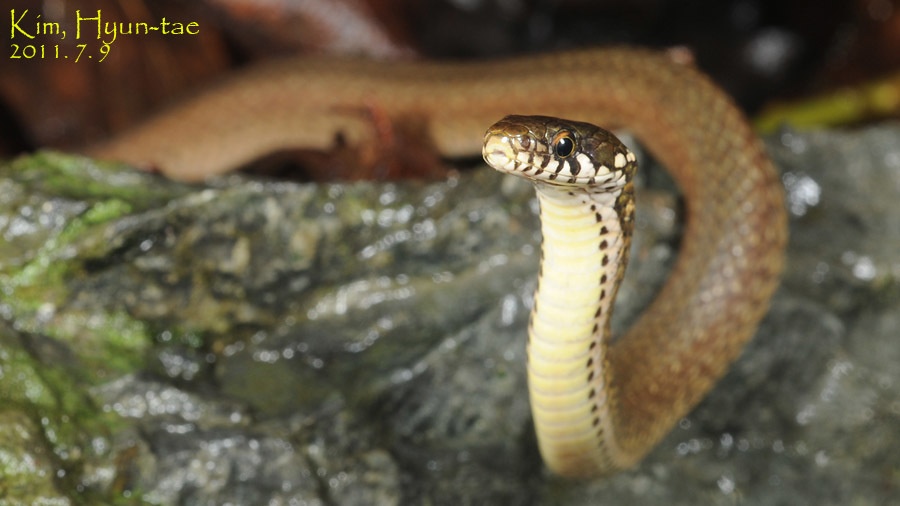
There are three species of venomous snake in Japan: the Japanese keelpack, the “habu” and “mamushi”. Habu and mamushi are vipers — member of the Viperidae family. Venomous sea snakes are sometimes found in Japanese waters around Okinawa but they are more often found further south in places like the Philippines, Indonesia and Pacific islands.
The fangs of vipers, are long. They are so long they have hinges and lie folded up on the roof of the mouth until they are needed: then they flip into position when the mouth opens wide and the bone to which they fangs are connected rotates. The fangs are ready immediately. When they strike their prey they inject their venom like hypodermic needles. The fangs are periodically changed. Rattlesnakes shed their fangs every 60 days. Poisonous snakes need their venom to immobilize prey (they don't use it to kill prey necessarily) and defend themselves. To avoid injury from the claws and bites of large prey, snakes aim to immobilize it as quickly as possible with venom.
On the venomous snakes of Japan, naturalist Mark Brazil wrote: summer is “a great time of year to seek out warmth-loving reptiles, and the further south you are in Japan the more species you have to look for, with Okinawa being best blessed”…. Basking in sunshine is a favorite activity of many species of snakes, but for some reason members of the family Viperidae particularly enjoy it. They become drowsy in the sun, or perhaps it’s because they have become cool and then sluggish that they move into the sun to warm themselves and become active. Either way, exposed banks and roadsides are ideal places to find them, whether the Habu and Himehabu snakes of the Ryukyu Islands or the Mamushi, which ranges from Yakushima Prefecture north to Hokkaido.”
RELATED ARTICLES:
SNAKES, FROGS, LIZARDS AND TURTLES IN JAPAN factsanddetails.com
VENOMOUS SNAKES: VENOM, PHYSIOLOGY, DEADLIEST SPECIES factsanddetails.com
VENOMOUS SNAKE BITES: ANTIVENOMS, WHAT TO DO AND NOT DO factsanddetails.com
SNAKES: HISTORY, CHARACTERISTICS, LARGEST, SENSES, FEEDING, BREEDING factsanddetails.com
REPTILES: TAXONOMY, CHARACTERISTICS, THREATENED STATUS factsanddetails.com
UNUSUAL SNAKES IN ASIA: FLYING, CARTWHEELING AND TENTACLED ONES factsanddetails.com
JAPANESE GIANT SALAMANDER: CHARACTERISTICS, BEHAVIOR AND REPRODUCTION factsanddetails.com
Snake Victims in Japan
Several hundred or a few thousand snake-bites are reported annually in Japan with the number depending on the source. In July 2017, Japan Today reported: “A 10-year-old boy in Itami city in Hyogo Prefecture near Kobe fell unconscious after he was bitten by a poisonous snake. The boy was playing with a friend in a park in a residential area in the late afternoon when he was bitten on the wrist, local police said. He was taken to hospital and later regained consciousness. The boy's mother called an ambulance a few hours after he was bitten as his bleeding did not stop and he complained of headache. His symptoms suggest the snake was a tiger keelback, the police said. The snake was captured by the boy's friend and handed over to the police. [Source: Japan Today, July 30, 2017]
Alexandra Thompson wrote in the Daily Mail: In 2016 and 2008 two men from Japan were diagnosed with acute compartment syndrome (ACS) after going to hospital complaining of agonising pain and swelling, with no apparent cause. ACS is a painful and potentially serious condition caused by bleeding or swelling within a bundle of muscles. This causes an increase in pressure, which restricts blood flow to the area, and could damage nearby muscles and nerves. The legs, feet, arms and hands are most commonly affected. Symptoms include intense pain, tenderness, tightness, tingling and numbness. Treatment involves making an incision in the muscles to release pressure.
According to a study in the journal BMJ Case Reports, The men's muscles were severely enlarged, and they suffered kidney damage, paralysis and tissue death. After lengthy hospital stays of up to 48 days, both men were discharged, but took years before they stopped being plagued by their excruciating symptoms. Doctors believe their ACS occurred due to a venomous bite from a mamushi, although neither mean showed any sign of being bitten (mamushi wounds often go unnoticed due to the snakes' fangs being very thin).[Source: Alexandra Thompson, Daily Mail, April 11, 2018]
In April 2016 an unnamed man, 38, went to hospital complaining of severe pain in his left arm, according to BMJ Case Reports. Eight hours before going to hospital, the patient fell in his garden and developed swelling in his left forearm with tolerable pain. Scans revealed no broken bones or internal bleeding, yet his pain and swelling worsened, leading doctors to believe he was suffering from ACS.As well as developing a squint and double vision, tests revealed evidence of liver damage and inflammation.

Surgery was performed soon after his arrival at the hospital to relieve swelling and wash the suspected venom out of the affected area. Although the patient was put on a high dose of antibiotics, just two days later he developed excess fluid on his left lung and around his heart. He also lost his ability to move his affected hand and arm. After being placed on hemodialysis, which cleans the blood, on day four, the patient gradually started to improve and was finally discharged after 32 days with full hand and arm movement. He said: 'I am satisfied with the treatment I received from the medical team. 'I got back to my preinjury state completely 3 months after the injury.'
In July 2008 an unnamed man, 42, went to hospital complaining of severe pain and swelling in his legs. Eighteen hours earlier, he stumbled in a street gutter and was treated with antibiotics at a different medical centre. There, he was referred to a specialist after doctors suspected his soft tissue had started to die due to bacteria entering his body. While at the specialist hospital he was diagnosed with ACS and, within two hours, underwent surgery to relieve pressure on his legs. The patient was discharged on day 48 with mild paralysis, which did not completely disappear for two years. He said: 'I was pleased with the medical care I received from the hospital staff. 'Although I had a slight symptom of peroneal nerve paralysis for about two years after the treatment, I could still perform my daily activities.'
In April 2012, a Japanese man was killed by a pet shop snake. The Yomiuri Shimbun reported: “A 66-year-old man has died after apparently being bitten by a nonvenomous snake at a pet shop run by his son in Ushiku, Ibaraki Prefecture. Shoji Fujita's wife found her husband lying on the ground with blood running down his head and arm at the breeding facility attached to the pet shop at about 11 p.m., according to police.Fujita was later pronounced dead at a hospital. An autopsy will be conducted to determine the cause of death. The police said Fujita went to the breeding facility to check the room temperature at 10:30 p.m. His wife later went in and found her husband lying near a 6.5-meter-long reticulated python, which had escaped from a wooden box. Reticulated pythons are native to Southeast Asia. [Source: Yomiuri Shimbun, April 17, 2012]
Mamushis
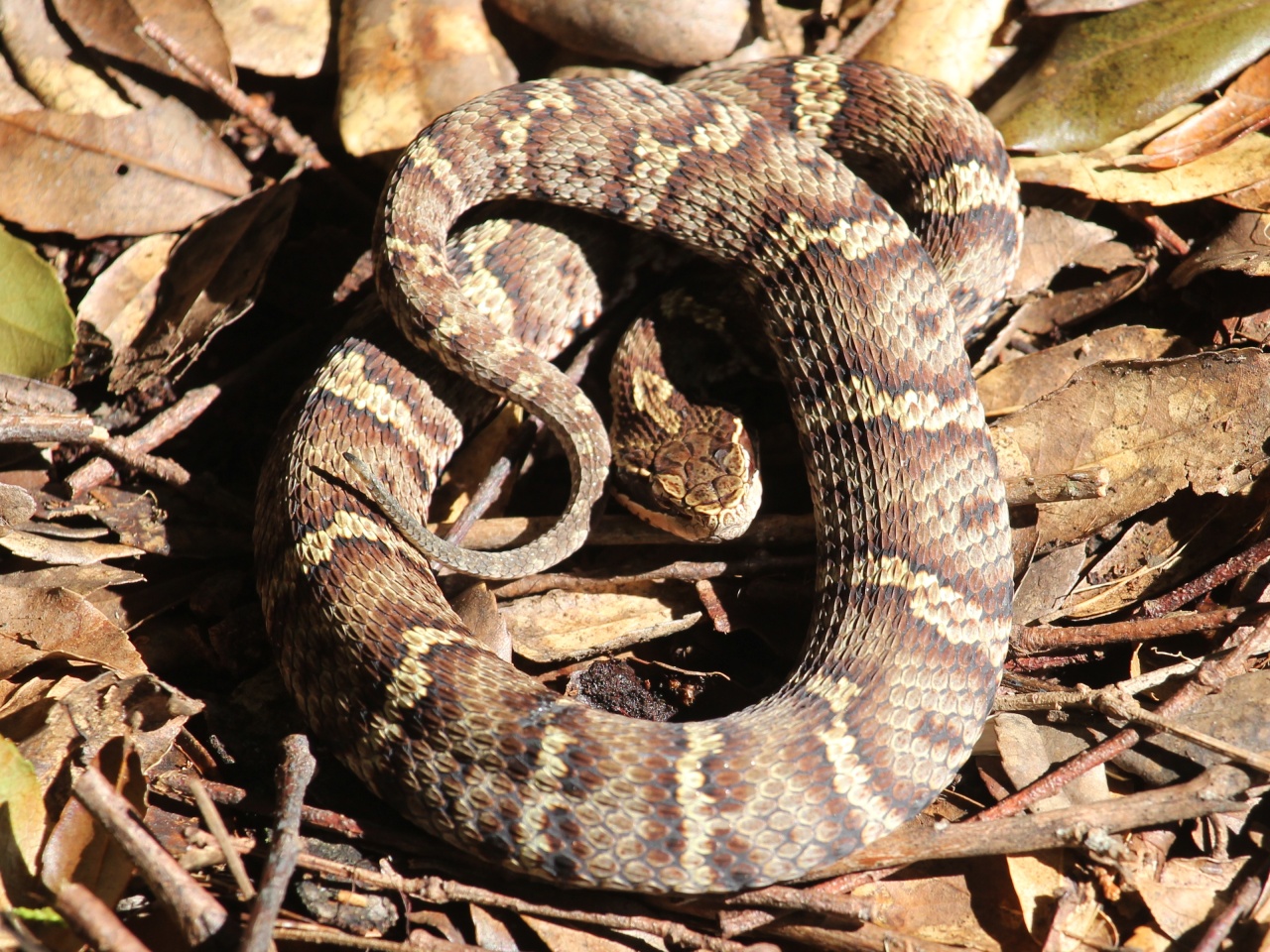
The Mamushi pit viper (Gloydius blomhoffii) is the most dangerous snake on Japan's main islands. Resembling a copperhead, it is a pit viper and has features found in other pit vipers: 1) huge poison glands that puff out their cheek and give their head a triangular shape; 2) long hollow fangs in the front of the mouth that are folded down when the mouth is closes but automatically open when the mouth opens. Mamushi occur in a range of habitats, including meadows, open woodland, swamps, marshes, rocky hillsides, mountains and montane rock outcroppings.
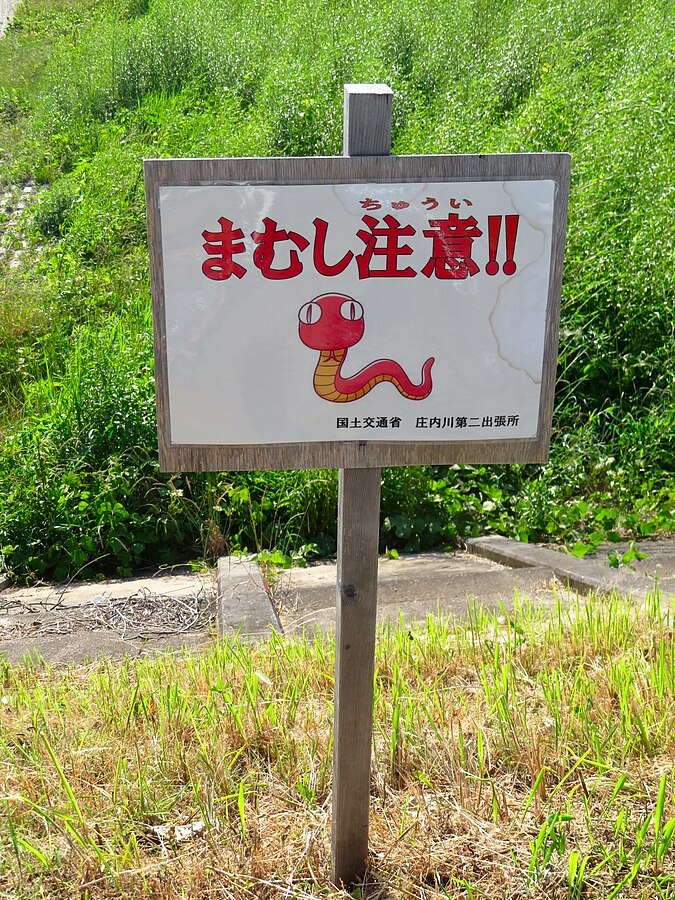
Illustrated warning boards for mamushi are sometimes seen on nature trails. Their bite causes tissues to literally liquify, and you can end up with a piece of your body missing. The father in law of a friend was bitten in the leg by a mambushi while working in a rice field in Okayama. The bit causes the tissues in his calve muscles to melt. His spent some time in the hospital and now has a chunk missing from his lower leg and has some difficulty walking.
Mamushi are also called the Japanese moccasin, Japanese pit viper, Qichun snake, Salmusa or Japanese mamushi. They were once considered to be divided into four subspecies but are regarded as monotypic. Every year, 2000–3000 people in Japan are bitten by a mamushi. Bitten victims typically require one week of treatment in a hospital. Severe bites require intensive care, and approximately 10 victims die annually. [Source: Wikipedia]
Mamushi are sometimes pickled in sake or alcohol are consumed as a health tonic. The same thing is done with similar species found on the Asian mainland as well. Dried and powdered mamushi often mixed with soft-shelled turtle (suppon) has long been used as a general restorative and male sexual enhancer. In Japan, mamushi are also placed in bottles of clear liquor, which is then drunk to prevent or cure colds. [Source: Kevin Short, Daily Yomiuri, January 3, 2013]
Mamushi Characteristics and Behavior
Mamushi are close relatives of the North American copperhead and water moccasin. Although they possess a powerful venom, they are not that big, only a half meter or so long, and usually not very aggressive. Despite their scary appearance they are shy creatures that avoid human contact. People that are bitten by them usually try to handle them or accidentally step on them.
The average length of a mature mamushi is 45–81 centimeters (17.75 to 31. 8 inches); the longest specimen ever recorded was a length of 91 centimeters (three feet). The body pattern consists of a pale gray, reddish-brown, or yellow-brown background, overlaid with a series of irregularly-shaped lateral blotches. These blotches are bordered with black and often have lighter centers. The head is dark brown or black, with beige or pale-gray sides. [Source: Wikipedia]
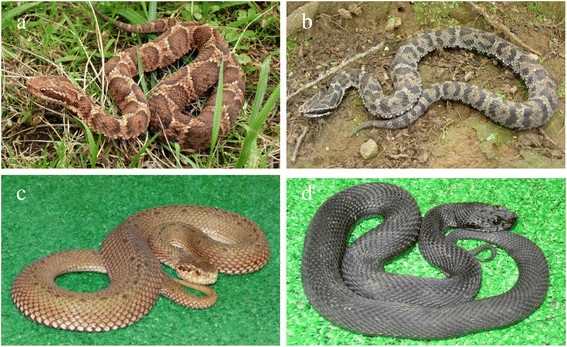
The mamushi hunts in the day and at night. They have heat sensitive glands that allow them to locate prey in the dark. They have fangs that inject poison like hypodermic needles. Mamushi are usually ambush predators who use their excellent camouflage to hide themselves in vegetation or leaf litter. They mainly hunt and eat rodents, but also prey on small birds, lizards, frogs and insects, and are often found in and around farmland due to the associated rodent populations.
Mamushi Venom, Bites and Treatments
Mamushi generally do not bite unless the target comes within striking distance, which is about 30 centimeters. Mamushi venom can cause severe swelling, sight loss and internal blood clotting. Mamushi wounds often go unnoticed due to the snakes' fangs being very thin and only around 5 millimeters long, with many dismissing the minor pain as having a splinter. [Source: Daily Mail]
Their venom varies very little in Japan in terms of its potency and effects. Its lethality as measured by LD50 in mice following intraperitoneal injection is in the range 0.3 mg/kg to 1.22 mg/kg. The venom mostly contains haemolytic toxins that affect the blood, but also has two neurotoxins that affect the nervous system —an alpha-toxin that is a post-synaptic inhibitor and a beta-toxin that is a pre-synaptic inhibitor. The venom contains the anticoagulant, mamushi L-amino-acid oxidase (M-LAO). [Source: Wikipedia]
The treatment protocol for a mumushi bite involves an incision of the wound for exclusion of the venom, and injection of mamushi antivenom. There is an effective antivenom manufactured in both Japan and China. Its effectiveness is increased when co-administered with a serine protease inhibitor such as FOY. There have been case reports of kidney failure, visual disturbances, palsy, and miscarriage in pregnant women. In one study in Japan, mamushi bite victims required a median duration of seven days of hospital treatment followed by a median of 31 days of out-patient treatment, sometimes with a full recovery taking up to several months.
Atsushi Sakai, chief researcher at the Japan Snake Center in Ota, Gunma Prefecturecenter, told the Asahi Shimbun,, the snake’s hemolytic venom destroys cells in veins and causes continuous bleeding.Bite victims can die of acute kidney failure. But early administration of anti-venom serum can greatly reduce severe symptoms. Campers need to beware, “There are cases in which mamushi enter tents and bite people," Sakai said. “You should avoid walking around in shorts and sandals at campsites, especially at night.” If you are bitten by a mamushi, immediate hospital treatment is most critical, he said, but it is better to lie still to slow the spread of the venom while waiting for an ambulance. [Source: Toshiyuki Takeya, Asahi Shimbun, July 29, 2021]
Habu

The habu (Protobothrops flavoviridis or Trimeresurus flavoviridis) is a kind of pit viper found on Okinawa and Amami Oshima island. Related to the mamushi, they are green and brown and often found crawling around on the branches of trees. Habu fatalities are rare. Of the 1,500 people who bitten by them in the 1990s only three people died. The remainder became very sick and had swollen limbs. The last fatality was in 1992. Only three known fatalities are known. According to the U.S. embassy: Habu have been described as very aggressive, poisonous snakes. Although Okinawan field workers and small animals are occasional snakebite victims, no consular personnel have experienced problems with snakes in recent memory. Prudence, however, especially at night, is the watchword.
The longest known habu snake measured 2.25 imeters and was displayed at the Okinawa World’s Habu Park. According to the U.S. military: Two native and two introduced species of habu snakes inhabit the vegetation and jungle of Okinawa, making hiking and late-night ground travel very dangerous for people here. During the warmer months, rodents like mice, shrew and other food sources are active, causing habu and other predators to be more active too. [Source: Airman 1st Class Hailey Davis18th Wing Public Affairs, Kadena Air Base, May 29, 2013]
In 1910, small Asian mongooses were brought to Okinawa to control rats and habu snakes. They mongooses preferred other prey and ate threatened species such as Okinawa rails. Rats and habu snakes have continued to thrive while less hardy native species have suffered. Cobra and mongoose fights and habu and mongoose fights were a form of amusement until 1999 when the fights were banned by new animal protection laws.
In Okinawa, habu are often collected to make habushu — a kind of sake or liquor also called awamori said to have medicinal properties. As is often the case with snake wine, the snakes may be placed in liquid while still alive, causing them to drown. Sometimes they are be stunned first and gutted while still alive. The body ferments with alcohol and other animals such as lizards or scorpions are thrown in. [Source: Wikipedia]
Habu Characteristics
Kevin Short wrote: “The Habu is a venomous pitviper of light olive or brown ground color overlaid with elongated dark green or brownish blotches on their back. It is often found between the woods and the palm fields and on rock walls and in tombs and caves. The blotches have yellow edges, sometimes contain yellow spots, and frequently fuse to produce wavy stripes. The belly is whitish with dark coloring along the edges. Amami Islanders have a high incidence rate of being bitten by the snake but fatalities are rare

Habu grow to an average length of 1.2 to 1.5 meters (4–5 feet), reaching a maximum of 2.4 meer (7.9 feet). They are slender snakes with a large head. The crown of the head is covered with small scales. The blotches have yellow edges, sometimes contain yellow spots, and frequently fuse to produce wavy stripes. The belly is whitish with dark coloring along the edges. Unlike most pit vipers, habu are oviparous and lays eggs, rather than bearing live young. Mating takes place in early spring and up to 18 eggs are laid in mid-summer. The hatchlings, which emerge after an incubation period of 5–6 weeks, are 25 centimeter (10 inches) in length and look the same as the adults. [Source: Wikipedia]
Okinawa Habu is longer than the three other species on the island. The Okinawa Habu's habitat is that of rock walls, caves and tombs. The Taiwan Habu, which grows up to 46 inches, and the Sakishima Habu, which grows up to 70 inches, are introduced species that inhabit caves and tombs as well. The Hime Habu, which grows up to 32 inches in length, is native to Okinawa and finds itself near wooded areas transitioning into fields and farming areas near fresh water. [Source: Airman 1st Class Hailey Davis18th Wing Public Affairs, Kadena Air Base, May 29, 2013]
Habu Venom, Bites and Treatment
The incidence of snakebite in the Amami Islands is 2 per 1,000 people, which is considered very high. Habu venom has of high toxicity, containing cytotoxin and hemorrhagin components, yet the fatality rate is less than one percent. A bite from a habu snake can cause nausea, vomiting, hypotension, and possibly death. There have been cases where victims report the loss of motor function in hands and legs following treatment. If a bite victim receives medical care promptly, bites are not life-threatening. However, six to eight percent suffer permanent disability.LD50 values of 3.1, 4.3, 3.7, 2.7, 3.7, 3.8 mg/kg IV, 5.1 mg/kg IP and 6.0, 3.5-5.0, 4.5 mg/kg SC have been reported for the venom. [Source: Wikipedia]
According to the U.S. military: "f someone is bitten, they should remove themselves from the area of the snake and transport the patient to the nearest medical facility as quickly as possible. The injured part of the body should be immobilized, without using a tourniquet splint, in a functional position below the level of the heart. The wound should then be cleansed for good infection control. Staying calm and resisting the "cut and suck" method are very critical for survival during a venomous snake attack. If an individual cuts an area in order to suck the venom out, they risk cutting arteries, veins or muscles. This also causes further traumatic injury and introduces oral bacteria into the wound. Tourniquets and pressure dressings can lead to worsening of local effects because the venom of a habu is hemotoxic, meaning it causes blood poisoning and can damage red blood cells. [Source: Airman 1st Class Hailey Davis18th Wing Public Affairs, Kadena Air Base, May 29, 2013]
When it comes to being bitten by a habu or any venomous snake, seeking medical attention immediately is critical. Treatment is primarily supportive. An intravenous drip will be started, labs will be drawn, and pain medication will be administered. The individual will be monitored for severity of local pain, and redness or bleeding that occurs within an hour or two of the bite. They will also be monitored for hemolysis, which is the destruction of blood cells, and kidney function. Severe local effects such as neuropathy and compartment syndrome, and treatment for infection complications such as tetanus will also be addressed.
Because anti-venom can cause side-effects for those bitten by a habu snake, it is not administered first. An immediate side-effect risk is an anaphylactic reaction, meaning having sensitivity to the substance. This is more likely to occur when a patient has previously received anti-venom.They can also develop a febrile reaction called a pyrogenic reaction (or fever), which usually resolves without therapy. The patient can suffer from serum sickness which constitutes a rash, fever and polyarthritis, which affects five joints simultaneously. This usually begins one to two weeks after the first exposure to the anti-venom or other responsible agents, and resolve within a few weeks of discontinuation.
Japanese Keelback
The Japanese keelback (“yamakagashi”) has distinctive yellow, red and black markings and can be as thick as a man’s arm. Even though it is quite venomous it is generally quite docile and lacks an effective poison delivery system and can even be handled. It is often seen in rice paddies and often feeds on frogs.
Kevin Short wrote: “Beware also, the largest of Japanese snakes, the Japanese Keelpack or Japanese Grass Snake may appear to be the most docile of snake … it is widely to believed to be non-poisonous but the snake was known to have killed someone in the ’80s. The snakes deliver their venom via some small back teeth, and have to actually chew on the victim to deliver the poison. The snakes like cobras flatten their necks when threatened.
The Japanese keelback possess two poisons: one that is ejected from inside its mouth that subdues prey; and another squirted from special glands at the back of the head that is used against attackers such as weasels, feral cats and tanukis. The keelback’s short fangs at the back its head drip poison in through an open wound and thus they have to bite hard and for a long time for the poison to be effective.
Image Sources: Wikimedia Commons, Japan Snake Institute.
Text Sources: Animal Diversity Web animaldiversity.org ; National Geographic, Live Science, Natural History magazine, David Attenborough books, Daily Yomiuri, Yomiuri Shimbun, Japan National Tourist Organization (JNTO), New York Times, Washington Post, Los Angeles Times, Smithsonian magazine, Discover magazine, The New Yorker, Time, BBC, CNN, Reuters, Associated Press, AFP, Lonely Planet Guides, Wikipedia, The Guardian, Top Secret Animal Attack Files website and various books and other publications.
Last updated March 2025