
ENVIRONMENTAL ISSUES AND POLLUTION IN JAPAN
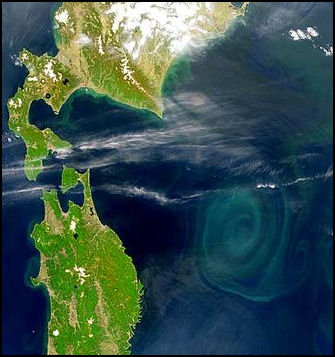
garbage in the sea off Japan Japan is a beautiful country with a lot natural wonders. The postwar economic miracle turned many parts of Japan into a land of development, factories, pavement and concrete rivers. One survey found that only seven percent of Japan’s sandy beaches are “natural.” The others have some artificial structure such as a tetrapods, levees or bank protection or have been altered in some other way by human activity.
Environmental pollution in Japan has accompanied industrialization since the Meiji period (1868-1912). In the 1960s diseases caused by factory-emitted water and air pollution were found in areas throughout Japan. The strict environmental protection measures that were subsequently implemented have reduced pollution caused by such emissions. Important problems remain to be solved, however, with action being necessary to, for example, reduce greenhouse-gas and particulate-matter emissions and increase recycling of industrial and household waste. [Source: Web-Japan, Ministry of Foreign Affairs, Japan]
In October 2009, a court in Hiroshima ruled against a shore project that would have involved reclaiming land a build a new bridge and roads on the Inland Sea on the grounds that scenic beauty had precedence over public works.
Japan has been credited with putting a lot of effort into reducing some forms of pollution but has been criticized for wreaking havoc on the environment in a number of areas and not forging a coherent long-term environmental policy. Resistance to environmental measures was a hallmark of the policy of Liberal Democratic Party, which ruled until 2009 and forged tight bonds with the businesses and bureaucracy that had traditionally put money, business and jobs ahead of environmental concerns.
Germany, Belgium, the Netherlands, Switzerland, the United States, Japan and Britain are all countries that pride themselves with their strict environmental laws. These countries also lead in the export of hazardous waste to third world countries.
Japan produced 119,998 tons of ozone-depleting CFCs in 1986. Now it produces virtually none.
There is a growing trend for products to bear labels showing their environmental friendliness, with an aim to increase eco-conscious consumers. These include 1) tea bags, featuring a green frog and the words, "Rainforest Alliance Certified," meaning the product is certified by an international environmental protection organization as one using raw ingredients grown on farms that are managed according to rigorous ecological and working environment standards; 2) "Bird Friendly" coffee, certified by the Washington-based Smithsonian Migratory Bird Center as organic coffee produced on farms with trees giving a natural shade cover, providing habitats for birds in tropical areas; and 3) paper products certified by the Forest Stewardship Council (FSC), certifying that the paper products were produced through responsibly managed forests. 4) Even a ham has a label, carrying the Carbon Footprint of Products logo, which shows the quantity of greenhouse gas emissions created during the product's life cycle. [Source: Yomiuri Shimbun, September 21, 2011]
Websites and Resources
Greenpeace Japan report Links in this Website: GLOBAL WARMING, RAIN FORESTS AND JAPAN Factsanddetails.com/Japan ; ENVIRONMENTAL ISSUES AND POLLUTION IN JAPAN Factsanddetails.com/Japan ; RECYCLING AND ENVIRONMENTAL GROUPS IN JAPAN Factsanddetails.com/Japan ; OIL, COAL, NATURAL GAS AND ENERGY IN JAPAN Factsanddetails.com/Japan ; NUCLEAR ENERGY IN JAPAN Factsanddetails.com/Japan ; SOLAR, WIND AND ALTERNATIVE ENERGY IN JAPAN Factsanddetails.com/Japan ; NATURAL RESOURCES AND JAPAN Factsanddetails.com/Japan ; WATER IN JAPAN Factsanddetails.com/Japan
Good Websites and Sources: E-Book: Industrial Pollution in Japan unu.edu/unupress ; Water Pollution Monitoring in Japan gec.jp/CTT_DATA ; Air Pollution Monitoring in Japan gec.jp/CTT_DATA ; Air Pollution in Japan (1964) ncbi.nlm.nih.gov ; Map of Air Pollution in East Asia (Japanese language) gis5.nies.go.jp/eastasia/ConcentrationMap and English Explanation japanprobe.com
Good Websites and Sources on the Environment: Ministry of Environment env.go.jp/en ; National Institute for Environmental Studies nies.go.jp ; Quality of the Environment, a 2003 Report env.go.jp/policy/hakusyo ; Japan for Sustainability japanfs.org ; Japan Times Environment Page japantimes.co.jp ; Essay on Comparing Japan and Britain on Environmental Criteria aboutjapan.japansociety.org ; Wikipedia article on Environmental Issues in Japan Wikipedia ; NPR Story on Public Works and the Environment npr.org/templates/story ; Essay on Japan’s Forests and History aboutjapan.japansociety.org ; Statistics and Research Japan Environment Association jeas.or.jp ; Statistical Handbook of Japan Environment and Life Chapter stat.go.jp/english/data/handbook ; 2010 Edition stat.go.jp/english/data/nenkan ; News stat.go.jp Research Institute of Innovative Technology rite.or.jp ; Aozora.or Aozora.or ; Virtual Center for Environmental Technology Exchange apec-vc.or.jp ; Google E-Book: Japan in the 21st Century, Environment, Economy and Society (2005) books.google.com/books ;
Japanese and the Environment

eco shoppers bag
reduces need for plastic bags The relationship between the Japanese and the environment is full of paradoxes. Their native religion, Shintoism, teaches people to have a deep reverence for nature yet they artificially restructure their Japanese landscape on a grand scale. The Japanese are excellent recyclers but also demand excessive packaging when they buy products. They go through great lengths to save endangered cranes and ibises yet zealously defend their right to eat whales.
Makoto Kurozumi, a professor at Tokyo University who specializes in the history of Japanese thought, believes that compassion for living things has traditionally been one of the most important characteristics of the Japanese people. “The origin of this is a tradition of animism that teaches that everything, including plants and trees, has a spirit. That has cultivated a compassion for all living creatures, in the Japanese,” he said
Takeshi Umehara, the great Japanese anthropologist, observed that the Shinto religion, in which man is regarded as a part of nature, drew from ancient Japan’s “civilization of the forest.” As early as the 17th century the Tokugawa shogunate was involved in reforesting parts of Japan, denuded by development (See Tokugawa Period, History).
Matagi hunters are people who wander through the forests and mountains, making a living from the plants and animals they collect there. Experienced hunters spend more than 100 days a year in the mountains and have maps in their heads. They collect mushrooms in the autumn, kill bears in the winter, pick sasai plants in the spring, catch sweetfish in the summer and know how to protect themselves if attacked by a bear. The last matagi hunters are in their 70s now and they are in danger of becoming extinct.
Measures Against Pollution in Japan
Japan experienced a number of serious forms of environmental pollution from the 1960s to the 1970s. Besides Minamata disease, a series of other pollution-related diseases surfaced, one after another, such as “itai-itai “disease, which broke out in the Jinzu-gawa river basin in Toyama Prefecture; respiratory disorders in the Tokyo-Yokohama, Nagoya, and Osaka-Kobe industrial belts; and chronic arsenic poisoning in the Toroku district in Miyazaki Prefecture. These forms of pollution occurred as a result of the priority placed on rapid economic growth and the downplay of standards to protect people’s health and safety. [Source: Web-Japan, Ministry of Foreign Affairs, Japan]
“The consequences led to Japan’s setting strict regulations to protect the environment from the 1960s onward. The regulation on soot and smoke emissions, enacted in 1962, was absorbed into the Air Pollution Control Law in 1968. The Water Quality Conservation Law and Factory Wastewater Control Law, both enacted in 1958, were integrated into the Water Pollution Control Law in 1970. The Pollution Countermeasures Basic Law passed in 1967 sought to create common principles and policies for pollution control in all government agencies and to promote an integrated effort to clean up the environment.
“The Basic Law indicates the responsibilities of the central government, local governments, and business firms with regard to controlling pollution. In addition, the Basic Law laid the framework for establishing environmental quality standards, drafting pollution-control programs, and aiding victims of diseases caused by pollution. In 1972, no-fault liability for compensation, which holds businesses responsible for health problems resulting from pollution (whether accidental or not), was introduced into various laws.
“In 1993 the Basic Law for Environmental Pollution Control was replaced by the Basic Environmental Law, which was enacted to facilitate implementation of comprehensive and systematic measures to protect the environment. Under this new Basic Law, Japan is actively working to promote environmental preservation worldwide through international cooperation and a rethinking of high-volume consumption practices in society. In 1997 the Environmental Impact Assessment Law was enacted. This law defines requirements for assessment of the environmental impact of large-scale public- and private-sector projects. In 2001 The Environment Agency, which had been created in 1971, was upgraded to cabinet ministry level, becoming the Ministry of the Environment.
Pollution in Japan

Greenpeace Japan at work According to a survey of expatriates living in Asia: India, China, Vietnam, the Philippines, Indonesia and Hong Kong are regarded as the dirtiest countries in Asia, while Singapore, Japan and Malaysia are regarded as the cleanest. Thailand, South Korea and Taiwan are in the middle.
Like China today Japan in the 1950s and 60s placed modernizing industry and raising incomes ahead of the environment and public health. At that time many Japanese cities were filthy. A great deal of pollution was created in Japan by oil refiners and steel and petrochemical plants as Japan quickly industrialized after World War II.
In the 1970s Japan was hit by two oil shocks and a consensus developed that economic growth had be balanced with energy conservation and a clean environment. In 1970, 14 antipollution laws were passed by what became know as the Pollution Diet. These laws set ambitious goals that are credited with cleaning Japan up but were vague and incomplete, leaving out, for example, environmental impact assessment.
Environmental standards were established with the enactment of the Basic Law for the Environmental Pollution Control in 1967. In 1971, the Environmental Agency was set up and efforts top prevent pollution and promote environmental protection began in earnest. The agency became the ministry of Environment when government bodies reorganized in 2001.
For all of its industry Japan is surprising unpolluted. Once I camped on a beach on a beautiful section of coastline. When I woke up the next morning I took a short walk and found a huge coal burning power plant on the other side of small rise that I had even noticed the night before.
Types of Pollution in Japan
Dioxin: Because of the limited land area in Japan, securing space to dispose of trash is a perennial issue. Japan has resorted to burning trash as a matter of necessity. In the 1990s pollution from dioxin released by trash incinerators became a major issue in society. The term “dioxin” refers to the compound tetrachlorodibenzo-p-dioxin, which has a propensity to accumulate in the body and to cause cancer and birth defects. The Law Concerning Special Measures Against Dioxin went into effect in 1999. This law included provisions for dioxin emission regulation, the monitoring of effects on health and the environment, and the preparation of government plans for reducing emissions. Japan achieved its target for dioxin emission reduction in 2004, when emissions were estimated to be approximately 95 percent less than those in 1997. Daily dioxin intake has also been steadily decreasing and is now estimated to be less than the tolerable daily intake level of 4 picograms per kilogram of body weight. [Source: Web-Japan, Ministry of Foreign Affairs, Japan]
Vehicle Emissions: As a result of the imposition of various rules and regulations, considerable progress has been made in limiting air pollution from factory smokestacks, but in Japan’s major cities air pollution from the nitrogen oxides and particulate matter emitted by motor vehicles continues to cause health problems. The majority of the particulate matter and approximately 80 percent of the nitrogen oxides emitted by motor vehicles comes from diesel engines. To address this problem, in 2002 the national government implemented legislation adding particulate matter restrictions to existing nitrogen oxide restrictions. In addition, restrictions that apply to trucks, buses, and diesel passenger cars limit the types of vehicles that can be operated in designated major metropolitan areas. Dissatisfied with the pace of national government efforts to reduce air pollution, in 2003 Tokyo, Saitama, Chiba, and Kanagawa prefectures implemented even stricter rules covering the particulate matter emissions of diesel trucks and buses. Vehicles that do not meet the new standards have to be replaced or have special filters installed.
High-Tech Pollution in Japan : Another issue in Japan is environmental pollution that is caused by high-tech pollution created by cutting-edge industries, such as integrated circuit production. Ground water pollution is caused by solvents. Examples are trichloroethylene, used for washing integrated circuits, and tetrachloroethylene, used largely in dry cleaning. Both of these chemicals are carcinogenic. The Water Pollution Control Law, revised in 1989, incorporated regulations to restrict toxic substances in ground water, including these two. A further revision, in 1996, granted governors the power to order the polluter to be responsible for clean up.
“Pollution caused by natural disasters”: The Great East Japan Earthquake and the accompanying tsunami in March 2011 damaged at least 270,000 buildings. The rubble and debris left behind, including ruined boats, cars, etc., plus those washed up on the shore, were in excess of 24 million tons. The national government took prompt measures to collect and dispose of this waste on behalf of the affected towns and villages, and covered the costs of the clean up by local governments. The government has also been monitoring the environment, measuring radioactivity in the air and water, following the leak of radioactive substances after the accident at the Tokyo Electric Power Company's Fukushima Daiichi Nuclear Power Station, which was knocked out by the tsunami.
The government has taken measures to cope with a variety of other forms of pollution and environmental disruption, including noise, vibration, ground subsidence, offensive odors, and pollution by agricultural chemicals. The number of complaints about noise is greater than for any other type of pollution. The greatest number of complaints concern noise from factories, but construction, traffic, airport, and railroad noise have all generated a considerable number of complaints.
Air Pollution in Japan
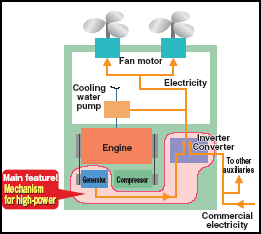
clean energy production Air pollution includes particles of soot, organic hazardous material, heavy metals, acid aerosols and dust. The smaller particles are sometimes more dangerous because they are more easily inhaled and go deeper into the lungs.
Pollution in Japan was much worst in the past than it is now. In the early 60s traffic policeman used to carry small cylinders of oxygen with them for a reprieve from the heavy doses of car exhaust fumes they breathed in ever day. Many people in Tokyo wore gas masks and bought oxygen from vending machines. An electric sign near the Ginza gace the time and temperature as well the current sulphur dioxide, carbon monoxide and noise levels in decibels.
Around 1970 children were collapsing on playgrounds and doctors were busy taking care of patients with a respiratory disease called "Yokkaichi asthma." When the situation was no longer tolerable the government began offering tax breaks for pollution-reduction measures and companies took measures in their own realizing it was more cost-effective to have healthy workers.
See Global Warming
Air Pollution Reduction in Japan
Air pollution in Japanese cities decreased markedly between 1967 and 1985. Laws passed in 1970 helped reduce the levels of sulphur dioxide emissions by 78 percent in 10 years.
The Tokyo government passed a law that went into effect in October 2003 that required drastic reductions in emissions from diesel powered vehicles. Tougher regulations went into effect in 2008 limit the amount of nitrogen oxide and particulate matter emission by diesel engines. Strict laws for automobile and motorcycle emissions have been in place for some time. There are plans to make them tougher.
In February 2002, a team of university and start-up businesses announced that it had developed a purifier made from substances extracted from Japanese cypress trees that removes 90 percent of the pollutants from diesel exhaust. The invention was hailed a great breakthrough.
Air Pollution in Japan from China
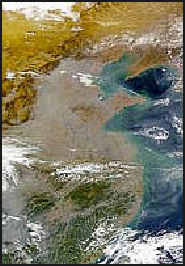
pollution over east China A number of prefectures are issuing an increased number of photochemical smog warning, in one case causing the canceling of athletic events at 85 primary schools. The increases are believed to be linked to pollution from China. Photochemical smog includes ozone, nitrogen oxides and hydrocarbons — derived from vehicle exhaust, factory smoke and other sources — that react to sunlight, creating photochemical oxidants, namely ozone.
On study found that 40 percent of the pollutants observed in the Kyushu region in May 2007, when levels of photochemical smog were particularly high, originated in China and 30 percent of those observed in the Tokyo area at that time were also from China.
Photochemical pollution can cause headaches, loss of consciousness and other problems for people who spend long hors outside and can cause coughing and eye irritation in less serious cases. Photochemical The readings have been particularly high in Kyushu.
Emissions of nitrogen oxide in China and other Asian countries has doubled since 1985 and is expect to rise 1.4 times by 2020. By some estimates half the oxidant emissions such as ozone in Japan originate in China.
Acid snow and acid rain with acid from China is blamed for killing pine trees in northern Honshu. In the autumn of 2005 an acidic mist with a ph of 3.2 — the same as culinary vinegar — was detected in the mountains of Toyama. The reading was from sulfuric acid formed from sulphur dioxide, Since emissions of sulfur dioxide are minimal in Japan it was assumed the acid came from China. So much acidic mist appears in the Toyama area that 12 percent of conifers growing at the 2,000-meter elevation mark in mountains are damaged and 40 percent of those at the 1,500-meter mark are blighted.
See China
See Yellow Dust, Weather
Water Pollution in Japan
Only about 36 percent of Japanese household are hooked up to sewers, compared to 97 in the United Kingdom and 65 percent in France.
Emissions of organic pollutants into water (millions of pounds a day): 11.7 in China; 5.5 in the United States; 3.4 in Japan; 2.3 in Germany; 3.2 in India; 0.6 in South Africa; and 0.4 in Mexico.
In the 1960s rivers in Japan were fouled by sewage, household wastewater and other pollutants. Some of the rivers in the Tokyo area were comprised of black water with white foam floating in thick layers at the top. Around some rivers children came down with bone diseases that deformed their limbs. In the 1970s the bay outside Kitakyushu was called the "Sea of Death." Its brownish-green water looked like waste from a crankcase. Rules and regulations imposed in the 1970s on sewage systems and drainage water greatly improved water quality. Some urban rivers in Japan are nw surprisingly clean.
Many urban rivers are polluted with high concentrations of E. Coli bacteria and people who swim in them risk getting sick.
The Sea of Japan between Japan and Korea is slowly dying. Fish catches are growing smaller every year. The problem is blamed on overfishing, exacerbated by competition between Japan, Korea, Russia and China, pollution and an increase in sea temperatures, caused perhaps by global warming.
Salmon returning to Japanese rivers have been found to have high levels of DDT and other highly toxic chemicals. DDT and the other chemicals have not been used in Japan for some time but are still used in southern Asia and may have contaminated waters ff off Japan.
Combatng Water Pollution in Japan
Freshwater mussels are being used to clean up dirty rivers in Japan. Capable of cleaning 180 liters of water a day, the Ikechogai mussels clean the water by consuming diatoms and other phytoplankton that feed on nitrogen and phosphorus. Although the water quality of some very dirty rivers’such as the Dotonborigawa River in downtown Osaka, where the mussels have been used — has improved the water is still not clean enough to swim in. Some of the mussels produce pearls.
In March 2008, clams were taken from Tokyo Bay for the first time in 40 years. The restoration of the clamming industry which ceased in 1969 because of water pollution and other reasons is a sign that the water quality in Tokyo Bay is improving.
The Kyu-Otagawa River, which flows through central Hiroshima, for a long time was mainly known for its contaminated water, sludge and foul smell. That is, until a few years ago when the river was dramatically cleaned up using “infiltration pillars” made from used coal ash from power plants which decomposes noxious sludge, gets rid of bad smells and makes the water clean enough to be inhabited by a variety of water creatures such as crabs and freshwater clams.
Toxic Materials in Japan
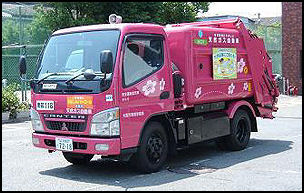
natural-gas-powered garbage truck Japan has a lot of factories. A lot of toxic materials are needed to produce all the goods that Japan produces and large amounts of toxic materials are left over when the products are produced. Toxic materials include leftover construction material, chemicals from factories, and even left over office equipment.
Concerns over PCB-laden florescent lighting units in schools became an issue when a condenser overheated in a school in western Tokyo, causing the lights to explode and spray toxic powders and chemicals on the heads of the students in an art class.
Mirex, a highly persistent and toxic organic pollutant, has been found in animals in Japan even though its use is banned. Some think that the pollutant has been brought in by high altitude winds or have leaked from underground dumps. About 3,690 tons of organic-chlorine insecticides including DDT, banned since 1970s, were buried without being detoxified in 174 location in Hokkaido and 30 prefectures.
Big companies have been involved in the dumping of toxic materials. Nissan dumped tons an oily toxic greasing agent at an abandoned aerospace factory in western Tokyo that wasn't discovered until construction began on a new park and condominiums at the site. Mitsubishi dumped cancer-causing chemicals near some factories outside Tokyo and had to warn local people not to drink the well water in the area. Sumitomo Metal Industries had to remove 15,000 tons of contaminated soil before construction could begin on Universal Studios amusement park in Osaka.
In August 2008, 13 people were hospitalized, complaining of feeling unwell, after toxic phosgene gas — used to make chemicals and drugs — leaked from a factory in Aizu-Wakamatsu. Fukushima Prefecture. A toxic gas leak of hydrogen fluoride from a chemical plant in Sakai, Osaka caused 23 people to suffer eye and throat injuries.
Illegal Dumping Toxic Materials in Japan
The illegal dumping of toxic chemical is a big issues. Material are often disposed of at clandestine sites with the help of the yakuza (the Japanese mafia). Estimates of the amount if illegal waste disposal ranges from 320,000 tons to 32 million tons a year. Some of the sites are quite dangerous. Some give off awful smells from toxic gasses created from chemical reactions of the waste materials. Some often gases are quite poisonous, even deadly.
The illegal dumping racket reportedly involves three different groups of people: the brokers who make the deals, the excavators who create the sites and truckers who haul the stuff. Each truck driver receives between $700 and $1200 per trip. Of this about half goes to the manager of the site. They in turn are believed to pay are large chunk of their income to organized crime for protection and arranging the deals.
Mercury and Minamata Bay

Famous 1971 Minamata Bay photo
by William Eugene Smith In 1950, the Chisso chemical company knowingly dumped large amounts of organic mercury and other heavy metal compounds into Minamata Bay in western Japan, poisoning fish and resulting in a generation of deformed babies. More than 1,200 people were killed and thousands were sickened or disabled. The tragedy was given worldwide through the famous photographs of Minamata victims by W. Eugene Smith published in Life magazine in 1971 (for his trouble Smith was severely beat up and permanently injured by Chisso thugs). Publicity of the Minamata Bay issue helped mobilize a grassroots environmental movement in Japan. [Book: “Minamata: Pollution and the Struggle for Democracy in Postwar Japan” by Timothy George (2001, Harvard)]
Timothy George wrote in “Minamata: Pollution and the Struggle for Democracy in Postwar Japan”, "Minamata is a story not just of the environment and human costs of rapid 'modernization,' but also of a callous and murderous corporation hiding its guilt; of collusion and confusion at all levels of government and society, including the scientific community and the media, that allowed the tragedy to happen and then be covered up."
The government told people fish were safe to eat and Chisso continued to dump mercury in the Minamata Bay even after they knew that fish and fisheaters, including cats suddenly struck with fits of "dancing," were being poisoned.
Chisso built a water treatment plant that did nothing to remove the mercury. To show the water was safe one Chisso executive drank "treated" waste water but the water in fact was uncontaminated water from another source. Chisso executives were was so greedy that when high levels of mercury were found in the bay they decided to mine the sediments for mercury rather than clean the water. Chisso was not forced to accept legal responsibility and financially compensate the victims until 1973.
In October 2004, a high court found the national and local government responsible for not taking action to halt the spread of mercury in Minamata Bay. There is still mercury in the waters on the Shiaranui Sea. By some estimates more than tow million people have experienced some kind of Minamata poisoning since the 1950s.
Legislation has been passed that expands the definition of a Minamata disease victim and recognizes more people who have it and provide compensation for them. A check up 1,051 people in Minamata in 2009 who had not received any compensation at that point revealed that 357 had symptoms of mercury poisoning such as numbness to the extremities and another 603 had certain neurological symptoms.
In March 2010, unrecognized suffers of Minamata disease agreed to settle a long-standing lawsuit by accepting a lump sum of ¥2.1 million and monthly medical allowances of between ¥12,900 and ¥17,700 per person. The number of people that could be covered may reach 35,000. As of March 2011, 40,000 unrecognized suffers had applied for compensation. At that time three Minamata groups ended their lawsuit and said they would end their case and not file suits for damages.
Minamata Bay Declared Safe
The governor of Kumamoto Prefecture declared the mercury levels in fish and shellfish from Minamata Bay safe for consumption on July 29, 1997. The governor’s declaration marked the complete removal of the net that had for 23 years prevented mercury-polluted fish in the bay from entering the sea in an effort to curb the environmentally induced malady known as Minamata disease. [Source: Web-Japan, Ministry of Foreign Affairs, Japan]
“Organic mercury (a methylmercury compound) was released from the Chisso Minamata Plant into Minamata Bay for more than 30 years up until 1966, contaminating both people and animals. The major symptoms of Minamata disease (organic mercury poisoning) are tremors (involuntary trembling or quivering), numbness of and sensory impairments in the limbs, muscular coordination failure, speech and language disorders, narrowing of the field of vision, and loss of equilibrium. Between August 1964 and July 1965, people exhibiting symptoms similar to the Minamata disease victims also appeared in great numbers in the lower part of Agano River basin in Niigata Prefecture.
“Minamata disease was recognized as an environmental pollution disease in 1968. The government then established procedures for the screening and official certification of Minamata disease victims, and it paid compensation to the people so certified. Although approximately 13,000 people applied for the certification, only about 3,000 received it. As a result, people who had been refused certification, and therefore compensation, filed lawsuits against the national and prefectural governments and Chisso Corporation. These people for the most part saw their cases reach a settlement by the government in 1995: a lump sum was paid to non-certified victims with sensory disorders in the limbs.
“About 10,000 people in Kagoshima, Kumamoto, and Niigata Prefectures, including those deceased, were awarded payment. The last remaining Minamata disease compensation lawsuit, by people who had not accepted the 1995 government offer, was finally settled in 2004 with a Supreme Court ruling that recognized the administrative responsibility of the national government and Kumamoto Prefecture. In recognition that 2006 is the 50th year since the government’s official acknowledgment of Minamata disease, in 2005 the government announced a number of initiatives for providing additional support to disease victims. It also passed a law in July 2009 concerning special measures to provide relief for uncertified victims of Minamata disease.
High Levels of Formaldehyde Found in Water in Chiba, Saitama, Gunma
In May, 2012, the Yomiuri Shimbun reported: “High levels of formaldehyde were found in filtered water at three water purification facilities in Chiba and Saitama prefectures and two other purification facilities in Chiba and Gunma prefectures, according to officials.All five plants suspended their intake of river water. The carcinogenic substance detected at two purification facilities was found in untreated water. The water treated at the three water treatment plants had been taken from rivers in the Tonegawa river system. [Source: Yomiuri Shimbun, May 20, 2011]
“In Chiba Prefecture, restrictions on water intake resulted in cuts in water supply, affecting 46,000 households in Noda beginning at 9:35 a.m. The Noda city government began supplying water to affected households. Water supplies were also cut in Kashiwa in the prefecture at noon, affecting 153,000 households all over the city. Local governments in Chiba Prefecture were preparing to dispatch water trucks to transport water to the affected areas.
“The chemical substance--whose levels reached 0.135 milligrams per liter, almost twice the acceptable level of 0.08 milligrams per liter--was found in treated water at the Kamihanawa purification facility in Noda, Chiba Prefecture,, prompting suspension of water intake from the Edogawa river at 3:55 p.m. the same day. The substance was also found in filtered water at two other purification facilities in Saitama Prefecture--0.168 milligrams per liter at the Gyoda treatment plant in Gyoda and 0.1 milligrams per liter at Showa purification facility in Kasukabe.
“It is suspected that hexamethylenetetramine, a chemical substance used for resin and rubber production, may have been released in the upper course of the river. There are several companies that handle the substance along the Karasugawa river in Gunma Prefecture, which is in the upper reaches of the Tonegawa river system. The Saitama and Gunma prefectural government were investigating the incident. "Human health will not be affected by the levels of the substance found this time. There's no problem with the water currently supplied, as water intake has been suspended," an official of the body that runs the Kita-Chiba plant said. Later it was revealed that the culprit was a chemical released by factories that was not dangerous by itself and wa snot restricted but sometimes changed into formaldehyde when exposed to river water.
Cancer Linked to Printing Chemicals
In 2012 it came to light that eight people died of bile duct cancer thought to connected with printing chemicals. The Japanese labor ministry said it had confirmed 17 bile duct cases in five prefectures. Among these eight have died. Chemicals suspected of causing bile duct cancer at printing companies are dichloromethane and 1, 2-dichloropropane, which are contained in the cleaning agents of printing machines.
“Tsuyoshi Nakamura and Kazuaki Ishii wrote in the Yomiuri Shimbun: “According to the labor ministry, 12 male workers in Osaka have been diagnosed with bile duct cancer, and six of those have died. However, a support group for families of the victims claims that another worker also died of the cancer. The group said the seven victims died from 1998 to 2010. [Source: Tsuyoshi Nakamura and Kazuaki Ishii, Yomiuri Shimbun, July 12, 2012]
“According to the group, the seven victims were in their 20s to 40s. The cancer was also found in two men working at a printing company in Miyagi Prefecture who are in their 20s and 30s, and the surviving victim among the three most recently found by the government is in his 40s. The high proportion of young people developing bile duct cancer among printing company workers is noteworthy because it is usually the elderly who are susceptible to the disease.
“The Health, Labor and Welfare Ministry investigated more than 500 printing firms in June 2011 following reports that workers of printing companies in Osaka city and Miyagi Prefecture had developed bile duct cancer. About 80 percent of printing firms did not follow government regulations on the use of chemical substances that may cause bile duct cancer, according to the findings of a government investigation. In announcing the results of the investigation, it said three more cancer patients, aged from their 40s to 70s, were confirmed in Tokyo and Ishikawa and Shizuoka prefectures. Two of the patients have died.
“The labor ministry has designated the two chemicals as "substances that may be responsible for causing cancer" and requires factories using the two chemicals to take appropriate safety measures, such as ventilating workrooms sufficiently and having workers wear masks. Such precautions were ordered for dichloromethane from 2002 and for 1, 2-dichloropropane from 2011, based on the Industrial Safety and Health Law and other regulations. The ministry investigated 561 printing companies and found that 494 used the two chemicals. However, 383 firms using the chemicals, or about 80 percent, failed to follow government regulations.
“This health problem was brought to light not by the government but by a researcher. In May, a study group led by Shinji Kumagai, an associate professor at the University of Occupational and Environmental Health in Kitakyushu, reported that former employees of a printing company in Osaka had developed bile duct cancer at a high rate. Kumagai said the company's operations consume a large amount of dichloromethane and 1, 2-dichloropropane, and pointed to the "possibility that the two chemicals caused the cancer."
Destruction of Freshwater Ecosystems in Japan
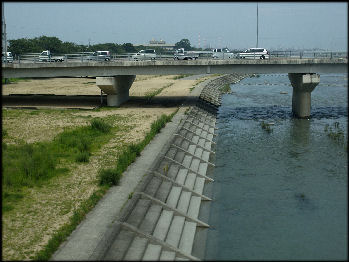
cement river All but two of Japan's rivers have been dammed or directed into concrete embankments. The number of natural lakes and wetlands has decreased from 230 in the mid-1980s to 210 today.
Rivers, streams and brooks that teamed with life have had their banks lined with concrete in the name of erosion and flood control but mainly to provide work for construction companies. In the case of brooks used to supply water for rice paddies concrete is often selected to widen channels when the job can be done just as effectively with earthen dikes. Among the creatures that are lost are a wide variety of aquatic insects and plankton and the fish, frogs, clams, shrimp that eat them and the kingfishers and egrets that eat them.
Asbestos in Japan
In June 2005, the leading machinery maker Kubota announced that a number of its workers at construction material factories had died from mesothelioma and other diseases believed to have been caused by the asbestos. Other investigations led to the discovery of other asbestos-related deaths.
In November 2005, the Japanese government decided to pay ¥2.6 million in lump sum payments to around 10,000 victims of asbestos poisoning and ¥2.4 million to families of victims that died.
Some people who died and became ill didn’t even work at the factories. Some died from illnesses believed to have been caused by asbestos used in insulation materials, There have even been cases of wives of workers who apparently became sick from cleaning clothes with asbestos fibers in them.
Asbestos is still found all over Japan. It was widely used in public buildings. Ones study found asbestos was used in 4,923 educational facilities, including kindergartens, primary, middle and high schools; 586 medical and social welfare facilities, including hospitals, nursing homes and child-care centers; 353 community facilities; and 327 municipal government facilities.
Oil Spills in Japan
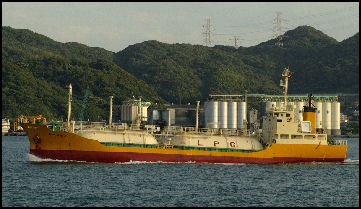
coastal tanker On January 2, 1997, a massive Russian tanker carrying 19 million liters of oil split open in heavy seas 65 miles off of the western coast of Japan near the Mikuni islands. High winds and huge waves dashed attempts to contain the spill, which swamped beaches, killed birds, ruined fisheries and threatened to shut down the largest concentration of nuclear power plants in the world around Wakasa Bay by clogging the plant's cooling system which draws water from the sea.
Japan's worst oil soil ever occurred in July, 1996 when the supertanker Diamond Garnce tore open when it hit a reef in Tokyo Bay, releasing 4 million gallons of oil and producing a slick that extending for four miles.
Red Tides and Giant Jellyfish in Japan
Japan suffers from periodic red tides. Red tides are dense blooms or massive concentration of oxygen-consuming microscopic algae that grow and spread at a great speed. Despite their name, most of the time they are not red (although they can be). They are usually different shades of brown and can be bright green.
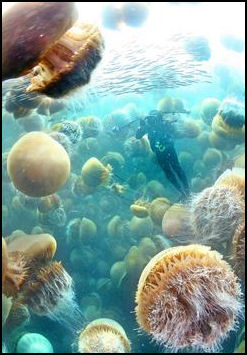
A red tide in June 2004 in the Inland Sea killed an estimate 300,000 fish. Among those killed were red sea bream and flatfish raised on fish farms. Red tides kills fish and other aquatic life through suffocation by depriving them of oxygen and producing toxins that can paralyze marine life. Once a red tide reaches critical mass, there is little that anyone can do other wait for it to end. A red tide can last anywhere form a few days to a few months. They are usually seasonally, typically occurring the fall in temperate climates.
Echizen jellyfish are nasty creatures that can weigh up to 200 kilograms and reach a size of two meters in diameter. They have caused havok in the fishing industry in Japan. The have been caught by the boatloads in the Sea of Japan off of Fukui, Shimane and Ishikawa Prefecture in western Honshu. They have brown poisonous tentacles that kill fish and cause them to lose their color. Their huge numbers fouls fishing nets with a nasty smell. Their massive weight tears the nets when they are pulled out of the water.
The damage to the fishing industry has been in the tens of billions of yen. On fisherman told the Yomiuri Shimbun, “The nets were fouled by hundreds of jellyfish as soon as they were put out. There was little room for other fish, The fish that touched the tentacles of the jellyfish turned white, and the retail value of the fish is reduced to zero.”
In the old days Echizen-kurage disappeared by peak autumn fishing season but warmer waters, perhaps caused by global warming, have caused them to stick around longer. The presence of the poisonous jellyfish has adversely affects fishing for cavalla and yellowtail because the fish try to stay clear of the jellyfish. Some blame China for the problem, saying the jellyfish originate in waters off the coast China and their growth is triggered by pollutants dumped in the sea. See Fishing
Jellyfish blooms have clogged seawater intake valves and caused nuclear power plants to reduce power.
Image Sources: 1) 6) NASA 2) and 3) Greenpeace Japan 5) Goods from Japan 7) Osaka Gas 8) William Eugene Smith, 9), 12) Ray Kinnane, 11) Hector Garcia site;
Text Sources: New York Times, Washington Post, Los Angeles Times, Daily Yomiuri, Times of London, Japan National Tourist Organization (JNTO), National Geographic, The New Yorker, Time, Newsweek, Reuters, AP, Lonely Planet Guides, Compton’s Encyclopedia and various books and other publications.
Last updated October 2012