
SUNDANESE LIFE
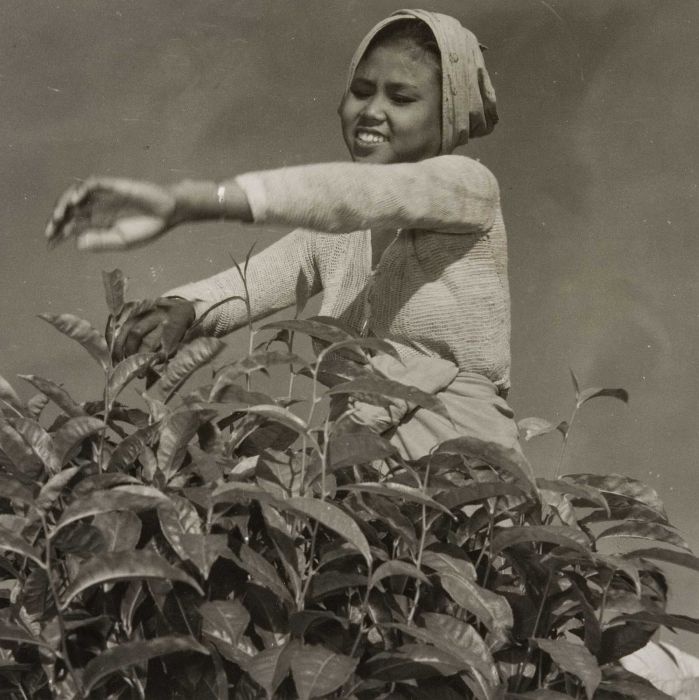
Most Sundanese are wet-rice farmers, who are capable of producing up to three crops a year. Landholdings tend to be too small to support their owners, who find jobs doing something else. Many trade, make handicrafts or work as farm laborers. Living conditions in West Java vary widely. A small minority of Sundanese enjoy great wealth, while many others live in informal settlements lacking basic services such as running water and electricity. Most people fall somewhere between these extremes, but economic inequality within Sundanese society remains pronounced. Since the 1980s, rising incomes and expanded consumer access have enabled more Sundanese to own items such as cars, televisions, jewelry, and fashionable clothing. In urban areas, motorcycles and private cars are now common, although most people still rely on public transportation for daily travel. At the same time, unemployment continues to be a persistent problem, often forcing Sundanese to migrate in search of work. [Source: A. J. Abalahin, “Worldmark Encyclopedia of Cultures and Daily Life,” Cengage Learning, 2009 ^^; David Straub, “Encyclopedia of World Cultures, East and Southeast Asia” edited by Paul Hockings (G.K. Hall & Company, 1993]
Clothes: Traditional Sundanese women's clothing consists of a kebaya, a long-sleeved, fitted lace blouse, and a sarung, a skirt-like garment. A kebaya is a long-sleeved, fitted lace blouse worn over another layer of clothing. The sarung is a length of cloth wrapped around the waist and hanging down to the ankles. Men also wear sarongs, but instead of kebayas, they wear long-sleeved batik shirts or fitted, embroidered jackets. Such traditional clothing is increasingly worn only on formal occasions, such as weddings. Everyday dress follows Western or Islamic styles. [Source: Junior Worldmark Encyclopedia of World Cultures, The Gale Group, Inc., 1999]
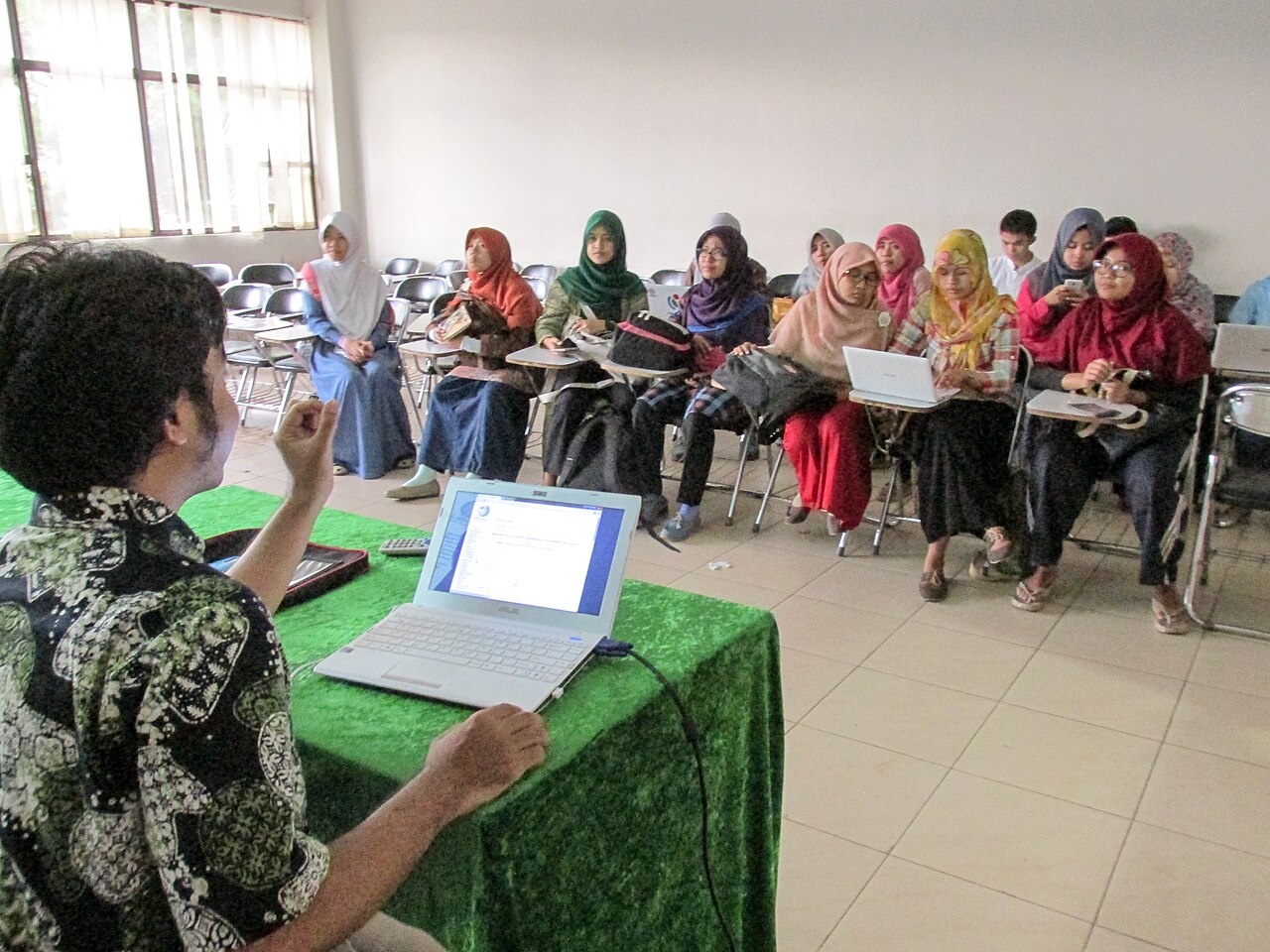
Education is highly valued among the Sundanese in general, and parents will sacrifice a great deal to pay for their children's education. This is reflected in West Java's higher literacy rates compared to other areas of Indonesia. For instance, in 1987, only 16.3 percent of West Javanese people over 10 years of age were illiterate, compared with over 20 percent in other provinces. This higher literacy rate may also reflect the better educational facilities available in West Java, which has been an educational hub since colonial times. ^^
RELATED ARTICLES:
SUNDANESE: HISTORY, RELIGION, LANGUAGE, POPULATION factsanddetails.com
SUNDANESE SOCIETY: FAMILY, MARRIAGE, GENDER factsanddetails.com
SUNDANESE CULTURE: FOLKLORE, MUSIC, SHADOW PUPPETRY factsanddetails.com
WEST JAVA: ANCIENT HISTORY, GUNUNG PADANG, SUNDANESE CULTURE factsanddetails.com
VILLAGES, RURAL LIFE AND THE SEA IN INDONESIA factsanddetails.com
URBAN LIFE IN INDONESIA: GROWTH, PROBLEMS, JAKARTA, NOW THE WORLD'S BIGGEST CITY factsanddetails.com
HOUSES IN INDONESIA factsanddetails.com
INDONESIAN SOCIETY factsanddetails.com
CLASSES, HIERARCHIES AND STRATIFICATION IN INDONESIAN SOCIETY factsanddetails.com
Tali Paranti and the Meaning of Sundanese Life
Tali Paranti refers to the culture of the Sundanese and covers the meaning of a Sundanese person's life. Before a Sundanese is born, and until a thousand days after his/her death, there are some basic principles that must be applied. There are also some requests that have to be fulfilled. There are elements from the unnatural world (ghostly world) that affect every human being, and all of these factors are part of the Sundanese belief system. These beliefs hold a very strong value. Since time immemorable, before even having a knowledge of literature, the Sundanese were maintained by Tali Paranti. Until today, those beliefs still exist. A few changes have colored the Sundanese religion, but the principles are still the same. [Source: Sunda.org ***]
Tali Paranti explains the orientation of the two powerful rulers of the unnatural world, which has a huge impact on the natural world, the dwelling of human beings. The first is called Nu Kawasa. The Sundanese belief about Nu Kawasa probably has been changed somewhat, due to the influence of foreign religions. Nowadays, the original characteristics of Nu Kawasa are not clearly defined. However, the concept of Nu Kawasa's well-being is still around. Tali Paranti remains the power that governs human life. The goal of the Sundanese is Mulih ka jati, pulang ka asal (at death, you return to your original place). The Sundanese believe that they will have a place in the future world, and that Nu Kawasa will be the one who chooses this place for them. ***
The function of Tali Paranti is to organize the life cycle of the Sundanese. The life cycle's ceremonies start before one is born and continue until the thousandth day after one's death. Out of all the life cycle ceremonies, the most important is circumcision for men and marriage for women. Circumcision is ranked first, followed by marriage. In these ceremonies, Dewi Sri (See Below) holds a vital position.
Sundanese Villages and Houses
Sundanese villages tend to be larger than those of the Javanese, with 1,000 to more than 7,000 residences. Clusters of houses are divided by fields, which tend to be small and scattered. Sundanese houses differ from those of the Javanese in that they are built on pilings. [Source: David Straub, “Encyclopedia of World Cultures, East and Southeast Asia” edited by Paul Hockings (G.K. Hall & Company, 1993) ~]
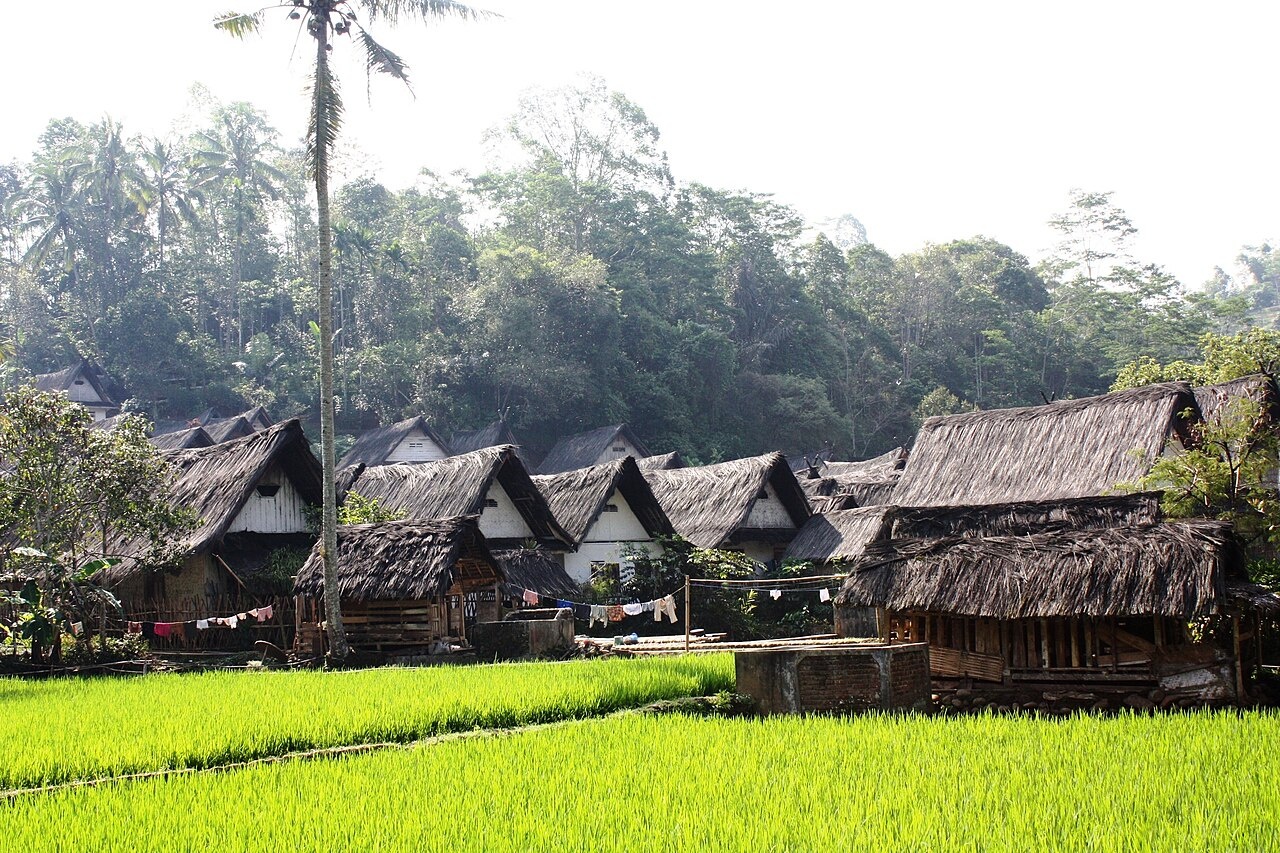
Sundanese house architecture emphasizes practicality, simplicity, and modesty. Designs are generally uniform and minimally ornamented, relying on natural materials and reflecting a strong concern for harmony with the surrounding environment. Traditional house forms have largely disappeared but some of their architectural elements endure and are found in other kinds of buildinga. [Source: Wikipedia]
Traditional Sundanese houses are typically gable-roofed structures known as the kampung style. Roofs are thatched with natural materials such as ijuk (black aren fibers), kirai, hateup leaves, or palm leaves, laid over wooden frames and beams. Walls are commonly made from woven bamboo, and the entire structure is raised on short stilts. Variations of the basic form include hipped roofs and gablet roofs, which combine elements of both gable and hip designs.
One of the most distinctive roof types is the Julang Ngapak, meaning “a bird spreading its wings,” characterized by wide, overhanging gablet eaves. Other recognized traditional house forms include Buka Pongpok, Capit Gunting, Jubleg Nangkub, Badak Heuay, Tagog Anjing, and Perahu Kemureb, each distinguished by roof shape and symbolic meaning.
In addition to the house itself, the rice barn, known as a leuit, is an essential structure in traditional Sundanese farming communities. The leuit plays a central role in storing harvested rice and holds strong cultural significance, particularly during the Seren Taun, when rice and agricultural abundance are ritually celebrated.
Sundanese Food
Sundanese cuisine revolves around rice, as reflected in the Sundanese saying, “If you haven’t eaten rice, then you haven’t eaten.” Plain boiled rice anchors every meal, while a variety of side dishes—vegetables, fish, or meat—provide contrast and balance. These accompaniments are flavored with ingredients such as garlic, galangal, turmeric, coriander, ginger, and lemongrass. The food itself is usually mildly seasoned, with heat added separately through a fiery chili paste made by grinding chilies and garlic with a mortar and pestle. [Source: A. J. Abalahin, “Worldmark Encyclopedia of Cultures and Daily Life,” Cengage Learning, 2009]
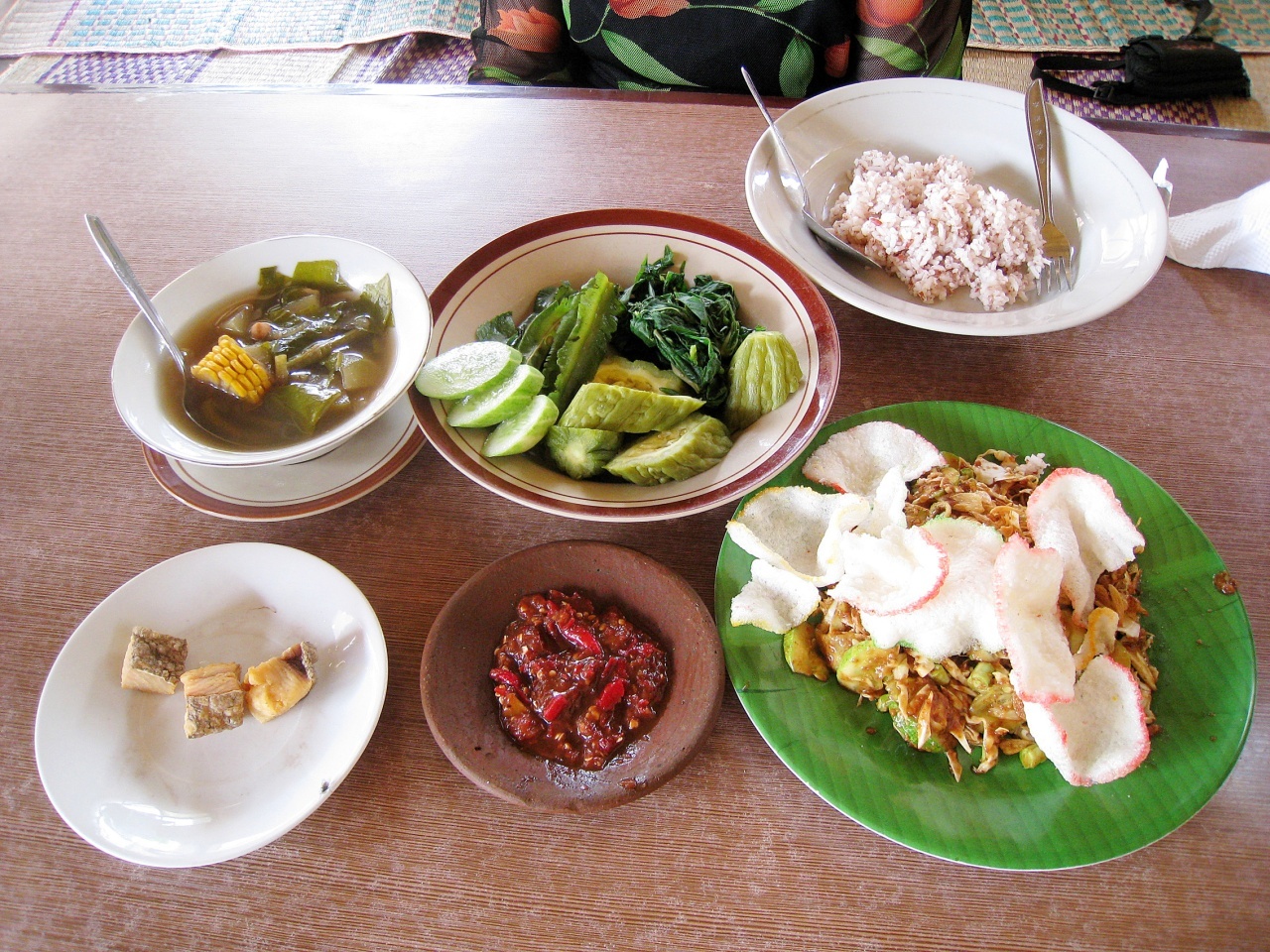
Vegetables play an especially important role in Sundanese diets. Many are eaten raw as lalap (or lalapan), including cucumbers, tomatoes, cabbage, lettuce, eggplant, basil, and other greens. Raw vegetables are typically paired with sambal dadak, a freshly prepared chili sauce.
Side dishes vary by region. In coastal areas, saltwater fish are common, while inland and mountainous regions favor pond-raised fish such as carp or goldfish. As Muslims, Sundanese avoid pork but regularly eat goat, sheep, water buffalo, and beef, along with poultry such as chicken, duck, goose, and pigeon. One dish for which they are particularly well known is lalapan, a platter composed entirely of raw vegetables such as papaya leaves, cucumber, basil, eggplant, and bitter melon.
Traditionally, meals are eaten seated on the floor, using the fingers of the right hand. Guests and men are served first, followed by others in turn. Daily meal times are early: breakfast before sunrise, lunch before noon, and dinner in the late afternoon, around five o’clock.
Sundanese Dishes
Sundanese food tends to be bland yet tasty unless you add sambal dadak (chili and other ingredients grinded together). If you're looking for a spicy snack add sambal dadak with nasi timbel (steamed rice formed into a roll inside a banana leaf). Usually sour vegetables soup (sayur asam) is accompanied by nasi timbel. Bandung has restaurants serving various kinds of food: Padangese (food from West Sumatra, very spicy), Javanese (sweeter), Chinese, Japanese, Korean, Western and Indian. [Source: Indonesia Tourism website]
One of the most well known Sundanese dishes, timbel, consists of nasi timbel, lalapan, sambal dadak, a piece of chicken (fried or roasted Sundanese style), fried tofu, fried tempeh, and a slice of jambal (salted fish). Other tasty dishes and hand food include gepuk (slices of beef, mixed in traditional herbs, then fried), pepes (fish, chicken of mushrooms mixed with crushed and blended herbs, folded into a banana leaf, then steamed) and sauteed greens. Batagor baso tahu goreng (fried meatballs and tofu) is one of the most sought-after specialties. It is sometimes made with fish and served with a special peanut sauce. Nasi goreng (fried rice), although not originally from Bandung, is a favorite. The ingredients vary, according to people's preference. Sometimes the rice is mixed with seafood (usually shrimps, pieces of cuttlefish or crab meat), chicken, vegetables, mutton and/or salted fish.
Among the popular Sundanese sweets are pisang molen (a traditional pastry filled with banana and cheese), brownies kukus (steamed brownies) and cakue (fried dough). Es cendol, made of blended/grinded rice, palm sugar, and coconut milk, is a treat on a hot day. Bandrek or bajigur when the weather is cooler. Bandung is known for milk products and yoghurt. Basically there are two kinds of yoghurt in Bandung: the thin one, and the thick one (French style).
Hot snacks are widely sold throughout Bandung. Among them are gehu-toge tahu- (tofu with beansprouts and vegetables filling), pisang goreng (fried banana), cireng-aci goreng (fried tapioca), and many more. You might be interested in trying snacks such as, nangka goreng (fried jackfruit), peuyeum goreng (fermented cassava, fried), nanas goreng (fried pineapple), Ketan bakar (roasted sticky rice) and jagung bakar/rebus (roasted/boiled corns).
Sundanese Work and Economic Activity
Wet-rice cultivation forms the economic foundation of Sundanese rural life, though some communities in the southwestern parts of Sunda still practice swidden agriculture. Yam, vegetables, peanuts and soybeans are raised for consumption. Cash crops include corn, root crops, chili peppers and tobacco. Many Sundanese fish or practice fish farming. Water buffalo and cattle are for work and transportation. Landholdings tend to be too small to support their owners, who find jobs doing something else. Many trade, make handicrafts or work as farm laborers. [Source: David Straub, “Encyclopedia of World Cultures, East and Southeast Asia” edited by Paul Hockings (G.K. Hall & Company,1993]
Land tenure in Sundanese villages combines private and communal arrangements. Most communities maintain shared lands, as well as plots reserved for original village members and for individuals who have rendered special service to the community. Additional land is allocated for the use of village officials, who traditionally receive no regular salary and depend on these usufruct rights for their support. [Source: A. J. Abalahin, “Worldmark Encyclopedia of Cultures and Daily Life,” Cengage Learning, 2009]
In West Java, underemployment is a more serious issue than outright unemployment. Most people manage to find some form of income, whether in the formal or informal economy, but struggle to earn enough to meet their needs. This problem is especially acute among younger, college-educated Sundanese, many of whom face limited job prospects. When employment opportunities do arise, they are often low-paying factory jobs producing items such as sneakers, televisions, clothing, or furniture. These positions are typically filled by young women, unskilled men, or migrants from Central Java, who are often perceived as more willing to work long hours with few benefits than the more family-oriented Sundanese.
Image Sources: Wikimedia Commons
Text Sources: “Encyclopedia of World Cultures Volume 5: East / Southeast Asia:” edited by Paul Hockings, 1993; National Geographic; New York Times, Washington Post, Los Angeles Times, Lonely Planet Guides, Library of Congress, Smithsonian magazine, The New Yorker, Time, Reuters, AP, AFP, Wikipedia, BBC, CNN, and various books and other publications.
Last Updated December 2025