
SUNDANESE SOCIETY AND VALUES
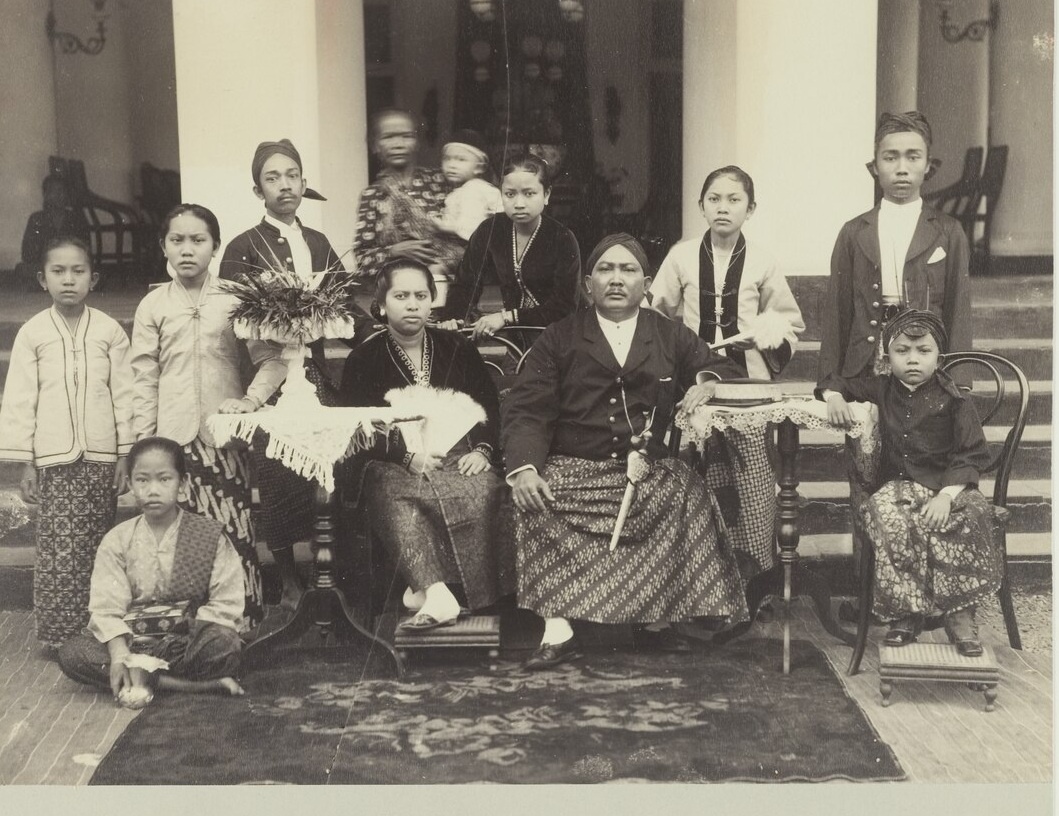
Sundanese society is shaped by values of friendliness and respect and is firmly centered on family and community life. A strong Islamic faith is blended with older local traditions, Respect for elders and adherence to social hierarchy are fundamental. This is reflected in the Sundanese language, which—like Javanese—uses different levels of speech, from informal (kasar) to refined (halus), to signal respect and relative social status. [Source: David Straub, “Encyclopedia of World Cultures Volume 5: East / Southeast Asia:” edited by Paul Hockings, 1993; A. J. Abalahin, “Worldmark Encyclopedia of Cultures and Daily Life,” Cengage Learning, 2009 ^^]
The Sundanese are widely regarded as gentle, cheerful, and hospitable, a quality summed up in the ideal of soméah. Social life emphasizes community (masarakat), family (kulawarga), and respect (hormat). Traditionally, Sundanese society was hierarchical, especially in the Priangan region around Bandung, where an elite class known as the menak stood above common people. At the same time, popular figures such as Kabayan symbolize wit and subtle resistance to authority. Village life has long been regulated by headmen and councils of elders, guided by custom and local wisdom that stresses mutual cooperation (gotong royong) and respect for ancestral teachings.
Kinship among the Sundanese is bilateral, with descent traced through both the mother’s and the father’s lines. Kinship terminology emphasizes generation and age more than gender or collateral distinctions. Among peasants, kinship ties are usually recognized only up to two generations upward and one degree sideways, while nobles tend to preserve longer genealogies to establish links to ancient Sundanese rulers.
Dutch colonial rule introduced a new administrative elite, and members of the colonial bureaucracy (pamong praja) came to enjoy the highest social status. Western education and fluency in Dutch became key avenues for social mobility. Today, the Sundanese live within the framework of the Indonesian state.
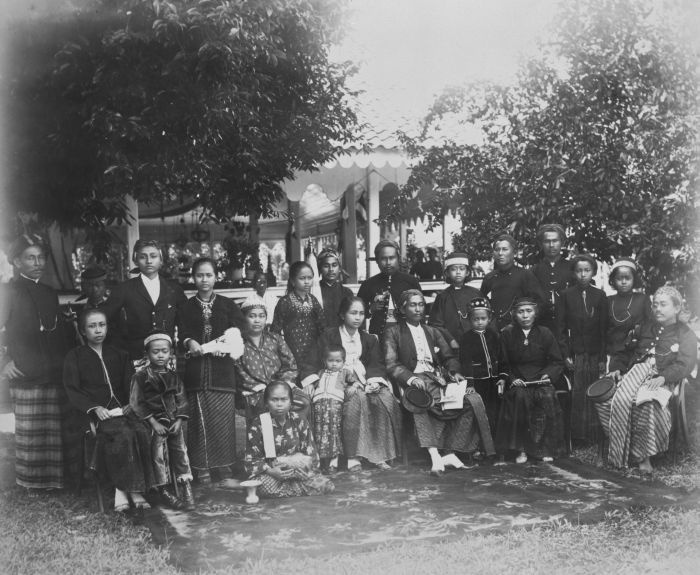
Sundanese kinship concepts extend symbolically across seven generations of ancestors and descendants, each marked by specific terms. In principle, all descendants of a seventh-generation ancestor are considered part of the extended family, though in practice the most important unit is the nuclear family of parents and children. Nuclear families usually maintain their own households, but it is common for relatives from either side of the family to stay temporarily, reflecting the enduring strength of family ties.
RELATED ARTICLES:
SUNDANESE: HISTORY, RELIGION, LANGUAGE, POPULATION factsanddetails.com
SUNDANESE LIFE: VILLAGES HOUSES, FOOD, WORK factsanddetails.com
SUNDANESE CULTURE: FOLKLORE, MUSIC, SHADOW PUPPETRY factsanddetails.com
WEST JAVA: ANCIENT HISTORY, GUNUNG PADANG, SUNDANESE CULTURE factsanddetails.com
Sundanese Customs and Etiquette
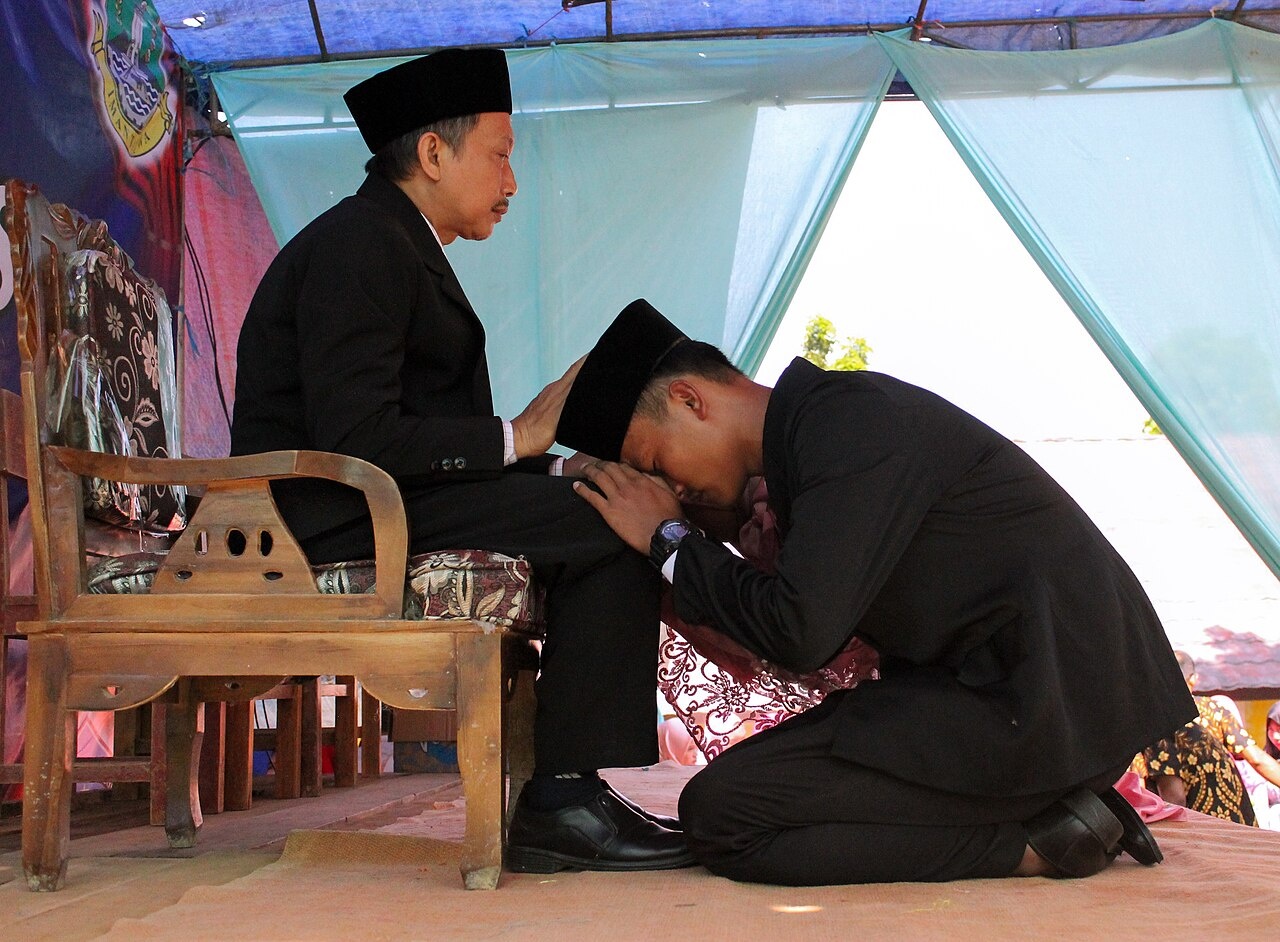
Sundanese social life places great importance on showing respect through an unwritten code of proper behavior. Formal greetings often involve a slight bow of the head and upper body, with the hands held together in front of the chest and the fingertips lightly touching those of the other person. In business contexts, handshakes are common and acceptable; they are given with the right hand and often followed by briefly touching the heart as the hands separate, signaling sincerity and respect. [Source: A. J. Abalahin, “Worldmark Encyclopedia of Cultures and Daily Life,” Cengage Learning, 2009]
When visiting someone’s home, a guest is expected to ask permission before entering. The host will invite the visitor to sit and customarily offer food or drink. Politeness requires that the guest initially decline, even though a drink is usually provided regardless. The guest should wait until the host explicitly invites them to drink before doing so. Likewise, when preparing to leave, the visitor should announce their intention. The host will almost always respond by saying the guest is leaving too soon and has not yet eaten, even if the visit has been long and the host had other obligations.
In courtship, an unspoken rule emphasizes respect and propriety. A man is expected to pick up his date at her home, speak with her family, pay for meals and entertainment, and escort her safely back afterward. From the outset, the woman’s family plays an active role and may step in if they believe the man is unsuitable or behaving inappropriately.
Sundanese Family and Rites of Passge
The nuclear family (kulawarga) is the basic unit of Sundanese society, and individuals have the greatest obligations to their kulawarga. The golongan, or kindred, occasionally assist in life-cycle ceremonies. Finally, the bondorojot is an ambilineal kin group that exists among some members of the higher social classes and functions in ancestor worship ceremonies. Sundanese socialization is the mother's responsibility alone. The father is seen as responsible for the child's physical existence. For this reason, perhaps, children are considered to have a spiritual connection with their mothers rather than their fathers.[Source: David Straub, “Encyclopedia of World Cultures Volume 5: East / Southeast Asia:” edited by Paul Hockings, 1993]
Birth Rites: At the birth of a Sundanese child, a paraji—a traditional midwife believed to possess shamanic knowledge—is commonly present to assist the mother, offer guidance, and provide spiritual protection. The paraji recites prayers and mantras to help ensure the safety of both mother and child. After delivery, the baby’s umbilical cord is cut with a special tool known as a hanis, and the placenta is buried beneath a rear window of the house. A small ritual celebration then follows, bringing together family and neighbors to give thanks to God and offer blessings for the newborn’s future.
Circumcision Ceremony: When boys reach about seven or eight years of age, they take part in a circumcision ceremony that marks an important step toward adulthood. Before the procedure, the boy is bathed and dressed in a sarung. Two men hold his legs while a specialist performs the circumcision. The ritual is carried out at the family home and is often accompanied by a communal gathering or feast. For many boys, this event is eagerly anticipated, as it brings new social recognition and responsibilities.
Inheritance: An individual's property is divided equally among the surviving spouse and offspring. When no spouse survives, all property is divided equally among the offspring, regardless of sex. This customary rule (adat) violates Islamic law, which stipulates that males receive twice what females receive. To avoid this, the male receives two-thirds of the estate and gives one-third to his sister. However, the house and surrounding gardens go to the offspring (usually the youngest daughter) who has lived with the parents to care for them.
Sundanese Marriage
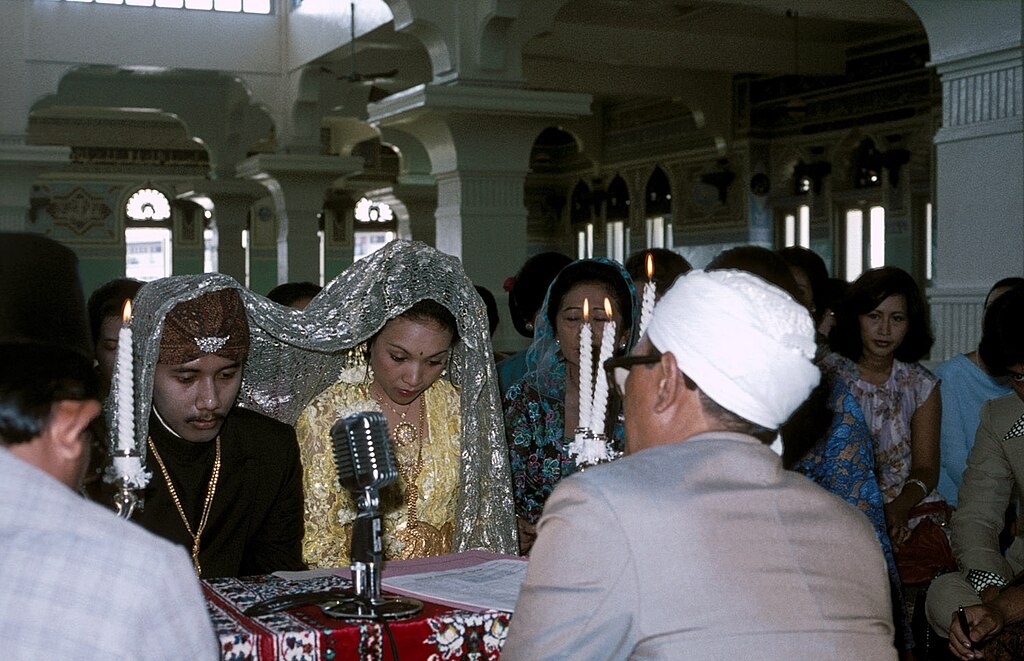
Sundanese marriages were traditionally arranged but now are mostly love matches The marriage process begins when the grooms presents a gift to the bride’s parents, is formalized by a marriage contract overseen by a district Muslim religious official (naib) and sanctified with a Muslim ceremony. Polygyny is accepted but rare; men claim cost and wives' opposition as barriers to multiple wives. Many marriage rituals revolve around the rice goddess, Dewi Sri. Ideally couples live on their own after the wedding but few can afford this so they live with one or the other’s parents. [Source: David Straub, “Encyclopedia of World Cultures Volume 5: East / Southeast Asia:” edited by Paul Hockings, 1993]
Traditionally, Sundanese marriages were arranged by parents through a formal nine-step ritual. The process began when the groom’s parents visited the bride’s family to ask whether their daughter was eligible for marriage. If she was, both families exchanged questions to assess whether the match was suitable. Once agreement was reached, the groom arrived with relatives and friends bearing gifts and money, and a family representative formally proposed to the bride’s parents. Acceptance marked the couple’s engagement, after which their interactions were governed by strict rules. In the days leading up to the wedding, the groom symbolically presented the bride with clothing, jewelry, and money, and on the day before the ceremony both sets of parents offered formal advice on building a harmonious marriage. [Source: A. J. Abalahin, “Worldmark Encyclopedia of Cultures and Daily Life,” Cengage Learning, 2009]
Today, this elaborate nine-step arrangement is increasingly uncommon. More often, parents express their preferences by discouraging relationships they disapprove of, hoping their daughter will choose a more acceptable partner. Ideally, a spouse should come from the same neighborhood and share a common ancestor, a form of marriage known as perkawinan gulangkep. However, growing urbanization has made such unions rarer, as many couples now meet at school or in the workplace rather than through family or neighborhood networks.
Sundanese Wedding Ceremony
On the wedding day, a Sundanese groom is formally collected from his home by representatives of the bride’s family and escorted to her house. There, he presents the bride with an agreed amount of gold. Guests from the bride’s side gather to meet the couple, share a communal meal, and offer gifts. A key moment follows when the parents ceremonially feed the bride and groom the last morsels they will receive from their parents’ hands, symbolizing their transition to independence and shared responsibility. About a week later, a reciprocal gathering is held at the groom’s home so his family and friends can formally welcome the bride. [Source: A. J. Abalahin, “Worldmark Encyclopedia of Cultures and Daily Life,” Cengage Learning, 2009]
According to expat.or.id: “Some common practices from a traditional Sundanese (West Java) wedding ceremony:Welcoming the bridegroom ceremony: 1) The bridegroom is welcomed with the umbul-umbul, a decoration indicating that a wedding ceremony is going on, which is also auspicious for the bridegroom. 2) The welcome is followed by a procession of ladies with candles. They pray to the Almighty seeking His blessing in order that there maybe no hindrances in the ceremony. 3) The showering of flowers by the dancers is symbolic of a fragrant future for the couple. 4) The umbrella held over the couple's heads, apart from serving as a protective symbol, indicates esteem and respect. 5) The mother of the bride gives the bridegroom a garland of flowers indicating his acceptability to the family. 6)The mother of the bride gives the bridegroom a keris, a hidden message to the son-in-law not to be disheartened while toiling for his family. [Source: expat.or.id /~/]
During the ceremony, the bride and groom sit side by side beneath a selendang or veil, representing two individuals united in one purpose. They then perform sungkem, bowing to kiss their parents’ knees to ask forgiveness, receive blessings, and affirm their ongoing devotion and respect. Another ritual, sawer, takes place near a water spout or gargoyle, whose flowing water symbolizes the unending love of parents for their children.
The couple is next seated under an umbrella at the entrance of the house while two singers—one male and one female—perform kidung, songs offered on behalf of the parents. These verses advise the newlyweds to live in harmony, treat one another with kindness, and invoke blessings from God. The sawer ritual concludes with the showering of symbolic items: 1) Turmeric rice Rice is a sign of prosperity and yellow stands for everlasting love; 2) Coins Reminding the couple to share their wealth with the less fortunate; 3) Candy Indicates sweetness and fragrance throughout their marriage; 4) A betel nut set near the couple is a reminder that their different customs should not spoil their harmonious marriage.
Nincak Endog; Sundanese Egg-Breaking Wedding Ceremony
The Nincak Endog is the egg breaking ceremony at a Sundanese wedding. According to expat.or.id: “The couple are required to stand facing each other in front of the entrance of the house. The bridegroom stands outside the entrance and the bride is inside the entrance. This ceremony is conducted by the lady in charge of the bridal makeup and serves as advice to the couple for their happiness and long wedded life.[Source: expat.or.id /~/]
The following items are used: 1) Harupat, seven broomsticks, are burnt and thrown away symbolizing the discarding of bad habits which endanger one. s married life. 2) An egg is broken, indicating that the groom will be the master of the house henceforth and the bride will serve him. 3) Ajug, seven candles, represents the direction the couple should follow to ensure a happy married life. 4) Elekon, hollow bamboo, which symbolizes emptiness. 5) Kendi, an earthen water jug filled with water, which stands for peace. 6) In the past, unmarried girls were not allowed to cross over logs. Here the bride is made to cross the log as a sign that she will always obey her husband. 7) The lady in charge of the ceremony gives the bride the harupat. The groom lights the harupat with the ajug. Then the flames are put out and the sticks are broken and thrown away. After the groom breaks the egg with his right foot, the bride cleans the groom's foot with the water from the kendi. Then the bride throws the kendi to break it. Then the couple are escorted to the house. The bride crosses the log and enters the house while the groom remains outside to perform the buka pintu ceremony. /~/
The Buka Pintu is a dialogue between the bride and groom in front of the house. However, they are represented by a couple who also sings for them. First, the couple knocks three times on the door, then enters into a dialogue whereby permission is requested by the groom to enter the bride's house. The bride consents on the condition that the groom will say the syahadat (confirming his Moslem faith). The song also solemnizes the importance of the nuptial ceremony. /~/
Huap Lingkung is symbolic of the last time the parents of the bride will feed their daughter. This is also the first dish prepared by the daughter in her new home. The dish consists of turmeric sticky rice with yellow spiced chicken on top of it. During the Patarik-Tarik Bakakak couple are given a barbecued spiced chicken. On hearing the word “go” from the lady conducting the ceremony, the couple has to pull the chicken apart. The one who gets the larger piece supposedly will bring in the larger share of the family fortune. This ceremony also serves to remind the couple to encourage each other to work hard together to gain good fortune. /~/
Sundanese Gender and Sexuality
Sundanese society traditionally draws a clear distinction between male and female roles, with women responsible for managing the household and men expected to earn cash income. In rural areas based on subsistence farming, this arrangement often gives women considerable influence, since food production remains centered on the home. In urban settings, however, where food must be purchased rather than grown, women are more likely to be economically dependent on their husbands. To reduce this dependence and improve household living standards, many women now pursue full- or part-time work. It has become common for women to enter the workforce before marriage to help support their parents. While many stop working after marriage, others continue, and even those without formal employment often engage in informal income-generating activities at home, such as catering or selling clothing. [Source: A. J. Abalahin, “Worldmark Encyclopedia of Cultures and Daily Life,” Cengage Learning, 2009]
In cities, Sundanese women generally enjoy a high degree of social freedom, and modern urban life in West Java provides education and career opportunities, particularly for the middle class. Conditions in rural areas are far harsher. Widespread poverty and unemployment have contributed to a serious sex trade problem that affects thousands of Sundanese women each year. Limited job prospects for young women, combined with a degree of cultural tolerance toward prostitution, have led some families to encourage their daughters to enter the trade. As a result, Sundanese women are found in brothels throughout Indonesia. Local governments have attempted to curb prostitution by restricting access to identity documents, while non-governmental organizations work to help women leave the sex trade.
Within Indonesian society more broadly, homosexuals and transgender individuals lack formal legal protections but are also not usually subjected to extreme persecution. In West Java, as elsewhere in Indonesia, gay men and transgender people are often open about their identities, though they remain outside full social acceptance.
Image Sources: Wikimedia Commons
Text Sources: “Encyclopedia of World Cultures Volume 5: East / Southeast Asia:” edited by Paul Hockings, 1993; National Geographic; New York Times, Washington Post, Los Angeles Times, Lonely Planet Guides, Library of Congress, Smithsonian magazine, The New Yorker, Time, Reuters, AP, AFP, Wikipedia, BBC, CNN, and various books and other publications.
Last Updated December 2025