
SUNDANESE CULTURE, CRAFTS AND LITERATURE
The Sundanese possess a remarkably rich cultural tradition expressed through music, dance, literature, and the arts. Their cultural life is both deeply rooted in tradition and open to innovation. Like the Javanese, the Sundanese are known for their batik art. The Sundanese are fond of clothes made of batik with bright colors. Batik cloth varies enormously in artistry, elaboration, quality, and cost. Formal occasions require that Javanese, Sundanese and Balinese women wear whole cloths wrapped ornately to form a skirt.[Source: A. J. Abalahin, “Worldmark Encyclopedia of Cultures and Daily Life,” Cengage Learning, 2009]
Batik is a technique used to create patterns on textiles, involving the application of beeswax to facilitate resist dyeing. Originally, batik was made by painting the wax on by hand using a special tool, then immersing the entire cloth in dye. Using this technique, it could take up to six months to complete one sarung. However, beginning in the mid-19th century, an industrial technique of stamping the cloth with wax was developed. This allowed for mass production, and today batik can be found in American and European stores. Sundanese literature has long been rooted in oral storytelling. The earliest known written work, Caritha Parahyangan, dates to around the year 1000 and celebrates the Javanese king Sanjaya as a heroic warrior. One of the oldest literary forms still practiced is pantun cerita, a style of traditional poetry in which each verse consists of two linked couplets, the first suggesting the second through sound or imagery. These poems recount tales of ancient Sundanese heroes and kingdoms and have been transmitted orally for centuries.
In more recent times, modern literary forms such as novels have developed among the Sundanese. Unlike Western literary traditions that distinguish sharply between “high” and popular literature, Sundanese novels have generally been written for a broad audience and are read by ordinary townspeople as well as educated urban readers.
RELATED ARTICLES:
SUNDANESE: HISTORY, RELIGION, LANGUAGE, POPULATION factsanddetails.com
SUNDANESE SOCIETY: FAMILY, MARRIAGE, GENDER factsanddetails.com
SUNDANESE LIFE: VILLAGES HOUSES, FOOD, WORK factsanddetails.com
WEST JAVA: ANCIENT HISTORY, GUNUNG PADANG, SUNDANESE CULTURE factsanddetails.com
Sundanese Folklore
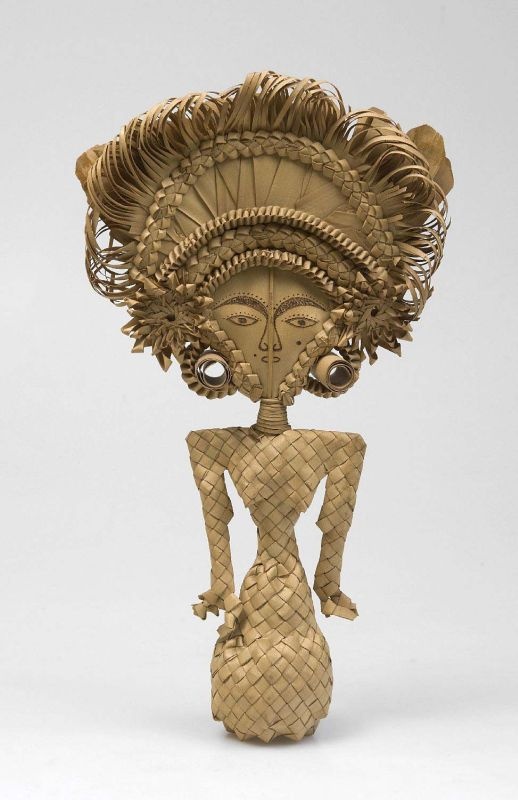
Myths and heroic tales play a central role in Sundanese cultural life and are expressed through many media, including films, puppet performances, oral poetry, novels, and comic books. Some stories are strongly local, explaining the origins of particular kingdoms or the mythical creation of lakes, mountains, or other distinctive landscapes. Others, such as episodes from the Ramayana, originated in India but have been reshaped over centuries to reflect Sundanese and broader Javanese cultural values. [Source: A. J. Abalahin, “Worldmark Encyclopedia of Cultures and Daily Life,” Cengage Learning, 2009 ^^]
Among all these narratives, the legend most often regarded as uniquely Sundanese is that of Nyi Roro Kidul, the Queen of the South Seas. This myth, preserved in old Javanese chronicles, dates back hundreds of years. According to the story, a princess of the fourteenth-century Pajajaran grew so consumed by her desire for power that her father placed a curse upon her. The curse granted her immense strength, greater even than his own, but confined her authority to the southern seas. Reborn as the stunningly beautiful Nyi Roro Kidul, she is believed to dwell beneath the waves off the south coast of West Java.
In legend, she reigns supreme over all spirits and is said to have received secret nighttime visits from Javanese kings and Muslim saints in her underwater palace. The myth continues to shape popular beliefs today: men who swim or fish along the southern coast are warned never to wear green, for those who do are believed to risk being claimed by Nyi Roro Kidul and disappearing forever into her realm.
Sunda Wiwitan is a folk religion followed by some of the Sundanese people, including Baduy and Bantenese. According to its origin myth of the Sundanese people: the supreme divine being, Sang Hyang Kersa, created seven bataras (deities) at Sasaka Pusaka Buana, the sacred place on earth. The eldest, Batara Cikal, is regarded as the ancestor of the Kanekes, while the other deities ruled different parts of Sunda lands in West Java. Sundanese legend also preserves memories of deep antiquity. The story of Sangkuriang is linked to the prehistoric lake once occupying the Bandung Basin, suggesting very early human habitation in the region. Another well-known proverb and legend explains the creation of the Parahyangan highlands, portraying them as a divine realm formed when the gods smiled—an image that emphasizes both their sacred character and natural beauty. [Source: Wikipedia]
Early Sundanese Mythology — Origin of Dewi Sri
Dewi Sri — the goddess of rice and fertility — is held in high esteem by the Sundanese and is closely associated with the Hindu goddess Lakshmi as both are attributed to wealth and family prosperity. Dewi Sri’s stature is revealed in importance she holds in Sundanese ceremonies. One myth that is very well known by the Sundanese is Nyi Pohaci Sanghiang Sri, a story about origin Dewi Sri. Once upon a time in the heavens, the Batara Guru commanded all the gods and goddesses to contribute their power in order to build a new palace. Anybody who disobeyed this commandment would lose his or her head. Upon hearing the Batara Guru's commandment, one of the gods, Anta, was very anxious. He didn't have arms or legs, and he wasn't sure how he could possibly do the job. Anta was shaped as a snake and he couldn't work. He sought advice from one of his friends, but unfortunately his friend was also confused by Anta's bad luck. Anta became very upset and cried. [Source: Wawacan Sulanjana, Sunda.org ***]
As he was crying, three teardrops fell to the ground. Amazingly, after touching the ground those teardrops became three eggs. His friend advised him to offer those eggs to the Batara Guru, hoping that he would give a fair judgement. With the three eggs in his mouth, Anta went to the Batara Guru's palace. On the way there, he was approached by a black bird who asked him a question. He couldn't answer because of the eggs in his mouth, but the bird thought that Anta was being arrogant. It became furious and began to attack Anta, and as a result one egg was shattered. Anta quickly tried to hied in the bushes, but the bird was waiting for him. The second attack left Anta with only one egg to offer to the Batara Guru. ***
Finally, he arrived at the palace and offered his teardrop (in the shape of an egg) to the Batara Guru. The offer was accepted and the Batara Guru asked him to nest the egg until it hatched. Miraculously, the egg hatched into a very beautiful girl. He gave the baby girl to the Batara Guru and his wife. Nyi Pohi Sanghian Sri was her name, and she grew up into a beautiful princess, becoming more and more beautiful as the days passed by. As her beauty grew, every man who saw her became attracted to her. Even her stepfather, the Batara Guru, started to feel an attraction toward her. Seeing the Batara Guru's new attitude toward Nyi Pohaci, all the gods became so worried about the situation that they conspired to separate Nyi Pohaci and the Batara Guru.
To keep the peace in the heavens, and to maintain Nyi Pohaci's good name, all the gods planned for her death. She was poisoned and her body buried on earth in a hidden place. But the graveyard was to hold a strange sign, for at the time of her burial, up grew a very useful plant that would forever benefit all human beings. From her eyes grew the plant that is called padi (rice paddy). ***
Sundanese Sports and Entertainment
Popular recreation in West Java centers on soccer, volleyball, badminton, and the martial art known as pencak silat. Most neighborhoods have small open fields where children play soccer and volleyball, while badminton is commonly played in front yards or at community courts. All of these sports attract spectators, but soccer inspires the greatest passion; in large cities such as Bandung, matches between local teams and visiting sides from other provinces have at times even sparked riots. [Source: A. J. Abalahin, “Worldmark Encyclopedia of Cultures and Daily Life,” Cengage Learning, 2009]
Pencak silat occupies a special place in Sundanese culture, blending elements of dance and self-defense. It is often taught to children in Islamic boarding schools (pesantren) by a guru. The discipline stresses both physical skill and spiritual development and is sometimes linked to mystical practices believed to endow practitioners with extraordinary powers.
Leisure life in West Java is strongly shaped by sore, or “the evening,” when people go out to watch films, stroll through town, eat at open-air cafés, and enjoy public performances. It is a social occasion meant both to observe and to be observed, prompting people to dress carefully; makeup, clothing, and even motor vehicles become symbols of pride and status.
Cinema-going varies widely by location. Urban theaters show a mix of Indonesian and foreign films—Indonesian productions generally being more popular—and offer air-conditioning and comfortable seating. In more marginal areas, screenings may take place in open-air cinemas resembling drive-ins without cars. Public performances are also popular. Crowds are reliably drawn to sinten, shows in which magicians demonstrate feats such as apparent invulnerability or startling transformations. Another enduring favorite is wayang golek, a wooden puppet theater that presents stories from the Ramayana and the Mahabharata, accompanied by singing and gamelan music.
At home, television provides constant entertainment. Programming blends Indian films, Latin American soap operas, American dramas, and a wide range of Indonesian shows. Often treated as background media, television accompanies daily chores and socializing, while soap operas in particular supply a steady source of conversation and shared amusement.
Sundanese Music and Dance
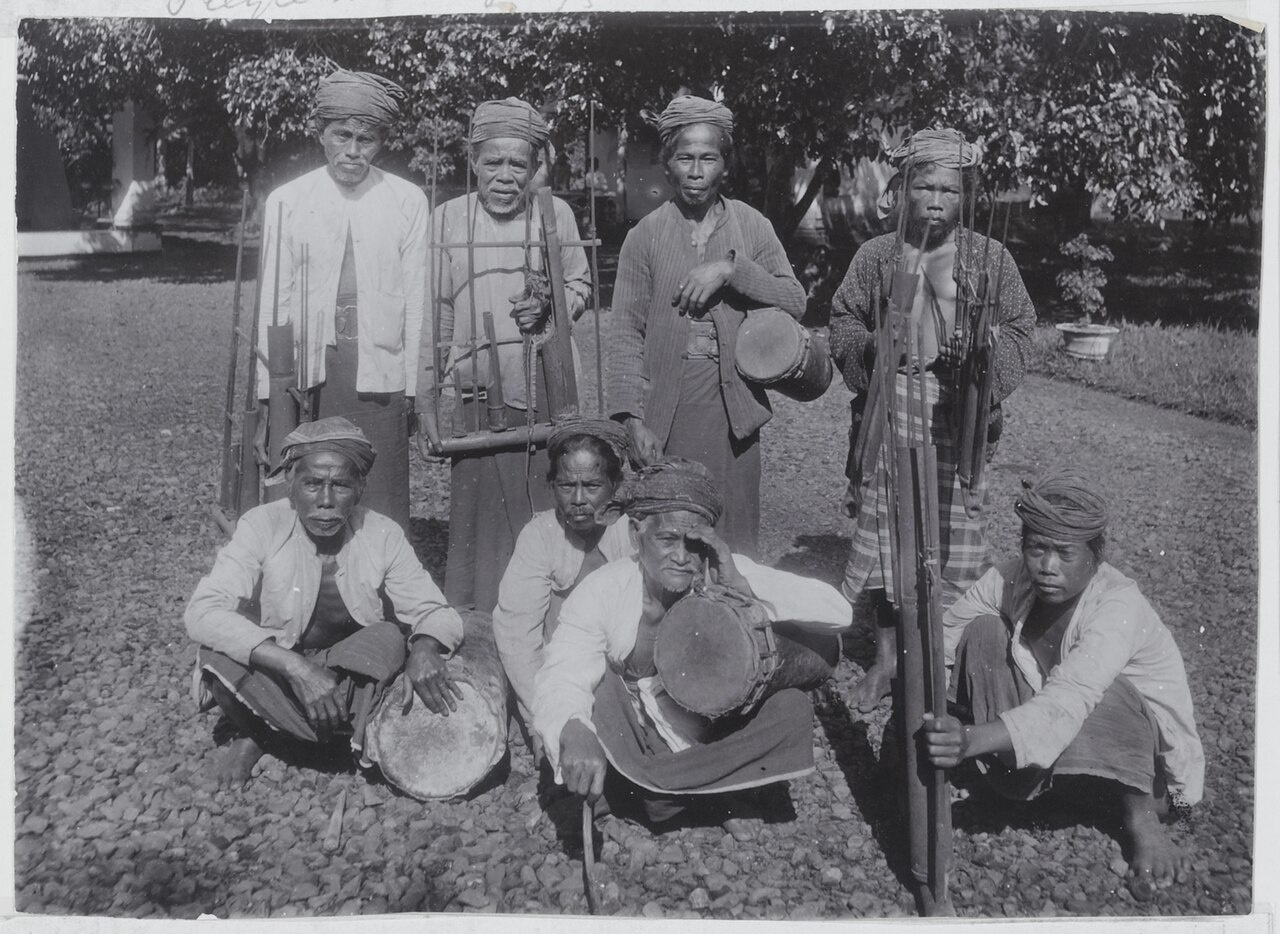
Sundanese musical styles range from classical orchestral forms to contemporary popular genres. One well-known traditional style is degung, performed by a simplified gamelan ensemble that blends soft percussion with the plaintive sound of the bamboo flute. Another distinctive musical tradition centers on the angklung, an ancient instrument made of suspended bamboo tubes of varying lengths that produce sound when shaken.
Once used mainly to accompany storytelling and processions, the angklung today can be heard playing everything from traditional melodies to works by Beethoven. Sundanese musicians tend to be highly adaptable, readily incorporating new influences, and many of Indonesia’s leading pop performers come from Sundanese backgrounds. Local music is often blended with modern styles, including electronic and dance beats. [Source: A. J. Abalahin, “Worldmark Encyclopedia of Cultures and Daily Life,” Cengage Learning, 2009 ^^]
Mournful Sundanese "kecapi" music has origins which can be traced back to the early civilizations that lived in this part of Java. The music is named after a lute-like instrument called the kecap, which has a very unusual sound. The Sundanese are regarded as expert instrument makers who get a good sound out of almost anything. Other traditional Sundanese instruments include the “suling”, a soft-tines bamboo flute, and the “angklung”, a cross between a xylophone and made from bamboo.
Sundanese gamelan from southwest Java highlights the “rehad”, “kendang” a large two-headed barrel drum), “kempul”, “bonang rincik” (a set of ten pot-shaped gongs) and “panerus” (a set of seven pot-shaped gongs), “saron”, and “sinden” (singer). Jaipongan is a percussion-based music using instruments from the Sundanese gamelan, particularly the “rehad” and “kendang”. It has a strange but danceable 16- or 32-beat rhythm, marked by a one-note gong, and no discernable Western influence.
Sundanese dance is characterized by restrained and highly controlled movements. Compared with Western dance, the gestures are smaller and fewer, with great emphasis placed on precision in the hands, fingers, eyes, head, and feet. Many dances show the influence of martial arts and are accompanied by gamelan music. Some dances are narrative in nature, such as the Mask Dance, which tells the story of a king consumed by bitterness after his love is rejected. Others are more social and expressive, including jaipong, a dynamic and sensual dance form that combines elements from several traditions. ^^
Wayang Golek
“Wayang golek” (wayang klitik) is like wayang kulit except the puppets are carved in relief and used without a screen. The three-dimensional puppets are carved from wood and elaborately painted and costumed. They have movable heads and arms and are manipulated with rods by a puppeteer below the stage. Many of the stories are the same Hindu ones used in Wayang Gulik but some are also inspired by Islamic stories.
“Wayang golek” is particularly popular in West Java and is associated with the Sundanese ethnic group. It is regarded as more populist and artheri than wayang kulit. It has traditionally been performed in Sundanese, the language of southwest Java. The puppets are often elaborately crafted. Some of the newer ones can stick out their tongue. Philip Kennicott wrote in the Washington Post, “They are extraordinary works of art even when inanimate; in the hands of a dalang their rudimentary motions take on exceptional subtlety. They strut and mope, bean each other on the head a lot, and enact complex stories while all the time swaying, just a little bit, rather like people on the edge of a dance floor.”
Dr. Jukka O. Miettinen of the Theatre Academy Helsinki wrote: “Wayang golek is a still popular form of rod puppetry, which, according to tradition, was invented by a Javanese Muslim ruler in the late sixteenth century. Its main repertoire is derived from the Menak cycle, dealing with the Muslim hero Amir Hamzah. Local variants of wayang golek have evolved in various parts of Java. The tradition is strongest in West Java, where it has been used in performing the stock repertoire of wayang purwa, that is, the Ramayana, the Mababbarata, as well as local tales, and the East Javanese Adventures of Prince Panji. [Source: Dr. Jukka O. Miettinen, Asian Traditional Theater and Dance website, Theatre Academy Helsinki **]
“Wayang golek uses a set of 60–70 puppets, which do not always portray specific characters, but stock types, the puppets thus being interchangeable. The heads and arms are carved three-dimensionally in wood, and the lower part of the body is covered by a batik sarong, beneath which the dalang operates the rod that makes the puppet’s head turn. He uses his other hand to manipulate the rods for the arms and hands. There is no screen, the dalang, the orchestra, and the singers all being visible to the audience.”**
Wayang Cepak
“Wayang Cepak” is a style of wayang golek practiced in West Java. It is a dying form practiced mostly around Cirebon. It has been around for at least 700 years, making it one of the oldest continuously performed forms of theater in the world, and is known for its distinctive style of carving.
Describing a Wayang Cepak show presided over by a dalang named Warsad Darya, Jamie James wrote in the New York Times, "The stage, a pair of stout banana trees, was flanked by a brilliant array of 130 puppets, all carved and painted by Warsad. They were costumed in lustrous silk and satin, and adorned with glittering spangles, bugles and beads. A fluorescent tube, mounted on a beam overhead and shaded by a pink curtain, cast a soft light. From the beam dangled offerings to the ancient pre-Muslim gods of Java: pineapples, pumpkins, passion fruit, bottles of soda and beer, cigarettes." [Source: Jamie James, New York Times, March 26, 2000]
"After a clangorous overture, a 15-year-old girl came out in front of the stage and impersonated several characters from the wayang, wearing masks and scarves and moving with grace or heavy-limbed power, as the character demanded....Then Warsad, seated in the floor behind the stage began to work his magic: no other word suffices.
The puppets floated across he stage, their heads and arms manipulated from below by slender rods. An aristocratic lady rushed into view, tossing her head fretfully and flailing her arms as the dalang crooned her cry of distress...A handsome prince entered, strutting purposely, his virile confident voice offering her solace. One by one the characters were introduced and planted in their places, carrying on complex conversations, punctuated by songs, which propel an enormously complicated plot." [Ibid]
Image Sources: Wikimedia Commons
Text Sources: “Encyclopedia of World Cultures Volume 5: East / Southeast Asia:” edited by Paul Hockings, 1993; National Geographic; New York Times, Washington Post, Los Angeles Times, Lonely Planet Guides, Library of Congress, Smithsonian magazine, The New Yorker, Time, Reuters, AP, AFP, Wikipedia, BBC, CNN, and various books and other publications.
Last Updated December 2025