
LEMMING SPECIES

Lemmings are microtine rodents (Arvicolinae), a subfamily that includes voles, lemmings, and muskrats. They are most closely related to the other subfamilies in the Cricetidae (comprising the hamsters and New World rats and mice). Arctic lemmings include true lemmings, of the genus Lemmus, and collared lemmings, of the genus Dicrostonyx. Although both have a circumpolar — though not identical — distribution, the two genera differ in many respects. Collared lemmings are much more resistant to extreme low temperatures than true lemmings. Consequently, its distribution extends farther north: collared lemmings are found on the northernmost islands of the Canadian Arctic and in northern Greenland, whereas the range of true lemmings reaches down to the boreal zone and does not include Greenland or the northern Canadian islands. [Source: barentsinfo.org]
Dicrostonyx genus contains the collared lemmings or varying lemmings. They are the only North American rodents that turn completely white in winter. There are seven species
Northern collared lemming (Dicrostonyx groenlandicus)
Ungava collared lemming (Dicrostonyx hudsonius)
Nelson's collared lemming (Dicrostonyx nelsoni)
Ogilvie Mountains collared lemming (Dicrostonyx nunatakensis)
Richardson's collared lemming (Dicrostonyx richardsoni)
Arctic lemming (Dicrostonyx torquatus)
Unalaska collared lemming (Dicrostonyx unalascensis)
Lemmus genus contains several species of lemming sometimes referred to as the true lemmings. They are distributed throughout the Arctic region, particularly in Eurasian Arctic of Russia and Scandinavia:
Amur lemming (Lemmus amurensis)
Norway lemming (Lemmus lemmus)
Beringian lemming (Lemmus nigripes)
East Siberian lemming (Lemmus paulus)
West Siberian lemming (Lemmus sibiricus)
Canadian lemming (Lemmus trimucronatus)
Myopus genus contains one species: the Wood lemming (Myopus schisticolor) is found in the taiga biome of China, Estonia, Finland, Mongolia, Norway, Russia, and Sweden.
Synaptomys genus are known as bog lemmings and live North American in wet forested and open areas. There are two species:
Northern bog lemming (Synaptomys borealis)
Southern bog lemming (Synaptomys cooperi)
Eolagurus genus contains two species:
Yellow steppe lemming (Eolagurus luteus)
Przewalski's steppe lemming (Eolagurus przewalskii)
Lagurus genus contains a single species: the steppe lemming (Lagurus lagurus) of central Eurasia.
RELATED ARTICLES:
LEMMING BOOM-AND-BUST REPRODUCTION AND MYTHS ABOUT MASS SUICIDE factsanddetails.com
NORWAY LEMMINGS: CHARACTERISTICS, BEHAVIOR AND REPRODUCTION factsanddetails.com
STEPPE LEMMINGS: CHARACTERISTICS, BEHAVIOR AND REPRODUCTION factsanddetails.com
True Lemmings and Collared Lemmings
Arctic lemmings include true lemmings, of the genus Lemmus, and collared lemmings, of the genus Dicrostonyx. Although both have a circumpolar — though not identical — distribution, the two genera differ in many respects. Collared lemmings are much more resistant to extreme low temperatures than true lemmings. Consequently, its distribution extends farther north: collared lemmings are found on the northernmost islands of the Canadian Arctic and in northern Greenland, whereas the range of true lemmings reaches down to the boreal zone and does not include Greenland or the northern Canadian islands. [Source: barentsinfo.org]
True lemmings eat mosses, supplemented by grasses and sedges. Collared lemmings prefer forbs and shrubs like avens and willows. This distinction is reflected in habitat use. In the Arctic tundra, Lemmus is usually found on wet lowlands or moist patches. Dicrostonyx lives almost exclusively on dry and sandy hills and ridges.
Collared lemmings are also known as varying lemmings. Short and stocky with a very heavy coat year round, they are the only North American rodents and the only genus in Rodentia that turn completely white in winter. Eskimos have traditionally used the soft white winter coats of collared lemmings for clothing decoration and toys for the children. [Source: Tara Poloskey, Animal Diversity Web (ADW) |=|]
Northern Collared Lemmings

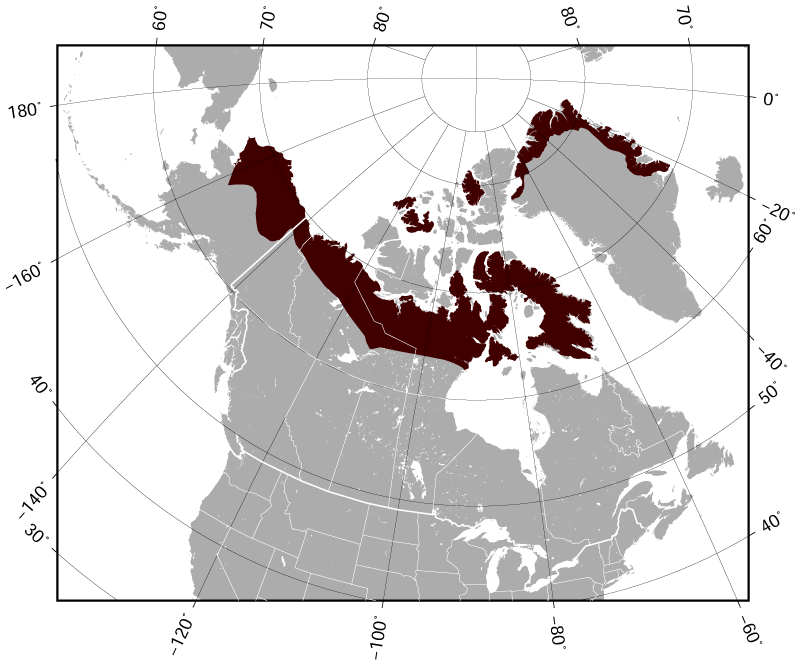
Northern collared lemmings (Dicrostonyx groenlandicus) are also called Nearctic collared lemmings, Bering collared lemmings, Victoria collared lemming and sometimes called the Peary Land collared lemming in Canada. They small lemmings found in Arctic North America and Wrangel Island. At one time, they considered to be a subspecies of the Arctic lemming (Dicrostonyx torquatus). Some sources believe several other species of collared lemmings found in North America are actually subspecies of Northern collared lemmings. [Source: Wikipedia]
Northern collared lemmings are found in tundra biomes of Alaska; the Arctic islands and Northwest Territories in Canada; Greenland; St. Lawrence Island and Wrangel Island in Russia. They are native to Arctic regions and have been introduced to other places. They are mainly terrestrial and fossorial (burrowing) life-style but have been seen swimming in the Arctic waters.
[Source: Tara Poloskey, Animal Diversity Web (ADW) |=|]
Northern collared lemmings are not endangered. They are designated as a species of least concern on the International Union for Conservation of Nature (IUCN) Red List and have no special status on the Convention on International Trade in Endangered Species (CITES). Predators of the Varying Lemming include Norwegian snowy owls, Norwegian short-eared owls, ermines, foxes, wolves, pomarine jaegars, least weasels, falcons, gulls, hawks, wolverines and the polar bears. It is uncommon for these lemmings to live more than one year in the wild. Their average lifespan in captivity is 3.3 years. |=|
Northern Collared Lemming Characteristics and Behavior
Northern collared lemmings range in weight from 30 to 112 grams (1.06 to 3.95 ounces) and have a head and body length of 10 to 15.7 centimeters (4 and 6.3 inches), with a tail one to and two centimeters long. Their average basal metabolic rate is 0.459 watts. Fur color varies with the seasons: in summer it is light to dark grey with a buffy to reddish brown tone, with dark lines down the back and on the sides of the head. The winter coat color is uninterrupted white. [Source: Tara Poloskey, Animal Diversity Web (ADW) |=|]
Northern collared lemmings are fossorial (engaged in a burrowing life-style or behavior, and good at digging or burrowing) and have developed a unique double digging claw in the winter to break through the ice and snow of the tundra. Northern collared lemmings can be distinguished from other species of the genus by its narrow rostrum (hard, beak-like structures projecting out from the head or mouth), smaller, straighter incisors and the unusually short hind foot.
Northern collared lemmings are herbivores (eat plants or plants parts). Their diet of consists of willow buds, fruits, flowers, grasses and twigs. In captivity they will eat mushrooms and mosses. The morphology of the teeth suggests that they prey on insects, but such behavior has not been observed in the wild.
Northern collared lemmings are motile (move around as opposed to being stationary) and sense using touch and chemicals usually detected with smell. They dig burrows in tundra sod in the summer and snow in the winter. Their burrows can reach up to six meters in length and be 20 centimeters wide. They typically lead to a "nest" made of grasses are placed beneath the snow or inside a snow bank.
Populations cycles of Northern collared lemmings are typical of lemmings in that every few years the numbers peak, followed by a "crash" Males are polygynous (have more than one female as a mate at one time). The female estrus cycle lasts for 9.6 days, occuring several times in the breeding season, which generally runs from January to September but can vary depending on the weather The average gestation period is 20 days and the average number of offspring is 3.4 but can vary between one and 11. A female typically has two to three litters per year in the wild. In captivity they can have up to five. The young weigh 3.8 grams on average at birth and are weaned at 15-20 days.On average females reach sexual or reproductive maturity at 40 days; males do so at 85 days. Nests may be protected by males, but evidence of territoriality is inconclusive. |=|
West Siberian Lemmings
West Siberian lemmings (Lemmus sibiricus) are also know as Western Siberian brown lemmings or simply brown lemming. They are true lemming and live in Russia. Like other lemmings, they belongs to the family Cricetidae of rodents and do not hibernate during winter. They live in burrows and are prey to several animals, including the snowy owls and the Arctic foxes. [Source: Jennifer Barker, Animal Diversity Web (ADW); Wikipedia |=|]
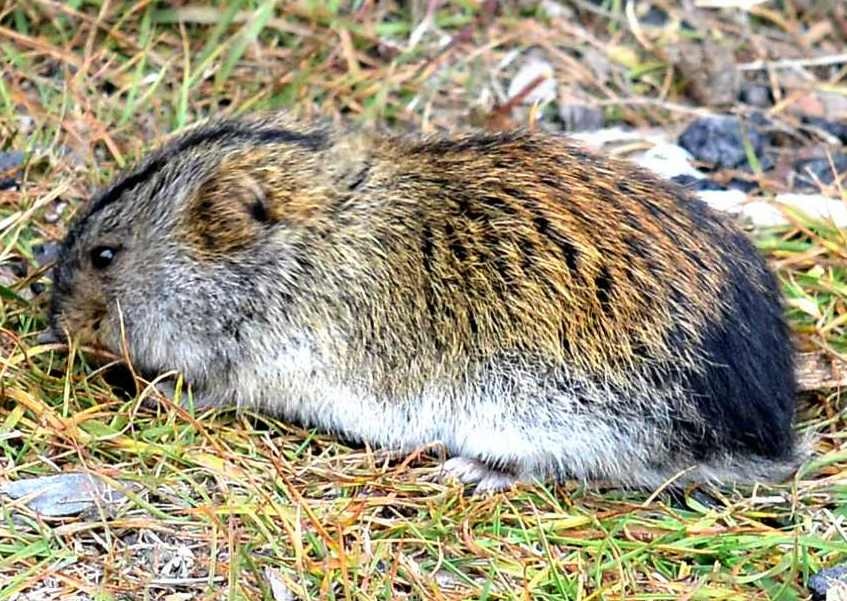
West Siberian lemmings are found in the tundra regions of Siberia from the region just south of the White Sea east all the way to the Verkhoyansk Range, which serves as a barrier between them and East Siberian lemming (Lemmus paulus), which was formerly considered a subspecies of West Siberian lemmings. West Siberian lemmings live in northern treeless regions, usually in low-lying, flat meadow habitats dominated by graminoids and mosses. In summer, they live in areas rich in grasses and sedges, moving in winter to mossy areas with permanent snow cover or wet meadows.
West Siberian lemmings not endangered. They are designated as a species of least concern on the International Union for Conservation of Nature (IUCN) Red List and have no special status on the Convention on International Trade in Endangered Species (CITES). Although they are not in any kind of immediate danger West Siberian lemmings may decline in the future as a result of climate change. The predicted northward migration of Canadian biota, may result in a reduction of the range of the West Siberian lemming, which is limited in the north by the Arctic Ocean and is quite inflexible when it comes to diet and habitat and could be harmed if their habitat changes too much.
West Siberian Lemming Characteristics
West Siberian lemmings have stout bodies which do not appear as elongated as other microtine rodents (lemmings, voles and muskrats. They range in weight from 45 to 130 grams (1.6 to 4.6 ounces), with their average weight being 80 grams (2.82 ounces). Their total body length is 13 to 18 centimeters (5.2 to 7.1 inches), averaging 15 centimeters (six inches). Sexual Dimorphism (differences between males and females) is present: Males are five to 10 percent larger than females. [Source: Jennifer Barker, Animal Diversity Web (ADW) |=|]
West Siberian lemmings have small eyes, small ears hidden under the fur, blunt muzzles, and short tails (1.8 to 2.6 centimeters, averaging 2.1 centimeters, including hair at the tip). Their backs and sides are tawny brown to cinnamon, with a paler underbelly; unlike some other lemming species they do not change color in the winter. Older adults may have a rusty-colored patch on the rump. |=|
West Siberian lemmings are strictly herbivores (eat plants or plants parts). They only eat live plant parts. For most of the year, they eat fresh grasses, sedges, and mosses (except sphagnum). In summer in areas of wet tundra, monocot leaves, make up 76 to 90 percent of their diet. In winter they eat frozen (but still green) plant material: the available 1-2 centimeters of basal leaf sheaths, and moss shoots. Mosses can make up nearly one-half of their winter diet, and are also important in dry tundra, where mosses make up about 30 percent of their diet. Because their food is so low in nutrients, they must eat quite a lot of it. They forage for 1-2 hours at a time, at roughly 3-hour intervals, throughout the 24-hour day. |=|
West Siberian Lemming Behavior and Reproduction
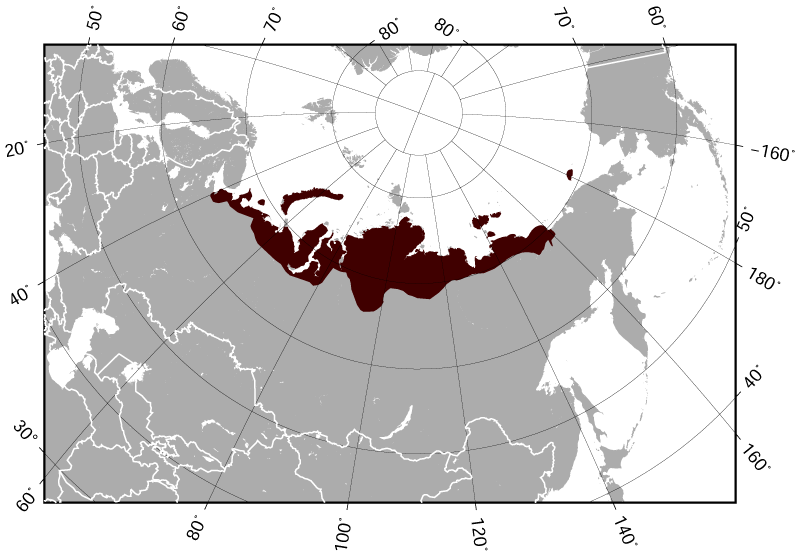
West Siberian lemmings are motile (move around as opposed to being stationary) and mainly solitary, defending separate individual territories consisting of underground burrow systems dug into the tundra soil or snow cover. Territories may overlap extensively in a given area, but individual animals of both sexes tend to avoid each other except for reproduction. They sense using touch and chemicals usually detected with smell. [Source: Jennifer Barker, Animal Diversity Web (ADW); Wikipedia |=|]
As is the case with other species of lemmings,Siberian brown lemming routinely experience large-scale fluctuations in their population sizes. They become sexually mature very early, normally at five to six weeks of age, but possibly as early as three weeks in some summers. Females can breed immediately after giving birth. They give birth to two to 13 young, after a three week gestation period. Litter size averages eight in summer, four to five in early and late winter, and three in mid-winter. There appears to be no reproduction during the spring snow melt (May through early June) nor during the fall snow pack formation (September through early October). |=|
Little is known about the reproductive habits of Siberian brown lemmings, but it is likely that females rear the young alone, since no males have been caught in a wild nest with young. Non-receptive captive females have been known to attack males. It is also likely that breeding is promiscuous, since males have larger home ranges than females, and there is substantial overlap in the home ranges of multiple individuals. |=|
Northern Bog Lemmings
Northern bog lemmings (Synaptomys borealis) are found occur across North America from Labrador to southern Alaska but are uncommon in northwestern and eastern Canada. There is an isolated population south of the St. Lawrence River in the Northern Appalachian Mountains into Maine. Their geographic range is thought to be explained by their strong ties to boreal bog forests, which have been retreating northward along with Northern bog lemmings. The first fossil record of Synaptomys was found in the Wisconsin Glacial age deposits in the Great Basin, where they are no longer found. Evidence suggests that a glacial meltwater stream provided a local environment which was more mesic and supported a restricted population of lemmings in this canyon-bottom region. [Source: Danielle Nicholas, Animal Diversity Web (ADW) |=|]
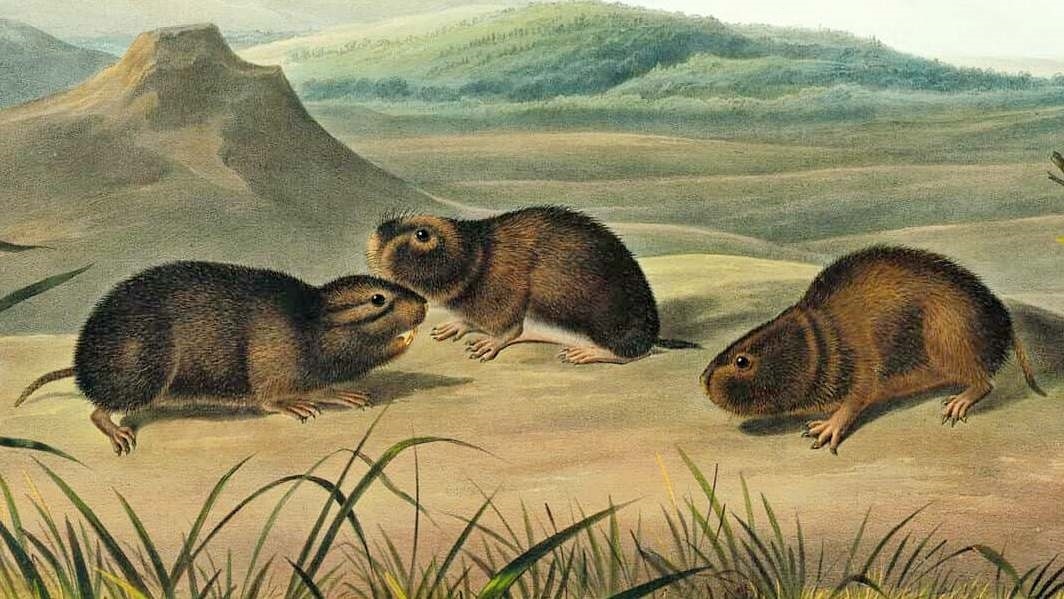
Northern bog lemmings are active year-round and do nout hibernate. They mainly occur in sphagnum-Labrador tea-black bogs but they are also found to live among deep, moist spruce woods, wet, subalpine meadows, and alpine tundra. They primarily live in burrows among sedges and grasses where moisture levels are high and growth of sedges and grasses are sufficient to provide cover and food. During the winter months this risk of predation is lowered and most activity occurs above ground. Lemmings construct globular nests composed of mosses, grasses, and sedges at ground level just beneath the snow in the winter months and build their nests underground in the summer months Foraging activities are largely confined to runway systems where vegetation is harvested and either consumed or removed to underground nests via excavated burrow systems. |=|
Northern bog lemmings are not endangered. They are designated as a species of least concern on the International Union for Conservation of Nature (IUCN) Red List and have no special status on the Convention on International Trade in Endangered Species (CITES). During the snow free months these lemmings are active both above and below ground, but most occurs below ground to avoid predation the numerous mammalian and avian predators that seek them out.
Northern Bog Lemming Characteristics, Behavior and Reproduction
Northern bog lemmings have a stocky build, with short legs and a tail which is slightly longer than their hind feet. They range in weight from 27 to 35 grams (0.95 to 1.23 ounces) and have a head and body length ranging from 12.2 to 14.4 centimeters (4.8 to 5.7 inches). Their tail is 2 to 2.7 centimeters (0.8 to 1.2 inches) long. Their hind feet are 1.8 to 2.1 centimeters (0.7 to 0.8 inches) long. Sexual Dimorphism (differences between males and females) is not present: Both sexes are roughly equal in size and look similar. [Source: Danielle Nicholas, Animal Diversity Web (ADW) |=|]
The ears of Northern bog lemmings are relatively small and their nose is blunt. Danielle Nicholas wrote in Animal Diversity Web: The fur is coarse and appears ruffled, the color varies from grayish brown to chestnut brown on their dorsal side and pale gray ventrally. The bicolored tail is brown above and white below. Flank glands of adult males are often clearly marked by a patch of white hair. Females possess eight teats of which two are pectoral pairs and two are inguinal pairs. Synaptomys cooperi has six mammae. |=|

Northern bog lemmings can be identified by several cranial features. They have a short rostrum (hard, beak-like structures projecting out from the head or mouth), projections on the upper incisors, and mandibular incisors which are thin and pointed. They can be differentiated from their closest relative,Synaptomys cooperi, (southern bog lemmings) by the absence of closed triangles on their mandibular molars and a palate which extends in a sharply pointed, backward projecting spine. |=|
Northern bog lemmings primarily feed on sedges and grasses. They actively clip sedges, grasses, and leafy plants to line the above ground runways between burrow entrances. Runways without clippings indicate an abandoned burrow system. Northern bog lemmings are are motile (move around as opposed to being stationary) and sense using touch and chemicals usually detected with smell. They repeatedly leave fresh droppings along their runways, creating a scent 'signpost' which identifies it as an active runway. They often share runway systems with meadow voles (Microtus pennsylvanicus). |=|
The breeding season for Northern bog lemmings extends from May to late August. Their litter sizes ranges from two to eight, with an average size of four to five young per litter. Female Northern bog lemmings are capable of breeding one day after giving birth and are thus capable of having two or three litters per breeding season. This indicates the potential for rapid population growth under ideal environmental conditions, though they tend to be uncommon throughout their range. |=|
Wood Lemmings
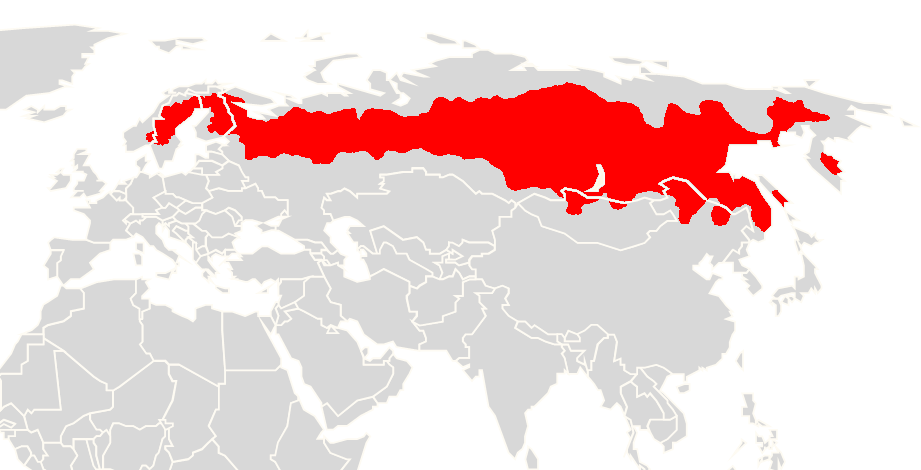
Wood lemmings (Myopus schisticolor) live in taiga (boreal forests) and coniferous forests in a zone that stretches from Norway across Siberia to northern Mongolia and the Russian Far East. They are especially abundant in many areas of central Sweden, Finland and Russia and also occur the taiga biome of China and Estonia. They mainly reside in the moss layer on the floor of wet nordic coniferous woodlands and are sometimes found living under the roots of trees and beneath fallen tree trunks. As a ruled they are restricted to forests and are mainly found at elevations from 600 to 2,450 meters (1968 to 8,040feet). [Source: Jessica Ollendorff, Animal Diversity Web (ADW) |=|]
Wood lemmings are not endangered. They are designated as a species of least concern on the International Union for Conservation of Nature (IUCN) Red List and have no special status on the Convention on International Trade in Endangered Species (CITES). Wood lemmings face numerous predators including owls, buzzards, foxes and weasels. Their average lifespan in the wild is only one year. They are rarely seen except in years when their populations booms. Because they do best in relatively narrow ecological niche conditions they are easily disrupted by human activities and maybe climate change.
Wood lemmings are herbivores(eat plants or plants parts). Among the plant foods they eat are leaves, wood, bark, stems, bryophytes (mosses), rushes, grasses, sedges. They are particularly fond of the stems of red wortleberry, and the bark of juniper. They store and cache food. Wood lemmings have a high metabolic rate, typical of rodents living in high latitudes. Wood lemmings gnaw tunnels in moss cushions, feeding mainly on these mosses. In autumn in Finland, they collect and store many moss piles in the spruce forests they occupy and hide their stores under stones, tree trunks and other areas where they are sheltered from the rain. Sometimes stores are kept in open places, such as under growing trees, but this is unusual. The areas with collected mosses are clearly distinguishable from feeding areas. In feeding areas only the tips of the mosses are taken, while in collecting patches the mosses are taken whole. The stores are generally eaten during that following winter. Stores are thought to be especially important during the early winter; 50 percent of them are consumed completely. |=|
Wood Lemming Characteristics and Behavior
Wood lemming are stout rodents. They range in weight from 20 to 45 grams (0.7 to 1.6 ounces) and have a head and body length ranging from eight to 11.5 centimeters (3.15 to 4.53 inches). Their average basal metabolic rate is 0.522 watts. [Source: Jessica Ollendorff, Animal Diversity Web (ADW) |=|]
Wood lemmings have small ears that project little beyond the fur but which are well developed, rounded and well haired. Valves in the ears regulate the size of the ear openings. The thumb of the hand is small but bears a large, flattened nail with parallel sides and a notch at the end. In this respect Wood lemmings somewhat resemble true lemmings (Lemmus), but are smaller. Wood lemming are ash-gray in color with a cinnamon-colored saddle. Due to the similarity of their molar pattern to that of Norway lemming, taxonomists have often assigned wood lemmings to the genus Lemmus. However, wood lemmings have distinctively less hair on the soles of its feet and a wide thumb claw that distinguishes them from Norway lemmings.
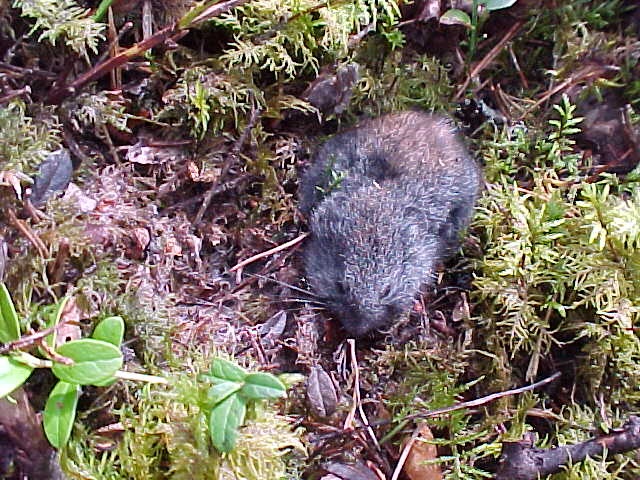
According to Animal Diversity Web: Wood lemmings have a soft fur, dense and slaty black above with a definite reddish brown area on the contour of the back extending from the shoulders to within 1.5 centimeters of the base of the tail. The rest of the coat is slightly paler on the ventral surface. The peculiar metallic luster on the upper parts is produced by silvery tips on the shorter hairs, with an indistinct showing of black guard hairs. The tail is heavily furred. The palms are naked. The hind feet are densely haired behind the pads but are naked in front of the pads, like the palms of the forefeet. There is no substantial difference in the coloration of the sexes, nor is there much seasonal variation in color. The winter coat is slightly longer than the summer fur. |=|
Wood lemming are motile (move around as opposed to being stationary) and migratory (make seasonal movements between regions, such as between breeding and wintering grounds). They sense using touch and chemicals usually detected with smell. High population densities and locally limited migrations occur. Male home ranges are consistently larger than those of females. On average, males move distances four to 12 times further than females.
Why There Are Three Times as Many Female Wood Lemmings as Males
Much of research done involving wood lemmings has focused on their sex chromosomes. Wood lemmings produce about three times as many female as male offspring. This is due to an unusual genetic system where they have two different types of X chromosomes, the normal X and a mutated X*. Females with that mutation on their X-chromosome inhibit the male determining effect of the Y chromosome. This leads to three genetic types of females: XX, XX and XY and one genetic type of males XY. The XY females are fertile, but only produce X* ova, which means they only produce female offspring. [Source: Wikipedia, Jessica Ollendorff, Animal Diversity Web (ADW) |=|]
It is not fully known the extent to which nature balances out the differences in the adult population, but sampling studies seem to suggest males make up as little as 25 percent of the population. Females with abnormal genotype (XO, XXY, X*YY) occur regularly. The high female sex ratio may be an adaptation against local mate competition and inbreeding during population low points. It has been suggested that the sex imbalance could be a means by which the wood lemming increases their birth rate. Because one male can mate with several females propagation may be most successfully accomplished by increasing the number of females in the population
The mating system of wood lemmings is similar to that of other lemmings. The number of offspring ranges from two to 8, with the average number of offspring being 4.6. The average gestation period is 21 days. Young are altricial, meaning they are relatively underdeveloped at birth. The average weaning age is 20 days. On average females reach sexual or reproductive maturity as early as five weeks and males do so as early as three months. |=|
Norway Lemmings
Norway lemmings (Lemmus lemmus) and plump, mouse-sized creatures with thick brown fur patterned with black and orange. Also known as Norwegian lemmings, they live primarily in the tundra and birch woods of the Scandinavian mountains and are famous for their boom-and-bust population fluctuations, migrations and purportedly for following a leader and leaping en masse off cliffs, something which is not true. Lemmings are small rodents, usually found in or near the Arctic in tundra biomes. They form the subfamily Arvicolinae (also known as Microtinae) together with voles and muskrats, which in turn is part of the superfamily Muroidea, which also includes rats, mice, hamsters and gerbils. Lemmus species generally live for one to two years. The oldest recorded Norway lemming was a specimen in captivity which lived for 3.3 years.
A common species of lemming, Norway lemmings are found in northern Fennoscandia (Scandinavia and the Karelia part of Russia), where they are the only vertebrate species endemic to the region. These lemmings are active both day and night, alternating naps with periods of activity. They dwells in tundra and fells, and prefers to live near water. Adults feed primarily on sedges, grasses and moss. By some reckonings, Fennoscandia, where Norway lemmings live, stretches from the Russian Kola Peninsula in the east to the west coast of Norway in the west and from the northern coast of Norway south to the Baltic Sea. However, Norway lemmings may migrate further south than that during on of their population booms.
Norway lemmings are found in tundra and alpine regions. During the winter they live in insulated spaces under the snow, which them with warmth, shelter, access to food, and protection from predators. When there is no snow cover, Norway lemmings live in a variety of mainly wetlands habitats, including bog and marshes. They also make their home in areas where dwarf shrubs are the main vegetation. Norway lemmings seek safety and shelter in shallow underground spaces which may be burrows they dig themselves or burrows already dug by another animal or an already existing underground space. [Source: Alexandria Stubblefield, Animal Diversity Web (ADW) |=|]
Steppe Lemmings
Steppe lemmings (Lagurus lagurus) are also known as steppe voles. Small rodents somewhat similar in appearance to the Norway lemming, they are more active at night than the day but are not entirely nocturnal. Their diet consists of shoots and leaves. They reside in steppes and semiarid environments in Russia, Ukraine, Kazakhstan, northwestern China, and western Mongolia. [Source: Wikipedia]
There are four subspecies of steppe lemming. 1) Steppe lemmings lagurus is found in Ukraine and central Kazakhstan. 2) The eastern subspecies, L.l. altorum, is found in southeastern Kazakhstan, northwest China, and Mongolia. 3) Lagurus lagurus agressus, the northern subspecies, is found in the northern European portion of the former U.S.S.R. and in northern Kazakhstan. 4) The isolated subspecies L. l. abacanicus is found in the Minusinsk basin in Krasnoyarsk, Russia. [Source: Adam Rountrey, Animal Diversity Web (ADW) |=|]
Steppe lemmings not endangered. They are designated as a species of least concern on the International Union for Conservation of Nature (IUCN) Red List and have no special status on the Convention on International Trade in Endangered Species (CITES). Humans keep them as pets and utilize them for science. They have been used in research related to cancer and exposure to toxic chemicals. Steppe lemmings carry diseases such as tularemia (Francisella tularensis) and the plague (Yersinia pestis). Incidence of these diseases is known to increase during years of high vole populations. Also, steppe lemmings can eat crops and pastures used by livestock.
See Separate Article: STEPPE LEMMINGS: CHARACTERISTICS, BEHAVIOR AND REPRODUCTION factsanddetails.com
Image Sources: Wikimedia Commons
Text Sources: Animal Diversity Web animaldiversity.org ; National Geographic, Live Science, Natural History magazine, David Attenborough books, New York Times, Washington Post, Los Angeles Times, Smithsonian magazine, Discover magazine, The New Yorker, Time, BBC, CNN, Reuters, Associated Press, AFP, Lonely Planet Guides, Wikipedia, The Guardian, Top Secret Animal Attack Files website and various books and other publications.
Last updated June 2025