
TOQUE MACAQUES
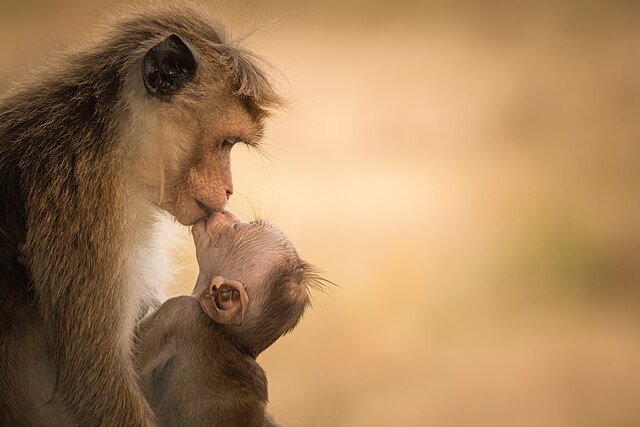
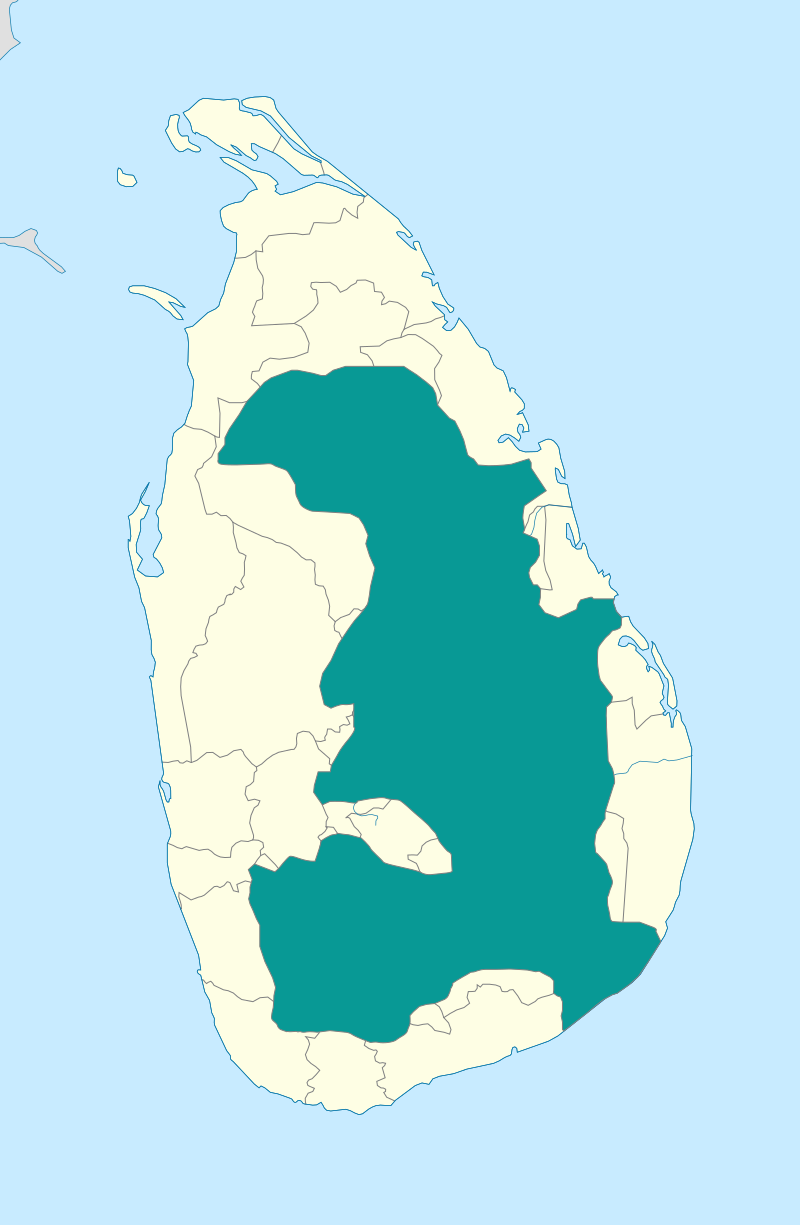
Toque macaques (Macaca sinica) live only on the island of Sri Lanka. They are found in all areas of the country except the Jaffna Peninsula in northern Sri Lanka and the Trincomalee area in northeastern Sri Lanka. They live in tropical areas and areas with an extended dry season) in forests, scrub forests, swamps, agricultural areas and areas near rivers at elevations from sea level to 2100 meters (6880 feet).[Source: Matthew Kanelos, Animal Diversity Web (ADW) /=]
Matthew Kanelos wrote in Animal Diversity Web: Toque macaques live in a variety of biomes throughout Sri Lanka. They spend a large amount of time in trees and live in all types of forests. The type of trees and tree height varies with region. The most important resource is a source of drinking water. This accounts for the lack of any toque macaque in the northern penninsula and parts of southern Sri Lanka. As a result of occupying separate regions two sub species are recognized. The lowland species, Toque macaque sinica, lives in northern Sri Lanka. This region has much smaller trees and only receives one meter of rainfall a year. The highland species, Toque macaque aurifrons, lives in the evergreen forests of southwestern Sri Lanka. This region gets over three meters of rainfall a year.
The lifespan of toque macaques in the wild is typically 4.5 to 4.8 years but they can live up 30 years in the wild. Their lifespan in captivity is is up to 35 years. The expected lifespan in the wild is low due to high infant mortality rates. There is also significant mortality among adolescent males when they venture off to join a different troop. Once toque macaques have reached sexual maturity they will likely live to an old age.
On the International Union for Conservation of Nature (IUCN) Red List toque macaques are listed as Endangered. In CITES (Convention on International Trade in Endangered Species of Wild) they have no special status. In Sri Lanka, they are widely viewed as pests because they raid crops and garbage dumps. Toque macaques are sometimes shot and poisoned as ways to keep them out of crops. They are sometimes sold as pets. The population of toque macaques has decreasing by about half in the last 40 years. This loss is due primarily to habitat destruction and human-related death. Although they are protected internationally, they are not protected by Sri Lankan law but there are many parks and reserves in Sri Lanka where can find sanctuary.
RELATED ARTICLES:
MACAQUES: CHARACTERISTICS, BEHAVIOUR, MATING factsanddetails.com ;
PRIMATES: HISTORY, TAXONOMY, CHARACTERISTICS, BEHAVIOR factsanddetails.com ;
MONKEY TYPES: OLD AND NEW WORLD, LEAF- AND FRUIT-EATING factsanddetails.com ;
MAMMALS: HAIR, CHARACTERISTICS, WARM-BLOODEDNESS factsanddetails.com ;
PESKY, TROUBLESOME URBAN MONKEYS AND MONKEY ATTACKS factsanddetails.com
MACAQUE SPECIES factsanddetails.com ;
MACAQUES IN INDIA factsanddetails.com ;
TROUBLESOME MONKEYS AND MONKEY ATTACKS IN INDIA factsanddetails.com
Toque Macaque Characteristics
Toque macaques are the smallest species of macaque. They range in weight from 2.5 to 6.12 kilograms (5.5 to 13.5pounds), with their average weight being 4.2 kilograms (9.25 pounds). Their body length (excluding the tail) ranges from 36.7 to 49.5 centimeters (14.45 to 19.49 inches), with their average length being 44.8 centimeters (17.64 inches). Sexual Dimorphism (differences between males and females) is present: Males are larger than females. Sexes are colored or patterned differently. As is the case with other primates, Toque macaques have excellent control over their hands and feet. They have well developed thumb-index finger control. [Source: Matthew Kanelos, Animal Diversity Web (ADW) /=]
According to Animal Diversity Web: Toque macaques have a golden brown coat on their dorsal surface and white hair on their ventral surface. This white coat extends to the cheeks and around the ears. The have a small tuft of hair on the top of their head that resembles a hat. The amount of hair on the top of the head is geographically variable within their range. They have a long tail that is black dorsally and pale white ventrally. Toque macaques have muscular cheek pouches that are used for storage during foraging. These pockets are lined with mucous and the muscles serve to push the food back into their mouth. Individuals have thirty two teeth; their dental formula is 2/2, 1/1, 2/2, 3/3. There is Sexual Dimorphism in canine size, with males having larger canines. All of their molars are quadrucuspid. Their faces are hairless.
Toque macaque males have a tan face while females have different shades of pink. Males are larger than females and complete their development later. Females have a head and body length of 400 millimeters while males are around 475 millimeters. Both males and females have long tails that are slightly longer than their head and body length. Their ears and lips are black. Toque macaques may be the smallest species of Macaca, but they have one of the largest tails compared to body size. They also have very large ears that are nine percent of the head and body length. Their basal metabolic requirement is 150 kcal/ kilograms daily. There are two described subspecies of toque macaque: Toque macaque aurifrons, which lives in the lowland dry region in northern Sri Lanka, and Toque macaque sinica, which lives in the wet evergreen forests in southern Sri Lanka. Toque macaque sinica is slightly larger has darker, denser, dorsal hair.
Toque Macaque Feeding, Predators and Ecological Roles
Toque macaques are herbivores (eat plants or plants parts), frugivores (eat fruits) and omnivores (eats a variety of things, including plants and animals). Animal foods include birds, mammals,, reptiles, insects. Among the plant foods they eat are leaves fruit flowers sap or other plant fluids. They also eat fungus. [Source: Matthew Kanelos, Animal Diversity Web (ADW) /=]
Matthew Kanelos wrote in Animal Diversity Web: Toque macaques spend much of their day foraging for food in trees and on the ground. They have special pouches in their cheeks that are used to store food during foraging. If they sense danger while foraging they will put their food in their mouth and flee to safety. Once safe they will eat the contents.
In their range there are 46 different types of trees, only six of which are not utilized for food. When available they will eat small invertebrates or vertebrates such as birds or lizards. Although these are not a main source of energy for toque macaque they represent an important source of protein and a considerable portion of time is spent searching for such prey. During the dry season water obtained from food is not enough to sustain toque macaques, so they must make daily trips to watering holes. Toque macaques also raid crop, such as rice, cocoa, and coconut.
Toque macaques spend most of their time in trees, which limits their exposure to potential predators, the main known ones being mugger crocodiles, leopards, Indian pythons and Russell's vipers. When on the ground the macaques appear much more cautious then when they are in the trees. They avoid open spaces when possible. When they must be in the open, they stay in compact groups. When any member senses danger the whole group will flee to nearby trees. When frightened they sometimes freeze in place when in dense foliage. To avoid predation they sleep high in forks of trees that are far from the central trunk. Groups of toque macaque rarely sleep in the same tree over consecutive nights to avoid predation. They do fall prey to large, arboreal (live mainly in trees), predators, including snakes, and possibly to large avian predators, although none are reported.
Toque macaques play many roles in their ecosystem. It is estimated that a troop will eat up to one percent of the annual fruit production of the forest they live in. Through their frugivory they also help to disperse seeds. They are predators of small lizards and birds, but these are not a staple of their diet. Toque macaques a commensal relationship with two species of monkeys, Hanuman langurs and purple-faced langurs, with which they co-occur. They are often observed foraging together. They do not compete for food resources as toque macaque primarily eats fruit and both langur species eat leaves. They are hosts to a variety of parasites.
Toque Macaque Behavior and Communication
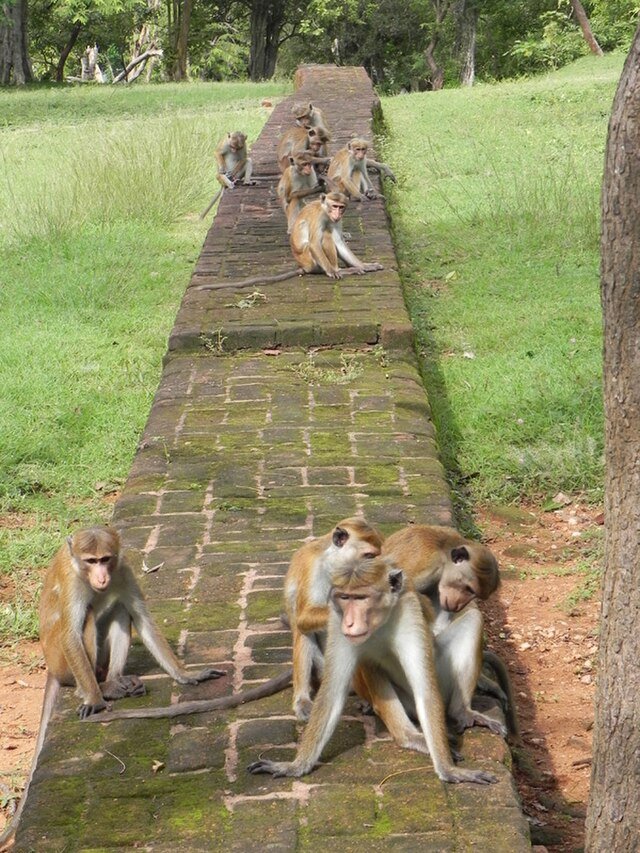
Toque macaques are mainly arboreal (live mainly in trees) trees), scansorial (able to or good at climbing) and diurnal (active mainly during the daytime). They are also motile (move around as opposed to being stationary), sedentary (remain in the same area), territorial (defend an area within the home range), social (associates with others of its species; forms social groups), and have dominance hierarchies (ranking systems or pecking orders among members of a long-term social group, where dominance status affects access to resources or mates). The size of their range territory is .17 to two square kilometers, with their average territory size being .4 square kilometers. [Source: Matthew Kanelos, Animal Diversity Web (ADW) /=]
According to Animal Diversity Web: In trees they use a quadripedal style of locomotion. When walking on the ground, they walk on their digits. Bipedal walking occurs on the ground when the hands are full. They are social, forming groups of up to forty members. These groups are long-standing, but emigration between groups occurs in males during the late juvenile stage. In groups there is a two to one ratio of females to males. Toque macaques are very active and forage for food for a large part of every day. Males and females play different roles in groups. Males lead the group and settle fights between younger members. They play no role in the raising of young. Females are the primary care providers for young and a female's position in the dominance hierarchy may influence that of her young. The age distribution is even, with half of group members being adults and half infants or juveniles. There is a clear dominance hierarchy in groups, with the oldest male being most dominant. Following the oldest males are subadult males, adult females, and finally juveniles.
Toque macaque sense and communicate using vision, touch, sound and chemicals usually detected with smell. As they are active mainly during the daytime they rely heavily on vision. They have excellent stereoscopic and color vision. Often they distinguish between food sources using their vision, instead of smell.
They use acoustic communication among individuals and groups. There has been 30 different vocalizations recorded. They use warning calls to alarm other group members of danger and other vocal communication during play. There is a clear dominance hierarchy in groups of toque macaque and the dominant male is easy to identify. He is generally well groomed and muscular. Grooming is a common social activity. During the breeding season females communicate that they are in estrous by secreting a pungent mucous from their cervix that males smell.
Toque Macaque Mating, Reproduction and Offspring
Toque macaques are polygynandrous (promiscuous), with both males and females having multiple partners. They engage in seasonal breeding and breed once a year. The breeding season is generally between July and September. The exact month of breeding varies with location. In the breeding season females come into estrous once a month. Mounting is always initiated by a male. The average number of offspring is 0.69. [Source: Matthew Kanelos, Animal Diversity Web (ADW) /=]
According to Animal Diversity Web: Females in estrus secrete a pungent mucus from their vagina which serves as a signal of her fertility to potential mates. They are promiscuous and paternity of offspring is generally unknown. Once a pair are ready to mate they withdraw from their troop but are often followed by younger males who attempt to mate with the female after the first male. Although there is a well developed dominance hierarchy among troops of toque macaque, copulation frequency is not higher among the dominant males.
The gestation period ranges from five to six months. The weaning age ranges from 140 to 190 days, with being 170 days. The average time to independence is two years. On average females reach sexual or reproductive maturity at age five years and males do so at age seven years. The majority of parental investment is from females. During late pregnancy their energy requirements almost double what they are when they are not pregnant.
There is an extended period of juvenile learning. Females supervise groups of playing young together. Juveniles play in groups with other members that are the same age. Mothers provide protection to their young, but a mother will only protect its youngest child in the presence of danger. Young learn by watching older members of troops. Males provide little care to the young as there is no way to be sure of paternity.
Image Sources: Wikimedia Commons
Text Sources: Animal Diversity Web animaldiversity.org ; National Geographic, Live Science, Natural History magazine, David Attenborough books, New York Times, Washington Post, Los Angeles Times, Smithsonian magazine, Discover magazine, The New Yorker, Time, Reuters, Associated Press, AFP, Lonely Planet Guides, Wikipedia, The Guardian, Top Secret Animal Attack Files website and various books and other publications.
Last updated December 2024