
HANUMAN LANGURS
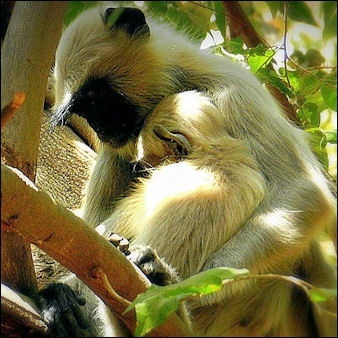
caring langur
Hanuman langurs (Semnopithecus entellus) live in India, Bangladesh, Sri Lanka, southern Tibet, Nepal, Bhutan, Sikkim, northern Pakistan and Kashmir. Named after the Hindu monkey god, these monkeys have adapted to a number of environments: temperate and tropical rain forests, desert edges, mountains, savanna grasslands, scrub forests, and alpine scrub — from sea level up to elevations of 4000 meters (13123 feet) — as well to urban and suburban areas. They were previously known as Presbytis entellus. In captivity Hanuman langurs often live into their early thirties. In the wild, males can live to 18 years old, and females can live to 30 years old. Some are reported to have lived to be more than 40 years old. [Source: Rebecca Semke, Animal Diversity Web (ADW) /=]
Hanuman langurs and spend about 80 percent of their time on the ground. They are known for living in close proximity with humans, especially in the city of Jodhpur, India, which has over a million inhabitants. They have traditionally been forest dwelling primates in India but are found only in forest openings in Bangladesh. The amount of rainfall varies greatly throughout their range (10 to 200 centimeters). There is a great range of temperatures too — from -7˚C to 46˚C,
Hanuman langurs are primarily herbivores (primarily eat plants or plants parts), and folivores (eat mainly leaves). Animal foods include insects. Among the plant foods they eat are leaves, wood, bark, stems, seeds, grains, nuts, fruit and flowers lichens. The breakdown of their diet is as follows: leaves (52-61 percent), fruits (15-25 percent), flowers (4-13 percent), insects (0.4-3 percent), and other foods such as bark, gum, and soil (9-16 percent). More developed leaves are preferred over young leaves. They are not highly selective foragers, and consume human food when available. In times of food shortage, they are known to consume bark.
Hanuman langurs are not endangered. In India, there are about 100,000 of them. There are also significant numbers of them in Sri Lanka. It is thought that a single breeding pair resulted in the population found in southeast Bangladesh. The International Union for Conservation of Nature (IUCN) Red List classifies them as a species of “Least Concern”. They were listed as near threatened in 2004. In CITES (Convention on International Trade in Endangered Species of Wild) they are in Appendix I, which lists species that are the most endangered among CITES-listed animals and plants. /=\
Natural predator include leopards, dholes, tigers, wolves, golden jackals and pythons. They sleep in the upper forest canopy to avoid predators. Deforestation has reduced the number of roosting trees, giving predators easier access to langurs. Hanuman langurs live side by side with Bonnet macaques, toque macaque and hooded leaf monkeys. Each species has distinct niche so there isn’t so much competition for resources. Soapberry bug nymphs rely on Hanuman langurs to remove fruit casings, enabling them to eat.
RELATED ARTICLES:
LANGURS: TYPES, GENUSES, LEAF MONKEYS, BEHAVIOR factsanddetails.com
LANGURS OF INDIA AND SOUTH ASIA: SPECIES, CHARACTERISTICS, BEHAVIOR factsanddetails.com
LANGURS AND LEAF MONKEYS OF SOUTHEAST ASIA: SPECIES, CHARACTERISTICS, BEHAVIOR factsanddetails.com;
DOUC LANGURS (DOUCS): SPECIES, CHARACTERISTICS, BEHAVIOR factsanddetails.com
LANGURS OF INDONESIA: SPECIES, CHARACTERISTICS, BEHAVIOR factsanddetails.com
LANGURS AND LEAF MONKEYS OF NORTHERN INDONESIA, BORNEO AND MALAYSIA factsanddetails.com
PRIMATES: HISTORY, TAXONOMY, CHARACTERISTICS, BEHAVIOR factsanddetails.com ;
MONKEY TYPES: OLD AND NEW WORLD, LEAF- AND FRUIT-EATING factsanddetails.com ;
MAMMALS: HAIR, CHARACTERISTICS, WARM-BLOODEDNESS factsanddetails.com
Hanuman Langur Characteristics
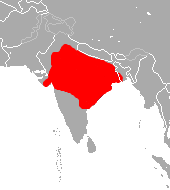
Bengal Gray Langur (Semnopithecus entellus) range
Hanuman langurs generally range in weight from 9.9 to 13 kilograms (21.8 to 28.6 pounds) and have a head and body length that ranges from 58.5 to 64 centimeters (23 to 25.2 inches), plus a tail between 69 and 108 centimeters (27 to 42.5 inches) . In extreme cases their head and body length can reach 78 centimeters (31 inches) can weigh as much and 23.6 kilograms (52 pounds) Even though they are is quite at home in the trees and can leap horizontally 15 meters and jump vertically 5 meters, it spends much of its time on the ground. Their long tails helps them balance on cliffs, where they sometimes hang out [Source: Rebecca Semke, Animal Diversity Web (ADW) /=]
Sexual Dimorphism (differences between males and females) is present: Males are slightly larger than females. Males weigh about 13 kilograms compared to females who weigh about 9.9 kilograms. Excluding their tail, males are about 64 centimeters long, and females are about 58.5 centimeters long. Male Hanuman langur tails average 91.0 centimeters and those of females average 86 centimeters.
The upper parts of Hanuman langur’s body and head are mostly brown, grey or buff. The crown and lower parts are white, orange-white or yellowish. They langurs have a tinge of red on their backs and white fur on their front. Their feet, hands, face, and ears are black, and their face is framed with white fur. Their tail is usually longer than the body, with a white tip. Infants are born with fine, dark brown or black fur. Their skin is pale, but darkens to black by three months old. They have 32 teeth and their dental arrangement formula is 2/2 1/1 2/2 3/3.
Hanuman Langur Behavior and Communication
Hanuman langurs are arboreal (live mainly in trees), scansorial (able to or good at climbing), terricolous (live on the ground), diurnal (active during the daytime), motile (move around as opposed to being stationary), sedentary (remain in the same area),, territorial (defend an area within the home range), social (associates with others of its species; forms social groups), and have dominance hierarchies (ranking systems or pecking orders among members of a long-term social group, where dominance status affects access to resources or mates).[Source: Rebecca Semke, Animal Diversity Web (ADW) /=]

The size of Hanuman langurs’s home range territory is 0.07 to 22 square kilometers. Bachelor groups typically have larger home ranges than other groups. They usually do not move their home ranges. These monkeys may engage in aestivation (prolonged torpor or dormancy such as hibernation (the state that some animals enter during winter in which normal physiological processes are significantly reduced, thus lowering the animal’s energy requirements).
Hanuman langurs are most active in the mornings and evenings during the summer. In the winter they are more active during midday. Even though they spend 80 percent of their time on the ground they are mostly quadrupedal (use all four limbs for walking and running). They use trees primarily for sleeping.
Hanuman langurs communicate with vision, touch and sound and sense using vision, touch, sound and chemicals usually detected with smell. They use their vision to find food and move around their environment and females display estrous via head shaking. According to Animal Diversity Web: Hanuman langurs have about 19 different types of calls. In the morning, mature males make a loud whooping call when leaving their sleeping trees. They may also make cacophonous barks if they are surprised by a predator. Adult and sub-adult males often grunt or cough during group movements. Isolation peeps can be heard from members who get lost or separated from their group. Its most distinctive call is a booming morning whoop that apparently helps to define the space occupied by different groups.
Hanuman Langur Mating, Reproduction and Offspring
Hanuman langurs can be both polygynous (males have more than one female as a mate at one time) and polygynandrous (promiscuous, with both males and females having multiple partners). Males sometimes form bachelor groups. These monkeys engage in seasonal breeding. They breed once annually. The breeding season varies with locations, but is often between July and October, with births occurring between February and April.. [Source: Rebecca Semke, Animal Diversity Web (ADW) /=]
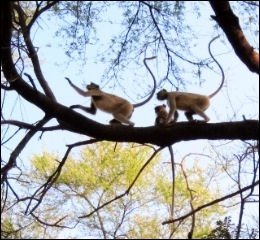
According to Animal Diversity Web: Male dominance is usually determined through fighting. Younger, sexually mature females have higher ranking, and decrease in rank with age. Females advertise they are in estrous by head shaking and presenting the anogenital region to potential mates. Females continue mating during gestation to prevent infanticide by dominant males.
Gestation lasts for 200 to 212 days.The age in which offspring are weaned ranges from 8.6 to 13 months and the age in which they become independent ranging from one to two years. On average females reach sexual or reproductive maturity at 2.9 years and males on average reach sexual or reproductive maturity at five years.
Infant Hanuman langurs spend the first week of life with their mothers. After that, infants are also cared for by other females that have recently given birth, however, the mother still provides most of the care. Mothers are very protective of their infants, who are often placed at the center of the group for increased protection. Females from surrounding groups sometimes kidnap infants. Mothers have been observed risking their lives to rescue their offspring. By six weeks old, infants begin eating on their own. Between the ages of nine to 12 months, infants are only around their mother 20 percent of the time. Males are forced to disperse before they become sexually mature, while females stay with their natal group.
Hanuman Langur Group Behavior
Hanuman langurs are gregarious and form groups ranging from two to over 100 members. They typically hang out in groups with 13 to 37 members. Each group is led by a single male and generally has twice as many females as males. Males often work out their rank by fighting.
Sometimes an all-male group will attack mixed-sex groups. If the dominant male is defeated sometimes the new leader will kill all the infants. This measure will bring the females into estrus within a couple weeks and allow the new leader to mate and father new offspring.
Females often share babysitting duties within a close-knit group of females and their offspring. The young are born with dark fur than turns thick and greyish gold after a few months. More than half are killed by disease, predators or infanticide---a common practice when a new male takes over a langur group.
According to Animal Diversity Web: Dominance hierarchies play an important role in tree use behavior. The highest ranking male sleeps at the highest position in the tree, because it is the safest. Directly below the dominant male are females and their offspring, then younger females, with adolescent males at the lowest position. They often groom each other, which is performed according to local dominance hierarchies. Dominant Hanuman langurs groom one another and receive grooming more often than subordinate langurs. [Source: Rebecca Semke, Animal Diversity Web (ADW) /=]
Hanuman Langurs and Humans
Hanuman langurs are regarded as pests. They are known to raid crops and steal food from people’s homes. Because they are viewed as sacred animals in many parts of India body parts are have been kept as amulets. They have also been utilized in the pet trade. But human-languar relations aren't all bad. Jennifer S. Holland wrote in National Geographic, “ Hindus revere Hanuman langurs as a symbol of the monkey deity Hanuman, whose simian army helped rescue Sita, the god Rama's wife, from a demon king, according to a Sanskrit epic. Langurs' black faces and extremities call to mind the burns that Hanuman suffered in the course of his heroism. [Source: Jennifer S. Holland, National Geographic, August 2011]
The lifestyle of the monkeys reflects this state of grace. In the city of Jodhpur, at the edge of the Thar, or Great Indian, Desert, some 2,100 wild langurs regularly leap into human society to sample its goods. A number of Hanuman langurs reside at Mandor Garden on the outskirts where they are often seen munching on picnic snacks, which are sometimes given to them and sometimes snatched. In the That Desret temperatures sometimes reach 120 degrees.
Local Hindus share picnics in parks and turn shrines into buffets of offerings for the monkeys. Some let the holy beasts glean from their gardens. That's a nice change of pace from life in the Thar, where sizzling heat and scant moisture make survival a challenge, and the monkeys must scrounge for plants and occasional insects to eat. Since most langurs are tree dwellers, these often scamper high on the desert cliffs or perch on nearby rooftops. But the human population is growing fast in the region these days, and people may be tempted to retaliate if the monkeys' garden incursions turn into full-fledged crop raids. Even animals this beloved could wear out their welcome.
Using Langurs to Control Rhesus Monkeys
Animal control officials often use langurs, which are bigger and fiercer monkeys, to scare away the smaller macaques or drive them into cages. Jennifer S. Holland wrote in National Geographic, “Hanuman langurs are trained in New Delhi to scare off aggressive rhesus monkeys and other wild animals that might roam into public spaces and cause mischief. When the city hosted the 2010 Commonwealth Games... its municipal council used 38 langurs to help with critter control. These [Source: Jennifer S. Holland, National Geographic, August 2011]
Julian West wrote in The Telegraph: “The Indian government has put several large monkeys on its payroll in a last-ditch attempt to scare away thousands of smaller rhesus monkeys that have been attacking New Delhi's civil servants, sabotaging hotlines and stealing state secrets. The fearsome-looking langur monkeys now patrol South Block, the magnificent red sandstone complex that houses the defence, external affairs and finance ministries - as well as the army headquarters and Delhi's main hospital - snarling menacingly at intruders. Each receives a salary of 600 rupees (£10) a month, paid in bananas. [Source: Julian West, The Telegraph, April 15, 2001]
“The staff at President's House, Lutyens's splendid monument to the raj which adjoins South Block, devised the novel plan of using langur patrols after monkeys were found peering into President Narayan's private quarters and romping over his verandah. The langurs, which are extremely ferocious and attack other monkeys on sight, make their rounds each morning before the civil servants arrive with their tempting tiffin-carriers, or lunch-boxes. However, as temporary employees, unlike the horses, dogs and mules employed by the government, they have not been given the customary Indian civil service numbers. Unfortunately, though, South Block's cheeky monkeys have decamped to New Delhi's main post office. The city's residents, who are already accustomed to losing large quantities of their mail through pilfering, have resigned themselves to yet more monkey business.
Image Sources: Wikimedia Commons
Text Sources: Animal Diversity Web animaldiversity.org ; National Geographic, Live Science, Natural History magazine, David Attenborough books, New York Times, Washington Post, Los Angeles Times, Smithsonian magazine, Discover magazine, The New Yorker, Time, Reuters, Associated Press, AFP, Lonely Planet Guides, Wikipedia, The Guardian, Top Secret Animal Attack Files website and various books and other publications.
Last updated December 2024