
TIGERS IN CHINA

South China tiger
Conservationists estimate that there are less than 400 tigers left in China today. These tigers are members of three sub species: Bengal, South China and Northeastern (or Manchurian, similar to the Siberian tiger). The rarest are the South China tigers. The number of Bengal tigers in China is unknown if there are any. They may live in Xishuangbanna Autonomous region in the Yunnan Province along the Myanmar and Laos border. The now extinct Persian tiger once roamed as far east as Xinjiang in western China.
A man named He Guangwei, who lives in Mengxian County on the Yellow River in Henan Province, reportedly made his living by catching tigers and other large animals barehanded using martial arts techniques. In his 50 year career he has reportedly caught 230 leopards, seven tigers, 700 wild boars and 800 wolves. If attacked he advises people to go for the face. "You have to kick the animals quickly and hard in vulnerable places like the ears and belly," he says. "But this usually kills the animal, so I don't do it unless my life is at stake...A quick hard blow will make its eyes water, and it stops to rub them, but the blow must be sharp and accurate — if several blows aren't effective, you're in trouble.”
Although China's wild tiger population is tiny, thousands of the animals are bred in captivity each year. Forestry bureaus are responsible for conservation and receive the bulk of funds related to this end. China's tiger farmers, who have bred more than 5,000 animals, are pushing for a relaxation of the ban on the trade of tiger parts in the hope of selling bones and penises for traditional medicine. Siberian Tiger Forest Park in Harbin has more than 700 Siberian tigers. Part of their “survival training? involves setting loose a calf and then releasing a half dozen tigers to chase it down.
Tigers Wikipedia article on the South China Tiger Wikipedia ; Save China’s Tigersavechinastigers.org ; South China Tiger in Africa Video YouTube ; National Geographic article on Saving the South China Tiger nationalgeographic.com ; Fake Photos chinadaily.com.cn ; Indian Tiger indiantiger.org ; South China Tiger Info lion_roar.tripod.com ; On Wild Animals in China: Living National Treasures: China lntreasures.com/china ; Animal Info animalinfo.org ; ARKive (do a Search for China or the Animal Species You Want) arkive.org Animal Picture Archives (do a Search for the Animal Species You Want) animalpicturesarchive Animals Asia Campaign to Help Animals animalsasia.org ;
RELATED ARTICLES:
TIGERS: CHARACTERISTICS, STRIPES, NUMBERS, HABITAT factsanddetails.com ;
TIGER BEHAVIOR: COMMUNICATION, MATING AND CUB-RAISING factsanddetails.com ;
TIGERS ON THE HUNT: PREY, METHODS, SUCCESS RATIOS factsanddetails.com ;
TIGERS AND HUMANS: TOURISM, TIGER HUNTS, STUDIES factsanddetails.com ;
ATTACKS BY WILD TIGERS factsanddetails.com ;
ENDANGERED TIGERS: NUMBERS, LOSS OF HABITAT AND PLACES WHERE THEY REMAIN factsanddetails.com ;
ENDANGERED ANIMALS IN CHINA factsanddetails.com ;
Websites and Resources on Animals: Animal Diversity Web animaldiversity.org ; BBC Earth bbcearth.com; A-Z-Animals.com a-z-animals.com; Live Science Animals livescience.com; Animal Info animalinfo.org ; World Wildlife Fund (WWF) worldwildlife.org the world’s largest independent conservation body; National Geographic National Geographic ; Endangered Animals (IUCN Red List of Threatened Species) iucnredlist.org
RECOMMENDED BOOKS: “Rewilded: Saving the South China Tiger” by Li Quan Amazon.com; “Winter Ecology of the Amur Tiger” by A.G. Yudakov (1970s) Amazon.com; “Amur Tiger” by David Prynn (2004) Amazon.com; “Tigers of the World: The Science, Politics and Conservation of Panthera tigris” by Ronald Tilson, Philip J. Nyhus Amazon.com; Wildlife: “Chinese Wildlife” ( Bradt Travel Wildlife Guides) by Martin Walters Amazon.com; “Guide to the Wildlife of Southwest China” by William McShea, Sheng Li, et al. Amazon.com; “Wild China: Natural Wonders of the World's Most Enigmatic Land by Phil Chapman, George Chan, et al. Amazon.com; “Wildlife of China” by China Wildlife Conservation Association Amazon.com; “Wildlife Wonders of China: A Pictorial Journey through the Lens of Conservationist Xi Zhinong” by Zhinong Xi, Rosamund Kidman Cox, et al. Amazon.com; “Mammals of China (Princeton Pocket Guides” by Andrew T. Smith and Yan Xie Amazon.com; “China Red Data Book of Endangered Animals: Mammalia” by Wang Song Amazon.com; “Rare Wild Animals” (Culture of China) by Yang Chunyan, Zhang Cizu, et al. Amazon.com
South China Tigers

range of South China tiger
South China tigers are probably extinct in the wild now. They are believed to be the oldest of all tigers and the tiger from which all other tigers descended. They were so rare that no photograph of them in the wild exists and they haven't been seen in the wild for decades. These tigers had a low birth rate. Unlike the Manchurian and Bengal tigers, which are found in other countries, South China tigers were found only in China.
South China tigers measure 2.64 meters from the end of their nose to the tip of their tail and weigh an average of 75 kilograms. Females are about 20 kilograms lighter than males. They lived in forests, bush lands and grassland in mountain. areas. They liked attacking from hiding places and killed their prey with their paws and teeth and ate large-and-middle-sized herbivores and domestic animals. They could be found in South Yunnan and mountain areas in South China. [Source: Center of Chinese Academy of Sciences, kepu.net]
South China tigers were fierce nocturnal animals. Their prey included: roe deer, deer, wild boars or even black bears. They were good at swimming. Tigers are quite cautious and suspicious. As soon as they sense anything unusual they tend to retreat or make detour rather than take any risks. Tigers are solitary and each tiger occupied a territory of 80-100 square kilometers.
South China Tiger Numbers and Sightings
There were about 4,000 South China tigers in the 1950s, when they were fairly common in Hunan, Fujian, Guishou and Jiangxi provinces in southern China. During the 1950s and 60s many of the animals were killed in an "anti-pest" campaign of Mao Zedong and the rest have been claimed by deforestation and unregulated hunting. Today the last remaining South China tigers are found in the forested mountains of southern Hunan and northern Guandong.
There are thought to be only 25 to 50 South China tigers remaining in the wild. They live in four disconnected enclaves of mountain forest in southern China, mostly in Hunan province. It is unlikely they will survive much longer. Some think the species will die out in the wild by 2010. It was declared extinct by one conservation group in 2002,
There are only about 60 to 70 South China tigers in zoos. Some have been born at the Suzhou Zoo. A special reserve is being set up for them in southern China that was scheduled to open in 2008 as a tie in with the Olympics in Beijing.
A South China tiger was reportedly photographed by a farmer in October 2007 in a mountainous area of Shaanxi in northwest China. Many had thought the subspecies had died out in the wild. It had been a couple decades since one had officially been spotted. After close scrutiny on the Internet, many thought the photo was a fake — perhaps a paper tiger manipulated with Photoshop — created by forestry officials to draw tourists to Shaanxi. In the the photograph was determined to be a fake and the official behind it was sent to prison.
In 2009, a man in Yunnan province hunted and ate the last tiger in a nature preserve. [Source: Jessica Meyers, Los Angeles Times, October 5, 2016]
Effort to Save the South China Tiger
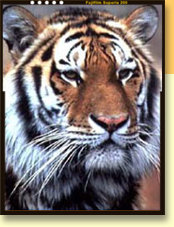
South China tiger Lahu Valley Reserve, an 81,000-acre (33,000 hectare) sanctuary and training center for the South China tiger has been set up in Free State, South Africa by a Beijing-born former fashion executive named Li Quan. The tigers in the sanctuary were born in Chinese zoos and have been placed in a 62-hectare bush enclosure, where they are taught to hunt, and then moved to a 600-hectare camp. The plan is to reintroduce the tigers in the wild — Born Free-style — and help resurrect the South China tiger in the wild in this way. The “rewilding project” has the backing of the government in Beijing and several mostly Chinese celebrities, including the actors Jackie Chan and Michelle Yeoh, director Chen Kaige and entrepreneur David Tang.
Qian is married to American investment banker Stuart Bray who has helped bankroll her “rewilding” project, which thus far has cost about $12 million. Lahu Valley Reserve is comprised of 17 former sheep farms located in a dry and dusty part of the Karoo area of South Africa. The fairly open and rocky landscape is quite different from forested areas the tigers live in in China. The Karoo area of South Africa was selected as the site of the program because China lacks the habitat and the conservation expertise to pull off such an endeavor. China was supposed to have an area ready for the tigers with sufficient habitat and game in Hunan or Jiangxi province in 2007 but as of 2008 the people that lived in the area had not been moved out.
Quan has been criticized and even ridiculed by animal conservation groups, who say the money that has been spent on the program would be better spent on saving the habitat of tigers that exist in the wild. Judy Mill of Conservation International has called Qian’s project “a circus sideshow dressed up as ecotourism” and called Qian “a wealthy dilettante” who “feels as if she has done something.”
Another tiger is named Madonna. It is not clear whether Tiger Woods or Madonna have approved the use of their names. Critics claim the project is an expensive distraction from protecting the tiger species in their natural habitat. The same criticism has been levelled at China's captive breeding of pandas and other endangered species.
Five South China tigers have been brought to Lahu Valley Reserve. All learned to hunt wild South African game and were fed freshly-shot springboks. After two years one died of heart failure and pneumonia. Another was seriously bitten by a baboon and got dangerously dehydrated. Another took some time to get over her fear of the swaying grass and often sought out a cage where she felt safe. A cub that was born had to be rescued from her mother who did not know how lick the cub dry or keep him warm.
The tigers have spent four years “learning” how to mate and to kill guinea fowl, antelope and blesbok. A ranger with the Lahu Valley project told the Los Angeles Times, the tigers “have no mother to teach them to pluck the feathers off a guinea fowl or break open a springbok, They hope to learn by trial and error. The first couple of kills have to be quite easy. Then you make the process more difficult.”
As of April 2008, three cubs had been born at Lahu Valley. The cubs were born to two females and fathered by a male tiger who appears to have been aroused to perform by the arrival of another male.
Siberian (Amur) Tigers and Manchurian Tigers

Madonna in the snow
The population of the Siberian Tiger — which can grow to three meters in length and 300 kilograms — in China is estimated at 18 to 22 (2010). The Siberian Tiger is officially known as the Amur tiger. Decades of poaching and logging have ravaged the population of the Siberian tiger — only about 500 still live in the wild worldwide.
An estimated 15 to 20 Manchurian tiger, called the northeastern tiger in China, are left in China with another dozen or so in North Korea. They are found in the Lesser Hinggan Ling and Changbai mountains along the Korean border. Five or six tigers have been counted in Hunchun Nature Reserve in Jilin Province in northern China. They are difficult to see the wild but can be seen in zoos in Korea, Russia and China. They may be breeding with Amur (Siberian) tigers.
The Manchurian tiger is either a close relative of or the same as Siberian tigers. They once ranged across Manchuria and Korea, with Siberian tigers living in eastern Russia. Chinese say many tigers fled to Russia because of a fires in northern China in the 1980s and 90s but have since returned. Now it is said there is so little food for the tigers they resort to eating frogs to survive.
Some say there are six surviving subspecies native to the boreal forests, or taiga, of China, Russia and Korea. These include the Siberian tigers, also known as Amur or Korean tigers, and the Manchurian tiger. But it is unclear if they are different enough from each other to qualify as subspeices.
The Siberian Tiger Park in Harbin specializes in research and breeding of Siberian tigers. At last count it had over 700 tigers. At the park tigers are thrown chickens and goats as spectators applaud.
See Separate Article: SIBERIAN TIGERS IN CHINA factsanddetails.com
Captive Tigers in China
Although China's wild tiger population is tiny, thousands of the animals are bred in captivity each year. Forestry bureaus are responsible for conservation and receive the bulk of funds related to this end. In February 2012, AFP reported: “China says it has nearly 6,000 endangered tigers in captivity, but just 50 to 60 living in the wild in its northeast. Pictures of tourists sitting on top of a strapped-down cub at a "tiger park" in Jilin province went viral on Chinese social networking in January 2014. The park promptly terminated its contract with an "on-site animal circus" which took responsibility for the incident, Chinese media reported. . [Source: AFP, February 7, 2012 ]
In July 2016, Siberian tigers at a wildlife park in Beijing mauled a grandmother to death and wounded another when they stepped out of their car in an enclosure, a Chinese state-run newspaper said. Associated Press reported: A tiger pounced on one of the women after she got out of a private car in which she was touring the Beijing Badaling Wildlife World, the Legal Evening News reported.
The second woman was injured by another tiger that leapt at her after she stepped out of the vehicle to try to help her companion, the report said. The Yanqing district government confirmed in an official microblog post that the tiger attack took place at the park, which lies at the foot of the Great Wall. It offered few details but said the injured person was being treated. Visitors are allowed to drive their own vehicles around the park, but are forbidden from getting out while in certain enclosures, the report said. A woman who answered the phone at the park refused to comment on the attack, saying only that the park was closed for two days due to forecasts of heavy rain. [Source: Associated Press, July 24, 2016]
In September 2016, China.org reported: A Siberian tiger was attacked and killed by others at Changchun Botanical and Zoological Garden in northeast China's Jilin Province. The 2-year-old female was wandering outside of its territory when the attack took place, a witness said. Liu Chang, assistant to the park director, said the exact reason remained unkown since the attack happened away from video surveillance. The tiger was the offspring of one attacker, Liu said, adding that it is possible that the former bled during the tussle, which attracted other tigers to the fight. The ambush of tigers were scared away with firecrackers after the incident. The body of the dead tiger has been kept pending further investigation by the local forestry department. The park now has eight tigers that are all caged except for one that is allowed to roam within a certain zone. [Source: China.org, September 9, 2016

Tiger Bones and Medicine
According to an article in China Today magazine: "The tiger is a kind of treasure. The hide of the tiger can be made into an expensive coat. The bones, the kidneys, the stomach and the penis are very valuable medicine. The medicine from the ribs of the tiger is a very good and effective medicine for curing rheumatoid arthritis."
Through the 1980s there was not a large demand for tiger parts and the stockpile of tiger parts was enough to meet the demand for traditional Chinese medicine. In the previous years the market was supplied by thousands of Chinese tigers killed as pests and threats to human life. For a while there was an even a glut of tiger bone products.
Today, there are reportedly tiger farms in Manchuria. In December, 2002, one hundred rare Bengal tigers were donated by Thailand to China. There were reports in newspapers that the tigers were going to be raised like cattle for meat. One newspaper reported that a place called “Love World” on Hainan Island planned to offer tiger meats dishes while people watched tigers roaming around. Government officials said there was no truth to the reports.
See Separate Article TIGER PARTS, CHINESE MEDICINE POACHING AND THE TIGER BONE TRADE factsanddetails.com
Image Sources: 1) Chinese Academy of Sciences; 2) Kostich; 3,5) Julie Chao http://juliechao.com/pix-china.html ; 4) Tooter for Kids; 6, 7) WWF
Text Sources: Animal Diversity Web animaldiversity.org ; National Geographic, Live Science, Natural History magazine, David Attenborough books, New York Times, Washington Post, Los Angeles Times, Smithsonian magazine, Discover magazine, The New Yorker, Time, Reuters, Associated Press, AFP, Lonely Planet Guides, Wikipedia, The Guardian, Top Secret Animal Attack Files website and various books and other publications.
Last updated January 2025