
SIBERIAN (AMUR) TIGERS AND MANCHURIAN TIGERS
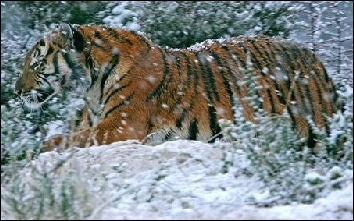
Madonna in the snow
The population of the siberian tigers — which can grow to three meters in length and weigh 300 kilograms — in China is estimated at 18 to 22 (2010). Siberian tigers are also known as Amur tiger. Decades of poaching and logging have ravaged their population — only about 500 still live in the wild worldwide.
An estimated 15 to 20 Manchurian tiger, called the northeastern tiger in China, are left in China with another dozen or so in North Korea. They are found in the Lesser Hinggan Ling and Changbai mountains along the Korean border. Five or six tigers have been counted in Hunchun Nature Reserve in Jilin Province in northern China. They are difficult to see the wild but can be seen in zoos in Korea, Russia and China. They may be breeding with Amur (Siberian) tigers.
Some say there are six surviving subspecies of tiger native to the boreal forests, or taiga, of China, Russia and Korea. These include the Siberian tigers and the Manchurian tiger. But it is unclear if they are different enough from each other to qualify as subspeices. The Manchurian tiger is either a close relative of or the same as Siberian tigers. They once ranged across Manchuria and Korea, with Siberian tigers living in eastern Russia. Chinese say many tigers fled to Russia because of a fires in northern China in the 1980s and 90s but have since returned. Now it is said there is so little food for the tigers they resort to eating frogs to survive.
The Siberian Tiger Park in Harbin specializes in research and breeding of Siberian tigers. At last count it had over 700 tigers. At the park tigers are thrown chickens and goats as spectators applaud.
See Separate Articles:
SIBERIAN TIGERS: CHARACTERISTICS, HISTORY, SIZE, WHERE THEY LIVE factsanddetails.com;
SIBERIAN TIGERS BEHAVIOR: HUNTING, PREY, REPRODUCTION, CUBS factsanddetails.com;
HUMANS, SCIENTISTS, CENSUSES AND SIBERIAN TIGERS factsanddetails.com;
SIBERIAN TIGER CONSERVATION factsanddetails.com;
SIBERIAN TIGER ATTACKS factsanddetails.com
Siberian Tiger in China in the late 1990s
On Siberian tigers in China in the late 1990s, Dunishenko and Kulikov wrote: "We found tracks of three to five tigers, all of them along the Russian border within China. Given these circumstances, one has to sadly admit that the even partially viable populations of Amur tigers are going to be found in the wild only in Russia...The last tiger in the Malyi Khingan [a mountain range in China's Heilongjiang Province and the adjacent parts of Russia's Amur Oblast and Jewish Autonomous Oblast] disappeared in the early 1970s. At least ten animals were present there in the 1950s. The disappearance of this population is a targeted warning to those who would suggest that there are adequate numbers of tigers in the wild. The reason the tigers disappeared from the Malyi Khingan is simple — the perimeter was enclosed with a thick barrier of barbed wire and the animals were left in total isolation. Exchanges of genetic material and breeding individuals with Chinese populations ceased, growth could not keep pace with natural death, and no one has seen any sign of a tiger in the reserve for more than 20 years now. [Source: “The Amur Tiger” by Yury Dunishenko and Alexander Kulikov, The Wildlife Foundation, 1999 ~~]

Siberian tiger (Amur or Manchurian tiger)
"Our general impression was that China’s Jilin Province has wonderful, carefully cared for forests. Everywhere, vigilant fire spotters keep watch over the land from high observation towers. Gates are locked when there is no snow; the forest is entered only with special permission and a clear objective — even a cash bribe will not gain on entrance. At times of forest fire danger, smoking is prohibited not only in forests, but also on village streets. A smoker’s punishment is to be fired from the job, which, in China, is like a death sentence. Timber is intensively harvested, but without the use of tractor skidders that stamp out anything alive that gets in its path. Trees are skidded along trails with oxen; there are almost no tracks are left behind. The timber- felling units and the forest management agencies have been combined into one structure, but they aren’t biting the hand that feeds them: harvest sites are being replanted with larch, oak, ash. In a word, things are grand; if only it was like that in Russia! ~~
"But that is only one side of the coin. The other side is that these grand forest landscapes are almost lifeless! Everything has been caught in snares and cagey traps and then eaten by the locals. You will find neither grayling nor taimen in Jilin’s magnificent mountain streams; these waterways have been rendered into deserts. Small fish are caught with electrodes, and mollusks and frogs are wrestled out from under rocks with crowbars; all of the rocks along the stream bottoms have been turned over many times. Where spotted deer, musk deer and wild boar still exist, all animal trails are laden with snares. In general, Jilin’s wild animals are an order of magnitude less than what one finds in Russia; they are being replaced by cattle that wander the forest year-round on unrestricted pasture. Cows, like elk, break and eat rose willow, and like red Manchurian deer, trample down horsetail and gather acorns. It is almost not even worth posing the question: where did the Amur tiger — more numerous in China one hundred years ago than in its northern habitat in Russia, — disappear in China?" ~~
Comeback of the Siberian Tiger in China
Barbara Demick wrote in the Los Angeles Times: “In China, the number of Siberian tigers living in the wild (far smaller than those in captivity) has been listed in government statistics at between 18 and 22 for some years, said Li Zhixing, who has worked for decades on tiger protection. Nobody knows the exact number, because the Chinese don't have tracking collars on the tigers, but Li believes there could be as many as 40 now and that the population is growing. "I personally think the number of tigers has doubled in the last decade and that the area populated by tigers has become much larger," said Li. Chinese have been amazed not only by the apparent growth of the tiger population but also by how far the felines have spread. It made headlines around China this year when tigers were seen near Jiamusi, a city 140 miles from the Russian border. [Source: Barbara Demick, Los Angeles Times, October 1, 2013]
In December 2016, a member of Jilin province's forestry bureau found Siberian tiger tracks near the city of Jiaohe at the Shengli forest farm, which is located between the world's two largest Siberian tiger habitats. The China Daily reported: “The paw prints were photographed and the bureau says that based on the length of the animal's stride it is about 2 meters tall. Later, rangers who were tracking and monitoring the area around the farm found urine and hair samples, and the bodies of two wild boars. “One ranger noted, "The big one was almost completely eaten, leaving only bones, and the smaller one was half eaten."They also reported finding tracks of roe deer, a favorite food of the tiger. Wu Zhigang, of the Jilin forest research institute, said that signs of the Siberian tiger in Jilin indicate that the species has increased rapidly in number with 27 already monitored.” There are thought to be about 12 in neighboring Heilongjiang province. [Source: China Daily, January 12, 2016]
In China, More Humans Encountering Wild Siberian Tigers
Jonathan Kaiman wrote in The Guardian, “In 2010, Chinese authorities launched an initiative to boost numbers in the Hunchun National Siberian Tiger Nature Reserve near the country's border with Russia and North Korea. The scheme has shown promising results – the State Forestry Administration announced on Tuesday that China's wild Siberian tiger population has increased from 12 just over a decade ago to 22, according to the state newswire Xinhua. Officials hope the number will reach 40 within a decade. [Source: Jonathan Kaiman, The Guardian, May 24, 2013]
Yet residents of Xigou village, part of the county-level city of Hunchun, have mixed feelings about the increase, Xinhua reported. Wang Zenxiang recounted a close encounter late in March, saying: "After hearing some noise, I thought it was my cattle coming back home. However, when I opened the door to my backyard and turned on a flashlight, I felt my breath disappear – it was a tiger." Tigers had attacked his cattle shortly afterwards, despite the fence he had erected to keep them out, he told Xinhua.
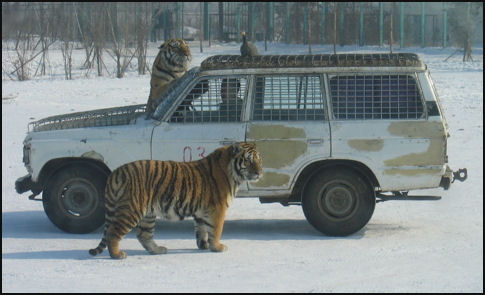
Tigers in animal park
Although the tigers have not yet physically harmed any locals, two villagers said they had a narrow escape last week while looking missing cattle. "To minimise local residents' losses and prevent public backlash, Hunchun border police started a campaign to educate locals about first aid and emergency response methods in the event of a wild tiger attack," Xinhua said.
The growing number of "human-tiger conflicts" may also pose dangers for the big cats as well. "Eating livestock may cause the tigers to become more domesticated and ruin their relationship with local residents," Lang Jianmin, and official at the reserve, said. "If one of them eats sickened livestock, the entire species could be harmed." The World Wildlife Fund, which has worked with the Chinese government on the initiative, recently cited a park ranger's discovery of a deer carcass as further evidence that the area's wild tiger population is on the rise.
Siberian Tigers Attacks on Humans in China
In the 19th century in China's Jilin Province, tigers reportedly attacked woodsmen and coachmen, and occasionally entered cabins and dragged out both adults and children. In January 2002, a man was attacked by a tiger on a remote mountain road near Hunchun in Jilin province, China, near the borders of Russia and North Korea. He suffered compound fractures but managed to survive. When he sought medical attention, his story raised suspicions as Siberian tigers seldom attack humans. An investigation of the attack scene revealed that raw venison carried by the man was left untouched by the tiger. Officials suspected the man to be a poacher who provoked the attack. The following morning, tiger sightings were reported by locals along the same road, and a local TV station did an on-site coverage. The group found tiger tracks and blood spoor in the snow at the attack scene and followed them for approximately 2,500 meters, hoping to catch a glimpse of the animal. Soon, the tiger was seen ambling slowly ahead of them. As the team tried to get closer for a better camera view, the tiger suddenly turned and charged, causing the four to flee in panic. [Source: Wikipedia]
About an hour after that encounter, the tiger attacked and killed a 26-year-old woman on the same road. Authorities retrieved the body with the help of a bulldozer. By then, the tiger was found lying 20 meters away, weak and barely alive. It died not long aftewards. A later investigation revealed that the first victim was a poacher who set multiple snares that caught both the tiger and a deer. The man was later charged for poaching and harming endangered species. He served two years in prison.[97] After being released from prison, he worked in clearing the forest of old snares.
In 2006 and 2007, people were injured in tiger attacks near Hunchun, but both survived. "My father used to tell how he once helped Russians hunt tigers, but in my lifetime — and I'm almost 50 — there hadn't been tigers around here until now," Che Shiguo, a farmer from the outskirts of Jiamusi, in Heilongjiang province, told the Los Angeles Times. He saw a tiger devouring a 3-month-old calf in August. “He screamed, and the tiger ran away. "If not, I would probably have been eaten by the tiger too," Che said. "We never go out into the mountains now alone. We are always in groups of two or three so there is somebody to scare off the tiger," Qi Shuyan, 46, who works on the same ranch in Jintang as Liu Xiangqing, told the Los Angeles Times. Li, the tiger expert, says attacks are relatively rare here because of Chinese respect for the tiger, revered by many as a mountain god. "There is a superstition here that a tiger will only attack you if you do something bad," Li said. "Sometimes when people encounter a tiger, they don't run, they just kneel and pray." [Source: Barbara Demick, Los Angeles Times, October 1, 2013]
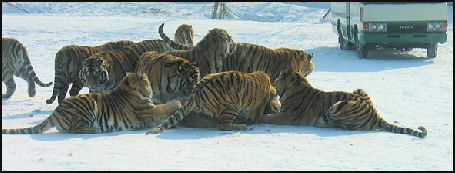
Manchurian tigers feeding in an animal park
Che Jinxia, the last woman to survive an attack, received more than 50,000 yuan (about $8,000), a record. In the early 2000s, a woman was mauled to death by a Manchurian (Siberian) tiger in the Hunchun Nature Reserve. The tiger had been injured in a poachers trap and conservationists say it probably wouldn’t have attacked the women if it hadn’t been hurt. The tiger was found next to the woman. It’s injury was mended by a veterinarian and returned to the wild.
Siberian Tiger Attacks on Livestock in China
Between 2007 and 2010 there has been more than 120 reported tiger attacks on farm animals. Many more attacks have occurred since then and compensation has been increased. Reporting from Jintang, remote Chinese village wedged between the Russian and North Korean borders,Barbara Demick wrote in the Los Angeles Times: “In a lifetime of herding, Liu Xiangqing had never seen cows so scared.“Normally, at 6 a.m., they would be gathered together, contentedly chewing and grazing in the dawn light. But this June morning, they were scattered through the pine scrub, pacing with agitation, their ears alert. Liu took a quick head count and realized one was missing, a 2-year-old bull. By the time the remains were located, the tail and thighs were missing, the entrails spilled in the dirt. There was a gash in the neck; claw marks raked down the torso. [Source: Barbara Demick, Los Angeles Times, October 1, 2013]
“It was a sure sign: The Siberian tiger was back. "In my whole life, I'd never seen a real tiger, but I knew it couldn't be anything else," said the elfin-like Liu, 52, who grew up in this remote region. Although they weigh as much as 675 pounds, Siberian tigers are elusive creatures that slink into the forest when humans approach. Villagers learn that a tiger has been on the prowl when they spot paw prints (or pug marks, as they are known) the diameter of melons. Or, as is happening more frequently in China, they discover that livestock is missing or mauled.
“Four cows were killed in five days in May in another village near the border. One of the largest of Liu's herd, a 1,300-pound bull, lost his tail to a tiger but stayed alive by fighting back. In March, a farmer investigating a noise pointed his flashlight into the darkness and saw a tiger with claws dug into a cow. He chased it away by banging a metal bucket and setting off a firecracker.
“The Chinese government also has sought to improve the public's attitude toward tigers by compensating farmers for pilfered livestock. Liu, for example, expects to receive about $500 for the young bull killed in June. Chinese newspapers now contain a multitude of articles about tiger attacks on farms, further raising awareness.
Putin’s Tiger Blamed for Killing Goats, Dogs and Chickens in China
In early 2014, one of three Siberian tigers released into the wild by Russia’s Vladimir Putin was blamed for killing some goats in China. Ben Quinn wrote in The Guardian, “Months after it was released in the wild by Vladimir Putin, a Siberian tiger is being fingered as the culprit behind a cross-border raid that has resulted in the deaths of a number of goats in north-east China. Now, however, Chinese state media have reported local authorities as claiming that the tiger, known as Ustin, has killed two goats. Three others are still reported missing, according to the official Xinhua news agency. According to a witness, the dead goats’ skulls had been crushed with puncture holes “the size of a human finger clearly visible”.[Source: Ben Quinn and agencies, The Guardian, January 25, 2014]
Ustin reportedly crossed into China in October with another of Putin’s tigers, both of which carry tracking devices. It is not the first time that the tigers have been accused of killings after crossing from Russia to China. Another of the big cats, known as Kuzya, was alleged in October to have attacked a henhouse in north-eastern China, raising concerns that farmers might hunt it down. On that occasion, the alleged victims were five chickens at a farm in Luobei county, Heilongjiang province. Xinhua did not say how Kuzya was identified as the culprit, although she had been fitted with a tracking device that had previously signalled that she was entering China.
In December 2014, Kuzya—one of the Siberian tigers—released by Putin was blamed for killing some hens and dogs in China. Ollie Gillman of the Daily Mail reported: “An endangered Siberian tiger released into the wild by Vladimir Putin has continued its killing spree, feasting on a pet dog. Kuzya was filmed devouring the hound for two hours on Heixiazi island, which sits on the Amur river between Russia and China. The beast, who has also killed a flock of chickens on its rampage across north-east China, is now believed to have returned to Russia. Kuzya, seen wearing a GPS tracking device, attacked and killed the pet dog in the early hours of December 2014, China Central Television reported. [Source: Ollie Gillman, MailOnline, December 15, 2014]
Satellite tracking showed the rare Amur cat swam across a river - evidently in search of a Chinese meal after a shortage of its staple of deer in eastern Russia. In October Kuzya, who is 21 months old, attacked a hen house in northern China, eating five chickens and infuriating farmers. Animal remains were found near the tiger's tracks, and feathers and blood near a smashed hen house. The big cat was spotted again in Taipinggou nature reserve in Heilongjiang province and some 60 cameras have been set up in a bid to track him.
The Russians alerted Beijing through diplomatic channels amid fears angry farmers might shoot the tiger. Chen Zhigang, the nature reserve director, said a Russian expert had informed him of Kuzya's location and had 'expressed hope that we can protect it'. Last month another of the tigers, Ustin, followed Kuzya into China, killing two goats, with another three going missing. The dead goats' skulls had been crushed with puncture holes 'the size of a human finger clearly visible', a witness said.
Despite the attacks, the foreign ministry in Beijing pledged that Putin's tiger would be protected, citing an existing agreement on cross-border protection of Siberian tigers. 'We will make joint efforts with the Russian side to protect wild Siberian tigers which travel back and forth between China and Russia,' spokesman Hong Lei said in a statement.
Earlier Russian ecologists expressed fears for the animal in China. Vasiliy Gorobeiko, deputy head of natural resources management in the Jewish Automomous Oblast republic in eastern Russia - where the tiger was roaming before he crossed the border - said China was more populated and he could be shot for worrying farm animals. 'Certainly, China will be informed about President Putin's tiger via Foreign Affairs ministry channels but time is needed for this information to reach local ecologists, and before then the tiger may well alarm the local villagers and may even suffer,' he said at the time. 'Kuzya knows how to avoid people and did so well in Russia but in that agricultural area of China, it will be hard for him.'
In December 2015, China's official Xinhua News Agency said that Ustin had bit and killed 15 goats and left another three missing at a farm in Heilongjiang province's Fuyuan county. Associated Press reported: Xinhua said the farm's owner, Guo Yulin, was stressed about the tiger, but that he would be compensated by the local forestry department for the loss of the 18 goats. Kuzya, was believed to have raided a farm and eaten five chickens last month in another Heilongjiang county. Guo told Xinhua that he was alerted by dog barks on Sunday night, but that his check turned up nothing unusual. He said he woke up the next morning to find two goats dead and three others missing. Xinhua said the goats' skulls were crushed by the tiger and that a hole the size of a human finger was visible on each goat's head. The farmer said the tiger returned the following night but made no noise at all. "When I opened the goat house in the morning, dead goats were everywhere," Guo said, according to Xinhua. Local experts found the tiger's footprints around the goat house and on its roof, Xinhua reported. Guo was asked to either relocate his goats or reinforce his farm, it said. [Source: Associated Press, December 10, 2015]
Threats to the Siberian Tiger
Many Siberian Tigers are isolated from one another by roads and railways, making it difficult for them to breed. The conservation group WWF warns that the animal may be extinct in the wild in China within three decades if current trends continue. The tiger is the group's priority for 2010. [Source: Jonathan Watts, The Guardian, February 7, 2010]
The main threat to Siberian Tigers comes from economic development, which intrudes into the tiger's habitat. In some places it takes the form of roads or railways; elsewhere, it is logging, mines and frog farms. “Infrastructure construction has blocked the tiger's migration channels and the rising population density has eaten into the tiger's territory,” Wu Zhigang, of the Jilin Science Academy told The Guardian . “We must restore these channels by building elevated roads or tunnels.”
In 2009, a dead female tiger was found trapped in a snare. The trapper — a frog farmer — was caught. Barbara Demick wrote in the Los Angeles Times: “Many people in the down-at-the-heels villages near the Russian border trap other animals, which Li believes also has an effect on tigers. First of all, tigers can easily be snared in traps. More important, trapping sets off a destructive cycle of theft; if humans steal the deer and wild pigs that are the tigers' natural prey, the tigers in turn are prompted to steal the humans' livestock. [Source: Barbara Demick, Los Angeles Times, October 1, 2013]
Tiger Conservation in Northern China
The Chinese government has drawn up plans for a tiger-friendly model of forestry management. The Wildlife Conservation Society is also trying to foster tiger eco-tourism in the region, partly through the launch of an annual Hunchun tiger festival. It will be expanded this year with a conservation marathon, exhibitions, forums, screenings and tiger-themed essay and art competitions. “We want to appeal to nature lovers by showing that the tiger habitat is an ideal environment,” Sun Quanhai, the local director of the society. Told The Guardian “Hunchun's forest coverage exceeds 80 percent. The local government have realized the importance of conservation and decided to make Hunchun the 'tiger town' of China.”
China marked year of tiger on the Chinese zodiac in 2010 with a multimillion-dollar scheme to protect the Amur (Siberian Tiger) funded by the Chinese government, World Bank and NGOs. In November 2010, Chinese Premier Wen Jiabao and Russian Prime Minister Vladamir Putin agree to cooperate to save the world’s tigers and pledged to join the international effort to double the number of tigers in the wild by 2020. The scheme include acquiring land for expanded reserves, linking tiger communities, relocating residents, training local officials and reconfiguring forestry management to allow for sustainable economic use and cohabitation by predators and prey species. The survey in Hunchun and Siberia is a preliminary step that shows an unprecedented level of co-operation between China, Russia, the World Bank and conservation groups. [Source: Jonathan Watts, The Guardian, February 7, 2010]
Barbara Demick wrote in the Los Angeles Times: “Li credits campaigns to restore the degraded forests in China and Russia. The latter began tiger-protection efforts in the 1940s and has the largest population of Siberian tigers, between 400 and 900, according to the World Wildlife Fund. But in recent years, China has caught up and might even be moving ahead in creating tiger-friendly habitat, Li said. "Russia has fewer people than China, so it is a better place for tigers. But they are doing a lot of logging and burning off of agriculture fields after harvest, and the tigers don't like that," said Li, a native of Hunchun, the largest city in the region. "It is not hard for a tiger to jump over the barbed-wire fences at the border and come to China." [Source: Barbara Demick, Los Angeles Times, October 1, 2013]
“Although Chinese still buy illegal body parts of tigers — poached in India or killed in captivity — for traditional medicine, the wild tigers have not been hunted in China since the 1950s, Li said. In fact, hunting of all animals except rats is banned in China. "Getting rid of the traps is absolutely critical to making a better environment for the tigers," said Li, who was making the rounds recently in the villages near the border, distributing beekeeping equipment to encourage an alternative livelihood to trapping.
“Here in Jilin province, the Forestry Ministry has designated a wildlife preserve containing 108,700 acres of spruce, pine and larch forest, the favorite habitat of the tiger. In August, scientists released 37 deer into the preserve to attract tigers as well as leopards, another endangered species native to the region. "If you want to protect tigers, you have to protect their food supply," Zhang Changzhi, a scientist with the World Wildlife Fund, which is sponsoring the project, said as he toured a preserve in Wangqing county recently. Heat-detecting cameras attached to trees attest to the success of the project; they have produced three photographs of leopards and one of a tiger.
“Chinese efforts on behalf of the Siberian tiger have won worldwide praise among environmentalists. A 2010 report in the journal of the Yale School of Forestry & Environmental Studies compared China's preservation efforts favorably with India's and ventured that China might even earn the right to claim it "saved the tiger." Describing a conservationists looking for tigers around Hunchun in the slopes and valleys near the North Korean border, Jonathan Watts wrote in the The Guardian, “Taking turns to act as human ploughs, Liang Jianmin and his tiger survey team forge through mile after mile of knee-deep snow in the mountain forests near China's frozen mountain border with Siberia. From dawn to dusk they track, looking for droppings, paw prints, bark scratchings, scraps of fur caught on twigs and fences, any sign that the Siberian Tiger. In the first week, the team found a piece of tiger fur caught on a fence, and droppings and sightings of the main prey species — wild boar and sika deer — as well as snares and traps left by poachers. [Source: Jonathan Watts, The Guardian, February 7, 2010]
Discovery of an Siberian Tiger Cub
The first Siberian Tiger cub to be found in the wild in China in at least 20 years was found in March 2010 but died less than two days after being discovered. The Guardian reported: Early on the morning of 25 February, Han Deyou, a forester in the Wanda mountains in the northern province of Heilongjiang claimed to have discovered a wild tiger cub trapped in a pile of firewood in his yard. Afraid of its roars and aggression, he called local police and forestry officials, who fed the captive animal beef and chicken as they waited for wildlife experts from a tiger breeding center to arrive in the remote area the following morning...Authorities covered up the death, which casts a shadow over what was potentially the best conservation news the country has had for decades. [Source: Jonathan Watts, The Guardian, March 1, 2010]
“The tiger was anaesthetised with a dart, taken away and detained in the jail of the local public security bureau. Experts confirmed it was a Siberian tiger, weighing 28.5kg and thought to be about around nine months old. Regional media said the cub had probably sought shelter after being separated from its mother in the unusually deep winter snows.”
“Local authorities hailed the discovery as an “explosively” important development, according to the Northeast China Net website. There are only about 20 tigers left in the wild. According to regional media, no cubs have been found since the founding of the People's Republic of China more than 60 years ago, though conservationists say records are unreliable before the 1990s.” The discovery of the young tiger appeared to show that the animals were still breeding in the wild, the best possible news at the start of a year in which the government, World Bank and conservation groups plan to invest heavily in a new program to save the biggest cat on the planet.”
“But the case was quickly shrouded in mystery, tragedy and secrecy. Ma Hongliang, the propaganda chief of The East Is Red Forest Bureau, told the Guardian that the cub is dead, but the news has been withheld. He has advised Central China Television and other domestic journalists not to report the death because of possible negative publicity. He declined to answer questions about the time and cause of death. Experts tried their best to save the cub,” he said. “It was too weak to survive.” [Source: Jonathan Watts, The Guardian, March 1, 2010]
Image Sources: 1) Chinese Academy of Sciences; 2) Kostich; 3,5) Julie Chao http://juliechao.com/pix-china.html ; 4) Tooter for Kids; 6, 7) WWF
Text Sources: Animal Diversity Web animaldiversity.org ; National Geographic, Live Science, Natural History magazine, David Attenborough books, New York Times, Washington Post, Los Angeles Times, Smithsonian magazine, Discover magazine, The New Yorker, Time, Reuters, Associated Press, AFP, Lonely Planet Guides, Wikipedia, The Guardian, Top Secret Animal Attack Files website and various books and other publications.
Last updated May 2025