
LARGE HORNBILL SPECIES IN ASIA
Some Asian hornbills are very large birds with magnificent bright red, yellow, blue and pink colorations. The rhinoceros hornbill is one of the largest of the 50 fruit-eating bird species and seven hornbill species found on Borneo. They reach a meter in length and are associated with the god of war by Borneo’s Iban people. They are huge birds whose wing whooshing noises bring to mind pterodactyls. Females use resin for plastering over the crevices and small holes in her nest hole.
The largest and heaviest hornbills is the southern ground hornbill of southern Africa which has an average weight of 3.77 kilograms (8.3 pounds), and can weigh up to 6.3 kilograms (14 pounds) (See the Bottom of the article). The longest species of hornbill is the helmeted hornbill (Rhinoplax vigil). It is 150 centimeters (4 feet 11 inches) long in part to its extended tail feathers. They have unique solid ivory casques and tail feathers that are over a meter long. They have been observed engaging n long bouts in which they repeatedly knock their heads together. They have one of the loudest calls, a deep "hou hou". A casque is an enlargement of the bones of the upper mandible or the skull, either on the front of the face, the top of the head, or both. Often it is on top pf the bill.
Great hornbills are even bigger. They feed in fruit, primarily figs, plucked from among the foliage. In some cases the descend to the ground to gather fallen fruit. They live in small groups that roost communally. These birds generally spend their day methodically visiting one fruiting tree after another.
RELATED ARTICLES:
HORNBILLS: CHARACTERISTICS, BEHAVIOR, NEST-BUILDING factsanddetails.com
HORNBILL SPECIES IN ASIA factsanddetails.com
BIRDS IN ASIA: ARGUSES, IBISES, EAGLES, RARE SPECIES factsanddetails.com
JUNGLE FOWL (CHICKENS): CHARACTERISTICS, BEHAVIOR AND REPRODUCTION factsanddetails.com ;
PEACOCKS: CHARACTERISTICS, BEHAVIOR AND REPRODUCTION factsanddetails.com
BIRDS: THEIR HISTORY, CHARACTERISTICS, COLORS factsanddetails.com ;
BIRD FLIGHT: FEATHERS, WINGS, AERODYNAMICS factsanddetails.com ;
BIRD BEHAVIOR, SONGS, SOUNDS, FLOCKING AND MIGRATING factsanddetails.com
Great Hornbills
Great hornbills (Buceros bicornis) are also known as great pied hornbills, concave-casqued hornbills and great Indian hornbills. They have a wing span of 1.5 meters (five feet) and produce a loud huffing noise when they fly. They have yellow and white markings on their wings. Their yellow casque and bill has patches of red on it. To really look sharp the male applies a gloss of yellow oil to his bill and casque from a preen gland at the base of his tail. They live in rain forests and feed mostly on fruit but occasionally eat green snakes which they swallow like — a string of spaghetti.” Great hornbills do not welcome human intrusions. They have been known to drop branches on scientists that observed their nesting habits without using a blind.
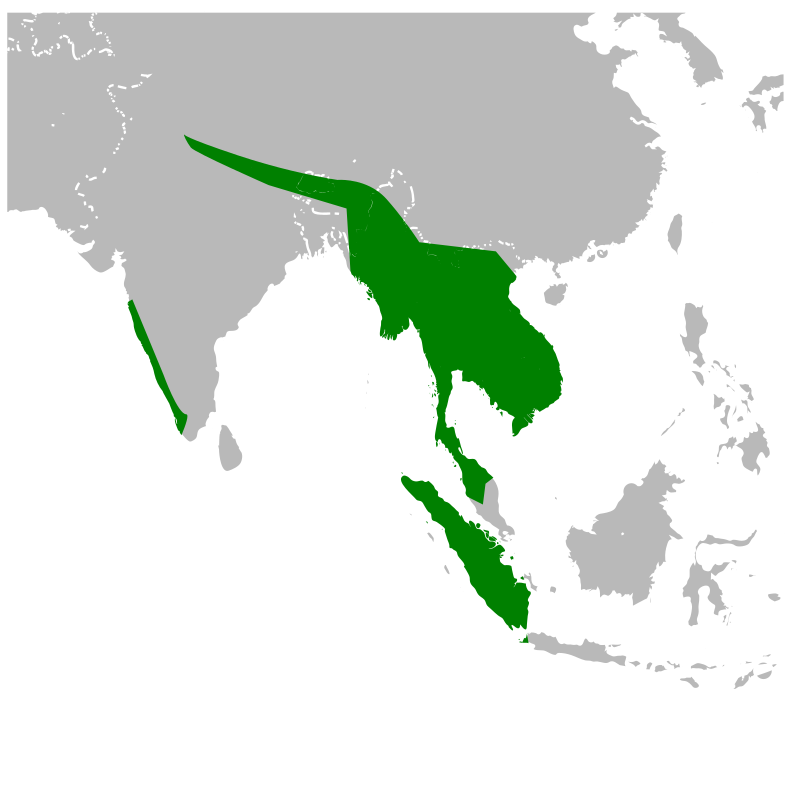
Great hornbills are found in South and Southeast Asia and Indonesia. They are breeding areas in Bhutan, Nepal, India, China, Cambodia, Laos, Malaysia, Myanmar, Thailand, Vietnam and Indonesia. In India, they and several other hornbill species live in the Western Ghats mountain range and forests in both the northeastern and southern regions. [Source: Spurthi Paruchuri, Animal Diversity Web (ADW) /=]
Great hornbills are found live mainly in rainforests and mature evergreen forests at elevations of 600 to 2000 meters (1970 to 6562 feet). Old-growth trees that reach above the canopy are preferred for nesting. The height of the tree and the presence of a natural cavity large enough to hold a female and her eggs are more important than the type of tree. The same nesting site is used year after year if possible. Great hornbills have been reported living to between 60 and 70 years old, but their lifespan is thought to range from 35 to 40 in the wild, which is still pretty long for a bird. A lack natural predators and plentiful food supplies contribute to their relatively long lifespan./=\
On the International Union for Conservation of Nature (IUCN) Red List great hornbills are listed as Near Threatened. In CITES (Convention on International Trade in Endangered Species of Wild) they are in Appendix I, which lists species that are the most endangered among CITES-listed animals and plants. The biggest threats to these birds are deforestation and other habitat disturbances, particularly the removal of old-growth trees that these birds use for nesting. Their large size and distinctive sounds make great hornbills relatively easy targets for hunters. These bird have been killed for their meat, feathers and casque, which are used by some indigenous people for ornamentals.
Great Hornbill Characteristics and Diet
Great hornbills have an average weight of three kilograms (6.61 pounds) and range in length from 95 to 120 centimeters (37.4 to 47.2 inches). Their wingspan ranges from 1.5 to 1.8 meters (59.4 to 70 inches). They are endothermic (use their metabolism to generate heat and regulate body temperature independent of the temperatures around them) and homoiothermic (warm-blooded, having a constant body temperature, usually higher than the temperature of their surroundings). Sexual Dimorphism (differences between males and females) is present: Males and females are similar except that the irises of males are red while those of females are white, and males have slightly larger bills and casques. [Source: Spurthi Paruchuri, Animal Diversity Web (ADW) /=]
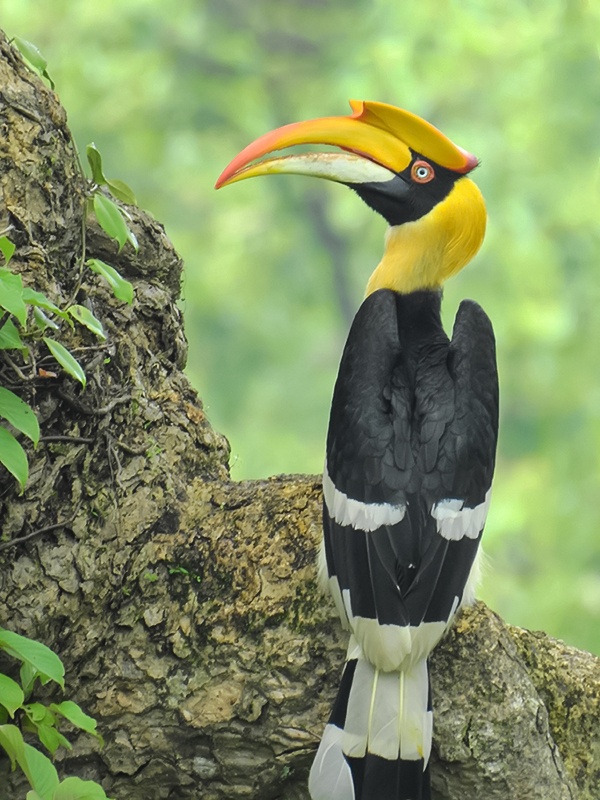
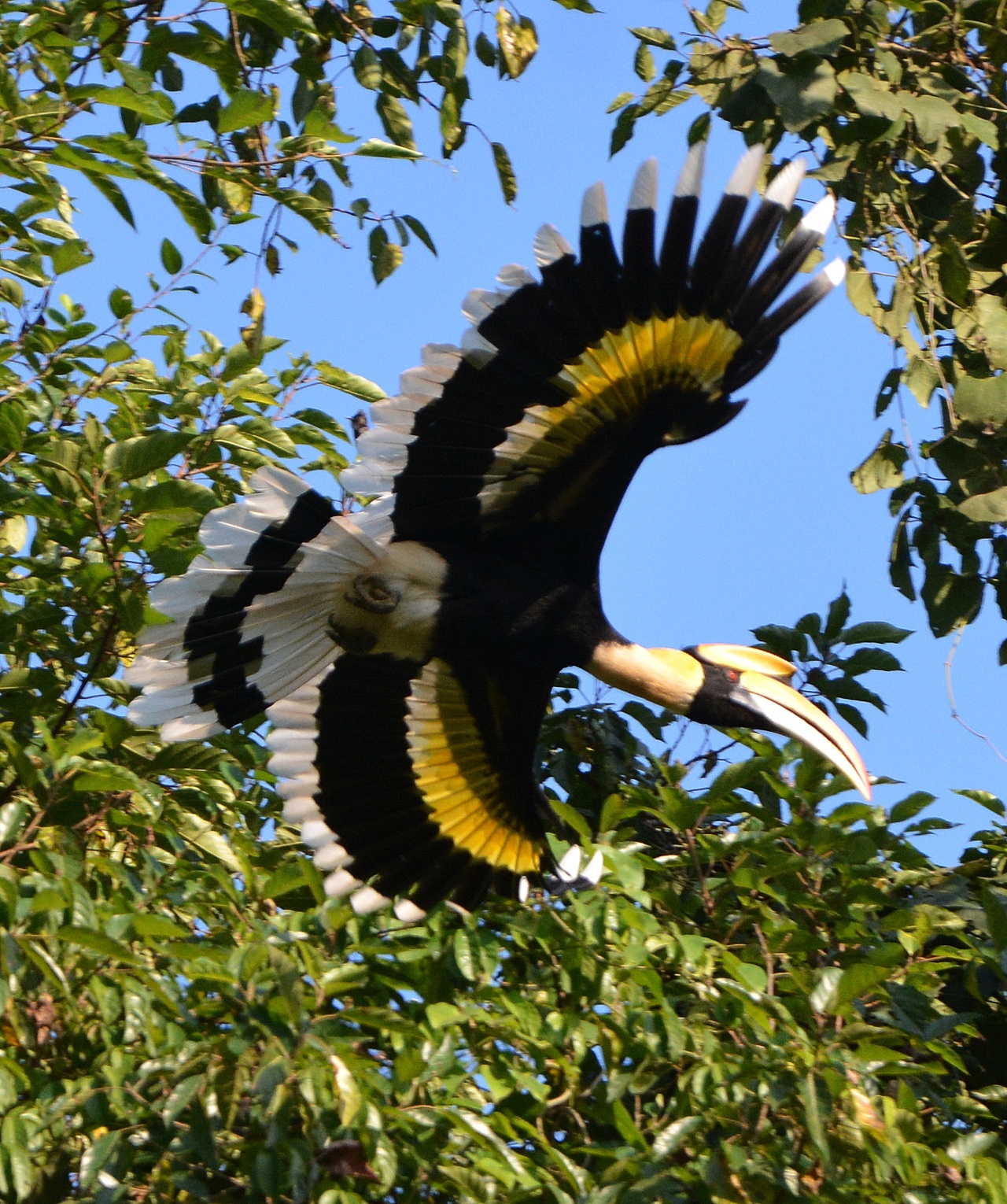
Great hornbills are brightly colored and easy to recognize. The body, head, and wings are primarily black; the abdomen and neck are white. The tail is white and is crossed by a black band. A preen gland near the tail secretes tinted oil, which is spread across the feathers by the bird during grooming, giving them an oily sheen and tint their the bill, neck, casque, tail and wing feathers a yellow to reddish color. The most recognizable feature of great hornbills and the easiest way to distinguish them from other hornbill species are their greatly curved bill and prominent casque. The casque is a hollow structure located on top of the bill. It may be used by males to fight with other males and attract females. Like many other hornbills, these birds have prominent eyelashes.
Great hornbills are predominantly frugivores (eat fruits). They feed on both lipid-rich and sugar-rich fruits as well as small mammals, birds, amphibians, reptiles, and insects as well. During the breeding seaons they load up lipid-rich fruits such as those in the genuses Knema and Myristica commonly known as nutmeg trees, and several in the family Lauraceae such as Beilschmiedia. Lipid-rich fruits are rich sources of energy during the breeding season when energy needs are significantly higher for both parents and young. During the rest of the year, great hornbills rely on sugar-rich fruits such those of Vitex altissima and several species in the genus Ficus (fig trees). Figs account for the majority of fruit consumption of Great hornbills throughout the year. Great hornbills have been known to protect fig trees from other birds such as wreathed hornbills
Male great hornbills bring up to 13 meals of fruit a day to nesting females. One male was observed delivering 150 figs in one visit, regurgitated one after another, as well as beetles, snakes, giant scorpions, geckos, bats and young of other birds. Females reportedly like some variety to their diet and have refused food if they are brought to much of the same thing.
Great Hornbill Behavior and Communication
Great hornbills are arboreal (live mainly in trees), diurnal (active during the daytime), motile (move around as opposed to being stationary), sedentary (remain in the same area) and socialThe size of their range territory varies 3.7 square kilometers during the breeding season to 14.7 square kilometers during the non-breeding season. Great hornbills tend hang out in monogamous pairs, with offspring. At night they may gather in large communal roosts which may contain hundreds of individuals. They do not migrate. Males fight each other by butting their casques, possibly as a display of dominance in competition for females. Females are sealed up in the nest tree during the breeding season. [Source: Spurthi Paruchuri, Animal Diversity Web (ADW) /=]
Great hornbills sense using vision, touch, sound and chemicals usually detected with smell and communicate with vision, touch and sound, sometimes employing duets (joint displays, usually between mates, and usually with highly-coordinated sounds). Male great hornbills use their bills and casques when competing for mates. Males ram their casques against each other, often in flight, in the lead up to the mating season. The size of a male casque may be a visual cue to attract mates./=\
With the exception of the nesting season, Great hornbills vocalizes loudly and frequently, producing sounds that have been described as "cackling" or "roaring." These birds are most vocal when they gather in their large, communal night roosts. Roosts have been hypothesized to be "information hubs" where individuals share information on things like good feeding locations. Duets are used by great hornbill pairs during courtship, with a male and afemale alternating calls. Great hornbills also make a characteristic "whooshing" sound when they fly. This unique flight sound is produced from lack of flight feather coverts. /=\
Great Hornbill Mating, Reproduction and Offspring
Great hornbills engage in seasonal breeding. They breed once a year, usually between February and May. The number of eggs laid each season ranges from one to two, with average number being is two.The time to hatching ranges from 38 to 40 days, with independence occurring on average at 15 weeks. [Source: Spurthi Paruchuri, Animal Diversity Web (ADW) /=]
Great hornbills tend to be monogamous, and the pair remains together throughout their lives. Males compete for females by butting into each other in the presence of a female prior to the breeding season. Mates, or potential mates, also perform duets (joint displays, usually between mates, and usually with highly-coordinated sounds) where the male calls, the female replies, and they continue on in a loud volley.
During the breeding season a monogamous pair chooses a tree where the female can lay her eggs. This tree is usually a very tall, old-growth tree with a hole in it. Ideally, the same tree is used year after year. After selected a hole in the tree that is large enough, the female uses both her own feces and her mate's to cover the entrance from the inside, thus confining herself inside. She makes a small slit through which the male provides food. While inside the hole, the female lays and then incubates her eggs. The male provides fruits from trees in the genus Beilschmiedia, which are widely available during the breeding season. She receives no food than this. Inside the tree, the female undergoes a complete molt which renders her unable to fly for a period of time. /=\
After the chicks hatch, the female remains confined in the tree for around five weeks when she emerges to help the male gather food for the growing young. The young re-seal themselves within the cavity after the female leaves. For the next two weeks, both parents provide food for the young. After the young emerge, the parents continue to feed them until they reach roughly 15 weeks of age, at which point they are considered independent.
Rhinoceros Hornbills
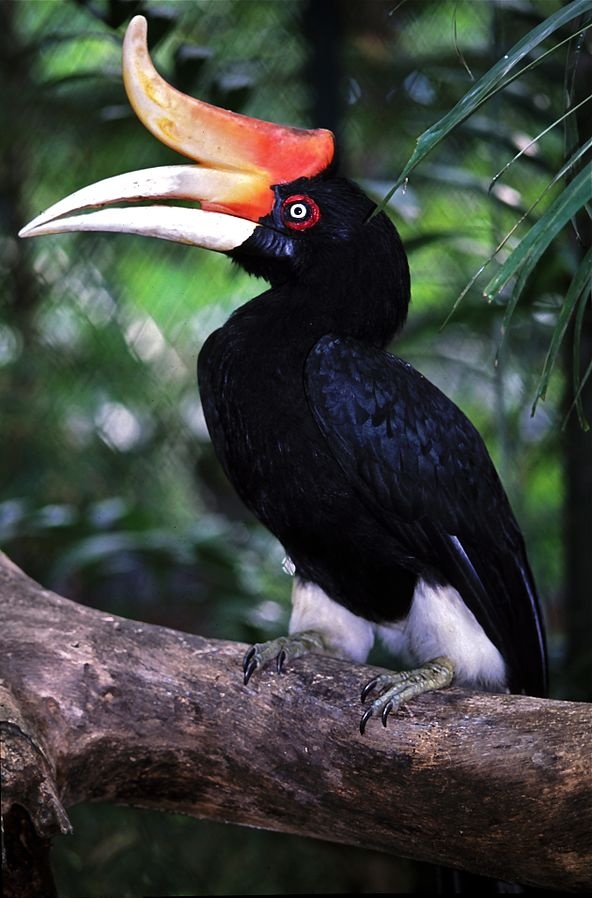
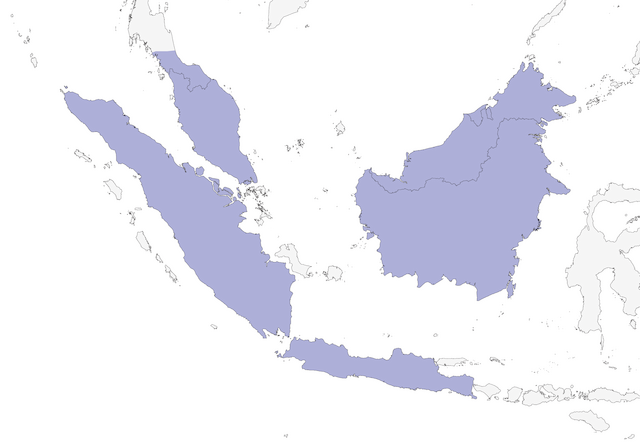
Rhinoceros hornbills (Buceros rhinoceros) are found in Southeast Asia in Malaysia, southern Thailand and Myanmar, Borneo, Sumatra, and Java. They are usually found in primary, lowland rainforests, hill dipterocarp forests, mountainous forests, and swamp forests at elevations of 130 to 1500 meters (427 to 4920 feet). Their habitat usually contains large, mature trees used for nesting and fruit-bearing trees that provide food. If undisturbed habitat is not available, they do inhabit tall secondary forests and slightly disturbed areas. There are reports of Rhinoceros hornbills inhabiting small farms and palm oil plots in Malaysia, which some say is a last resort as other nearby forests have been disturbed.[Source: Ashlynn Pryal, Animal Diversity Web (ADW) /=]
On the International Union for Conservation of Nature (IUCN) Red List rhinoceros hornbills are listed as Vulnerable. In CITES (Convention on International Trade in Endangered Species of Wild) they are in Appendix II, which lists species not necessarily threatened with extinction now but that may become so unless trade is closely controlled. Rhinoceros hornbill populations are declining. Habitat loss as a result of deforestation is considered the greatest threat to these birds. Logging, both legal and illegal, destroys nesting trees.
Some villagers and indigenous people have hunted them for food and feathers, which have been used in traditional ceremonies and banquets for important guests. The tail feathers have been used in traditional clothing. As part of the illegal pet trade rhinoceros hornbill chicks are captured when they are young, and illegally sold. Singapore was a top exporters of rhinoceros hornbills in the past, and this may be one reason why the species is longer there. Adult rhinoceros hornbill face few if any natural predators but their eggs and chicks are sometimes taken by animals such as yellow-throated martens, binturongs, tree-climbing snakes, and monitor lizards. Helmeted hornbills, which are larger than rhinoceros hornbills, reportedly eat rhinoceros hornbill chicks. A sealed nest cavity helps eggs and chicks remain protected from predators.
Rhinoceros Hornbill Characteristics and Diet
Rhinoceros hornbills range in weight from 2.2 to 2.6 kilograms (4.8 to 5.7 pounds) and are 80 to 90 centimeters (31 to 35 inches) long. They have the largest wingspan of all the hornbills — up to 1.8 meters (6 feet). They are endothermic (use their metabolism to generate heat and regulate body temperature independent of the temperatures around them) and live up to 30 years. Sexual Dimorphism (differences between males and females) is not present: Both sexes are roughly equal in size and look similar. [Source: Ashlynn Pryal, Animal Diversity Web (ADW) /=]
Rhinoceros hornbills have black plumage, all black wings, a white vent, and a long white tail with a black band in the center. The bill is large, with a structure called a casque above the upper mandible. The upper and lower mandible are naturally white, but are usually stained an orange-yellow color due to oil secreted from the uropygial gland. The coloration is transferred onto their mandibles and casque during preening. The casque is hollow, curves upwards, and is usually dark orange to reddish in color. There was no mention of geographic or seasonal variation in the literature. /=\
Male and female rhinoceros hornbills look very similar. One distinguishing characteristic is that males have reddish-orange colored irises, while females have bluish-white colored irises. Juveniles look very similar to adults with respect to plumage. Juveniles can be distinguished by an underdeveloped casque and yellow tarsus. Juveniles also have bluish-white irises, no matter the sex. Rhinoceros hornbills that are not yet sexually mature may have lighter or more white mandibles and casque, due to the uropygial gland not producing full color until the bird is completely developed. /=\
Rhinoceros hornbills look very similar to their closest relatives, the great hornbill. The most noticeable differences between the two species are that great hornbills have white greater wing coverts and a straighter, more yellow casque while rhinoceros hornbills have completely black wings and a reddish casque that curves upwards near the tip.
Rhinoceros hornbills are omnivores (eat a variety of things, including plants and animals), with fruit making up the majority of their diet. Figs, the fruit of the wild Ficus genus, are their main source of food, with one study finding that figs made up 76.9 percent of their total diet. Other fruits often eaten include fruit from Parkia speciosa, berries from Polyalthia genus, fruit from Aglaia spectabilis, durians from the Durio genus, fruit from Dacryodes rostrat, and Canarium odontophyllum fruit. Among the protein sources are invertebrates and small vertebrates such as beetles, centipedes, cicadas, worms, grasshoppers, millipedes, scorpions, spiders, walking sticks bugs, fish, small mammals such as rats and bats and small reptiles, such as snakes and lizards.
Rhinoceros Hornbill Behavior, and Communication
Rhinoceros hornbills are arboreal (live mainly in trees), diurnal (active during the daytime), motile (move around as opposed to being stationary) and territorial (defend an area within the home range). Breeding pairs have home territories of up to 2.3 square kilometers. They can be be territorial specifically when fruit in trees are ripe. [Source: Ashlynn Pryal, Animal Diversity Web (ADW) /=]
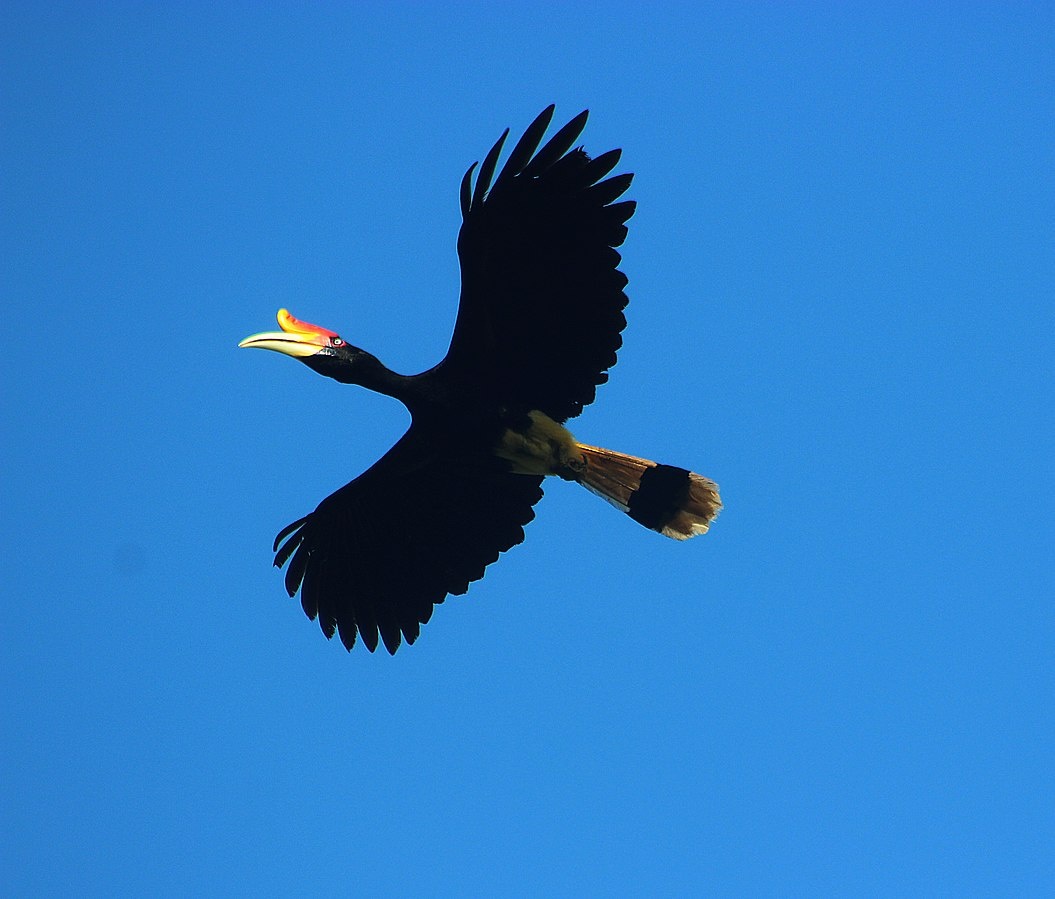
Rhinoceros are most active in the day in the morning and evening and roost at night. They are social and noisy birds especially when they are roosting. Breeding pairs often forage together and tend to stay within home territory. Subadults and non-breeding adults often form large flocks that travel long distances together in search of food. In one study, around 70 rhinoceros hornbills were observed flocking together on a palm oil plantation. Rhinoceros hornbills often dominant when several species of hornbills gather at fig trees to feed on fruit. Smaller species of hornbills typically wait until rhinoceros hornbills have had their fill and fly away before they start eating from the same fruit tree. There is sometimes competition between rhinoceros hornbill pairs over nesting cavities during the breeding season, with to less dominant pairs giving up their nest.
Rhinoceros hornbills sense and communicate using vision, touch, sound and chemicals usually detected with smell. They also employ duets (joint displays, usually between mates, and usually with highly-coordinated sounds) to communicate. It is believed that their casque may enhance vocalizations by functioning as an acoustic resonating chamber. Their calls are distinctive and can be heard over a large area and have been described as loud honking. Head-raising and vocalizations are an important part of rhinoceros hornbill courtship displays and pair bonding. During courtship and the breeding season, pairs vocalize together and engage in duetting./=\
Rhinoceros Hornbill Reproduction
Rhinoceros hornbills are monogamous (have one mate at a time) and cooperative breeders (helpers provide assistance in raising young that are not their own). They engage in seasonal breeding. They breed once a year between January and June depending on environmental conditions and food availability. The number of eggs laid each season ranges from one to two. The time to hatching ranges from 37 to 46 days. Young are altricial, meaning that they are born relatively underdeveloped and are unable to feed or care for themselves or move independently for a period of time after birth. Parental care is provided by both females and males. The age in which they fledge and become independent ranges from 111 to 131 days. On average males and females reach sexual or reproductive maturity at five years. [Source: Ashlynn Pryal, Animal Diversity Web (ADW) /=]
Females choose a mate based his courtships displays, which often consist of loud calling, duet calling between the male and female, and a head raised posture by the male. Behavior before and after copulation may consist of duetting, preening, males offering the female food, billing, and biting. After the eggs hatch, the female remains sealed inside the nest cavity for around five to seven more weeks with the hatchlings. They are fed by the make through a slit in the nest cavity cover. After that period is up the female exits the nest but keep the young sealed inside. She helps her mate feed the young until they are fledged, and nearly independent, at about four months old.
Successful hybridization has occurred between rhinoceros hornbills and great hornbills in both captivity and the wild. If a female great hornbill cannot find a mate of her own species she may choose to mate with a male rhinoceros hornbill. Wild hybridization incidences have been observed twice in Thailand. In both cases a hybrid chick was raised successfully by the parents.
Southern Ground Hornbills
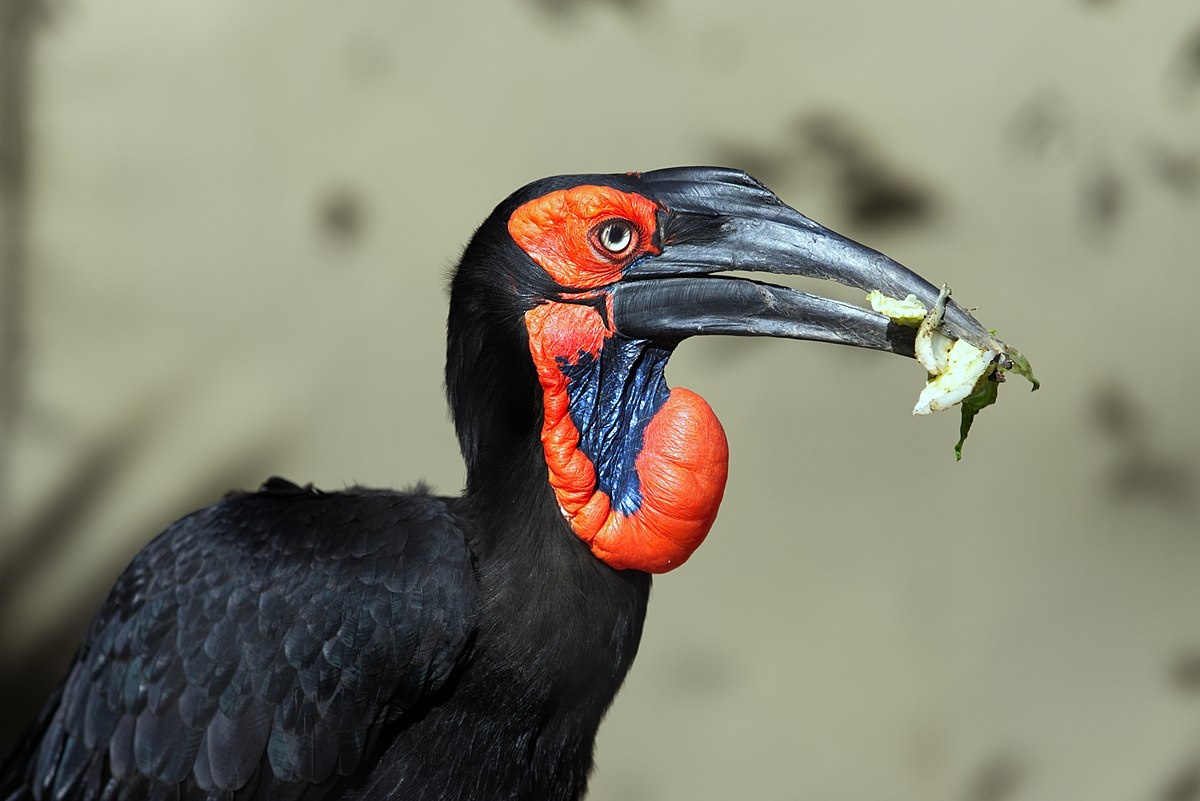
Southern ground hornbills are the largest hornbills. Residing in southern Africa, they weigh up to five kilograms and are the size of turkeys. They have dark bodies, bright red skin folds around their heads and throats and long black bills. They are the most carnivorous of hornbill species. Their bills, gullets and throats are large enough to swallow a squirrel whole, head first; their neck muscles and strong enough to break open the shell of a tortoise.
Southern ground hornbills hang out in small groups and move in a line through grass, brush and bush, snatching up insects and occasional mouses and scorpions. For relief from the hot sun they keep their mouths open to help them ventilate and open their wings to expose pare patch of skin on their wings Although the can fly they prefer to scamper on the ground. Each group has a leader that shows its dominance by giving out or withholding food. Females can be identified by ther blue patch under their bill.
Southern ground hornbills have disappeared from 70 percent of their range in South Africa. Most of the loses are the result of habitat destruction but a number of birds have been killed by farmers because they had the obnoxious habit of breaking windows when attacked reflections of themselves. One park ranger told National Geographic that he knew of one farmer that lost 27 windows in one afternoon and said the birds returned three weeks later to “see if they had gotten rid of their antagonists.”
Michael Long wrote in National Geographic: “they have chutzpah. They are dignified, self-assured, confident, inquisitive if not meddling, and have a tendency to manipulate.” They “can waak up look you forthrightly in the eye.”
Image Sources: Wikimedia Commons
Text Sources: Animal Diversity Web animaldiversity.org ; National Geographic, Live Science, Natural History magazine, David Attenborough books, New York Times, Washington Post, Los Angeles Times, Smithsonian magazine, Discover magazine, The New Yorker, Time, Reuters, Associated Press, AFP, Lonely Planet Guides, Wikipedia, The Guardian, Top Secret Animal Attack Files website and various books and other publications.
Last updated February 2025