
PEAFOWL
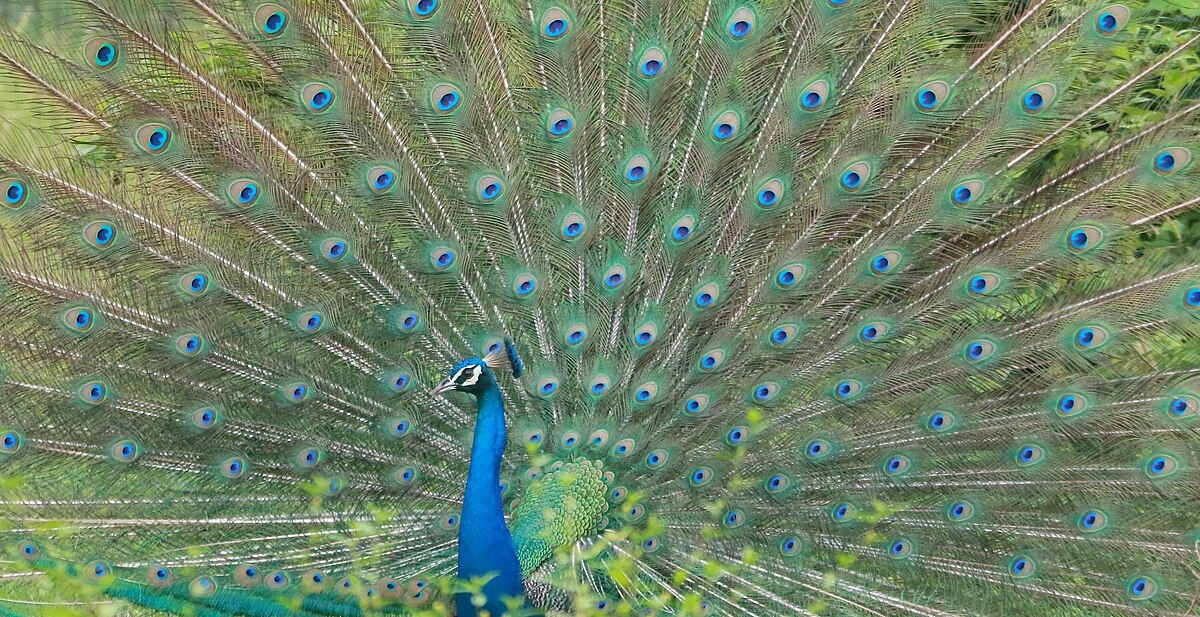
Peafowl — the common name for two bird species of the genus Pavo — is the proper name for what most people call peacocks. They are ground-dwelling forest birds that are native to Asia. They are members of the pheasant family — Galliformes — and related to chickens and jungle fowl.
There are three species with the name peafowl: the green peafowl, the Indian peafowl and the Congo peafowl. Indian peafowl are quite similar with green peafowl; only that the color of their tails are mainly blue and the feather crest of Indian peafowl are like a bat. The Congo peafowl was only discovered in 1936 in the rain forests of the eastern Congo. They are native only to the Congo Basin and are not true peafowl.
Male peafowl are referred to as peacocks, and female peafowl are referred to as peahens. The Indian peafowl have been adapted to humans and share parks with them in India and Europe. The green peafowl is regarded as endangered in its native Southeast Asia, mainly through destruction of its forest habitat.
Peafowl are hunted by leopards, tigers, jackals, dholes. martens, civets and hawk eagles. They prefer brush land with scattered bushes and trees. When threatened they quickly run away and disappear into the bushes. Predators that do take them often do so by surprise. The male train can contribute to their predation. When they are displaying, the train makes them easy to spot. Predators can also snatch a male's train if they are roosting too low in a tree. Tigers, for example, tigers can stretch up to three meters and leap even higher and have been known to pull peacocks down from trees. As male peacocks have trains over a meter long they need to be at least five meters from the ground. Peafowl can use the spurs on their legs in self defense but often these are insufficient to defend against large and aggressive predators or predators that attack quickly.
RELATED ARTICLES:
BIRDS IN ASIA: ARGUSES, IBISES, EAGLES, RARE SPECIES factsanddetails.com
HORNBILLS: CHARACTERISTICS, BEHAVIOR, NEST-BUILDING factsanddetails.com
HORNBILL SPECIES IN ASIA factsanddetails.com
LARGE HORNBILL SPECIES factsanddetails.com
JUNGLE FOWL (CHICKENS): CHARACTERISTICS, BEHAVIOR AND REPRODUCTION factsanddetails.com
BIRDS: THEIR HISTORY, CHARACTERISTICS, COLORS factsanddetails.com ;
BIRD FLIGHT: FEATHERS, WINGS, AERODYNAMICS factsanddetails.com ;
BIRD BEHAVIOR, SONGS, SOUNDS, FLOCKING AND MIGRATING factsanddetails.com
Indian Peafowl — Peacocks
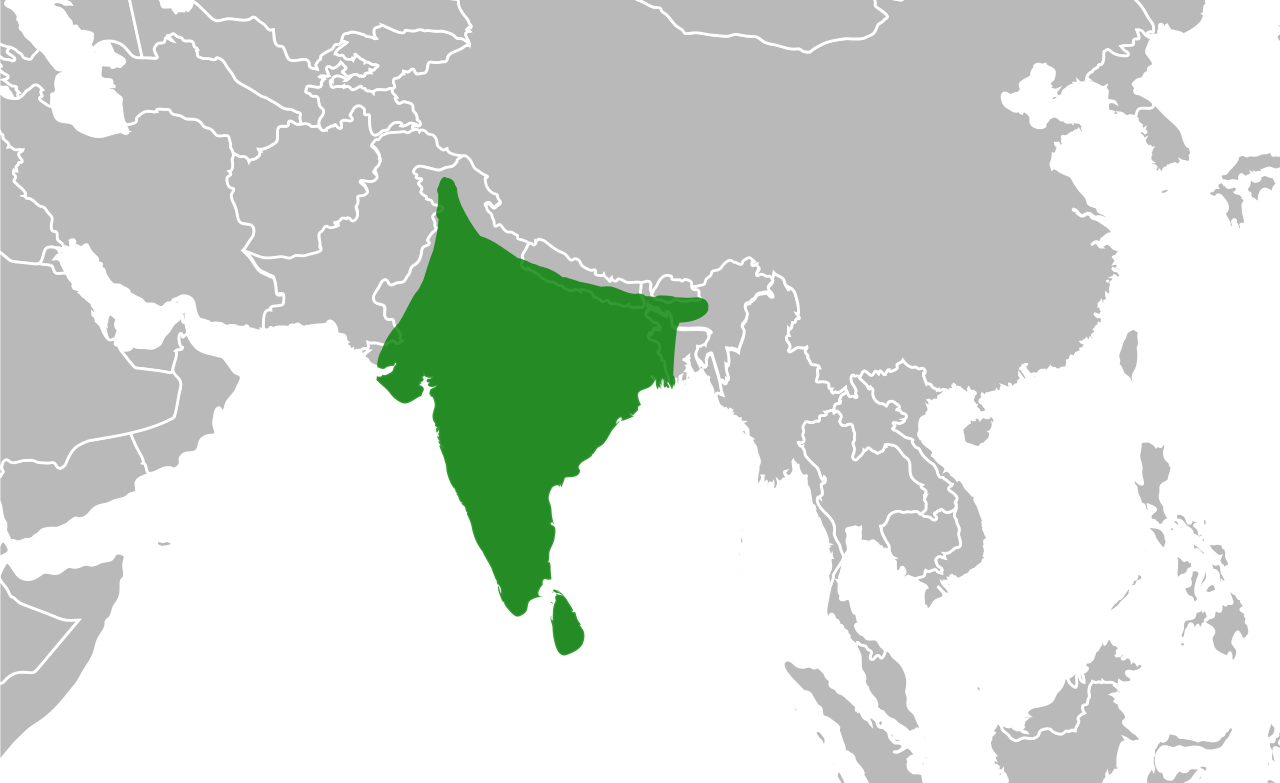
The Indian peafowl (Pavo cristatus, peacocks) are native to Southeast Asia, India and Sri Lanka, where they are still common in the wild. They are also know as the common peafowl and the Indian peafowl. Males are called peacocks. Females are called peahens. A group of peacocks is called an "ostentation" or a "flock." In the wild this usually consist of one cock and three of hour hens.
Indian peafowl are peacocks. They are native to Sri Lanka and India, but can also be found naturally in Pakistan, Nepal, Bhutan, Bangladesh, Myanmar, Southeast Asia, and Indonesia, The Arakan hills in Myanmar had long prevented this species from moving naturally to the east, while the mountains of the Himalayas and Karakoram further prevented their travel north. But the did make their way east with the help of humans perhaps. They have been introduced to North America, Europe and Australia.
Indian peafowl live in temperate and tropical land environments in savannas, grasslands, forests, rainforests and mountains as well as urban and suburban areas at elevations of 900 to 1200 meters (2953 to 3937 feet). Indian peafowl do not migrate or travel widely. They are most common in deciduous, open forest habitats. Indian peafowl have been able to adapt to much colder climates than their native range. They can survive winters in southern Britain with only a simple shelter. It is said they do not do so well in places that are both damp and cold but southern Britain can be cold and damp. They are often kept in urban gardens and zoos, where they require little maintinance other than food, which can often find themselves.
There are four variations in the Indian peafowl. 1)white feathered peafowl, completely white feathers from the top of its head to the end of its train, with the ocelli barely visible; 2) pied, feathered peafowl, with random white feathers in the plumage, the result of an incomplete dominant gene; 3) the black-winged peafowl, with dark feathers with blue and green tips, due to a different mutation; 4) Indian peafowl- green peafowl hydrids. For several decades, new mutations in plumage has been discovered almost every year. White feathered peafowl are not albinos because they can breed and have brown eyes rather than pink eyes like albinos. When white feathered peafowls breed with each other all their offspring are white feathered peafowl. [Source: Erin Fowler, Animal Diversity Web (ADW) /=]
Green Peafowl
Green Peafowl (Pavo muticus) are the largest pheasant bird. The body and tail length of males, is 2.3 meters; of females, about one meter. Adults weigh seven to eight kilograms. They live in mountain forests and in low latitude tropical and sub-tropical forests, bamboo woods and bush lands. They get food with their bill or peck after scratching with claws and eat leaves, flowers, fruit of vegetation of various kinds and insects. They can be found South and Southeast Asia.
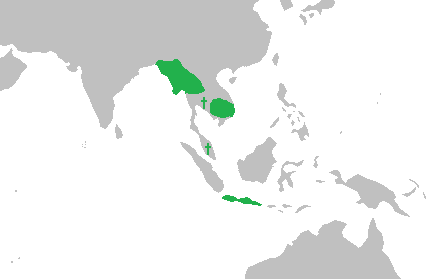
Green Peafowl like to hang around at ground level and get most of their food there. They don’t fly much except to escape when threatened The rest on trees during the night. The build their nests and lay their eggs in hiding places in the bush. During the mating season, males display their tails to show their beautiful feathers while making "ah, wu, ah, wu" noises. The tail feathers of green peacocks can number more than 100 pieces.
Green peafowl are also called Indonesian peafowl and are the national bird of Myanmar. They were once common throughout Southeast Asia, but now only a few isolated populations survive in Cambodia and adjacent areas of Vietnam. They have been listed as endangered on the The International Union for Conservation of Nature (IUCN) Red List since 2009 (See Humans Below). Green peacocks have a reputation for being much more hostile and aggressive than Indian peacocks. When these birds are in an aggressive mood they first erect their trains and engage in a strutting display. They then rush and scream and fight like roosters in a cock fight.
In one study in Dak Lak, Vietnam, green peafowl preferred dry deciduous forest over mixed and evergreen forest and liked areas that had sufficient water sources and were relatively distant from human settlements. Among their basic requirements were a suitable roost tree, a small territory, and sufficient food. [Source: Erin Fowler, Animal Diversity Web (ADW) /=]
Peacocks and History
The peacock has been domesticated for at least 4,000 years in Asia and is found now in almost every country in the world. Its spectacular tail feather display has been an inspiration for rulers and elite. The seat of power of the Mogul empire and the later the Shah of Iran was the "Peacock Throne," a magnificent throne with an image of a peacock with an expanded tail wrought in gold and precious stones in the background.
The Greeks knew of peacocks and called them Juno's bird. The Romans associated the eyespots on the peacock's tail with the hundred-eyed giant Argus. For early Christians they were a symbol of immortality. The Chinese gave peacock feathers to distinguished mandarins; medieval European aristocrats served peacocks at banquets as a special delicacy. "Proud as a peacock" is an old saying.
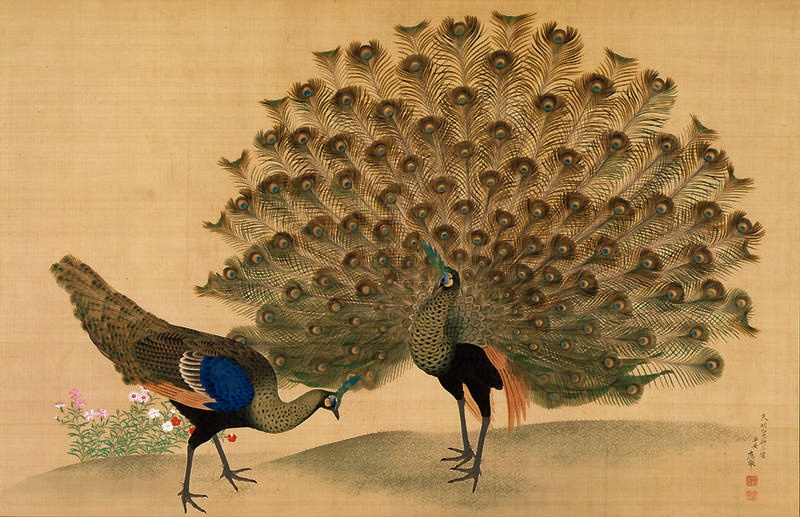
In India, peacocks have traditionally been associated with good luck and kept to ward off snakes, tigers and evil spirits. A sacred Hindu law forbids harming a peacock in any way. Some shrines are home scores of peacocks that roost on nearby trees and live off handouts.
Peacocks and their tails initially presented Charles Darwin with a challenge to his theory on evolution but then let to a great insight. Nicholas Wade wrote in the New York Times, “Showy male ornaments, like the peacock’s tail, appeared hard to explain by natural selection because they seemed more of a handicap than an aid to survival. “The sight of a feather in a peacock’s tail, whenever I gaze at it, makes me sick,” Darwin wrote. But from worrying about this problem, he developed the idea of sexual selection, that females chose males with the best ornaments, and hence elegant peacocks have the most offspring. [Source: Nicholas Wade, New York Times, February 9, 2009]
Peafowl Characteristics and Diet
Indian peafowl are known for their beautiful train and plumage. If the length of the tail and wing span is included, they can be regarded as one of the largest flying birds. They range in weight from 2.7 to six kilograms (5.9 to 13.2 pounds), with their average weight being four kilograms (8.8 pounds). They range in length from 0.86 to 2.12 meters (2.82 to 6.96 feet), with their average length being 1.50 meters (4.92 feet). Their wingspan ranges from 1.4 to 1.6 meters (4.59 to 5.25 feet). They are endothermic (use their metabolism to generate heat and regulate body temperature independent of the temperatures around them), homoiothermic (warm-blooded, having a constant body temperature, usually higher than the temperature of their surroundings) and are polymorphic (“many forms”, species in which individuals can be divided into easily recognized groups, based on structure, color, or other similar characteristics). Both sexes have spurs that are around 2.5 centimeters long. Males use these during the breeding season when fighting with other males. [Source: Erin Fowler, Animal Diversity Web (ADW) /=]
Sexual Dimorphism (differences between males and females) is present: Males are larger than females. Sexes are colored or patterned differently with the male being more colorful. Ornamentation is different. Adult males weigh between four to 5.9 kilograms (nine and 13 pounds) and are 1.8 to 2.4 meters (six to eight feet) in length, including their tail. Females weigh between 2.7 to four kilograms (six and nine pounds) and are 0.6 to 0.9 meters (two to three feet) in length. They lack the large tail feathers that males have. Females are brown, grey, and cream-colored. The males have a long train, about 1.2 meters in length on average, from June to December.
Peafowl are omnivores (eat a variety of things, including plants and animals) and need a lot of water to drink. Animal foods include amphibians, reptiles, insects terrestrial worms. Among the plant foods they eat are leaves, roots and tubers seeds, grains, and nuts flowers. Indian peafowl consume worms, insects, lizards, frogs, snakes, tree buds, flowers, grain, grass and bamboo shoots. Termites are highly sought after. Their Sanskirt name means “killer of snakes”. They sometimes eat young cobras and other venomous and for this are valued and revered. To help them breakdown and grind food, peafowl ingest pebbles which are stored in their gizzard and help grind up grains. /=\
Peafowl live to a maximum age of 30 years. Indian peafowl can live up to 25 years in the wild, but the average is around 20 years due to predation, diseases, electrocution from flying into power lines, pesticide poisoning, and destruction of their natural habitat. In captivity, the maximum life span is 23.2 years, with an average around 16 years. The difference in lifespan between captive and wild birds can be explained by diet and lifestyle. In the wild, peafowl are always searching for food and get a wide variety of foods as they eat whatever they can find. In captivity, they are often given one kind of feed and don’t get much exercise as they don’t have to constantly search for food.
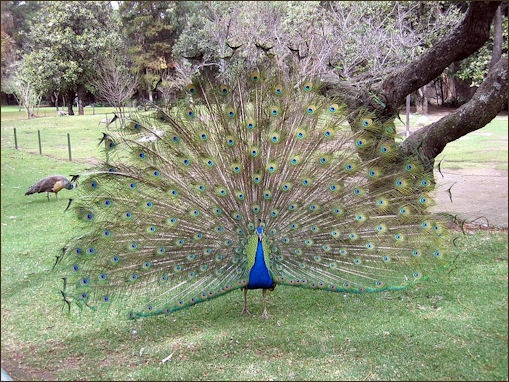
Indian peafowl male
Peacock Plumage and Feathers
Male peafowl — peacocks — are the ones with the elaborate tail plumage, which is called a train. These feathers are believed to play a role in attracted females and intimidating rivals. Males and females have similar in appearance until they are two years old. After that the male begins to develop their brilliant tail plumage. The feathers grow on back of the male just above the tail, not on the tail itself.
A peacock’s train is made up of around 150 feathers that can rise up to five feet from the body. The peacock plumage comes in metallic shades of bronze, blue, green and gold. Most of the times these are folded up in train begin the tail. When the male is aroused the feathers and the quills of the tail stand erect and spread like a fan. The tail feather are short, stiff quills that hold the fan in place. The 150 “feathers” in the fan are protective extensions, or vervets, that cover the quills. The wing feathers beat rapidly behind a spread fan.
Male India peafowl discard their trains in January, but they grown again rapidly as the breeding season approaches. Their necks and breasts are bright, iridescent blue. Golden feathers line their sides and backs, and their trains are an iridescent arrangement of multiple colors featuring ocelli (eye-spots), with brown-, green-, and black-colored feathers. When displayed, the male’s train spreads out like a wide fan. Around 30 to 40 of the ocelli around the outer edges of the fan are not round but v-shaped. [Source: Erin Fowler, Animal Diversity Web (ADW) /=]
Male peacock tails are twice as long as their body length and are clearly a burden to carry around. The tail makes it harder to escape predators and gives the predators a large target to aim for. The feathers also require a lot of maintenance. Peacocks spend a great deal of time preening. Even though it might seem the bright coloring of male peafowl would stand out and make them easy targets for predators, when run off into brush and foliage, they can be very hard to spot.
The plumes of the peacock look multicolored but are actually brown. The plumes are made of keratin, the same material found in human fingernails. The color is created by microscopic melanin reflective rods in the tiny barbules that line each of the feather’s barbs. Slight differences in the spacing and layering of the melanin rods in the keratin causes different colors to be reflected. Melanin is the substance that causes darkness in human skin. The process is somewhat similar to the way water droplets create rainbows. Sir Isaac Newton had suggested this possibility 300 years ago.
Peacock Behavior
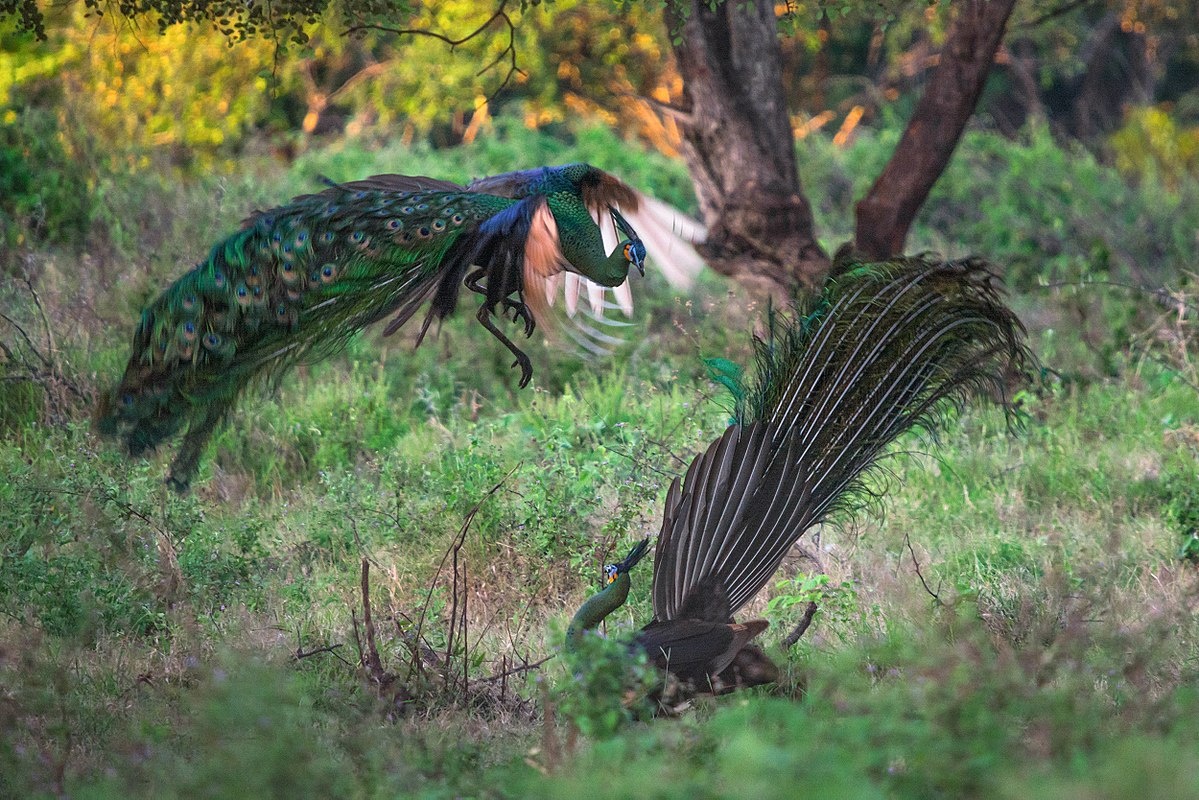
Peafowl can fly and are arboreal (live in trees), terricolous (live on the ground), diurnal (active during the daytime), motile (move around as opposed to being stationary), sedentary (remain in the same area) and territorial (defend an area within the home range). They are generally solitary but can hang out in groups. Males defend their territory during the breeding season, attacking competing males with their spurs. During the non-breeding months, the males are less aggressive towards other males, but will attack other animals (such as humans) if they feel threatened. [Source: Erin Fowler, Animal Diversity Web (ADW) /=]
Peacocks can be social birds and sometimes sleep and move around in a group. Sometimes they sleep on the tops of trees, rear to rear, for protection from predators. If any members of the group senses a threat they let out alarm calls that alerts the others. Indian peafowl need lots of water to drink, but they not bathe in water as it weighs down their feathers and slows them down. If their feathers do get wet, they wait in a safe location until they are dry. Instead of water baths, peafowl take dust baths which help them rid themselves of parasites or bugs.
Peafowl spend a lot of time preening their feathers, especially the males whose mating success depends on their displays. During the breeding season, females seek out males and males aim to attract them. A single male can have a harem with up to six females. Outside of the breeding season, females live alone or with other females in groups of two or three. Males also can live in small groups with other males or alone.
Peacocks can be vicious fighters. They have been observed attacking cobras. They generally do to display their plumage when high winds make it too difficult to maintain their balance. Their trains are not used exclusively for courtship displays. Males display intimidate other males or scare off predators. When fighting, males leap up in the air and slash down at their opponents with their spurs./=\
Peafowl Flight and Movement
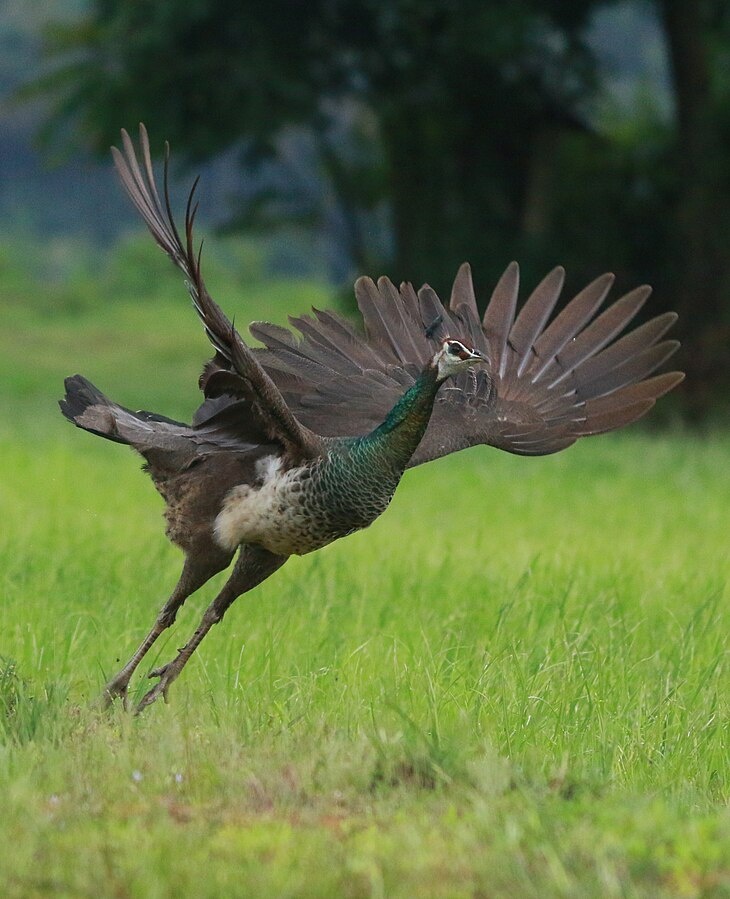
Peafowl generally stay in one area as long as they have a reliable source of food and a tree to roost in. At zoos and parks they are generally allowed to run free because it is known they will not wander far. Indian peafowl have long, strong, grayish-brown legs equipped for running into brush for safety.
Peafowl can fly over fences and houses. Like chickens they can only fly for short distances. Flying is regarded mainly as means of escaping predators not traveling long distances. Not bogged down by a large train females can fly better than males. When covering long distances they move in a series of short flights of several meters rather than one long flight. To get from place to place they walk, jump and run. They have spurs on their feet which they can use to fight off attacks much as fighting cocks do.
Peafowl are very cautious and constantly on the alert for potential danger. Its head is always moving about, searching its surroundings for any predators. They seek protection high up in trees when they sleeps. Indian peafowl only fly to the lowest branch, and then works their way up branch by branch until they have reached a height safe from predators. If peafowl are threatened often their first reaction is to run away into dense undergrowth. Their coloring makes its difficult spot them in shrubbery and bush. Even a group of fifteen peafowl can vanish quickly shady foliage. If cover is not available and they are forced to take flight, they generally do not fly very fast or very far. [Source: Erin Fowler, Animal Diversity Web (ADW) /=]
Peafowl Communication
Peafowl sense using vision, touch, sound and chemicals usually detected with smell. They communicate with vision and sound. Male peacocks make a strange whooping noise that has been described as resembling a half-human half baboon. The elaborate ornamentation of male plumage is an important visual cue that communicates fitness to potential mates.[Source:Erin Fowler, Animal Diversity Web (ADW) /=]
Erin Fowler wrote in Animal Diversity Web: The calls of Indian peafowl are extremely loud and are often described as unpleasant, harsh shrieking. These calls are extremely varied, with up to six alarm calls issued by both sexes and seven additional calls that males emit during territorial disputes. Three of the calls the males produce are only associated with reproduction, and are typically only used during breeding season. These calls are only created by sexually-mature males, and can affect mating success. The calls mostly differ in pitch and the number of notes. These calls could be more important than the actual visual display of the males trains in which even the most elaborate can have varying rates of mating success.
Vocal calls with more than five notes are generally more successful and it is believed that these types of calls are sexually selected by the females. Also, when predators, humans, or any other type of disturbance agitates a peafowl, they can issue an alarm call. The type of alarm call emitted depends on the threat. However, no matter how great the level of alarm, peafowls of any age and gender call back to increase awareness among the group. If the call indicates great danger, the peafowls will relocate to a safer position. /=\
Peafowl Reproduction and Mating
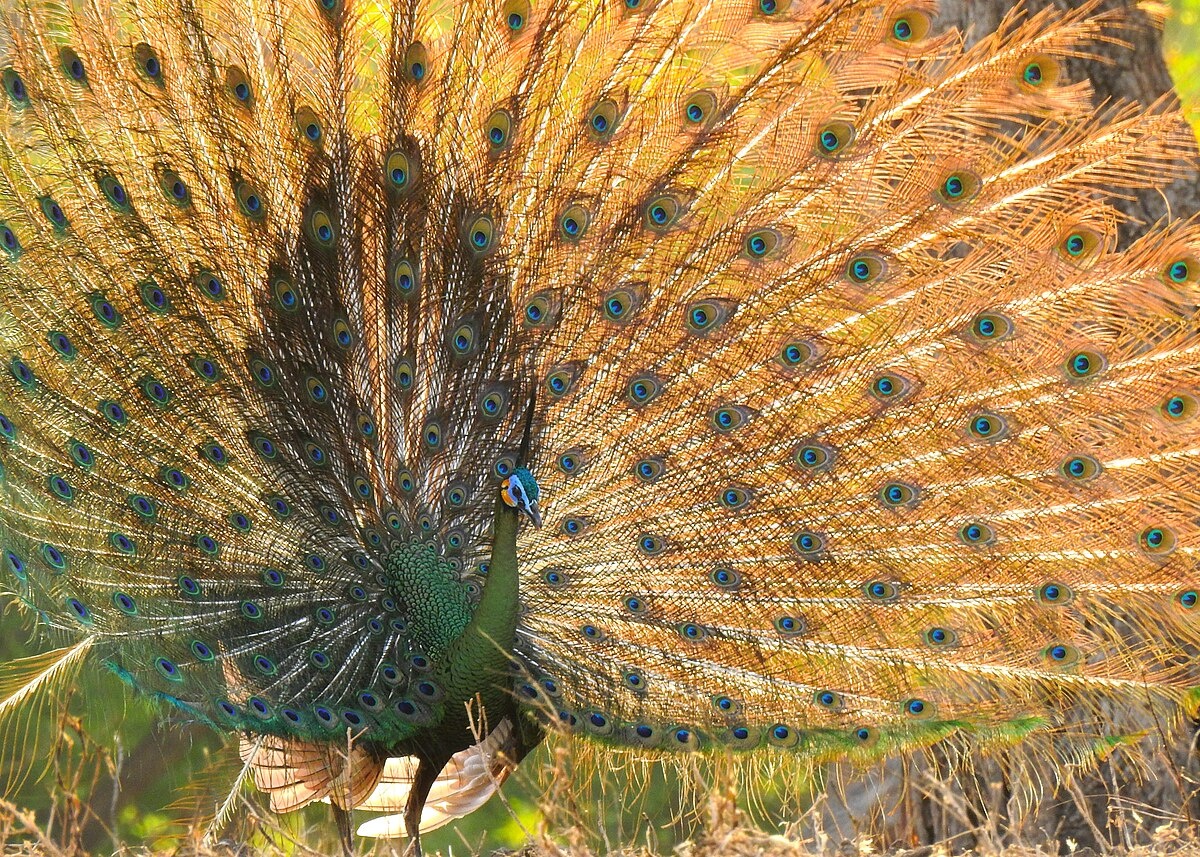
Peafowl are polygynous (males have more than one female as a mate at one time). They engage in seasonal breeding and becomes sexually mature at three years, though some males can breed at age two. Indian peafowl breed once per year, usually from April to September, and can breed more often if the eggs are lost. Females generally lay three to five brownish oval eggs, but have been known to lay up to 12 eggs. The eggs are laid one at a time every other day. Their glossy shells have deep, small pores that let in water to keep them moist. The incubation period lasts up to 28 days. [Source: Erin Fowler, Animal Diversity Web (ADW) /=]
During the breeding season, females seek out males and males aim to attract them. A single male can have a harem with up to six females. Both sexes have spurs that are around 2.5 centimeters long. Males use these during the breeding season when fighting with other males. When fighting, males leap up in the air and slash down at their opponents with their spurs./=\
The most desirable males in the eyes of the females preside over harems of three to five peahens, Peahens can also be very aggressive in their search for a mate. Bigger and stronger one will fight away other females and try to monopolize the male by repeatedly mating with him. Favored males tend to mate with more females and the same female more than once. Males typically mate with up to six different peahens in one breeding season.
Peafowl Courtship Displays
Male peafowl use their spectacularly-colored plumage in elaborate courtship displays. There does appear to be a significant positive correlation between a peacock’s train and his mating success. Females prefer elaborate, heavily spotted trains. Possessing a huge, unwieldy tail suggests the male is strong and may be sexy in the eyes of the females.
Male peacocks raise and fan out their tail feathers during courtship displays. They may beat their small wings behind the fan and strut around, this way and that and let out loud scream. It is not entirely clear what attract the females the most: size, sheen, or color. Females seem to prefer males with elaborate, heavily spotted trains and loud calls. Young males with less developed trains and softer calls generally don’t attract a mate.
Males invest a great deal of energy to produce and maintain their cumbersome trains which has trade-offs such as making it harder to avoid predators and search for food. Mating success is usually more successful for the males with the highest number of eyespots (also called ocelli) on their train. In experiments, in which the eyespots were artificially removed, mating success decreased significantly. There is also a positive correlation between the number of eyespots, the amount of time a male displays to a female during the breeding season, and the overall health of the individuals. Other factors may also be at work. Behavioral displays are flexible and can change day to day and mate to mate, Sometimes peacocks use the sun at different angles when performing visual displays such as “train-rattling” or “wing-shaking”. [Source: Erin Fowler, Animal Diversity Web (ADW) /=]
In May 2008 Natural History magazine reported: Show-off males are common among birds, but peacocks stand out for their extravagantly long tail feathers adorned with dramatic spots. There is general agreement that long and elaborate trains have evolved as a result of female preference but ther there is evidence that this is changing. Mariko Takahashi of the University of Tokyo and three colleagues studied the sexual behavior of a feral population of the Indian peafowl in Izu Cactus Park, Japan. After seven years, the team concluded that peahens were not most attracted to males with longer trains, more symmetrical arrangements of tail sports or greater number of tail spots. Instead they spent more time with males that shook their tails at them — a display called shivering. Takahashi said that high rates of shivering may be a consequence of a female already having chosen a male not a cause of it. [Source: Natural History magazine and Animal Behavior, May 2008]
Peafowl Offspring and Parenting
Peafowls make their nests in the ground on low branches or in a hole behind a cover of grass, bamboo, or shrubbery. The peahen usually lays three to eight eggs. Sometimes the eggs of several peahens are mixed and different mothers take turns incubating them. The time to hatching ranges from 27 to 29 days. The average fledging age is one weeks and the age in which they become independent ranging from seven to 10 weeks and the average time to independence is eight weeks. On average females reach sexual or reproductive maturity at three years and males do so at two to three years. [Source: Erin Fowler, Animal Diversity Web (ADW) /=]
Chicks are usually a light yellow to brown color and precocial, which means they are relatively well-developed when born. Parental care is provided by females. Pre-birth, pre-weaning and pre-independence provisioning and protecting are done by females. The nest is made up of dry sticks and leaves. Naturally, a peahen will only lay one clutch per breeding season. In captivity, if a clutch is taken away from the female, she mate again and do this again and lay up to three clutches in a breeding season. The clutches removed from the mother can be given to a foster parent such as a turkey hen. /=\
Chicks are mobile and fully feathered at hatching and can fly in about one week. If a female mates with a favored male, they usually have larger eggs with a higher amount of testosterone deposited in the yolk. Chicks of males who have the largest or most eye-spots tend to grow faster and have a better survival rate. Although the chicks are fairly strong, they do need relatively warm temperatures to survive and can die in colder climates. Some aviculturists have avoided this problem by raising eggs in incubators.
Peachicks learn to eat and drink through imitation. Males and females look alike until the males develop their train and bright feathers. It takes up to three years for males to develop a full train. It is almost impossible to tell the difference between males and female until a couple of months after hatching when males have longer legs. Also, males have light gray outer primary feathers while females have brown ones.
Peafowl, Humans and Conservation
Indian peafowl feather extract mixed with water or ash has been used to treat venomous bites of Russell vipers, Indian cobras, and Malabar pit vipers. The extract is high in iron, protein, and steroids, which inhibit harmful enzymes in the venom that cause tissue damage. This is a traditional snakebite remedy in India for those who live far away from hospitals and don’t have access to modern medicine and antivenom. Villagers like peacocks themselves because they kill deadly snakes and consumes a large number of crop-eating insects. [Source: Erin Fowler, Animal Diversity Web (ADW) /=]
Peafowl feathers have long been used for decoration. Feathers were used to adorn helmets and hats during the Middle Ages, and more recently have used in flower arrangements and to wake up nap-taking kids in nursery school. The feathers have also been used to fletch arrows and have been woven into clothes. Because of their extravagant trains, peacocks have been depicted in art and used as the symbol of one of the main U.S. television networks. In Hindu and Buddhist religions, Indian peafowls are considered vehicles of the gods. The Peacock Throne was the imperial throne of the Mughal emperors. Over one hundred feathers can be collected from a single peacock when it molts, so it is not necessary to kill them to get the feathers.
Indian peafowl are relatively common. The International Union for Conservation of Nature (IUCN) Red List classifies them as a species of “Least Concern”. In CITES (Convention on International Trade in Endangered Species of Wild) they have no special status. Green peafowl however have been listed as endangered on the IUCN Red List since 2009, primarily due to widespread deforestation, agriculture and loss of suitable habitat. Their populations have been severely fragmented and peacocks have been captured for private and home aviculture and by the pet trade, feather collectors and hunters for meat.
Peafowl are sometimes are regarded as crop pests but they can also control insect pests. Eating them is greatly frowned upon especially in India where the birds are protected under strong wildlife laws. In August 2024, youtiber and influencer Kodam Pranay Kumar was imprisoned after "other videos in his mobile phone confirmed" that the bird he'd cooked for his curry dish video was indeed a peacock. [Source AFP, August 13, 2024]
Damned Cocky and Destructive Peacocks
Peafowl are big strong, birds and in the wrong circumstances can be very destructive. In 2017, Associated Press reported: A female peacock has ruffled more than just feathers at a Los Angeles-area liquor store. Without a peep, the peahen strutted into the open door of the Royal Oaks Liquor Store in Arcadia. Store manager and college senior Rani Ghanem said he didn't even know it was there until a customer walked in and asked him about "el pollo," Spanish for "the chicken." Ghanem said he then tried to guide the sharp-clawed bird outside but that spooked her and at one point the bird flew directly toward him and then up onto a top shelf of the store. And that spooked Ghanem. [Source: Amanda Lee Myers, The Associated Press, 06/07/2017]
An animal-control officer responded after Ghanem called 911, approaching the peahen with gloves and a fishing net. That's when the hilarity ensued, Ghanem said. "He was trying to get it with the fishing net, and (the bird) jumped on the first wine bottle. When that happened, I was like, 'Aw, this is about to be a big mess,' '' Ghanem said. "He tried to get it again with the net ... It just went straight diving into all the bottles. The more he kept on trying to use the net, the more it kept on flapping its wings and knocking everything over.''
At one point, cellphone video taken by Ghanem shows the officer catching a wine bottle in the net as the bird crashes through a shelf and a dozen bottles shatter to the ground. Unable to watch more destruction, Ghanem puts on a sweatshirt to protect himself from the bird's claws and helps the officer ensnare it. He said they took the bird outside and that it was unharmed. "I'm like, 'You break, you buy, dude.' But clearly he didn't." In all, Ghanem said the peahen was in the store for 90 minutes and broke $500 worth of the family store's best bottles, including champagne. "Yeah, he's got expensive taste,'' Ghanem joked in the store on Tuesday. "I'm like, 'You break, you buy, dude.' But clearly he didn't. He got away with it.'' Peacocks are common to Arcadia, about 13 miles northeast of downtown Los Angeles at the base of the San Gabriel Mountains. They were introduced after the city's founder imported them from India in the early 1900s.
In the spring of 2004, Cookley, England was invaded by a flock of 14 peacocks. Nick Britten wrote in The Telegraph: “There are strange goings-on. Signs of vandalism are everywhere — cars scratched, gutters torn down, gardens ripped up. The culprits can be constantly heard but not easily seen. When they are, residents head for the safety of their homes. No one knows where the peacocks arrived from, but most are hoping they won't stay long. Pensioners and children have been warned to keep their distance, while anyone who has tried to capture them has discovered a stubborn, gang-like mentality as they strut around in packs and refuse to give themselves up. [Source: Nick Britten, The Telegraph, May 6, 2004]
"Although it sounds funny, it is quite a serious issue," said Chris Nicholls, a local councillor who has been receiving complaints from residents. "One man said one of the peacocks saw his own reflection in his car and started attacking it, thinking it was another male. 'When he went to stop it, a group of them, about six, became quite aggressive and backed him off." A male and a female have been seen on and off in surrounding woodland next to the Worcestershire village for the past few years, but in recent weeks the numbers have swollen. Showing little regard or concern for their new hosts, the peacocks are being blamed for damaging brick walls, knocking off slate roofing, wrecking guttering and destroying manicured lawns. Worse still is the infernal racket they make, adding sleepless nights to the list of woes that the residents of Cookley have begun compiling.
Mr Nicholls, 54, said: "Everyone likes peacocks. They are very beautiful creatures, until they start causing damage to your home and property. "I watched as one of the birds landed on guttering by the bedroom window. Due to its sheer size the lot came toppling down." Hilda Ward, 66, said she was having to have her roof repaired. "They are very graceful creatures but they are doing a lot of damage to homes in this part of the village. Every time I plant new flowers they are pulled out and there are droppings on my lawn and all over the roof." Their size and unwillingness to be imprisoned has so far made them impossible to catch. A number of human-bird stand-offs have taken place, and all have ended in the same result.
Paul Hancock, 43, a toolmaker, said: "We get them landing on our garage at all times of night and day. They fly on to the roof and start making a terrible noise. When they see their own reflections in the landing window, they really become aggressive. "I've tried everything to get them off my property but there is no way I'm getting too close. The males are quite frightening. And they have sharp claws that would be able to cut the skin to ribbons. "Two or three peacocks could quite easily hurt someone badly especially because there are always two or three of them. They seem to hang around in packs.
"I have tried everything from spraying them with water to playing loud music, but it just doesn't seem to bother them." Nancy Rixon, 36, said her two children, Bethany, 10, and Christopher, eight, were "fascinated" - but she had warned them to admire the birds from afar. She said: "There is no denying that they are extremely beautiful. They are always at the front or the back of the house and although I still let the children go out and play I warn them not to get too close. "They are enormous birds and if they become aggressive, they could be extremely intimidating."
Image Sources: Wikimedia Commons
Text Sources: Animal Diversity Web animaldiversity.org ; National Geographic, Live Science, Natural History magazine, David Attenborough books, New York Times, Washington Post, Los Angeles Times, Smithsonian magazine, Discover magazine, The New Yorker, Time, Reuters, Associated Press, AFP, Lonely Planet Guides, Wikipedia, The Guardian, Top Secret Animal Attack Files website and various books and other publications.
Last updated February 2025