
HORNBILL SPECIES
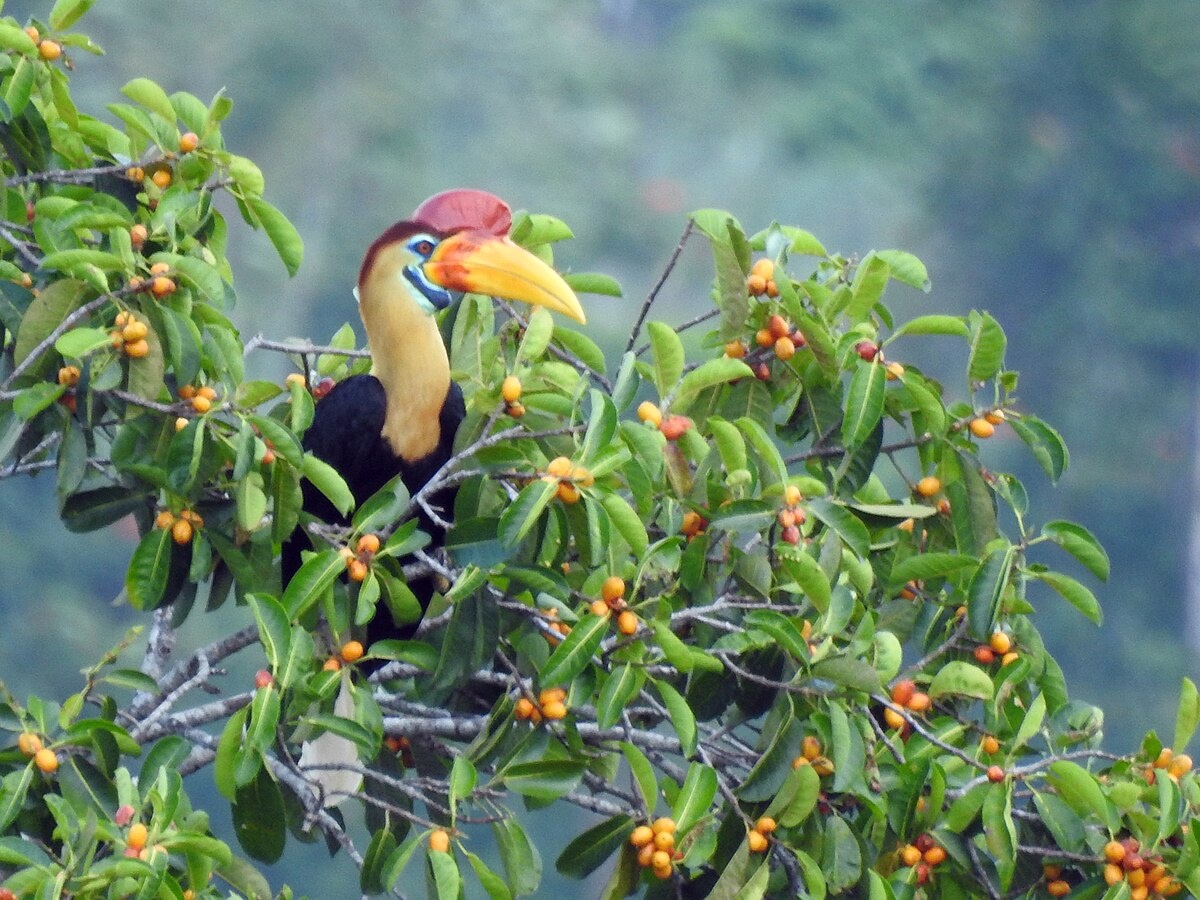
There are 62 species of hornbill, which belong are part of the Bucerotidae bird family. They are are found in Africa, Asia, and Melanesia and live in a variety of landscapes, including forests, savannas, and rocky areas. A total of 26 hornbill species are globally threatened or near threatened with extinction. The helmeted hornbill, rufous-headed hornbill, and Sulu hornbill are critically endangered. The Sulu hornbill is threatened by hunting, human land use, and climate change.
There are 32 species of hornbills in Asia. Many of them live in tropical and subtropical forests. Among them are the Rufous-headed Hornbill, a critically endangered species found only in the Philippines; the oriental pied-hornbill, found in Bhutan, mostly in the southern regions of the country; wreathed hornbill: and Rufous-necked hornbills.
Hornbills can vary quite a bit in terms of size and colors. The smallest species is the black dwarf hornbill (Tockus hartlaubi), which lives in tropical Africa. It weighs 99.1 grams (3.50 oz) and is 32 centimeters (1 foot 1 inch) in length. The largest and heaviest is the southern ground hornbill which has an average weight of 3.77 kilograms (8.3 pounds), and can weigh up to 6.3 kilograms (14 pounds).
Some hornbills have associations with other animal species. For example, some species of hornbills in Africa have a mutualistic relationship with dwarf mongooses, foraging together and warning each other of nearby birds of prey and other predators. Other relationships are commensal, for example following monkeys or other animals and eating the insects flushed up by them.
RELATED ARTICLES:
HORNBILLS: CHARACTERISTICS, BEHAVIOR, NEST-BUILDING factsanddetails.com
LARGE HORNBILL SPECIES factsanddetails.com
BIRDS IN ASIA: ARGUSES, IBISES, EAGLES, RARE SPECIES factsanddetails.com
JUNGLE FOWL (CHICKENS): CHARACTERISTICS, BEHAVIOR AND REPRODUCTION factsanddetails.com ;
PEACOCKS: CHARACTERISTICS, BEHAVIOR AND REPRODUCTION factsanddetails.com
BIRDS: THEIR HISTORY, CHARACTERISTICS, COLORS factsanddetails.com ;
BIRD FLIGHT: FEATHERS, WINGS, AERODYNAMICS factsanddetails.com ;
BIRD BEHAVIOR, SONGS, SOUNDS, FLOCKING AND MIGRATING factsanddetails.com
Great Hornbills
Great hornbills (Buceros bicornis) are also known as great pied hornbills, concave-casqued hornbills and great Indian hornbills. They have a wing span of 1.5 meters (five feet) and produce a loud huffing noise when they fly. They have yellow and white markings on their wings. Their yellow casque and bill has patches of red on it. To really look sharp the male applies a gloss of yellow oil to his bill and casque from a preen gland at the base of his tail. They live in rain forests and feed mostly on fruit but occasionally eat green snakes which they swallow like — a string of spaghetti.” Great hornbills do not welcome human intrusions. They have been known to drop branches on scientists that observed their nesting habits without using a blind.

Great hornbills are found in South and Southeast Asia and Indonesia. They are breeding areas in Bhutan, Nepal, India, China, Cambodia, Laos, Malaysia, Myanmar, Thailand, Vietnam and Indonesia. In India, they and several other hornbill species live in the Western Ghats mountain range and forests in both the northeastern and southern regions. [Source: Spurthi Paruchuri, Animal Diversity Web (ADW) /=]
Great hornbills are found live mainly in rainforests and mature evergreen forests at elevations of 600 to 2000 meters (1970 to 6562 feet). Old-growth trees that reach above the canopy are preferred for nesting. The height of the tree and the presence of a natural cavity large enough to hold a female and her eggs are more important than the type of tree. The same nesting site is used year after year if possible. Great hornbills have been reported living to between 60 and 70 years old, but their lifespan is thought to range from 35 to 40 in the wild, which is still pretty long for a bird. A lack natural predators and plentiful food supplies contribute to their relatively long lifespan./=\
On the International Union for Conservation of Nature (IUCN) Red List great hornbills are listed as Near Threatened. In CITES (Convention on International Trade in Endangered Species of Wild) they are in Appendix I, which lists species that are the most endangered among CITES-listed animals and plants. The biggest threats to these birds are deforestation and other habitat disturbances, particularly the removal of old-growth trees that these birds use for nesting. Their large size and distinctive sounds make great hornbills relatively easy targets for hunters. These bird have been killed for their meat, feathers and casque, which are used by some indigenous people for ornamentals.
See Separate Article: LARGE HORNBILL SPECIES factsanddetails.com
Red-Knobbed Hornbills
The colorful red-knobbed hornbills, found only on Suluwesi, are sometimes called "flying dogs" because they produce a loud barking noise that can be heard 300 yards away as well a variety of croaks, squawks and honks. Weighing up to five pounds (2.2 kilograms), they feed mainly on fig tree trees and help the figs by dispersing their seeds in the bird's dropping. At nesting time females seal themselves inside tree cavities with their dropping. [Source: Margaret Kinnaird, Natural History, January, 1996]
Red-knobbed hornbills are found in huge concentrations on Suluwesi's Tangkoko volcano, where the world's highest densities of hornbills have been recorded. Fig trees in the Tangkoko-DuaSudara Nature Reserve sometimes draw 200 hornbills. The huge concentration are the result of an abundance of figs that fruit year round. Red-knobbed hornbills eat 30 of the 40 or so kinds of figs that grow on the volcano.
Males have a large red nob and an oversized red bill. After chicks are born, the male take care of almost all the food collecting duties. Figs on the volcano vary from pea-size to plum size. The hornbill’s favorite is a large cherry red fig that they eat in vast quantities and males present to females as a courtship gesture. They also eat berries, wild mangos, nutmegs, and avocado-like drupes. The birds are currently threatened by loss of habitat, which is vulnerable to catastrophic drought, fires and volcanic eruptions.
Rhinoceros Hornbills
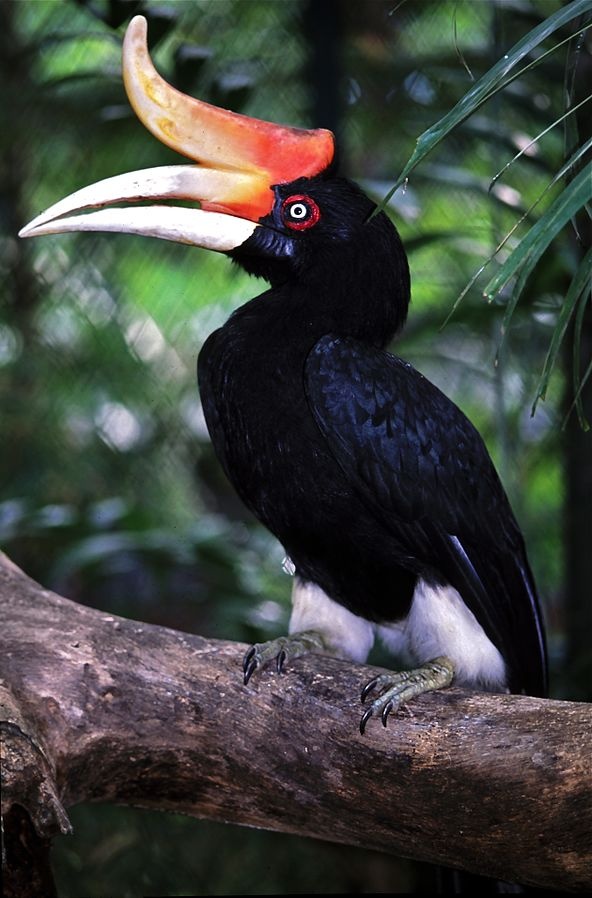
Rhinoceros hornbills (Buceros rhinoceros) are found in Southeast Asia in Malaysia, southern Thailand and Myanmar, Borneo, Sumatra, and Java. They are usually found in primary, lowland rainforests, hill dipterocarp forests, mountainous forests, and swamp forests at elevations of 130 to 1500 meters (427 to 4920 feet). Their habitat usually contains large, mature trees used for nesting and fruit-bearing trees that provide food. If undisturbed habitat is not available, they do inhabit tall secondary forests and slightly disturbed areas. There are reports of Rhinoceros hornbills inhabiting small farms and palm oil plots in Malaysia, which some say is a last resort as other nearby forests have been disturbed.[Source: Ashlynn Pryal, Animal Diversity Web (ADW) /=]
On the International Union for Conservation of Nature (IUCN) Red List rhinoceros hornbills are listed as Vulnerable. In CITES (Convention on International Trade in Endangered Species of Wild) they are in Appendix II, which lists species not necessarily threatened with extinction now but that may become so unless trade is closely controlled. Rhinoceros hornbill populations are declining. Habitat loss as a result of deforestation is considered the greatest threat to these birds. Logging, both legal and illegal, destroys nesting trees.
Some villagers and indigenous people have hunted them for food and feathers, which have been used in traditional ceremonies and banquets for important guests. The tail feathers have been used in traditional clothing. As part of the illegal pet trade rhinoceros hornbill chicks are captured when they are young, and illegally sold. Singapore was a top exporters of rhinoceros hornbills in the past, and this may be one reason why the species is longer there. Adult rhinoceros hornbill face few if any natural predators but their eggs and chicks are sometimes taken by animals such as yellow-throated martens, binturongs, tree-climbing snakes, and monitor lizards. Helmeted hornbills, which are larger than rhinoceros hornbills, reportedly eat rhinoceros hornbill chicks. A sealed nest cavity helps eggs and chicks remain protected from predators.
See Separate Article: LARGE HORNBILL SPECIES factsanddetails.com
Hornbills in the Philippines
The Palawan hornbill is 55 to 65 centimeters long (head and body length) and weighs 601 and 713 grams. Found only on the Philippine island of Palawan and two neighboring islands, it lives primarily in primary and secondary forests but also found in mangrove swamps and cultivated areas. There are estimated to be 2,500 to 10,000 of them. [Source: Canon advertisement in National Geographic]
The Palawan hornbill is a great asset to fruiting trees. It gathers fruits in a gular pouch, then processes and spits out the seeds where they able to thrive, away from the competing parent tree. Living in pairs or small groups, this hornbill nests in large trees and ranges from undergrowth to canopy. The bird is threatened by deforestation, poaching and the capture of eggs for pets or feed.
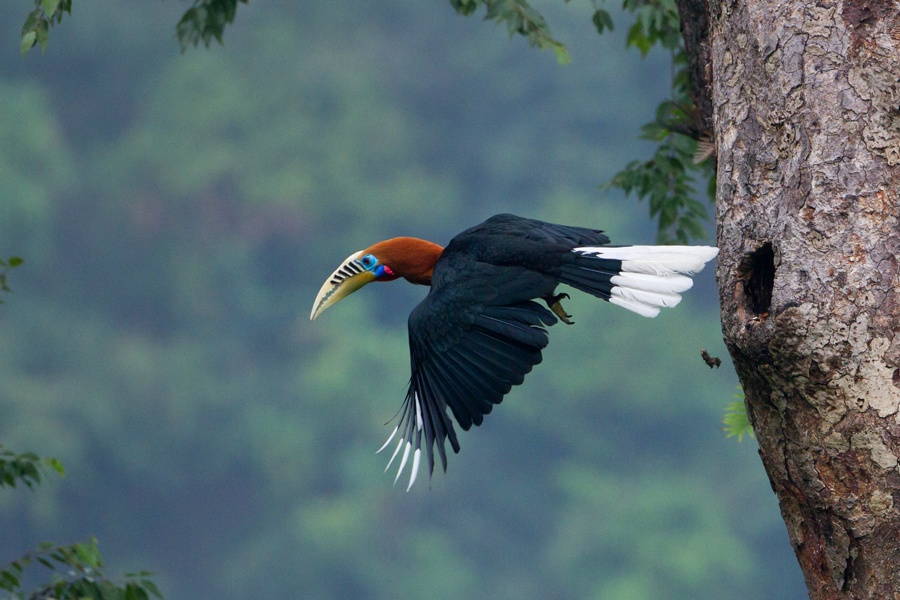
The Visayan wrinkled hornbill is 60 to 65 centimeters long (head and body length).Males weigh 1.1 to 1.2 kilograms. Females weigh 700 to 800 grams. Found only on the Philippines’ Visayan islands, it lives primarily in primary forests. The bird is presumed extinct on Guimaras and now only survives on the Western Visayas islands of Negros and Panay. There are estimated to be only 120 to 160 of them left. [Source: Canon advertisement in a 2004 National Geographic]
The Visayan wrinkled hornbill has bright yellow, orange and red markings on its head and bill and produces load calls that can be heard at great distances away. When the female is ready to lay eggs she and her mate use mud to wall-off their three-hole nest. While nesting she remains inside the walled-off nest, relying on the male to bring food. If something happens to him the whole family perishes. The species is threatened by poaching and loss of primary forest habitat.
Rufuous-Necked Hornbills
The rufuous-necked hornbill is 90 to 100 centimeters long. Males weigh 2.5 kilograms and females weigh 2.3 kilograms. The male is a colorful bird with dark wings, orange body, red flaps under its bill and blue splotches around its eyes. The female is all black. [Source: Canon advertisement in 2001 National Geographic]
The rufuous-necked hornbill lives in dense evergreen and deciduous forests at 700 to 2000 meters from northeast India to Vietnam. Fewer than 1,000 of the birds live in Thailand, its last stronghold, mostly in remote mountainous areas. Number elsewhere are unknown. They are threatened by hunting by tribesmen and loss of habitat due to logging and agriculture.
The rufuous-necked hornbill mate for life and call to each other constantly when they search for fruit in the forest. While she raises her chicks, the female is sealed inside a tree 20 meters above the ground, for three months and relies on her mate to bring her and their offspringfood.
Wrinkled Hornbills
Wrinkled hornbills live in lowland primary forests in Malaysia, Sumatra and Borneo. Their head coloring is similar to but not as pronounced as that of red-knobbed hornbills. They are between 65 and 70 centimeters in length and weigh between 1.2 and 1.5 kilograms. The number of wrinkled hornbills is unknown. Their habitat has been reduced by logging.
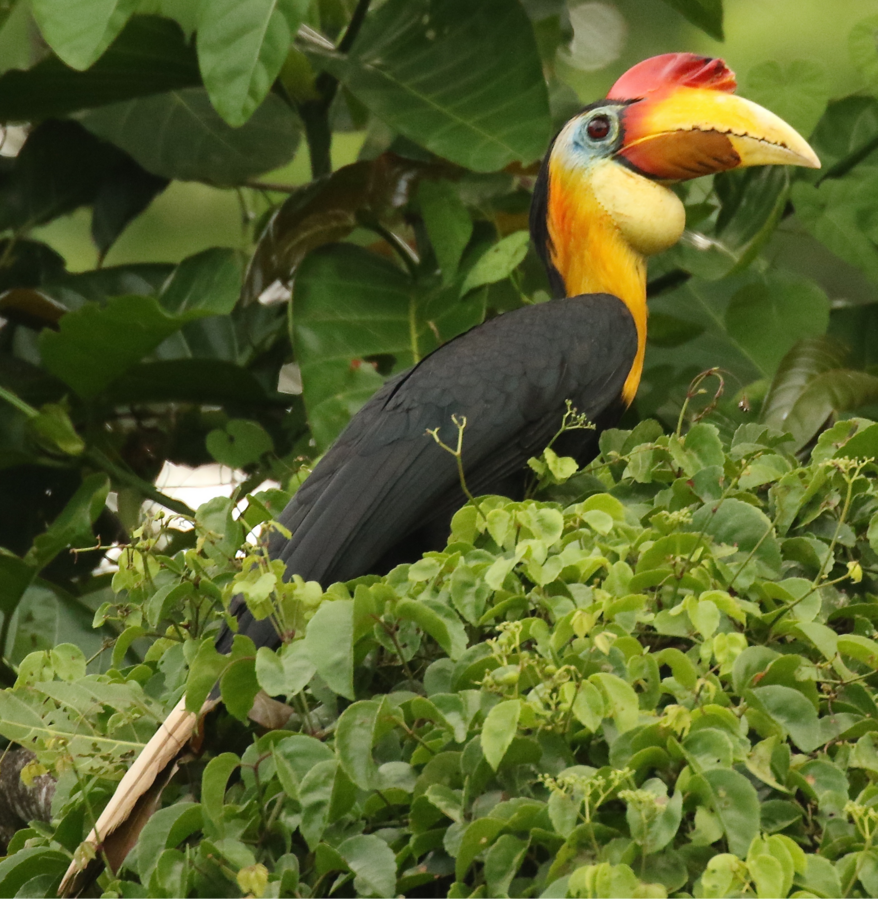
Wrinkled hornbills fly through the forest canopy looking for fruiting trees. They follow an undulating flight path, making soft coughing noises with their throats and loud rushing noises with their flapping wings. They are monogamous and pairs raise their young together.
Males have bright yellow feathers on the auriculars (feathers that cover a bird's ears) , cheeks, throat, neck-sides and chest, but these areas are black in the female, except for the blue throat. The bill of the male is yellow with a red base and casque, and a brownish basal half of the lower mandible. The bill and casque of the female is almost entirely yellow. [Source: Wikipedia]
Wrinkled hornbills mainly eat fruit, such as figs, although it does also eat small animals such as frogs and insects. Wrinkled hornbills do not drink, but get the water they need from their food. Their call is a harsh "Kak-kak", or a deep "Row-wow" which can be heard for miles.
Wrinkled hornbills are monogamous and pairs remain together for life. They use holes found in trees for nests, and the female will plaster over the entrance with mud and droppings, leaving a nesting mother and her chicks only a small hole, too small for them to exit. They are fed exclusively by the male, who regurgitates food for them. After several months, when the chicks are ready, the female will break out of her nest.
Image Sources: Wikimedia Commons
Text Sources: Animal Diversity Web animaldiversity.org ; National Geographic, Live Science, Natural History magazine, David Attenborough books, New York Times, Washington Post, Los Angeles Times, Smithsonian magazine, Discover magazine, The New Yorker, Time, Reuters, Associated Press, AFP, Lonely Planet Guides, Wikipedia, The Guardian, Top Secret Animal Attack Files website and various books and other publications.
Last updated February 2025