
SWANS
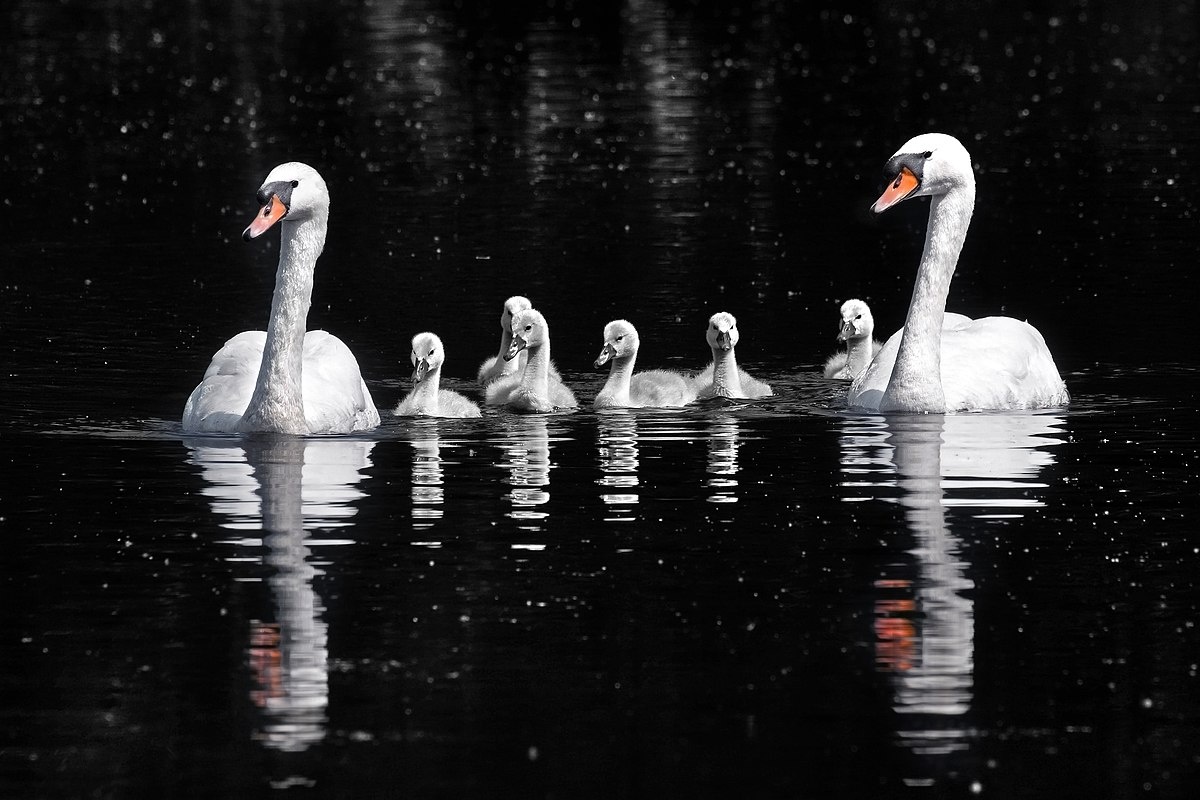
Swans are the largest of all waterfowl. They are generally snowy white, with long graceful necks, a black "mask" around their eyes and yellow bill markings that extend forward past their nostrils. There are eight species and they can be found in all the continents except Africa and Antarctica. The northern species are known for their loud calls. Their names— trumpeter, whooper and whistler— reflect this. Swans can be quite large with some standing 1.25 meters (4 feet tall), weighing about 15 kilograms (35 pounds) and boasting a wing span of up to 2.7 meters (8 feet). A male swan is called a cob. A female is called a pen. Young are called cygnets. A group is used to be called a sloth.
Swans are classified in the genus Cygnus and are closely related to geese and ducks. They are long-lived, and usually mate for life. They travel in family groups, which often include adolescent birds not yet old enough to breed, and tend to return every year to the same wintering spot. Most swans build huge nests. Some trumpeter swan nests even float. Swans are monogamous except when unable to produce offspring and then they may chose new partners. Both sexes help care for the young. Several species carry their cygnets on their backs. Kevin Short wrote in the Japan News: Cygnets, are gray, and the bill markings are pale pink. By the time the swans head back northwards in late February or early March the cygnets will be considerably whiter in overall color, and their bill markings will have changed to pale yellow. The whooper swans are primarily herbaceous. They strain floating vegetation from the water surface, and also upend their bodies to stretch their long necks down to the pond bottom, where they yank up the soft new shoots of aquatic plants such as wild rice (makomo). When resting, the swans bury their heads in their wing feathers. [Source: Kevin Short, Japan News, November 11, 2014]
In Western culture, swans are symbols of beauty, of lasting love. and elegance and they look that way when soar in the air and cruise along the surface of the water. But looks can be deceiving: to maintain their graceful glide swans have to paddle their feet hard underwater and take offs and landings takes a great deal of effort and space and even then aborted take offs and crash landings are not uncommon. Also, swans can be quite aggressive and even dangerous (See Below). According to the New York Times they can deliver highly effective blows of their bony-elbowed wings. Rene Lynch wrote in the Los Angeles Times, “Swans have a seemingly placid demeanor... But the creatures are territorial and can be quite aggressive when threatened. This aggression makes them good at driving off geese; it can also lead to tragedy. [Source: Rene Lynch, Los Angeles Times, April 16, 2012]
By royal decree half the swans that live on the Thames between Sunbury and Pangbourne belong to the British monarchy. The other half is divided between two guilds, Vinters and the Dyers. Marks on the birds rump identify ownership and each year in late July the three groups head out onto the Thames to go "swan upping." During this ritual recent hatchlings are captured and marked according to their parentage.
See Separate Article: SWAN SPECIES IN ASIA AND EUROPE: WHOOPERS, MUTES AND TUNDRA SWANS factsanddetails.com ; BLACK SWANS: CHARACTERISTICS, BEHAVIOR AND REPRODUCTION ioa.factsanddetails.com
Ducks, Swans and Geese

There are over 150 species of waterfowl, including ducks, swans and geese. They typically have webbing between their front three toes for swimming and wide, flat bills with fine serrations on the sides. Most are ground nesters. Chicks are covered with a dense coat of soft, fluffy feathers known as down. Adult birds have soft down underneath their feathers for insulation and waterproofing. This down is used as filling for sleeping bags and down coats.
Geese and swans are among the heaviest birds. They have long necks and are mostly herbivores. Ducks are smaller, with shorter necks and eat a wider variety of food, ranging from flies to floating algae to fish. Males tend to be colorful while females are drab.
Many northern hemisphere species of waterfowl breed in the marshes, lakes and tundra of Alaska, Canada and Siberia and migrate to wintering areas further south. The 15 species of true geese are found mainly in the Arctic and subarctic regions. They are gregarious and can live for a long time (captive birds live up to 50 years). Canadian geese and snow geese belong to this group.
See Anatids Under DUCKS: CHARACTERISTICS, ANATIDS, BEHAVIOR, REPRODUCTION factsanddetails.com
11-Million- Ancestor of Swan — A Flightless, Marine, Filter-Feeder
Eleven million years ago, in what is now Japan, an ancestor swans lived in the ocean according to a paper published in in April, 2022 in the Bulletin of the Gunma Museum of Pure Historical past. Based on an almost complete skeleton found in a stone slab in riverbed in Gunma Prefecture, Japan, the prehistoric swan, called Annakacygna, had lengthy, filter-feeding heads, small wings and significantly unusual hips. The paper was written by Hasegawa Yoshikazu, director of the Gunma Museum of Pure Historical Past, and Hiroshige Matsuoka, a paleontologist.
The New York Times reported: Initially Dr. Matsuoka thought he was a weird duck, maybe an animal that dove within the oceans simply offshore of the then-newly risen Japanese Archipelago. However as bones had been cleared from the slab, he concluded that the short-winged skeleton belonged to a flightless swan. The species, which he and Dr. Yoshikazu named Annakacygna hajimei, was about the same length as black swans. One other set of fossils from a associated species, which they named Annakacygna yoshiiensis, more similar to trumpeter swans. [Source: New York Times, April 29, 2022]
Each birds had been “fatter and heavier than modern swans,” Dr. Matsuoka said. Compared to existing swans, the ancient swans had unusually broad and robust hips, and their bones were thicker than usually for a water bird causing them to ride low in the water. Oddest of all were the wings. Flightless birds normally have underdeveloped wing muscles and bones if they still retain their wings. However in Annakacygna, the shoulder joints and muscle attachments that pull the wings backward were unexpectedly well-developed, with uniquely formed wrists that stored the digits — and with them, the wings — completely bent. At first, these wings puzzled the scientists. However after watching videos mute swans holding chick on thier back, Dr. Matsuoka surmised the wing structures may have been used to carry chicks.
Annakacygna appear to have been coastal birds. Their lengthy, filter-feeding beaks resemble these of shoveler geese, permitting them to dabble for plankton within the cool seas off the Japanese coast. Modern swans have straight, vegetation-nibbling beaks. Some prehistoric waterfowl were quite large. The Pleistocene large swan of Malta, which some researchers say was land-bound, was 30 percent bigger than modern mute swans.
See Separate Article: DUCKS: CHARACTERISTICS, ANATIDS, BEHAVIOR, REPRODUCTION factsanddetails.com
Flying Swans
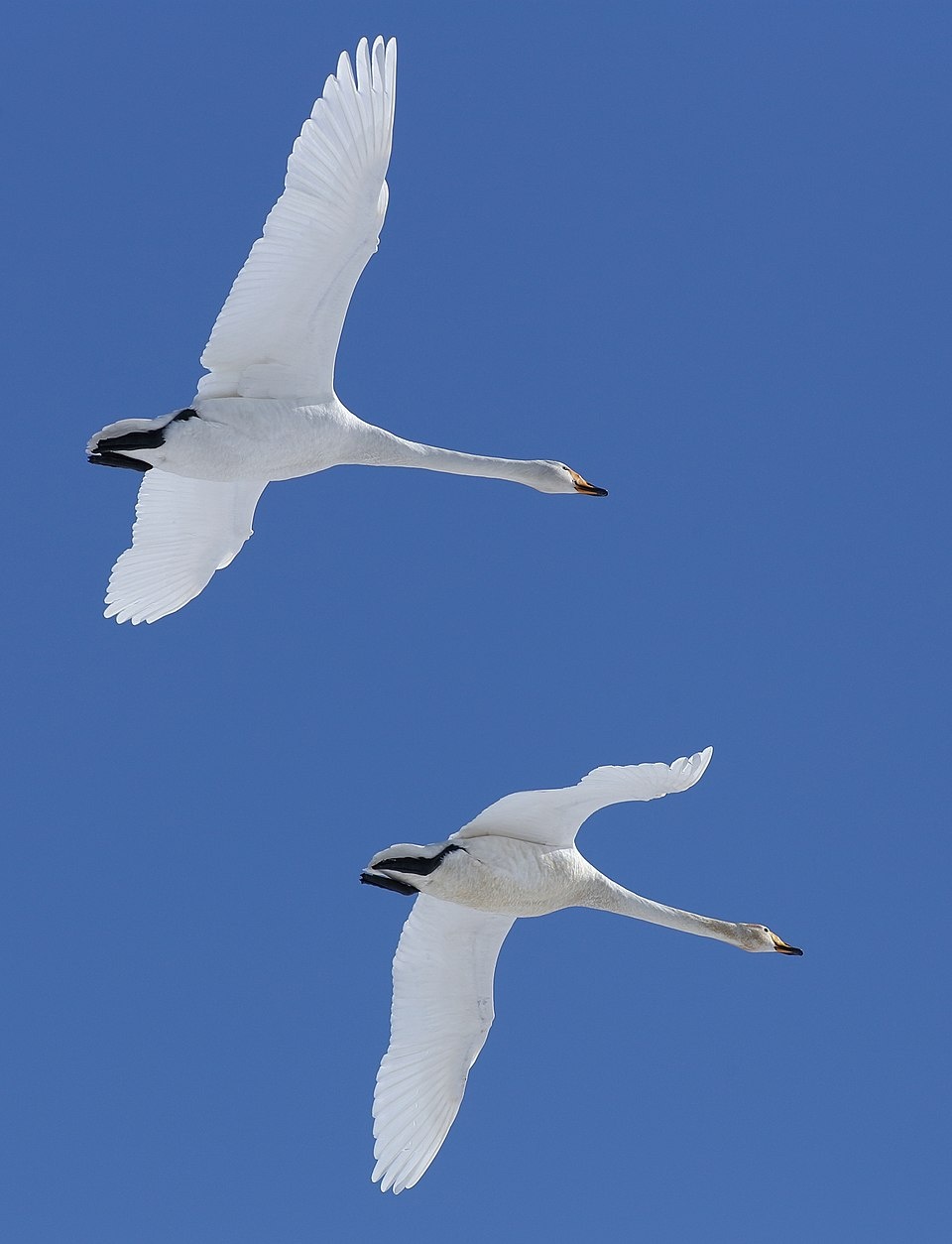
Swans fly with their long thin necks stretched out straight. This contrasts with egrets who fly with their necks tucked in an S-shape. When relaxing they often place their beak into their feathers, To keep their feathers snowy white takes constant preening and cleaning. It not uncommon for swan to sit in a river and splash water over its wings for five minutes and then retire to the bank and groom its feathers for another five minutes — and repeat this process several times a day.
Swans are one of the heaviest if all flying birds. A full-grown adult can weigh as much as 15 kilograms (35 pounds). Taking off requires a lot of energy. Swans generally need a running start to take off. When landing they glide across the water's surface, their webbed toes braking in the water and their flapping wings braking in the air.
Taking off requires a lot of energy. Swans run as fast they can on the smooth surface of water and beat their wings frantically while continually moving their feet until they are aloft. When the feet lose contact with the water, the swan tucks them under the body like the landing gear on an airplane. Landing for a swans is equally difficult. They almost never attempt it on land. When they do it in the water, they open their wings to stall and trust their feet in front of them sort of like a baseball player sliding into second base.
Swan Behavior
Swans emit a wide range of sounds from high-pitched noises of young swans to bass notes of old males. "The "swan song" of dying was long thought to be a myth but has been heard from wounded swans as they descended to earth. Their monogamous mating habits is what has made them a symbol of lasting love.
Jessica Robinson wrote in Animal Diversity Web: Social dominance is the key to survival in swan populations. The most stable swan unit is the family, which includes both three to seven cygnets from that year, and occasionally young from previous years. The most dominant family is not necessarily the largest unit; instead, it is determined collectively by each member’s ability to gain resources. Units with more dominant ranks have greater access to food, resting areas, resources, and safe areas. Aggressive encounters are associated with dominance in a hierarchy. To establish dominance, males fight to protect their families. [Source:Jessica Robinson, Animal Diversity Web (ADW) |=|]
Unmated birds are not as likely to have aggressive encounters because of their lower social rank. For a family, once dominance is established, their social rank is maintained throughout the winter. For a young, single swan, once dominance is established, their social rank increases with years in the flock because they presumably feed more efficiently and fight more aggressively. Within a family, swans use pre-flight signaling to make sure family members take off together. Males tend to lead the movement in the autumn, and females lead the movement in the spring. These signals include head bobbing, or neck bending and stretching repeatedly prior to flight, opening of the wings, and other visual displays. |=|
Swan Feeding

Swans use their wide bills to strain floating algae, small invertebrates and pieces of edible plant material from the surface of the water. They can not dive or swim underwater like cormorants or grebes but they can upend themselves with their tail sticking up in the air and fully extend their necks downward to reach plants at the bottom of the pond, sometimes violent twisting their neck to uproot plants.
Swans feed in deeper waters than ducks and other waterfowl that share their habitat and thus do not compete with them directly for food. Rather, food is made more readily available to other birds by swans because parts of the plants they consume float to the surface while the swans are feeding. However, species of swans compete with other swan speciess for food because they feed in similar ways. [Source: Alicia Ivory, Animal Diversity Web (ADW) |=|]
In shallow fresh waters, whooper swans use their webbed feet to dig in the mud and then dip their head into the water to feed on shallow roots and tubers. They can also feed in terrestrial habitats or near saltwater tidal environments. In freshwater ecosystems, large quantities of biomass are lost when whooper swans feed on their preferred submerged macrophyte, fennel pondweed; this stimulates the pondweed to grow at intermediate depths. In contrast, their less favored plant, claspingleaf pondweed grows at either shallow or deep depths. As such, whooper swans play a key role in impacting plant community structures. [Source: Priscilla Kuo, Animal Diversity Web (ADW) |=|
Swan Species
Europe is home to Mute swans, whooper swans and tundra swans. North America is home to trumpeter swans, the largest fowl in North America, and whistler swans. Whopper swans migrate between Siberia and Japan. In Australia there are black swans with soot-black plumage, white primaries, and a coral colored bill.
Mute Swans (Cygnus olor) are an Eurasian species that occur at lower latitudes than the whooper swan and Bewick's swan across Europe into southern Russia, China and the Russian Maritimes. They are among the oldest bird species still living today. Mute swans — have an orange bill with a distinctive black hump at the base. They are seen in lakes and marshes and ponds and rivers in parks and other urban areas Their name derives from their being less vocal than other species They are native to Europe and Asia but has been introduced to North America, southern Africa and Australia. Escaped ones have become naturalized in Japan. Mute swans tend to stay in the same place all year. During the mating season males can be quite aggressive. By tradition, all unmarked mute swans on the River Thames belong to the monarch. Source: Wikipedia]
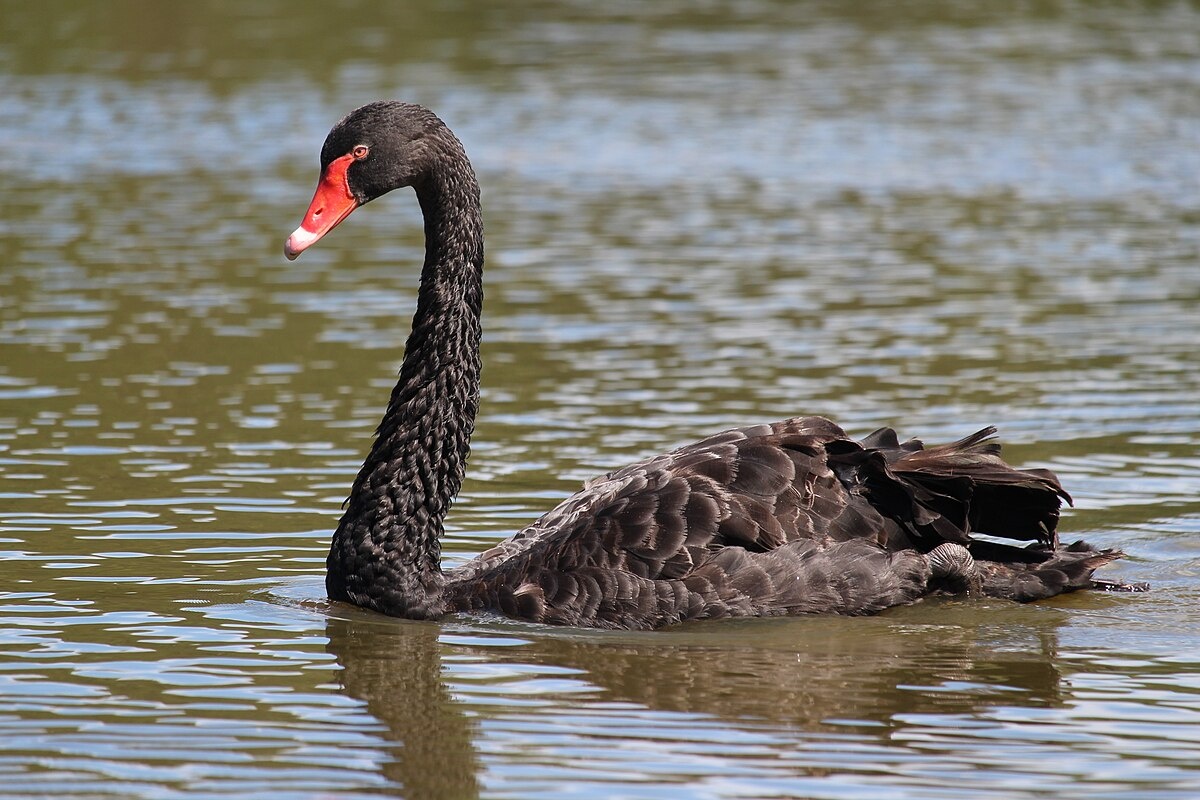
Black Swans (Cygnus atratus) are native to Australia. Nomadic with erratic migration patterns dependent upon climatic conditions, they have black plumage and a red bill. Black swans have introduced into New Zealand and the Chatham Islands, with additional smaller introductions in Europe, the United States, Japan and China.
Whooper Swans (Cygnus cygnus) breed in subarctic Europe and Asia, migrating to temperate Europe and Asia in winter. Whooper swans can measure 1½ meters from head to tail, with a wingspan of over two meters. They have thick bodies and can weigh up to 12 kilograms, making them one of the heaviest flying birds.
Trumpeter Swans (Cygnus buccinator) are the largest North American swans. Very similar to whooper swans — and sometimes treated as a subspecies of then — they were hunted almost to extinction but have since recovered.
Tundra Swan (Cygnus columbianus) breed on the Arctic tundra and winter in more temperate regions of Eurasia and North America. There are two forms, generally considered to be subspecies but considered separate species by some authorities. Bewick's Swans (Cygnus columbianus bewickii) are the Eurasian form that migrates from Arctic Russia to western Europe and eastern Asia (China, Korea, Japan) in winter. Whistling Swans (Cygnus columbianus columbianus) are the North American form. Whistling swans are slightly smaller than whoopers and look almost exactly the same except the yellow markings on their beaks stops before their nostrils while the markings on whoopers extends past the nostrils. Whistling swans tend to breed in the arctic tundra, while whoopers prefer boreal forests further south.
Swan Attacks
In April 2010, the BBC reported, a swan on the River Cam in England made the news after repeatedly attacking rowers. It was nicknamed Mr Asbo, named after the Anti-Social Behaviour Orders issued by UK courts at the time. Two years later, there are still calls for it to be removed from the river, as the seasonal attacks go on. But such incidents are very rare, says John Huston of the Abbotsbury Swannery in Dorset, where there are 1,000 swans but no recorded attacks on humans in the colony's 600-year history. [Source: Daniel Nasaw and Tom Geoghegan, BBC, April 17, 2012]
On being attacked by a swan, Jim Todd of BBC News wrote: “I was ambushed by a swan. I was fishing on a small river in Dorset when it swam past me, going upriver. I naturally stopped what I was doing until it was some 30m further on, and started casting downstream. But every time I looked upriver it seemed to be closer. Finally, when the current had pushed it to within 15m, it turned around and flew at me. It was a terrifying and humbling moment. All I could think was to run, but I had a steep bank with nettles behind me and scrambling up it in a panic left me with a face full of stings.”
In response to a question in a Guardian forum on whether swans could break your leg with their wing, Tim Haughton of Upholland, UK wrote: “My great uncle had his arm broken by a swan while canoeing on the canal near Gorton Manchester.” Allan Steele of Ayr, Scotland said: “My friend and I were walking back to our residences in Stirling when another student walking by the lake must have got too close to a nest by accident. The resulting attack by the mother swan was serious enough for hospital treatment, and a leg cast. whether the injury was caused by the wing or by the beak I couldn’t tell you but the swan was pretty ferocious. I give them a wide berth now.”

Alistair Morris of Billericay, UK wrote: “I've never heard of anyone's leg being broken by a swan, but my grandmother had her arm broken by one. She was a keen ornithologist and got too close to a pen on her nest, hence the attack and resulting injury. I don't know how old she was when the attack took place or if she suffered from brittle bones but it happened before I was born and she was in her late 50s when I came along.” Thomas Effing of Agness, USA wrote: “I'm not sure, but I was bitten by a swan when I was 10 and it nearly broke my foot. I was wearing sandals, so all I suffered was shock and some bruising and bleeding. I have read that a swan can kill a man by flapping its wings (the wingspan can be longer than an average human's height, and they do have powerful muscles). I would advise warning children to keep away from swans and large geese, as they are quite strong (and vicious!). Many people like to feed them like they feed ducks, and this can lead to injury. There may be records of this happening, because there are so many swans in parks where kids feed whatever animal is around with a bag of stale bread. They are quite beautiful creatures, though!”
Swan Kills 37-Year-Old Father of Two
In April 2012, a wan killed a man in the Chicago area. One of the swans charged his kayak, capsizing it, Cook County Sheriff Tom Dart, whose deputies investigated the death, told the BBC. The man tried to swim to shore but eyewitnesses told the sheriff's investigators the swan appeared to have actively blocked him. "I find myself still scratching my head," says Sheriff Dart. "This truly is one of the ones that keeps you from saying 'I've seen everything now.'"
Rene Lynch wrote in the Los Angeles Times, “Anthony Hensley was a 37-year-old married father of two who worked for a company that uses dogs and swans to shoo pesky geese from properties in the area. Hensley had taken to a kayak Sunday morning to check on the swans in a Des Plaines-area pond when one of the larger birds turned on him, the Chicago Sun-Times reported. Cook County sheriff’s investigators believe Hensley either got too close to the swan or the swan’s nesting area, the Sun-Times said. Hensley rolled off his kayak and landed in the water, and the swan kept up its relentless attack. [Source: Rene Lynch, Los Angeles Times, April 16, 2012 ^^^]
“The Sun-Times reports that the swan continued to pursue Hensley as he tried to swim to shore. Hensley was submerged when emergency workers arrived, and an autopsy found that he died from drowning near the Bay Colony condominiums in unincorporated Des Plaines. Hensley's family members were grief-stricken, struggling to take it all in. Like many, they couldn't understand how Hensley was unable to beat off the swan. "Maybe he didn’t want to hurt the animal," Hensley's father-in-law, George Koutsogiannis, told the Sun-Times. "Maybe he didn’t fight back enough when the swan attacked him....I can’t understand how this was possible." ^^^
“There were no immediate details about the swan that attacked Hensley, or its fate. Hensley reportedly did not have life insurance, and a memorial fund was set up to help his family. As for his business, geese can be plenty destructive to landscaping, and their sheer numbers can make areas unusable due to all the droppings. By comparison, a handful of swans can be model neighbors. ^^^
How Dangerous Are Swans
After the Chicago area attack, The BBC reported: “According to ornithologists, the swan's aggressive reaction is typical for the species, the mute swan, when defending a nest. "It's presumably a male swan and it's presumably paired, and it's set up home for the spring," says Chris Perrins, Her Majesty's Swan Warden and a retired Oxford ornithologist. "It's going to defend that territory." The males are fierce in defence of their nests, especially during the spring nesting season - April to June. [Source: Daniel Nasaw and Tom Geoghegan, BBC, April 17, 2012]
John Huston of the Abbotsbury Swannery in Dorset said : "If you approach a swan nest on the river, they might get aggressive and hiss and flap their wings, but the danger is over-rated and it's a myth that they will break your leg or arm with their wings. "They are not that strong and it's mostly show and bluster." Perrins says he has spent many years handling swans and never been injured, just received the odd bruise. "They do fairly vigorously defend their little patch this time of year. Once the eggs are hatched he'll stay with the family and defend it. "They have a reputation for being a bit aggressive, but it's only that it's a matter of size, I guess. Presumably a duck wouldn't attack you because you look a bit big."
However, a large swan can give a thump, he says, and the best advice is to stay away from the nest, which is often a place along the bank or shore where the reeds are flattened and the female is sitting. Mute swans often defend in pairs, says Julia Newth, research officer at the Wildlife and Wetlands Trust. "Habitats with abundant food and with suitable nesting sites may be highly fought over. "Those intruding on their territory, including large wildfowl, land mammals and people, may be warded off with an aggressively fast swimming approach, often accompanied with hissing and busking, which is a threat display where the swans neck is curved back and its wings are half raised.
"Mute swans tend to use the power of their wings to attack rather than their beaks." John Faaborg, a biologist at the University of Missouri and president of the American Ornithologists' Union, has known people who were hurt by geese attacks. "And I am sure that swans can do major damage given that they are so big." In this case in Chicago, he says, it's understandable that someone in a river with their clothes and shoes on was unable to overpower a swan and swim to shore.
New York Declares War on Swans
In 2014, AFP reported: “In Britain, wild swans may be prized for their beauty and protected by the Queen, but the US state of New York has declared war on them, branding them a violent menace. Draft proposals to kill or resettle the state’s 2,200 wild mute swans by 2025 may be supported by some conservationists but have sparked uproar among animal rights activists. Mute swans were brought to North America by European settlers to adorn their estates in the late 1800s but the authorities no longer consider them a beauty worthy of roaming free. [Source: Agence France-Presse, January 31, 2014]
The New York state department of environmental conservation says swans attack people, destroy vegetation, pose a threat to jetliners and damage water because their feces contain e coli. Ever since US Airways flight 1549 collided with a flock of geese in 2009 and landed on the Hudson river, the US Department of Agriculture has set about annually culling Canada geese. Now the New York state conservation department wants to expand the offensive and eliminate free-ranging mute swans by 2025, killing them or allowing “responsible ownership” of the birds in captivity. “Lethal control methods will include shooting of free-ranging swans and live capture and euthanasia in accordance with established guidelines for wildlife,” said the draft proposal. Nests would also be destroyed, and eggs oiled, punctured or sterilized to prevent hatching, it added.
Pressure group Goose Watch NYC, which was set up to protest against the geese culls, demanded the plan be scrapped. “It’s just outrageous to try to exterminate an entire species that has been living in the state for more than 150 years, almost 200 years,” Watch founder David Karopkin told AFP. He rubbished the idea that 2,200 swans posed a threat to a state of 18 million people. “I’ve yet to find anyone who has been seriously injured by a mute swan,” he said. “When they’re being aggressive it’s often in relation to them protecting their nest, their babies. I mean people need to have some common sense,” he added.
But some conservationists happily support the state plan. Paul Curtis, associate professor in the department of natural resources of Cornell University, told AFP that it was appropriate and in keeping with proposals in other states. There have been four documented swan strikes at JFK airport, he said. Swans can pose a nuisance and they deplete food sources. “The goal is to limit population growth in the wild, and remove swans from places where they cause problems or do damage to plant communities,” he wrote. “The plan could be effective if a variety of lethal and non-lethal approaches are used,” he added. The state conservation department also hit back against critics, telling AFP the proposal to resettle the swans make it “more balanced and comprehensive” than many have suggested.
Image Sources: Wikimedia Commons
Text Sources: Animal Diversity Web animaldiversity.org ; National Geographic, Live Science, Natural History magazine, David Attenborough books, New York Times, Washington Post, Los Angeles Times, Smithsonian magazine, Discover magazine, The New Yorker, Time, BBC, CNN, Reuters, Associated Press, AFP, Lonely Planet Guides, Wikipedia, The Guardian, Top Secret Animal Attack Files website and various books and other publications.
Last updated June 2025