
CONTEMPT FOR SCIENCE AND PHILOSOPHY IN ANCIENT ROME
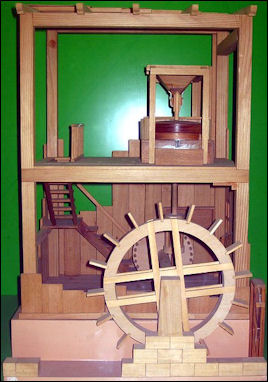 Philosophy had never ceased to excite suspicion and sarcasm at Rome. The citizen who wanted to might indulge in it in friendly conversations, in casual and private conferences, or in solitary meditations in his ivory tower, but if he wished to take it up more seriously he had either to be rich enough to maintain a master at his own cost in his own house, or to expatriate himself in some distant town where philosophers were allowed to air their speculations. [Source: “Daily Life in Ancient Rome: the People and the City at the Height the Empire” by Jerome Carcopino, Director of the Ecole Franchise De Rome Member of the Institute of France, Routledge 1936]
Vespasian banished the philosophers from Rome and excluded them everywhere from the privileges reserved for grammatici and rhetoricians; and the study of philosophy in Rome had never recovered from the ancient interdict pronounced against it by the Senate in 161 B.C. and repeated i~ 153 B.C., when in defiance of the diplomatic immunity which they enjoyed, it expelled from the city the academician Carneades, the Stoic Diogenes, and the peripatetic Critolaus.
Physics and metaphysics, politics and history were equally taboo in regular and public courses of instruction; and eloquence, denied action, divorced from pure thought and pure science, gyrated in a weary circle of literary exercises and verbal virtuosity. Thus it happened that despite their popularity with well-to-do youth, despite the protection granted them by the emperors, despite the place of honor which they occupied in the city, where Caesar had allotted them the tabernae of his Forum and Trajan a hemicycle of his, the preparatory studies of grammar and rhetoric were sterilised by the incurable formalism to which eloquence herself had been reduced. The better to sift out the students, the grammar class, which was the first step to rhetoric, remained bilingual till the end of the empire.
RELATED ARTICLES:
ANCIENT ROMAN TECHNOLOGY europe.factsanddetails.com;
ARCHIMEDES AND HIS INVENTIONS europe.factsanddetails.com;
ANCIENT ROMAN INFRASTRUCTURE: BRIDGES, TUNNELS, PORTS factsanddetails.com ;
ANCIENT ROMAN AQUEDUCTS: HISTORY, CONSTRUCTION AND HOW THEY WORKED europe.factsanddetails.com ;
SCIENCE IN ANCIENT GREECE europe.factsanddetails.com ;
MATHEMATICS IN ANCIENT GREECE: GEOMETRY, MEASUREMENTS, THEOREMS europe.factsanddetails.com ;
ASTRONOMY IN ANCIENT GREECE europe.factsanddetails.com ;
ANCIENT GREEK TECHNOLOGY factsanddetails.com
RECOMMENDED BOOKS:
“The Cambridge Companion to Ancient Greek and Roman Science” by Liba Taub (2020) Amazon.com;
The Oxford Handbook of Science and Medicine in the Classical World by Paul Keyser and with John Scarborough (2018) Amazon.com;
“Intelligence Activities in Ancient Rome: Trust in the Gods but Verify” by Rose Mary Mary Sheldon (2007) Amazon.com;
“A Companion to Science, Technology, and Medicine in Ancient Greece and Rome (Blackwell) by Georgia L. Irby (2016) Amazon.com;
“Ancient Greek and Roman Science: A Very Short Introduction”
by Liba Taub Amazon.com;
“The Origins of Alchemy in Graeco-Roman Egypt”, Illustrated, by Jack Lindsay (1970) Amazon.com;
“The Library of Alexandria: Centre of Learning in the Ancient World” by Roy MacLeod | (2004) Amazon.com;
“Lost Discoveries: The Ancient Roots of Modern Science – from the Babylonians to the Maya” by Dick Teresi (2010) Amazon.com;
“Greek and Roman Technology: A Sourcebook of Translated Greek and Roman Texts” (Routledge) by Andrew N. Sherwood, Milorad Nikolic, John W. Humphrey Amazon.com;
“Technology and Culture in Greek and Roman Antiquity” by S. Cuomo (2007) Amazon.com;
“Technology and Society in the Ancient Greek and Roman Worlds” by Tracey Elizabeth Rihll (2013) Amazon.com;
"Ancient Inventions” by Peter James and Nick Thorpe (Ballantine Books, 1995) Amazon.com;
“The Time Museum, Volume I, Time Measuring Instruments; Part 3, Water-clocks, Sand-glasses, Fire-clocks” by Anthony J. Turner (1984) Amazon.com;
“Time Museum Catalogue of the Collection: Time Measuring Instruments, Part 1 : Astrolabes, Astrolabe Related Instruments” (1986) by A. J. Turner Amazon.com;
“London's Roman Tools: Craft, Agriculture and Experience in an Ancient City” by Owen Humphreys (2021) Amazon.com;
“An Essay on the Ancient Weights and Money and the Roman and Greek Liquid Measures”
by Robert Hussey (2009) Amazon.com;
Time in Ancient Rome
The year one on the Christian calendar was regarded as the year 745 A.U.C (“ab urbe condita” —“from the foundation of the city”) on the Roman calendar. It marked the year that Romulus and Remus founded Rome. Romans initially counted days and the equivalent of weeks and months with Kalends, Nones and Ides.
The Romans developed the idea of the week and gave names to the months. They had an eight-day week which they later changed to seven. By the A.D. third century Romans divided the day into only two parts: before midday “(ante meridiem” A.M.) and after midday (“ post meridiem” P.M.). Someone was in charge of noticing when the sun crossed the meridiem since lawyers were supposed to appear before noon. Later the day was dived into parts: early morning, forenoon, afternoon, and evening and eventually followed a sundial that marked "temporary" hours.
The ancient Greeks had no weeks, nor names for the different days. They followed a 12 month calendar similar to the one used by Babylonians with 29 and 30 day lunar months and a 13th month added on the seventh of thirteen years to ensure that the calendar stayed in sync with the seasons. Each city state added the thirteen month at different times to mark local festivals and suit political needs. A complex system of "intercalculating" was employed to decide on meeting times between citizens of different states and to make arrangements for the pick-up and delivery of goods. [Source: "The Discoverers" by Daniel Boorstin,∞]
The term the “dog days” of summer dates back to Roman times when it was observed that during the hottest days of summer the bright star Sirius rose and fell in the constellation Canis Major (the Big Dog).
RELATED ARTICLES:
TIME IN ANCIENT ROME: CALENDARS, SUNDIALS, HOURS europe.factsanddetails.com
TIME IN ANCIENT GREECE: CLOCKS, DIVISIONS, DAYS europe.factsanddetails.com
Sundials and Waterclocks in Ancient Rome
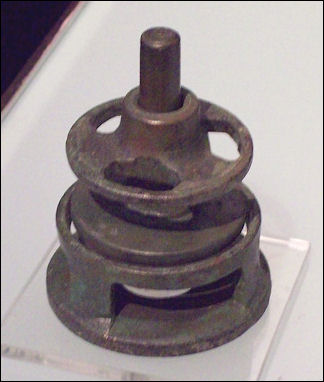
Roman hydraulic pump
Although sun dials had been around at least since 1500 B.C. in ancient Egypt they became more sophisticated and common place under the Romans. Roman sundials not only mapped out hours they cut them into halves and quarters. Not everyone was happy about the advancement. The Roman playwright Plautus wrote in the 2nd century B.C.: “The gods confound the man who first found out how to distinguish the hours. Confound him, who in this place set up a sundial, to cut and hack up my days so wretchedly into small pieces!”
Harold Whetstone Johnston wrote in “The Private Life of the Romans”: “The place of our clock was taken in the peristylium or garden by the sundial (solarium), such as is often seen nowadays in our parks and gardens; this measured the hours of the day by the shadow of a stick or pin. It was introduced into Rome from Greece in 268 B.C. About a century later the water-clock (clepsydra) was also borrowed from the Greeks. This was more useful because it marked the hours of the night as well as of the day and could be used in the house. It consisted essentially of a vessel filled at a regular time with water, which was allowed to escape from it at a fixed rate, the changing level marking the hours on a scale. As the length of the Roman hours varied with the season of the year and the flow of the water with the temperature, the apparatus was far from accurate. Shakespeare’s reference in Julius Caesar (II, i, 192) to the striking of the clock is an anachronism.” [Source: “The Private Life of the Romans” by Harold Whetstone Johnston, Revised by Mary Johnston, Scott, Foresman and Company (1903, 1932) |+|]
Long before they were applied to time, seconds and minutes were used to represent units on a circle or arc. In the Greco-Roman era, Ptolemy used the units, based on the Babylonian base-60 system, on his maps. In the Middle Ages, minutes used on circular clock dials. Seconds as a time measurement were introduced in the late 17th century when clocks accurate enough to tick off seconds were developed.
Like their Athenian counterpart, the Roman waterclock was a bowl with a hole near the bottom that measured about 20 minutes. These devised were used in courts and government legal proceedings to limit the speaking time of lawyers, officials and orators. In Rome, the expression "to lose water" meant wasting time and "to grant water" meant to allocate a lawyer more time. Longwinded speakers in the Senate were chided that "their water should be taken away" By the time water clocks were perfected in Europe they were soon replaced by swinging pendulum and spring activated clocks.
Roman Measurements
Many of the ancient units of measurement were for practical reasons based parts of the body. The digit (width of a finger), the palm (the width of four fingers), the foot and the cubit (the distance from the tip of the middle finger to the elbow) were all measurements of length. The "pace" (the precursor of the yard and meter) was equal to one large step and "fathom" (roughly six feet) was the distance between two outstretched hands. ["The Creators" by Daniel Boorstin]
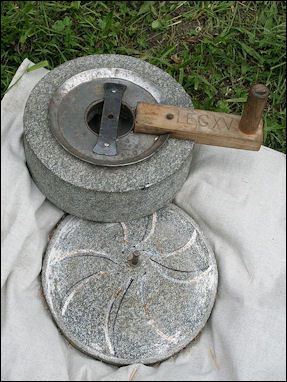
handmill from first century The Romans took measuring to new levels. They kept standards for weights and measures in a temple in Rome. In accordance with Roman law, people in all parts of the empire had to use weights like those of the standards. The Romans developed graded glass bottles for measuring liquids, elaborate scales and land survey equipment. They even devised an odometer" (a cart with a system of cogs attached to the back axle that caused a stone to drop through a hole into a box with a loud thunk every 1,860 yards to mark places where milestones should be deposited.
Rome introduced the “ mille passus” based on 1000 paces (double steps), or the length of 1000 soldiers, lined up two paces apart. It was equal to 5000 Roman feet or 4865 modern feet (about 95 percent the length of a modern mile). The modern mile comes to us from the Romans via Britain. In the late 16th century, Queen Elizabeth I added 280 feet so the mile would be exactly eight "furrow-longs" or furlongs.⋆
Other Roman liner measurements: 1) the digitus (0.73 inch); 2) the Roman foot (0.973 foot); 2) the gradus (2.43 feet); and 4) the actus (116.4 feet). Among Roman weight measurements were: 1) the as (.72 pound); 2) the uncia (420 grains); 3) the libra (12 unciae); 4) the talent (125 librae); 5) the bes (.48 pound); 6) the denarius (0.16 grains); 7) the obolus (8.77 grains); and 8) the scrupulum (17.53 grains).
In ancient times a lot of the standard formulas that modern engineers and architects use to measure stress and balance had not yet been invented. Most building were but together with knowledge learned through trial and error. One of the first scientific principals of architecture — that a the base of column should be equal to one sixth of its height — was based on the observation that the size of a person's foot is one sixth of his height.
Why We Use Arabic Numerals Instead of Roman Ones
The Greeks and Romans were unable to make the breakthrough of the concept of zero. The first Old World Culture believed to have figured it out was the ancient Hindus. Roman numerals were cumbersome. Engineers and architects didn’t use them. Instead they used “simple geometry to establish the desired dimension for their designs, creating standard lengths of chain or rope. Then they used a compass and straightedge to align the architectural elements in correct and pleasing proportions.”
Arabic numerals were introduced into Europe during the Middle Ages by Italian merchants, and in reality they were actually Hindu numerals that were introduced to the Middle East from India by Arab traders. What made the Hindu numbers so appealing is that the value of number was determined by its position which was not true with Roman numbers. "1," for example, could represent "1," "10," "100" or "1,000,000,000,000" depending on its place in relation to the zeros.
This mathematical advancement was made possible by the Hindu understanding of the concept of zero. The only other ancient culture to understand this concept was the Mayas. The main advantage of Roman numerals was that addition and subtraction in some case was very simple. If you subtract 21 (XXI) from 83 (LXXXIII), for example, all you have to do is remove the XXI from LXXXIII, leaving LXII (62). This technique is not as simple if you take away 49 (XLIX) from 50 (L).
Roman Numbers
Joseph P. Hyder wrote: The numeral system developed by the Romans was used by most Europeans for nearly 1800 years, far longer than the current Hindu-Arabic system has been in existence. Although the Roman numeral system provided for easy addition and subtraction, other arithmetic operations proved more difficult. Combined with the lack of an effective system for utilizing fractions and the absence of the concept of zero, the cumbersome nature of the Roman numeral system, while it served most of the needs of the Romans, hindered future mathematical advances. [Source: Joseph P. Hyder, Science and Its Times: Understanding the Social Significance of Scientific Discovery (2000), Encyclopedia.com]
Before examining the limitations posed by the use of Roman numerals, it is necessary to understand how Roman numerals are utilized. A numeral is any symbol used to represent a number. In the Hindu-Arabic numeral system, the numeral 3 represents the number three. When the numeral 3 is held in place by one or more zeros, the value increases by an order of magnitude, e.g., 30, 300, 3000, and so on. In the Roman numeral system, numerals are represented by various letters. The basic numerals used by the Romans are: I = 1, V = 5, X = 10, L = 50, C = 100, D = 500, M = 1000. These numerals can be strung together, in which case they would be added together in order to represent larger numbers. For example, the number 72 would be represented as LXXII (L + X + X + I + I, or 50 + 10 + 10 + 1 + 1 in Arabic numbers).
In order to prevent numbers from becoming too long and cumbersome, the Romans also allowed for subtraction when a smaller numeral precedes a larger numeral. Therefore, the number 14 would be represented as XIV instead of XIIII. Under this system, a numeral can only precede another numeral that is equal to ten times the value of the smaller numeral or less. For example, I can only precede and, thus, be subtracted from V and X, which are equal to five and ten times the value of I, respectively. Under this rule, the number 1999 cannot be represented as MIM, because M is equal to one thousand times the value of I. The Roman representation of 1999 is MCMXCIX, or M (1000) + CM (1000-100) + XC (100-10) + IX (10-1). Most of these rules, while often used by the Romans, were not standardized until the Middle Ages. Thus, one might find 9 represented on some older documents as VIIII instead of IX.
Because the largest numeral used by the Romans was M, or 1000, it proved impractical to write extremely large numbers, such as 1,000,000, as a string of 1000 Ms. To avoid this problem the Romans wrote a bar, called a vinculum, over numerals to express that numeral as a number 1000 times its original value. Instead of writing 6000 as MMMMMM, 6000 could simply be written as V̄Ī and 1,000,000 as M̄. Using this form of notation, the Romans were capable of writing large numbers.
History of Roman Numerals
Joseph P. Hyder wrote: The Roman numeral system for representing numbers was developed around 500 B.C. As the Romans conquered much of the world that was known to them, their numeral system spread throughout Europe, where Roman numerals remained the primary manner for representing numbers for centuries. Around A.D. 1300, Roman numerals were replaced throughout most of Europe with the more effective Hindu-Arabic system still used today. [Source: Joseph P. Hyder, Science and Its Times: Understanding the Social Significance of Scientific Discovery (2000), Encyclopedia.com]
The Romans adopted the symbols that they used for their numerals from a variety of sources, including their Greek counterparts. The origin of I to represent one is straightforward, derived from counting on one's hand, where one finger, which resembles I, equals one of whatever was being counted. The V came to represent five because when five items are counted on the hand, a V is formed by the space between the thumb and first finger.
Originally the Romans adopted the Greek letter X, or chi, to represent 50. Through the study of monument transcriptions historians have been able to determine that L replaced X as 50, and X came to represent 10. How X came to represent 10 is not entirely clear. One theory suggests that X was derived from one V, or five, placed on top of another, upside-down V. Thus, the two Vs formed an X. Another theory suggests that when counting to 10, Romans did so by making ten vertical marks and then crossing them out with an X in order to easily count groups of ten. This is similar to the manner in which Americans keep tallies by groups of five in which four vertical marks are crossed through with a fifth diagonal mark. Eventually the Romans adopted just X to be the numeral for 10. The symbol C came to represent 100, because it is the first letter of the Latin word for one hundred, centum. Likewise, M was adopted for 1000, because the Latin word for one thousand is mille.
Unlike the Greeks, the Romans were not concerned with pure mathematics, such as number theory, geometric proofs, and other abstract ideas. Instead, the Romans preferred utilitarian mathematics. The Romans primarily used mathematics to figure personal and government accounts, keep military records, and aid in the construction of aqueducts and buildings. The Roman numeral system allowed for simple addition and subtraction. For addition, Romans simply lined up all of the numerals from the numbers being added, and simplified. For example, in order to solve the problem 7 + 22, or VII + XXII, the numerals were first arranged in de scending order, or XXVIIII. Because VIIII, or 9, is not in acceptable form, this was changed to IX, the generally recognized manner of writing 9. The correct answer remains, XXIX, or 29. Subtraction can be done in a similar manner by crossing out similar numerals from the two different numbers.
Problems with Roman Numerals and How The Romans Compensated
Joseph P. Hyder wrote: The fact that multiplication and division were fairly difficult operations for the Romans spurred development of counting boards to aid with these operations. The counting boards, which resembled the familiar abacus, could also be used for addition and subtraction. Counting boards based on the Roman design were used throughout Europe until the Middle Ages. Even with these counting boards, multiplication and division of large numbers remained a difficult task. Therefore, Romans developed and often consulted multiplication and division tables to solve problems involving large numbers.
In addition to difficulty with the multiplication and division of numbers, several other problems severely limited the use and effectiveness of Roman numerals. One flaw of the Roman numeral system was the absence of a way to numerically express fractions. Romans were aware of fractions, but putting them to use was difficult, as they were expressed in written form. The Romans would have written three-eighths as tres octavae. The Romans usually expressed fractions in terms of the uncia. An uncia originally meant 1/12 of the Roman measure of weight (English derived the word "ounce" from uncia). Soon, however, uncia evolved to mean 1/12 of anything. Although basing the use of fractions on 1/12s, the Romans were able to express one-sixth, one-fourth, one-third, and half. While the modern numerical expression of one-fourth is ¼, the Romans would have expressed one-fourth as three unciae (3/12 = ¼). This system allowed the Romans to approximate measures, but they could not easily express exact measures.
Another flaw that limited Roman mathematics was the absence of the concept of zero. As with the previous number systems of the Sumerians, Babylonians, and Egyptians, the Romans did not have a place-value system that included the concept of zero as a placeholder for numerals. This forced the Romans to adopt the cumbersome system with numerals that represented 1, 5, 10, 50, 100, 500, and 1000, as described above. Unlike the ancient Greeks, the Romans also did not understand or explore the concept of irrational numbers. This severely limited the Romans in geometry, because much of geometry rests on an understanding of π, the ratio of the circumference of a circle to its diameter.
Although not limiting from a practical engineering standpoint, these flaws in the Roman mathematical systems limited the advancement of mathematical theory in Rome. In the wake of Roman conquests, most of Europe adopted the Roman numeral system and used it throughout the Middle Ages. Accordingly, theoretical mathematical advances were likewise also stunted throughout most of Western civilization for nearly 1,000 years. The absence of zero and irrational numbers, impractical and inaccurate fractions, and difficulties with multiplication and division prevented the Romans and the Europeans who later used the system from making advances in number theory and geometry as the Greeks had done in the Pythagorean and Euclidean schools.
During these mathematical Dark Ages, advancements in these fields were made by Middle Eastern and Indian subcontinent civilizations. With the innovation of zero place use within the Hindu-Arabic place-value system, great advances were made in these regions in the fields of geometry, number theory, and the invention and advancement of algebra.
Regardless of the Roman numeral system's limitations, the existing archaeological record establishes that the Romans were able to overcome many of those limitations with regard to the practicalities of construction. Roman roads and aqueducts remain as a testament to the engineering feats that the Romans were able to accomplish with their flawed system. Although Roman numerals are no longer a necessary component of mathematics, they are an important part of the history of the development of Western civilization. Modern numerals remain aesthetically important because of their widespread artistic use in art, architecture, and printing.
Pliny the Elder
Pliny the Elder was one of the world's greater chroniclers. An avowed workaholic, he wrote his historical works and encyclopedia with "20,000 noteworthy facts" in his free time while he worked as an army officer, bureaucrat, governor in several provinces and admiral in Rome's largest fleet. Pliny was born in northern Italy in A.D. 23. Little is known about his early life. Pliny the Younger was his nephew. [Source: Jerry Dennis, Smithsonian, November 1995]
"What made Pliny's achievement possible," wrote classicist Lionel Casson, "was a fanatical way he had of making every minute count. He burned the midnight oil literally: his standard routine was to get in hours of study before the break of day, when his official responsibilities began." Pliny often began his day at midnight and worked 20 or 24 hours a day. He kept a pen and writing tablet next his plate so he could jot notes while eating. When he traveled about the streets of Rome he insisted on being carried by slaves in litter, instead of wasting his time walking, so he could continue reading and work on route. His personal secretary was outfit with a special long sleeve tunic that enabled him to take notes even in bad climate weather and he often worked while getting a massage at the Roman baths.
Pliny was obsessed with the written word and is also credited with introducing the a table of contents. He poured over countless Greek and Latin texts, even ordering his secretary to read to him even while he was dining or taking a bath. He believed books were the ultimate repository of knowledge, “our civilization — or at any rate our written records — depends especially on the use of writing materials,” he wrote.
Candida Moss wrote in the Daily Beast: “In his own day, Pliny the Elder was believed to be the most learned man of the era and is best known to us for his thirty-seven volume Natural History; an enormously influential exhaustive compendium filled with fascinating tidbits about everything to do with geography, zoology, and botany. He amassed his information by industriously copying facts out of other books and by constantly reading or being read to by slave-readers. Some of his impressions still sit with us today: it’s from Pliny that we get expression (and concept) “in a nutshell.” [Source: Candida Moss, Daily Beast, February 9, 2020]
He also passed on the Roman idea that elephants were afraid of mice. In a world of natural and organic everything, he advises the use of blood from lamb’s testicles as a deodorant and mouse droppings as ancient Rogaine. Some have speculated that he even influenced Charles Darwin, a member of the Plinian Society, develop his theory of inheritable traits. So valuable were his numerous notebooks that he was once offered the astronomical sum of 400,000 sesterces for them. Not everything Pliny the Elder wrote has lasting utility: he warns that the venom of basilisk serpent of Africa was so potent that it rose up the spear of a man on horseback and killed both the rider and his horse. It wasn’t until 1492 that people began to challenge whether or not his prescriptions and observations were actually correct. Considering that he discusses headless men, griffins, cannibals, a group with back-turned feet, and a people of Cyclopes, that’s probably for the best.
Works by Pliny the Elder
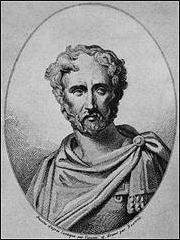
Pliny the Elder Pliny once wrote: "Nature, that is to say, life is my subject.” “Natural History” , Pliny's 37-book encyclopedia, referenced 2,000 volumes by at least 1000 authors. It contained facts about astronomy, geology, meteorology, geography, anthropology, botany, medicine, zoology, art, helmets with ostrich plumes, types of mattresses and the difficulties of sponge diving. He offered tips of raising bees and figs, described how ro make glue from oxhides, gave advice on choosing onions and reported heaps of fantastic and erroneous information.
In “ Natural History” , Pliny described a race of headless people whose eyes were on their shoulders, two-headed people who communicated by barking, fast-running people with 16 toes and backward feet; one-legged people that got around by hoping; big-footed people who reclined on their backs and used their feet as umbrellas; and mouthless people who drew their nourishment from roots.
Animals in “ Natural History “ included elks lacking knee joints, lions with human faces, scorpions with tails that fed on people, and snakes that preyed on elephants and were capable bursting rocks with their breath. “Natural History” was a bestsellers and assumed as fact through the Middle Ages. Pliny also wrote “The Art of Using a Javelin on Horseback” , “Life of Pomponius Secundus” , “The History of Wars in Germany” , “The Students” , “ Linguistic Queries” and “History of Our Own Times” .
Pliny the Elder and the Eruption of Vesuvius
While most people headed as quickly as they could away from Pompeii, the very curious Roman historian and naturalist Pliny the Elder headed straight for it. At the time of the eruption Pliny and his nephew, Pliny the Younger, were across the Bay of Naples, 15 miles from Vesuvius and 20 miles away from Pompeii. The elder Pliny considered the eruption a novelty and, taking a Roman fleet with him, sailed towards Pompeii. The nephew initially stayed behind and wrote an account of what happened, apparently pieced together from his own observations and the accounts of survivors.
Pliny the Younger wrote that Pliny the Elder "had been out in the sun, and taken a cold bath" and "my mother drew his attention to a cloud of unusual size and appearance...It was not clear from which mountain the cloud was rising. Later we knew it was Vesuvius...My uncle's scholarly acumen saw at once it was important enough for a closer inspection and he ordered a boat to be made ready."
"He was entirely fearless...he hurried to the place everyone else was hastily leaving...Ashes were already falling, hotter and thicker as the ships drew near." His boat was bombarded with fiery ashfall and blocked with floating rafts of pumice but eventually he made it to Stabiae which was about the same distance from Pompeii as Pompeii was from Vesuvius.
Pliny the Elder died in the eruption of Vesuvius. He advised calm when the volcano began erupting and stayed in Pompeii even though he had enough warning to escape. He went outside the day after the initial eruption, on August 25, with a pillow tied to his head. Some think that Pliny the Elder died choked by ash after landing in the beach near Pompeii.
See Separate Article: ERUPTION OF VESUVIUS IN A.D. 79: EFFECTS, EARTHEQUAKES AND PLINY THE ELDER europe.factsanddetails.com
Image Sources: Wikimedia Commons, The Louvre, The British Museum
Text Sources: Internet Ancient History Sourcebook: Rome sourcebooks.fordham.edu ; Internet Ancient History Sourcebook: Late Antiquity sourcebooks.fordham.edu ; “Outlines of Roman History” by William C. Morey, Ph.D., D.C.L. New York, American Book Company (1901) ; “The Private Life of the Romans” by Harold Whetstone Johnston, Revised by Mary Johnston, Scott, Foresman and Company (1903, 1932); BBC Ancient Rome bbc.co.uk/history/ ; Project Gutenberg gutenberg.org ; Metropolitan Museum of Art, National Geographic, Smithsonian magazine, New York Times, Washington Post, Los Angeles Times, Live Science, Discover magazine, Archaeology magazine, Reuters, Associated Press, The Guardian, AFP, The New Yorker, Wikipedia, Encyclopædia Britannica, Encyclopedia.com and various other books, websites and publications.
Last updated November 2024