
MACAQUES
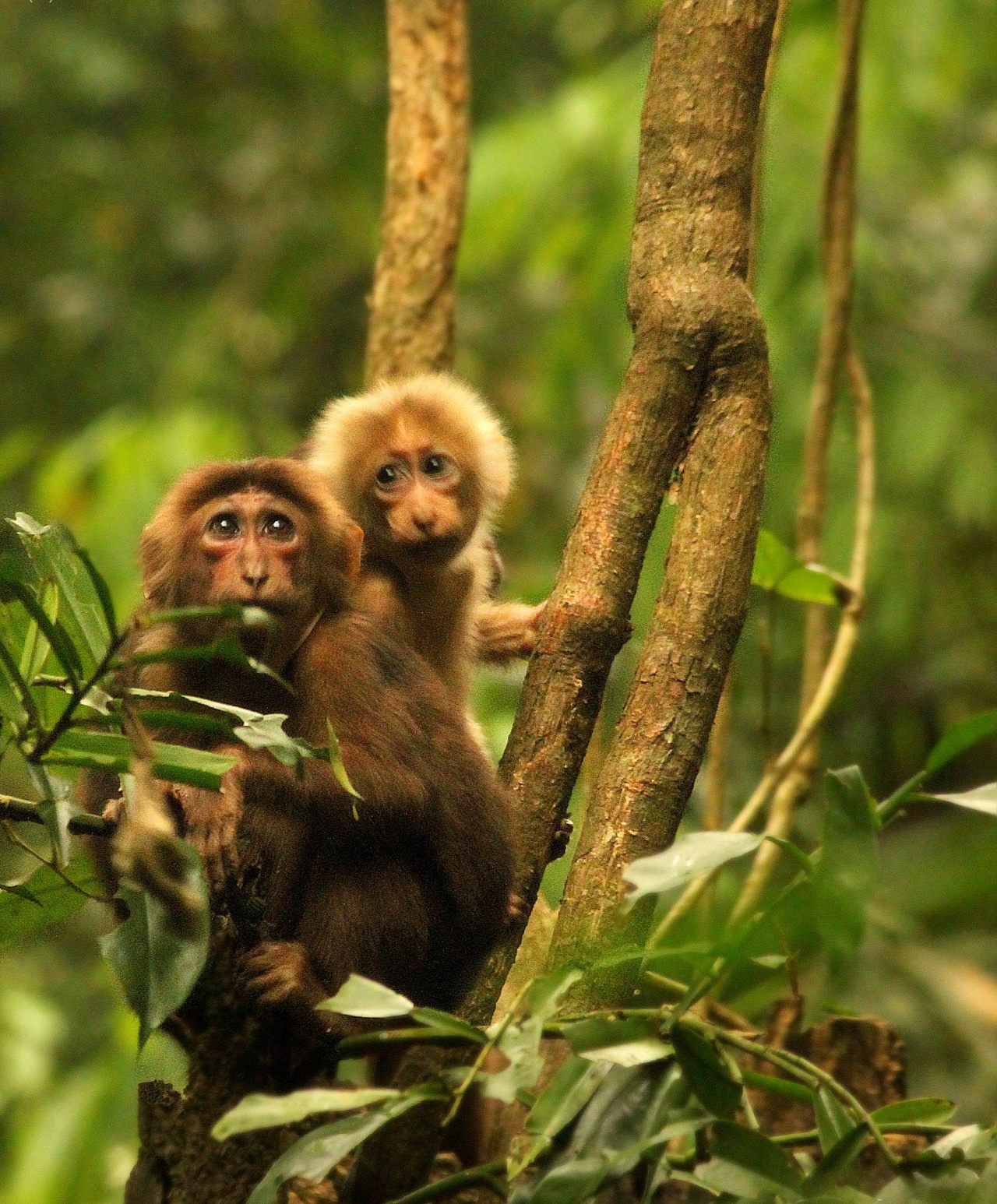
Macaques are medium-size monkeys with stout bodies and strong limbs. There are 23 species in five families and 40 different subspecies. They range across from the Old World from the Atlantic to the Pacific, including Spain, Morocco, Afghanistan Sri Lanka, Tibet, and Japan, but are found mostly in Southeast Asia, Indonesia and India. Forests and mountains have been their traditional habitat but many now live in cities.
Aside from humans, macaques are the most widespread primate genus. By some estimates, in evolutionary terms, the primate line that produced humans separated from macaque line about 25 million years ago. "The macaque is one of the most successful and versatile of all primates,”David Attenborough wrote. “If you wanted to pick a monkey that was bright, adaptable, versatile, resilient, enterprising, tough and capable of surviving in extreme conditions and taking on all comers, the macaque would win hands down.” They do equally well in mountains. marshes, rain forests and cities.
Macaques constitute the genus (Macaca) of gregarious Old World monkeys of the subfamily Cercopithecinae. Relatives of guenons, they are primarily frugivorous (preferring fruit), although their diet also includes seeds, leaves, flowers, and tree bark. Some species such as the long-tailed macaque, also called the crab-eating macaque, supplement their diets with small amounts of meat from shellfish, insects, and small mammals. On average, a southern pig-tailed macaque in Malaysia eats about 70 large rats each year. All macaque social groups are arranged around dominant matriarchs. [Source: Wikipedia]
RELATED ARTICLES:
MACAQUES: CHARACTERISTICS, BEHAVIOUR, MATING factsanddetails.com ;
PRIMATES: HISTORY, TAXONOMY, CHARACTERISTICS, BEHAVIOR factsanddetails.com ;
MONKEY TYPES: OLD AND NEW WORLD, LEAF- AND FRUIT-EATING factsanddetails.com ;
MAMMALS: HAIR, CHARACTERISTICS, WARM-BLOODEDNESS factsanddetails.com ;
PESKY, TROUBLESOME URBAN MONKEYS AND MONKEY ATTACKS factsanddetails.com
MACAQUE SPECIES factsanddetails.com ;
MACAQUES IN INDONESIA factsanddetails.com
Macaques in Southeast Asia
Assam Macaques are mainly brown in color. Their scientific name is M. assamensis (McClelland, 1840). There are two subspecies: M. a. assamensis (Eastern Assamese macaque) and M. a. pelops (Western Assamese macaque). They are native to Southeastern Asia. They are 36–77 centimeters (14–30 inches) long, with a 9–20 centimeter (4–8 inch) tail. They live in the forest and eat fruit, leaves, grains, buds, seeds, flowers, and bark, as well as insects and small invertebrates. They are near-threatened. Their numbers are unknown. Their population is declining. [Source: Wikipedia]
Crab-Eating Macaques are mainly brown in color. Their scientific name is M. fascicularis (Raffles, 1821). There are ten subspecies. They are native to Southeastern Asia. They are 40–47 centimeters (16–19 inches) long, with a 50–60 centimeter (20–24 inch) tail. They live in the forest, intertidal marine, caves, inland wetlands, grassland, shrubland, and savanna and eat fruit, crabs, flowers, insects, leaves, fungi, grasses, and clay. They are endangered. Their numbers are unknown. Their population is declining.

Formosan Rock Macaques are gray in color. Their scientific name is M. cyclopis (Swinhoe, 1862). They are native toTaiwan. They are 36–45 centimeters (14–18 inches) long, with a 26–46 centimeter (10–18 inch) tail. They live in the forest and eat fruit, leaves, berries, seeds, insects, and small vertebrates, buds, and shoots. They are a least concern species. Their numbers are unknown. Their population is steady
Northern Pig-Tailed Macaques are gray in color. Their scientific name is M. leonina (Blyth, 1863). They are native to Southeastern Asia. They are 36–77 centimeters (14–30 inches) long, with a 9–20 centimeter (4–8 inch) tail. They live in the forest and eat Leaves, seeds, stems, roots, flowers, bamboo shoots, rice, gums, insects, larvae, termite eggs and spiders. They are vulnerable. Their numbers are unknown. Their population is declining.
Rhesus Macaques brown in color. Their scientific name is M. mulatta (Zimmermann, 1790). They are native to southern and southeastern Asia. They are 45–64 centimeters (18–25 inches) long, with a 19–32 centimeter (7–13 inch) tail. They live in the forest, savanna, and shrubland and eat Fish, crabs, shellfish, bird eggs, honeycombs, crayfish, crabs, spiders, plants, gums and pith. They are a least concern species. Their numbers are unknown.
Southern Pig-Tailed Macaques are mainly brown in color. Their scientific name is M. nemestrina (Linnaeus, 1766). They are native to Southeastern Asia. They are 46–57 centimeters (18–22 inches) long, with a 13–26 centimeter (5–10 inch) tail. They live in the forest and shrubland and eat fruit, insects, seeds, leaves, dirt, and fungus, as well as birds, termite eggs and larvae, and river crabs. They are endangered. Their numbers are unknown. Their population is declining.
Stump-Tailed Macaques are reddish brown in color. Their scientific name is M. arctoides (I. Geoffroy, 1831). They are native to Southeastern Asia. They are 48–65 centimeters (19–26 inches) long, with a 3–7 centimeter (1–3 inch) tail. They live the forest and eat fruit, seeds, flowers, roots, leaves, frogs, crabs, birds, and bird eggs. They are vulnerable. Their numbers are unknown. Their population is declining.
Stump-Tailed Macaques
Stump-tailed macaques (Scientific name: Macaca arctoides) are native to southeast Asia and can be found in China, India, Myanmar (Burma), West Malaysia, Thailand, Vietnam, eastern Bangladesh, and the Malay Peninsula. There is an introduced population in Tanaxpillo, Veracruz, Mexico, an island not inhabited by humans, where they live in conditions similar to their natural habitat in Asia. They can live up to 30 years in captivity. However, they tend to have shorter lifespans in the wild. Their average lifespan in captivity is 30 years.[Source: Charlotte Erfurth, Animal Diversity Web (ADW) /=]
Stump-tailed macaques live in tropical areas in forests and rainforests up to elevations of 2500 meters (8200 feet). They range in weight from 7.5 to 10.2 kilograms (16.5 to 22.5 pounds) and range in length from 48.5 to 65 centimeters (19 to 25.6 inches). Stump-tailed macaques have hairless tails that are shorter than other macaque species. Tail length ranges from 3.2 to 69 millimeters.
Stump-tailed macaques are also known as bear macaques because they have shaggy, dark brown hair covering them. They have hairless faces with red skin which darkens with sun exposure. Infants are born with white hair that darkens as they grow older. Adult males and females show balding on the tops of their heads, much like human males, receding from the forehead towards the back of the skull, as they age. As in all other cercopithecines, they have cheek pouches that they use to store food when foraging. They are terrestrial quadrupedal movers.
Stump-tailed macaques are sexually dimorphic. Males are larger, ranging from 9.9 to 10.2 kilograms and 51.7 to 65 centimeters in height while females weigh 7.5 to 9.1 kilograms and are 48.5 to 58.5 centimeters in height. Males also have much larger canines, which they use for asserting dominance within their group.
Stump-tailed macaques are listed as vulnerable on the International Union for Conservation of Nature (IUCN) Red List. They are listed in CITES (Convention on International Trade in Endangered Species of Wild): Appendix II, which lists species not necessarily threatened with extinction now but that may become so unless trade is closely controlled. Humans have used stump-tailed macaques for testing the anti-hairloss drug minoxidil (Rogaine). By doing this researchers were able to produce a safe product for human use. Stump-tailed macaques can be a nuisance to farmers by crop raiding.
Stump-tailed macaque populations decreased 20 percent between the year 2000 and 2010. Some Indian and Bangladesh populations haven't been seen since 1990. Habitat loss and hunting are see as the main causes. They are also becoming more uncommon in Thailand and Malaysia, where urban and agricultural expansion has threatened native habitats. In India, these macaques are legally protected and land set aside for them and some enforced protection. Natural predators include large raptors, leopards, dogs, and clouded leopards. To deter predators, they shake branches, bare their canines, assume aggressive postures, and alpha males will "roar".
Stump-Tailed Macaque Behavior and Communication
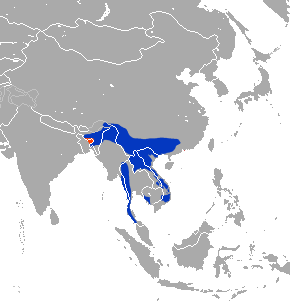
range of the stump-tailed macaque
Stump-tailed macaques are terricolous (living in the ground), diurnal (active mainly during the daytime), motile (move around as opposed to being stationary), nomadic (move from place to place, generally within a well-defined range), sedentary (remain in the same area), territorial (defend an area within the home range), social (associates with others of its species; forms social groups), and have dominance hierarchies (ranking systems or pecking orders among members of a long-term social group, where dominance status affects access to resources or mates). Territory size is unknown but is believed to be several square kilometers. During the day they travel two to three kilometers. They tend to travel less during the rainy season. After foraging during the day, they travel back to their sleeping sites in trees. [Source: Charlotte Erfurth, Animal Diversity Web (ADW) /=]
Stump-tailed macaques live in groups of up to 60 individuals consisting of adult males, females, and young. Females are philopatric (remain in or return to the area of their birth). and males leave after sexual maturity. Hierarchical rank is reinforced through physical contact such as biting and slapping. However, compared to other macaque species, they are more peaceful and egalitarian in their social structure. When young males move into a new group they fight to establish rank in the hierarchy. After a disagreement or fight they have a specific ritual of reconciliation. The subordinate will present his rump to the dominant male, who will kiss or embrace the subordinate. The subordinate will respond by "lip smacking" or "teeth chattering".
Stump-tailed macaques sense and communicate with vision, sound, touch and chemicals usually detected with smell. Common forms of visual communication are "teeth chattering", presenting one's rump to another individual, "lip smacking" and "barred teeth". When in heat, the females have swellings on their behind. This is a form of sexual communication, that they are receptive to mating. Vocal communication often consists of "coo" which is used to stay in contact with other group members or when approaching another individual. They also use grunts when approaching another after fighting or if they are interested sexually. Alpha males "roar" to fend off predators. When infants are distressed they will let out a shrill "whistle".
Stump-Tailed Macaque Feeding and Reproduction
Stump-tailed macaques are omnivores (eats a variety of things, including plants and animals) but are primarily frugivores (eat mainly fruits) . Animal foods include birds, small mammals, reptiles, insects, frogs, freshwater crabs, bird eggs, terrestrial worms aquatic crustaceans. Among the plant foods they eat are leaves, roots and tubers seeds, grains, nuts, fruit, and flowers. They have cheek pouches that, when filled, can hold a volume equal to that of their stomach. They forage starting in the morning and continue through midday. They have also been known to raid corn crops and eat cultivated fruits.
Stump-tailed macaques are polygynandrous (promiscuous), with both males and females having multiple partners. They engage in seasonal breeding and reproduce about every two years. The breeding season is from in October and November in wild. The average number of offspring is one. /=\
According to Animal Diversity Web: Dominance plays a big role in who gets to mate. High ranking males monopolize females in the group. However, lower ranking males have other strategies of obtaining mating opportunities. They hang back and mate with females when the dominant male is not watching. Often referred to as the "sneaker" male strategy. Both males and females initiate mating, though males tend to be more active when it comes to sexual behavior. Females make eye contact and present their perineal region (rump). Males approach females and sit next to them. Males chatter their teeth and grimace. When copulation is occurring, other group members often harass the pair.
The average gestation period is 177 days. The average weaning age is nine months and the average time to independence is 18 months. On average females reach sexual or reproductive maturity at age four years and males reach sexual or reproductive maturity at 4.5 to five years. Young inherit rank maternally as females are philopatric. The primary caregiver for young is the mother. She nurses, carries, and protects them. Additionally, all the females in the group care for the young of other females, especially if the mother is high ranking. Females carry, play with, protect, and groom the young. Alpha males will also help protect young and infants since there is a good chance they are their offspring. Stump-tailed macaques are more gentle with their young than other macaque species. Their is no threat of kidnapping from other group members, so mothers tend to be lenient with their young and give them independence in exploring the environment around them.
Rhesus Monkeys
Rhesus monkeys (Scientific Name: Macaca mulatta) are a kind of macaque native to northern India and Pakistan but found throughout South Asua and Southeast Asia. Also known as Rhesus macaques, they can adapt to almost any environment. They streak through bazaars, walk through snow and are as comfortable in city streets as they are in the forest. They often live around temples and are regarded as sacred.
Populations of rhesus monkeys are most commonly found in a broad arc that stretches western Afghanistan, through India to northern Thailand. This species was wll represented in the past in southern China and Tibet, but humans have caused their decline over the past century or so. Because rhesus monkeys is often used for research, today populations are kept in captivity world wide. [Source: Joshua Seinfeld, Animal Diversity Web (ADW) /=]
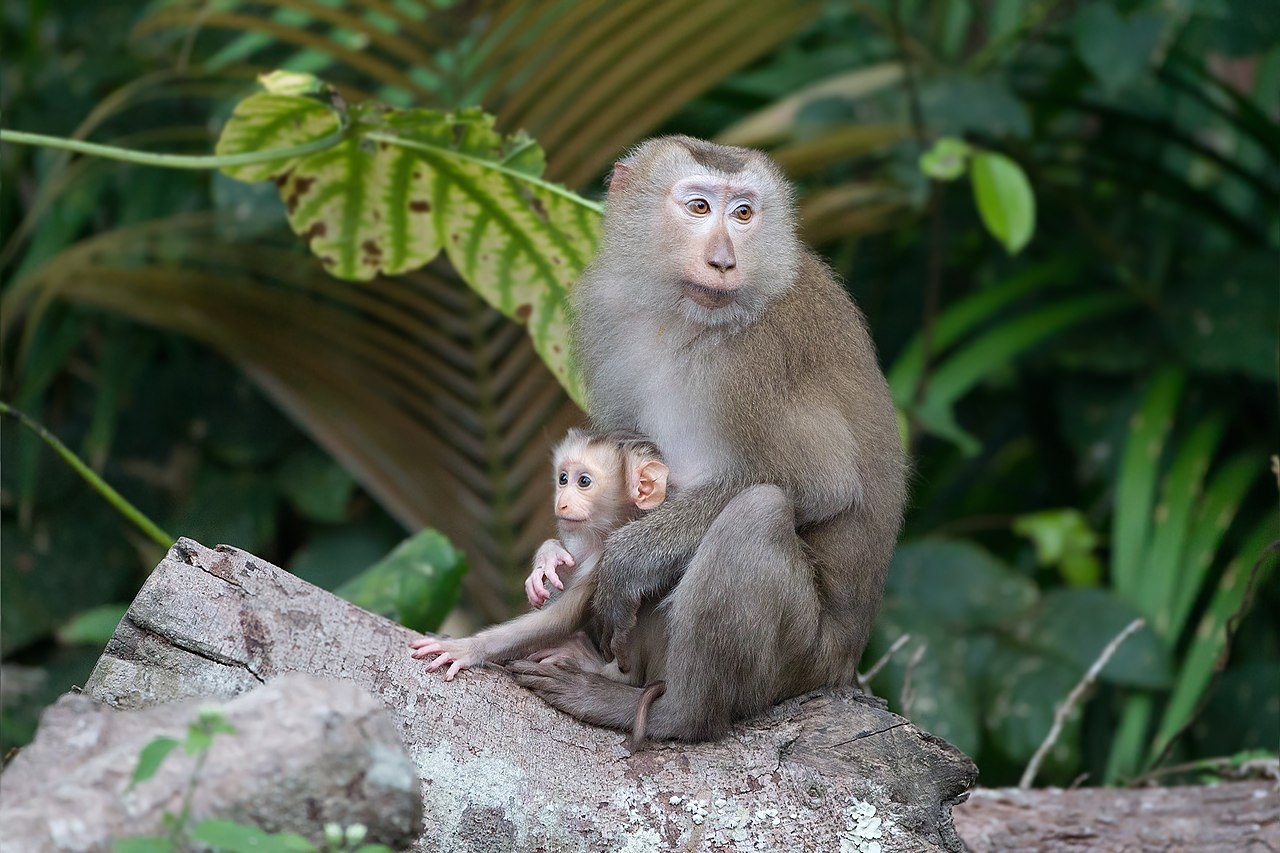
Rhesus monkeys are small-to-medium-size primates. They have grizzled-brown fur on their back and slightly lighter color fur on their front side. The hair is short on the head. The face and buttocks of adults are red. They range in weight from four to 12 kilograms (8.81 to 26.43 pounds) and range in length from 45 to 64 centimeters (17.72 to 25.20 inches). The tail adds an additional 19 to 32 centimeters to the total length.
Rhesus monkeys are a popular zoo animal because of its innate curiosity and active lifestyle. These monkeys are also used extensively for research. They are especially useful in biological, medicinal, and psychological research. Rhesus monkeys is most often used in psychological research when the emphasis is on perception, learning, or behavior. /=\
Rhesus monkeys are the commonest monkeys in India. They make up most of India’s 1.5 million monkeys. Rhesus monkeys live in matriarchal societies, with mothers ranking above their daughters (and supporting them in fights) until they are very old. There is also a hierarchy of matriarchal units that is determined by relations between dominant female in each group. The situation in which family members will come to the aid of a female or not are usually defined by the ranking of the adversary. Rankings are sometime dramatically altered when females are claimed by disease or predators.
See Separate Article: RHESUS MONKEYS factsanddetails.com
Pig-Tailed Macaques
Pig-tailed macaques are relatively large monkeys native to Southeast Asia. Males can measure up to 65 centimeters (two feet) from the buttocks to the top of the head and weigh up to 18 kilograms (40 pounds). When threatened they screech and bare their canines. The buttocks of females become swollen and red when they are receptive to mating.
Pig-tailed macaques are regarded as "clever, political animals" with "good mother-infant bonding and particularly strong peer interaction and play." Their thick fur protects them from bees and stinging ants. In some parts of Malaysia, pig-tailed macaques are used to pick coconuts.
Pigtail macaques are widely distributed throughout Southeast Asia and found in Assam and northeast India, Yunnan and souther China, Borneo, Kalimantan, Sumatra in Indonesia, eastern Bangladesh, Myanmar (Burma), Thailand, Laos, Cambodia, Vietnam, Peninsular Malaysia and Bangka, and neighboring islands. Pigtail macaques have been introduced in Singapore and the Natuna Islands. [Source: Kayla Ayers and Candace Vanderpoel, Animal Diversity Web (ADW) /=]
Pigtail macaques mainly live in tropical areas in rain forests and swamps from sea level to more than 2000 meters (feet). They prefer dense, humid rainforest with temperatures ranging from 18 to 30 degrees Celsius (64 to 86 Fahrenheit). They tend to live in places with a rainy season and slight temperatures variations according to the seasons and regions. Rainforests they inhabit get as much as 250 centimeters (8.2 feet) of rain each year.
See Separate Article: PIG-TAILED MACAQUES factsanddetails.com
Crab-Eating Macaques
Crab-eating macaques (Macaca fascicularis) are also called long-tailed macaques, cynomolgus or Java monkeys. Most don’t live by the sea, preferring trees instead . Those that do have access to the sea feed on crabs, other crustaceans and other animals exposed by low tide. They are usually unsuccessful in efforts to chase crabs but are able to catch them when the they wait at the crab’s hole and grab when it emerges to take a look. These monkeys have been observed getting pinched by a crab and frantically flapping their hands in the air. There are also inland A crab-eating macaque at the Sacred Monkey Forest Sanctuary in Ubud, a Balinese town in Indonesia.
Crab-eating macaques are found in southeast Asia from Myanmar (Burma) to the Philippines and southward through southern Thailand, Cambodia, southern Vietnam, Malaysia, and Indonesia, and as far east as the Timor Islands. They are regarded as the most arboreal (tree living) of all macaque species. You can find them in tropical areas and areas with an extended dry season in primary rainforests, scrub forests, disturbed and secondary forests, and riverine and coastal forests of nipa palm. One study of crab-eating macaque behavior reported that they never came to the ground except within five meters of the edge of a river near their tree. They also live in coastal areas, near brackish water and in mangroves and swamps, agricultural areas and areas near rivers. [Source: Christopher Bonadio, Animal Diversity Web (ADW) /=]
Crab-eating macaques are "ecologically diverse." Among the habitats in which they have had the most success are disturbed habitats and on the periphery of forests. In Sumatra, they have achieved their highest population densities in mixed mangrove swamps, secondary hill forests, and riverine forests. Some were also observed in freshwater swamps, scrub grassland, lowland primary forests, and rubber groves. /=\
See Separate Article: CRAB-EATING MACAQUES factsanddetails.com
Formosan Rock Macaques
Formosan rock macaques(Macaca cyclopis) are found in the mountainous terrain of northeastern and southwestern Taiwan. They may once lived near the sea coast but are largely restricted to inland areas because of human activity. They can still be found in a few coastal areas. These macaques primarily inhabit mixed coniferous-hardwood temperate forest, as well as bamboo and grassland at elevations between 100 and 3600 meters (328 to 11811 feet). Living in areas with a temperate climate similar to that of the southern U.S. and southern Europe, they reach an age of about 30 years old in captivity. Lifespans in the wild are probably shorter.[Source: Crystal Chiu, Animal Diversity Web (ADW) /=]
Formosan rock macaques are quadrupedal (use all four limbs for walking and running) and have a rounded head and flat muzzle.They range in weight from five to 18 kilograms (11 to 39.6 pounds) and range in length from 36 to 45 centimeters (14.2 to 17.7 inches), excluding their tail which varies in length from 26 to 46 centimeters. Sexual dimorphism (differences between males and females) is present: Males are larger than females. Formosan rock macaques use their cheek pouches to carry food in while foraging. Their fur is dark gray to brown in color. Their hair is soft and a dark gray in winter and a drab olive color in the summer. Their abdominal skin is slightly blue.
Formosan rock macaques are primarily omnivores (eats a variety of things, including plants and animals). Animal foods include insects and small vertebrates. Among the plant foods they eat are leaves seeds, grains, and nuts fruit. These macaques also reportedly raid crops. Reports from over a century ago described how the animal traveled with great agility over virtually inaccessible rocks on the seacoast, and a main constituent of their diet was crustaceans and mollusks.
The IUCN Red List classifies them as a species of “Least Concern”. They are placed in CITES Appendix II, which lists species not necessarily threatened with extinction now but that may become so unless trade is closely controlled. Clouded leopards are the main natural predators of these animals Humans have to hunted them animals for their meat. Young one may be taken by raptors.
Formosan Rock Macaque Behavior and Communication
Formosan rock macaques are terricolous (live on the ground), diurnal (active mainly during the daytime), motile (move around as opposed to being stationary), sedentary (remain in the same area), social (associates with others of its species; forms social groups), and have dominance hierarchies (ranking systems or pecking orders among members of a long-term social group, where dominance status affects access to resources or mates). Formosan rock macaques are comfortable in terrain with few trees or none. They are not shy and sometimes visit the fields of Taiwanese villagers and are particularly inclined to dig up sweet potatoes and peanuts.[Source: Crystal Chiu, Animal Diversity Web (ADW) /=]
Formosan rock macaques live in a multimale-multifemale social system with group sizes averaging 45 individuals. However, because of the recent decline in numbers, group structure resembles that of a unimale system and group sizes range typically between two and 10 individuals. Troops have two to eight males, with a ratio of 1.25 males to 1.5 females. Territories overlap partially. Males emigrate and are solitary or form bachelor troops. Small troops with only one male have been observed to have an influx of bachelor males during the breeding season. /=\
Formosan rock macaques communicate with vision, touch and sound and sense using vision, touch, sound and chemicals usually detected with smell. They emit 'scream calls' when approached by a non-group members. Group members answer this call with a sound that sounds like "kyaw-kyaw". Staring with an open mouth but with the teeth covered indicates aggression The fear grimace display — with their lips retracted so that the teeth are shown and clenched — is an appeasement signal to reduce aggression in aggressive encounters. /=\
Formosan Rock Macaque Mating, Reproduction and Offspring
Formosan rock macaques are polygynous (males having more than one female as a mate at one time). Females five to nine years old usually give birth every other year, older females give birth every year. During estrus the perineum of the female swells at the base of the tail and along the thighs. These macaques engage in seasonal breeding. The mating season occurs from November through January, with the average number of offspring being one. /=\
The average gestation period is 165 days. The average weaning age is 12 months. Young weigh an average of 400 grams at birth. Since mating season occurs from November through January, births occur from April through June. The mating season coincides with the peak of fruit availability.
According to Animal Diversity Web: Most parental care is provided by the mother. She grooms, nurses, protects her infant until it becomes independent. There is an extended period of juvenile learning. In most macaques, the period of nursing is about a year. Young are typically independent by two years of age. However, females may have relationships with their female kin for the remainder of their lives. Females remain in their natal group with the onset of maturity, but males disperse shortly before adolescence. There is a hierarchical dominance system among group members based upon the matriline. The position of the mother in the dominance hierarchy affects status of young. Young inherit the territory of their mother.

Macaque species: 1) Barbary Macaque (Macaca sylvanus), 2) Lion-tailed Macaque (Macaca silenus), 3) Crested Macaque (Macaca migra), 4) Gorontalo Macaque (Macaca nigrescens), 5) Heck’s Macaque (Macaca hecki), 6) Tonkean Macaque (Macaca tonkeana), 7) Moor Macaque (Macaca maura), 8) Booted Macaque (Macaca ochreata), 9) Pagai Macaque (Macaca pagensis), 10) Siberut Macaque (Macaca siberu), 11) Sunda Pig-tailed Macaque (Macaca nemestrina), 12) Northern Pig-tailed Macaque (Macaca leonina), 13) Toque Macaque (Macaca sinica), 14) Bonnet Macaque (Macaca radiata)
Image Sources: Wikimedia Commons
Text Sources: Animal Diversity Web animaldiversity.org ; National Geographic, Live Science, Natural History magazine, David Attenborough books, New York Times, Washington Post, Los Angeles Times, Smithsonian magazine, Discover magazine, The New Yorker, Time, Reuters, Associated Press, AFP, Lonely Planet Guides, Wikipedia, The Guardian, Top Secret Animal Attack Files website and various books and other publications.
Last updated December 2024