
PALM OIL AND MALAYSIA
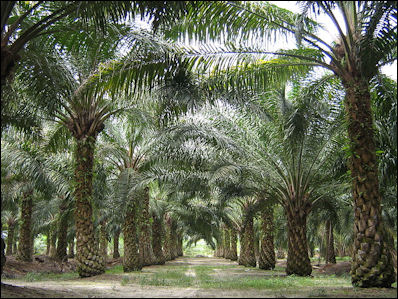
Oil palms in Malaysia Malaysia is the world's second biggest palm oil producer and exporter, and its companies are also big players in neighboring Indonesia, the largest producer of palm oil. Malaysia would like to produce more palm oil, but it is running out of viable land for new oil-palm plantations, according to the US Department of Agriculture.
Palm is Malaysia’s most lucrative crop. According to the Washington Post: “In 2011, the export of palm oil and palm-based products netted $27 billion — a five-fold increase over the past decade — as a result of brisk trade with China, Pakistan, the European Union, India and the United States, which imported record levels that year. Palm oil accounts for 7 to 10 percent of Malaysia's GDP, making it the third largest income-generating natural commodity after petroleum and timber. Indonesia is the world's second largest palm oil producer. Palm oil became very profitable in Malaysia as the value of ringgit crashed after the Asian economic crisis in 1997-98.
Native to West Guinea in Africa, the oil palm tree was introduced to Malaysia in 1870, with commercial production beginning in 1917. Over the years it replaced rubber as Malaysia’s primary cash crop. The Malaysian Palm Oil Association represents 40 percent of the country’s growers. In the early 2000s, palm oil plantations covered 3.5 million hectares, a tenth of Malaysia, an area larger than Belgium, You can get a sense of much how land this is when you fly into Kuala Lumpur and you see row upon row of plantation palm trees. Expansion of oil palm is linked to the loss of 700,000 hectares of tropical forest in Malaysia as of 2005.
A fifth of Malaysia’s crude palm oil is produced in the state of Sarawak. A larger amount comes from Sabah (See Below), which produces around seven percent of the world's palm oil. A large amount is also produced in Peninsular Malaysia, where cultivation of the oil first took root. There one of the biggest problems that palm oil farmers face is elephants. Apparently they love palm fruit, even the semi-rotten fermented fruit. When they eat the fermented fruit they get drunk and apparently the do indeed like doing that.
See Separate Articles: PALM OIL: USES, HISTORY, AGRICULTURE AND PRODUCTION factsanddetails.com; PALM OIL BUSINESS: PRODUCERS, COMPANIES, IMPORTERS factsanddetails.com; PALM OIL AND RAIN FOREST DEFORESTATION factsanddetails.com
Palm Oil and the Malaysian Government
In 2018, Malaysia mandated that all mills, plantations, and small growers must have their palm oil operations certified as sustainable by the end of 2019
But that wasn't always the case. Massive palm oil and rubber plantations created with the Malaysia government help have gobbled up hundreds of thousands of square miles of the nation's tropical rain forests. In a typical government-sponsored program: first the trees are cut down; then, three months later, the area is burned. After seven months the area is cleared and burned again. Then palm trees are planted, sprayed and fertilized. At 28 months the trees are pollinated palms by hand and not long after that the first fruit is ready. [Source: Peter White, National Geographic January 1983 ┧]
Promoted by incentives which give plantation owners a 100 percent tax exemption for 10 years, thousands of hectares of forest have been cleared for palm oil and other types of plantations. While plantations on cleared and degraded forest lands are ecologically and economically beneficial, clearing natural forest for plantations results in increased erosion and biodiversity loss.
Palm Oil and Borneo
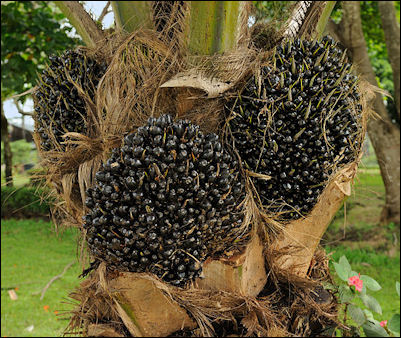
palm oil fruit Jason Motlagh wrote in the Washington Post, “The toll is most acutely felt in Borneo, the Southeast Asian island shared by the two countries that are home to one of the oldest rain forests on Earth and mankind’s closest relative, the orangutan. According to a new study, oil palm plantations over the past two decades have cleared about 6,200 square miles of primary and logged forested land. Palm oil deforestation and hunting have combined to reduce Bornean orangutan populations to 54,000, half the total of the 1980s, according to environmental groups. At this rate, some predict, the iconic animal could be extinct within years. [Source: Jason Motlagh, Washington Post, November 26, 2012 /*/]
“Borneo started losing its rain-forest cover in the 1960s when the Malaysian government pushed the expansion of oil palms to complement rubber tree growth. Migrant workers traveled in droves from Indonesia and the Philippines to work on the plantations being carved out of the backcountry. /*/
“Critics of the palm oil industry counter that the breakneck expansion of plantations into virgin tracts of Borneo’s countryside is benefiting little more than a handful of major companies, which gain extra income from timber, at the expense of one of the world’s most biologically diverse areas and the farmworkers who do the heavy lifting. A joint study published last month by Stanford and Yale universities found that land-clearing operations for plantations in Borneo emitted more than 140 million metric tons of carbon dioxide emissions in 2010 alone, equal to annual emissions from about 28 million vehicles. /*/
“We may see tipping points in forest conversion where critical biophysical functions are disrupted, leaving the region increasingly vulnerable to droughts, fires and floods,” project leader Lisa M. Curran, a professor of ecological anthropology at Stanford University, said in a statement. “It’s a perfect storm of human rights abuses and social conflict on the one hand and the destruction of some of the most biologically diverse forests in the world on the other,” said Laurel Sutherlin, communications director for the Rainforest Action Network, a San Francisco-based environmental organization. “Extraordinary ecosystems are becoming dead tree farms.” /*/
“Indonesian officials have announced plans to convert about 18 million more hectares — an area the size of Missouri — into palm oil plantations by 2020. Malaysia wants to double the area under cultivation over the same period to drive development in its rural eastern provinces, where infrastructure and living standards lag far behind its wealthier, more industrialized western peninsula. /*/
Palm Oil in Sabah
Hillary Rosner wrote in National Geographic:“On a sticky afternoon near the northeastern tip of Borneo, small groups of elephants graze by a murky river. As the sun drops toward the treetops, the groups converge at a muddy riverbank. Soon more than 50 elephants are swimming in an orderly line across the wide, fast-moving Kinabatangan River, bobbing their giant heads and spraying water out their trunks. The Kinabatangan is among the easiest places to see wildlife in Sabah, the Malaysian state that occupies northern Borneo. From boats on the river, tourists can view rare and iconic species — Borneo pygmy elephants, proboscis monkeys, rhinoceros hornbills, even orangutans — without getting their boots dirty. It’s a thrill to watch these animals in the open. But the reason they’re so visible is that they have nowhere else to go. For endless, sprawling miles around the river, the forest has been obliterated and replaced by oil palms. You can drive for hours, passing a parade of tanker trucks carrying palm oil, and barely see another species of tree.[Source: Hillary Rosner, National Geographic, December 2018]
“In Sabah in the 1970s, the government turned to agriculture to address its decades-long overdependence on timber. It earmarked large swaths of fertile flatland in lowland forests, including the Kinabatangan region, for growing crops. “The assumption was that all the best soil should be allocated for agriculture,” says John Payne, a conservation biologist who has lived in Sabah since 1979.
“Through the 1980s, Sabah’s agricultural land was largely devoted to cocoa. But when falling world prices and a pest called the cocoa-pod borer made the crop less profitable, most plantations switched to oil palms. Land was cheap, so companies from the Malaysian mainland began snapping it up, building mills and other infrastructure. That made it easier for growers to get their fruit to market — and large-scale forest clearing began in earnest. Today one-fifth of the state is covered in oil palms. Sabah produces more than 7 percent of the world’s palm oil. The ecological cost has been astonishing. Many remaining forest fragments are disconnected from one another — islands of jungle that look intact but are largely empty of animal life. “What used to house the highest density of orangutans is now oil palm,” Payne says.
“The palm oil boom has helped bring clear economic benefits to Sabah: paved roads, better schools, satellite television. In Kota Kinabalu, the state’s capital, gleaming new shopping malls feature Western and Asian luxury brands.
Oil Palm and the Sabah Government
Hillary Rosner wrote in National Geographic:“And at the helm of the state’s forestry department until recently was Sam Mannan, the chief conservator of forests. Under his leadership Sabah expanded its protected lands over the past decade from 12 to 26 percent of the state — more than 7,000 square miles. Mannan’s goal was to increase that to 30 percent by 2025, linking up parks, wildlife reserves, and other blocks of state-owned forest with replanted corridors for animals to move through. [Source: Hillary Rosner, National Geographic, December 2018]
“A gregarious man with a devilish streak — he once joked at a press conference that rhinos were going extinct because “they’re stupid” — Mannan believed in collaborating with palm oil producers. “Without oil palm, conservation in Sabah would be in trouble,” Mannan told me in his office in the seaside city of Sandakan, once the island’s timber capital. Only petroleum contributes more revenue to Sabah’s government than the oil palm industry. “The money is going back to conservation,” Mannan said. You could argue, I pointed out, that without oil palms you wouldn’t need as much money for conservation. “You could argue that way,” Mannan said, “but you would be poor.”
“This past August, Mannan was terminated by Sabah’s new government, which had launched an investigation into possibly illegal logging deals made by the previous administration. Mannan had managed to annoy those on both sides of the palm oil debate in Malaysia during his nearly two-decade tenure. But many environmentalists had considered him a restraint on the industry — a “visionary, bold, and effective” government leader, Payne says.
Palm Oil Boom Town in Sabah
Reporting from Sabah, Jason Motlagh wrote in the Washington Post, “Twenty-five years ago, Lahad Datu was just another sleepy port town on the fringe of Malaysian Borneo, frequented by traders, sea gypsies and the occasional pirate gang. These days, big money is flowing into banks and construction projects that have multiplied in the city center, where a gaudy silver statue honors the cash crop that put the former backwater on the map: palm oil. [Source: Jason Motlagh, Washington Post, November 26, 2012 /*/]
“The transformation of Lahad Datu is emblematic of the boom going on in Malaysia’s Sabah province, which accounts for about a quarter of Borneo’s land area. The local population has doubled over the past 15 years. American fast-food chains and other new businesses have arrived. And real estate prices are soaring in what has been dubbed “Palm City.” On the southern edge of town, lines of tanker trucks deliver crude palm oil to a sprawling, state-owned refinery complex where smokestacks belch into the night. Fresh lots have been set aside for prospective investors, and officials hope that a deep-water port under construction nearby will position the region to be a top exporter of biodiesel fuel. /*/
“Longtime residents who recall a time when street crime and power failures were a fact of life boast that their children are coming back to the city to start businesses and profit from the boom. “The quality of life here has improved tremendously,” Tammay Bin Inton, 58, a community leader, said as he joked with friends at a popular coffee shop. Nasrun Datuk Mansur, a state assemblyman and assistant to the Sabah chief minister, said the industry is “the catalyst for all types of business activities that are helping Lahad Datu develop very fast, and I believe it’s true for the whole country.” /*/
Palm Oil Labor
Workers on a palm oil plantation earn about $2.60 a day. Many of the workers in Peninsular Malaysia are Indians. In Sarawak many are legal and illegal migrants from Indonesia, some of whom have been in Sarawak so long there their kids have grown up and gone to school there.
Jason Motlagh wrote in the Washington Post, “Lost in the environmental debate is the plight of thousands of migrant workers — mostly from Indonesia — who remain the life’s blood of Malaysian palm oil plantations. Some have labored in the country for more than 30 years. Yet the government does not provide education or health-care services to them and the estimated 36,000 children living on backcountry farms. The laborers and their children “are invisible; they have no future. They just work and work and work,” said Alison Neri, the director of a social welfare organization that assists Indonesian migrants in eastern Malaysia. [Source: Jason Motlagh, Washington Post, November 26, 2012 /*/]
“Leonary Marcus, 17, came with his parents from Indonesia as a young boy. He attended a learning center run by a local nonprofit organization, but without legal documents, he was ineligible for secondary school. For the past five years he has toiled on the plantations, earning about $7.50 a day. “It’s a hard life, but what choice do I have?” he said. /*/
“Without access to state schools, workers’ children are destined to hard labor in the shadows, said Aegile Fernandez, director of Tenaganita, an organization that assists undocumented migrants in the country. She said it was the “duty of every government to look after every child on its soil — no questions asked.” /*/
“On a recent afternoon, Mappi Tabbo and his five children, ages 5 to 19, loaded a pickup truck with their day’s haul of palm nuts. Ten years after leaving Indonesia for a better-paying job, the 41-year-old still risks arrest, a penalty that exceeds a year’s wages and possible deportation if caught by police.He avoids town altogether.” /*/
Palm Oil Biofuels in Malaysia
Nippon Oil, Toyota and the Malaysian state-run oil company Petronas have worked together to create a biofuel made from palm oil. Malaysia at one point said it would set aside six million tons of palm oil — 40 percent of the nation’s crop — for biodeisel. In the mid 2000, there was a rush of investment into the sector and construction of plants that make ethanol from palm oil. In August 2006, Malaysia's first commercial-scale biodiesel plant began operations in Pasir Gudang, Johor. The $11 million plant makes fuel that is five percent palm oil and 95 percent diesel. The biodiesel industry has been identified as one of the 12 National Key Economic Activities (NKEA) under the Tenth Malaysia Plan.
Projects requiring Malaysian and Indonesian palm oil as feedstocks have been criticized by some environmental advocates. Friends of the Earth has published a report asserting that clearance of forests for oil-palm plantations is threatening some of the last habitat of the orangutan. Also, in a column for The Guardian, writer George Monbiot claimed that land clearance by cutting and burning large forest trees frees large amounts of carbon dioxide that is never reabsorbed by the smaller oil palms. If true, then biodiesel production from plantation-grown palm oil may be a net source of atmospheric carbon dioxide. How these issues are resolved may determine whether Malaysia eventually becomes a major producer of biodiesel. [Source: Wikipedia]
Wilmar, Palm Oil and Robert Kuok
Wilmar International Limited is a Singaporean investment holding company that provides management services to its over 400 subsidiary companies. Founded in 1991 and headquartered in Singapore, it is Asia’s leading agribusiness group. It also ranks amongst the largest listed companies by market capitalisation on the Singapore Exchange.
Wilmar is a major player in the palm oil business. As of 2010 it was: 1) the largest global processor and merchandiser of palm and lauric oils; 2) one of the largest plantation companies in Indonesia/Malaysia; 3) the largest palm biodiesel manufacturer in the world; 4) a leading consumer pack edible oils producer, oilseeds crusher, edible oils refiner, specialty fats and oleochemicals manufacturer in China; 4) one of the largest edible oils refiners and a leading producer of consumer pack edible oils in India; 5) the largest edible oils refiner in Ukraine; and 6) the leading importer of edible oils into East Africa and one of the largest importers of edible oils into South-east Africa. [Source: Wilmar]
Wilmar is largely owned by Chinese Malaysian tycoon Robert Kuok, Malaysia’s richest man with assets of $12.5 billion in 2013, according to Forbes. Forbes says: Kuok “made his money in sugar, palm oil, shipping and property. His Kuok Group boasts a huge network of companies under 3 main groups in Hong Kong, Singapore and Malaysia. Biggest source of wealth is his stake in Wilmar, the world's largest listed palm oil company. But the stock weakened during the past twelve months as palm oil prices slumped. Wilmar is run by his nephew, Kuok Khoon Hong, a Singapore citizen who's also a billionaire thanks to his 10 percent stake in the company. [Source: Forbes]
Wilmar commenced operations as a palm oil trading company in 1991, In 2006, it was renamed Wilmar International Limited. In 2007, it completed the merger with Kuok Group’s palm plantation, edible oils, grains and related businesses in a deal worth US$2.7 billion, as well as a restructuring exercise to acquire the edible oils, oilseeds, grains and related businesses At that time, Wilmar Holdings Pte Ltd (WHPL), included stakes in Archer Daniels Midland Asia Pacific (ADM) and its subsidiaries in these businesses. Also in 2007, Wilmar formed a joint venture with Olam International Ltd and SIFCA Group, one of Africa’s largest agro -industrial groups with significant interests across palm oil, cotton seed oil, natural rubber and sugar sectors in Africa.
In 2010 Wilmar acquired Australian conglomerate CSR's sugar business Sucrogen, world's fifth-largest sugar-refiner, for US$1.47 billion. In 2011, the first bio refinery plant for jets in Indonesia commenced operations under Wilmar leadership. It produced 500 tons of biofuel per day Q4 2012, 80 percent of it would be biodiesel while the rest will be bio-olefin, the most important components for aviation biofuel, although still needed further processing.
Wilmar’s Palm Oil Business
Wilmar engages in oil palm cultivation and milling, and is one of the largest oil palm plantation owners in Indonesia and Malaysia. Business activities include oil palm cultivation, edible oils refining, oilseeds crushing, consumer pack edible oils processing and merchandising, specialty fats, oleochemicals, and biodiesel manufacturing, and grains processing and merchandising. [Source: Wikipedia]
Wilmar's merchandising and processing segment encompass: 1) merchandising of palm oil and laurics-related products; 2) operations of palm oil processing and refinery plants; 3) crushing, further processing and refining of a range of edible oils, oilseeds, grains and soyabean. Its consumer products segment has oil bottling business in the People's Republic of China, Vietnam and Indonesia. Its plantation and palm oil mills segment engages in oil palm cultivation and milling. Other segment includes manufacturing and distribution of fertiliser and ship-chartering services.
According to Wilmar: “Our oil palm plantations are strategically located in the various regions of Malaysia and Indonesia where the climatic conditions are suitable for planting oil palms. In Indonesia, our plantations are located in Sumatra, West Kalimantan and Central Kalimantan (southern region) while in Malaysia, they are located in the states of Sabah and Sarawak. In addition, the Group also owns oil palm plantations in Ghana and through joint ventures, owns plantations in Uganda and West Africa. As at 31 December 2012, Wilmar had approximately 255,648 hectares (ha) of planted area of which about 73 percent is located in Indonesia, 23 percent in East Malaysia and 4 percent in Africa. [Source: Wilmar +=+]
“In addition to holding land rights to plantation land, we manage approximately 41,407 ha of oil palm plantation under the Plasma Scheme in Indonesia as at 31 December 2012. The Plasma Programme is an initiative designed for the development of oil palm plantations for smallholders by a developer of plantations. We are committed to purchasing all the fruits produced by the small landholders’ plantations. Wilmar intends to grow its plantation business through greenfield projects and acquisitions to tap on the growing demand for palm oil. “Apart from plantations, Wilmar also owns palm oil mills to process fruits from our own and surrounding plantations. The key products of oil palm cultivation and milling are crude palm oil and palm kernel which are sold to palm oil refiners or further processed by our Merchandising & Processing – Palm & Laurics operation. +=+
According to the Forest People’s Program: “Wilmar International is the world’s largest palm oil trading company valued at US$17.9 billion dollars. Through a raft of subsidiaries the Singapore-based company holds a ‘land bank’ of over 600,000 hectares, principally in Sabah, Sarawak, Sumatra and Kalimantan in Malaysia and Indonesia. It is also expanding its operations into Africa. It accounts for about 45 percent of all globally traded palm oil. [Source: Forest People’s Program\\]
About 30 percent of the crude palm oil that Wilmar processes in its huge refineries comes from its own estates while the rest is bought from other suppliers. It is estimated that less than 10 percent of the palm oil that it trades comes from its own estates and mills. Wilmar has received substantial support from the World Bank’s private sector arm the International Finance Corporation. \\
Wilmar’s Poor Environmental Record
In 2012, Wilmar was named the world's least environmentally friendly company by US news magazine Newsweek. According to Friends of the Earth Netherlands, Wilmar International starts forest fires and violates the rights of the local population. Due to their poor environmental performance they were excluded in 2013 from The Government Pension Fund of Norway, the largest stock owner in Europe.
According to the Forest People’s Program: “Wilmar’s operations have been widely criticised for failing to adhere to the law, for the take over of communities’ lands without their consent, for the clearance of forests without prior environmental impact assessments and for illegal burning. There are numerous land disputes between Wilmar subsidiaries and local communities, as well as conflicts over the way it treats smallholders. [Source: Forest People’s Program\\]
Since 2007, Wilmar, which is a prominent member of the Roundtable on Sustainable Palm Oil, has been seeking to reform its practices but new problems keep emerging. As part of a coalition with international and Indonesian NGOs and community based organisations, FPP has been helping promote dialogues with Wilmar aimed at securing community lands, resolving existing conflicts and preventing further abuses. We have also called on Wilmar to apply the RSPO standard to all the palm oil that it trades.
Three Malaysian Palm Oil Entities to Merge
In January 2007, the three Malaysian giants (Sime Darby, Guthrie and Golden Hope) merged into the vehicle entity named Synergy Drive. In November 2007, Synergy Drive was renamed Sime Darby Berhad. The merged entity of three Malaysian corporations is a diversified Malaysian multinational with a workforce of 104,300 employees. Its core businesses are plantations, property, motor, heavy equipment and energy & utilities. As a result of the merger, the new Sime Darby became one of the world’s leading listed oil palm plantation groups. Sime Darby Berhad also has a significant presence in downstream palm oil activities. Revenue: $13.9 billion (2011); Net income: $1.2 billion (2011).
Before the merger actually took place, Associated Press reported: “ The deal will create the biggest listed palm oil producer in the world in terms of output and market value, analysts said. The new entity could be merged under a new company called Synergy Drive. "The one good reason I can see is that they can benefit from combined hectarages," said Malaysia's Plantation Industries and Commodities Minister Peter Chin said. "They would be able to synergize in their mills and refiners" while reducing cost and improving efficiency, he added. The government has said it would attempt to streamline its enterprises in a bid to cut costs and reduce overlap in businesses. It has also said it would push Malaysia's palm oil producers to develop its biofuels industry, which has attracted attention as countries try to reduce their dependence on fossil fuels. [Source: AP, November 23, 2006]
A combination of the three companies' palm oil businesses will yield annual revenue of at least $2.02 billion and yearly operating profit of around $248 million. The three companies also have a total 1.3 million acres of land in Malaysia and Indonesia planted with oil palm, producing more than 2.1 million tons of crude palm oil annually _ equivalent to 13 percent of Malaysia's total output.
In October 1910, British businessmen William Sime and Henry Darby established Sime, Darby & Co., a fledgling player in the lucrative rubber industry. The company later diversified to cultivating palm oil and cocoa and met with enormous success. At the time of the company's founding, William Middleton Sime was a 37-year-old Scottish adventurer and fortune seeker. He had two failed ventures behind him – one in import-export business and the other in coffee plantations - when he left his job as a mercantile assistant in Singapore. Henry Darby was a wealthy 50-year-old English banker who owned property in Northern Malaya.
In the late 1970s just under half the equity in Sime Darby Holdings was acquired by Malaysian investors – mainly through Tradewinds (Malaysia) Sendirian Berhad. In December 1979 with the incorporation of two new Malaysian entities, Sime Darby Berhad (SDB) and Consolidated Plantations Berhad (CPB), Sime Darby moved its headquarters to Kuala Lumpur and became a Malaysian registered and managed concern. In 1981, the group became a wholly Malaysian-owned company after former Malaysian Prime Minister Mahathir Mohamad engineered a raid by Pemodalan Nasional Berhad to take over the group at the London Stock Exchange. By 1983, the Malaysian equity stood at over 54 percent.
Guthrie company was founded in Singapore in 1821 by Alexander Guthrie. It was the first British trading company in South East Asia. Guthrie introduced rubber and oil palm in Malaysia in 1896 and 1924 respectively. Guthrie Group was made a public company in 1987 and was subsequently listed on the Kuala Lumpur Stock Exchange (KLSE) in 1989 in what was then the largest public issue in Malaysia.
In 1905 Harrisons and Crosfield, a British tea and coffee trading company, purchased several small estates in Malaysia for £50,000 and amalgamated them to form the Golden Hope Rubber Estate.[1] In 1982 Harrisons and Crosfield sold three large plantation groups - Golden Hope, Pataling, and London Asiatic[2] - to Malaysian concerns for £146 million.[1] The business was renamed Golden Hope Plantations Berhad in 1990 after Pemodalan Nasional Berhad took majority equity of the company. Its interests originally were in tropical agriculture but, while plantations have remained a core business interest, the company has diversified into other areas including glycerine manufacture, fruit juices and real estate. The group now has 83 subsidiaries based in seven countries. The main estate and plantations are Carey Island and Banting in Selangor.
Sustainable Oil Palm Agriculture in Sabah?
The palm oil industry in Malaysia, working in conjunction with the WWF, formed the Roundtable on Sustainable Palm Oil (RSPO) which endeavours to ensure development of palm oil in a sustainable way. The Roundtable on Sustainable Palm Oil have also directly endorsed various organisations, such as 'GreenPalm', to help make a contribution towards improving the environmental issues caused by palm oil production in the country. [Source: New York Times, June 3, 2010]
Hillary Rosner wrote in National Geographic:“In Sabah, a group of scientists, activists, RSPO members, and government officials is trying to right past wrongs. Payne now runs the Palm Oil & NGO (PONGO) Alliance, an industry-NGO coalition that aims to convert 5 percent of the biggest plantations on Borneo back to forest for orangutans. Hutan, a conservation organization, has planted more than 100,000 trees of 38 species, trying to preserve a corridor for wildlife along the river. [Source: Hillary Rosner, National Geographic, December 2018]
“Ultimately, says RSPO CEO Darrel Webber, a Sabah native, the culture of the palm oil industry must change. With Mannan’s backing, Webber and a Malaysian activist, Cynthia Ong, launched an ambitious effort to do that in Sabah. Their goal is to teach everyone from smallholders with just a few acres to high-flying CEOs how and why to do palm oil better — and then to certify the state’s entire supply as sustainable. “As demand increases and Sabah wants to supply that, we have to put some lines in the sand,” Ong says.
“The state hopes to be certified as a whole by 2025, though exactly how is still a question. “We’re building the plane while flying it,” Ong says. Wild Asia, a Malaysian nonprofit, is organizing hundreds of smallholders in the Kinabatangan and other regions into groups that can be certified together and sell palm fruit to a certified mill. Nestlé, a large palm oil consumer that doesn’t own plantations itself, is helping to fund the project. Farmers get a better price; RSPO members such as Nestlé get a way to trace their oil. “We want to link this to the supply chain,” says Kertijah Abdul Kadir of Nestlé.
“Since 2011 she also has overseen the planting of some 700,000 trees along the Kinabatangan River, covering more than 6,000 acres. Elsewhere in Sabah, Wilmar, the world’s largest palm oil supplier and another RSPO member, is replanting forests to protect watersheds and create wildlife corridors. Reforestation is labor-intensive, expensive, and slow — several lifetimes of waiting won’t produce anything resembling an old-growth rain forest. But it’s a start.
“Critics of the RSPO complain that working with companies that caused the loss of forests renders the effort suspect. They say one of the main requirements for certification — no new deforestation — sets the bar far too low. The RSPO’s Webber, who once worked for WWF, responds by comparing the palm oil industry to St. Paul on the road to Damascus. “Do you forgive a huge sinner because that person could be your greatest missionary?” Webber asks. “Or do we keep all the sinners out, and then what change would we have? We have to find a way to bring on board the whole group.”
Image Sources:
Text Sources: New York Times, Washington Post, Los Angeles Times, Times of London, Lonely Planet Guides, Library of Congress, Malaysia Tourism Promotion Board, Compton’s Encyclopedia, The Guardian, National Geographic, Smithsonian magazine, The New Yorker, Time, Newsweek, Reuters, AP, AFP, Wall Street Journal, The Atlantic Monthly, The Economist, Foreign Policy, Wikipedia, BBC, CNN, and various books, websites and other publications.
Last updated March 2022