
VIOLENCE TOWARDS CHINESE IN INDONESIA
The Chinese are often the victims of violence. Tens of the thousands died in 1965 during the anti-Communist purges of 1965 that left between 300,000 and 1,000,000 Indonesians dead. Communists. Even so most of the dead were indigenous Indonesians. In December 1965, after a failed communist coup in September 1965, mobs were engaged in large-scale killings, most notably in Jawa Timur Province and on Bali, but also in parts of Sumatra. Members of Ansor, the Nahdatul Ulama's youth branch, were particularly zealous in carrying out a "holy war" against the PKI on the village level. Chinese were also targets of mob violence. Estimates of the number killed — both Chinese and others — vary widely, from a low of 78,000 to 2 million; probably somewhere around 300,000 is most likely. Whichever figure is true, the elimination of the PKI was the bloodiest event in postwar Southeast Asia until the Khmer Rouge established its regime in Cambodia a decade later. [Source: Library of Congress]
Anti-Chinese riots in Medan, Sumatra in 1994 left one man dead and alarmed Chinese businessman throughout Indonesia. An ethnic Chinese factory owner was pulled from his car and stoned and beaten death as he tried to protect his factory from thousands of laborers who protesting the mysterious death of a union activist. Thousands of looters with machetes and iron picks laid to a shopping mall owned by Chinese. Many Chinese n Indonesia saw this as an early warning and they began moving their assets to safer havens such as Singapore, and Australia.
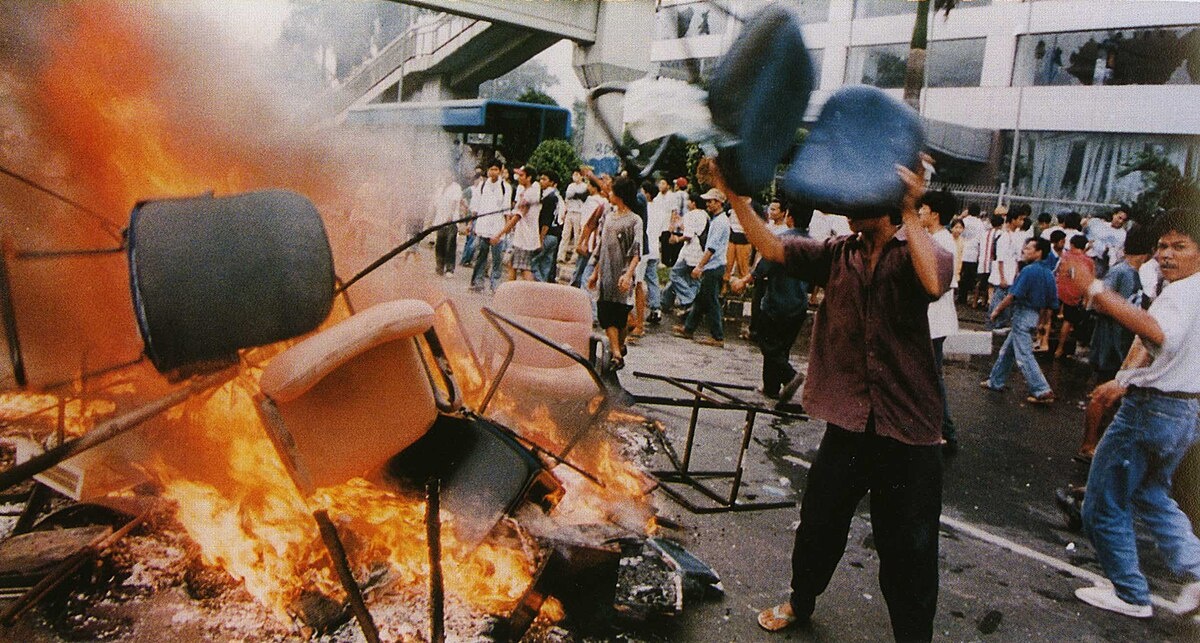
In May 1998, riots broke out in which hundreds of Chinese stores were burned and Chinese women were raped and murdered. When many Chinese Indonesians fled the violence, the subsequent capital flight resulted in further economic hardship in a country already suffering a financial crisis. By 2005 many had returned, but the economic and social confidence of many Chinese in the country was badly shaken by the experience.
See Separate Article FALL OF SUKARNO, RISE OF SUHARTO AND THE MYSTERIOUS COUP OF 1965 factsanddetails.com
Violence Against the Chinese After the Asian Economic Crisis
man shot in the face in the 1940s
During the Asian economic crisis in 1997-1998 and through the period before and after Suharto’s resignation in May 1998 and the selection of a new president in June 1999, ethnic Chinese were the targets of violence all across Indonesia. Ethnic Chinese women and girls as young as 10 were raped during looting of Chinese neighborhoods by organized gangs. Some of the victims were gang raped in front of their parents and then set on fire and killed."Some of the attacker said, 'You must be red because you are Chinese and a non-Muslim," one woman told the New York Times and added that many women committed suicide afterwards rather than lose face.
Many of the riots were sparked by resentment towards the Chinese for their wealth. Because ethnic Chinese control so much of the Indonesian economy, many Indonesians blamed them for the crisis and took out their anger by looting Chinese-owned shops, shouting anti-Chinese slogans and attacking Chinese. The violence was often triggered by rumors and small things. One spate of violence began after a Chinese man complained about the noise made by drummers during a Muslim feast day.
In January 1998, people in eastern Java broke into Chinese-owned stores with crow bars and looted rice, cooking oil and other staples. The looters accused the Chinese of price gauging, although prices they charged were the same as those charged by Muslim merchants. One sympathizer told the Independent. "The Chinese are uptight and greedy. I support what happened, and it will happen again if the prices keep going up.”
In May 1998, the month that Suharto was ousted, “pro-democracy student demonstrations morphed into an orgy of rioting that hit Chinese-owned shops and homes with particular fury,” according to Washington Post. Much of the violence was not a spontaneous venting of revenge but a planned campaign of terror. Witnesses often reported that violence began when thugs, brought in by truck, began shouting anti-Chinese and pro-Muslim slogans like "Destroy the Chinese," "I love Muslims," and "Money hung Chinese fools," outside Chinese-owned businesses and encouraging local people to join them. One man told Time, "Everyone wanted to get in a kick or a cut; it was a badge of pride to have taken part.”
Victims of the May 1998 Anti-Chinese Violence
John M. Glionna wrote in the Los Angeles Times, “In May 1998, during two deadly days of racially fueled mayhem, rioters killed 1,000 people and raped 87 women, most of Chinese descent. Others cowered in their homes as the rape squads, reportedly led by army thugs, roamed the streets of Jakarta, the Indonesian capital. Ruminah winces as she recalls the afternoon a mob ransacked her tiny hair salon, smashing windows and destroying both the business and her faith in justice in her homeland. The petite Ruminah goes by one name, lost more than her shop that day. Her developmentally disabled son was killed in a fire set by looters at a nearby mall. "I'm not a smart person," said Ruminah, an Indonesian-born Muslim whose grandmother married a Chinese merchant here, "but I know my son died that day because he looked Chinese." [Source: John M. Glionna, Los Angeles Times, July 4, 2010 /]
man being taken to hospital
“In Ruminah's lower-class street in East Jakarta, neighbors viewed her as Chinese, even though the mother of five has never truly identified with her Chinese roots. She can't speak Chinese and doesn't even know where in China to trace her roots. "They would ask the same question: 'Why do you live here among the poor? We know that all the Chinese are rich,' " Ruminah recalled. Local boys teased her 14-year-old son, Gunawan, but not because of his learning disability. "They harassed him because he looked Chinese," she said. "He would come home crying, and my husband would tell him to ignore the taunts. He said they were just words." /
“That changed during the 1998 Asian financial crisis, when mobs took to the streets and attacked ethnic Chinese they blamed for the economic downturn. Many analysts believe Suharto encouraged the violence to take the pressure off his government for the loss of jobs and rising prices. On the first night, Ruminah went looking for her son, who had gone to watch a fire at a local mall. Later, wearing a mask to guard against the stench, she inspected hundreds of corpses laid out in the parking lot outside the mall. She never found him. "I only have his burned clothes," she said, her voice breaking.” /
Andrew Higgins wrote in the Washington Post, “When mob violence swept across the Indonesian capital in May 1998, Basuki Tjahaja Purnama, an ethnic Chinese geologist and businessman, joined terrified neighbors in the heavily Chinese district of Pluit to defend their lives and property. They used sticks, gasoline bombs and even a few old shotguns to fend off attackers drunk with anti-Chinese fury. The frenzy of looting, rape and murder — triggered by a deep economic crisis and a vicious struggle for political power — stirred comparisons to Nazi assaults against the Jews. It so traumatized Indonesians of Chinese descent that many fled abroad, despairing at the seemingly ineradicable racism of their home country. [Source: Andrew Higgins, Washington Post, August 18, 2012]
Descriptions of Attacks Against the Chinese
Describing an attack on Chinese in February 1998 in western Java, Ron Maroau wrote in Newsweek, "The first warning came in a phone call from school. Don't send your daughter today...Rumors were swirling...angry Muslims would attack Chinese-owned stores after noon prayers at a local mosque."
"Just before noon, a crowd of at least 20 angry young men began heaving rocks into the shop. Wielding knives, scythes and iron bars, they stormed inside, knocking over displays of rice, sugar, soybeans and cooking oil. They robbed the cash drawer, stole two tons of rice, started a fire...shouting "Kill the Chinese." The owner was chased down the street by an angry mob and found safety in a shop owned by a non-Chinese Indonesian friend.”
Describing violence against the Chinese in Sumatra in September 1998, David Liehold wrote in Time, "The trouble began with a rumor...word had got around that a Malay man had been killed by an ethnic Chinese following a minor traffic accident. Within hours mobs of armed men were rampaging through the streets, setting fire to mostly Chinese-owned houses and shops, By sunrise...more than 400 buildings had been damaged or destroyed, and the Chinese fled to neighboring towns.
Reaction By Chinese to the Violence
During the unrest around the time of Suharto’s resignation many Chinese fled their homes. Those that had enough money escaped to Australia, Singapore or Malaysia. Those that didn't went to neighboring towns. Around 200,000 Chinese Indonesians sought to establish residence outside of Indonesia. Almost 8,000 most wealthy ethnic Chinese from Indonesia quietly moved to Perth and other Australian cities. Chinese in Beijing and the Philippines demonstrated outside embassies in those countries over the treatment of ethnic Chinese in Indonesia.
Chinese in Indonesia stockpiled weapons, formed vigilante groups to protective neighborhoods, hired private security guards to protect their homes. Chinese shop owners paid soldiers to guard their property. Chinese tycoons drove around in huge four-wheel-drive vehicles with massive crash bars on the bumpers and ample space for body guards. Some wealthy Chinese gave out free food or sold food at cheap prices to earn good will of the people.
Chinese with dark skin had an easier time avoiding trouble because they blended in better with Indonesians. Some of the violence and rage among the global Chinese diaspora was stirred by photos that circulated on the Internet showing ethnic Chinese women purportedly being raped and murdered. Many of those photos proved to be hoaxes.
Lack of Justice After the Anti-Chinese Violence
John M. Glionna wrote in the Los Angeles Times, “Many of the 5 million ethnic Chinese here, who represent a scant 2 percent of the population in this predominantly Muslim nation of 248 million, have for years awaited the results of a government investigation of the attacks. Twelve years later, no arrests have been made. The inquiry stalled years ago when investigators said they failed to find hard evidence of military involvement. The Indonesian government has recently suggested that it will no longer pursue the matter, despite lingering suspicions that the riots were instigated by soldiers influenced by the nation's political leadership. Without an official report to the contrary, many Indonesians question whether the rapes even occurred. [Source: John M. Glionna, Los Angeles Times, July 4, 2010 /]
“Activists say there are new efforts at national healing. Prabowo Subianto, the former son-in-law of Suharto, met last summer with ethnic Chinese to publicly explain for the first time that he was not involved in the mayhem. "Many are still ambivalent about his story," said Jemma Purdey, a research fellow at the Center of Southeast Asian Studies at Monash University in Australia. "But if you meet someone and they tell you straight to your face they didn't have part in things, you have to respect that." In 2009, government officials also met with historians to draft language for Indonesian school textbooks acknowledging that the anti-ethnic Chinese bloodshed actually happened. "The scar from that violence remains," said Yentriyani, the commission leader. "How much Indonesians want to heal it, depends on who you talk to." /
Anti-China Online Hoaxes in Indonesia
In 2019, the South China Morning Post reported: Chinese Indonesians in Jakarta fear attacks on the community, as anti-China hoaxes spread on social media. After several people died in violent protests in Jakarta, messages spread on social media blaming the deaths on ‘police from China’The messages prompted the government to temporarily restrict social media functions on[Source: South China Morning Post, May 22, 2019]
As violent protests broke out in the Indonesian capital early resulting in the deaths of several people, messages started circulating on social media that the deceased were shot by “police from China”. The message was followed by photos of light-skinned masked police officers that came with the caption: “China has sent security forces to Indonesia disguised as foreign workers.” In another photo, a man is pictured in a selfie that showed a light-skinned officer from Indonesia’s mobile brigade police (Brimob) in the background.
Image Sources: Wikimedia Commons
Text Sources: “Encyclopedia of World Cultures Volume 5: East / Southeast Asia:” edited by Paul Hockings, 1993; National Geographic; New York Times, Washington Post, Los Angeles Times, Lonely Planet Guides, Library of Congress, Smithsonian magazine, The New Yorker, Time, Reuters, AP, AFP, Wikipedia, BBC, CNN, and various books and other publications.
Last Updated December 2025